

Perinatal depression screening practices in a large health system: identifying current state and assessing opportunities to provide more equitable care
Open accessThe DOI matches its Crossref record; 42 of the 42 references it cites were found in a registry or an index.
Abstract
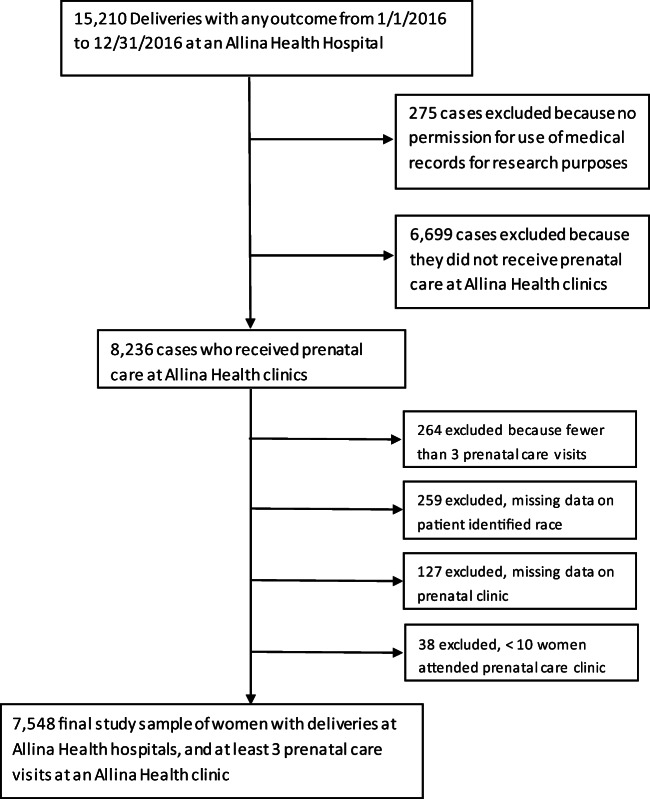
The purpose of this study was to assess the prevalence of prenatal and postpartum depression screening in a large health system and to identify covariates for screening, with a specific focus in understanding disparities in practice. A retrospective cohort of women with deliveries in 2016 was created using electronic health records. Primary outcomes were depression screening during pregnancy and the first 3 months postpartum. Generalized linear mixed models with women nested within clinic were used to determine the effect of maternal and clinical characteristics on depression screening. The sample included 7548 women who received prenatal care at 35 clinics and delivered at 10 hospitals. The postpartum sample included 7059 women who returned within 3 months for a postpartum visit. Of those, 65.1% were screened for depression during pregnancy, and 64.4% were screened postpartum. Clinic site was the strongest predictor of screening, accounting for 23–30% of the variability in screening prevalence. There were no disparities identified with regard to prenatal screening. However, several disparities were identified for postpartum screening. After adjusting for clinic, women who were African American, Asian, and otherwise non-white (Native American, multi-racial) were less likely to be screened postpartum than white women (AOR (CI)’s 0.81 (0.65, 1.01), 0.64 (0.53, 0.77), and 0.44 (0.21, 0.96), respectively). Women insured by Medicaid/Medicare, a proxy for low-income, were less likely to be screened postpartum than women who were privately insured (AOR (CI) 0.78 (0.68, 0.89)). National guidelines support universal depression screening of pregnant and postpartum women. The current study found opportunities for improvement in order to achieve universal screening and to deliver equitable care.
Overview
The claims and statistics of this paper haven’t been checked yet.
Free: it reads the open-access text and checks the first 5 claims that cite a source we can check. Create a free account to check every claim.
Integrity signals
Registry
Cites
Statistics
Figures
Verification
Claims the paper makes
The claims and statistics of this paper haven’t been checked yet.
Free: it reads the open-access text and checks the first 5 claims that cite a source we can check. Create a free account to check every claim.
Claims other papers make about this one
Each is checked against this paper’s own text: does it say what the citing paper says it does?
The cited source says what the claim attributes to it.
In the citing paper
“Although the American College of Obstetricians and Gynecologists [85] recommends that all women be screened for depression and anxiety during pregnancy and the postpartum period, screening is not implemented universally [86], particularly for anxiety disorders [87].”
From Trajectories of Maternal and Paternal Internalizing Symptoms from Pregnancy to 2 Years Postpartum: Identifying Modifiable Risk and Protective Factors (2024) · cites this paper as [86]
Self-check
Percentages, sums and reported differences re-computed from the paper’s own numbers.
The self-check needs the paper’s full text.
Citations
Cites
The PHQ-9: Validity of a brief depression severity measure
Kroenke, K., Spitzer, R. L., & Williams, J. B. W. (2001) · Journal of General Internal Medicine · doi:10.1046/j.1525-1497.2001.016009606.x · Cited by 44,910
Spitzer, R. L. (1999) · JAMA · doi:10.1001/jama.282.18.1737 · Cited by 9,802 · cited 2×
“Screening was measured as completion of the Patient Health Questionnaire (PHQ)-9 (Kroenke et al. 2001; Spitzer et al. 1999) or PHQ-2 (Kroenke et al.”
MethodThe Patient Health Questionnaire-2: Validity of a Two-Item Depression Screener
Kroenke, K., Spitzer, R. L., & Williams, J. B. W. (2003) · Medical Care · doi:10.1097/01.mlr.0000093487.78664.3c · Cited by 6,359
The quality of health care delivered to adults in the United States
McGlynn, E. A., Asch, S. M., Adams, J., Keesey, J., Hicks, J., DeCristofaro, A., & Kerr, E. A. (2003) · New England Journal of Medicine · doi:10.1056/nejmsa022615 · Cited by 5,079 · cited 2×
“…across many health care fields and specialties, a significant time gap between release of clinical guidelines and integration into standard care (Institute of Medicine and Committe on Standards for Developing Trustworthly Clinical Practice Guidelines 2011; McGlynn et al. 2003; Morris et al. 2011).”
BackgroundThe answer is 17 years, what is the question: understanding time lags in translational research
Morris, Z. S., Wooding, S., & Grant, J. (2011) · Journal of the Royal Society of Medicine · doi:10.1258/jrsm.2011.110180 · Cited by 3,340 · cited 2×
“…across many health care fields and specialties, a significant time gap between release of clinical guidelines and integration into standard care (Institute of Medicine and Committe on Standards for Developing Trustworthly Clinical Practice Guidelines 2011; McGlynn et al. 2003; Morris et al. 2011).”
BackgroundPerinatal Depression: A Systematic Review of Prevalence and Incidence
Gavin, N. I., Gaynes, B. N., Lohr, K. N., Meltzer-Brody, S., Gartlehner, G., & Swinson, T. (2005) · Obstetrics & Gynecology · doi:10.1097/01.aog.0000183597.31630.db · Cited by 3,282
Clinical Practice Guidelines We Can Trust
Committee on Standards for Developing Trustworthy Clinical Practice Guidelines, Board on Health Care Services, & Institute of Medicine (2011) · National Academies Press eBooks · doi:10.17226/13058 · Cited by 3,081
Prevalence of Depression During Pregnancy: Systematic Review
Bennett, H. A., Einarson, A., Taddio, A., Koren, G., & Einarson, T. R. (2004) · Obstetrics & Gynecology · doi:10.1097/01.aog.0000116689.75396.5f · Cited by 1,725 · cited 5×
“Rates of PND and PPD are associated with racial and socioeconomic disparities, with higher prevalence levels among low-income and African American women (Bennett et al. 2004; Goyal et al. 2010; Melville et al. 2010; Orr et al. 2006).”
BackgroundInfluentialScreening for Depression in Adults: US Preventive Services Task Force Recommendation Statement
Siu, A. L., and the US Preventive Services Task Force (USPSTF), Bibbins-Domingo, K., Grossman, D. C., Baumann, L. C., Davidson, K. W., Ebell, M., García, F. A. R., Gillman, M., Herzstein, J., et al. (2016) · JAMA · doi:10.1001/jama.2015.18392 · Cited by 1,407
Gaynes, B. N., Gavin, N., Meltzer-Brody, S., Lohr, K. N., Swinson, T., Gartlehner, G., Brody, S., & Miller, W. C. (2005) · PsycEXTRA Dataset · doi:10.1037/e439372005-001 · Cited by 1,211
Racial/ethnic disparities in pregnancy-related deaths — United States, 2007–2016
Petersen, E. E., Davis, N. L., Goodman, D., Cox, S., Syverson, C., Seed, K., Shapiro-Mendoza, C., Callaghan, W. M., & Barfield, W. (2019) · MMWR Morbidity and Mortality Weekly Report · doi:10.15585/mmwr.mm6835a3 · Cited by 880 · cited 3×
“Gaps in screening are also concerning in light of the potential contributions of mental health (Goldman-Mellor and Margerison 2019) to increasing maternal mortality and associated disparities (Petersen et al. 2019b).”
BackgroundSpitzer, R. L., Williams, J. B. W., Kroenke, K., Hornyak, R., & McMurray, J. (2000) · American Journal of Obstetrics and Gynecology · doi:10.1067/mob.2000.106580 · Cited by 847 · cited 2×
“Systematic screening has been demonstrated to increase the identification of depression (Avalos et al. 2016; Evins et al. 2000; Gaynes et al. 2005; O'Connor et al. 2016) and to be more effective at identifying depression than clinical assessment alone (Gaynes et al. 2005; Spitzer et al. 2000).”
BackgroundPetersen, E. E., Davis, N. L., Goodman, D., Cox, S., Mayes, N., Johnston, E., Syverson, C., Seed, K., Shapiro-Mendoza, C. K., Callaghan, W. M., et al. (2019) · MMWR. Morbidity and Mortality Weekly Report · doi:10.15585/mmwr.mm6818e1 · Cited by 797
ACOG Committee Opinion No. 757: Screening for Perinatal Depression
(2018) · Obstetrics & Gynecology · doi:10.1097/aog.0000000000002927 · Cited by 771
Depressive Symptoms among Pregnant Women Screened in Obstetrics Settings
Marcus, S. M., Flynn, H. A., Blow, F. C., & Barry, K. L. (2003) · Journal of Women's Health · doi:10.1089/154099903765448880 · Cited by 742 · cited 2×
“Despite its adverse consequences, depression is both underdiagnosed and undertreated in pregnant and postpartum women (Flynn et al. 2006; Kelly et al. 2001; Marcus et al. 2003), leading to more severe outcomes like hospitalizations, increased morbidity, and suicide (Bonari et al.”
BackgroundPrenatal and Postpartum Maternal Psychological Distress and Infant Development: A Systematic Review
Kingston, D., Tough, S., & Whitfield, H. (2012) · Child Psychiatry & Human Development · doi:10.1007/s10578-012-0291-4 · Cited by 670
O’Connor, E., Rossom, R. C., Henninger, M., Groom, H. C., & Burda, B. U. (2016) · JAMA · doi:10.1001/jama.2015.18948 · Cited by 563
Perinatal Risks of Untreated Depression during Pregnancy
Bonari, L., Pinto, N., Ahn, E., Einarson, A., Steiner, M., & Koren, G. (2004) · The Canadian Journal of Psychiatry · doi:10.1177/070674370404901103 · Cited by 524
Goyal, D., Gay, C., & Lee, K. A. (2010) · Women's Health Issues · doi:10.1016/j.whi.2009.11.003 · Cited by 438
Committee Opinion No. 630: Screening for Perinatal Depression
(2015) · Obstetrics & Gynecology · doi:10.1097/01.aog.0000465192.34779.dc · Cited by 424
Depressive Disorders During Pregnancy: Prevalence and Risk Factors in a Large Urban Sample
Melville, J. L., Gavin, A., Guo, Y., Fan, M.-Y., & Katon, W. J. (2010) · Obstetrics & Gynecology · doi:10.1097/aog.0b013e3181f60b0a · Cited by 329 · cited 11×
“Specifically, 22.7% of American Indian, 11.5% of African American, and 8.8% of multi-racial women did not return for a postpartum visit compared to 5.5% of white women.”
BackgroundInfluentialRacial and Ethnic Disparities in Postpartum Depression Care Among Low-Income Women
Kozhimannil, K. B., Trinacty, C. M., Busch, A. B., Huskamp, H. A., & Adams, A. S. (2011) · Psychiatric Services · doi:10.1176/appi.ps.62.6.619 · Cited by 329
Incorporating Recognition and Management of Perinatal Depression Into Pediatric Practice
Earls, M. F., Yogman, M. W., Mattson, G., Rafferty, J., COMMITTEE ON PSYCHOSOCIAL ASPECTS OF CHILD AND FAMILY HEALTH, Baum, R., Gambon, T., Lavin, A., & Wissow, L. (2019) · Pediatrics · doi:10.1542/peds.2018-3259 · Cited by 327
Race, Ethnicity, and Language Data: Standardization for Health Care Quality Improvement
Ulmer, C. C., McFadden, B., & Nerenz, D. R. (2009) · University Libraries (University of Maryland) · doi:10.13016/jjuy-tsdb · Cited by 319
Untreated prenatal maternal depression and the potential risks to offspring: a review
Davalos, D. B., Yadon, C. A., & Tregellas, H. C. (2012) · Archives of Women's Mental Health · doi:10.1007/s00737-011-0251-1 · Cited by 268
Incorporating Recognition and Management of Perinatal Depression Into Pediatric Practice
Rafferty, J., Mattson, G., Earls, M. F., Yogman, M. W., COMMITTEE ON PSYCHOSOCIAL ASPECTS OF CHILD AND FAMILY HEALTH, Gambon, T. B., Lavin, A., & Wissow, L. S. (2019) · Pediatrics · doi:10.1542/peds.2018-3260 · Cited by 265
Kelly, R. H., Zatzick, D. F., & Anders, T. F. (2001) · American Journal of Psychiatry · doi:10.1176/appi.ajp.158.2.213 · Cited by 250
Postpartum depression: A comparison of screening and routine clinical evaluation
Evins, G. G., Theofrastous, J. P., & Galvin, S. L. (2000) · American Journal of Obstetrics and Gynecology · doi:10.1067/mob.2000.105409 · Cited by 224
Consensus Bundle on Maternal Mental Health: Perinatal Depression and Anxiety
Kendig, S., Keats, J. P., Hoffman, M. C., Kay, L. B., Miller, E. S., Moore Simas, T. A., Frieder, A., Hackley, B., Indman, P., Raines, C., et al. (2017) · Obstetrics & Gynecology · doi:10.1097/aog.0000000000001902 · Cited by 222
Maternal self-harm deaths: an unrecognized and preventable outcome
Mangla, K., Hoffman, M. C., Trumpff, C., O’Grady, S., & Monk, C. (2019) · American Journal of Obstetrics and Gynecology · doi:10.1016/j.ajog.2019.02.056 · Cited by 215 · cited 1×
“However, surveillancemethods for these deaths currently exclude deaths due to suicide or drug use, underrepresenting the contribution of mental health to maternal mortality (Mangla et al. 2019; Petersen et al. 2019a).”
BackgroundRacial Disparities in Diagnosis and Treatment of Depression: A Literature Review
Simpson, S. M., Krishnan, L. L., Kunik, M. E., & Ruiz, P. (2007) · Psychiatric Quarterly · doi:10.1007/s11126-006-9022-y · Cited by 178
Maternal drug-related death and suicide are leading causes of postpartum death in California
Goldman-Mellor, S. J., & Margerison, C. E. (2019) · American Journal of Obstetrics and Gynecology · doi:10.1016/j.ajog.2019.05.045 · Cited by 173
Flynn, H. A., Blow, F. C., & Marcus, S. M. (2006) · General Hospital Psychiatry · doi:10.1016/j.genhosppsych.2006.04.002 · Cited by 158
Risks of untreated depression during pregnancy.
Bonari, L., Bennett, H., Einarson, A., & Koren, G. (2004) · Europe PMC (PubMed Central) · Cited by 118
Perinatal Depression: Hiding in Plain Sight
Lusskin, S. I., Pundiak, T. M., & Habib, S. M. (2007) · The Canadian Journal of Psychiatry · doi:10.1177/070674370705200802 · Cited by 116
Orr, S. T., Blazer, D. G., & James, S. A. (2005) · Annals of Epidemiology · doi:10.1016/j.annepidem.2005.08.004 · Cited by 99
Improved Perinatal Depression Screening, Treatment, and Outcomes With a Universal Obstetric Program
Avalos, L. A., Raine-Bennett, T., Chen, H., Adams, A. S., & Flanagan, T. (2016) · Obstetrics & Gynecology · doi:10.1097/aog.0000000000001403 · Cited by 85
Obstetric care provider engagement in a perinatal depression screening program
Kim, J., Porte, L. M. L., Adams, M. G., Gordon, T. E. J., Kuendig, J. M., & Silver, R. K. (2009) · Archives of Women s Mental Health · doi:10.1007/s00737-009-0057-6 · Cited by 50
Now What? Effects of On-Site Assessment on Treatment Entry After Perinatal Depression Screening
Miller, L. J., McGlynn, A., Suberlak, K., Rubin, L. H., Miller, M., & Pirec, V. (2012) · Journal of Women's Health · doi:10.1089/jwh.2012.3641 · Cited by 46
Universal screening for postpartum depression: an inquiry into provider attitudes and practice
Delatte, R., Cao, H., Meltzer-Brody, S. E., & Menard, M. K. (2009) · American Journal of Obstetrics and Gynecology · doi:10.1016/j.ajog.2008.12.022 · Cited by 37
Fedock, G. L., & Alvarez, C. (2018) · Journal of Women s Health · doi:10.1089/jwh.2017.6765 · Cited by 35
Barbero (2014) · doi:10.1016/j · Cited by 1
Research works printed but not linked: 1
- Committee on Obstetric Practice (2015) The American College of Obstetricians and Gynecologists Committee Opinion no. 630. Screening for perinatal depression. Obstet Gynecol 125:1268–1271. https://doi.org/10.1097/01.AOG.0000465192.34779.dc · DOI · Paper page
Cited by
ACOG Committee on Clinical Practice Guidelines–Obstetrics (2023) · Obstetrics & Gynecology · doi:10.1097/aog.0000000000005200 · Cited by 294
Wang, L., Kroenke, K., Stump, T. E., & Monahan, P. O. (2021) · General Hospital Psychiatry · doi:10.1016/j.genhosppsych.2020.12.007 · Cited by 153
Prioritizing Maternal Mental Health in Addressing Morbidity and Mortality
Wisner, K. L., Murphy, C., & Thomas, M. M. (2024) · JAMA Psychiatry · doi:10.1001/jamapsychiatry.2023.5648 · Cited by 91
Postpartum Depression—Identifying Risk and Access to Intervention
Gopalan, P. R., Spada, M. L., Shenai, N., Brockman, I., Keil, M. A., Livingston, S., Moses‐Kolko, E. L., Nichols, N., O’Toole, K. S., Quinn, B., et al. (2022) · Current Psychiatry Reports · doi:10.1007/s11920-022-01392-7 · Cited by 120
Greenberg, M., Gandhi, M., Davidson, C. M., & Carter, E. B. (2022) · American Journal of Obstetrics and Gynecology · doi:10.1016/j.ajog.2022.04.001 · Cited by 71
Metadata
- Authors
- Sidebottom, A., Vacquier, M., LaRusso, E., Erickson, D., & Hardeman, R.
- Affiliations
- Allina Health (US)
- University of Minnesota (US)
- Corresponding author
- Sidebottom, Abbey
- Venue
- Archives of Women's Mental Health
- Published
- 2020-05-05
- Volume
- 24
- Issue
- 1
- Pages
- 133-144
- ISSN
- 1434-1816 (ISSN-L)
- 1435-1102
- PMC
- PMC7929950
- OpenAlex
- W3022837574
- Cited by
- 141
- References
- 41
- Citations by year
- 2026: 23 · 2025: 27 · 2024: 32 · 2023: 24 · 2022: 21 · 2021: 12 · 2020: 1
- FWCI
- 10.85
- Type
- journal article
- Language
- en
- Open access
- hybrid
- doi.org
- Licence
- cc-by
- creativecommons.org/licenses/by/4.0 (tdm)
- creativecommons.org/licenses/by/4.0 (vor)
- Locations
- Archives of Women s Mental Health (publishedVersion, cc-by)
- PubMed Central (publishedVersion, cc-by)
- PubMed (publishedVersion)
- Funders
- Abbott Northwestern Hospital Foundation (16-8005)
- Topics
- Health Sciences › Medicine › Public Health, Environmental and Occupational Health › Maternal Mental Health During Pregnancy and Postpartum
- Health Sciences › Medicine › Pediatrics, Perinatology and Child Health › Maternal and Neonatal Healthcare
- Health Sciences › Medicine › Psychiatry and Mental health › Mental Health Treatment and Access
- Keywords
- perinatal depression, depression screening, postpartum depression screening, health disparities, racial disparities, low-income women, universal screening, quality of care, health equity
- MeSH terms
- Aged, Depression, Female, Medicare, Humans, Pregnancy, Prenatal Care, Retrospective Studies, United States, Depression, Postpartum
About these checks
Registry, retraction, Cites and statistics results are computed, not judged, with one exception: a printed reference that no index lists is read once by a model before it counts as a citation error. Claims are extracted by a model and kept only when their quote appears verbatim in the text; each cited source is then checked, with a model’s help, for whether it says what the claim relies on. Those verdicts can be wrong — read the claim’s quote and the cited source before relying on one.
Statistics and arithmetic are recomputed, not judged.
Confidence bands are shown only for fields calibrated on our annotated test set. None is calibrated yet, so no band is shown.
What counts as a claim ›How we measure confidence ›How we check this ›
Are you an author, or do you see a problem with this page? Request a review
Data sources
Bibliographic data: Semantic Scholar, OpenAlex, Crossref.
Contains information from the Semantic Scholar Academic Graph Datasets, made available under the ODC Attribution License (ODC-BY 1.0).
Semantic Scholar’s data is described in: Kinney, R., et al. (2023). The Semantic Scholar Open Data Platform. arXiv:2301.10140.
