

Low Evidence for Tinnitus Risk Factors: A Systematic Review and Meta-analysis
Open accessThe DOI matches its Crossref record; 62 of the 63 references it cites were found in a registry or an index; 1 of the 50 sources its claims cite were checked for support.
Abstract
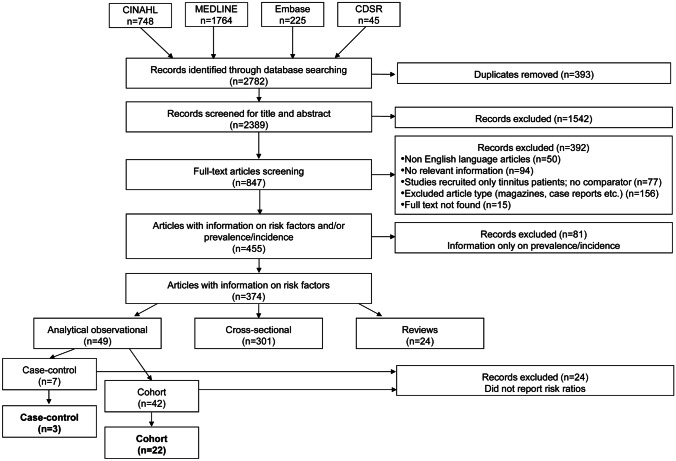
Aims/Hypothesis: Identifying risk factors for tinnitus could facilitate not only the recommendations for prevention measures, but also identifying potential pathways for new interventions. This study reports the first comprehensive systematic review of analytical observational studies able to provide information about causality (i.e., case–control and cohort designs). Methods: A literature search of four electronic databases identified epidemiological studies published on tinnitus and different exposures. Independent raters screened all studies, extracted data, and evaluated study quality using the Newcastle–Ottawa Scale. Reported relative risks (RR), hazard ratios (HR), odds ratios (OR), and prevalence ratios (PR) with 95% confidence intervals (CI) were used to compute crude estimates of RR for tinnitus risk factors. Results: From 2389 records identified, a total of 374 articles were read as full text (24 reviews, 301 cross-sectional studies, 42 cohort studies, and 7 case–control studies). However, from 49 case–control and cohort studies, only 25 adequately reported risk ratios. Using the findings from these studies, positive causal associations were found for various hearing-related factors (i.e., unspecified hearing loss, sensorineural hearing loss, occupational noise exposure, ototoxic platinum therapy, and otitis media). Evidence was also found for a number of non-otological risk factors including temporo-mandibular joint disorder, depression, chronic obstructive pulmonary disease, and hyperlipidemia. Negative associations indicating preventative effects were found for diabetes and high alcohol consumption. No associations were found for low alcohol consumption, body mass index, head injury, heart failure, hypertension, leisure noise exposure, migraine, rheumatoid arthritis, sex, smoking, stroke, and whiplash. However, with the exception of unspecified hearing loss, these findings resulted from pooling no more than 4 studies, illustrating that the vast majority of the associations still remain inconclusive. Conclusions: These systematic review and meta-analysis confirm a number of otological and non-otological risk factors for tinnitus. By highlighting major gaps in knowledge, our synthesis can help provide direction for future research that will shed light on the pathophysiology, improve management strategies, and inform more effective preventions.
Overview
CoChat Summary
TL;DR
This systematic review and meta-analysis found that only 25 of 374 included articles were analytical observational studies reporting risk ratios, and most associations were pooled from no more than 4 studies. It confirms hearing-related and some non-otological risk factors for tinnitus, but concludes that evidence remains limited and inconclusive for most exposures.
Key findings
- From 2389 records, 374 articles were included; 49 were case–control or cohort studies, but only 25 met the first-level quality threshold by reporting risk ratios.
- Positive associations were found for unspecified hearing loss (RR 1.94; 95% CI 1.41–2.67), sensorineural hearing loss (RR 3.68; 95% CI 2.93–7.04), occupational noise exposure (RR 1.70; 95% CI 1.49–1.94), otitis media (RR 1.63; 95% CI 1.61–1.65), platinum therapy (RR 2.81; 95% CI 1.81–4.36), temporomandibular joint disorder (RR 2.06; 95% CI 1.30–3.27), and depression (RR 1.31; 95% CI 1.28–1.34).
- Negative associations indicating possible preventative effects were found for diabetes (RR 0.85; 95% CI 0.82–0.88) and high alcohol consumption (RR 0.94; 95% CI 0.91–0.96).
- No associations were found for low alcohol consumption, body mass index, head injury, heart failure, hypertension, leisure noise exposure, migraine, rheumatoid arthritis, sex, smoking, stroke, or whiplash; with the exception of unspecified hearing loss, these findings came from pooling no more than 4 studies.
Methods
- Systematic review and meta-analysis pre-registered in PROSPERO and reported per MOOSE; four databases were searched (MEDLINE, Embase, CDSR, CINAHL) on 29/11/2017 and updated on 06/11/2019, with no start-date restriction and English full-text inclusion.
- Eligible designs included cross-sectional, case–control, cohort, meta-analyses, pooled analyses, and systematic reviews; meta-analysis required case–control or cohort studies reporting RR, HR, OR, or PR with 95% CIs.
- Quality was assessed with the Newcastle–Ottawa Scale; random-effects meta-analyses used the DerSimonian and Laird estimator, with heterogeneity assessed by Q and I² tests in R version 3.5.2.
Limitations
- The paper states that the paucity of risk-ratio data is an inherent limitation: results were based on an average of two or three sources, limiting generalizability and validity and precluding firm causal inferences; few high-quality studies covered a selected set of risk factors, mostly auditory conditions, and the latest search update was 06/11/2019.
- The paper states it cannot draw conclusions on sex-specific mechanisms, and notes large heterogeneity in adjustment factors and statistical models, with high between-study heterogeneity (I² = 69–99%) for factors such as unspecified hearing loss, sensorineural hearing loss, smoking, sex, temporomandibular joint disorder, body mass index, heart failure, migraine, and head injury.
- Evident from the text: the abstract lists COPD and hyperlipidemia as positive associations, while the Results section lists them among exposures with no evidence (hyperlipidemia RR 1.18; 95% CI 1.00–1.40; COPD RR 0.95; 95% CI 0.90–1.00), indicating an internal reporting inconsistency.
Model-written summary. Check it against the paper before relying on it.
Integrity signals
Registry
Cites
Statistics
Figures
Verification
Claims the paper makes
1 Valid · 4 Not valid · 33 Not checked · 108 Own results and interpretations
The sources with a verdict support this claim; the rest weren’t checked yet, have no full text we could read, or their verdicts aren’t rated yet.
In the paper
“This information lacks generalizability as risk factors do not necessarily affect all population groups in the same way [21, 22].”
§ Low Evidence for Tinnitus Risk Factors: A Systematic Review and Meta-analysis > Introduction
What the sources say
- Not checked yetcites [21] Offord DR Kraemer HC Risk factors and prevention Evid Based Ment Health 2000 3 70 10.1136/ebmh.3.3.70 source
Checked before — its earlier verdict is held back until a new check runs.
- Supportedcites [22] Westreich D Edwards JK Lesko CR Cole SR Stuart EA Target validity and the hierarchy of study designs Am J Epidemiol 2019 188 438 443 10.1093/aje/kwy228 30299451 PMC6357801 source
The paper's 'Identification of Externally Valid Effects in a Target Population' section states that when an effect-measure modifier has a different prevalence in the study sample than in the target population, generalizability 'is not guaranteed', and the 'Target Populations and External Validity' section adds that because the prevalence of effect-measure modifiers differs from one target population to another, external validity of an effect estimate differs across populations (with the biological-sex example). The same section also notes that nonnull causal effects necessarily exhibit heterogeneity on the risk-difference or risk-ratio scale when baseline risk differs, which is the source's version of the claim that a risk factor's effect does not carry uniformly across population groups. The only mild shift is that the paper frames this as generalizability not being assured absent exchangeability assumptions, whereas the citing sentence says the information 'lacks generalizability'; the causal-heterogeneity half of the claim is stated directly. (LLM, conf=0.85)
plain- Asserted: passes — The authors put it forward as true.
- Checkable: passes — It can be checked against evidence.
- Load-bearing: passes — The paper’s conclusions depend on it.
- Based: passes — The paper gives a reason why it holds.
- Not checked yet
A result the paper reports from its own data — it cites no other source for it, so there is none to check. The quote shows it is in the paper.
In the paper
“temporo-mandibular joint disorder was associated with tinnitus (RR, 2.06; 95% CI, 1.30–3.27; I2 = 97%; p < 0.01; Supplementary Fig. 11)”
§ Low Evidence for Tinnitus Risk Factors: A Systematic Review and Meta-analysis > Results > Strength of Evidence for Tinnitus Risk Factors
plainstates an association- Asserted: passes — The authors put it forward as true.
- Checkable: passes — It can be checked against evidence.
- Load-bearing: passes — The paper’s conclusions depend on it.
- Based: passes — The paper gives a reason why it holds.
A result the paper reports from its own data — it cites no other source for it, so there is none to check. The quote shows it is in the paper.
In the paper
“No associations were found for low alcohol consumption, body mass index, head injury, heart failure, hypertension, leisure noise exposure, migraine, rheumatoid arthritis, sex, smoking, stroke, and whiplash.”
§ Low Evidence for Tinnitus Risk Factors: A Systematic Review and Meta-analysis > Abstract > Results
plain- Asserted: passes — The authors put it forward as true.
- Checkable: passes — It can be checked against evidence.
- Load-bearing: passes — The paper’s conclusions depend on it.
- Based: passes — The paper gives a reason why it holds.
A result the paper reports from its own data — it cites no other source for it, so there is none to check. The quote shows it is in the paper.
In the paper
“Chronic obstructive pulmonary disease (COPD) (RR, 0.95; 95% CI, 0.90–1.00; I2 = 0%; p = 0.71; Supplementary Fig. 22)”
§ Low Evidence for Tinnitus Risk Factors: A Systematic Review and Meta-analysis > Results > Strength of Evidence for Tinnitus Risk Factors
plain- Asserted: passes — The authors put it forward as true.
- Checkable: passes — It can be checked against evidence.
- Load-bearing: unclear — It is unclear whether the paper’s conclusions depend on it.
- Based: passes — The paper gives a reason why it holds.
A result the paper reports from its own data — it cites no other source for it, so there is none to check. The quote shows it is in the paper.
In the paper
“No associations were found for low alcohol consumption, body mass index, head injury, heart failure, hypertension, leisure noise exposure, migraine, rheumatoid arthritis, sex, smoking, stroke, and whiplash.”
§ Low Evidence for Tinnitus Risk Factors: A Systematic Review and Meta-analysis > Abstract > Results
plain- Asserted: passes — The authors put it forward as true.
- Checkable: passes — It can be checked against evidence.
- Load-bearing: passes — The paper’s conclusions depend on it.
- Based: passes — The paper gives a reason why it holds.
58 more claims
Create a free account to see all 146 claims and to verify the 49 references still open.
- It may state two separate claims as one. 41
- Probably not a substantial claim. 60
Self-check
Percentages, sums and reported differences re-computed from the paper’s own numbers.
Each contradiction between two passages listed here was confirmed by an independent check.
Rated minor: it would not touch a result — a value no result rests on, a p-value that stays on the same side of the significance level, or a conflict that is clerical, resolved elsewhere in the paper, or outside its own findings.
In the paper
§ Low Evidence for Tinnitus Risk Factors: A Systematic Review and Meta-analysis > Discussion > Limitations
“unspecified hearing loss, sensorineural hearing loss, smoking, sex, temporomandibular joint disorder, body mass index, heart failure, migraine, and head injury (I2 = 69–99%, p > 0.05).”
§ Low Evidence for Tinnitus Risk Factors: A Systematic Review and Meta-analysis > Results > Strength of Evidence for Tinnitus Risk Factors
“unspecified hearing loss (RR, 1.94; 95% CI, 1.41–2.67; I2 = 69%; p = 0.02; Supplementary Fig. 1)”
Rated minor: it would not touch a result — a value no result rests on, a p-value that stays on the same side of the significance level, or a conflict that is clerical, resolved elsewhere in the paper, or outside its own findings.
In the paper
§ Low Evidence for Tinnitus Risk Factors: A Systematic Review and Meta-analysis > Methods > Data Extraction
“This resulted in a taxonomy comprising six domains each with categories and sub-categories.”
§ Low Evidence for Tinnitus Risk Factors: A Systematic Review and Meta-analysis > Methods > Data Extraction
“The six domains were (i) socio-demographic, (ii) hearing related, (iii) otological, (iv) potentially ototoxic medications, (v) lifestyle, (vi) comorbidities, and (v) other (Table 2).”
Rated minor: it would not touch a result — a value no result rests on, a p-value that stays on the same side of the significance level, or a conflict that is clerical, resolved elsewhere in the paper, or outside its own findings.
In the paper
§ Low Evidence for Tinnitus Risk Factors: A Systematic Review and Meta-analysis > Results
“Among the cohort studies, seven were prospective designs, while the rest were from retrospective.”
§ Low Evidence for Tinnitus Risk Factors: A Systematic Review and Meta-analysis > Results > Description of Included Studies
“A short description of the 10 prospective cohort studies is given as follows.”
Citations
Cites
Baguley, D., McFerran, D., & Hall, D. (2013) · The Lancet · doi:10.1016/s0140-6736(13)60142-7 · Cited by 1,245
Self-citationCruickshanks, K. J., Wiley, T. L., Tweed, T. S., Klein, B. E. K., Klein, R., Mares-Perlman, J. A., & Nondahl, D. M. (1998) · American Journal of Epidemiology · doi:10.1093/oxfordjournals.aje.a009713 · Cited by 1,134 · cited 5×
“However, the study population is limited to older adults who are residents of the township of Beaver Dam, Wisconsin, USA [19, 20].”
BackgroundInfluentialTinnitus: causes and clinical management
Langguth, B., Kreuzer, P. M., Kleinjung, T., & De Ridder, D. (2013) · The Lancet Neurology · doi:10.1016/s1474-4422(13)70160-1 · Cited by 799
Global Prevalence and Incidence of Tinnitus: A Systematic Review and Meta-analysis
Jarach, C. M., Lugo, A., Scala, M., van den Brandt, P. A., Cederroth, C. R., Odone, A., Garavello, W., Schlee, W., Langguth, B., & Gallus, S. (2022) · JAMA Neurology · doi:10.1001/jamaneurol.2022.2189 · Cited by 548
Self-citation(2021) · Progress in Brain Research · doi:10.1016/bs.pbr.2020.12.002 · Cited by 320 · cited 1×
“However, tinnitus in a help-seeking individual is qualitatively different from tinnitus in an individual not seeking medical support, and while the former is evaluated by a healthcare professional, the latter is self-reported [59].”
BackgroundNondahl, D. M., Cruickshanks, K. J., Wiley, T. L., Klein, R., Klein, B. E. K., & Tweed, T. S. (2002) · Journal of the American Academy of Audiology · doi:10.1055/s-0040-1715975 · Cited by 301 · cited 9×
“Similarly, knowledge on the association of otosclerosis and tinnitus results from a single case–control study [20] that has not been replicated elsewhere.”
BackgroundInfluentialEditorial: towards an understanding of tinnitus heterogeneity
Cederroth, C. R., Gallus, S., Hall, D. A., Kleinjung, T., Langguth, B., Maruotti, A., Meyer, M., Norena, A., Probst, T., Pryss, R., et al. (2019) · Frontiers in Aging Neuroscience · doi:10.3389/fnagi.2019.00053 · Cited by 227
Self-citationWhy Is There No Cure for Tinnitus?
McFerran, D. J., Stockdale, D., Holme, R., Large, C. H., & Baguley, D. M. (2019) · Frontiers in Neuroscience · doi:10.3389/fnins.2019.00802 · Cited by 203
Diabetes mellitus and hearing loss: A review
Samocha-Bonet, D., Wu, B., & Ryugo, D. K. (2021) · Ageing Research Reviews · doi:10.1016/j.arr.2021.101423 · Cited by 178 · cited 1×
“In the case of diabetes, there is reasonable evidence for a positive association between type 1 and type 2 diabetes and sensorineural hearing loss, and it is suggested that there may be shared risk factors such as glucose processing abnormalities and aging, in addition to some pathologies created by diabetes leading t…”
BackgroundTarget Validity and the Hierarchy of Study Designs
Westreich, D., Edwards, J. K., Lesko, C. R., Cole, S. R., & Stuart, E. A. (2019) · American Journal of Epidemiology · doi:10.1093/aje/kwy228 · Cited by 165 · cited 1×
“This information lacks generalizability as risk factors do not necessarily affect all population groups in the same way [21, 22].”
Background
Cited by
Tinnitus: Clinical Insights in Its Pathophysiology-A Perspective
Langguth, B., Ridder, D. D., Schlee, W., & Kleinjung, T. (2024) · Journal of the Association for Research in Otolaryngology · doi:10.1007/s10162-024-00939-0 · Cited by 88
“According to a recent systematic review [16], hearing loss, occupational noise exposure, otitis media, ototoxic medication and depression were identified as main risk factors for the development of tinnitus.”
Self-citationBatts, S. A., & Stanković, K. M. (2024) · The Lancet Regional Health - Americas · doi:10.1016/j.lana.2023.100659 · Cited by 41
“23 When controlling for these variables in a logistic regression model, there were no signi fi cant associations between tinnitus and sex or race/ethnicity; the one exception was lower risk among Asians.”
ResultTinnitus and Its Comorbidities: A Comprehensive Analysis of Their Relationships
Maihoub, S., Mavrogeni, P., Molnár, V., & Molnár, A. (2025) · Journal of Clinical Medicine · doi:10.3390/jcm14041285 · Cited by 27
“Additionally, pulmonary conditions, including chronic obstructive pulmonary disease (COPD) and asthma [20], along with interstitial lung disease, further illustrate the systemic nature of tinnitus.”
Tinnitus risk factors and its evolution over time
Hobeika, L., Fillingim, M., Tanguay-Sabourin, C., Roy, M., Londero, A., Samson, S., & Vachon‐Presseau, É. (2025) · Nature Communications · doi:10.1038/s41467-025-59445-3 · Cited by 30
“The features were selected a priori by consensus among all authors, based on their relevance to tinnitus as established in the literature 11 .”
Tan, Y., Fang, L., Zhu, Y., & Hashimoto, K. (2024) · Journal of Psychiatric Research · doi:10.1016/j.jpsychires.2024.07.038 · Cited by 20
Vanneste, S., Byczynski, G., Verplancke, T., Ost, J., Song, J., & Ridder, D. D. (2024) · NeuroImage · doi:10.1016/j.neuroimage.2024.120713 · Cited by 20
“A risk factor for tinnitus is hearing loss (Biswas et al., 2023), which drives neuroplasticity changes, including increases in the spontaneous neural firing and/or synchrony in the auditory cortex in response to reduced input (Sedley, 2019).”
Walter, U., Pennig, S., Bleckmann, L., Röschmann-Doose, K., Wittig, T., Thomsen, J., & Schlee, W. (2025) · Journal of Medical Internet Research · doi:10.2196/59575 · Cited by 17
“The multifaceted nature of tinnitus, risk factors, and the purely subjective evaluation and accompanying comorbidities make the treatment challenging [2,3].”
Self-citationBoecking, B., Stoettner, E., Brüeggemann, P., & Mazurek, B. (2024) · Frontiers in Psychiatry · doi:10.3389/fpsyt.2024.1257299 · Cited by 17
Zha, B., Zhang, Y., Shi, F., Cheng, L., Rong, Z., Yu, L., Liu, W., Xue, Q., Ye, M., Yang, J., et al. (2024) · Frontiers in Neurology · doi:10.3389/fneur.2024.1373390 · Cited by 12
Wendrich, A. W., Assouly, K. K. S., van Heteren, J. A. A., Peters, J. P. M., Grolman, W., Stokroos, R. J., Versnel, H., & Smit, A. L. (2024) · Frontiers in Neurology · doi:10.3389/fneur.2024.1428106 · Cited by 16
“Therefore, hearing loss is considered the most important risk factor for tinnitus (9, 10).”
BackgroundThe Role of Diet in Tinnitus Onset: A Hospital-Based Case-Control Study from Italy
Jarach, C. M., Lugo, A., Garavello, W., van den Brandt, P. A., Odone, A., Cederroth, C. R., Bosetti, C., & Gallus, S. (2023) · Nutrients · doi:10.3390/nu15030621 · Cited by 13
“In a recent systematic review and meta-analysis of tinnitus risk factors, Biswas and colleagues [3] revealed the scant evidence on exposures causally related to tinnitus.”
BackgroundSelf-citationVanneste, S., Ridder, D. D., Gallus, S., Husain, F. T., Kleinjung, T., Langguth, B., Lopez-Escamez, J. A., Schlee, W., Mohan, A., & Elgoyhen, A. B. (2026) · Nature Reviews Disease Primers · doi:10.1038/s41572-026-00702-0 · Cited by 18
“Furthermore, mild cognitive impairment has been associated with perceived tinnitus handicap, measured by the Tinnitus Handicap Inventory (a survey used to evaluate the effect of tinnitus on daily life), and with high-frequency hearing loss 64 , although the direction of causality remains uncertain.”
InfluentialSelf-citationIntegrating gender analysis into research: reflections from the Gender-Net Plus workshop
Cederroth, C. R., Earp, B. D., Prada, H. C. G., Jarach, C. M., Lir, S. A., Norris, C. M., Pilote, L., Raparelli, V., Rochon, P. A., Sahraoui, N., et al. (2024) · EClinicalMedicine · doi:10.1016/j.eclinm.2024.102728 · Cited by 14
Self-citationChronischer Tinnitus im Wechselspiel somatischer und psychischer Faktoren
Boecking, B., Brüeggemann, P., Rose, M., & Mazurek, B. (2023) · HNO · doi:10.1007/s00106-023-01370-2 · Cited by 10
Hyperacusis: Focus on Gender Differences: A Systematic Review
Musumano, L. B., Hatzopoulos, S., Fancello, V., Bianchini, C., Bellini, T., Pelucchi, S., Skarzynski, P. H., Skarzynska, M. B., & Ciorba, A. (2023) · Life · doi:10.3390/life13102092 · Cited by 11
“According to the literature, hyperacusis usually presents numerous other clinical manifestations, of which the main and most life-disabling is tinnitus [20].”
BackgroundPrevalence of Tinnitus and Related Factors Among Middle-aged People in Korea
Lee, D. (2024) · The Journal of Korean Physical Therapy · doi:10.18857/jkpt.2024.36.5.171 · Cited by 7
Frosolini, A., Benedetti, S., Manfredini, D., Pollis, M., Gennaro, P., & Gabriele, G. (2025) · CRANIO® · doi:10.1080/08869634.2025.2485028 · Cited by 5
“Biswas et al. [15] discussed various potential risk factors, pointing out that both hearing-related and non-otologic factors, including TMDs, may contribute to tinnitus onset.”
InfluentialShoushtarian, M., Bravo, M., Datta, S., & Fallon, J. B. (2024) · International Journal of Audiology · doi:10.1080/14992027.2023.2296866 · Cited by 8
“A review of risk factors for tinnitus found no associations for gender and tinnitus (Biswas et al. 2022), however, in future studies gender-matched groups will ensure our models better represent any gender differences.”
TINNITUS. A Non-invasive Neuromodulatory Perspective
Rossi, S., & Mandalà, M. (2024) · Current Treatment Options in Neurology · doi:10.1007/s11940-024-00802-w · Cited by 7
“Little is known about the causes of tinnitus, if not that there are several well-known risk factors and disorders that can lead to tinnitus [8].”
Nocini, R., Henry, B. M., Mattiuzzi, C., & Lippi, G. (2023) · Diagnostics · doi:10.3390/diagnostics13061037 · Cited by 6
“[23], who concluded that patients with otitis media have an over 60% enhanced risk of developing tinnitus (relative risk [RR], 1.”
BackgroundWhat's New in Ototoxicity Management?
Fernandez, K. A., Garinis, A. C., Knight, K. R., Konrad‐Martin, D., Morata, T., Poling, G. L., Reavis, K. M., Sanchez, V. A., & Dreisbach, L. E. (2023) · Perspectives of the ASHA Special Interest Groups · doi:10.1044/2023_persp-23-00153 · Cited by 7
Escalera‐Balsera, A., Parra‐Perez, A. M., Gallego‐Martinez, A., Frejo, L., Martin-Lagos, J., de Jesús, V. R., Pérez-Vázquez, P., Perez‐Carpena, P., & Lopez-Escamez, J. A. (2023) · Genes · doi:10.3390/genes15010022 · Cited by 6
“Severe tinnitus is a rare, debilitating condition associated with otological and non-otological risk factors, such as SNHL, depression, and sleep disorders [8,37].”
BackgroundEffect of oral caroverine in the treatment of tinnitus: A quasi-experimental study
Dash, A. K., Panda, A., Prusty, N., Satpathy, M. R., Bisoyi, S. K., & Barik, P. A. (2024) · Journal of Family Medicine and Primary Care · doi:10.4103/jfmpc.jfmpc_617_24 · Cited by 5
Boecking, B., Brüeggemann, P., & Mazurek, B. (2024) · Frontiers in Psychiatry · doi:10.3389/fpsyt.2024.1375813 · Cited by 5
“Often (though not always), chronic tinnitus occurs alongside high frequency hearing loss (3) – and both phenomena can contribute to psychological distress in emotionally vulnerable individuals.”
BackgroundInfluentialHo, L. F., Guo, Y., Chen, L., Fung, H., Mak, W., Cheung, S. C., Tsang, P. H., Chen, M., Chan, K. L., Zhang, H., et al. (2025) · Complementary Therapies in Medicine · doi:10.1016/j.ctim.2025.103191 · Cited by 3
Tinnitus Measured in Everyday Life: A Literature Review of Ecological Momentary Assessment Studies
Engelke, M., Müller, S., Langguth, B., Pryss, R. C., & Schlee, W. (2025) · Journal of the Association for Research in Otolaryngology · doi:10.1007/s10162-025-00995-0 · Cited by 4
Self-citationHearing loss and tinnitus: association with employment and income among young adults
Jacobs, M., Tobener, E., & Ellis, C. (2025) · Frontiers in Audiology and Otology · doi:10.3389/fauot.2025.1595281 · Cited by 3
Bhatt, I. S., Tucker, D. A., Britton, M., Hoffa, A., Pate, B. J., Dias, R., & Garay, J. A. R. (2025) · Journal of the Association for Research in Otolaryngology · doi:10.1007/s10162-025-01008-w · Cited by 5
Adamczyk, P., Wilson, D., Prakash, P., Corsetti, R., Mirza, M., McClure, H., Roberts, D. S., Skoe, E., & Parham, K. (2025) · Otology & Neurotology · doi:10.1097/mao.0000000000004789 · Cited by 3
“[4,5] Tinnitus is associated with a range of debilitating consequences, including sleep disturbances, [6] anxiety, [7] and impaired cognitive performance.”
Fuchten, D., Stegeman, I., Mao, Y., Eikelboom, R. H., Hunter, M. L., & Smit, A. L. (2026) · PLoS ONE · doi:10.1371/journal.pone.0340817 · Cited by 3
“However, most studies exploring these factors employ a cross-sectional design [5,6].”
InfluentialTinnitus and tinnitus disorder: Genetic, neurobiological, and clinical differentiation
Ridder, D. D., Kleinjung, T., Song, J., Adhia, D. B., Hall, M., Mohan, A., Vanneste, S., Londero, A., Weisz, N., Schlee, W., et al. (2026) · iScience · doi:10.1016/j.isci.2026.116080 · Cited by 8
“168 –175 An explanation for this discrepancy is provided by a recent study in which data from the UK biobank were used to identify risk factors for ‘‘tinnitus’’ (tinnitus presence) and ‘‘tinnitus disor-der’’ (tinnitus severity) separately.”
Self-citationAn Umbrella Review of Diabetes Mellitus and Hearing Impairment
Liu, L., Xu, Q., Zhu, M., Cui, J. Y., Liu, Y., & Liu, Y. (2025) · Journal of Evidence-Based Medicine · doi:10.1111/jebm.70030 · Cited by 3
Eimontas, J., Gegieckaitė, G., Asačiova, I., Stičinskaitė, N., Arcimavičiūtė, L., Savickaitė, D., Vaitiekūnaitė-Zubriakovienė, D., Polianskis, M., Gans, J. J., Beukes, E. W., et al. (2023) · Trials · doi:10.1186/s13063-023-07299-9 · Cited by 5
“There is still limited knowledge of the causal risk factors of tinnitus; however, there is some evidence for hearing loss and other physical conditions as well as depression being risk factors [3].”
BackgroundLangguth, B., Bulla, J., Fischer, B., Baurecht, H., Schecklmann, M., Marcrum, S. C., & Vielsmeier, V. (2023) · Journal of Clinical Medicine · doi:10.3390/jcm12093321 · Cited by 6
“the general weakness of the association between tinnitus, BMI, RR and HR in our clinical sample closely mirrored that for a large control dataset and is broadly consistent with results of recent meta-analyses [4,7].”
BackgroundResultShin, S., Byun, S. W., & Lee, H. Y. (2023) · Otology & Neurotology · doi:10.1097/mao.0000000000004030 · Cited by 3
Le, M., Šarkić, B., & Anderson, R. (2024) · Brain Injury · doi:10.1080/02699052.2024.2353798 · Cited by 4
“This aligns with trends observed in other systematic reviews, where participant-reported tinnitus data, particularly within case-control and retrospective study designs, are more frequently utilized in comparison to other validated methodologies (18,33).”
What Do Mismatch Negativity (MMN) Responses Tell Us About Tinnitus?
Yukhnovich, E. A., Alter, K., & Sedley, W. (2024) · Journal of the Association for Research in Otolaryngology · doi:10.1007/s10162-024-00970-1 · Cited by 4
“Even much of the research into risk factors of tinnitus (except hearing loss-related factors) is not yet conclusive enough to determine causal relationships [36].”
Tinnitus, the phantom sound: A review of history and guidelines for care
Harmon, E. D., & Goodman, M. L. (2025) · The Nurse Practitioner · doi:10.1097/01.npr.0000000000000274 · Cited by 3
Zhang, C., Wang, Y., Zhao, C., Xue, R., Hu, C., & Guo, B. (2025) · Frontiers in Neurology · doi:10.3389/fneur.2025.1647071 · Cited by 3
Tinnitus Subtyping and Personalized Treatment via Audiometric and Psychometric Clustering
Kim, S. J., Shin, S.-H., Byun, S. W., & Lee, H. Y. (2025) · Yonsei Medical Journal · doi:10.3349/ymj.2025.0088 · Cited by 2
Boecking, B., Steinmetzger, K., Brüeggemann, P., Matthias, R., & Mazurek, B. (2026) · Scientific Reports · doi:10.1038/s41598-025-32526-5 · Cited by 3
“As outlined in the Introduction, HL is the most well-established risk factor for the initial onset of tinnitus 2 .”
The 83 symptoms of tinnitus: Content overlap of commonly used scales for tinnitus burden
Engelke, M., Simões, J. P., Langguth, B., Schlee, W., & Basso, L. (2026) · PLoS ONE · doi:10.1371/journal.pone.0340468 · Cited by 3
“However, hearing loss, either due to presbycusis or insult to the auditory system is considered the main risk factor [2,3].”
Self-citationTemporomandibular joint disorders and tinnitus: a systematic review and meta-analysis
Alghamdi, H. A., Alwably, A., Alsaad, F. I., Alghamdi, R. J., & Faden, A. (2026) · BMC Oral Health · doi:10.1186/s12903-026-07898-3 · Cited by 2
“Consistently, previous research has emphasized that cohort and case-control studies provide dependable data for epidemiological investigations [69, 70].”
Hassoon, D. R., Alptekin, S., & Alattar, A. M. (2026) · MAPAN · doi:10.1007/s12647-026-00924-3 · Cited by 2
Lipid parameters and depression in patients with chronic tinnitus: A cross-sectional observation
Boecking, B., Klasing, S., Brüeggemann, P., Rose, M., & Mazurek, B. (2024) · Journal of Psychosomatic Research · doi:10.1016/j.jpsychores.2024.111613 · Cited by 4
Rademaker, M. M., Smit, A. L., Stokroos, R. J., van Smeden, M., & Stegeman, I. (2023) · Frontiers in Neurology · doi:10.3389/fneur.2023.1213687 · Cited by 2
Tinnitus risk factors and its evolution over time: a cohort studyPreprint
Hobeika, L., Fillingim, M., Tanguay-Sabourin, C., Roy, M., Londero, A., Samson, S., & Vachon‐Presseau, É. (2024) · medRxiv · doi:10.1101/2024.08.02.24311367 · Cited by 2
Modelling Tinnitus Functional Index reduction using supervised machine learning algorithms
Agyemang, E. F. (2024) · Statistics in Transition New Series · doi:10.59139/stattrans-2024-003 · Cited by 2
Seidel, D. U., Bode, S., & Kostev, K. (2025) · Audiology Research · doi:10.3390/audiolres15040102 · Cited by 1
“Numerous studies have identified codiagnoses that are frequently associated with tinnitus, including arterial hypertension, atherosclerosis, dyslipidemia, various forms of hearing loss and other inner ear disorders, as well as depression [5–9].”
Xue, X., Liu, P., Zhang, C., Zhang, Z., Zhou, H., Ding, Z., Wang, L., Jiang, Y., Lu, S., Weidong, S., et al. (2025) · Annals of Medicine · doi:10.1080/07853890.2025.2584694 · Cited by 1
“The primary risk factors for tinnitus include hearing loss, anxiety, depression, sleep disorders, head and facial injuries, and the use of ototoxic medications [3,4].”
Boecking, B., Steinmetzger, K., Rose, M., Brüeggemann, P., & Mazurek, B. (2026) · Frontiers in Psychiatry · doi:10.3389/fpsyt.2025.1724030 · Cited by 1
Linking misophonia and tinnitus: Common and divergent neurobiological mechanisms
Melanthiou, D., Panayiotou, G., Paraskevopoulos, E., Chatzittofis, A., Koumas, M., Onisiforou, A., & Zanos, P. (2026) · Neuroscience & Biobehavioral Reviews · doi:10.1016/j.neubiorev.2026.106584 · Cited by 3
Association between diabetes and tinnitus traits in the UK Biobank: a population-based cohort study
Ji, X., Zhang, Z. Y., Shao, X., Yu, R., Gu, D., Ren, J., & Zhao, H. (2026) · Acta Diabetologica · doi:10.1007/s00592-026-02695-4 · Cited by 1
“Diabetes has been recognized as a risk factor for the devel - opment of tinnitus through multiple pathological mechanisms [ 10 , 11].”
Beyond the auditory: anxiety bridges sleep disturbances and depressive symptoms to tinnitus handicap
Fan, L., Fan, L., Wu, Q., Zhou, J., Wu, L., Hu, H., & Gao, H. (2026) · Frontiers in Psychiatry · doi:10.3389/fpsyt.2026.1830941 · Cited by 1
Raj-Koziak, D., Chmiela, S., Skarżyńśki, H., & Skarzynski, P. H. (2026) · Journal of Clinical Medicine · doi:10.3390/jcm15114274 · Cited by 1
“Hearing loss is one of the strongest and most consistently reported factors associated with tinnitus, and noise exposure is a major determinant of both auditory threshold shifts and tinnitus symptoms [49–51].”
Kesari, S., Liu, A., Gill, J. M., Nguyen, M., Truong, J., Nersesian, R., Chacon, E., Sharma, A., Wagle, N. A., Griffiths, C. F., et al. (2023) · The International Tinnitus Journal · doi:10.5935/0946-5448.20230007 · Cited by 1
“A systemic review found the global prevalence of tinnitus to range from 4.1% to 37.2% 4 .”
BackgroundInfluentialFresemann, M., Boecking, B., Steinmetzger, K., Brüeggemann, P., Rose, M., & Mazurek, B. (2023) · Journal of Personalized Medicine · doi:10.3390/jpm14010023 · Cited by 1
Chen, F., Mohan, A., Sé, C. Ó., & Vanneste, S. (2025) · Imaging Neuroscience · doi:10.1162/imag_a_00574 · Cited by 1
Clinical Practice Guideline: Tinnitus Update
Adams, M. E., Cramer, J. D., Tunkel, D. E., Lee, V. S., Bourgeois, J. A., Eshraghi, A. A., Fagelson, M. A., White, K. B., Juliano, A. F., Kim, H., et al. (2026) · Otolaryngology–Head and Neck Surgery · doi:10.1002/ohn.70417 · Cited by 1
Association of Tinnitus in The Patients with Cervical and Temporomandibular Dysfunction
Zahra, H., Masood, A., Um-e-Hani, U.-E.-H., Bin, S. S. A., Abdullah, M., Ahmad, S., Raza, H., Malik, A., & Maqbool, S. (2023) · British Journal of Multidisciplinary and Advanced Studies · doi:10.37745/bjmas.2022.0327
Rademaker, M. M. (2023) · Utrecht University Repository (Utrecht University) · doi:10.33540/1932
Cederroth, C. R. (2024) · Journal of the Association for Research in Otolaryngology · doi:10.1007/s10162-024-00931-8
Self-citationLedesma, M., Fernández, R. S., Cuesta, M., & Cobo, P. (2024) · Auditio · doi:10.51445/sja.auditio.vol8.2024.105
Gender Differences in the Prevalence and Risk Factors of Tinnitus Among Older Adults in South Korea
Lee, D. (2025) · Journal of the Korean Society of Physical Medicine · doi:10.13066/kspm.2025.20.1.75
Chronischer Tinnitus aus psychologischer Sicht
Boecking, B., & Mazurek, B. (2025) · HNO · doi:10.1007/s00106-025-01586-4 · Cited by 2
Management of Tinnitus in Patients with and without Hearing Loss: A Systematic Review
Al-Shadafan, M. M. (2025) · International Journal of Otolaryngology and Head & Neck Surgery · doi:10.4236/ijohns.2025.143021
Fülzúgás: társtünetek és lehetséges provokáló tényezők
Molnár, A., Mavrogeni, P., Répássy, G. D., & Maihoub, S. (2025) · Orvosi Hetilap · doi:10.1556/650.2025.33337
Tinnitus and Cognition in the Elderly: Unraveling the Impact of Symptom Burden on Cognitive Decline
Alshehri, S., & Hatem, A. A. S. A. (2025) · Brain Sciences · doi:10.3390/brainsci15080869
“Importantly, prior research has often failed to adequately account for confounding variables such as hearing impairment, depression, and sleep disturbance—factors that are both prevalent among tinnitus sufferers and independently linked to cognitive decline [13,14].”
karakas, O., Şimşek, A., & Tan, M. (2025) · Research Square · doi:10.21203/rs.3.rs-7231296/v1
Tonal Tinnitus Does Not Interfere with Tone Detection at the Tinnitus Pitch-Matched Frequency
Borst, J. G. G., & Goedegebure, A. (2025) · Trends in Hearing · doi:10.1177/23312165251376382 · Cited by 2
Lee, S. J., Park, S. I., Choi, I. S., Lee, H. J., & Lee, J. M. (2025) · Journal of Clinical Medicine · doi:10.3390/jcm14217492
Xing, Q., Jiang, Y., Xu, D., Hou, Z., & Xu, J. (2025) · International Journal of General Medicine · doi:10.2147/ijgm.s546037
“13 Patient selection criteria are often inconsistent, with some studies recruiting solely based on symptom duration and others including heterogeneous patient populations without stratification by tinnitus type or severity.”
Next-generation neuromodulation in tinnitus: multimodal approaches and deep targets
Broecker, F., & Vanneste, S. (2026) · Frontiers in Audiology and Otology · doi:10.3389/fauot.2025.1730278
An, S., Jeon, J. C., Park, B., Kim, D. E., Park, N., & Kim, S. Y. (2026) · Sex- and Gender-Specific Biomedicine · doi:10.65400/sgbm.2026.1.1.74
Al-Lahham, S., Dweikat, R., Nazzal, T., Maraqa, A., Khalil, J., Albadawi, T., Doufish, R., Amer, W., Ghanim, M. A., Abuawad, M., et al. (2026) · PLoS ONE · doi:10.1371/journal.pone.0344420
Boateng, J. O., Soer, M., & Jager, L. B.-D. (2026) · The Egyptian Journal of Otolaryngology · doi:10.1186/s43163-026-01059-7
Palve, S., Kale, Y. D., Nene, D., Barhate, P. D., Garhate, S. V., Payghan, V. V., & Parkhi, A. A. (2026) · Cureus · doi:10.7759/cureus.105159
“Computed tomography is used to visualize middle ear abnormalities, mastoid abnormalities, ossicular abnormalities, or congenital abnormalities [36], whereas magnetic resonance imaging is used to give a detailed assessment of the cochlear nerve, internal auditory canal, and central auditory pathways…”
Tang, Y., Zhang, X., Smith, L., Shkembi, A., Green, G. E., & Neitzel, R. L. (2026) · BMC Public Health · doi:10.1186/s12889-026-27048-2 · Cited by 1
“The risk factors for tinnitus are incompletely understood [1, 16].”
Lin, I.-F., Tsai, P., Wu, J., Lin, C.-Y., & Guo, Y. L. (2026) · Safety and Health at Work · doi:10.1016/j.shaw.2026.03.002
Engelke, M., Langguth, B., Probst, T., Pryss, R., Schoisswohl, S., Simões, J. P., ten Klooster, P. M., Tödtli, B., Vogel, C., & Schlee, W. (2026) · Internet Interventions · doi:10.1016/j.invent.2026.100943
Self-citationTinnitus Trends in Young Adults: Prevalence and Duration from 2008 to 2023
Bartholomew, R. A., Kersbergen, C. J., & Bhattacharyya, N. (2026) · Annals of Otology Rhinology & Laryngology · doi:10.1177/00034894261449794
Simões, J. P., Engelke, M., Goedhart, H., Vesala, M., Schlee, W., & Marcrum, S. C. (2026) · Journal of Clinical Medicine · doi:10.3390/jcm15114043
“The etiology of tinnitus is complex and incompletely understood; however, sensorineural hearing loss, such as due to noise exposure or presbycusis, is a well-established risk factor [3].”
Self-citationNajibi, A., Bazmi, S., Moradi, M., Mohammadi, Z., Kamel, A. A., Yazdanpanah, M. H., & Farjam, M. (2026) · BMJ Open · doi:10.1136/bmjopen-2025-109272
Modifiable risk factors for tinnitus: A Mendelian randomization study
Zheng, K., Zheng, Y., Yonghong, L., & Lin, J. (2026) · Journal of International Medical Research · doi:10.1177/03000605261461948
Zhu, Y., Fang, K., Fang, L., Zhou, J., Zhao, M., Hu, H., Jiang, D., Gao, H., & Li, Y. (2026) · Frontiers in Neurology · doi:10.3389/fneur.2026.1869226
Mondelli, G. C., Ferreira, R. J. D. S., Honório, H. M., de Matos, I. L., Lourençone, L. F. M., Simoes, J. P., & Mondelli, M. F. C. G. (2026) · Revista CEFAC · doi:10.1590/1982-0216/20262849125s
Mondelli, G. C., Ferreira, R. J. D. S., Honório, H. M., de Matos, I. L., Lourençone, L. F. M., Simoes, J. P., & Mondelli, M. F. C. G. (2026) · Revista CEFAC · doi:10.1590/1982-0216/20262849125
Hecht, Q. A., Husain, F. T., Kaniewska, E., Fallon, A., Lovelace, S., Franklin, C. G., Esquivel, C. R., Young‐McCaughan, S., Peterson, A. L., Flores, A., et al. (2026) · American Journal of Audiology · doi:10.1044/2026_aja-26-00017 · Cited by 1
Periodontal Procedure Intensity and Incident Tinnitus in Korean Adults: A Nationwide Cohort Study
Kim, Y., Son, M., Kim, S., & Cho, B.-J. (2026) · Medicina · doi:10.3390/medicina62081578
“Standardized baseline audiometry and detailed hearing-loss status could not be incorporated, and occupational or recreational noise exposure was not measured, although hearing loss and noise exposure are major risk factors for tinnitus [6,17].”
Shahmansouri, M., Saki, N., Cheraghian, B., Saki, S., & Rahimi, Z. (2026) · American Journal of Otolaryngology · doi:10.1016/j.amjoto.2026.104916
Szabo, H. A., Theodoroff, S. M., McMillan, G. P., Kampel, S. D., Heassler, A. E., Whittle, N. K., & Bramhall, N. F. (2026) · Hearing Research · doi:10.1016/j.heares.2026.109789
Carollo, A., Puzzilli, D., Longo, P., Conforti, A., Businco, L. D. R., & Brandimarte, B. (2026) · Life · doi:10.3390/life16101588
Winter, M., Schlee, W., Langguth, B., & Pryss, R. (2026) · Communications in computer and information science · doi:10.1007/978-3-032-28463-1_1
Self-citationBecker, B., Reuter, K., Praetorius, M., Schaefer, I., Hoven, H., Harth, V., Zyriax, B.-C., Brüeggemann, P., Mazurek, B., Härter, M., et al. (2026) · European Archives of Oto-Rhino-Laryngology · doi:10.1007/s00405-026-10518-z
Executive Summary of the Clinical Practice Guideline on Tinnitus Update
Adams, M. E., Cramer, J. D., Tunkel, D. E., Lee, V. S., Bourgeois, J. A., Eshraghi, A. A., Fagelson, M. A., White, K. B., Juliano, A. F. T., Kim, H., et al. (2026) · Otolaryngology · doi:10.1002/ohn.70418 · Cited by 1
“17,22,23 Among patients with tinnitus, up to 33% may meet criteria for major depressive disorder.”
Metadata
- Authors
- Biswas, R., Genitsaridi, E., Trpchevska, N., Lugo, A., Schlee, W., Cederroth, C. R., Gallus, S., & Hall, D. A.
- Affiliations
- University of Nottingham (GB)
- Karolinska Institutet (SE)
- Mario Negri Institute for Pharmacological Research (IT)
- University of Regensburg (DE)
- Corresponding author
- Cederroth, Christopher R.
- ORCID
- Venue
- Journal of the Association for Research in Otolaryngology
- Published
- 2022-11-15
- Volume
- 24
- Issue
- 1
- Pages
- 81-94
- ISSN
- 1438-7573 (ISSN-L)
- PMC
- PMC9971395
- OpenAlex
- W4309161327
- Cited by
- 97
- References
- 62
- Citations by year
- 2026: 36 · 2025: 25 · 2024: 22 · 2023: 14
- FWCI
- 3.04
- Type
- journal article
- Language
- en
- Open access
- hybrid
- doi.org
- Licence
- cc-by
- creativecommons.org/licenses/by/4.0 (tdm)
- creativecommons.org/licenses/by/4.0 (vor)
- Locations
- Journal of the Association for Research in Otolaryngology (publishedVersion, cc-by)
- PubMed Central (publishedVersion, cc-by)
- PubMed (publishedVersion)
- University of Regensburg Publication Server (University of Regensburg) (acceptedVersion)
- Funders
- H2020 (722046)
- Horizon 2020 Framework Programme (848261)
- GENDER-NET (GNP-182)
- Karolinska Institute
- Topics
- Life Sciences › Neuroscience › Sensory Systems › Hearing, Cochlea, Tinnitus, Genetics
- Physical Sciences › Physics and Astronomy › Acoustics and Ultrasonics › Noise Effects and Management
- Health Sciences › Health Professions › Speech and Hearing › Hearing Loss and Rehabilitation
- Keywords
- tinnitus, sensorineural hearing loss, occupational noise exposure, otitis media, temporomandibular disorders, depression, chronic obstructive pulmonary disease, hyperlipidemia, diabetes mellitus, alcohol consumption, tinnitus prevention
- MeSH terms
- Cross-Sectional Studies, Hearing Loss, Sensorineural, Humans, Risk Factors, Tinnitus, Hearing Loss, Observational Studies as Topic
About these checks
Registry, retraction, Cites and statistics results are computed, not judged, with one exception: a printed reference that no index lists is read once by a model before it counts as a citation error. Claims are extracted by a model and kept only when their quote appears verbatim in the text; each cited source is then checked, with a model’s help, for whether it says what the claim relies on. Those verdicts can be wrong — read the claim’s quote and the cited source before relying on one.
A language model drew the claims from the paper on 2026-11-21, under version 3 of the claim definition (model deepseek-v4.1-flash, prompt extract-v3).
A second model labelled each claim on 2026-11-21 (model jev-1.13-20260917, definition revision gold-guideline-v0.2).
Cited sources are checked with a language model’s help (qwen3.8-omni-flash).
Statistics and arithmetic are recomputed, not judged.
Confidence bands are shown only for fields calibrated on our annotated test set. None is calibrated yet, so no band is shown.
What counts as a claim ›How we measure confidence ›How we check this ›
Are you an author, or do you see a problem with this page? Request a review
Data sources
Bibliographic data: Semantic Scholar, OpenAlex, Crossref.
Contains information from the Semantic Scholar Academic Graph Datasets, made available under the ODC Attribution License (ODC-BY 1.0).
Semantic Scholar’s data is described in: Kinney, R., et al. (2023). The Semantic Scholar Open Data Platform. arXiv:2301.10140.
