

The DOI matches its Crossref record; 30 of the 30 references it cites were found in a registry or an index.
Clinical outcome of a headache-specific multidisciplinary treatment program and adherence to treatment recommendations in a tertiary headache center: an observational study
Open accessAbstract
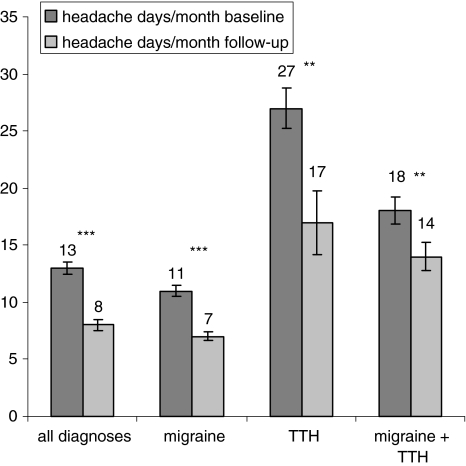
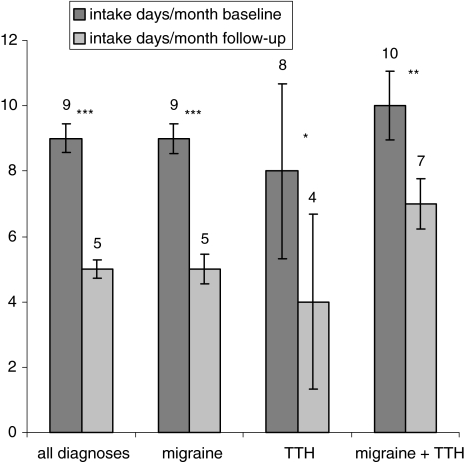
This study investigated the outcome of a 5-day headache-specific multidisciplinary treatment program (MTP) and the adherence to treatment recommendations in 295 prospectively recruited consecutive headache patients [210 migraine, 17 tension-type headache (TTH), 68 combination headache, including 56 medication-overuse headache (MOH)]. Headache frequency decreased from 13.4 (±8.8) to 8.8 (±8.0) days per month after 12-18 months. Forty-three percent of the participants fulfilled the primary outcome (reduction of headache frequency of ≥50%), which was less likely in patients with combination of migraine and TTH compared to migraine (OR = 3.136, p = 0.002) or TTH (OR = 1.029, n.s.). Increasing number of headache days per month (OR = 1.092, p ≤ 0.0001) and adherence to lifestyle modifications (OR = 1.269, p = 0.004) predicted primary outcome. 51 of 56 MOH patients were treated successfully. Thirty-five percent of the patients were adherent to pharmacological prophylaxis, 61% to relaxation therapy, and 72% to aerobic endurance sports. MTP is effective in headache treatment. Adherence to therapy was associated with better outcome.
Overview
The claims and statistics of this paper haven’t been checked yet.
Run the check — free, no account needed. It reads the open-access text and checks the sources it cites.
Integrity signals
Registry
Cites
Statistics
Figures
Verification
Claims the paper makes
The claims and statistics of this paper haven’t been checked yet.
Run the check — free, no account needed. It reads the open-access text and checks the sources it cites.
Claims other papers make about this one
Each is checked against this paper’s own text: does it say what the citing paper says it does?
The source backs part of the claim, not all of it — or backs it for a different population, condition or comparison.
In the citing paper
“A person-centered approach that integrates various intervention components is more effective [28,29] and may enhance personal control and efficacy in headache management [14].”
From Development and Evaluation of a Smartphone-Based Chatbot Coach to Facilitate a Balanced Lifestyle in Individuals With Headaches (BalanceUP App): Randomized Controlled Trial (2024) · cites this paper as [28]
Experimental — accuracy not yet measured
Self-check
Percentages, sums and reported differences re-computed from the paper’s own numbers.
The self-check needs the paper’s full text.
Citations
Cites
The International Classification of Headache Disorders: 2nd edition
Olesen, J., Goadsby, P. J., & Steiner, T. (2003) · The Lancet Neurology · doi:10.1016/s1474-4422(03)00590-8 · Cited by 5,046
The global burden of headache: A documentation of headache prevalence and disability worldwide
Stovner, L., Hagen, K., Jensen, R., Katsarava, Z., Lipton, R., Scher, A., Steiner, T., & Zwart, J.-A. (2007) · Cephalalgia · doi:10.1111/j.1468-2982.2007.01288.x · Cited by 2,444 · cited 1×
“Primary headaches, in particular migraine and tensiontype headache (TTH) cause severe burden of disease and create high costs in the health care system [1, 2].”
BackgroundSelf-citationOlesen, J. (2004) · Cephalalgia · doi:10.1111/j.1468-2982.2003.00824.x · Cited by 2,056
Interventions for enhancing medication adherence
Haynes, R. B., Ackloo, E., Sahota, N., McDonald, H. P., & Yao, X. (2008) · Cochrane Database of Systematic Reviews · doi:10.1002/14651858.cd000011.pub3 · Cited by 1,244 · cited 1×
“Increasing the effectiveness of adherence might have more substantial impact on clinical outcome than improvement in specific medical treatments [27].”
Guidelines for Controlled Trials of Prophylactic Treatment of Chronic Migraine in Adults
Silberstein, S. D., Tfelt‐Hansen, P. C., Dodick, D., Limmroth, V., Lipton, R. B., Pascual, J., & Wang, S. J. (2008) · Cephalalgia · doi:10.1111/j.1468-2982.2008.01555.x · Cited by 303
Bigal, M., Rapoport, A., Sheftell, F., Tepper, S., & Lipton, R. (2004) · Cephalalgia · doi:10.1111/j.1468-2982.2004.00691.x · Cited by 275 · cited 1×
“Overuse of acute medication is responsible for the development or maintenance of chronic daily headache (CDH) and successful detoxification results in a 70% return to an episodic pattern of migraine [19].”
BackgroundClinical features, pathophysiology, and treatment of medication-overuse headache
Evers, S., & Marziniak, M. (2010) · The Lancet Neurology · doi:10.1016/s1474-4422(10)70008-9 · Cited by 233 · cited 2×
“Longitudinal studies in academic headache clinics reported relapse rates from 30 to 41% 1 year after initial outpatient withdrawal treatment in MOH [5–8].”
BackgroundMedication Overuse Headache: Rates and Predictors for Relapse in a 4-year Prospective Study
Katsarava, Z., Muessig, M., Dzagnidze, A., Fritsche, G., Diener, H., & Limmroth, V. (2004) · Cephalalgia · doi:10.1111/j.1468-2982.2004.00789.x · Cited by 226 · cited 2×
“Longitudinal studies in academic headache clinics reported relapse rates from 30 to 41% 1 year after initial outpatient withdrawal treatment in MOH [5–8].”
BackgroundSelf-citationHolroyd, K. A., & Penzien, D. B. (1990) · Pain · doi:10.1016/0304-3959(90)91085-w · Cited by 223
Behavioral Management of Recurrent Headache: Three Decades of Experience and Empiricism
Penzien, D. B., Rains, J. C., & Andrasik, F. (2002) · Applied Psychophysiology and Biofeedback · doi:10.1023/a:1016247811416 · Cited by 162 · cited 1×
“The prophylactic effect of relaxation training in headache treatment is already proven in several studies [21–23].”
Result
Cited by
Sorted by citations
Systematic Review of Migraine Prophylaxis Adherence and Persistence
Hepp, Z., Bloudek, L. M., & Varon, S. F. (2014) · Journal of Managed Care Pharmacy · doi:10.18553/jmcp.2014.20.1.22 · Cited by 334
Ashina, S., Mitsikostas, D. D., Lee, M. J., Yamani, N., Wang, S., Messina, R., Ashina, H., Buse, D. C., Pozo‐Rosich, P., Jensen, R., et al. (2021) · Nature Reviews Disease Primers · doi:10.1038/s41572-021-00257-2 · Cited by 290
Self-citationPathophysiology, prevention, and treatment of medication overuse headache
Diener, H., Dodick, D. W., Evers, S., Holle, D., Jensen, R., Lipton, R. B., Porreca, F., Silberstein, S. D., & Schwedt, T. J. (2019) · The Lancet Neurology · doi:10.1016/s1474-4422(19)30146-2 · Cited by 226
Self-citationLuedtke, K., Allers, A., Schulte, L. H., & May, A. (2015) · Cephalalgia · doi:10.1177/0333102415597889 · Cited by 232
Kaiser, U., Sabatowski, R., & Azad, S. C. (2015) · Der Schmerz · doi:10.1007/s00482-015-0030-4 · Cited by 160
Metadata
- Authors
- Gaul, C., van Doorn, C., Webering, N., Dlugaj, M., Katsarava, Z., Diener, H.-C., & Fritsche, G.
- Affiliations
- Essen University Hospital (DE)
- Corresponding author
- Gaul, Charly
- Venue
- The Journal of Headache and Pain
- Published
- 2011-05-05
- Volume
- 12
- Issue
- 4
- Pages
- 475-483
- ISSN
- 1129-2369 (ISSN-L)
- 1129-2377
- PMC
- PMC3139052
- OpenAlex
- W2017444456
- Cited by
- 156
- References
- 30
- Citations by year
- 2026: 6 · 2025: 5 · 2024: 8 · 2023: 10 · 2022: 14 · 2021: 7 · 2020: 8 · 2019: 13 · 2018: 13 · 2017: 12 · 2016: 6 · 2015: 13 · 2014: 17 · 2013: 8 · 2012: 10
- FWCI
- 8.97
- Type
- journal article
- Language
- en
- Open access
- gold
- doi.org
- Locations
- The Journal of Headache and Pain (publishedVersion, cc-by)
- Europe PMC (PubMed Central) (publishedVersion, cc-by)
- PubMed Central (publishedVersion, cc-by)
- PubMed (publishedVersion)
- Topics
- Health Sciences › Medicine › Clinical Neurology › Migraine and Headache Studies
- Health Sciences › Dentistry › Oral Surgery › Temporomandibular Joint Disorders
- Health Sciences › Health Professions › Physical Therapy, Sports Therapy and Rehabilitation › Musculoskeletal pain and rehabilitation
- Keywords
- migraine, tension-type headache, medication overuse headache, medication adherence, headache frequency, lifestyle modification, pharmacological prophylaxis, relaxation training, headache centers
- MeSH terms
- Adolescent, Adult, Aged, Exercise Therapy, Female, Headache, Humans, Male, Middle Aged, Patient Compliance, Relaxation Therapy, Treatment Outcome, Pain Clinics, Young Adult
About these checks
Registry, retraction, Cites and statistics results are computed, not judged, with one exception: a printed reference that no index lists is read once by a model before it counts as a citation error. Claims are extracted by a model and kept only when their quote appears verbatim in the text; each cited source is then checked, with a model’s help, for whether it says what the claim relies on. Those verdicts can be wrong — read the claim’s quote and the cited source before relying on one.
Statistics and arithmetic are recomputed, not judged.
Confidence bands are shown only for fields calibrated on our annotated test set. None is calibrated yet, so no band is shown.
What counts as a claim ›How we measure confidence ›How we check this ›
Are you an author, or do you see a problem with this page? Request a review
