

Causal Structure Learning: A Combinatorial Perspective
Open accessThe DOI matches its Crossref record; 94 of the 95 references it cites were found in a registry or an index, and 1 are not checked yet.
Abstract
In this review, we discuss approaches for learning causal structure from data, also called causal discovery. In particular, we focus on approaches for learning directed acyclic graphs and various generalizations which allow for some variables to be unobserved in the available data. We devote special attention to two fundamental combinatorial aspects of causal structure learning. First, we discuss the structure of the search space over causal graphs. Second, we discuss the structure of equivalence classes over causal graphs, i.e., sets of graphs which represent what can be learned from observational data alone, and how these equivalence classes can be refined by adding interventional data.
Overview
The claims and statistics of this paper haven’t been checked yet.
Free: it reads the open-access text and checks the first 5 claims that cite a source we can check. Create a free account to check every claim.
Integrity signals
Registry
Cites
Statistics
Figures
Verification
Claims the paper makes
The claims and statistics of this paper haven’t been checked yet.
Free: it reads the open-access text and checks the first 5 claims that cite a source we can check. Create a free account to check every claim.
Claims other papers make about this one
Each is checked against this paper’s own text: does it say what the citing paper says it does?
The source backs part of the claim, not all of it — or backs it for a different population, condition or comparison.
In the citing paper
“A key difficulty for applying the potential outcome framework for our task is ‘the mixing of confounders with outcomes’.”
From Causal identification of single-cell experimental perturbation effects with CINEMA-OT (2023) · cites this paper as [19]
Experimental — accuracy not yet measured
Self-check
Percentages, sums and reported differences re-computed from the paper’s own numbers.
The self-check needs the paper’s full text.
Citations
Cites
Advances in neural information processing systems 7
Cios, K., & Shields, M. (1997) · Neurocomputing · doi:10.1016/s0925-2312(97)90018-7 · Cited by 22,059
Advances in Neural Information Processing Systems 19
(2007) · The MIT Press eBooks · doi:10.52202/085713 · Cited by 15,539
Causality: Models, Reasoning, and Inference
Pearl, J. (2009) · doi:10.1017/cbo9780511803161 · Cited by 11,653
Advances in Neural Information Processing Systems 14: Proceedings of the 2001 Conference
(2002) · The MIT Press eBooks · doi:10.7551/mitpress/1120.001.0001 · Cited by 8,890
Causation, Prediction, and Search
Spirtes, P., Glymour, C., & Scheines, R. (2001) · doi:10.7551/mitpress/1754.001.0001 · Cited by 4,521
The max-min hill-climbing Bayesian network structure learning algorithm
Tsamardinos, I., Brown, L. E., & Aliferis, C. F. (2006) · Machine Learning · doi:10.1007/s10994-006-6889-7 · Cited by 1,822 · cited 1×
“Beyond the constraint-based and score-based paradigms for causal structure learning already discussed, there are a variety of hybrid methods [170, 142, 144, 7, 120], which generally use constraints to reduce the search space, and scores to optimize over this reduced search space.”
MethodDAGs with NO TEARS: Continuous Optimization for Structure Learning
Zheng, X., Aragam, B., Ravikumar, P., & Xing, E. P. (2018) · arXiv · doi:10.48550/arxiv.1803.01422 · Cited by 1,700
Bayesian Graphical Models for Discrete Data
Madigan, D., York, J., & Allard, D. (1995) · International Statistical Review / Revue Internationale de Statistique · doi:10.2307/1403615 · Cited by 1,090 · cited 1×
“Markov chain Monte Carlo (MCMC) methods have been especially popular, beginning with the structure MCMC algorithm [110],”
MethodLearning Bayesian networks is NP-complete
Chickering, D. M. (1996) · Lecture Notes in Statistics · doi:10.1007/978-1-4612-2404-4_12 · Cited by 1,001
Review of Causal Discovery Methods Based on Graphical Models
Glymour, C., Zhang, K., & Spirtes, P. (2019) · Frontiers in Genetics · doi:10.3389/fgene.2019.00524 · Cited by 860
Friedman, N., & Koller, D. (2003) · Machine Learning · doi:10.1023/a:1020249912095 · Cited by 811 · cited 8×
“Markov chain Monte Carlo (MCMC) methods have been especially popular, beginning with the structure MCMC algorithm [110], which runs a Metropolis–Hastings algorithm over the space of DAG models, using edge additions and deletions to move in this space.”
MethodInfluentialRichardson, T., & Spirtes, P. (2002) · The Annals of Statistics · doi:10.1214/aos/1031689015 · Cited by 545
Targeted Maximum Likelihood Estimation for Causal Inference in Observational Studies
Schuler, M. S., & Rose, S. (2017) · American Journal of Epidemiology · doi:10.1093/aje/kww165 · Cited by 399 · cited 1×
“This has been extensively studied in the literature on semiparametric efficiency [15, 135], double machine learning [85], and targetedmachine learning [139], also covered in a recent review [90].”
BackgroundLearning high-dimensional directed acyclic graphs with latent and selection variables
Colombo, D., Maathuis, M. H., Kalisch, M., & Richardson, T. S. (2012) · The Annals of Statistics · doi:10.1214/11-aos940 · Cited by 384 · cited 3×
“The FCI algorithm has inspired several variants, including Really Fast Causal Inference (RFCI) [36], and FCI+ [35].”
BackgroundMethodCausal Networks: Semantics and Expressiveness
(1990) · Machine Intelligence and Pattern Recognition · doi:10.1016/b978-0-444-88650-7.50011-1 · Cited by 357
Learning Bayesian networks: approaches and issues
Daly, R., Shen, Q., & Aitken, S. (2011) · The Knowledge Engineering Review · doi:10.1017/s0269888910000251 · Cited by 319 · cited 1×
“The problem of learning such a causal graph from data, known as causal structure learning (or causal discovery), has been the focus of much recent work in computer science, statistics, and bioinformatics , covered in a number of recent reviews [40, 41, 64, 74, 113].”
BackgroundD-VAE: A Variational Autoencoder for Directed Acyclic GraphsPreprint
Zhang, M., Jiang, S., Cui, Z., Garnett, R., & Chen, Y. (2019) · arXiv (Cornell University) · doi:10.48550/arxiv.1904.11088 · Cited by 232 · cited 1×
“Finally, at the other extreme of this tradeoff, gradient-based methods [195, 183, 103, 192] relax the discrete search space over DAGs to a continuous search space, allowing gradient descent and other techniques from continuous optimization to be applied to causal structure learning.”
MethodLearning graphical model structure using L1-regularization paths
Schmidt, M., Niculescu-Mizil, A., & Murphy, K. J. (2007) · National Conference on Artificial Intelligence · Cited by 230
CAM: Causal additive models, high-dimensional order search and penalized regression
Bühlmann, P., Peters, J., & Ernest, J. (2014) · The Annals of Statistics · doi:10.1214/14-aos1260 · Cited by 223 · cited 1×
“Indeed, [78] shows that in linear models, symmetry is only possible in the Gaussian case, and give more general results for the case where fi is non-linear, which form the basis for structure learning methods such as the Causal Additive Model (CAM) algorithm [24].”
MethodInterventions and Causal Inference
Eberhardt, F., & Scheines, R. (2007) · Philosophy of Science · doi:10.1086/525638 · Cited by 220
Identifiability of Gaussian structural equation models with equal error variances
Peters, J., & Bühlmann, P. (2014) · Biometrika · doi:10.1093/biomet/ast043 · Cited by 214
Structure Learning in Graphical Modeling
Drton, M., & Maathuis, M. H. (2017) · Annual Review of Statistics and Its Application · doi:10.1146/annurev-statistics-060116-053803 · Cited by 209
Geiger, D., & Heckerman, D. E. (2002) · The Annals of Statistics · doi:10.1214/aos/1035844981 · Cited by 209
Invariant Causal Prediction for Nonlinear Models
Heinze-Deml, C., Peters, J., & Meinshausen, N. (2018) · Journal of Causal Inference · doi:10.1515/jci-2017-0016 · Cited by 197
Learning Causal Bayesian Network Structures From Experimental Data
Ellis, B., & Wong, W. H. (2008) · Journal of the American Statistical Association · doi:10.1198/016214508000000193 · Cited by 183
(2018) · CRC Press eBooks · doi:10.1201/9780429463976 · Cited by 178 · cited 2×
“structural equations or the distributions of exogenous variables, the Markov factorization property and the global Markov property are equivalent [112].”
BackgroundImproving Markov Chain Monte Carlo Model Search for Data Mining
Giudici, P., & Castelo, R. (2003) · Machine Learning · doi:10.1023/a:1020202028934 · Cited by 171 · cited 8×
“This difficulty has motivated a search for “smoother” sampling spaces, either by adding moves to structure MCMC [62, 67], or by changing the search space, as was done in order MCMC [45, 49], partial order MCMC [118], and partition MCMC [99].”
MethodInfluentialHeinze-Deml, C., Maathuis, M. H., & Meinshausen, N. (2018) · Annual Review of Statistics and Its Application · doi:10.1146/annurev-statistics-031017-100630 · Cited by 169
Improving the structure MCMC sampler for Bayesian networks by introducing a new edge reversal move
Grzegorczyk, M. A., & Husmeier, D. (2008) · Machine Learning · doi:10.1007/s10994-008-5057-7 · Cited by 167
Integer Linear Programming for the Bayesian network structure learning problem
Bartlett, M., & Cussens, J. (2017) · Artificial Intelligence · doi:10.1016/j.artint.2015.03.003 · Cited by 164
Learning Optimal Bayesian Networks: A Shortest Path Perspective
Yuan, C., & Malone, B. (2013) · Journal of Artificial Intelligence Research · doi:10.1613/jair.4039 · Cited by 163
Approximate Kernel-Based Conditional Independence Tests for Fast Non-Parametric Causal Discovery
Strobl, E. V., Zhang, K., & Visweswaran, S. (2019) · Journal of Causal Inference · doi:10.1515/jci-2018-0017 · Cited by 158
Two optimal strategies for active learning of causal models from interventional data
Hauser, A., & Bühlmann, P. (2013) · International Journal of Approximate Reasoning · doi:10.1016/j.ijar.2013.11.007 · Cited by 156
Geometry of the faithfulness assumption in causal inference
Uhler, C., Raskutti, G., Bühlmann, P., & Yu, B. (2013) · The Annals of Statistics · doi:10.1214/12-aos1080 · Cited by 148
Self-citationThe hardness of conditional independence testing and the generalised covariance measure
Shah, R. D., & Peters, J. (2020) · The Annals of Statistics · doi:10.1214/19-aos1857 · Cited by 146 · cited 1×
“Unfortunately, impossibility results [146] state that any uniformly valid conditional independence test (i.”
BackgroundMethods for causal inference from gene perturbation experiments and validation
Meinshausen, N., Hauser, A., Mooij, J. M., Peters, J., Versteeg, P., & Bühlmann, P. (2016) · Proceedings of the National Academy of Sciences · doi:10.1073/pnas.1510493113 · Cited by 140
Learning directed acyclic graph models based on sparsest permutations
Raskutti, G., & Uhler, C. (2018) · Stat · doi:10.1002/sta4.183 · Cited by 137
Self-citationConsistency guarantees for greedy permutation-based causal inference algorithms
Solus, L., Wang, Y., & Uhler, C. (2020) · Biometrika · doi:10.1093/biomet/asaa104 · Cited by 137
Self-citationGraphs for Margins of Bayesian Networks
Evans, R. J. (2015) · Scandinavian Journal of Statistics · doi:10.1111/sjos.12194 · Cited by 117
Partition MCMC for Inference on Acyclic Digraphs
Kuipers, J., & Moffa, G. (2016) · Journal of the American Statistical Association · doi:10.1080/01621459.2015.1133426 · Cited by 110
High-dimensional consistency in score-based and hybrid structure learning
Nandy, P., Hauser, A., & Maathuis, M. H. (2018) · The Annals of Statistics · doi:10.1214/17-aos1654 · Cited by 98 · cited 3×
“Simulation results suggest that score-based and hybrid approaches perform better for fixed sample sizes [120, 76, 8].”
BackgroundMethodMargins of discrete Bayesian networks
Evans, R. J. (2018) · The Annals of Statistics · doi:10.1214/17-aos1631 · Cited by 88 · cited 1×
“For example, an acyclic directed mixed graph (ADMG) encodes a subset of the equality constraints of the marginal DAG model via the associated nested Markov model [149, 136]; in fact, the nested Markov model is known to encode all equality constraints in the case of discrete variables [48].”
Estimating Identifiable Causal Effects through Double Machine Learning
Jung, Y., Tian, J. W., & Bareinboim, E. (2021) · Proceedings of the AAAI Conference on Artificial Intelligence · doi:10.1609/aaai.v35i13.17438 · Cited by 84
Foundations of structural causal models with cycles and latent variables
Bongers, S., Forré, P., Peters, J., & Mooij, J. M. (2021) · The Annals of Statistics · doi:10.1214/21-aos2064 · Cited by 83 · cited 1×
“Recent work [21] has investigated the semantics of cyclic causal models, showing that Markov properties and other desirable properties hold in the case of certain solvability conditions.”
BackgroundA Hybrid Causal Search Algorithm for Latent Variable Models.
Ogarrio, J., Spirtes, P., & Ramsey, J. (2016) · PubMed · Cited by 78
An interventionist approach to causation in psychology
Campbell, J. (2007) · Causal Learning · doi:10.1093/acprof:oso/9780195176803.003.0005 · Cited by 73 · cited 1×
“Most significantly, a hard intervention, also called a perfect, surgical [27], or structural [45] intervention, is one which completely removes the dependence of a target Xi on its parents.”
BackgroundInterventions, Where and How? Experimental Design for Causal Models at ScalePreprint
Tigas, P., Annadani, Y., Jesson, A., Schölkopf, B., Gal, Y., & Bauer, S. (2022) · Neural Information Processing Systems · doi:10.48550/arxiv.2203.02016 · Cited by 73 · cited 1×
“While these approaches are designed for the noiseless setting, in which an infinite amount of data is gathered from each intervention, more recent works [100, 168] explore greedy approaches in the noisy setting.”
BackgroundIntroduction to Nested Markov Models
Shpitser, I., Evans, R. J., Richardson, T. S., & Robins, J. M. (2014) · Behaviormetrika · doi:10.2333/bhmk.41.3 · Cited by 70
Probability distributions with summary graph structure
Wermuth, N. (2011) · Bernoulli · doi:10.3150/10-bej309 · Cited by 67 · cited 1×
“As in the case of marginalization, several graphical representations, including MC graphs [98], summary graphs [178], and regression graphs [179, 139] have been introduced to capture constraints induced by such conditional models; [47] provides an exact graphical characterization of all equality and inequality constra…”
MethodDiscovering Cyclic Causal Models with Latent Variables: A General SAT-Based ProcedurePreprint
Hyttinen, A., Hoyer, P. O., Eberhardt, F., & Järvisalo, M. (2013) · arXiv (Cornell University) · doi:10.48550/arxiv.1309.6836 · Cited by 64 · cited 1×
“Algorithms for the general case include SAT-based approaches [83], exact score-based approaches [133], and constraintbased approaches [50, 117, 159].”
MethodUnifying Markov properties for graphical models
Lauritzen, S. L., & Sadeghi, K. (2018) · The Annals of Statistics · doi:10.1214/17-aos1618 · Cited by 59
Alonso-Barba, J. I., de la Ossa, L., Gámez, J. A., & Puerta, J. M. (2012) · International Journal of Approximate Reasoning · doi:10.1016/j.ijar.2012.09.004 · Cited by 57 · cited 1×
“Beyond the constraint-based and score-based paradigms for causal structure learning already discussed, there are a variety of hybrid methods [170, 142, 144, 7, 120], which generally use constraints to reduce the search space, and scores to optimize over this reduced search space.”
MethodProbability distributions with summary graph structure
Wermuth, N. (2008) · Cited by 52
Wang, X., Parast, L. M., Tian, L., & Cai, T. (2019) · Biometrika · doi:10.1093/biomet/asz065 · Cited by 52
On scoring Maximal Ancestral Graphs with the Max–Min Hill Climbing algorithm
Tsirlis, K., Lagani, V., Triantafillou, S., & Tsamardinos, I. (2018) · International Journal of Approximate Reasoning · doi:10.1016/j.ijar.2018.08.002 · Cited by 51
A constraint-based algorithm for causal discovery with cycles, latent variables and selection bias
Strobl, E. V. (2018) · International Journal of Data Science and Analytics · doi:10.1007/s41060-018-0158-2 · Cited by 48
Forré, P. D., & Mooij, J. M. (2018) · arXiv (Cornell University) · doi:10.48550/arxiv.1807.03024 · Cited by 47 · cited 1×
“Algorithms for the general case include SAT-based approaches [83], exact score-based approaches [133], and constraintbased approaches [50, 117, 159].”
MethodKocaoglu, M., Dimakis, A. G., Vishwanath, S., & Hassibi, B. (2017) · AAAI Publications (The Association for the Advancement of Artificial Intelligence (AAAI)) · doi:10.1609/aaai.v31i1.10674 · Cited by 45
DCI: learning causal differences between gene regulatory networks
Belyaeva, A., Squires, C., & Uhler, C. (2021) · Bioinformatics · doi:10.1093/bioinformatics/btab167 · Cited by 41
Self-citationSemiparametric Inference For Causal Effects In Graphical Models With Hidden VariablesPreprint
Bhattacharya, R., Nabi, R., & Shpitser, I. (2020) · arXiv (Cornell University) · doi:10.48550/arxiv.2003.12659 · Cited by 41 · cited 1×
“This has been extensively studied in the literature on semiparametric efficiency [138, 16], double machine learning [87], and targeted machine learning [143], also covered in a recent review [92].”
BackgroundThe three faces of faithfulness
Zhang, J., & Spirtes, P. (2015) · Synthese · doi:10.1007/s11229-015-0673-9 · Cited by 40
Learning Neural Causal Models from Unknown Interventions
Ke, N. R., Bilaniuk, O., Goyal, A., Bauer, S., Larochelle, H., Schölkopf, B., Mozer, M. C., Pal, C., & Bengio, Y. (2019) · arXiv (Cornell University) · doi:10.48550/arxiv.1910.01075 · Cited by 40 · cited 1×
“Score-based approaches include greedy algorithms, such as Greedy Interventional Equivalence Search (GIES) [72], and gradient-based algorithms, such as meta-learning approaches [91] and DCDI [23].”
MethodGeneral Transportability – Synthesizing Observations and Experiments from Heterogeneous Domains
Lee, S., Correa, J. D., & Bareinboim, E. (2020) · Proceedings of the AAAI Conference on Artificial Intelligence · doi:10.1609/aaai.v34i06.6582 · Cited by 38
Constraint-Based Causal Discovery using Partial Ancestral Graphs in the presence of CyclesPreprint
Mooij, J. M., & Claassen, T. (2020) · UvA-DARE (University of Amsterdam) · doi:10.48550/arxiv.2005.00610 · Cited by 38
Causal Discovery in the Presence of Measurement Error: Identifiability ConditionsPreprint
Zhang, K., Gong, M., Ramsey, J., Batmanghelich, K. N., Spirtes, P., & Glymour, C. (2017) · arXiv (Cornell University) · doi:10.48550/arxiv.1706.03768 · Cited by 38 · cited 1×
“Alternatively, many works [86, 70, 102, 189, 26, 181, 93, 140] consider recovering unobserved variables under the measurement assumption and a form of purity or anchor assumption, where each unobserved variable must have some number of observed variables which are only their children.”
BackgroundSemiparametric doubly robust targeted double machine learning: a reviewPreprint
Kennedy, E. H. (2022) · arXiv (Cornell University) · doi:10.48550/arxiv.2203.06469 · Cited by 38 · cited 1×
“This has been extensively studied in the literature on semiparametric efficiency [138, 16], double machine learning [87], and targeted machine learning [143], also covered in a recent review [92].”
BackgroundCausal Clustering for 1-Factor Measurement Models
Kummerfeld, E., & Ramsey, J. (2016) · ACM SIGKDD Conference on Knowledge Discovery and Data Mining (KDD) · doi:10.1145/2939672.2939838 · Cited by 37
von Kügelgen, J., Rubenstein, P. K., Schölkopf, B., & Weller, A. (2019) · arXiv (Cornell University) · doi:10.48550/arxiv.1910.03962 · Cited by 35 · cited 1×
“While these approaches are designed for the noiseless setting, in which an infinite amount of data is gathered from each intervention, more recent works [100, 168] explore greedy approaches in the noisy setting.”
BackgroundCounting and Sampling from Markov Equivalent DAGs Using Clique Trees
Ghassami, A., Salehkaleybar, S., Kiyavash, N., & Zhang, K. (2019) · Proceedings of the AAAI Conference on Artificial Intelligence · doi:10.1609/aaai.v33i01.33013664 · Cited by 31
Learning High-dimensional Directed Acyclic Graphs with Mixed Data-types.
Andrews, B., Ramsey, J., & Cooper, G. F. (2019) · PubMed · Cited by 29
Causal Discovery from Discrete Data using Hidden Compact Representation.
Cai, R., Qiao, J., Zhang, K., Zhang, Z., & Hao, Z. (2018) · PubMed · Cited by 28
Causal Bandits without prior knowledge using separating sets
de Kroon, A. D., Mooij, J., & Belgrave, D. (2020) · CLEaR · doi:10.48550/arxiv.2009.07916 · Cited by 25 · cited 1×
“If the causal graph is not assumed to be known, there is an additional exploration-exploitation tradeoff that needs to be taken into account, which has been considered in recent work [99, 111, 19].”
Transportability of Causal Effects: Completeness Results
Bareinboim, E., & Pearl, J. (2021) · Proceedings of the AAAI Conference on Artificial Intelligence · doi:10.1609/aaai.v26i1.8232 · Cited by 24
Shah, R. D., Frot, B., Thanei, G.-A., & Meinshausen, N. (2020) · Journal of the Royal Statistical Society Series B (Statistical Methodology) · doi:10.1111/rssb.12359 · Cited by 22 · cited 2×
“For example, several works [51, 141] consider recovering the unobserved variables in settings with pervasive confounding, i.”
BackgroundGlocker, B., Musolesi, M., Richens, J. G., & Uhler, C. (2021) · Nature Communications · doi:10.1038/s41467-021-25743-9 · Cited by 22 · cited 1×
“However, in many scientific settings, such as biology, where interventions such as genetic or chemical perturbations can readily be performed, an important component of causal discovery is the choice of what data to gather [63].”
BackgroundSelf-citationRotnitzky, A. G., & Smucler, E. (2019) · arXiv (Cornell University) · doi:10.48550/arxiv.1912.00306 · Cited by 21
Counting and Sampling Markov Equivalent Directed Acyclic Graphs
Talvitie, T., & Koivisto, M. (2019) · Proceedings of the AAAI Conference on Artificial Intelligence · doi:10.1609/aaai.v33i01.33017984 · Cited by 20
Counting Markov equivalence classes for DAG models on trees
Radhakrishnan, A., Solus, L., & Uhler, C. (2018) · Discrete Applied Mathematics · doi:10.1016/j.dam.2018.03.015 · Cited by 18
Self-citationDiscovering causal graphs with cycles and latent confounders: An exact branch-and-bound approach
Rantanen, K., Hyttinen, A., & Järvisalo, M. (2019) · International Journal of Approximate Reasoning · doi:10.1016/j.ijar.2019.10.009 · Cited by 12
Polynomial-Time Algorithms for Counting and Sampling Markov Equivalent DAGs
Wienöbst, M., Bannach, M., & Liśkiewicz, M. (2021) · AAAI Publications (The Association for the Advancement of Artificial Intelligence (AAAI)) · doi:10.1609/aaai.v35i13.17448 · Cited by 11
An efficient algorithm for counting Markov equivalent DAGs
Ganian, R., Hamm, T., & Talvitie, T. (2021) · Artificial Intelligence · doi:10.1016/j.artint.2021.103648 · Cited by 10
On sampling graphical Markov modelsPreprint
Bernstein, M., & Tetali, P. (2017) · arXiv (Cornell University) · doi:10.48550/arxiv.1705.09717 · Cited by 10 · cited 1×
“A recent advance [180] provides a polynomialtime algorithm for this task based on a representation of the equivalence class via clique trees, improving over previous algorithms with exponential worst-case runtime [74, 15, 166, 59, 6, 54].”
MethodThe IMAP Hybrid Method for Learning Gaussian Bayes Nets
Schulte, O., Frigo, G., Greiner, R., & Khosravi, H. (2010) · Lecture notes in computer science · doi:10.1007/978-3-642-13059-5_14 · Cited by 9 · cited 1×
“Beyond the constraint-based and score-based paradigms for causal structure learning already discussed, there are a variety of hybrid methods [170, 142, 144, 7, 120], which generally use constraints to reduce the search space, and scores to optimize over this reduced search space.”
MethodDCI: Learning Causal Differences between Gene Regulatory NetworksPreprint
Belyaeva, A., Squires, C., & Uhler, C. (2020) · bioRxiv (Cold Spring Harbor Laboratory) · doi:10.1101/2020.05.13.093765 · Cited by 6 · cited 1×
“In the batched data setting, [176, 194, 13] considers targeted learning of the difference between two DAG models, instead of the DAG models themselves.”
MethodSelf-citationAnchored Discrete Factor AnalysisPreprint
Halpern, Y., Horng, S., & Sontag, D. A. (2015) · arXiv (Cornell University) · doi:10.48550/arxiv.1511.03299 · Cited by 5 · cited 1×
“Alternatively, many works [86, 70, 102, 189, 26, 181, 93, 140] consider recovering unobserved variables under the measurement assumption and a form of purity or anchor assumption, where each unobserved variable must have some number of observed variables which are only their children.”
BackgroundCausal Modeling of Dynamical SystemsPreprint
Bongers, S., Blom, T., & Mooij, J. M. (2018) · arXiv (Cornell University) · doi:10.48550/arxiv.1803.08784 · Cited by 3 · cited 1×
“While the underlying dynamics of the system are necessarily acyclic over time, feedback loops can arise when modeling the equilibrium states of such systems [20].”
BackgroundAdaptively Exploiting d-Separators with Causal BanditsPreprint
Bilodeau, B., Wang, L., & Roy, D. M. (2022) · arXiv (Cornell University) · doi:10.48550/arxiv.2202.05100 · Cited by 2 · cited 1×
“If the causal graph is not assumed to be known, there is an additional exploration-exploitation tradeoff that needs to be taken into account, which has been considered in recent work [99, 111, 19].”
The DeCAMFounder: Non-Linear Causal Discovery in the Presence of Hidden VariablesPreprint
Agrawal, R., Squires, C., Prasad, N., et al. (2021) · arXiv (Cornell University) · doi:10.48550/arxiv.2102.07921 · Cited by 2 · cited 3×
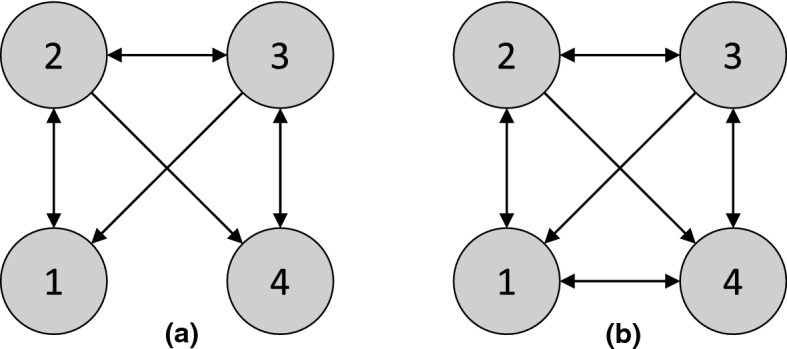
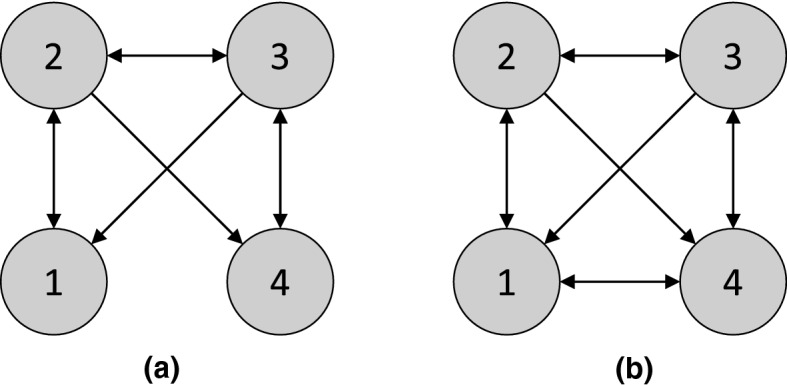
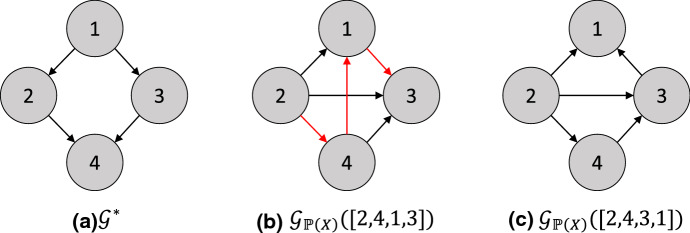
“(c) The minimal I-MAP associated with the permutation π((1)) = [2, 4, 3, 1], obtained after flipping the covered edge 1→ 3.”
BackgroundSelf-citationThe Global Markov Property for a Mixture of DAGsPreprint
Strobl, E. V. (2019) · arXiv (Cornell University) · doi:10.48550/arxiv.1909.05418 · Cited by 1 · cited 1×
“recovering a mixture of DAG models [161, 160, 141, 67], where there is a single unobserved variable that is a parent of all variables in the graph.”
BackgroundEfficient inference of interventional distributionsPreprint
Bhattacharyya, A., Gayen, S., Kandasamy, S., Raval, V., & Vinodchandran, N. V. (2021) · arXiv (Cornell University) · doi:10.48550/arxiv.2107.11712 · Cited by 1 · cited 1×
“Indeed, interventional data has been considered in recent works [1, 18] on the statistical and computational complexity of causal inference tasks, where the causal graph is assumed to be known and the task is to estimate interventional distributions.”
BackgroundUniversal Lower Bound for Learning Causal DAGs with Atomic InterventionsPreprint
Porwal, V., Srivastava, P., & Sinha, G. (2021) · arXiv (Cornell University) · doi:10.48550/arxiv.2111.05070 · Cited by 1 · cited 1×
“Taken together, these recent advances suggest several future directions, including (1) characterizing the number of multi-target interventions needed by an oracle in the adaptive case [128], (2) approximation guarantees for experimental design, compared to either oracles or optimal strategies, and (3) experimental des…”
BackgroundThe Proximal ID AlgorithmPreprint
Shpitser, I., Wood-Doughty, Z., & Tchetgen, E. J. T. (2021) · arXiv (Cornell University) · doi:10.48550/arxiv.2108.06818 · cited 1×
“bution is the observational distribution defined by M , possibly with some variables unobserved, the first subtask is covered by the ID algorithm [146] and its variants [147].”
BackgroundCausal Inference Despite Limited Global Confounding via Mixture ModelsPreprint
Gordon, S., Mazaheri, B., Rabani, Y., et al. (2021) · arXiv (Cornell University) · doi:10.48550/arxiv.2112.11602 · cited 1×
“recovering a mixture of DAG models [161, 160, 141, 67], where there is a single unobserved variable that is a parent of all variables in the graph.”
BackgroundOptimal estimation of Gaussian DAG modelsPreprint
Gao, M., Tai, W. M., & Aragam, B. (2022) · arXiv (Cornell University) · doi:10.48550/arxiv.2201.10548 · cited 1×
“Such lower bounds have been established for the exponential family setting [61] and the linear equal-variance setting [56], but the lower bounds for a wide range of settings and assumptions remain uncharacterized.”
BackgroundGreedy Causal Discovery is GeometricPreprint
Linusson, S., Restadh, P., & Solus, L. (2021) · arXiv (Cornell University) · doi:10.48550/arxiv.2103.03771 · cited 1×
“Notably, [109] shows that GES and a number of other greedy approaches can also be viewed geometrically.”
Background
Research works printed but not linked: 97
- Acharya, J., Bhattacharyya, A., Daskalakis, C., Kandasamy, S.: Learning and testing causal models with interventions. Advances in Neural Information Processing Systems 31 (2018)
- Addanki, R., Kasiviswanathan, S., McGregor, A., Musco, C.: Efficient intervention design for causal discovery with latents. In: International Conference on Machine Learning, pp. 63–73. PMLR (2020)
- Agrawal, R., Squires, C., Yang, K., Shanmugam, K., Uhler, C.: ABCD-strategy: Budgeted experimental design for targeted causal structure discovery. In: The 22nd International Conference on Artificial Intelligence and Statistics, pp. 3400–3409. PMLR (2019)
- Agrawal, R., Uhler, C., Broderick, T.: Minimal I-MAP MCMC for scalable structure discovery in causal DAG models. In: International Conference on Machine Learning, pp. 89–98. PMLR (2018)
- AhmadiTeshnizi, A., Salehkaleybar, S., Kiyavash, N.: Lazyiter: a fast algorithm for counting Markov equivalent DAGs and designing experiments. In: International Conference on Machine Learning, pp. 125–133. PMLR (2020)
- Bareinboim, E., Pearl, J.: Transportability from multiple environments with limited experiments: Completeness results. Advances in neural information processing systems 27 (2014)
- Bernstein, D., Saeed, B., Squires, C., Uhler, C.: Ordering-based causal structure learning in the presence of latent variables. In: International Conference on Artificial Intelligence and Statistics, pp. 4098–4108. PMLR (2020)
- Bhattacharya, R., Nagarajan, T., Malinsky, D., Shpitser, I.: Differentiable causal discovery under unmeasured confounding. In: International Conference on Artificial Intelligence and Statistics, pp. 2314–2322. PMLR (2021)
- Brenner, E., Sontag, D.: SparsityBoost: a new scoring function for learning Bayesian network structure. In: Proceedings of the Twenty-Ninth Conference on Uncertainty in Artificial Intelligence, pp. 112–121 (2013)
- Brouillard P Lachapelle S Lacoste A Lacoste-Julien S Drouin A Differentiable causal discovery from interventional data Advances in Neural Information Processing Systems 2020 33 21865 21877
- Cai, R., Xie, F., Glymour, C., Hao, Z., Zhang, K.: Triad constraints for learning causal structure of latent variables. Advances in neural information processing systems 32 (2019)
- Castelletti, F., Peluso, S.: Network structure learning under uncertain interventions. Journal of the American Statistical Association (just-accepted), 1–28 (2022)
- Chen, R., Dash, S., Gao, T.: Integer programming for causal structure learning in the presence of latent variables. In: International Conference on Machine Learning, pp. 1550–1560. PMLR (2021)
- Chickering, D.M.: A transformational characterization of equivalent Bayesian network structures. In: Proceedings of the Eleventh conference on Uncertainty in artificial intelligence, pp. 87–98 (1995)
- Chickering, D.M.: Optimal structure identification with greedy search. Journal of machine learning research 3(Nov), 507–554 (2002)
- Chickering, M.: Statistically efficient greedy equivalence search. In: Conference on Uncertainty in Artificial Intelligence, pp. 241–249. PMLR (2020)
- Chobtham, K., Constantinou, A.C.: Bayesian network structure learning with causal effects in the presence of latent variables. In: International Conference on Probabilistic Graphical Models, pp. 101–112. PMLR (2020)
- Claassen, T., Mooij, J.M., Heskes, T.: Learning sparse causal models is not NP-hard. In: Proceedings of the Twenty-Ninth Conference on Uncertainty in Artificial Intelligence, pp. 172–181 (2013)
- Cooper, G.F., Yoo, C.: Causal discovery from a mixture of experimental and observational data. In: Proceedings of the Fifteenth conference on Uncertainty in artificial intelligence, pp. 116–125 (1999)
- Correa J Bareinboim E General transportability of soft interventions: Completeness results Advances in Neural Information Processing Systems 2020 33 10902 10912
- Cussens, J.: Bayesian network learning with cutting planes. In: Proceedings of the 27th Conference on Uncertainty in Artificial Intelligence (UAI 2011), pp. 153–160. AUAI Press (2011)
- Cussens, J.: GOBNILP: Learning Bayesian network structure with integer programming. In: M. Jaeger, T.D. Nielsen (eds.) Proceedings of the 10th International Conference on Probabilistic Graphical Models, Proceedings of Machine Learning Research, vol. 138, pp. 605–608. PMLR (2020). http://proceedings.mlr.press/v138/cussens20a.html
- Eaton, D., Murphy, K.: Exact Bayesian structure learning from uncertain interventions. In: Artificial intelligence and statistics, pp. 107–114. PMLR (2007)
- Eberhardt, F., Glymour, C., Scheines, R.: On the number of experiments sufficient and in the worst case necessary to identify all causal relations among n variables. In: Proceedings of the Twenty-First Conference on Uncertainty in Artificial Intelligence, pp. 178–184 (2005)
- Friedman, N., Nachman, I.: Gaussian process networks. In: Proceedings of the Sixteenth conference on Uncertainty in artificial intelligence, pp. 211–219 (2000)
- Frot, B., Nandy, P., Maathuis, M.H.: Robust causal structure learning with some hidden variables. arXiv preprint arXiv:1708.01151 (2017) · arXiv
- Gao, M., Aragam, B.: Efficient Bayesian network structure learning via local Markov boundary search. Advances in Neural Information Processing Systems 34 (2021)
- Ghassami, A., Salehkaleybar, S., Kiyavash, N., Bareinboim, E.: Budgeted experiment design for causal structure learning. In: International Conference on Machine Learning, pp. 1724–1733. PMLR (2018)
- Ghassami, A., Yang, A., Kiyavash, N., Zhang, K.: Characterizing distribution equivalence and structure learning for cyclic and acyclic directed graphs. In: International Conference on Machine Learning, pp. 3494–3504. PMLR (2020)
- Ghoshal, A., Honorio, J.: Information-theoretic limits of Bayesian network structure learning. In: Artificial Intelligence and Statistics, pp. 767–775. PMLR (2017)
- Ghoshal, A., Honorio, J.: Learning identifiable Gaussian Bayesian networks in polynomial time and sample complexity. Advances in Neural Information Processing Systems 30 (2017)
- Gillispie, S.B., Lemieux, C.: Enumerating Markov Equivalence Classes of Acyclic Digraph Models. In: Proceedings of the 17th Conference in Uncertainty in Artificial Intelligence, pp. 171–177 (2001)
- Greenewald, K., Katz, D., Shanmugam, K., Magliacane, S., Kocaoglu, M., Boix Adsera, E., Bresler, G.: Sample efficient active learning of causal trees. Advances in Neural Information Processing Systems 32 (2019)
- Harris, N., Drton, M.: PC algorithm for nonparanormal graphical models. Journal of Machine Learning Research 14(11) (2013)
- Hauser A Bühlmann P Characterization and greedy learning of interventional Markov equivalence classes of directed acyclic graphs The Journal of Machine Learning Research 2012 13 1 2409 2464
- He Y Jia J Yu B Counting and exploring sizes of Markov equivalence classes of directed acyclic graphs The Journal of Machine Learning Research 2015 16 1 2589 2609
- He, Y.B., Geng, Z.: Active learning of causal networks with intervention experiments and optimal designs. Journal of Machine Learning Research 9(Nov), 2523–2547 (2008)
- Hu, Z., Evans, R.: Faster algorithms for Markov equivalence. In: Conference on Uncertainty in Artificial Intelligence, pp. 739–748. PMLR (2020)
- Hyttinen A Eberhardt F Hoyer PO Learning linear cyclic causal models with latent variables The Journal of Machine Learning Research 2012 13 1 3387 3439
- Hyttinen A Eberhardt F Hoyer PO Experiment selection for causal discovery Journal of Machine Learning Research 2013 14 3041 3071
- Hyttinen, A., Eberhardt, F., Järvisalo, M.: Constraint-based causal discovery: Conflict resolution with answer set programming. In: UAI, pp. 340–349 (2014)
- Jaakkola, T., Sontag, D., Globerson, A., Meila, M.: Learning Bayesian network structure using LP relaxations. In: Proceedings of the Thirteenth International Conference on Artificial Intelligence and Statistics, pp. 358–365. JMLR Workshop and Conference Proceedings (2010)
- Jaber A Kocaoglu M Shanmugam K Bareinboim E Causal discovery from soft interventions with unknown targets: Characterization and learning Advances in neural information processing systems 2020 33 9551 9561
- Kalisch, M., Bühlman, P.: Estimating high-dimensional directed acyclic graphs with the PC-algorithm. Journal of Machine Learning Research 8(3) (2007)
- Kano, Y., Shimizu, S., et al.: Causal inference using nonnormality. In: Proceedings of the international symposium on science of modeling, the 30th anniversary of the information criterion, pp. 261–270 (2003)
- Katz, D., Shanmugam, K., Squires, C., Uhler, C.: Size of interventional Markov equivalence classes in random DAG models. In: The 22nd International Conference on Artificial Intelligence and Statistics, pp. 3234–3243. PMLR (2019)
- Kivva, B., Rajendran, G., Ravikumar, P., Aragam, B.: Learning latent causal graphs via mixture oracles. Advances in Neural Information Processing Systems 34 (2021)
- Kocaoglu, M., Dimakis, A., Vishwanath, S.: Cost-optimal learning of causal graphs. In: International Conference on Machine Learning, pp. 1875–1884. PMLR (2017)
- Kocaoglu, M., Shanmugam, K., Bareinboim, E.: Experimental design for learning causal graphs with latent variables. Advances in Neural Information Processing Systems 30 (2017)
- Koivisto M Sood K Exact Bayesian structure discovery in Bayesian networks The Journal of Machine Learning Research 2004 5 549 573
- Koster, J.T.: Marginalizing and conditioning in graphical models. Bernoulli pp. 817–840 (2002)
- Lachapelle, S., Brouillard, P., Deleu, T., Lacoste-Julien, S.: Gradient-Based Neural DAG Learning. In: International Conference on Learning Representations (2019)
- Lattimore, F., Lattimore, T., Reid, M.D.: Causal bandits: Learning good interventions via causal inference. Advances in Neural Information Processing Systems 29 (2016)
- Lindgren, E., Kocaoglu, M., Dimakis, A.G., Vishwanath, S.: Experimental design for cost-aware learning of causal graphs. Advances in Neural Information Processing Systems 31 (2018) · DOI
- Lorch, L., Rothfuss, J., Schölkopf, B., Krause, A.: DiBS: Differentiable Bayesian Structure Learning. Advances in Neural Information Processing Systems 34 (2021)
- Lu, Y., Meisami, A., Tewari, A.: Causal bandits with unknown graph structure. Advances in Neural Information Processing Systems 34 (2021)
- Meek, C.: Causal inference and causal explanation with background knowledge. In: Proceedings of the Eleventh conference on Uncertainty in artificial intelligence, pp. 403–410 (1995)
- Meek, C.: Graphical models: Selecting causal and statistical models. Ph.D. thesis, PhD thesis, Carnegie Mellon University (1997)
- Nair, V., Patil, V., Sinha, G.: Budgeted and non-budgeted causal bandits. In: International Conference on Artificial Intelligence and Statistics, pp. 2017–2025. PMLR (2021)
- Niinimäki T Parviainen P Koivisto M Structure discovery in Bayesian networks by sampling partial orders The Journal of Machine Learning Research 2016 17 1 2002 2048
- Park, G., Park, H.: Identifiability of generalized hypergeometric distribution (ghd) directed acyclic graphical models. In: The 22nd International Conference on Artificial Intelligence and Statistics, pp. 158–166. PMLR (2019)
- Parviainen, P., Koivisto, M.: Bayesian structure discovery in Bayesian networks with less space. In: Proceedings of the Thirteenth International Conference on Artificial Intelligence and Statistics, pp. 589–596. JMLR Workshop and Conference Proceedings (2010)
- Peters, J., Janzing, D., Schölkopf, B.: Elements of causal inference: foundations and learning algorithms. The MIT Press (2017)
- Radhakrishnan, A., Solus, L., Uhler, C.: Counting Markov equivalence classes by number of immoralities. In: 33rd Conference on Uncertainty in Artificial Intelligence. AUAI Press Corvallis (2017)
- Rajendran, G., Kivva, B., Gao, M., Aragam, B.: Structure learning in polynomial time: Greedy algorithms, Bregman information, and exponential families. Advances in Neural Information Processing Systems 34 (2021)
- Ramsey, J., Spirtes, P., Zhang, J.: Adjacency-faithfulness and conservative causal inference. In: Proceedings of the Twenty-Second Conference on Uncertainty in Artificial Intelligence, pp. 401–408 (2006)
- Richardson, T.S., Evans, R.J., Robins, J.M., Shpitser, I.: Nested Markov properties for acyclic directed mixed graphs. arXiv preprint arXiv:1701.06686 (2017) · arXiv
- Rothenhäusler, D., Heinze, C., Peters, J., Meinshausen, N.: Backshift: Learning causal cyclic graphs from unknown shift interventions. Advances in Neural Information Processing Systems 28 (2015)
- Saeed, B., Belyaeva, A., Wang, Y., Uhler, C.: Anchored causal inference in the presence of measurement error. In: Proceedings of the Thirty-Sixth Conference on Uncertainty in Artificial Intelligence (2020)
- Saeed, B., Panigrahi, S., Uhler, C.: Causal structure discovery from distributions arising from mixtures of DAGs. In: International Conference on Machine Learning, pp. 8336–8345. PMLR (2020)
- Shimizu, S., Hoyer, P.O., Hyvärinen, A., Kerminen, A., Jordan, M.: A linear non-Gaussian acyclic model for causal discovery. Journal of Machine Learning Research 7(10) (2006)
- Shimizu S Inazumi T Sogawa Y Hyvärinen A Kawahara Y Washio T Hoyer PO Bollen K DirectLiNGAM: A direct method for learning a linear non-Gaussian structural equation model The Journal of Machine Learning Research 2011 12 1225 1248
- Shpitser, I., Pearl, J.: Identification of joint interventional distributions in recursive semi-Markovian causal models. In: proceedings of the 21st national conference on Artificial intelligence-Volume 2, pp. 1219–1226 (2006)
- Spirtes, P., Meek, C., Richardson, T.: Causal inference in the presence of latent variables and selection bias. In: Proceedings of the Eleventh conference on Uncertainty in artificial intelligence, pp. 499–506 (1995)
- Spirtes, P., Richardson, T.: A polynomial time algorithm for determining DAG equivalence in the presence of latent variables and selection bias. In: Proceedings of the 6th International Workshop on Artificial Intelligence and Statistics, pp. 489–500 (1996)
- Squires C Magliacane S Greenewald K Katz D Kocaoglu M Shanmugam K Active structure learning of causal DAGs via directed clique trees Advances in Neural Information Processing Systems 2020 33 21500 21511
- Squires, C., Wang, Y., Uhler, C.: Permutation-based causal structure learning with unknown intervention targets. In: Conference on Uncertainty in Artificial Intelligence, pp. 1039–1048. PMLR (2020)
- Squires, C., Yun, A., Nichani, E., Agrawal, R., Uhler, C.: Causal structure discovery between clusters of nodes induced by latent factors. In: First Conference on Causal Learning and Reasoning (2022)
- Strobl, E.V.: Improved causal discovery from longitudinal data using a mixture of DAGs. In: The 2019 ACM SIGKDD Workshop on Causal Discovery, pp. 100–133. PMLR (2019)
- Studeny, M.: Probabilistic conditional independence structures. Springer Science & Business Media (2006)
- Studenỳ, M., Hemmecke, R., Lindner, S.: Characteristic imset: a simple algebraic representative of a Bayesian network structure. In: Proceedings of the 5th European workshop on probabilistic graphical models, pp. 257–264. HIIT Publications (2010)
- Sussex, S., Uhler, C., Krause, A.: Near-optimal multi-perturbation experimental design for causal structure learning. Advances in Neural Information Processing Systems 34 (2021)
- Tian, J., Pearl, J.: Causal discovery from changes. In: Proceedings of the Seventeenth conference on Uncertainty in artificial intelligence, pp. 512–521 (2001)
- Triantafillou S Tsamardinos I Constraint-based causal discovery from multiple interventions over overlapping variable sets The Journal of Machine Learning Research 2015 16 1 2147 2205
- Verma, T., Pearl, J.: Equivalence and synthesis of causal models. In: Proceedings of the Sixth Annual Conference on Uncertainty in Artificial Intelligence, pp. 255–270 (1990)
- Wang, Y., Solus, L., Yang, K., Uhler, C.: Permutation-based causal inference algorithms with interventions. In: 31st Annual Conference on Neural Information Processing Systems, NIPS 2017, Long Beach, United States, 4 December 2017 through 9 December 2017, vol. 2017, pp. 5823–5832. Neural information processing systems foundation (2017)
- Wang, Y., Squires, C., Belyaeva, A., Uhler, C.: Direct estimation of differences in causal graphs. Advances in neural information processing systems 31 (2018)
- Xie F Cai R Huang B Glymour C Hao Z Zhang K Generalized independent noise condition for estimating latent variable causal graphs Advances in Neural Information Processing Systems 2020 33 14891 14902
- Yang, K., Katcoff, A., Uhler, C.: Characterizing and learning equivalence classes of causal DAGs under interventions. In: International Conference on Machine Learning, pp. 5541–5550. PMLR (2018)
- Yu, Y., Chen, J., Gao, T., Yu, M.: DAG-GNN: DAG structure learning with graph neural networks. In: International Conference on Machine Learning, pp. 7154–7163. PMLR (2019)
- Zhalama, Zhang, J., Eberhardt, F., Mayer, W.: SAT-Based Causal Discovery under Weaker Assumptions. In: UAI (2017)
- Zhang, J., Spirtes, P.: Strong faithfulness and uniform consistency in causal inference. In: Proceedings of the Nineteenth conference on Uncertainty in Artificial Intelligence, pp. 632–639 (2002)
- Zhang, J., Spirtes, P.: A transformational characterization of Markov equivalence for directed acyclic graphs with latent variables. In: Proceedings of the Twenty-First Conference on Uncertainty in Artificial Intelligence, pp. 667–674 (2005)
- Zhang, K., Hyvärinen, A.: On the identifiability of the post-nonlinear causal model. In: 25th Conference on Uncertainty in Artificial Intelligence (UAI 2009), pp. 647–655. AUAI Press (2009)
- Zhang, K., Peters, J., Janzing, D., Schölkopf, B.: Kernel-based conditional independence test and application in causal discovery. In: Proceedings of the Twenty-Seventh Conference on Uncertainty in Artificial Intelligence, pp. 804–813 (2011)
- Zhang, V., Squires, C., Uhler, C.: Matching a desired causal state via shift interventions. Advances in Neural Information Processing Systems 34 (2021)
- Zhao, B., Wang, Y.S., Kolar, M.: Direct estimation of differential functional graphical models. Advances in Neural Information Processing Systems 32 (2019)
Cited by
Causal identification of single-cell experimental perturbation effects with CINEMA-OT
Dong, M., Wang, B., Wei, J., de O. Fonseca, A. H., Perry, C. J., Frey, A., Ouerghi, F., Foxman, E. F., Ishizuka, J. J., Dhodapkar, R. M., et al. (2023) · Nature Methods · doi:10.1038/s41592-023-02040-5 · Cited by 94
“In the field of causal inference, such a case is described as learning with both interventions and latent confounding, which remains an active area of research [27].”
Causal Discovery from Temporal Data: An Overview and New Perspectives
Gong, C., Zhang, C., Yao, D., Bi, J., Li, W., & Xu, Y. (2024) · ACM Computing Surveys · doi:10.1145/3705297 · Cited by 154
Chen, P., Song, Y., & Xia, Y. (2025) · Future Generation Computer Systems · doi:10.1016/j.future.2025.108256 · Cited by 57
Molecular causality in the advent of foundation models
Lobentanzer, S., Rodríguez-Mier, P., Bauer, S., & Sáez-Rodríguez, J. (2024) · Molecular Systems Biology · doi:10.1038/s44320-024-00041-w · Cited by 30
“Causal discovery is more expensive than inference both computationally and data-wise, because it involves distinguishing between correlation and causation and extracting generalisable relationships from the data (Heinze-Deml et al, 2018; Squires and Uhler, 2022).”
BackgroundInfluentialPavlović, M., Hajj, G. S. A., Kanduri, C., Pensar, J., Wood, M. E., Sollid, L. M., Greiff, V., & Sandve, G. K. (2024) · Nature Machine Intelligence · doi:10.1038/s42256-023-00781-8 · Cited by 33
Metadata
- Authors
- Squires, C., & Uhler, C.
- Affiliations
- Massachusetts Institute of Technology (US)
- Broad Institute (US)
- Corresponding author
- Squires, Chandler
- Uhler, Caroline
- Venue
- Foundations of Computational Mathematics
- Published
- 2022-08-01
- Volume
- 23
- Issue
- 5
- Pages
- 1781-1815
- ISSN
- 1615-3375 (ISSN-L)
- 1615-3383
- PMC
- PMC9342837
- OpenAlex
- W4289261842
- Cited by
- 31
- References
- 81
- Citations by year
- 2026: 4 · 2025: 5 · 2024: 12 · 2023: 10
- FWCI
- 2.22
- Type
- journal article
- Language
- en
- Open access
- hybrid
- doi.org
- Licence
- cc-by
- creativecommons.org/licenses/by/4.0 (tdm)
- creativecommons.org/licenses/by/4.0 (vor)
- Locations
- Foundations of Computational Mathematics (publishedVersion, cc-by)
- PubMed Central (publishedVersion, cc-by)
- PubMed (publishedVersion)
- arXiv (Cornell University) (submittedVersion)
- DSpace@MIT (Massachusetts Institute of Technology) (submittedVersion, cc-by-nc)
- arXiv (Cornell University)
- Funders
- Massachusetts Institute of Technology
- Topics
- Physical Sciences › Computer Science › Artificial Intelligence › Bayesian Modeling and Causal Inference
- Physical Sciences › Mathematics › Statistics and Probability › Statistical Methods and Inference
- Physical Sciences › Computer Science › Computational Theory and Mathematics › Advanced Graph Theory Research
- Keywords
- causal discovery, directed acyclic graphs, search space structure, equivalence classes, observational data, interventional data, combinatorial optimization, Bayesian networks
About these checks
Registry, retraction, Cites and statistics results are computed, not judged, with one exception: a printed reference that no index lists is read once by a model before it counts as a citation error. Claims are extracted by a model and kept only when their quote appears verbatim in the text; each cited source is then checked, with a model’s help, for whether it says what the claim relies on. Those verdicts can be wrong — read the claim’s quote and the cited source before relying on one.
Statistics and arithmetic are recomputed, not judged.
Confidence bands are shown only for fields calibrated on our annotated test set. None is calibrated yet, so no band is shown.
What counts as a claim ›How we measure confidence ›How we check this ›
Are you an author, or do you see a problem with this page? Request a review
Data sources
Bibliographic data: Semantic Scholar, OpenAlex, Crossref.
Contains information from the Semantic Scholar Academic Graph Datasets, made available under the ODC Attribution License (ODC-BY 1.0).
Semantic Scholar’s data is described in: Kinney, R., et al. (2023). The Semantic Scholar Open Data Platform. arXiv:2301.10140.
