

Can search result summaries enhance the web search efficiency and experiences of the visually impaired users?
Open accessThe DOI matches its Crossref record; 79 of the 81 references it cites were found in a registry or an index.
Abstract
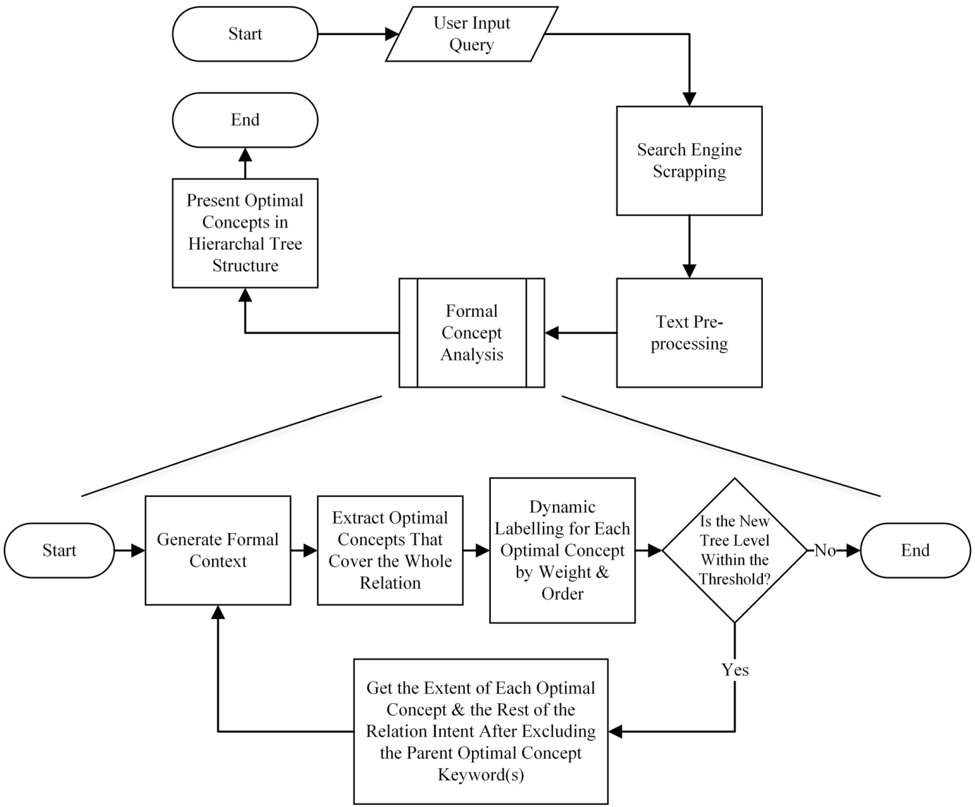
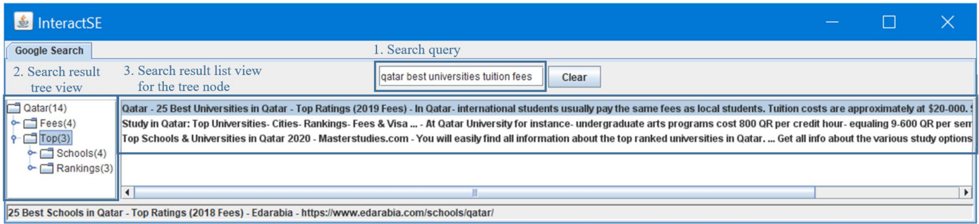
There are limited studies that are addressing the challenges of visually impaired (VI) users when viewing search results on a search engine interface by using a screen reader. This study investigates the effect of providing an overview of search results to VI users. We present a novel interactive search engine interface called InteractSE to support VI users during the results exploration stage in order to improve their interactive experience and web search efficiency. An overview of the search results is generated using an unsupervised machine learning approach to present the discovered concepts via a formal concept analysis that is domain-independent. These concepts are arranged in a multi-level tree following a hierarchical order and covering all retrieved documents that share maximal features. The InteractSE interface was evaluated by 16 legally blind users and compared with the Google search engine interface for complex search tasks. The evaluation results were obtained based on both quantitative (as task completion time) and qualitative (as participants’ feedback) measures. These results are promising and indicate that InteractSE enhances the search efficiency and consequently advances user experience. Our observations and analysis of the user interactions and feedback yielded design suggestions to support VI users when exploring and interacting with search results.
Overview
The claims and statistics of this paper haven’t been checked yet.
Free: it reads the open-access text and checks the first 5 claims that cite a source we can check. Create a free account to check every claim.
Integrity signals
Registry
Cites
Statistics
Figures
Verification
Claims the paper makes
The claims and statistics of this paper haven’t been checked yet.
Free: it reads the open-access text and checks the first 5 claims that cite a source we can check. Create a free account to check every claim.
Claims other papers make about this one
Each is checked against this paper’s own text: does it say what the citing paper says it does?
The cited source says what the claim attributes to it.
In the citing paper
“Organizing long search results into clusters was found to be helpful and time-efficient by participants in the study by Aqle etal. [57], who tested an accessible search engine prototype.”
From The accessibility of digital technologies for people with visual impairment and blindness: a scoping review (2024) · cites this paper as [57]
Self-check
Percentages, sums and reported differences re-computed from the paper’s own numbers.
The self-check needs the paper’s full text.
Citations
Cites
Statistical Power Analysis for the Behavioral Sciences
Cohen, J. (2013) · doi:10.4324/9780203771587 · Cited by 25,373
The magical number seven, plus or minus two: Some limits on our capacity for processing information.
Miller, G. A. (1994) · Psychological Review · doi:10.1037/0033-295x.101.2.343 · Cited by 17,161
Grounded theory research: Procedures, canons, and evaluative criteria
Corbin, J. M., & Strauss, A. (1990) · Qualitative Sociology · doi:10.1007/bf00988593 · Cited by 11,133
An algorithm for suffix stripping
Porter, M. F. (1980) · Program · doi:10.1108/eb046814 · Cited by 8,096 · cited 1×
“…stops words (e.g., a, an, at, and, that, and which); (2) elimination of other words containing less than three characters (e.g., hi, go, and id); (3) obtaining terms using Por-ter’s Snowball algorithm [58, 59] to eliminate suffixes and affixes for converting words to their English language roots;”
MethodFormal Concept Analysis: Mathematical Foundations
Ganter, B., Wille, R., & Franzke, C. (1998) · CERN Document Server (European Organization for Nuclear Research) · Cited by 4,245
New Effect Size Rules of Thumb
Sawilowsky, S. S. (2009) · Journal of Modern Applied Statistical Methods · doi:10.22237/jmasm/1257035100 · Cited by 3,254
IBM computer usability satisfaction questionnaires: Psychometric evaluation and instructions for use
Lewis, J. R. (1995) · International Journal of Human-Computer Interaction · doi:10.1080/10447319509526110 · Cited by 2,429
Inside the search process: Information seeking from the user's perspective
Kuhlthau, C. C. (1991) · Journal of the American Society for Information Science · doi:10.1002/(sici)1097-4571(199106)42:5<361::aid-asi6>3.0.co;2-# · Cited by 2,166
Bleiholder, J., & Naumann, F. (2009) · ACM Computing Surveys · doi:10.1145/1456650.1456651 · Cited by 1,838
The design of browsing and berrypicking techniques for the online search interface
Bates, M. J. (1989) · Online Review · doi:10.1108/eb024320 · Cited by 1,757
Exploratory search: from finding to understanding
Marchionini, G. (2006) · Communications of the ACM · doi:10.1145/1121949.1121979 · Cited by 1,506
Information seeking in electronic environments
(1996) · Choice Reviews Online · doi:10.5860/choice.33-3366 · Cited by 1,487
Information Seeking in Electronic Environments
Marchionini, G. (1995) · doi:10.1017/cbo9780511626388 · Cited by 833 · cited 1×
“The process of information-seeking develops over time with the change in the knowledge of information seekers and their attitudes toward various tasks [8, 29].”
BackgroundHearst, M. A. (2009) · doi:10.1017/cbo9781139644082 · Cited by 797
Methods for Evaluating Interactive Information Retrieval Systems with Users
Kelly, D. (2009) · Foundations and Trends® in Information Retrieval · doi:10.1561/1500000012 · Cited by 633
Exploratory Search: Beyond the Query-Response Paradigm
White, R. W., & Roth, R. A. (2009) · Synthesis lectures on information concepts, retrieval, and services · doi:10.2200/s00174ed1v01y200901icr003 · Cited by 632
Psychometric Evaluation of the PSSUQ Using Data from Five Years of Usability Studies
Lewis, J. R. (2002) · International Journal of Human-Computer Interaction · doi:10.1080/10447318.2002.9669130 · Cited by 621
Concept lattices and conceptual knowledge systems
Wille, R. (1992) · Computers & Mathematics with Applications · doi:10.1016/0898-1221(92)90120-7 · Cited by 553
A survey of Web clustering engines
Carpineto, C., Osiński, S., Romano, G., & Weiss, D. (2009) · ACM Computing Surveys · doi:10.1145/1541880.1541884 · Cited by 399
Information-seeking strategies of novices using a full-text electronic encyclopedia
Marchionini, G. (1989) · Journal of the American Society for Information Science · doi:10.1002/(sici)1097-4571(198901)40:1<54::aid-asi6>3.0.co;2-r · Cited by 386
What Frustrates Screen Reader Users on the Web: A Study of 100 Blind Users
Lazar, J., Allen, A., Kleinman, J., & Malarkey, C. (2007) · International Journal of Human-Computer Interaction · doi:10.1080/10447310709336964 · Cited by 354
Characterizing the influence of domain expertise on web search behavior
White, R. W., Dumais, S. T., & Teevan, J. (2009) · Proceedings of the Second ACM International Conference on Web Search and Data Mining · doi:10.1145/1498759.1498819 · Cited by 312 · cited 1×
“We allowed the user to select their preferred tasks, provided that they did not involve a previously performed search [71].”
MethodAn algorithm for suffix stripping
Porter, M. F. (2006) · Program · doi:10.1108/00330330610681286 · Cited by 306
Formal Concept Analysis as Mathematical Theory of Concepts and Concept Hierarchies
Wille, R. (2005) · Lecture Notes in Computer Science · doi:10.1007/11528784_1 · Cited by 297 · cited 1×
“We use FC to identify the optimal concepts covering the entire relationship and represent these concepts [61] in a hierarchical structure [62].”
MethodThe Depth/Breadth Tradeoff in Hierarchical Computer Menus
Miller, D. P. (1981) · Proceedings of the Human Factors Society Annual Meeting · doi:10.1177/107118138102500179 · Cited by 275
Revisiting Mixed Methods and Advancing Scientific Practices
Creswell, J. W. (2015) · Oxford Handbooks Online · doi:10.1093/oxfordhb/9780199933624.013.39 · Cited by 207 · cited 1×
“Three mixed-method design strategies were presented in a previously conducted study [67]; our user study follows a convergent design strategy in which the qualitative and quantitative data are collected in parallel.”
MethodInteractions with Search Systems
White, R. W. (2016) · Cambridge University Press eBooks · doi:10.1017/cbo9781139525305 · Cited by 195
Clarifying Search: A User-Interface Framework for Text Serches
Shneiderman, B., Byrd, D., & Croft, W. B. (1997) · D-Lib Magazine · doi:10.1045/january97-shneiderman · Cited by 190
WebinSitu: a comparative analysis of blind and sighted browsing behavior
Bigham, J. P., Cavender, A. C., Brudvik, J. T., Wobbrock, J. O., & Ladner, R. E. (2007) · Proceedings of the 9th international ACM SIGACCESS conference on Computers and accessibility · doi:10.1145/1296843.1296854 · Cited by 153
Users can change their web search tactics: Design guidelines for categorized overviews
Kules, B., & Shneiderman, B. (2007) · Information Processing & Management · doi:10.1016/j.ipm.2007.07.014 · Cited by 134
Understanding User Behavior Through Log Data and Analysis
Dumais, S., Jeffries, R., Russell, D. M., Tang, D., & Teevan, J. (2014) · Ways of Knowing in HCI · doi:10.1007/978-1-4939-0378-8_14 · Cited by 131
Beyer, H. (1981) · Biometrical Journal · doi:10.1002/bimj.4710230408 · Cited by 125
Toward creating a fairer ranking in search engine results
Gao, R., & Shah, C. (2020) · Information Processing & Management · doi:10.1016/j.ipm.2019.102138 · Cited by 107
Williamson, K., & Asla, T. (2009) · Library & Information Science Research · doi:10.1016/j.lisr.2009.01.002 · Cited by 99
Hierarchical web resources retrieval by exploiting Fuzzy Formal Concept Analysis
Maio, C. D., Fenza, G., Loia, V., & Senatore, S. (2011) · Information Processing & Management · doi:10.1016/j.ipm.2011.04.003 · Cited by 97
Supporting Complex Search Tasks
Hassan Awadallah, A., White, R. W., Pantel, P., Dumais, S. T., & Wang, Y.-M. (2014) · Proceedings of the 23rd ACM International Conference on Conference on Information and Knowledge Management · doi:10.1145/2661829.2661912 · Cited by 93 · cited 1×
“We could use “complex” inter-changeably with the exploratory to describe these search tasks [42].”
MethodSahib, N. G., Tombros, A., & Stockman, T. (2012) · Journal of the American Society for Information Science and Technology · doi:10.1002/asi.21696 · Cited by 83
Biclustering neighborhood-based collaborative filtering method for top-n recommender systems
Alqadah, F., Reddy, C. K. A., Hu, J., & Alqadah, H. F. (2014) · Knowledge and Information Systems · doi:10.1007/s10115-014-0771-x · Cited by 72
JustSpeak: enabling universal voice control on Android
Zhong, Y., Raman, T. V., Burkhardt, C., Biadsy, F., & Bigham, J. P. (2014) · Proceedings of the 11th Web for All Conference · doi:10.1145/2596695.2596720 · Cited by 70 · cited 1×
“Two studies [36–38] have explored the addition of voice control to screen readers.”
BackgroundStatistical Significance, Power, and Sample Sizes: A Systematic Review of SIGIR and TOIS, 2006-2015
Sakai, T. (2016) · Proceedings of the 39th International ACM SIGIR conference on Research and Development in Information Retrieval · doi:10.1145/2911451.2911492 · Cited by 70
What Is Known About the Impact of Impairments on Information Seeking and Searching?
Berget, G., & MacFarlane, A. (2019) · Journal of the Association for Information Science and Technology · doi:10.1002/asi.24256 · Cited by 66
Access to information on the World Wide Web for blind and visually impaired people
Oppenheim, C., & Selby, K. (1999) · Aslib Journal of Information Management · doi:10.1108/eum0000000006993 · Cited by 57
Improving search engine interfaces for blind users: a case study
Andronico, P., Buzzi, M., Castillo, C., & Leporini, B. (2006) · Universal Access in the Information Society · doi:10.1007/s10209-006-0022-3 · Cited by 56
Xie, I., Babu, R., Lee, T. H., Castillo, M. D., You, S., & Hanlon, A. M. (2020) · Information Processing & Management · doi:10.1016/j.ipm.2019.102110 · Cited by 56
Ivory, M. Y., Yu, S., & Gronemyer, K. (2004) · CHI '04 Extended Abstracts on Human Factors in Computing Systems · doi:10.1145/985921.986088 · Cited by 49 · cited 1×
“This stage is also the most demanding for VI web users, who have to spend approximately twice the time spent by users with 20/20 vision to search for the appropriate information [19].”
BackgroundSearch, sense making and learning: closing gaps
Marchionini, G. (2018) · Information and Learning Sciences · doi:10.1108/ils-06-2018-0049 · Cited by 47
Web Screen Reading Automation Assistance Using Semantic Abstraction
Ashok, V., Puzis, Y., Borodin, Y., & Ramakrishnan, I. V. (2017) · Proceedings of the 22nd International Conference on Intelligent User Interfaces · doi:10.1145/3025171.3025229 · Cited by 44
Overlaying social information: The effects on users’ search and information-selection behavior
Orso, V., Ruotsalo, T., Leino, J., Gamberini, L., & Jacucci, G. (2017) · Information Processing & Management · doi:10.1016/j.ipm.2017.06.001 · Cited by 43
Bridging Screen Readers and Voice Assistants for Enhanced Eyes-Free Web Search
Vtyurina, A., Fourney, A., Morris, M. R., Findlater, L., & White, R. W. (2019) · The World Wide Web Conference · doi:10.1145/3308558.3314136 · Cited by 42 · cited 1×
“A recent study has shown that voice-based VAs can improve the navigation systems [81].”
BackgroundCapti-speak: a speech-enabled web screen reader
Ashok, V., Borodin, Y., Puzis, Y., & Ramakrishnan, I. V. (2015) · Proceedings of the 12th International Web for All Conference · doi:10.1145/2745555.2746660 · Cited by 33 · cited 1×
“Two studies [36–38] have explored the addition of voice control to screen readers.”
BackgroundDesigning search engine user interfaces for the visually impaired
Leporini, B., Andronico, P., & Buzzi, M. (2004) · International Web for All Conference (W4A) · doi:10.1145/990657.990668 · Cited by 31 · cited 1×
“These difficulties are considerably critical for VI web users [7].”
BackgroundInteractive IR User Study Design, Evaluation, and Reporting
Liu, J., & Shah, C. (2019) · Synthesis Lectures on Information Concepts, Retrieval, and Services · doi:10.1007/978-3-031-02319-4 · Cited by 26
Evaluating a search interface for visually impaired searchers
Sahib, N. G., Tombros, A., & Stockman, T. (2015) · Journal of the Association for Information Science and Technology · doi:10.1002/asi.23325 · Cited by 25
Evaluating a modified Google user interface via screen reader
Leporini, B., Andronico, P., Buzzi, M., & Castillo, C. (2008) · Universal Access in the Information Society · doi:10.1007/s10209-007-0111-y · Cited by 24
Hassan, A., & White, R. W. (2012) · ACM International Conference on Information and Knowledge Management (CIKM) · doi:10.1145/2396761.2398537 · Cited by 24
Web Service Interface Decomposition Using Formal Concept Analysis
Daaji, M., Ouni, A., Kessentini, M., Gammoudi, M. M., & Bouktif, S. (2017) · IEEE International Conference on Web Services (ICWS) · doi:10.1109/icws.2017.30 · Cited by 24 · cited 1×
“In recent FCA research papers, different methods were proposed for filtering top-n recommendation task [48], decomposition web service interface to improve its usability [49], and clustering scenario [50].”
MethodPreliminary Evaluation of Interactive Search Engine Interface for Visually Impaired Users
Aqle, A., Khowaja, K., & Al‐Thani, D. (2020) · IEEE Access · doi:10.1109/access.2020.2977593 · Cited by 24
Self-citationStanton, N. A., Salmon, P. M., Walker, G. H., Baber, C., & Jenkins, D. P. (2017) · CRC Press eBooks · doi:10.4324/9781351156325 · Cited by 24
Text Summarization Based on Conceptual Data Classification
Alja’am, J. M., Jaoua, A., Hasnah, A., Hassan, F., Mohamed, H., Mosaid, T., Saleh, H., Abdullah, F., & Cherif, H. (2006) · International Journal of Information Technology and Web Engineering · doi:10.4018/jitwe.2006100102 · Cited by 21
Self-citationPREFCA: A portal retrieval engine based on formal concept analysis
Negm, E., Abdelrahman, S., & Bahgat, R. (2016) · Information Processing & Management · doi:10.1016/j.ipm.2016.08.002 · Cited by 21
Implicit search feature based approach to assist users in exploratory search tasks
Hendahewa, C., & Shah, C. S. (2015) · Information Processing & Management · doi:10.1016/j.ipm.2015.06.004 · Cited by 19
Towards a conceptual framework for provider information behaviour
Davies, R., & Williams, D. (2013) · Journal of Documentation · doi:10.1108/jd-01-2012-0001 · Cited by 16
Reusing process fragments for fast service composition: a clustering-based approach
Mezni, H., & Kbekbi, M. (2018) · Enterprise Information Systems · doi:10.1080/17517575.2018.1460866 · Cited by 14
An improved Web search engine for visually impaired users
Yang, Y., Hwang, S., & Schenkman, B. N. (2011) · Universal Access in the Information Society · doi:10.1007/s10209-011-0250-z · Cited by 13
A further exploration of title size and author number
White, A. J. (1991) · Journal of the American Society for Information Science · doi:10.1002/(sici)1097-4571(199106)42:5<384::aid-asi9>3.0.co;2-g · Cited by 13
Conceptual Interactive Search Engine Interface for Visually Impaired Web Users
Aqle, A., Al‐Thani, D., & Jaoua, A. (2018) · IEEE/ACS International Conference on Computer Systems and Applications (AICCSA) · doi:10.1109/aiccsa.2018.8612874 · Cited by 7 · cited 2×
“Our maximum navigation level was set to five, limiting the discovered concepts to a fair number of search results at each level for the exploration stage [51] and providing us with an ability to apply future enhancements that may include an increment of the returned research results from 20 to 60.”
BackgroundSelf-citationStanton (2017) · Cited by 7
The Effects of Cross-modal Collaboration on the Stages of Information Seeking
Al-Thani, D., Stockman, T., & Tombros, A. (2015) · Proceedings of the XVI International Conference on Human Computer Interaction · doi:10.1145/2829875.2829925 · Cited by 6 · cited 3×
“Therefore, we propose a mechanism for presenting an overview of the search results to the user by generating a general summary of the relevant search results [1, 22].”
BackgroundInfluentialSelf-citationJaoua, A. (1995) · Information Sciences · doi:10.1016/0020-0255(95)00132-8 · Cited by 5
Self-citationUsing Formal Concept Analysis for Heterogeneous Information Retrieval
Nafkha, I., & Jaoua, A. (2005) · Qatar University QSpace (Qatar University) · Cited by 5
Self-citationEvaluating an Interface for Cross-Modal Collaborative Information Seeking
Al‐Thani, D., & Stockman, T. (2018) · Interacting with Computers · doi:10.1093/iwc/iwy017 · Cited by 5
Self-citationAccessible Information Seeking
Morris, M. R. (2020) · Conference on Human Information Interaction and Retrieval · doi:10.1145/3343413.3379540 · Cited by 5
Analyze Unstructured Data Patterns for Conceptual Representation
Aqle, A., Al‐Thani, D., & Jaoua, A. (2017) · International Conference on Computational Science and Computational Intelligence (CSCI) · doi:10.1109/csci.2017.46 · Cited by 4 · cited 1×
“The stemming step reduces the number of terms and data complexity [60].”
BackgroundSelf-citationHuman Factors Methods Integration: A Case Study in the Railway Industry
Stanton, N. A., Salmon, P. M., Walker, G. H., Baber, C., & Jenkins, D. P. (2017) · CRC Press eBooks · doi:10.4324/9781351156325-13 · Cited by 3
Interaction and User Interfaces
Peters, C., Braschler, M., & Clough, P. D. (2011) · Springer eBooks · doi:10.1007/978-3-642-23008-0_4 · Cited by 2 · cited 1×
“Multilingual support should adhere to multilingual design principles [82].”
BackgroundDeveloping a Web Search Interface for the Visually Impaired
Beinema, T. C. (2017) · Cited by 2
Masood, A., Rehman, M., Anjum, M., Alam, M., Kanwal, S., & Rafiq, M. T. (2015) · International Journal of Computer Applications · doi:10.5120/ijca2015907002 · Cited by 1
Al‐Thani, D., & Stockman, T. (2016) · International Conference on Collaboration Technologies and Systems (CTS) · doi:10.1109/cts.2016.0095 · Cited by 1 · cited 2×
“Al-Thani [57] studied VI users and suggested two design recommendations for collaborative information seeking: (1) provide an overview of the search results; and (2) cluster search results make the navigation process faster with screen-reader.”
BackgroundMethodSelf-citationBarbero (2014) · doi:10.1016/j · Cited by 1
Research works printed but not linked: 9
- 3. Sahib, N.G., Thani, D. Al, Tombros, A., Stockman, T.: Acces- sible Information Seeking. In: Proc. of Digital Futures (2012)
- 4. Bigham, J.P., Cavender, A.C., Brudvik, J.T., Wobbrock, J.O., Lander, R.E., New, U.S.A., ACM, New York: WebinSitu. In Proceedings of the 9th international ACM SIGACCESS confer- ence on Computers and accessibility-Assets '07. 51. doi:https :// doi.org/10.1145/12968 43.12968 54. (2007). https://doi.org/https ://doi.org/10.1145/12968 43.12968 54 · doi:10.1145/12968
- 16. Kuhlthau, C.C., Heinström, J., Todd, R.J.: The 'information search process' revisited: is the model still useful. Inf. Res. 13, 13-14 (2008)
- 40. Craven, J.: Linear searching in a non-linear environment the information seeking behaviour of visually impaired people on the world wide web in lecture notes in computer science, pp. 530-537. Springer Berlin Heidelberg, Berlin (2004)
- 76. Johnson, T.P.: Snowball sampling: introduction in :wiley statsref: statistics reference online. Wiley, Chichester (2014)
- 79. Yatani, K.: Effect sizes and power analysis in hci in human computer interaction series, pp. 87-110. Springer International Publishing, Cham (2016)
- 86. Vtyurina, A., Fourney, A., Morris, M.R., Findlater, L., White, R.W.: VERSE: Voice. Exploration. Retrieval. Search. ( July 18). Retrieved November 11, from https ://www.micro soft. com/en-us/resea rch/video /verse -voice -explo ratio n-retri eval- searc h/. and Bridging screen readers and voice assistants for enhanced eyes-free web sea. World Wide Web Conf. ACM doi10114533085583314136. 2019, 3590-3594 2019. https://doi. org/https ://doi.org/10.1145/33085 58.33141 36 · doi:10.1145/33085
- 87. Vtyurina, A., Fourney, A., Morris, M.R., Findlater, L., White, R.W.: Bridging Screen Readers and Voice Assistants for Enhanced Eyes-Free Web Search. In: The World Wide Web Conference on - WWW '19. ACM Press, New York, New York, USA, 3590-3594 2019 · DOI · Paper page
- 88. Peters, C., Braschler, M., Clough, P.: Interaction and user inter- faces in multilingual information retrieval, pp. 85-128. Springer Berlin Heidelberg, Berlin (2012)
Cited by
Hamideh Kerdar, S., Bächler, L., & Kirchhoff, B. M. (2024) · Discover Computing · doi:10.1007/s10791-024-09460-7 · Cited by 41
“In this example, the screen reader user can skip the unwanted clusters, rather than read out each result aloud, which could cause confusion or be time-consuming: “ This is very helpful to categorize search results ” [57].”
Digital accessibility: A systematic Literature Review
Chadli, F. E., Gretete, D., & Moumen, A. (2021) · SHS Web of Conferences · doi:10.1051/shsconf/202111906005 · Cited by 24
Speaking with My Screen Reader: Using Audio Fictions to Explore Conversational Access to Interfaces
Phutane, M., Jung, C., Chen, N., & Azenkot, S. (2023) · International ACM SIGACCESS Conference on Computers and Accessibility (ASSETS) · doi:10.1145/3597638.3608404 · Cited by 25
Xie, I., Lee, T.-H., Lee, H. S., Wang, S., & Babu, R. (2023) · Information Research · doi:10.47989/ir283337 · Cited by 22
“In the desktop environment, Aqle et al. (2020) created a search interface for blind and visually impaired users with enhanced accessibility and usability functions and compared it with the Google interface.”
MethodXie, I., Babu, R., Lee, T.-H., Wang, S., & Lee, H. S. (2021) · Information Processing & Management · doi:10.1016/j.ipm.2021.102612 · Cited by 14
Metadata
- Authors
- Aqle, A., Al-Thani, D., & Jaoua, A.
- Affiliations
- Hamad bin Khalifa University (QA)
- Qatar University (QA)
- Corresponding author
- Aqle, Aboubakr
- Jaoua, Ali
- Venue
- Universal Access in the Information Society
- Published
- 2020-11-06
- Volume
- 21
- Issue
- 1
- Pages
- 171-192
- ISSN
- 1615-5289 (ISSN-L)
- 1615-5297
- OpenAlex
- W3105003459
- Cited by
- 16
- References
- 81
- Citations by year
- 2025: 4 · 2024: 3 · 2023: 6 · 2022: 1 · 2021: 2
- FWCI
- 2.12
- Type
- journal article
- Language
- en
- Update notices
- correction (2020-12-02)
- Open access
- hybrid
- doi.org
- Licence
- cc-by
- creativecommons.org/licenses/by/4.0 (tdm)
- creativecommons.org/licenses/by/4.0 (vor)
- Locations
- Universal Access in the Information Society (publishedVersion, cc-by)
- Figshare (submittedVersion, cc-by)
- Qatar University QSpace (Qatar University) (submittedVersion)
- Funders
- Qatar National Research Fund (GSRA4-1-0514-17066)
- Hamad Bin Khalifa University
- Qatar National Library
- Topics
- Physical Sciences › Computer Science › Information Systems › Information Retrieval and Search Behavior
- Social Sciences › Human Factors and Ergonomics › Digital Accessibility for Disabilities
- Physical Sciences › Computer Science › Human-Computer Interaction › Usability and User Interface Design
- Keywords
- visually impaired users, web search, screen readers, formal concept analysis, search efficiency, user experience, unsupervised learning
About these checks
Registry, retraction, Cites and statistics results are computed, not judged, with one exception: a printed reference that no index lists is read once by a model before it counts as a citation error. Claims are extracted by a model and kept only when their quote appears verbatim in the text; each cited source is then checked, with a model’s help, for whether it says what the claim relies on. Those verdicts can be wrong — read the claim’s quote and the cited source before relying on one.
Statistics and arithmetic are recomputed, not judged.
Confidence bands are shown only for fields calibrated on our annotated test set. None is calibrated yet, so no band is shown.
What counts as a claim ›How we measure confidence ›How we check this ›
Are you an author, or do you see a problem with this page? Request a review
Data sources
Bibliographic data: Semantic Scholar, OpenAlex, Crossref.
Contains information from the Semantic Scholar Academic Graph Datasets, made available under the ODC Attribution License (ODC-BY 1.0).
Semantic Scholar’s data is described in: Kinney, R., et al. (2023). The Semantic Scholar Open Data Platform. arXiv:2301.10140.
