

Technical trading and cryptocurrencies
Open accessThe DOI matches its Crossref record, with a small difference in title or year; 81 of the 81 references it cites were found in a registry or an index; 4 of the 34 sources its claims cite were checked for support.
Abstract
This paper carries out a comprehensive examination of technical trading rules in cryptocurrency markets, using data from two Bitcoin markets and three other popular cryptocurrencies. We employ almost 15,000 technical trading rules from the main five classes of technical trading rules and find significant predictability and profitability for each class of technical trading rule in each cryptocurrency. We find that the breakeven transaction costs are substantially higher than those typically found in cryptocurrency markets. To safeguard against data-snooping, we implement a number of multiple hypothesis procedures which confirms our findings that technical trading rules do offer significant predictive power and profitability to investors. We also show that the technical trading rules offer substantially higher risk-adjusted returns than the simple buy-and-hold strategy, showing protection against lengthy and severe drawdowns associated with cryptocurrency markets. However there is no predictability for Bitcoin in the out-of-sample period, although predictability remains in other cryptocurrency markets.
Overview
CoChat Summary
TL;DR
This paper examines almost 15,000 technical trading rules across five cryptocurrency markets—two Bitcoin price series plus Litecoin, Ethereum, and Ripple—and finds significant in-sample predictability and profitability for all five rule classes. After multiple-hypothesis adjustments many rules remain significant and often beat buy-and-hold on risk-adjusted measures, but Bitcoin shows no out-of-sample predictability while the other cryptocurrencies do.
Key findings
- All five technical trading rule classes generate statistically significant average annualized returns in each cryptocurrency at the 5% level; filter and channel breakout rules perform best, with annualized returns as high as 16.45% for Ripple.
- Breakeven transaction costs are often substantially higher than typical cryptocurrency costs: they range from 7.88 basis points for the support-resistance rule in Litecoin to 147.56 basis points for the filter rule in Ethereum, and reach 66.41 and 57.51 basis points for CoinDesk and Bitstamp, respectively.
- Multiple-hypothesis procedures confirm profitability: after Bonferroni, Holm, BH, and BY adjustments, the percentage of rules remaining significant at the 5% level ranges from 20.35% to 50.41% across cryptocurrencies.
- Technical rules offer substantially higher risk-adjusted returns than buy-and-hold and protect against lengthy severe drawdowns, but out-of-sample results show negative annualized returns, Sharpe, and Sortino ratios for both Bitcoin markets, while Litecoin, Ripple, and Ethereum remain positive.
Methods
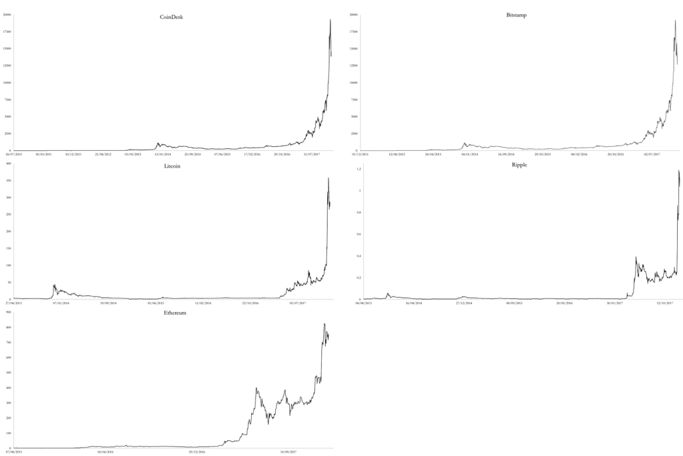
- Daily data from CoinDesk Bitcoin (from 18 July 2010), Bitstamp Bitcoin (from 1 December 2012), Litecoin (from 28 April 2013), Ripple (from 4 August 2013), and Ethereum (from 7 August 2015), all ending 31 December 2017.
- 14,919 technical trading rules from five classes: moving average, filter, support-resistance, oscillator, and channel breakout. Performance is assessed with mean returns, Sharpe, Sortino, Calmar ratios, and breakeven transaction costs, and compared with buy-and-hold.
- Data-snooping controls use stationary bootstrap with 1,000 realizations and block length 0.1 to obtain individual bootstrapped p-values following Sullivan et al. (1999), then Bonferroni, Holm, BH, and BY multiple-hypothesis procedures; out-of-sample tests apply the best in-sample rules to the first six months of 2018.
Limitations
- Stated: transaction costs differ by cryptocurrency and exchange and are difficult to accurately estimate, especially for CoinDesk as an average of exchanges; the paper therefore reports breakeven transaction costs rather than applying a single cost.
- Stated: the choice of in-sample and out-of-sample periods is an issue, and technical trading performance tends to diminish over time and after academic publication; the out-of-sample test covers only the first six months of 2018.
- Evident: the in-sample period ends 31 December 2017 and the out-of-sample window is short, so the findings may not generalize to later cryptocurrency market regimes; the Bonferroni and Holm adjustments are described as very conservative and may understate the number of profitable rules.
Model-written summary. Check it against the paper before relying on it.
Integrity signals
Registry
Cites
Statistics
Figures
Verification
Claims the paper makes
4 Valid · 0 Not valid · 24 Not checked · 85 Own results and interpretations
Every source the paper cites for this claim was checked and supports it.
In the paper
“This is especially important for technical trading rules since there is a trend in the literature for the performance of the rules to diminish over time (Menkhoff 2007).”
What the sources say
- Supportedcites Menkhoff 2007 matched to “The Obstinate Passion of Foreign Exchange Professionals: Technical Analysis” (2007) source
Section 4 (p. 11) says there is evidence that traditional moving-average trading rules became much less profitable from the 1970s to the 1990s, supporting the claimed trend. It also notes exceptions: some complex rules may not have become less profitable, and significant profits remain. (LLM, conf=0.88)
plainstates an association- Asserted: passes — The authors put it forward as true.
- Checkable: passes — It can be checked against evidence.
- Load-bearing: passes — The paper’s conclusions depend on it.
- Based: passes — The paper gives a reason why it holds.
- Supported
The cited sources support only part of this claim — read each source’s verdict below.
In the paper
“This is also reflected in the academic literature where Corbet et al. (2019) show that the majority of academic papers on cryptocurrencies solely focus on Bitcoin.”
What the sources say
- Partly supportedcites Corbet et al. 2019 matched to “RETRACTED: Cryptocurrencies as a financial asset: A systematic analysis” (2019) sourceExperimental — accuracy not yet measured
In the discussion accompanying Figure 2 (page unavailable), the paper reports that Bitcoin was the central cryptocurrency in 74.3% of the papers it analysed. That supports the majority claim for its selected papers, but being the central topic does not establish that those papers focused solely on Bitcoin. (LLM, conf=0.88)
plain- Asserted: passes — The authors put it forward as true.
- Checkable: passes — It can be checked against evidence.
- Load-bearing: unclear — It is unclear whether the paper’s conclusions depend on it.
- Based: passes — The paper gives a reason why it holds.
- Partly supported
The sources with a verdict support this claim; the rest weren’t checked yet, have no full text we could read, or their verdicts aren’t rated yet.
In the paper
“Another solution to address the data-snooping issue is to employ an out-of-sample analysis to examine if the best technical trading rules from the in-sample estimation performs well out of sample (Sullivan et al. 1999; Harvey et al. 2016).”
What the sources say
- Not checked yetcites Sullivan et al. 1999 matched to “Data-snooping, technical trading rule performance and the Bootstrap” (1999) source
Checked before — its earlier verdict is held back until a new check runs.
- Supportedcites Harvey et al. 2016 matched to “… and the Cross-Section of Expected Returns” (2016) source
Section 3.1 (‘Why multiple testing?’) identifies out-of-sample validation as one of two ways to address bias from multiple testing and calls it the cleanest way to rule out spurious factors when feasible. It cautions that a genuine out-of-sample test requires future data; simply holding out data already observable to researchers does not qualify. (LLM, conf=0.92)
plainstates a cause- Asserted: passes — The authors put it forward as true.
- Checkable: passes — It can be checked against evidence.
- Load-bearing: passes — The paper’s conclusions depend on it.
- Based: passes — The paper gives a reason why it holds.
- Not checked yet
A result the paper reports from its own data — it cites no other source for it, so there is none to check. The quote shows it is in the paper.
In the paper
“The breakeven transaction costs range 7.88 basis points for the supportresistance rule in Litecoin to 147.56 basis points for the filter rule in Ethereum.”
plain- Asserted: passes — The authors put it forward as true.
- Checkable: passes — It can be checked against evidence.
- Load-bearing: passes — The paper’s conclusions depend on it.
- Based: passes — The paper gives a reason why it holds.
- Rests on an assumption not shown here.
A result the paper reports from its own data — it cites no other source for it, so there is none to check. The quote shows it is in the paper.
In the paper
“For instance, 36.06% of oscillator rules generate breakeven transaction costs greater than 50 basis points for CoinDesk while 47.35% of channel breakout rules generate rules with breakeven transaction costs greater than 50 basis points for Ethereum.”
plain- Asserted: passes — The authors put it forward as true.
- Checkable: passes — It can be checked against evidence.
- Load-bearing: unclear — It is unclear whether the paper’s conclusions depend on it.
- Based: passes — The paper gives a reason why it holds.
- Rests on an assumption not shown here.
59 more claims
Create a free account to see all 113 claims and to verify the 7 references still open.
- Probably not a substantial claim. 17
- It may state two separate claims as one. 36
- The quote only partly states this claim. 2
Self-check
Percentages, sums and reported differences re-computed from the paper’s own numbers.
Each contradiction between two passages listed here was confirmed by an independent check.
Rated major: it would touch a result — a value a result rests on, reported and recomputed p-values on opposite sides of the significance level, two passages that conflict with no sign which is right, or a cited work retracted before this paper was published.
In the paper
“MA 2 = # q × # x × # d × # k = 9 × 7 × 5 × 2 = 945”
Reported 945 · recomputed 630
Rated minor: it would not touch a result — a value no result rests on, a p-value that stays on the same side of the significance level, or a conflict that is clerical, resolved elsewhere in the paper, or outside its own findings.
In the paper
§ 6.5 Out-of-sample performance · p. 23
“| CoinDesk | CB2: 25/0.05/0.025/5 | - 0 . 0010 | - 0 . 0502 | - 0 . 3470 | | Bitstamp | CB2: 25/0.05/0.025/3 | - 0 . 0091 | - 0 . 0641 | - 0 . 0553 | | Litecoin | CB2: 25/0.05/0.025/5 | 0 . 0775 | 1 . 3553 | 2 . 1900 | | Ripple | MA1: 2/0.001/1 | 0 . 0546 | 0 . 7380 | 1 . 2162 |”
§ Appendix · p. 26
“x ∈ { 0 , 0 . 01 , 0 . 05 , 0 . 1 , 0 . 5 , 1 , 5 } , # x = 7”
Cited works that were retracted
Works this paper cites that were later retracted, from the retraction notices publishers deposit. Major when the notice came out before this paper was published.
Rated major: it would touch a result — a value a result rests on, reported and recomputed p-values on opposite sides of the significance level, two passages that conflict with no sign which is right, or a cited work retracted before this paper was published.
In the paper
“Corbet, S., Lucey, B., & Yarovaya, L. (2018). Datestamping the bitcoin and ethereum bubbles. Finance Research Letters, 26, 81–88.”
Cited work 10.1016/j.frl.2017.12.006 · retracted 2018-09-01 · notice 10.1016/j.frl.2017.12.006 · this paper published 2019-08-30
A note, not an issue: for example, a cited work that was retracted only after this paper was published, which its authors could not have known.
In the paper
“Corbet, S., Lucey, B., Urquhart, A., & Yarovaya, L. (2019). Cryptocurrencies as a financial asset: A systematic analysis. International Review of Financial Analysis, 62, 182–199.”
Cited work 10.1016/j.irfa.2018.09.003 · retracted 2026-02-01 · notice 10.1016/j.irfa.2026.105078 · this paper published 2019-08-30
Citations
Cites
2 retracted
RETRACTED: Cryptocurrencies as a financial asset: A systematic analysis
Corbet, S., Lucey, B., Urquhart, A., & Yarovaya, L. (2019) · International Review of Financial Analysis · doi:10.1016/j.irfa.2018.09.003 · Cited by 1,172
Self-citationRetractedRETRACTED: Datestamping the Bitcoin and Ethereum bubbles
Corbet, S., Lucey, B., & Yarovaya, L. (2018) · Finance Research Letters · doi:10.1016/j.frl.2017.12.006 · Cited by 638
RetractedControlling the False Discovery Rate: A Practical and Powerful Approach to Multiple Testing
Benjamini, Y., & Hochberg, Y. (1995) · Journal of the Royal Statistical Society Series B: Statistical Methodology · doi:10.1111/j.2517-6161.1995.tb02031.x · Cited by 109,482 · cited 4×
“One of the earliest FDR controlling methods is by Benjamini and Hochberg (1995) and is a stepwise procedure that, assuming all individual p-values are ordered from smallest to largest and defining: j∗ = max { j : p ≤ j × δ M } (7)”
InfluentialThe control of the false discovery rate in multiple testing under dependency
Benjamini, Y., & Yekutieli, D. (2001) · The Annals of Statistics · doi:10.1214/aos/1013699998 · Cited by 10,490
Politis, D. N., & Romano, J. P. (1994) · Journal of the American Statistical Association · doi:10.1080/01621459.1994.10476870 · Cited by 2,649
Simple technical trading rules and the stochastic properties of stock returns
BROCK, W., LAKONISHOK, J., & LeBARON, B. (1992) · The Journal of Finance · doi:10.1111/j.1540-6261.1992.tb04681.x · Cited by 2,301
… and the Cross-Section of Expected Returns
Harvey, C. R., Liu, Y., & Zhu, H. (2016) · Review of Financial Studies · doi:10.1093/rfs/hhv059 · Cited by 2,119
A Reality Check for Data Snooping
White, H. (2000) · Econometrica · doi:10.1111/1468-0262.00152 · Cited by 1,851 · cited 1×
“In equity markets, Brock et al. (1992) show that technical trading provides significant predictability over 90 years for theDow Jones Industrial Average, while Sullivan et al. (1999) and White (2000) show that the findings of Brock et al. (1992) are not due to data-snooping.”
BackgroundDoes Academic Research Destroy Stock Return Predictability?
MCLEAN, R. D., & PONTIFF, J. (2016) · The Journal of Finance · doi:10.1111/jofi.12365 · Cited by 1,566
Bitcoin, gold and the dollar – A GARCH volatility analysis
Dyhrberg, A. H. (2016) · Finance Research Letters · doi:10.1016/j.frl.2015.10.008 · Cited by 1,544 · cited 1×
“…Bitcoin markets (Urquhart 2016; Nadarajah and Chu 2017; Bariviera 2017; Tiwari et al. 2018), the hedging properties of Bitcoin (Brière et al. 2015; Dyhrberg 2016a,b; Bouri et al. 2017; Urquhart and Zhang 2019), the price discovery within Bitcoin exchanges (Brandvold et al. 2015; Brauneis and…”
Research works printed but not linked: 3
- Chordia, T., Goyal, A., & Saretto, A. (2018). p -hacking. SSRN Available at: https://ssrn.com/ abstract=3017677 (pp. 32-36).
- Young, T. W. (1991). Calmar ratio: A smoother tool. Futures , 20 (1), 40.
- Young, T. W. (1991). Calmar ratio: A smoother tool. Futures , 20 (1), 40.
Cited by
An index of cryptocurrency environmental attention (ICEA)
Wang, Y., Lucey, B., Vigne, S. A., & Yarovaya, L. (2022) · China Finance Review International · doi:10.1108/cfri-09-2021-0191 · Cited by 181
Herding and feedback trading in cryptocurrency markets
KING, T. L., & Koutmos, D. (2021) · Annals of Operations Research · doi:10.1007/s10479-020-03874-4 · Cited by 119
“…prices) and, since these websites are viewed by many and are publicly available, may contribute to amplify herding behaviors at any given time.5 Hudson and Urquhart (2019) illustrate how technical trading strategies, many of which derive from equity markets and which use past prices to try and…”
BackgroundFinancial modelling, risk management of energy instruments and the role of cryptocurrencies
Huynh, T. L. D., Shahbaz, M. Q., Nasir, M. A., & Ullah, S. (2020) · Annals of Operations Research · doi:10.1007/s10479-020-03680-y · Cited by 108
“1 3 technical trading and returns (Hudson and Urquhart 2019).”
Cryptocurrencies in Modern Finance: A Literature Review
Rejeb, A., Rejeb, K., & Keogh, J. G. (2021) · ETIKONOMI · doi:10.15408/etk.v20i1.16911 · Cited by 154
“In simple terms, cryptocurrencies are a new type of currency (Duque, 2020; Hudson & Urquhart, 2019) that is digital and produced from cryptographic algorithms, exchanged across the Internet using protocols such as peer-to-peer networking (Nakamoto, 2008).”
BackgroundForecasting the volatility of Bitcoin: The importance of jumps and structural breaks
Shen, D., Urquhart, A., & Wang, P. (2020) · European Financial Management · doi:10.1111/eufm.12254 · Cited by 104
Self-citationWhich factors drive Bitcoin volatility: Macroeconomic, technical, or both?
Wang, J., Ma, F., Bouri, E. I., & Guo, Y. (2022) · Journal of Forecasting · doi:10.1002/for.2930 · Cited by 101
Dynamic efficiency and arbitrage potential in Bitcoin: A long-memory approach
Duan, K., Li, Z., Urquhart, A., & Ye, J. (2021) · International Review of Financial Analysis · doi:10.1016/j.irfa.2021.101725 · Cited by 82
Self-citationLiquidity risk and expected cryptocurrency returns
Zhang, W., & Li, Y. (2021) · International Journal of Finance & Economics · doi:10.1002/ijfe.2431 · Cited by 81
Is idiosyncratic volatility priced in cryptocurrency markets?
Zhang, W., & Li, Y. (2020) · Research in International Business and Finance · doi:10.1016/j.ribaf.2020.101252 · Cited by 56
MAX Momentum in Cryptocurrency Markets
Li, Y., Urquhart, A., Wang, P., & Zhang, W. (2020) · International Review of Financial Analysis · doi:10.1016/j.irfa.2021.101829 · Cited by 74
Self-citationWhat effect did the introduction of Bitcoin futures have on the Bitcoin spot market?
Jalan, A., Matkovskyy, R., & Urquhart, A. (2021) · European Journal of Finance · doi:10.1080/1351847x.2020.1869992 · Cited by 60
“…Corbet et al. 2019a; Borri 2019; Urquhart and Zhang 2019), potential for returns from investing in Bitcoin (Brière, Oosterlinck, and Szafarz 2015; Hudson and Urquhart 2019; Kajtazi and Moro 2019; Platanakis and Urquhart 2020) as well as the volatility dynamics of Bitcoin (Katsiampa 2017; Chaim…”
BackgroundSelf-citationGhabri, Y., Rhouma, O. B., Gana, M. R., Guesmi, K., & Benkraiem, R. (2022) · International Review of Financial Analysis · doi:10.1016/j.irfa.2022.102197 · Cited by 56
Herding in the crypto market: a diagnosis of heavy distribution tails
Shrotryia, V. K., & Kalra, H. (2021) · Review of Behavioral Finance · doi:10.1108/rbf-02-2021-0021 · Cited by 62
Fernández-Vázquez, S., Rosillo, R., de la Fuente, D., & Puente, J. (2022) · Business Process Management Journal · doi:10.1108/bpmj-11-2021-0750 · Cited by 67
Pairs Trading in Cryptocurrency Markets
Fil, M., & Krištoufek, L. (2020) · IEEE Access · doi:10.1109/access.2020.3024619 · Cited by 60
“along with lower volatility than buy-andhold [41]–[43].”
Chan, S., Chu, J., Zhang, Y., & Nadarajah, S. (2021) · Research in International Business and Finance · doi:10.1016/j.ribaf.2021.101541 · Cited by 51
Cryptocurrency market microstructure: a systematic literature review
de Almeida, J. M., & Gonçalves, T. C. (2023) · Annals of Operations Research · doi:10.1007/s10479-023-05627-5 · Cited by 57
“Additionally, the technical trading rules present high risk-adjusted returns compared to simple buy and-hold strategy (Hudson & Urquhart, 2021).”
Bitcoin intraday time series momentum
Shen, D., Urquhart, A., & Wang, P. (2021) · Financial Review · doi:10.1111/fire.12290 · Cited by 43
Self-citationGaies, B., Chaâbane, N., Arfaoui, N., & Sahut, J. (2024) · Research in International Business and Finance · doi:10.1016/j.ribaf.2024.102302 · Cited by 39
Can altcoins act as hedges or safe-havens for Bitcoin?
Li, Y., Lucey, B. M., & Urquhart, A. (2022) · Finance research letters · doi:10.1016/j.frl.2022.103360 · Cited by 39
Self-citationForecasting high-frequency stock returns: a comparison of alternative methods
Akyıldırım, E., Bariviera, A. F., Nguyen, D. K., & Şensoy, A. (2022) · Annals of Operations Research · doi:10.1007/s10479-021-04464-8 · Cited by 42
“Hudson and Urquhart (2019) use data from two Bitcoin markets and three other popular cryptocurrencies and find significant predictability and profitability in each cryptocurrency from testing almost 15,000 technical trading rules .”
BackgroundMethodThe dynamics of returns predictability in cryptocurrency markets
Bianchi, D., Guidolin, M., & Pedio, M. (2022) · European Journal of Finance · doi:10.1080/1351847x.2022.2084343 · Cited by 47
A Self-Adaptive Deep Learning-Based Algorithm for Predictive Analysis of Bitcoin Price
Jagannath, N., Barbulescu, T., Sallam, K. M., Elgendi, I., Okon, A. A., Mcgrath, B., Jamalipour, A., & Munasinghe, K. S. (2021) · IEEE Access · doi:10.1109/access.2021.3061002 · Cited by 35
“…describe that profits over the years have declined using technical analysis, studies suggest that there is a substantial increase in terms of profitability in foreign exchange markets [6], in addition to this, investors still focus on technical indicators as a part of their investment strategies.”
BackgroundAn On-Chain Analysis-Based Approach to Predict Ethereum Prices
Jagannath, N., Barbulescu, T., Sallam, K. M., Elgendi, I., Mcgrath, B., Jamalipour, A., Abdel‐Basset, M., & Munasinghe, K. S. (2021) · IEEE Access · doi:10.1109/access.2021.3135620 · Cited by 38
“However, despite claims that profits from the technical analysis have declined over time, research reveals that profits in the foreign currency markets have grown considerably [10].”
BackgroundIs It Possible to Forecast the Price of Bitcoin?
Chevallier, J., Guégan, D., & Goutte, S. (2021) · Forecasting · doi:10.3390/forecast3020024 · Cited by 30
Deep Learning and Machine Learning Insights Into the Global Economic Drivers of the Bitcoin Price
Köse, N., Gür, Y. E., & Ünal, E. (2025) · Journal of Forecasting · doi:10.1002/for.3258 · Cited by 36
Gong, X., Ye, X., Zhang, W., & Zhang, Y. (2023) · Energy Economics · doi:10.1016/j.eneco.2023.106533 · Cited by 23
Effectiveness of the Relative Strength Index Signals in Timing the Cryptocurrency Market
Zatwarnicki, M., Zatwarnicki, K., & Stolarski, P. (2023) · Sensors · doi:10.3390/s23031664 · Cited by 29
A Trend Factor for the Cross Section of Cryptocurrency Returns
Fieberg, C., Liedtke, G., Poddig, T., Walker, T. J., & Zaremba, A. (2025) · Journal of Financial and Quantitative Analysis · doi:10.1017/s0022109024000747 · Cited by 39
Can Bitcoin Investors Profit from Buy, Hold, and Sell Recommendations by Crypto Analysts?
Gerritsen, D. F., Lugtigheid, R. A. C., & Walther, T. (2020) · Finance research letters · doi:10.1016/j.frl.2021.102266 · Cited by 26
Algorithmic trading using combinational rule vector and deep reinforcement learning
Huang, Z., Li, N., Mei, W., & Gong, W. (2023) · Applied Soft Computing · doi:10.1016/j.asoc.2023.110802 · Cited by 19
Technology and automation in financial trading: A bibliometric review
Carè, R., & Cumming, D. J. (2024) · Research in International Business and Finance · doi:10.1016/j.ribaf.2024.102471 · Cited by 28
Dynamic time series momentum of cryptocurrencies
Borgards, O. (2021) · The North American Journal of Economics and Finance · doi:10.1016/j.najef.2021.101428 · Cited by 28
Mba, J. C., & Mai, M. M. (2022) · Journal of risk and financial management · doi:10.3390/jrfm15070285 · Cited by 16
On Stablecoin Price Processes and Arbitrage
Pernice, I. G. A. (2021) · Lecture notes in computer science · doi:10.1007/978-3-662-63958-0_11 · Cited by 14
Optimal Bitcoin Trading with Inverse Futures
Deng, J., Pan, H., Zhang, S., & Zou, B. (2019) · Annals of Operations Research · doi:10.1007/s10479-021-04125-w · Cited by 16
“Hudson and Urquhart (2019) apply technical trading rules to cryptocurrency markets.”
Artificial neural network analysis of the day of the week anomaly in cryptocurrencies
Tosunoğlu, N. G., Abacı, H., Ateş, G., & Akkaya, N. S. (2023) · Financial Innovation · doi:10.1186/s40854-023-00499-x · Cited by 21
“These new digital currencies, which have gained popularity and usage day by day in the past ten years, have taken their place in markets as a new financial instrument (Dierksmeier and Seele 2018; Hudson and Urquhart 2021; Jiang et al. 2021).”
BackgroundTesting the credibility of crypto influencers: An event study on Bitcoin
Meyer, E. A., Welpe, I. M., & Sandner, P. (2023) · Finance research letters · doi:10.1016/j.frl.2023.104864 · Cited by 12
How is price explosivity triggered in the cryptocurrency markets?
Cai, Y., Chevapatrakul, T., & Mascia, D. V. (2021) · Annals of Operations Research · doi:10.1007/s10479-021-04298-4 · Cited by 12
“…price jump risk (Chaim and Laurini 2018; Scaillet et al. 2018; Gronwald 2019), tail risk (Gkillas and Katsiampa 2018; Borri 2019), technical trading (Hudson and Urquhart 2021), herding and feedback trading (King and Koutmos 2021), price efficiency (Urquhart 2016; Nadarajah and Chu 2017; Bariviera…”
BackgroundSaji, T. G. (2021) · Journal of Financial Economic Policy · doi:10.1108/jfep-09-2021-0242 · Cited by 15
Trading patterns in the bitcoin market
Liu, A., Jahanshahloo, H., Chen, J., & Eshraghi, A. (2023) · European Journal of Finance · doi:10.1080/1351847x.2023.2241883 · Cited by 20
“For example, Hudson and Urquhart (2021) stated that there are more than 15, 000 technical trading rules adopted in cryptocurrency trading, which resulted in fierce competition, data-snooping and higher break-even transaction costs for the crypto traders who subsequently would demand higher…”
Directional Movement Distribution in the Bitcoin Markets
Szetela, B., Mentel, G., Mentel, U., & Bilan, Y. V. (2020) · Engineering Economics · doi:10.5755/j01.ee.31.2.25162 · Cited by 12
“Some authors examine trading strategies on cryptocurrencies e.g., (Detzel et al., 2018; Zbikowski, 2016; Feng et al., 2018; Czaplinski & Nazmutdinova, 2019; Hudson & Urquhart, 2019).”
BackgroundThe Dynamics of Returns Predictability in Cryptocurrency MarketsPreprint
Bianchi, D., Guidolin, M., & Pedio, M. (2020) · SSRN Electronic Journal · doi:10.2139/ssrn.3609949 · Cited by 12
Cryptocurrency factor momentum
Fieberg, C., Liedtke, G., Metko, D., & Zaremba, A. (2023) · Quantitative Finance · doi:10.1080/14697688.2023.2269999 · Cited by 12
Do clean energy indices outperform using contrarian strategies based on contrarian trading rules?
Day, M.-Y., & Ni, Y. (2023) · Energy · doi:10.1016/j.energy.2023.127113 · Cited by 12
A Trend Factor for the Cross-Section of Cryptocurrency ReturnsPreprint
Fieberg, C., Liedtke, G., Poddig, T., Walker, T., & Zaremba, A. (2025) · Social Science Research Network · doi:10.2139/ssrn.4601972 · Cited by 17
“…studies show that technical indicators effectively predict the returns of major cryptocurrencies (Corbet, Eraslan, Lucey, and Sensoy (2019), Hudson and Urquhart (2021), Ahmed, Grobys, and Sapkota (2020), Gerritsen, Bouri, Ramezanifar, and Roubaud (2020), Goutte, Le, Liu, and von Mettenheim…”
Rink, K. (2023) · Financial markets and portfolio management · doi:10.1007/s11408-023-00433-2 · Cited by 22
Kang, M., Hong, J., & Kim, S. (2025) · Physica A Statistical Mechanics and its Applications · doi:10.1016/j.physa.2025.130359 · Cited by 12
Nonlinearity everywhere: implications for empirical finance, technical analysis and value at risk
Amini, S., Hudson, R. S., Urquhart, A., & Wang, J. (2021) · European Journal of Finance · doi:10.1080/1351847x.2021.1900888 · Cited by 13
“The main difference between the two is that, given a certain rule, quantitative technical analysis is completely objective and every individual should come to the same conclusion while qualitative technical analysis is subjective and individuals may come to different conclusions from the same chart (Hudson and Urquhar…”
BackgroundInfluentialSelf-citationBetting on bitcoin: a profitable trading between directional and shielding strategies
Angelis, P. D., Marchis, R. D., Marino, M., Martire, A. L., & Oliva, I. (2021) · Decisions in Economics and Finance · doi:10.1007/s10203-021-00324-z · Cited by 10
“The literature offers a broad range of cryptocurrencies trading strategies, see e.g., Hudson and Urquhart (2019) and Hsu et al. (2016) among others.”
BackgroundChiu, C., Ni, Y., Hu, H.-C., Day, M.-Y., & Chen, Y. (2023) · Applied Sciences · doi:10.3390/app132312805 · Cited by 8
“In the meantime, Hudson and Urquhart [61] provide compelling evidence that technical trading rules offer substantially higher risk-adjusted returns than a simple buy-and-hold strategy, providing a robust hedge against cryptocurrency market fluctuations.”
BackgroundFauzi, M., Kusnadi, K., Musdizal, M., et al. (2022) · Jurnal Hukum Ekonomi Syariah AICONOMIA · doi:10.32939/acm.v1i2.2420 · Cited by 7
Blockchain Technology behind Cryptocurrency and Bitcoin for Commercial Transactions
Cahyadi, F. A., Owen, A. I., Ricardo, F., & Gunawan, A. A. S. (2021) · doi:10.1109/iccsai53272.2021.9609790 · Cited by 7
“The bitcoin advertise can be considered informationally productive and looks profoundly unstable [7].”
BackgroundThe rapid growth of cryptocurrencies: How profitable is trading in digital money?
Manahov, V. (2023) · International Journal of Finance & Economics · doi:10.1002/ijfe.2778 · Cited by 11
Nor, S. M., Zawawi, N. H. M., Wickremasinghe, G. B., & Halim, Z. A. (2023) · Axioms · doi:10.3390/axioms12020127 · Cited by 6
Akgül, A., Şahin, E. E., & ŞENOL, F. Y. (2022) · Chaos Theory and Applications · doi:10.51537/chaos.1199241 · Cited by 12
Cryptocurrencies and Lucky Factors: The value of technical and fundamental analysis
Wei, M., Kyriakou, I., Sermpinis, G., & Stasinakis, C. (2023) · International Journal of Finance & Economics · doi:10.1002/ijfe.2863 · Cited by 6
Next step for bitcoin: Confluence of technical indicators and machine learning
Máté, D., Raza, H., Ahmad, I., & Kovács, S. (2024) · JOURNAL OF INTERNATIONAL STUDIES · doi:10.14254/2071-8330.2023/17-3/4 · Cited by 10
“Hudson & Urquhart (2021) found that bitcoin did not exhibit predictability over the out-of-sample time.”
BackgroundESG crypto coins: speculative assets, or, the future of green money?
King, T., & Koutmos, D. (2024) · Review of Quantitative Finance and Accounting · doi:10.1007/s11156-024-01360-7 · Cited by 7
Data Selection to Train Machine Learning Models and Forecast Bitcoin Prices: Depth vs. Width
Dempere, J. M., Il-Agure, Z., & Memić, D. (2022) · International Conference on Information Technology Trends (ITT) · doi:10.1109/itt56123.2022.9863966 · Cited by 5
“Likewise, Hudson and Urquhart [13] assess the performance of 15,000 technical trading rules in cryptocurrency markets and find that TA provides predictive power and profitability to investors characterized by higher risk-adjusted returns than the buy-and-hold strategy.”
BackgroundTechnical trading profitability: Evidence from international oil and gas companies
Nor, S. M., & Zawawi, N. H. M. (2022) · AIP conference proceedings · doi:10.1063/5.0105714 · Cited by 4
Łęt, B., Sobański, K., Świder, W., & Włosik, K. (2022) · International Journal of Management and Economics · doi:10.2478/ijme-2022-0030 · Cited by 4
“Consequently, the results corroborate these obtained by other researchers [Huang et al., 2019; Gerritsen et al., 2020; Resta et al., 2020; Detzel et al., 2021; Hudson and Urquhart, 2021].”
ResultAre simple technical trading rules profitable in bitcoin markets?
Deprez, N., & Frömmel, M. (2024) · International Review of Economics & Finance · doi:10.1016/j.iref.2024.05.003 · Cited by 6
Cryptocurrency Market Efficiency Revisited: A Bibliometric Analysis
Abdeljawad, I., Tina, A., Hassan, M. K., & Rashid, M. (2025) · International Journal of Financial Engineering · doi:10.1142/s2424786325500215 · Cited by 11
Rink, K. (2025) · Financial Innovation · doi:10.1186/s40854-025-00763-2 · Cited by 5
Putri, R. N. M. H., Primasari, N. S., & Khusnah, H. (2022) · Jurnal Ilmiah Akuntansi dan Keuangan · doi:10.32639/jiak.v11i1.25 · Cited by 3
Łęt, B., Sobański, K., Świder, W., & Włosik, K. (2023) · Eurasian studies in business and economics · doi:10.1007/978-3-031-36286-6_16 · Cited by 7
Corazza, M., Pizzi, C., & Marchioni, A. (2024) · Computational Management Science · doi:10.1007/s10287-024-00506-1 · Cited by 2
“The elaborated MA trading rule considers the persistence of the condition in the original MA rule for d ma trading days (Hudson and (2) In such a way, the 0 case is admitted.”
Altın Fiyatı Üzerinde MACD İndikatörünün Test Edilmesi
GÜNEŞ, H. (2023) · Ekonomi ve Finansal Araştırmalar Dergisi · doi:10.56668/jefr.1374595 · Cited by 1
Machine learning predicts stablecoin
Liu, X., & Shen, D. (2025) · Finance research letters · doi:10.1016/j.frl.2025.108444 · Cited by 2
Saji, T. G., & Paul, G. (2025) · Cogent Economics & Finance · doi:10.1080/23322039.2025.2602346 · Cited by 1
ADCAT: Revolutionizing Dollar Cost Averaging with AutoML
Khurana, S. S., Singh, P., & Garg, N. K. (2025) · Computational Economics · doi:10.1007/s10614-025-11238-y · Cited by 1
Intraday Bitcoin price shocks: when bad news is good news
Quirós, J. L. M., & Quirós, M. D. M. M. (2022) · Journal of Applied Economics · doi:10.1080/15140326.2022.2151253 · Cited by 2
“…(2020), (2021), Gerritsen, Bouri, Ramezanifar, and Roubaud (2020), Resta, Pagnottoni, and De Giuli (2020), Bouri, Lau, Saeed, Wang, and Zhao (2021), Hudson and Urquhart (2021), Naeem, Bouri, Peng, Shahzad, and Vo (2021), Diaconaşu, Mehdian, and Stoica (2022), Shahzad, Bouri, Ahmad, and Naeem…”
Uzun, I., Lobachev, M., Kharchenko, V. S., Schöler, T., & Lobachev, I. M. (2024) · Computation · doi:10.3390/computation12070132 · Cited by 6
“Using libraries like Pandas and NumPy for data handling and analysis, and based on well-founded technical analysis techniques [23], this research was designed to formulate a rule-based system that automatically identifies and categorizes candlestick patterns in cryptocurrency market data [24].”
MethodBitcoin: an alternative currency to pay for goods and services or a useful investment tool?
Rowland, Z., Šuleř, P., & Cajkovicova, B. (2021) · SHS Web of Conferences · doi:10.1051/shsconf/202112903026 · Cited by 2
Expectation Anchoring and Brownian Motion in Financial MarketsPreprint
Teeple, K. (2020) · SSRN Electronic Journal · doi:10.2139/ssrn.3667920
Study of Security in Cryptocurrency
Jani, N., & Doshi, N. (2022) · Smart innovation, systems and technologies · doi:10.1007/978-981-19-3571-8_8
Cryptocurrencies on a New Rise
Sadeesh, J., & Suresh, E. (2023) · Advances in finance, accounting, and economics book series · doi:10.4018/978-1-6684-5691-0.ch005
An analysis of various crypto coins and their suitability for real-time applications
Radha, R. S., & Jayanthiladevi (2023) · i-manager’s Journal on Software Engineering · doi:10.26634/jse.18.2.20375
TECHNOLOGY AND AUTOMATION IN FINANCIAL TRADING: A BIBLIOMETRIC REVIEWPreprint
Carè, R., & Cumming, D. J. (2024) · SSRN Electronic Journal · doi:10.2139/ssrn.4885729
Dhaku, C. R., Shivarudrasetty, D., Arumugam, S. K., et al. (2024) · Lecture notes in networks and systems · doi:10.1007/978-3-031-64650-8_45
Price predictability at ultra-high frequency: Entropy-based randomness test
Shternshis, A., & Marmi, S. (2024) · Communications in Nonlinear Science and Numerical Simulation · doi:10.1016/j.cnsns.2024.108469
“For example, it has been found to generate excess profits in currency markets [3] including cryptocurrencies [4].”
Riding the Crypto Rollercoaster: Agent-Based Insights into Bitcoin's Price DynamicsPreprint
Stephan, J., Fritzsch, S., & Weiß, G. N. F. (2025) · SSRN Electronic Journal · doi:10.2139/ssrn.5118226
Pairs trading in the cryptocurrency market: a novel approach utilizing NSGA-II
My, L. N. T., Ko, P.-C., Lin, P.-C., et al. (2025) · Applied Economics · doi:10.1080/00036846.2025.2512152
“Hudson and Urquhart (2021) apply technical trading rules on four popular cryptocurrencies to examine their predictive power and profitability in this market.”
Dehghani, M., Panahi, M., Motamedi, P., Panahi, E., & Mohseni, A. H. (2025) · doi:10.1109/ipria68579.2025.11263623
“Similarly, [8] analyzed seven technical indicators using daily price data from July 2010 to January 2019 and found that trading range breakouts significantly predicted Bitcoin price movements, outperforming the buy-and-hold strategy, particularly in strongly trending markets.”
Enhancing Smart Money Concept Win-Rates using a Naïve Bayes Volume Filter
Baparuha, S. B., & Adikara, F. (2025) · International Conference on Informatics, Multimedia, Cyber and Information System (ICIMCIS) · doi:10.1109/icimcis68501.2025.11327429
Han, D., & Kim, Y. (2026) · Systems · doi:10.3390/systems14010111 · Cited by 1
“…rules such as moving averages (MAs) and trading range breakouts (TRBs) deliver statistically significant excess returns in specific samples or market conditions [18], and broader searches evaluating nearly 15,000 rules find that some predictability remains even after data snooping corrections [19].”
JIANG, X., Zhang, Z., & Wu, J. (2026) · IEEE Transactions on Consumer Electronics · doi:10.1109/tce.2026.3683776
“First, in major cryptocurrency exchanges, the fee for a single trade is typically around 0.1%, implying a round-trip transaction cost of approximately 0.2% [48].”
InfluentialCortés, D. G., Nandy, M., Lodh, S., Senyo, P. K., Wu, J., & Onieva, E. (2026) · International Journal of Electronic Commerce · doi:10.1080/10864415.2026.2641979
“Based on our model and results, we establish that ML can predict better only by using a limited set of variables [22] without the need for other tools, technical rules [21], macroeconomic features [23], or technical analysis [57].”
Using On-Chain Data to Predict Bitcoin Cycles
Grobys, K., Näsman, S., & Sandretto, D. (2026) · Research In International Business and Finance · doi:10.1016/j.ribaf.2026.103486 · Cited by 1
“Hudson and Urquhart (2021) evaluated almost 15,000 technical trading rules using data on Bitcoin and three other popular cryptocurrencies and documented significant predictability and profitability across rule classes and assets.”
Support, resistance, and technical trading
Teeple, K. (2026) · Journal of Economic Dynamics and Control · doi:10.1016/j.jedc.2026.105422
Alahmadi, M., & Basingab, M. S. (2026) · Journal of risk and financial management · doi:10.3390/jrfm19100768
Metadata
- Authors
- Hudson, R., & Urquhart, A.
- Affiliations
- University of Hull (GB)
- ICMA Centre (GB)
- Corresponding author
- Urquhart, Andrew
- Venue
- Annals of Operations Research
- Published
- 2019-08-30
- Volume
- 297
- Issue
- 1-2
- Pages
- 191-220
- ISSN
- 0254-5330 (ISSN-L)
- 1572-9338
- OpenAlex
- W2970972678
- Cited by
- 90
- References
- 74
- Citations by year
- 2026: 7 · 2025: 12 · 2024: 9 · 2023: 18 · 2022: 16 · 2021: 20 · 2020: 6 · 2019: 2
- FWCI
- 13.33
- Type
- journal article
- Language
- en
- Open access
- hybrid
- doi.org
- Licence
- cc-by
- creativecommons.org/licenses/by/4.0 (tdm)
- creativecommons.org/licenses/by/4.0 (vor)
- Locations
- Annals of Operations Research (publishedVersion, cc-by)
- CentAUR (University of Reading) (submittedVersion, cc-by)
- Repository@Hull (Worktribe) (University of Hull) (submittedVersion, cc-by)
- RePEc: Research Papers in Economics (submittedVersion)
- Funders
- University of Reading
- Topics
- Social Sciences › Economics, Econometrics and Finance › Finance › Financial Markets and Investment Strategies
- Social Sciences › Decision Sciences › Management Science and Operations Research › Stock Market Forecasting Methods
- Physical Sciences › Computer Science › Information Systems › Blockchain Technology Applications and Security
- Keywords
- technical trading rules, cryptocurrency, Bitcoin, trading rule profitability, predictability, transaction costs, data snooping, multiple comparisons, risk-adjusted returns, out-of-sample predictability
About these checks
Registry, retraction, Cites and statistics results are computed, not judged, with one exception: a printed reference that no index lists is read once by a model before it counts as a citation error. Claims are extracted by a model and kept only when their quote appears verbatim in the text; each cited source is then checked, with a model’s help, for whether it says what the claim relies on. Those verdicts can be wrong — read the claim’s quote and the cited source before relying on one.
The claim verdicts this report counts are experimental: their accuracy is not yet measured.
A language model drew the claims from the paper on 2026-10-10, under version 3 of the claim definition (model deepseek-v4.1-flash, prompt extract-v3).
A second model labelled each claim on 2026-10-10 (model jev-1.13-20260917, definition revision gold-guideline-v0.2).
Cited sources are checked with a language model’s help (gpt-6-sol).
Statistics and arithmetic are recomputed, not judged.
Confidence bands are shown only for fields calibrated on our annotated test set. None is calibrated yet, so no band is shown.
What counts as a claim ›How we measure confidence ›How we check this ›
Are you an author, or do you see a problem with this page? Request a review
Data sources
Bibliographic data: Semantic Scholar, OpenAlex, Crossref.
Contains information from the Semantic Scholar Academic Graph Datasets, made available under the ODC Attribution License (ODC-BY 1.0).
Semantic Scholar’s data is described in: Kinney, R., et al. (2023). The Semantic Scholar Open Data Platform. arXiv:2301.10140.
