

Interventions at the Transition from Prison to the Community for Prisoners with Mental Illness: A Systematic Review
Open accessThe DOI matches its Crossref record; 37 of the 37 references it cites were found in a registry or an index.
Abstract
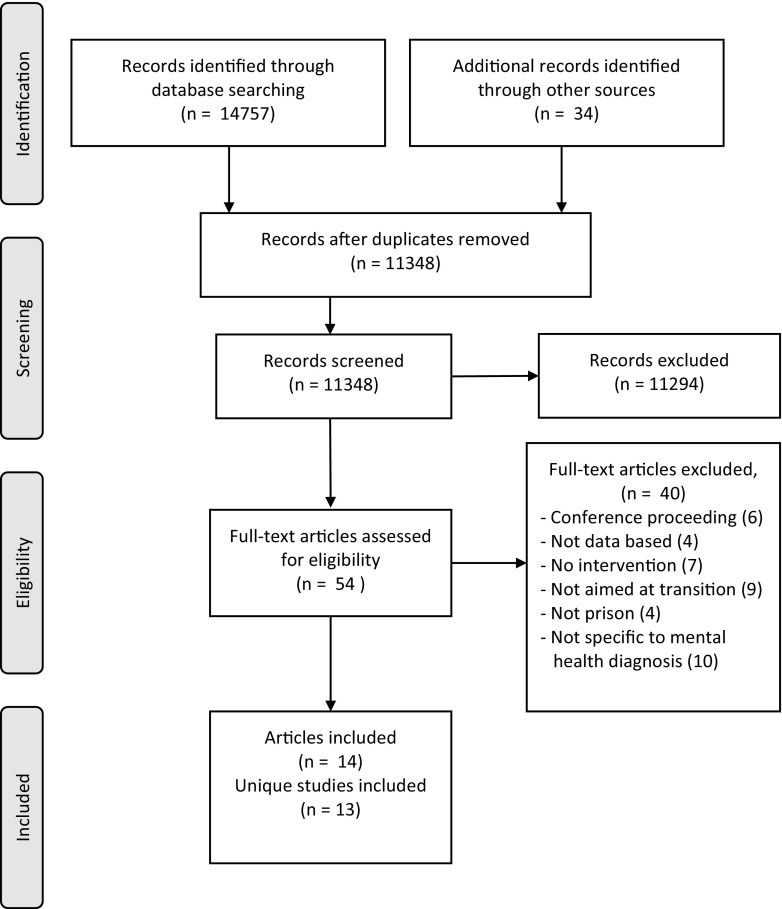
Prisoners have high rates of mental illness and the transition from prison to the community is a problematic time for the provision of mental health services and a range of negative outcomes have been identified in this period. A systematic review was conducted to identify interventions for prisoners with diagnosed mental health conditions that targeted this transition period. Fourteen papers from 13 research studies were included. The interventions identified in this review were targeted at different stages of release from prison and their content differed, ranging from Medicaid enrolment schemes to assertive community treatment. It was found that insurance coverage, and contact with mental health and other services can be improved by interventions in this period but the impact on reoffending and reincarceration is complex and interventions may lead to increased return to prison. There is a developing evidence base that suggests targeting this period can improve contact with community mental health and other health services but further high quality evidence with comparable outcomes is needed to provide more definitive conclusions. The impact of programmes on return to prison should be evaluated further to establish the effect of interventions on clinical outcomes and to clarify the role of interventions on reincarceration.
Overview
The claims and statistics of this paper haven’t been checked yet.
Free: it reads the open-access text and checks the first 5 claims that cite a source we can check. Create a free account to check every claim.
Integrity signals
Registry
Cites
Statistics
Figures
Verification
Claims the paper makes
The claims and statistics of this paper haven’t been checked yet.
Free: it reads the open-access text and checks the first 5 claims that cite a source we can check. Create a free account to check every claim.
Claims other papers make about this one
Each is checked against this paper’s own text: does it say what the citing paper says it does?
The source backs part of the claim, not all of it — or backs it for a different population, condition or comparison.
In the citing paper
“Overall, the effectiveness of most prison-based treatments on recidivism remains unclear because the evidence is inconsistent and subject to a range of limitations.18, 19, 20, 21, 22, 23, 24, 25, 26, 27, 28”
From Effectiveness of psychological interventions in prison to reduce recidivism: a systematic review and meta-analysis of randomised controlled trials (2021) · cites this paper as [18]
Experimental — accuracy not yet measuredThe cited source says what the claim attributes to it.
In the citing paper
“Previous reviews have often focused on specific groups—eg, women,26, 29 adolescents,20, 23 individuals who use drugs,25 people living with a mental health condition,18 and people with sexual21, 28 or other violent19, 27 index offences.”
From Effectiveness of psychological interventions in prison to reduce recidivism: a systematic review and meta-analysis of randomised controlled trials (2021) · cites this paper as [18]
The check wasn’t confident either way, so it gives no verdict — never disputed.
In the citing paper
“There are considerable methodological differences between these reviews, particularly in the quality of included primary studies,20 and the sources of this heterogeneity have rarely been examined.18”
From Effectiveness of psychological interventions in prison to reduce recidivism: a systematic review and meta-analysis of randomised controlled trials (2021) · cites this paper as [18]
Experimental — accuracy not yet measured
Self-check
Percentages, sums and reported differences re-computed from the paper’s own numbers.
The self-check needs the paper’s full text.
Citations
Cites
Preferred Reporting Items for Systematic Reviews and Meta-Analyses: the PRISMA statement
Moher, D., Liberati, A., Tetzlaff, J., Altman, D. G., & for the PRISMA Group (2009) · BMJ · doi:10.1136/bmj.b2535 · Cited by 83,823
Preferred Reporting Items for Systematic Reviews and Meta-Analyses: The PRISMA Statement
Moher, D., Liberati, A., Tetzlaff, J., Altman, D. G., & The PRISMA Group (2009) · PLoS Medicine · doi:10.1371/journal.pmed.1000097 · Cited by 64,042
Preferred reporting items for systematic reviews and meta-analyses: the PRISMA Statement.
(2009) · PubMed Central · Cited by 44,859
Wang, G., Ma, R., Qiao, G., Wada, K., Aizawa, Y., & Satoh, T. (2015) · Integrative Medicine International · doi:10.1159/000368408 · Cited by 18,657
Serious mental disorder in 23 000 prisoners: a systematic review of 62 surveys
Fazel, S., & Danesh, J. (2002) · The Lancet · doi:10.1016/s0140-6736(02)07740-1 · Cited by 2,201 · cited 2×
“Introduction It is well established that prisoners have high rates of mental health problems compared to the general population (Fazel and Danesh 2002; Fazel and Seewald 2012).”
BackgroundSevere mental illness in 33 588 prisoners worldwide: systematic review and meta-regression analysis
Fazel, S., & Seewald, K. (2012) · British Journal of Psychiatry · doi:10.1192/bjp.bp.111.096370 · Cited by 985
Mallik-Kane, K., & Visher, C. A. (2008) · PsycEXTRA Dataset · doi:10.1037/e719772011-001 · Cited by 458
Acute risk of drug‐related death among newly released prisoners in England and Wales
Farrell, M., & Marsden, J. (2008) · Addiction · doi:10.1111/j.1360-0443.2007.02081.x · Cited by 299
Suicide in recently released prisoners: a population-based cohort study
Pratt, D., Piper, M., Appleby, L., Webb, R., & Shaw, J. (2006) · The Lancet · doi:10.1016/s0140-6736(06)69002-8 · Cited by 290
Self-citationBaillargeon, J., Penn, J. V., Knight, K., Harzke, A. J., Baillargeon, G., & Becker, E. A. (2010) · Administration and Policy in Mental Health and Mental Health Services Research · doi:10.1007/s10488-009-0252-9 · Cited by 253 · cited 2×
“The primary outcome of the majority of the included studies was based on forensic outcomes, such as lowering recidivism rates, and whilst this is an important area, a key rationale for interventions aimed at this period is to prevent severe negative health outcomes of prisoners with mental illness after release (Baill…”
Background
Research works printed but not linked: 1
- Effective Public Health Practice Project Quality assessment tool for quantitative studies 2009 Hamilton, ON Effective Public Health Practice Project
Cited by
Baranyi, G., Scholl, C., Fazel, S., Patel, V., Priebe, S., & Mundt, A. P. (2019) · The Lancet Global Health · doi:10.1016/s2214-109x(18)30539-4 · Cited by 294
Beaudry, G., Yu, R., Perry, A. E., & Fazel, S. (2021) · The Lancet Psychiatry · doi:10.1016/s2215-0366(21)00170-x · Cited by 196
Mental and physical health morbidity among people in prisons: an umbrella review
Favril, L., Rich, J. D., Hard, J., & Fazel, S. (2024) · The Lancet Public Health · doi:10.1016/s2468-2667(24)00023-9 · Cited by 160
Mental and behavioral disorders in the prison context
Gómez-Figueroa, H., & Camino, A. (2022) · Revista Española de Sanidad Penitenciaria · doi:10.18176/resp.00052 · Cited by 88
Lovett, A., Kwon, H. R., Kidia, K. K., Machando, D., Crooks, M., Fricchione, G. L., Thornicroft, G., & Jack, H. E. (2019) · International Journal of Mental Health Systems · doi:10.1186/s13033-019-0273-z · Cited by 47
Self-citationMental health in the criminal justice system: A pathways approach to service and research design
Forrester, A., & Hopkin, G. (2019) · Criminal Behaviour and Mental Health · doi:10.1002/cbm.2128 · Cited by 43
Self-citationJanca, E. K., Keen, C., Willoughby, M., Borschmann, R., Sutherland, G. A., Kwon, S., & Kinner, S. A. (2022) · Social Psychiatry and Psychiatric Epidemiology · doi:10.1007/s00127-022-02390-z · Cited by 40
Hyde, J. K., Byrne, T. H., Petrakis, B. A., Yakovchenko, V., Kim, B., Fincke, B. G., Bolton, R. E., Visher, C. A., Blue‐Howells, J., Drainoni, M., et al. (2022) · Health & Justice · doi:10.1186/s40352-022-00195-5 · Cited by 44
“…care clinics and community health workers (Anderson-Facile, 2009; Fox et al., 2014; Morse et al., 2017), and those that use a Critical Time Intervention (CTI) approach (Doleac, 2019; Hignite & Haff, 2017; Hopkin et al., 2018; Lattimore et al., 2010; Malta et al., 2019; Moore et al., 2020).”
BackgroundStewart, A. C., Cossar, R. D., Wilkinson, A. L., Quinn, B., Dietze, P., Walker, S., Butler, T. G., Curtis, M., Aitken, C. K., Kirwan, A., et al. (2021) · Drug and Alcohol Dependence · doi:10.1016/j.drugalcdep.2021.108970 · Cited by 32
Manuel, J. I., Nizza, M., Herman, D. B., Conover, S., Esquivel, L. I., Yuan, Y., & Susser, E. (2022) · Administration and Policy in Mental Health and Mental Health Services Research · doi:10.1007/s10488-022-01224-z · Cited by 31
“To identify articles not included in our original search, we reviewed reference lists of studies that met inclusion criteria, reviewed existing relevant systematic reviews and general literature reviews (de Vet et al., 2013; Herman, 2014; Herman & Mandiberg, 2010; Herman et al., 2007; Hopkin et al., 2018; Vigod et al.…”
MethodBrowne, C. C., Korobanova, D., Chemjong, P., Harris, A. W. F., Glozier, N., Basson, J. V., Spencer, S., & Dean, K. (2022) · Frontiers in Psychiatry · doi:10.3389/fpsyt.2022.934837 · Cited by 31
A Systematic Review of Reviews of Correctional Mental Health Services Using the STAIR Framework
Simpson, A. I. F., Gerritsen, C. J., Maheandiran, M., Adamo, V., Vogel, T., Fulham, L., Kitt, T., Forrester, A., & Jones, R. M. (2022) · Frontiers in Psychiatry · doi:10.3389/fpsyt.2021.747202 · Cited by 37
Self-citationQuality indicators and performance measures for prison healthcare: a scoping review
Bellass, S., Canvin, K., McLintock, K., Wright, N. M. J., Farragher, T. M., Foy, R., & Sheard, L. (2022) · Health & Justice · doi:10.1186/s40352-022-00175-9 · Cited by 40
“…should be a reduction in health inequities through greater, rather than equal, intensity of service provision (Birmingham, Wilson, & Adshead, 2006; Charles & Draper, 2012; Exworthy, Wilson, & Forrester, 2011; Ismail & de Viggiani, 2018; Jotterand & Wangmo, 2014; Lines, 2006; Niveau, 2007).”
Jones, R. M., Manetsch, M., Gerritsen, C. J., & Simpson, A. I. F. (2020) · The Canadian Journal of Psychiatry · doi:10.1177/0706743720970829 · Cited by 29
“Services designed to target resources at high-intensity users have been successful elsewhere,(5,28,51) and there is promise for interventions that provide services to help bridge the transition from jail to the community.(41,42,52) The primary targets of intervention appear to be effectively treating those with SMI, p…”
BackgroundThe Effectiveness of Schema Therapy in Individuals Who Committed Crimes: A Systematic Review
Sousa, M., Gouveia, C. P. F., Cunha, O. S., & Rodrigues, A. D. C. (2024) · Trauma Violence & Abuse · doi:10.1177/15248380241254082 · Cited by 29
“Specifically, the effectiveness of most CBT-based treatments in prison settings is yet to be demonstrated conclusively (Beaudry et al., 2021; Byrne & Ghráda, 2019; Hopkin et al., 2018).”
BackgroundHarvey, T. D., Busch, S. H., Lin, H., Aminawung, J. A., Puglisi, L. B., Shavit, S., & Wang, E. A. (2022) · BMC Health Services Research · doi:10.1186/s12913-022-07985-5 · Cited by 25
Browne, C. C., Korobanova, D., Yee, N., Spencer, S., Ma, T., Butler, T. G., & Dean, K. (2022) · Australian & New Zealand Journal of Psychiatry · doi:10.1177/00048674221104411 · Cited by 29
“Intervention during the early post-release period for those with mental illness can increase contact with community mental health services and reduce the risk of reincarceration (Hawthorne et al., 2012; Hopkin et al., 2018).”
BackgroundPapaluca, T., Craigie, A., McDonald, L., Edwards, A., Winter, R., Hoang, A., Pappas, A., Waldron, A., McCoy, K. M., Stoove, M. A., et al. (2022) · Open Forum Infectious Diseases · doi:10.1093/ofid/ofac350 · Cited by 26
Inequities in Mental Health Services: A 16-Year Longitudinal Study of Youth in the Justice System
Luna, M. J., Abram, K. M., Aaby, D., Welty, L. J., & Teplin, L. A. (2023) · Journal of the American Academy of Child & Adolescent Psychiatry · doi:10.1016/j.jaac.2023.07.005 · Cited by 28
Societal Reentry of Prison Inmates With Mental Illness: Obstacles, Programs, and Best Practices
Galletta, E., Fagan, T. J., Shapiro, D. L., & Walker, L. E. (2021) · Journal of Correctional Health Care · doi:10.1089/jchc.19.04.0032 · Cited by 37
“Early treatment should include detailed information on services available in the inmate’s home community for housing, employment, medical care, and mental health care as well as creating links to these community resources (Hopkin et al. , 2018).”
Russell, C., Pang, M., Nafeh, F., MacDonald, S. F., Derkzen, D. M., Rehm, J. T., & Fischer, B. (2022) · International Journal of Qualitative Studies on Health and Well-Being · doi:10.1080/17482631.2022.2094111 · Cited by 29
“Many of the health and substance use challenges experienced by correctional populations are exacerbated upon release from prison into the community (Hall & Farrell, 2018; Hopkin et al., 2018).”
BackgroundBebbington, P., McManus, S., Coid, J. W., Garside, R., & Brugha, T. S. (2021) · Social Psychiatry and Psychiatric Epidemiology · doi:10.1007/s00127-021-02066-0 · Cited by 29
Hyde, J. K., Bolton, R. E., Kim, B., Yakovchenko, V., Petrakis, B. A., Visher, C. A., & McInnes, D. K. (2021) · Health & Social Care in the Community · doi:10.1111/hsc.13481 · Cited by 22
Conducting Randomized Controlled Trials of Complex Interventions in Prisons: A Sisyphean Task?
Lennox, C., Leonard, S., Senior, J., Stevenson, C., Rybczynska‐Bunt, S., Quinn, C., Byng, R., & Shaw, J. J. (2022) · Frontiers in Psychiatry · doi:10.3389/fpsyt.2022.839958 · Cited by 28
Self-citationGureje, O., & Abdulmalik, J. O. (2019) · The Lancet Global Health · doi:10.1016/s2214-109x(19)30057-9 · Cited by 20
No involuntary treatment of mental illness in Australian and New Zealand prisons
Carroll, A., Ellis, A., Aboud, A., Scott, R. J., & Pillai, K. (2020) · Journal of Forensic Psychiatry and Psychology · doi:10.1080/14789949.2020.1817524 · Cited by 21
Cunha, O. S., Pereira, B., Sousa, M., & Rodrigues, A. D. C. (2024) · Aggression and Violent Behavior · doi:10.1016/j.avb.2024.101923 · Cited by 25
Smith, D., Harnett, S., Flanagan, A., Hennessy, S., Gill, P., Quigley, N., Carey, C., McGhee, M., McManus, A., Kennedy, M., et al. (2018) · Frontiers in Psychiatry · doi:10.3389/fpsyt.2018.00549 · Cited by 15
“This finding may not be surprising as a number of more intensive post-release case management models have found an association with increased rates of re-imprisonment through the increased level of monitoring provided by these interventions in the post-release period (24).”
BackgroundResultBarrenger, S. L., Kriegel, L. S., Canada, K. E., & Wilson, A. B. (2021) · Criminal Justice and Behavior · doi:10.1177/0093854820983844 · Cited by 17
“…systematic reviews of interventions at the intersection of the mental health and criminal legal systems (Canada et al., 2019; Drake et al., 2004; Hopkin et al., 2018; Lamb et al., 1999; Lamb & Weinberger, 1998; Loveland & Boyle, 2007; Martin et al., 2012; Morgan et al., 2012; Skeem et al.,…”
BackgroundProblemas de salud mental en población penitenciaria. Un enfoque de salud pública
López, M., Laviana, M., Saavedra, F. J., & López, A. (2021) · Revista de la Asociación Española de Neuropsiquiatría · doi:10.4321/s0211-57352021000200005 · Cited by 23
Fovet, T., Lamer, A., Teston, R., Scouflaire, T., Thomas, P., Horn, M., & Amad, A. (2021) · Journal of Affective Disorders Reports · doi:10.1016/j.jadr.2021.100088 · Cited by 14
Design considerations for a digital service to support prison leavers
Grierson, M., Varghese, D., Bolton, M., & Olivier, P. L. (2022) · Designing Interactive Systems Conference · doi:10.1145/3532106.3533567 · Cited by 19
“Efective reintegration programs are widely considered to be those focused on transition planning and information sharing [6, 36, 51, 58, 72].”
BackgroundSerious mental illness in probation: A review
Brooker, C., Sirdifield, C., & Deinse, T. B. V. (2023) · European Journal of Probation · doi:10.1177/20662203231162739 · Cited by 15
“The extent of the disconnect between the recognition of needs and the receipt of services post-release from prison is illustrated in a systematic review of interventions to support prisoners diagnosed with mental illness at the transition into the community (Hopkin et al., 2018).”
BackgroundDe psychische gezondheid van gedetineerden in België en Nederland: een systematisch overzicht
Favril, L., & Dirkzwager, A. (2019) · Tijdschrift voor Criminologie · doi:10.5553/tvc/0165182x2019061001001 · Cited by 33
O’Meara, A., Morgan, L., Godden, S., & Davies, J. (2019) · Probation Journal · doi:10.1177/0264550519859067 · Cited by 14
“In their systematic review, Hopkin et al. (2018) noted several key factors as important for successful transitions.”
BackgroundSmith, H., Topp, S. M., Hoffmann, C. J., Ndlovu, T., Charalambous, S., Murray, L. K., Kane, J. C., Sikazwe, I. T., Muyoyeta, M., & Herce, M. E. (2020) · Current HIV/AIDS Reports · doi:10.1007/s11904-020-00518-x · Cited by 14
Do Prisoners With Reintegration Needs Receive Relevant Professional Assistance?
Pasma, A. J., van Ginneken, E. V., Palmen, H., & Nieuwbeerta, P. (2022) · International journal of offender therapy and comparative criminology · doi:10.1177/0306624x221086554 · Cited by 8
“These findings are in line with previous findings that discharge plans are often absent and that prisoners with health needs in particular are not always well-prepared in terms of continuation of healthcare upon release (e.g., Hopkin et al., 2018).”
BackgroundResultTransition Planning from Jail; Treatment Engagement, Continuity of Care, and Rearrest
Hicks, D. L., Comartin, E. B., & Kubiak, S. P. (2021) · Community Mental Health Journal · doi:10.1007/s10597-021-00820-x · Cited by 16
Palis, H., Hu, K., Rioux, W., Korchinski, M., Young, P., Greiner, L. E., Nicholls, T. L., & Slaunwhite, A. (2022) · JAMA Network Open · doi:10.1001/jamanetworkopen.2022.47146 · Cited by 12
Palis, H., Young, P., Korchinski, M., Wood, S., Xavier, J. C., Luk, N., Mahil, S., Bartlett, S. R., Brown, H., Salmon, A., et al. (2024) · BMC Public Health · doi:10.1186/s12889-023-17524-4 · Cited by 8
“…these immediate basic needs, are significant service needs to address the disproportionately high rates of chronic physical health problems faced by people who have been incarcerated, often coupled with the need for health system support to address mental health and or substance use needs [7, 8].”
BackgroundHailemariam, M., Bustos, T. E., Montgomery, B. W., Brown, G., Tefera, G. M., Adaji, R., Taylor, B., Eshetu, H., Barajas, C. B., Barajas, R., et al. (2024) · BMC Psychiatry · doi:10.1186/s12888-024-05612-7 · Cited by 21
“Community-based alternatives to incarceration including jail diversion, mental health courts, reen-try programs, crisis interventions and other programs have been introduced to improve the mental health and criminal legal outcomes of individuals with mental health needs [21].”
BackgroundThe impact of incarceration on health: A global systematic review
Pearce, L. A., Shuttleworth, R. R., Young, J. T., Borschmann, R., & Kinner, S. A. (2026) · Social Science & Medicine · doi:10.1016/j.socscimed.2026.118946 · Cited by 9
Akpanekpo, E. I., Kariminia, A., Srasuebkul, P., Trollor, J. N., Greenberg, D., Kasinathan, J. G., Schofield, P. W., Kenny, D. T., Simpson, M., Gaskin, C., et al. (2024) · BMJ Mental Health · doi:10.1136/bmjment-2023-300958 · Cited by 8
Psychiatry in Prisons and Corrections
Fovet, T., Mundt, A. P., & Fazel, S. (2023) · Springer eBooks · doi:10.1007/978-3-030-42825-9_103-1 · Cited by 9
Mental health intervention research in Latin American correctional settings: A scoping review
Beigel, L., Forrester, A., Torales, J. C., Aboaja, A. M., Arroyo, G. R., O’Higgins, M. G., Opitz‐Welke, A., & Mundt, A. P. (2023) · International Journal of Social Psychiatry · doi:10.1177/00207640231174372 · Cited by 11
“…in prosocial behavior and reductions in drug use reported in the controlled trials and cohort studies are promising and might be further evaluated at the transition from correctional to community settings, as this is known to be a critical time period for rehabilitation (Hopkin et al., 2018).”
Self-citationToward Equitable Health Care: Bridging the Gap in the Health of Incarcerated Individuals in Africa
Okunlola, P., Babatunde, A. O., Akoki, D. M., Ilori, O., Femi‐Lawal, V. O., Abiona, F. M., & Tundealao, S. T. (2024) · Public Health Challenges · doi:10.1002/puh2.70020 · Cited by 9
“The designs and target populations of these interventions vary, ranging from programs within the correctional centers to interventions for formerly incarcerated people who are re-entering the community settings [18].”
Jarvis, D., Shaw, J., & Lovell, T. (2022) · Journal of Forensic Practice · doi:10.1108/jfp-11-2021-0061 · Cited by 10
Self-citationPaynter, M. J., Heggie, C., Low, C., McKibbon, S., & Martin‐Misener, R. (2022) · Journal of Clinical Nursing · doi:10.1111/jocn.16464 · Cited by 10
Fovet, T., Scouflaire, T., Belet, B., Demeulemeester, E., Paindavoine, M., Gibour, C., Claeyman, V., Ghislain, L., Narguet, C., Qaoubii, O. E., et al. (2023) · Annales Médico-psychologiques revue psychiatrique · doi:10.1016/j.amp.2023.02.008 · Cited by 11
Versorgung von psychisch erkrankten Menschen im Strafvollzug
Orlob, S. (2023) · DNP – Die Neurologie & Psychiatrie · doi:10.1007/s15202-023-5628-2 · Cited by 6
Breaking the cycle: The role of the criminal justice system in understanding homicide rates
Croci, G., & Gomez, J. (2025) · Journal of Criminal Justice · doi:10.1016/j.jcrimjus.2025.102450 · Cited by 14
Vaisman, D. C., & Einat, T. (2021) · The Prison Journal · doi:10.1177/00328855211010412 · Cited by 7
“…negative objective and subjective impacts on the physical, mental, and emotional health of many prisoners, several researchers have pointed to the need to construct integrative, multifaceted, and long-term treatment and rehabilitative programs in prison and in the community (Hopkin et al., 2018).”
BackgroundInfluentialCriminal justice transitions among adolescents in Australia: A multi-state model
Akpanekpo, E. I., Kariminia, A., Srasuebkul, P., Trollor, J. N., Kasinathan, J. G., Greenberg, D., Schofield, P. W., Kenny, D. T., Gaskin, C., Simpson, M., et al. (2024) · Journal of Criminal Justice · doi:10.1016/j.jcrimjus.2024.102189 · Cited by 10
Prison education in the resocialization of incarcerated individuals
Romero-Carazas, R., Delgado, F. D. C., Casco, R. J. E., Bernedo-Moreira, D. H., Morales-García, W. C., Rodríguez-Asto, R. A. A., & Quiñones-Ormeño, L. K. (2025) · Frontiers in Education · doi:10.3389/feduc.2025.1592692 · Cited by 13
Cooper, J. A., Onyeka, I. N., O’Reilly, D., Kirk, R., & Donnelly, M. (2022) · BMJ Open · doi:10.1136/bmjopen-2021-056598 · Cited by 4
Tärnhäll, A., Björk, J., Wallinius, M., Gustafsson, P., Billstedt, E., & Hofvander, B. (2022) · Social Psychiatry and Psychiatric Epidemiology · doi:10.1007/s00127-022-02408-6 · Cited by 5
“We suggest further research on interventions targeting violent offenders with psychiatric needs in transition from prison into the community [65].”
BackgroundDattagupta, J., Banerjee, A., Maji, B. K., & Chattopadhyay, P. K. (2024) · International Journal of Adolescent Medicine and Health · doi:10.1515/ijamh-2024-0052 · Cited by 5
Timler, K., & Villaça, M. J. (2021) · Comedy Studies · doi:10.1080/2040610x.2021.1951109 · Cited by 7
Prison mental health in-reach teams in Aotearoa New Zealand: A national survey
McKenna, B., Skipworth, J., Forrester, A., & Shaw, J. J. (2021) · Psychiatry Psychology and Law · doi:10.1080/13218719.2020.1855269 · Cited by 4
“There is irrefutable evidence that a focus on reintegration strategies assists in improving prisoner morbidity and mortality post release and in reducing recidivism (Hancock et al., 2018; Hopkin et al., 2018; Pearsall, 2016; Smith-Merry et al., 2019).”
BackgroundSelf-citationMental health of prerelease incarcerated women
Eck, M., Lancelevée, C., Wathelet, M., Amad, A., Benradia, I., D’Ovidio, K., Duhem, S., Thomas, P., & Fovet, T. (2025) · Psychiatry Research · doi:10.1016/j.psychres.2025.116485 · Cited by 3
Clarke, C., & Allen-McCombs, J. (2025) · Advances in Social Work · doi:10.18060/28454 · Cited by 3
MacInnes, D. L., Khan, A. A., Tallent, J., Hove, F., Dyson, H., Grandi, T., & Parrott, J. M. (2021) · Social Psychiatry and Psychiatric Epidemiology · doi:10.1007/s00127-021-02045-5 · Cited by 3
“One systematic review has reviewed the evidence [25].”
BackgroundCooper, J. A., Murphy, S., Kirk, R., O’Reilly, D., & Donnelly, M. (2023) · PLoS ONE · doi:10.1371/journal.pone.0289218 · Cited by 3
Veterans Universal Passport: a pilot of a health and social care record for UK ex-service personnel
Godier-McBard, L. R., & Fossey, M. J. (2020) · BMJ Military Health · doi:10.1136/jramc-2019-001288 · Cited by 5
Intellectual, Developmental, and Physical Disabilities in U.S. Legal Settings: A Scoping Review
Holliday, S. B., Scruggs, A., Gittens, A. D., Matthews, S., Gadwah‐Meaden, C., Wolfe, R. L., Kroger, J., & Palimaru, A. I. (2023) · RAND Corporation eBooks · doi:10.7249/rra2880-1 · Cited by 4
Psychiatry in Prisons and Corrections
Fovet, T., Mundt, A. P., & Fazel, S. (2024) · Springer eBooks · doi:10.1007/978-3-030-51366-5_103 · Cited by 4
Tärnhäll, A., Björk, J., Wallinius, M., Billstedt, E., & Hofvander, B. (2025) · Psychiatry Research · doi:10.1016/j.psychres.2025.116384 · Cited by 5
“Research should also focus on effective interventions and medical care continuity for offenders with SMI during the transition from prison (Brooker et al., 2023; Hopkin et al., 2018; Parisi et al., 2022).”
Soler-Prieto, C., & Martín, F. M. (2022) · Anuario de Psicología Jurídica · doi:10.5093/apj2022a8 · Cited by 2
A prison mental health network in the RANZCP
Scott, R. J., Aboud, A., Das, M., & Nambiar, N. (2023) · Australasian Psychiatry · doi:10.1177/10398562221146451 · Cited by 2
Crier, N., Timler, K., Keating, P., Young, P., Brown, H. J., & Price, R. (2021) · Turtle Island Journal of Indigenous Health · doi:10.33137/tijih.v1i2.36134 · Cited by 2
Palimaru, A. I., Gittens, A. D., & Holliday, S. B. (2023) · RAND Corporation eBooks · doi:10.7249/rra2880-3 · Cited by 3
Baggio, S., Billieux, J., Dirkzwager, A., Iglesias, K., Moschetti, K., Perroud, N. A., Schneider, M. P., Vernaz, N., Wolff, H. J., & Heller, P. (2024) · Trials · doi:10.1186/s13063-023-07827-7 · Cited by 2
“Health care linkage programs between prison and community services are lacking, and there are several missed opportunities to treat this vulnerable population with high health needs [39–43].”
BackgroundNew Directions in the Treatment of Justice-Involved Individuals with Severe Mental Illness
Samost, D., Hwang, J., & Yanos, P. T. (2021) · Springer eBooks · doi:10.1007/978-3-030-77565-0_22 · Cited by 1
Programs for Care System Transitions in Mental Health: A Systematic Review
Apaydin, E. A., Delavale, V., Fu, N., Larkin, J., Chough, I., Motala, A., & Hempel, S. (2022) · Rand health quarterly · doi:10.7249/rhq-10-01-08 · Cited by 2
Colton, J., Misra, R., Woznick, E., Wiedermann, R., & Huh, A. S. (2024) · Community Mental Health Journal · doi:10.1007/s10597-024-01243-0 · Cited by 3
“(Hopkin et al., 2018; Mac-Donald et al., 2015).”
Cumming, I. (2024) · Cambridge University Press eBooks · doi:10.1017/9781911623809.005 · Cited by 1
Papadimitriou, A., Hawks, L. C., Williams, J. S., & Egede, L. E. (2025) · Journal of General Internal Medicine · doi:10.1007/s11606-025-09416-7 · Cited by 1
“23 However, the evidence for reduction in recidivism rates is equivocal and for broader health outcomes is understudied.”
Nishar, S., Jaiswal, J., Mandal, S., Brumfield, E., & Soske, J. (2025) · Administration and Policy in Mental Health and Mental Health Services Research · doi:10.1007/s10488-025-01435-0 · Cited by 6
Maity, K., Majumdar, V., Patra, S., & Anand, A. (2025) · Frontiers in Human Neuroscience · doi:10.3389/fnhum.2025.1553845 · Cited by 3
Anxiety Disorders in Prisoners: Causes, Prevention, and Strategies for Post-Prison Support
Kumar, V. S., & Krishnamurthy, K. (2025) · Springer eBooks · doi:10.1007/978-3-031-86114-7_1 · Cited by 1
Exploring Medication Safety in Transitions From Prison to Community: A Qualitative Study
Planner, C., Keers, R. N., Phipps, D. L., Eylem, Ö., Tyler, N., Shaw, J. J., Ashcroft, D. M., & Panagioti, M. (2026) · Health Expectations · doi:10.1111/hex.70684 · Cited by 1
“This aligns with evidence showing that continuity of care between prison and community settings is critical for improving health and social outcomes, including reductions in re‐offending among people released from prison [32, 33].”
Self-citationExploring Community-Centric Decarceration Strategies for People With Behavioral Health Needs
Bocanegra, K., Epperson, M. W., & Sawh, L. (2022) · Journal of the Society for Social Work and Research · doi:10.1086/720011 · Cited by 1
Walsh, J., Smith, D., Byrne, F., Hickey, P., Taylor, E., Caddow, M., Reynolds, O., & O’Neill, C. (2024) · Frontiers in Psychiatry · doi:10.3389/fpsyt.2024.1392072 · Cited by 2
Du, A., Kennedy, L., Addington, J., Bearden, C. E., Cannon, T. D., Carrión, R. E., Keshavan, M. S., Mathalon, D. H., Perkins, D. O., Stone, W. S., et al. (2025) · Schizophrenia Research · doi:10.1016/j.schres.2025.07.015 · Cited by 1
Modern Approaches to Addressing the Mass Incarceration of America's Mentally Ill Population
Bice, C., & Terry, A. N. (2023) · Academic Leadership Journal in Student Research · doi:10.58809/fcuy5269 · Cited by 1
Ryland, H. (2022) · Oxford University Press eBooks · doi:10.1093/med/9780198861478.003.0048 · Cited by 1
McKenzie, N., & Forrester, A. (2023) · Frontiers in Psychiatry · doi:10.3389/fpsyt.2023.1293060 · Cited by 1
Self-citationPolysubstance Opioid Use in a Justice-Involved Population
Bunting, A. M. (2019) · UKnowledge (University of Kentucky) · doi:10.13023/etd.2019.171
“Further, research has indicated that interventions and services aimed at the period of transition from prison to community can improve mental health service utilization post-release (Hopkin et al., 2018).”
BackgroundScale of Convicts ' Attitude To Work
Lenkov, S. L., Rubtsova, N. E., & Alexandrov, B. V. (2020) · Psychology and Law · doi:10.17759/psylaw.2020100217
MacInnes, D. L., Khan, A. A., Tallent, J., Hove, F., Dyson, H. J., Grandi, T., & Parrott, J. M. (2020) · Cited by 1
Mental Health Problems in Prison Populations
Mundt, A. P., & Delhey, S. (2021) · Elsevier eBooks · doi:10.1016/b978-0-12-818697-8.00180-1 · Cited by 1
Let's Talk Ontario's Prison Health
Lee, J. Y. (2021) · University of Western Ontario Medical Journal · doi:10.5206/uwomj.v89i2.10411
Promoting Smart Decarceration as a Grand Challenge
Pettus‐Davis, C., Tripodi, S. J., & Paseda, O. K. (2023) · Oxford University Press eBooks · doi:10.1093/obo/9780195389678-0320
Application of Penal Psychiatry to Persons Serving a Sentence: Historical and Legal Analysis
Демянчук, Т. М. (2023) · Ûridična psihologìâ · doi:10.33270/03233201.34
Zampella, B. (2023) · Journal of Forensic Social Work · doi:10.15763/issn.1936-9298.2023.7.2.30-42 · Cited by 1
“…illness being discharged from psychiatric hospitals, studies on CTI have recently been shown to reduce psychiatric hospitalization and criminal justice recidivism rates among prisoners with mental illness who were recently discharged from prison as well (Angell et al., 2014; Hopkin et al., 2018).”
BackgroundShaffer, P. M., Smelson, D. A., Helm, A. F., Gaba, A., Marcus, S., & Shaffer, H. J. (2023) · Journal of Psychology and Psychotherapy Research · doi:10.12974/2313-1047.2023.10.08
Humberside enhanced resettlement service (HERS) evaluation report
Atkinson, J., Finley, E., Ramsden, J., & Sefton, W. (2024) · Probation Journal · doi:10.1177/02645505241232127
Assertive community treatment as an alternative to incarceration for American pretrial detainees
Zampella, B., Talton, S., Lam, J., Khan, A., Bryant, T., & Kunz, M. (2024) · International Journal of Law and Psychiatry · doi:10.1016/j.ijlp.2024.101990
Mental Health Symptom Reduction in US Adults Postincarceration
Paseda, O. K., & Hall, T. (2024) · Research on Social Work Practice · doi:10.1177/10497315241253778
Critical Time Intervention in Criminal Legal Settings
Barrenger, S. L., Kriegel, L. S., & Angell, B. (2024) · Oxford University Press eBooks · doi:10.1093/9780197518144.003.0006
Metadata
- Authors
- Hopkin, G., Evans-Lacko, S., Forrester, A., Shaw, J., & Thornicroft, G.
- Affiliations
- King's College London (GB)
- University of Manchester (GB)
- Corresponding author
- Hopkin, G.
- Venue
- Administration and Policy in Mental Health and Mental Health Services Research
- Published
- 2018-01-23
- Volume
- 45
- Issue
- 4
- Pages
- 623-634
- ISSN
- 0894-587X (ISSN-L)
- 1573-3289
- PMC
- PMC5999162
- OpenAlex
- W2788819963
- Cited by
- 119
- References
- 36
- Citations by year
- 2026: 10 · 2025: 13 · 2024: 23 · 2023: 17 · 2022: 25 · 2021: 17 · 2020: 6 · 2019: 7 · 2018: 1
- FWCI
- 2.83
- Type
- journal article
- Language
- en
- Open access
- hybrid
- doi.org
- Locations
- Administration and Policy in Mental Health and Mental Health Services Research (publishedVersion, cc-by)
- Europe PMC (PubMed Central) (publishedVersion, other-oa)
- PubMed Central (publishedVersion, cc-by)
- PubMed (publishedVersion)
- Research Portal (King's College London) (publishedVersion, other-oa)
- ORCA Online Research @Cardiff (Cardiff University) (acceptedVersion)
- London School of Economics and Political Science Research Online (London School of Economics and Political Science) (acceptedVersion)
- London School of Economics and Political Science Research Online (London School of Economics and Political Science) (submittedVersion)
- Research Explorer (The University of Manchester) (submittedVersion, cc-by)
- Funders
- South London and Maudsley NHS Foundation Trust
- King's College Hospital NHS Foundation Trust
- National Institute for Health and Care Research (FP7/2007–2013)
- King's College London
- European Commission (2007–2013, FP7 2007-2013, FP7/2007)
- Topics
- Social Sciences › Sociology and Political Science › Criminal Justice and Corrections Analysis
- Social Sciences › Psychology › Clinical Psychology › Psychiatric care and mental health services
- Social Sciences › Psychology › Clinical Psychology › Psychopathy, Forensic Psychiatry, Sexual Offending
- Keywords
- transition from prison to community, assertive community treatment, insurance coverage, recidivism, reincarceration, community mental health services, prisoner reentry
- MeSH terms
- Mental Disorders, Community Mental Health Services, Continuity of Patient Care, Humans, Medicaid, Prisons, United States, Independent Living
About these checks
Registry, retraction, Cites and statistics results are computed, not judged, with one exception: a printed reference that no index lists is read once by a model before it counts as a citation error. Claims are extracted by a model and kept only when their quote appears verbatim in the text; each cited source is then checked, with a model’s help, for whether it says what the claim relies on. Those verdicts can be wrong — read the claim’s quote and the cited source before relying on one.
Statistics and arithmetic are recomputed, not judged.
Confidence bands are shown only for fields calibrated on our annotated test set. None is calibrated yet, so no band is shown.
What counts as a claim ›How we measure confidence ›How we check this ›
Are you an author, or do you see a problem with this page? Request a review
Data sources
Bibliographic data: Semantic Scholar, OpenAlex, Crossref.
Contains information from the Semantic Scholar Academic Graph Datasets, made available under the ODC Attribution License (ODC-BY 1.0).
Semantic Scholar’s data is described in: Kinney, R., et al. (2023). The Semantic Scholar Open Data Platform. arXiv:2301.10140.
