

The DOI matches its Crossref record; 93 of the 97 references it cites were found in a registry or an index.
Practical verification of decision-making in agent-based autonomous systems
Open accessAbstract
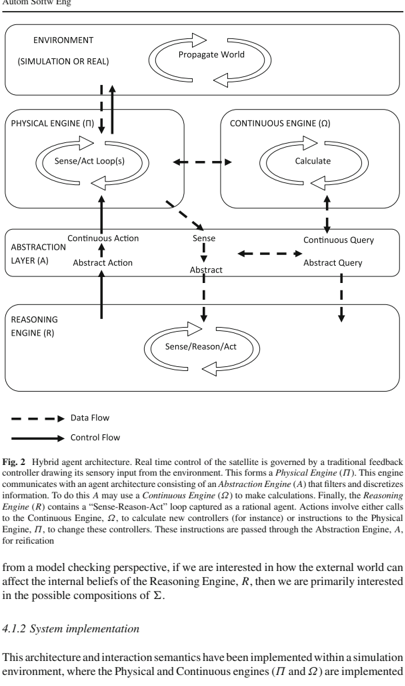
We present a verification methodology for analysing the decision-making component in agent-based hybrid systems. Traditionally hybrid automata have been used to both implement and verify such systems, but hybrid automata based modelling, programming and verification techniques scale poorly as the complexity of discrete decision-making increases making them unattractive in situations where complex logical reasoning is required. In the programming of complex systems it has, therefore, become common to separate out logical decision-making into a separate, discrete, component. However, verification techniques have failed to keep pace with this development. We are exploring agent-based logical components and have developed a model checking technique for such components which can then be composed with a separate analysis of the continuous part of the hybrid system. Among other things this allows program model checkers to be used to verify the actual implementation of the decision-making in hybrid autonomous systems.
Overview
The claims and statistics of this paper haven’t been checked yet.
Free: it reads the open-access text and checks the first 5 claims that cite a source we can check. Create a free account to check every claim.
Integrity signals
Registry
Cites
Statistics
Figures


Verification
Claims the paper makes
The claims and statistics of this paper haven’t been checked yet.
Free: it reads the open-access text and checks the first 5 claims that cite a source we can check. Create a free account to check every claim.
Claims other papers make about this one
Each is checked against this paper’s own text: does it say what the citing paper says it does?
The cited source says what the claim attributes to it.
In the citing paper
“The AI systems auditing literature is also multidisciplinary in that it harbours contributions from many academic disciplines, including computer science (Adler et al., 2018;Kearns et al., 2018), systems engineering (Dennis et al., 2016;Leveson, 2011), law (Laux et al., 2021;Selbst, 2021), media and communication studies (Bandy & Diakopoulos, 2019;Sandvig et al., 2014), social science (Metaxa et”
From Auditing of AI: Legal, Ethical and Technical Approaches (2023) · cites this paper as Dennis et al., 2016
Self-check
Percentages, sums and reported differences re-computed from the paper’s own numbers.
The self-check needs the paper’s full text.
Citations
Cites
Clarke, E. M., Grümberg, O., & Long, D. (1996) · Cited by 6,813
An Introduction to MultiAgent Systems
Wooldridge, M. (2002) · Cited by 5,394
Handbook of theoretical computer science
Leeuwen, J. V. (1990) · Medical Entomology and Zoology · Cited by 4,259
The Temporal Logic of Reactive and Concurrent Systems
Manna, Z., & Pnueli, A. (1992) · Springer eBooks · doi:10.1007/978-1-4612-0931-7 · Cited by 2,958
EMERSON, E. A. (1990) · Formal Models and Semantics · doi:10.1016/b978-0-444-88074-1.50021-4 · Cited by 2,585
BDI Agents: From Theory to Practice
Rao, A. S., & Georgeff, M. (1995) · Cited by 2,577
Shoham, Y. (1993) · Artificial Intelligence · doi:10.1016/0004-3702(93)90034-9 · Cited by 2,041
The algorithmic analysis of hybrid systems
Alur, R., Courcoubetis, C., Halbwachs, N., Henzinger, T. A., Ho, P.-H., Nicollin, X., Olivero, A., Sifakis, J., & Yovine, S. (1995) · Theoretical Computer Science · doi:10.1016/0304-3975(94)00202-t · Cited by 1,876
Intention is choice with commitment
Cohen, P. R., & Levesque, H. J. (1990) · Artificial Intelligence · doi:10.1016/0004-3702(90)90055-5 · Cited by 1,860
Henzinger, T. A. (2002) · Proceedings 11th Annual IEEE Symposium on Logic in Computer Science · doi:10.1109/lics.1996.561342 · Cited by 1,837
Research works printed but not linked: 6
- Bratman, M.E.: Intentions, Plans, and Practical Reason. Harvard University Press, Cambridge, MA (1987)
- Dennis, L.A., Farwer, B.: Gwendolen: A BDI language for verifiable agents. In: Workshop on Logic and the Simulation of Interaction and Reasoning, AISB (2008)
- Holzmann, G.: Spin Model Checker: Primer and Reference Manual. Addison-Wesley, Reading (2004)
- Kitano, H., Tadokoro, S.: RoboCup rescue: a grand challenge for multiagent and intelligent systems. AI Mag. 22(1), 39–52 (2001)
- Rao, A.S., Georgeff, M.P.: Modeling agents within a BDI-architecture. In: Proceedings of the 2nd International Conference on Principles of Knowledge Representation and Reasoning (KR&R), pp. 473–484. Morgan Kaufmann, San Mateo, CA (1991)
- Sierhuis, M.: Modeling and Simulating Work Practice. BRAHMS: a Multiagent Modeling and Simluation Language for Work System Analysis and Design. PhD thesis, Social Science and Informatics (SW), University of Amsterdam (2001)
Cited by
Morley, J., Floridi, L., Kinsey, L., & Elhalal, A. (2020) · Science and Engineering Ethics · doi:10.1007/s11948-019-00165-5 · Cited by 882
Research Priorities for Robust and Beneficial Artificial Intelligence
Russell, S., Dewey, D., & Tegmark, M. (2015) · AI Magazine · doi:10.1609/aimag.v36i4.2577 · Cited by 637
Ethics-Based Auditing of Automated Decision-Making Systems: Nature, Scope, and Limitations
Mökander, J., Morley, J., Taddeo, M., & Floridi, L. (2021) · Science and Engineering Ethics · doi:10.1007/s11948-021-00319-4 · Cited by 207
From ethical AI frameworks to tools: a review of approaches
Prem, E. (2023) · AI and Ethics · doi:10.1007/s43681-023-00258-9 · Cited by 242
Formal verification of ethical choices in autonomous systems
Dennis, L., Fisher, M., Slavkovik, M., & Webster, M. (2016) · Robotics and Autonomous Systems · doi:10.1016/j.robot.2015.11.012 · Cited by 223
Self-citation
Metadata
- Authors
- Dennis, L. A., Fisher, M., Lincoln, N. K., Lisitsa, A., & Veres, S. M.
- Affiliations
- University of Liverpool (GB)
- University of Southampton (GB)
- Corresponding author
- Dennis, Louise A.
- Venue
- Automated Software Engineering
- Published
- 2014-09-06
- Volume
- 23
- Issue
- 3
- Pages
- 305-359
- ISSN
- 0928-8910 (ISSN-L)
- 1573-7535
- OpenAlex
- W2138512963
- Cited by
- 102
- References
- 97
- Citations by year
- 2026: 9 · 2025: 5 · 2023: 9 · 2022: 8 · 2021: 20 · 2020: 17 · 2019: 9 · 2018: 8 · 2017: 3 · 2016: 5 · 2015: 8
- FWCI
- 5.52
- Type
- journal article
- Language
- en
- Open access
- hybrid
- doi.org
- Locations
- Automated Software Engineering (publishedVersion, cc-by)
- Research Explorer (The University of Manchester) (publishedVersion, other-oa)
- White Rose Research Online (University of Leeds, The University of Sheffield, University of York) (acceptedVersion)
- arXiv (Cornell University) (submittedVersion)
- arXiv (Cornell University)
- Funders
- University of Southampton
- Engineering and Physical Sciences Research Council (EP/J011843/2, EP/L024942/1, EP/F037201/1, EP/J011843/1, EP/L024845/1)
- Topics
- Physical Sciences › Computer Science › Computational Theory and Mathematics › Formal Methods in Verification
- Physical Sciences › Computer Science › Artificial Intelligence › Multi-Agent Systems and Negotiation
- Physical Sciences › Computer Science › Software › Logic, programming, and type systems
- Keywords
- agent-based systems, hybrid systems, hybrid automata, model checking, autonomous systems, compositional verification
About these checks
Registry, retraction, Cites and statistics results are computed, not judged, with one exception: a printed reference that no index lists is read once by a model before it counts as a citation error. Claims are extracted by a model and kept only when their quote appears verbatim in the text; each cited source is then checked, with a model’s help, for whether it says what the claim relies on. Those verdicts can be wrong — read the claim’s quote and the cited source before relying on one.
Statistics and arithmetic are recomputed, not judged.
Confidence bands are shown only for fields calibrated on our annotated test set. None is calibrated yet, so no band is shown.
What counts as a claim ›How we measure confidence ›How we check this ›
Are you an author, or do you see a problem with this page? Request a review
How to cite
Cite CoChat for the checks on this page, and the paper for its own findings.
- This page
- CoChat. (2026). Citation check: Practical verification of decision-making in agent-based autonomous systems. https://app.cochat.ai/papers/10.1007/s10515-014-0168-9
- The paper
- Dennis, L. A., Fisher, M., Lincoln, N. K., Lisitsa, A., & Veres, S. M. (2016). Practical verification of decision-making in agent-based autonomous systems. Automated Software Engineering. https://doi.org/10.1007/s10515-014-0168-9
Data sources
Bibliographic data: Semantic Scholar, OpenAlex, Crossref.
Contains information from the Semantic Scholar Academic Graph Datasets, made available under the ODC Attribution License (ODC-BY 1.0).
Semantic Scholar’s data is described in: Kinney, R., et al. (2023). The Semantic Scholar Open Data Platform. arXiv:2301.10140.
