

Development of Bacillus subtilis mutants to produce tryptophan in pigs
Open accessThe DOI matches its Crossref record; 18 of the 19 references it cites were found in a registry or an index.
Abstract
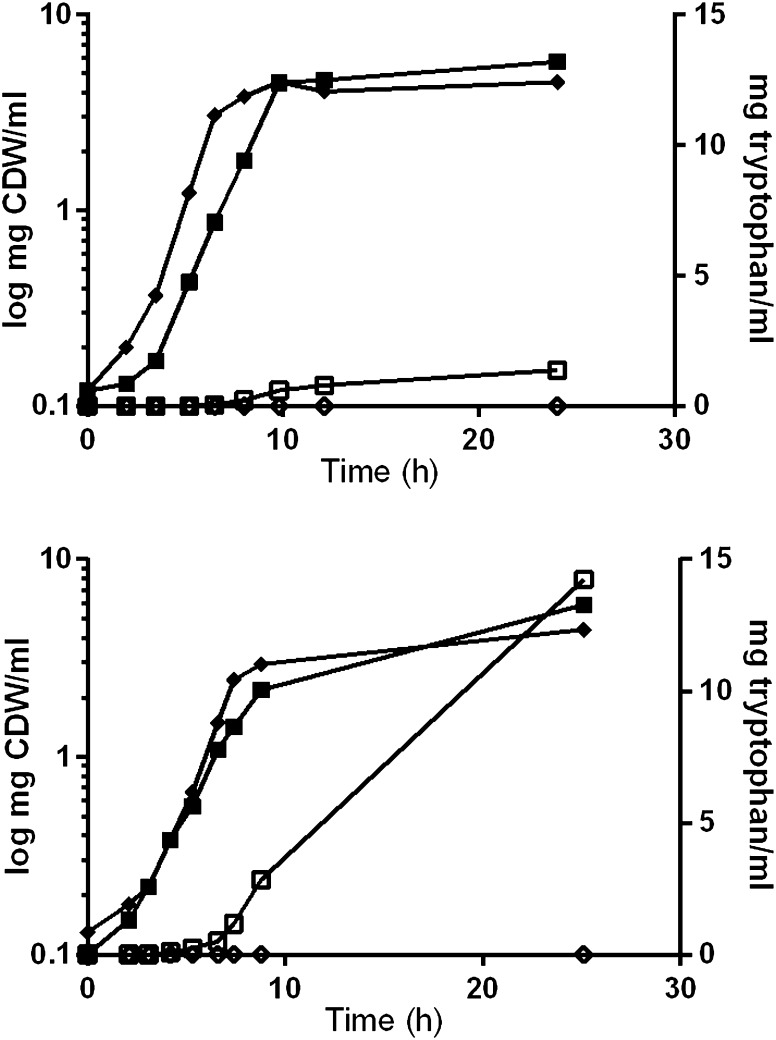
OBJECTIVES: To generate tryptophan-overproducing Bacillus subtilis strains for in situ use in pigs, to reduce the feed cost for farmers and nitrogen pollution. RESULTS: A novel concept has been investigated-to generate B. subtilis strains able to produce tryptophan (Trp) in situ in pigs. Mutagenesis by UV was combined with selection on Trp and purine analogues in an iterative process. Two mutants from different wild types were obtained, mutant 1 (M1) produced 1 mg Trp/l and mutant 2 (M2) 14 mg Trp/l. Genome sequence analysis revealed that M1 had three single nuclear polymorphisms (SNPs) and M2 had two SNPs compared to the wild type strains. In both mutants SNPs were found in genes regulating tryptophan synthesis. Reverse transcription PCR confirmed up-regulation of the tryptophan synthesis genes in both mutants, the expression was up to 3 times higher in M2 than in M1. CONCLUSIONS: Tryptophan-excreting B. subtilis strains were obtained with UV-mutagenesis and analogue selection and can be used in animal feed applications.
Overview
The claims and statistics of this paper haven’t been checked yet.
Free: it reads the open-access text and checks the first 5 claims that cite a source we can check. Create a free account to check every claim.
Integrity signals
Registry
Cites
Statistics
Figures
Verification
Claims the paper makes
The claims and statistics of this paper haven’t been checked yet.
Free: it reads the open-access text and checks the first 5 claims that cite a source we can check. Create a free account to check every claim.
Claims other papers make about this one
Each is checked against this paper’s own text: does it say what the citing paper says it does?
The source backs part of the claim, not all of it — or backs it for a different population, condition or comparison.
In the citing paper
“Some of the bacteria from these and other genera, such as B. helveticus, B. longum, B. animalis, Bacillus subtilis and Enterococcus faecium, have been reported to produce or promote the synthesis of neurotransmitters in the gut18–24, consequently modulating MGBA pathways and affecting behavior25–29.”
From Exploring the impact of probiotics on adult ADHD management through a double-blind RCT (2024) · cites this paper as [23]
Experimental — accuracy not yet measured
Self-check
Percentages, sums and reported differences re-computed from the paper’s own numbers.
The self-check needs the paper’s full text.
Citations
Cites
Cutting, S. M. (2011) · Food Microbiology · doi:10.1016/j.fm.2010.03.007 · Cited by 787
Bacillus subtilis: from soil bacterium to super-secreting cell factory
van Dijl, J. M., & Hecker, M. (2013) · Microbial Cell Factories · doi:10.1186/1475-2859-12-3 · Cited by 382 · cited 1×
“Bacilli are used extensively in the biotechnology industry to produce a vast range of enzymes (van Dijl and Hecker 2013) as well as probiotics in animal feed (Cutting 2011).”
Bacillus subtilis and Its Closest Relatives: From Genes to Cells
(2001) · ASM Press eBooks · doi:10.1128/9781555817992 · Cited by 301
Towards bacterial strains overproducing l-tryptophan and other aromatics by metabolic engineering
Ikeda, M. (2006) · Applied Microbiology and Biotechnology · doi:10.1007/s00253-005-0252-y · Cited by 271 · cited 2×
“Obtaining natural tryptophan producing Bacillus subtilis strains To obtain a Trp over-producing strain, different recombinant DNA techniques have been applied (Ikeda 2006) but, in the food and feed industry, recombinant DNA techniques are highly controversial.”
BackgroundMethodAlexopoulos, C., Georgoulakis, I. E., Tzivara, A., Kritas, S. K., Siochu, A., & Kyriakis, S. C. (2004) · Journal of Animal Physiology and Animal Nutrition · doi:10.1111/j.1439-0396.2004.00492.x · Cited by 206 · cited 2×
“Bacillus spores are used as probiotics for both animals and humans and has been used in the pig industry for 10–15 years, with positive effects on weight gain, reduced mortality rate and diarrhea (Alexopoulos et al. 2004).”
BackgroundCarbon source dependent promoters in yeasts
Weinhandl, K., Winkler, M., Glieder, A., & Camattari, A. (2014) · Microbial Cell Factories · doi:10.1186/1475-2859-13-5 · Cited by 206
Derkx, P. M., Janzen, T., Sørensen, K. I., Christensen, J. E., Stuer-Lauridsen, B., & Johansen, E. (2014) · Microbial Cell Factories · doi:10.1186/1475-2859-13-s1-s5 · Cited by 146 · cited 1×
“These methods are approved by authorities and has consumer acceptance, and have been extensively used in the food industry (Derkx et al. 2014).”
MethodSelf-citationValbuzzi, A., Gollnick, P. D., Babitzke, P., & Yanofsky, C. (2002) · Journal of Biological Chemistry · doi:10.1074/jbc.m111813200 · Cited by 48
Steinberg, W., & Anagnostopoulos, C. (1971) · Journal of Bacteriology · doi:10.1128/jb.105.1.6-19.1971 · Cited by 38 · cited 2×
“subtilis has a mechanism for recognizing the accumulation of uncharged tRNA and respond to this by increasing the Trp biosynthetic genes (Lee et al. 1996; Steinberg and Anagnostopoulos 1971).”
BackgroundYu, A. C.-S., Yim, A. K., Mat, W., Tong, A. H.-Y., Lok, S., Xue, H., Tsui, S. K., Wong, J. T.-F., & Chan, T. (2014) · Genome Biology and Evolution · doi:10.1093/gbe/evu044 · Cited by 34
Cited by
The Microbiota–Gut–Brain Axis and Alzheimer’s Disease: Neuroinflammation Is to Blame?
Megur, A., Baltriukienė, D., Bukelskienė, V., & Burokas, A. (2020) · Nutrients · doi:10.3390/nu13010037 · Cited by 323
Practical aspects of the use of probiotics in pig production: A review
Barba-Vidal, E., Martín-Orúe, S. M., & Castillejos, L. (2019) · Livestock Science · doi:10.1016/j.livsci.2019.02.017 · Cited by 133
Jiang, S., Yan, F., Hu, J., Mohammed, A. A. A., & Cheng, H. W. (2021) · Animals · doi:10.3390/ani11061494 · Cited by 110
Review: Are we using probiotics correctly in post-weaning piglets?
Barba-Vidal, E., Martín-Orúe, S. M., & Castillejos, L. (2018) · animal · doi:10.1017/s1751731118000873 · Cited by 84
Mechanisms of probiotic Bacillus against enteric bacterial infections
Zhu, J., Chen, Y., Imre, K., Arslan‐Acaröz, D., İstanbullugil, F. R., Fang, Y., Ros, G., Zhu, K., & Acaröz, U. (2023) · One Health Advances · doi:10.1186/s44280-023-00020-0 · Cited by 69
Skowron, K., Budzyńska, A., Wiktorczyk-Kapischke, N., Chomacka, K., Grudlewska‐Buda, K., Wilk, M., Wałecka-Zacharska, E., Andrzejewska, M., & Gospodarek-Komkowska, E. (2022) · International Journal of Molecular Sciences · doi:10.3390/ijms23147820 · Cited by 56
The Impact of Probiotic Bacillus subtilis on Injurious Behavior in Laying Hens
Jiang, S., Hu, J., & Cheng, H. W. (2022) · Animals · doi:10.3390/ani12070870 · Cited by 32
Gut flora in multiple sclerosis: implications for pathogenesis and treatment
Zhang, W., Wang, Y., Zhu, M., Liu, K., & Zhang, H. (2023) · Neural Regeneration Research · doi:10.4103/1673-5374.387974 · Cited by 26
Cheng, H.-W., Jiang, S., & Hu, J. (2019) · Oral Health by Using Probiotic Products · doi:10.5772/intechopen.86775 · Cited by 17
Exploring the impact of probiotics on adult ADHD management through a double-blind RCT
Levy Schwartz, M., Magzal, F., Yehuda, I., & Tamir, S. (2024) · Scientific Reports · doi:10.1038/s41598-024-73874-y · Cited by 15
“All statistical analyses were performed using SPSS software, version 23.”
MethodYaderets, V. V., Karpova, N. V., Glagoleva, E. V., Shibaeva, A. S., & Джавахия, В. В. (2023) · Microorganisms · doi:10.3390/microorganisms11112729 · Cited by 12
“Of course, this method is based on a kind of subjectivism; nevertheless, correlation between changes in the productivity level and changes of morphological traits of a strain has been confirmed by a number of studies [51].”
MethodB. subtilis Probiotics for Humans, Animals and Plants: Mechanisms, Applications and Prospects
Ergün, D., Tartar, G., & Karataş, A. Y. (2024) · IntechOpen eBooks · doi:10.5772/intechopen.1007721 · Cited by 3
Tong, Q., Li, Y., Wang, S., & Yan, S. (2019) · Analytical Letters · doi:10.1080/00032719.2019.1700516 · Cited by 1
Metadata
- Authors
- Bjerre, K., Cantor, M. D., Nørgaard, J. V., Poulsen, H. D., Blaabjerg, K., Canibe, N., Jensen, B. B., Stuer-Lauridsen, B., Nielsen, B., & Derkx, P. M. F.
- Affiliations
- Chr. Hansen (Denmark) (DK)
- Aarhus University (DK)
- Corresponding author
- Bjerre, Karin
- Venue
- Biotechnology Letters
- Published
- 2016-11-03
- Volume
- 39
- Issue
- 2
- Pages
- 289-295
- ISSN
- 0141-5492 (ISSN-L)
- 1573-6776
- PMC
- PMC5247549
- OpenAlex
- W2546498632
- Cited by
- 13
- References
- 19
- Citations by year
- 2024: 2 · 2023: 3 · 2022: 2 · 2021: 1 · 2020: 1 · 2019: 3 · 2018: 1
- FWCI
- 0.69
- Type
- journal article
- Language
- en
- Open access
- hybrid
- doi.org
- Locations
- Biotechnology Letters (publishedVersion, cc-by)
- PubMed Central (publishedVersion, cc-by)
- PubMed (publishedVersion)
- Scopus (Elsevier) (submittedVersion, other-oa)
- Funders
- Danish National Advanced Technology Foundation (062-2010-3)
- Topics
- Life Sciences › Biochemistry, Genetics and Molecular Biology › Molecular Biology › Microbial Metabolic Engineering and Bioproduction
- Life Sciences › Biochemistry, Genetics and Molecular Biology › Genetics › Bacterial Genetics and Biotechnology
- Life Sciences › Agricultural and Biological Sciences › Animal Science and Zoology › Animal Nutrition and Physiology
- Keywords
- Bacillus subtilis, tryptophan production, pigs, feed additives, UV mutagenesis, single nucleotide polymorphisms, gene upregulation, feed cost reduction
- MeSH terms
- Animals, Bacillus subtilis, Bacterial Proteins, Mutation, Operon, Swine, Tryptophan, Ultraviolet Rays, Gene Expression Regulation, Bacterial
About these checks
Registry, retraction, Cites and statistics results are computed, not judged, with one exception: a printed reference that no index lists is read once by a model before it counts as a citation error. Claims are extracted by a model and kept only when their quote appears verbatim in the text; each cited source is then checked, with a model’s help, for whether it says what the claim relies on. Those verdicts can be wrong — read the claim’s quote and the cited source before relying on one.
Statistics and arithmetic are recomputed, not judged.
Confidence bands are shown only for fields calibrated on our annotated test set. None is calibrated yet, so no band is shown.
What counts as a claim ›How we measure confidence ›How we check this ›
Are you an author, or do you see a problem with this page? Request a review
Data sources
Bibliographic data: Semantic Scholar, OpenAlex, Crossref.
Contains information from the Semantic Scholar Academic Graph Datasets, made available under the ODC Attribution License (ODC-BY 1.0).
Semantic Scholar’s data is described in: Kinney, R., et al. (2023). The Semantic Scholar Open Data Platform. arXiv:2301.10140.
