

Altered EEG Patterns in Individuals with Disorganized Attachment: An EEG Microstates Study
Open accessPublished version of a preprint
The DOI matches its Crossref record; 81 of the 82 references it cites were found in a registry or an index, and 1 are not checked yet; none of the 35 sources its claims cite is checked for support yet.
Abstract
Background: Over the past years, different studies provided preliminary evidence that Disorganized Attachment (DA) may have dysregulatory and disintegrative effects on both autonomic arousal regulation and brain connectivity. However, despite the clinical relevance of this construct, few studies have investigated the specific alterations underlying DA using electroencephalography (EEG). Thus, the main aim of the current study was to extend the scientific literature on the EEG microstates correlates of DA in a non-clinical sample (N= 50) before and after the administration of the Adult Attachment Interview (AAI). Methods: Two EEG Resting State (RS) recordings were performed before and after the AAI. Microstates indices were then calculated using Cartool software. Results: the Disorganized/Unrevolved (D/U) group showed a lower mean duration of map E and a higher occurrence of map F than the organized individuals. Then, an effect of time also emerged for the microstates indices. Finally, a positive and significant correlation between mean duration of map E post-AAI and coherence of mind was found as well as a negative and significant correlation with segmentation density of map F post-AAI. Conclusion: our results showed significant differences in the EEG dynamic patterns of mean duration of map E and segmentation density of map F between groups, and a time effect reflecting disintegration mechanisms after retrieval of attachment memories.
Checked 2026-11-24 · 1 reference not checked yet
Overview
CoChat Summary
TL;DR
In a non-clinical sample of 50 undergraduates, EEG microstate dynamics differed by disorganized/unresolved attachment status after the Adult Attachment Interview: D/U individuals showed shorter mean duration of map E and higher segmentation density of map F than organized/resolved individuals. The study also found time effects across several microstate indices and correlations between map E/F metrics and AAI coherence/unresolved trauma.
Key findings
- The D/U group (n = 21) showed lower mean duration of map E than the O/R group (n = 29), F(1;49) = 4.584, p = .037, and higher segmentation density/occurrence of map F, F(1;49) = 4.051, p = .049.
- A Time effect emerged for mean duration of maps A, C, E, F; time coverage of maps C, D, E, F; and segmentation density of maps D and E.
- Post-AAI mean duration of map E positively correlated with coherence of mind (r_p = .354, p = .012), and post-AAI segmentation density of map F negatively correlated with post-AAI mean duration of map E (r_p = -.405, p = .004).
- Coherence of mind also negatively correlated with unresolved trauma (r_p = -.364, p = .009; Table 3 labels this paired variable as unresolved loss). No other significant correlations were found.
Methods
- Two resting-state EEG recordings were performed before (T0) and after (T1) the Adult Attachment Interview (AAI, lasting approximately 1.30 hours) in 50 undergraduate students (36 female, 14 male; mean age 22.69 ± 2.37 years), recruited October 2017–May 2018; AAI classification yielded 21 D/U and 29 O/R participants.
- EEG was recorded with a 31-electrode headset (10–20 system); preprocessing used EEGLAB (1–40 Hz band-pass, average reference, ICA, spherical spline interpolation), and microstate analysis used Cartool 4.09 with k-means clustering, a meta-criterion, and six maps (A–F); indices were occurrence/segmentation density, coverage, and duration.
- ANCOVA tested T1 microstate indices as dependent variables, group (O/R vs. D/U) as a between-subject factor, and T0 indices as covariates; non-normal variables were Rankit-transformed, Cohen’s dppc2 estimated group effect size, and secondary Pearson correlations examined AAI coherence of mind, unresolved trauma, and unresolved loss.
Limitations
- Stated: the sample was university students, so findings should be extended to a clinical sample (e.g., psychiatric patients with D/U) and replicated in a different, larger group.
- Evident from the text: the sample is small (N = 50; D/U n = 21, O/R n = 29) and many ANCOVA tests were run across maps and indices without a stated correction for multiple comparisons, making the p = .037 and p = .049 group effects potentially fragile.
- Evident from the text: there was no follow-up beyond the immediate post-AAI recording, so the durability or causal direction of the observed microstate differences cannot be established.
Model-written summary. Check it against the paper before relying on it.
Integrity signals
Registry
Cites
Statistics
Figures
Verification
Claims the paper makes
0 Valid · 0 Not valid · 21 Not checked · 35 Own results and interpretations
A result the paper reports from its own data — it cites no other source for it, so there is none to check. The quote shows it is in the paper.
In the paper
“Time coverage Map E | T0 | 10.976 ± 7.119 | 8.561 ± 6.861 | .002 F Time (1; 49) = 10.692; p = | .417”
§ Altered EEG patterns in individuals with disorganized attachment: an EEG microstates study > Discussion
plain- Asserted: passes — The authors put it forward as true.
- Checkable: passes — It can be checked against evidence.
- Load-bearing: unclear — It is unclear whether the paper’s conclusions depend on it.
- Based: passes — The paper gives a reason why it holds.
A result the paper reports from its own data — it cites no other source for it, so there is none to check. The quote shows it is in the paper.
In the paper
“Segmentation density Map F T0 5.132 ± 1.416 5.241 ± 1.223 F Time (1;49) = 3.689; p = .061.284T1 5.114 ± 1.307 5.600 ± 1.098 F Group (1;49) = 4.051; p = .049”
§ Altered EEG patterns in individuals with disorganized attachment: an EEG microstates study > Discussion
plainstates an association- Asserted: passes — The authors put it forward as true.
- Checkable: passes — It can be checked against evidence.
- Load-bearing: passes — The paper’s conclusions depend on it.
- Based: passes — The paper gives a reason why it holds.
A result the paper reports from its own data — it cites no other source for it, so there is none to check. The quote shows it is in the paper.
In the paper
“Post-AAI Mean Duration | - | -.405** | -.265 | -.207 | .354*”
§ Altered EEG patterns in individuals with disorganized attachment: an EEG microstates study > Discussion
plainstates an association- Asserted: passes — The authors put it forward as true.
- Checkable: passes — It can be checked against evidence.
- Load-bearing: unclear — It is unclear whether the paper’s conclusions depend on it.
- Based: passes — The paper gives a reason why it holds.
A result the paper reports from its own data — it cites no other source for it, so there is none to check. The quote shows it is in the paper.
In the paper
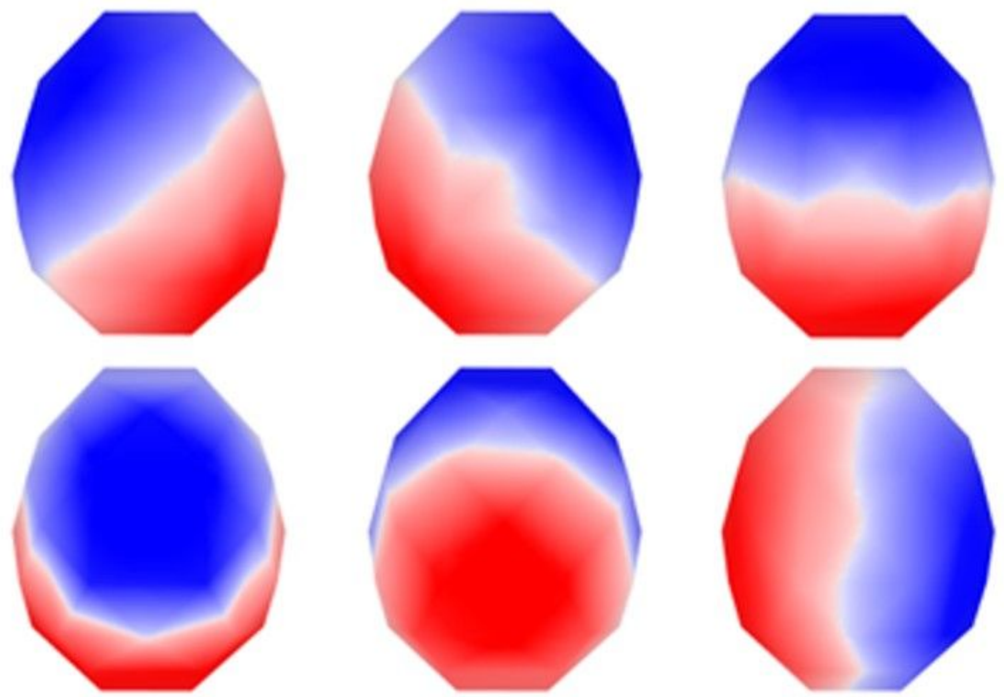
“EEG microstates clustering analysis using the meta-criterion identi ed 6 different maps (labeled as A, B, C, D, E, F) at both the individual and group levels as reported in Fig. 1.”
§ Altered EEG patterns in individuals with disorganized attachment: an EEG microstates study > Results
plain- Asserted: passes — The authors put it forward as true.
- Checkable: passes — It can be checked against evidence.
- Load-bearing: unclear — It is unclear whether the paper’s conclusions depend on it.
- Based: passes — The paper gives a reason why it holds.
A result the paper reports from its own data — it cites no other source for it, so there is none to check. The quote shows it is in the paper.
In the paper
“Post-AAI Mean Duration | - | -.405** | -.265 | -.207 | .354*”
§ Altered EEG patterns in individuals with disorganized attachment: an EEG microstates study > Discussion
plainstates an association- Asserted: passes — The authors put it forward as true.
- Checkable: passes — It can be checked against evidence.
- Load-bearing: passes — The paper’s conclusions depend on it.
- Based: passes — The paper gives a reason why it holds.
30 more claims
Create a free account to see all 56 claims and to verify the 30 references still open.
- Probably not a substantial claim. 17
- It may state two separate claims as one. 6
Self-check
Percentages, sums and reported differences re-computed from the paper’s own numbers.
Each contradiction between two passages listed here was confirmed by an independent check.
Rated major: it would touch a result — a value a result rests on, reported and recomputed p-values on opposite sides of the significance level, two passages that conflict with no sign which is right, or a cited work retracted before this paper was published.
In the paper
§ Altered EEG patterns in individuals with disorganized attachment: an EEG microstates study > Results
“Moreover, the coherence of mind subscale showed a signi cant and negative correlation with unresolved trauma (r p = -.364;p =. 009).”
§ Altered EEG patterns in individuals with disorganized attachment: an EEG microstates study > Discussion
“| Unresolved Loss | | | - | -.106 | -.364** | | Unresolved Trauma | | | | - | -.248 |”
Rated minor: it would not touch a result — a value no result rests on, a p-value that stays on the same side of the significance level, or a conflict that is clerical, resolved elsewhere in the paper, or outside its own findings.
In the paper
§ Altered EEG patterns in individuals with disorganized attachment: an EEG microstates study > Results
“21 participants (23.62 ± 1.94 years; 14 females) were classi ed as D/U and 29 as O/R (21.90 ± 1.63; 22 females).”
§ Altered EEG patterns in individuals with disorganized attachment: an EEG microstates study > Discussion
“| Age M ± SD | 21.90 ± 1.63 | 23.62 ± 2.94 | Z test = 1.043 | .227 |”
Rated minor: it would not touch a result — a value no result rests on, a p-value that stays on the same side of the significance level, or a conflict that is clerical, resolved elsewhere in the paper, or outside its own findings.
In the paper
§ Altered EEG patterns in individuals with disorganized attachment: an EEG microstates study > Results
“21 participants (23.62 ± 1.94 years; 14 females) were classi ed as D/U and 29 as O/R (21.90 ± 1.63; 22 females).”
§ Altered EEG patterns in individuals with disorganized attachment: an EEG microstates study > Discussion
“| Females N -% | 22 (75.86%) | 14 (66.66%) | χ2 = .511 | .475 |”
Citations
Cites
Delorme, A., & Makeig, S. (2004) · Journal of Neuroscience Methods · doi:10.1016/j.jneumeth.2003.10.009 · Cited by 24,371
The Brain's Default Network: Anatomy, Function, and Relevance to Disease
Buckner, R. L., Andrews‐Hanna, J. R., & Schacter, D. L. (2008) · Annals of the New York Academy of Sciences · doi:10.1196/annals.1440.011 · Cited by 9,761
Beck, A. T., Steer, R. A., & Brown, G. (2011) · PsycTESTS Dataset · doi:10.1037/t00742-000 · Cited by 7,535
The brief symptom inventory: an introductory report.
Derogatis, L. R., & Melisaratos, N. (1983) · Psychological Medicine · doi:10.1017/s0033291700048017 · Cited by 6,650
Cognitive and emotional influences in anterior cingulate cortex
Bush, G., Luu, P., & Posner, M. I. (2000) · Trends in Cognitive Sciences · doi:10.1016/s1364-6613(00)01483-2 · Cited by 6,259
Handbook of attachment: theory, research, and clinical applications
(1999) · Choice Reviews Online · doi:10.5860/choice.37-1841 · Cited by 5,389
Large-scale brain networks and psychopathology: a unifying triple network model
Menon, V. (2011) · Trends in Cognitive Sciences · doi:10.1016/j.tics.2011.08.003 · Cited by 4,168
Handbook of attachment: theory, research, and clinical applications
(2009) · Choice Reviews Online · doi:10.5860/choice.46-4135 · Cited by 3,806
Parametric measures of effect size.
Rosenthal, R. (1994) · Cited by 2,604
Estimating effect sizes from pretest-posttest-control group designs
Morris, S. B. (2008) · Organizational Research Methods · doi:10.1177/1094428106291059 · Cited by 2,133
Research works printed but not linked: 6
- Ainsworth, M., Blehar, M., Waters, E., & Wall, S. (1978). Patterns of Attachment. Hillsdale, NJ: Lawrence Eribaum Associates. Inc., Publishers, 144-153.
- Bowlby, J. (1973). Attachment and loss: Volume II: Separation, anxiety and anger. In Attachment and loss: Volume II: Separation, anxiety and anger (pp. 1-429). London: The Hogarth press and the institute of psycho-analysis. .
- George, C., Kaplan, N., & Main, M. (1996). Adult attachment interview. (U.o.C.a. Berkeley, ed 3.).
- Main M, Goldwyn R, Hesse E (1998) Adult attachment scoring and classification system. University of California, Berkeley
- Pedrabissi L, Santinello M (1989) Verifica della validità dello STAI forma Y di Spielberger. Giunti Organizzazioni Speciali, Firenze
- Spielberger CD, Gorsuch RL, Lushene RE, Vagg PR, Jacobs GA (1983) Manual for the state-trait anxietyinventory STAI (Form Y). Consulting Psychologists Press, Palo Alto
Cited by
Current State of EEG/ERP Microstate Research
Michel, C. M., Bréchet, L., Schiller, B., & Koenig, T. W. (2024) · Brain Topography · doi:10.1007/s10548-024-01037-3 · Cited by 60
Self-citationThe Psychopathological Domains of Attachment Trauma: A Proposal for a Clinical Conceptualization.
Farina, B., & Schimmenti, A. (2025) · PubMed Central · doi:10.36131/cnfioritieditore20250501 · Cited by 49
Self-citationCarbone, G. A., Imperatori, C., Adenzato, M., Presti, A. L., Farina, B., & Ardito, R. B. (2024) · Child Abuse & Neglect · doi:10.1016/j.chiabu.2024.106962 · Cited by 14
Self-citationCarbone, G. A., Presti, A. L., Farina, B., Adenzato, M., Ardito, R. B., & Imperatori, C. (2024) · International Journal of Psychophysiology · doi:10.1016/j.ijpsycho.2024.112440 · Cited by 8
Self-citationChouhan, S., Ghai, D., Sandhu, R., & Tripathi, S. L. (2026) · Neurological Sciences · doi:10.1007/s10072-025-08790-8 · Cited by 6
Metadata
- Authors
- Carbone, G. A., Michel, C. M., Farina, B., Adenzato, M., Ardito, R. B., Imperatori, C., & Artoni, F.
- Affiliations
- University of Turin (IT)
- University of Geneva (CH)
- European University of Rome (IT)
- Corresponding author
- Imperatori, Claudio
- ORCID
- Venue
- Brain Topography
- Published
- 2024-02-28
- Volume
- 37
- Issue
- 3
- Pages
- 420-431
- ISSN
- 0896-0267 (ISSN-L)
- 1573-6792
- OpenAlex
- W4392239719
- Semantic Scholar
- aa76b1b79911a008167211f9add0d47248f46fe7
- Cited by
- 8
- References
- 80
- Citations by year
- 2026: 2 · 2025: 2 · 2024: 4
- FWCI
- 1.22
- Type
- journal article
- Language
- en
- Open access
- green
- dx.doi.org
- Licence
- cc-by
- www.springernature.com/gp/researchers/text-and-data-mining (tdm)
- www.springernature.com/gp/researchers/text-and-data-mining (vor)
- Locations
- Brain Topography (publishedVersion)
- Research Square (submittedVersion, cc-by)
- PubMed (publishedVersion)
- Institutional Research Information System University of Turin (University of Turin) (submittedVersion)
- Virtual Community of Pathological Anatomy (University of Castilla La Mancha) (submittedVersion)
- Topics
- Life Sciences › Neuroscience › Cognitive Neuroscience › Functional Brain Connectivity Studies
- Social Sciences › Psychology › Social Psychology › Attachment and Relationship Dynamics
- Social Sciences › Psychology › Clinical Psychology › Psychoanalysis and Psychopathology Research
- Keywords
- disorganized attachment, EEG microstates, resting-state EEG, Adult Attachment Interview, attachment security, non-clinical sample
- MeSH terms
- Adult, Brain, Brain Mapping, Cognition, Electroencephalography, Emotions, Humans
About these checks
Registry, retraction, Cites and statistics results are computed, not judged, with one exception: a printed reference that no index lists is read once by a model before it counts as a citation error. Claims are extracted by a model and kept only when their quote appears verbatim in the text; each cited source is then checked, with a model’s help, for whether it says what the claim relies on. Those verdicts can be wrong — read the claim’s quote and the cited source before relying on one.
A language model drew the claims from the paper on 2026-11-24, under version 3 of the claim definition (model deepseek-v4.1-flash, prompt extract-v3).
A second model labelled each claim on 2026-11-24 (model jev-1.13-20260917, definition revision gold-guideline-v0.2).
Statistics and arithmetic are recomputed, not judged.
Confidence bands are shown only for fields calibrated on our annotated test set. None is calibrated yet, so no band is shown.
What counts as a claim ›How we measure confidence ›How we check this ›
Are you an author, or do you see a problem with this page? Request a review
Data sources
Bibliographic data: Semantic Scholar, OpenAlex, Crossref.
Contains information from the Semantic Scholar Academic Graph Datasets, made available under the ODC Attribution License (ODC-BY 1.0).
Semantic Scholar’s data is described in: Kinney, R., et al. (2023). The Semantic Scholar Open Data Platform. arXiv:2301.10140.
