

Altered EEG Patterns in Individuals with Disorganized Attachment: An EEG Microstates Study
Open accessPublished version of a preprint
The DOI matches its Crossref record; 81 of the 82 references it cites were found in a registry or an index, and 1 are not checked yet; none of the 35 sources its claims cite is checked for support yet.
Abstract
Background: Over the past years, different studies provided preliminary evidence that Disorganized Attachment (DA) may have dysregulatory and disintegrative effects on both autonomic arousal regulation and brain connectivity. However, despite the clinical relevance of this construct, few studies have investigated the specific alterations underlying DA using electroencephalography (EEG). Thus, the main aim of the current study was to extend the scientific literature on the EEG microstates correlates of DA in a non-clinical sample (N= 50) before and after the administration of the Adult Attachment Interview (AAI). Methods: Two EEG Resting State (RS) recordings were performed before and after the AAI. Microstates indices were then calculated using Cartool software. Results: the Disorganized/Unrevolved (D/U) group showed a lower mean duration of map E and a higher occurrence of map F than the organized individuals. Then, an effect of time also emerged for the microstates indices. Finally, a positive and significant correlation between mean duration of map E post-AAI and coherence of mind was found as well as a negative and significant correlation with segmentation density of map F post-AAI. Conclusion: our results showed significant differences in the EEG dynamic patterns of mean duration of map E and segmentation density of map F between groups, and a time effect reflecting disintegration mechanisms after retrieval of attachment memories.
Checked 2026-11-24 · 1 reference not checked yet
Overview
CoChat Summary
TL;DR
In a non-clinical sample of 50 undergraduates, EEG microstate dynamics differed by disorganized/unresolved attachment status after the Adult Attachment Interview: D/U individuals showed shorter mean duration of map E and higher segmentation density of map F than organized/resolved individuals. The study also found time effects across several microstate indices and correlations between map E/F metrics and AAI coherence/unresolved trauma.
Key findings
- The D/U group (n = 21) showed lower mean duration of map E than the O/R group (n = 29), F(1;49) = 4.584, p = .037, and higher segmentation density/occurrence of map F, F(1;49) = 4.051, p = .049.
- A Time effect emerged for mean duration of maps A, C, E, F; time coverage of maps C, D, E, F; and segmentation density of maps D and E.
- Post-AAI mean duration of map E positively correlated with coherence of mind (r_p = .354, p = .012), and post-AAI segmentation density of map F negatively correlated with post-AAI mean duration of map E (r_p = -.405, p = .004).
- Coherence of mind also negatively correlated with unresolved trauma (r_p = -.364, p = .009; Table 3 labels this paired variable as unresolved loss). No other significant correlations were found.
Methods
- Two resting-state EEG recordings were performed before (T0) and after (T1) the Adult Attachment Interview (AAI, lasting approximately 1.30 hours) in 50 undergraduate students (36 female, 14 male; mean age 22.69 ± 2.37 years), recruited October 2017–May 2018; AAI classification yielded 21 D/U and 29 O/R participants.
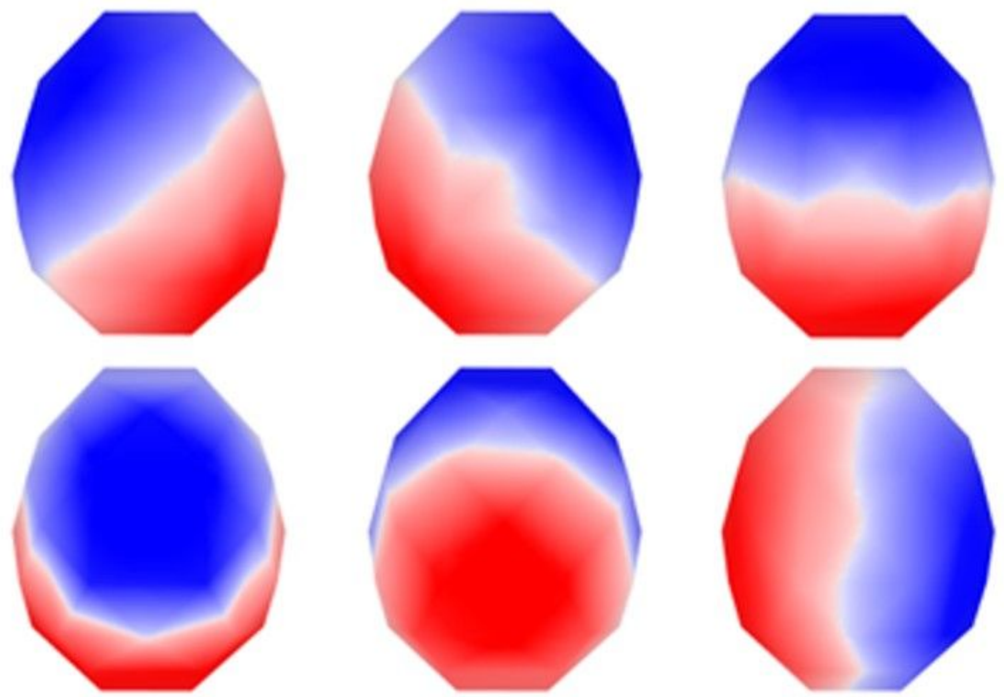
- EEG was recorded with a 31-electrode headset (10–20 system); preprocessing used EEGLAB (1–40 Hz band-pass, average reference, ICA, spherical spline interpolation), and microstate analysis used Cartool 4.09 with k-means clustering, a meta-criterion, and six maps (A–F); indices were occurrence/segmentation density, coverage, and duration.
- ANCOVA tested T1 microstate indices as dependent variables, group (O/R vs. D/U) as a between-subject factor, and T0 indices as covariates; non-normal variables were Rankit-transformed, Cohen’s dppc2 estimated group effect size, and secondary Pearson correlations examined AAI coherence of mind, unresolved trauma, and unresolved loss.
Limitations
- Stated: the sample was university students, so findings should be extended to a clinical sample (e.g., psychiatric patients with D/U) and replicated in a different, larger group.
- Evident from the text: the sample is small (N = 50; D/U n = 21, O/R n = 29) and many ANCOVA tests were run across maps and indices without a stated correction for multiple comparisons, making the p = .037 and p = .049 group effects potentially fragile.
- Evident from the text: there was no follow-up beyond the immediate post-AAI recording, so the durability or causal direction of the observed microstate differences cannot be established.
Model-written summary. Check it against the paper before relying on it.
Integrity signals
Registry
Cites
Statistics
Figures
Verification
Claims the paper makes
0 Valid · 0 Not valid · 21 Not checked · 35 Own results and interpretations
A result the paper reports from its own data — it cites no other source for it, so there is none to check. The quote shows it is in the paper.
In the paper
“Time coverage Map E | T0 | 10.976 ± 7.119 | 8.561 ± 6.861 | .002 F Time (1; 49) = 10.692; p = | .417”
§ Altered EEG patterns in individuals with disorganized attachment: an EEG microstates study > Discussion
plain- Asserted: passes — The authors put it forward as true.
- Checkable: passes — It can be checked against evidence.
- Load-bearing: unclear — It is unclear whether the paper’s conclusions depend on it.
- Based: passes — The paper gives a reason why it holds.
A result the paper reports from its own data — it cites no other source for it, so there is none to check. The quote shows it is in the paper.
In the paper
“Segmentation density Map F T0 5.132 ± 1.416 5.241 ± 1.223 F Time (1;49) = 3.689; p = .061.284T1 5.114 ± 1.307 5.600 ± 1.098 F Group (1;49) = 4.051; p = .049”
§ Altered EEG patterns in individuals with disorganized attachment: an EEG microstates study > Discussion
plainstates an association- Asserted: passes — The authors put it forward as true.
- Checkable: passes — It can be checked against evidence.
- Load-bearing: passes — The paper’s conclusions depend on it.
- Based: passes — The paper gives a reason why it holds.
A result the paper reports from its own data — it cites no other source for it, so there is none to check. The quote shows it is in the paper.
In the paper
“Post-AAI Mean Duration | - | -.405** | -.265 | -.207 | .354*”
§ Altered EEG patterns in individuals with disorganized attachment: an EEG microstates study > Discussion
plainstates an association- Asserted: passes — The authors put it forward as true.
- Checkable: passes — It can be checked against evidence.
- Load-bearing: unclear — It is unclear whether the paper’s conclusions depend on it.
- Based: passes — The paper gives a reason why it holds.
A result the paper reports from its own data — it cites no other source for it, so there is none to check. The quote shows it is in the paper.
In the paper
“EEG microstates clustering analysis using the meta-criterion identi ed 6 different maps (labeled as A, B, C, D, E, F) at both the individual and group levels as reported in Fig. 1.”
§ Altered EEG patterns in individuals with disorganized attachment: an EEG microstates study > Results
plain- Asserted: passes — The authors put it forward as true.
- Checkable: passes — It can be checked against evidence.
- Load-bearing: unclear — It is unclear whether the paper’s conclusions depend on it.
- Based: passes — The paper gives a reason why it holds.
A result the paper reports from its own data — it cites no other source for it, so there is none to check. The quote shows it is in the paper.
In the paper
“Post-AAI Mean Duration | - | -.405** | -.265 | -.207 | .354*”
§ Altered EEG patterns in individuals with disorganized attachment: an EEG microstates study > Discussion
plainstates an association- Asserted: passes — The authors put it forward as true.
- Checkable: passes — It can be checked against evidence.
- Load-bearing: passes — The paper’s conclusions depend on it.
- Based: passes — The paper gives a reason why it holds.
30 more claims
Create a free account to see all 56 claims and to verify the 30 references still open.
- Probably not a substantial claim. 17
- It may state two separate claims as one. 6
Self-check
Percentages, sums and reported differences re-computed from the paper’s own numbers.
Each contradiction between two passages listed here was confirmed by an independent check.
Rated major: it would touch a result — a value a result rests on, reported and recomputed p-values on opposite sides of the significance level, two passages that conflict with no sign which is right, or a cited work retracted before this paper was published.
In the paper
§ Altered EEG patterns in individuals with disorganized attachment: an EEG microstates study > Results
“Moreover, the coherence of mind subscale showed a signi cant and negative correlation with unresolved trauma (r p = -.364;p =. 009).”
§ Altered EEG patterns in individuals with disorganized attachment: an EEG microstates study > Discussion
“| Unresolved Loss | | | - | -.106 | -.364** | | Unresolved Trauma | | | | - | -.248 |”
Rated minor: it would not touch a result — a value no result rests on, a p-value that stays on the same side of the significance level, or a conflict that is clerical, resolved elsewhere in the paper, or outside its own findings.
In the paper
§ Altered EEG patterns in individuals with disorganized attachment: an EEG microstates study > Results
“21 participants (23.62 ± 1.94 years; 14 females) were classi ed as D/U and 29 as O/R (21.90 ± 1.63; 22 females).”
§ Altered EEG patterns in individuals with disorganized attachment: an EEG microstates study > Discussion
“| Age M ± SD | 21.90 ± 1.63 | 23.62 ± 2.94 | Z test = 1.043 | .227 |”
Rated minor: it would not touch a result — a value no result rests on, a p-value that stays on the same side of the significance level, or a conflict that is clerical, resolved elsewhere in the paper, or outside its own findings.
In the paper
§ Altered EEG patterns in individuals with disorganized attachment: an EEG microstates study > Results
“21 participants (23.62 ± 1.94 years; 14 females) were classi ed as D/U and 29 as O/R (21.90 ± 1.63; 22 females).”
§ Altered EEG patterns in individuals with disorganized attachment: an EEG microstates study > Discussion
“| Females N -% | 22 (75.86%) | 14 (66.66%) | χ2 = .511 | .475 |”
Citations
Cites
Delorme, A., & Makeig, S. (2004) · Journal of Neuroscience Methods · doi:10.1016/j.jneumeth.2003.10.009 · Cited by 24,371
The Brain's Default Network: Anatomy, Function, and Relevance to Disease
Buckner, R. L., Andrews‐Hanna, J. R., & Schacter, D. L. (2008) · Annals of the New York Academy of Sciences · doi:10.1196/annals.1440.011 · Cited by 9,761
Beck, A. T., Steer, R. A., & Brown, G. (2011) · PsycTESTS Dataset · doi:10.1037/t00742-000 · Cited by 7,535
The brief symptom inventory: an introductory report.
Derogatis, L. R., & Melisaratos, N. (1983) · Psychological Medicine · doi:10.1017/s0033291700048017 · Cited by 6,650
Cognitive and emotional influences in anterior cingulate cortex
Bush, G., Luu, P., & Posner, M. I. (2000) · Trends in Cognitive Sciences · doi:10.1016/s1364-6613(00)01483-2 · Cited by 6,259
Handbook of attachment: theory, research, and clinical applications
(1999) · Choice Reviews Online · doi:10.5860/choice.37-1841 · Cited by 5,389
Large-scale brain networks and psychopathology: a unifying triple network model
Menon, V. (2011) · Trends in Cognitive Sciences · doi:10.1016/j.tics.2011.08.003 · Cited by 4,168
Handbook of attachment: theory, research, and clinical applications
(2009) · Choice Reviews Online · doi:10.5860/choice.46-4135 · Cited by 3,806
Parametric measures of effect size.
Rosenthal, R. (1994) · Cited by 2,604
Estimating effect sizes from pretest-posttest-control group designs
Morris, S. B. (2008) · Organizational Research Methods · doi:10.1177/1094428106291059 · Cited by 2,133
The Use of Psychological Testing for Treatment Planning and Outcomes Assessment
(2004) · doi:10.4324/9781410610614 · Cited by 1,503
Michel, C. M., & Koenig, T. (2018) · NeuroImage · doi:10.1016/j.neuroimage.2017.11.062 · Cited by 1,329
Self-citationBOLD correlates of EEG topography reveal rapid resting-state network dynamics
Britz, J., Van De Ville, D., & Michel, C. M. (2010) · NeuroImage · doi:10.1016/j.neuroimage.2010.02.052 · Cited by 1,070
Self-citationSegmentation of brain electrical activity into microstates: model estimation and validation
Pascual-Marqui, R. D., Michel, C. M., & Lehmann, D. (1995) · IEEE Transactions on Biomedical Engineering · doi:10.1109/10.391164 · Cited by 986
Self-citationComputational Intelligence and Neuroscience
(2022) · Computational Intelligence and Neuroscience · doi:10.1155/8483 · Cited by 956
EEG alpha map series: brain micro-states by space-oriented adaptive segmentation
Lehmann, D., Ozaki, H., & Pal, I. (1987) · Electroencephalography and Clinical Neurophysiology · doi:10.1016/0013-4694(87)90025-3 · Cited by 913
Anterior cingulate cortex: unique role in cognition and emotion
Stevens, F. L., Hurley, R. A., & Taber, K. H. (2011) · The Journal of Neuropsychiatry and Clinical Neurosciences · doi:10.1176/jnp.23.2.jnp121 · Cited by 779
Millisecond by Millisecond, Year by Year: Normative EEG Microstates and Developmental Stages
Koenig, T., Prichep, L., Lehmann, D., Sosa, P. V., Braeker, E., Kleinlogel, H., Isenhart, R., & John, E. R. (2002) · NeuroImage · doi:10.1006/nimg.2002.1070 · Cited by 775
Spatiotemporal Analysis of Multichannel EEG: CARTOOL
Brunet, D., Murray, M. M., & Michel, C. M. (2011) · Computational Intelligence and Neuroscience · doi:10.1155/2011/813870 · Cited by 731
Self-citationAdult attachment measures: A 25-year review
Ravitz, P., Maunder, R., Hunter, J., Sthankiya, B., & Lancee, W. (2010) · Journal of Psychosomatic Research · doi:10.1016/j.jpsychores.2009.08.006 · Cited by 709 · cited 1×
“Previous research has shown that the AAI has good psychometric properties in both clinical and non-clinical samples (Bakermans-Kranenburg and Van IJzendoorn 1993; Ravitz et al. 2010).”
A Secure Base from Which to Explore Close Relationships
Waters, E., & Cummings, E. M. (2000) · Child Development · doi:10.1111/1467-8624.00130 · Cited by 587
Manual for the State-Trait Anxiety Inventory STAI (Form Y) ("Self-Evaluation Questionnaire")
Spielberger, C. D. (1983) · Cited by 558
(2008) · Cited by 525
Electroencephalographic Resting-State Networks: Source Localization of Microstates
Custo, A., Van De Ville, D., Wells, W. M., Tomescu, M. I., Brunet, D., & Michel, C. M. (2017) · Brain Connectivity · doi:10.1089/brain.2016.0476 · Cited by 516
Self-citationTrauma, dissociation, and disorganized attachment: Three strands of a single braid.
Liotti, G. (2004) · Psychotherapy: Theory, Research, Practice, Training · doi:10.1037/0033-3204.41.4.472 · Cited by 479
A psychometric study of the Adult Attachment Interview: Reliability and discriminant validity.
Bakermans-Kranenburg, M. J., & Van IJzendoorn, M. H. (1993) · Developmental Psychology · doi:10.1037//0012-1649.29.5.870 · Cited by 462
Psychophysiology in Attachment Interviews: Converging Evidence for Deactivating Strategies
Dozier, M., & Kobak, R. R. (1992) · Child Development · doi:10.1111/j.1467-8624.1992.tb01708.x · Cited by 461
Capturing the spatiotemporal dynamics of self-generated, task-initiated thoughts with EEG and fMRI
Bréchet, L., Brunet, D., Birot, G., Gruetter, R., Michel, C. M., & Jorge, J. (2019) · NeuroImage · doi:10.1016/j.neuroimage.2019.03.029 · Cited by 329
Self-citationPsychophysiology in Attachment Interviews: Converging Evidence for Deactivating Strategies
Dozier, M., & Kobak, R. R. (1992) · Child Development · doi:10.2307/1131569 · Cited by 319
Granqvist, P., Sroufe, L. A., Dozier, M., Hesse, E., Steele, M., van Ijzendoorn, M., Solomon, J., Schuengel, C., Fearon, P., Bakermans-Kranenburg, M., et al. (2017) · Attachment & Human Development · doi:10.1080/14616734.2017.1354040 · Cited by 317
The Functional Aspects of Resting EEG Microstates: A Systematic Review
Tarailis, P., Koenig, T., Michel, C. M., & Griškova-Bulanova, I. (2024) · Brain Topography · doi:10.1007/s10548-023-00958-9 · Cited by 304
Self-citationParent-Child Attachment and Emotion Regulation
Brumariu, L. E. (2015) · New Directions for Child and Adolescent Development · doi:10.1002/cad.20098 · Cited by 298
Disorganized attachment and caregiving
(2012) · Choice Reviews Online · doi:10.5860/choice.49-4756 · Cited by 229
Sica, C., & Ghisi, M. (2007) · Florence Research (University of Florence) · Cited by 216
Affect, Attachment, Memory: Contributions Toward Psychobiologic Integration
Fariborz, A., Thomas, L., Richard, L., Alan, L., Gordon, B., Teresa, M., & Schiff, E. Z. (1996) · Psychiatry · doi:10.1080/00332747.1996.11024764 · Cited by 207
Verifica della validità dello S.T.A.I. forma Y di Spielberger
Pedrabissi, L., & Santinello, M. (1989) · Padua Research Archive (University of Padova) · Cited by 174
Spherical Splines and Average Referencing in Scalp Electroencephalography
Ferrée, T. C. (2006) · Brain Topography · doi:10.1007/s10548-006-0011-0 · Cited by 165
Impact of Rank-Based Normalizing Transformations on the Accuracy of Test Scores
Soloman, S. R., & Sawilowsky, S. S. (2009) · Journal of Modern Applied Statistical Methods · doi:10.22237/jmasm/1257034080 · Cited by 161
MICROSTATELAB: The EEGLAB Toolbox for Resting-State Microstate Analysis
Kalburgi, S. N., Kleinert, T., Aryan, D., Nash, K. A., Schiller, B., & Koenig, T. W. (2023) · Brain Topography · doi:10.1007/s10548-023-01003-5 · Cited by 154
Child Maltreatment, Abuse, and Neglect: An Umbrella Review of Their Prevalence and Definitions.
Massullo, C., Rossi, E. D., Carbone, G. A., Imperatori, C., Ardito, R. B., Adenzato, M., & Farina, B. (2023) · PubMed Central · doi:10.36131/cnfioritieditore20230201 · Cited by 148
Self-citationAutonomic reactivity in relation to attachment and early adversity among foster children
Oosterman, M., De Schipper, J. C., Fisher, P., Dozier, M., & Schuengel, C. (2010) · Development and Psychopathology · doi:10.1017/s0954579409990290 · Cited by 145
EEG Resting-State Large-Scale Brain Network Dynamics Are Related to Depressive Symptoms
Damborská, A., Tomescu, M. I., Honzírková, E., Barteček, R., Hořínková, J., Fedorová, S., Ondruš, Š., & Michel, C. M. (2019) · Frontiers in Psychiatry · doi:10.3389/fpsyt.2019.00548 · Cited by 137
Self-citationBeilharz, J. E., Paterson, M., Fatt, S. J., Wilson, C. E., Burton, A. R., Cvejic, E., Lloyd, A. R., & Vollmer-Conna, U. S. (2019) · Australian & New Zealand Journal of Psychiatry · doi:10.1177/0004867419881206 · Cited by 123
Attachment in the preschool years: Theory, research and intervention
New, M. (1992) · Behaviour Research and Therapy · doi:10.1016/0005-7967(92)90154-9 · Cited by 122
Koenig, T. W., Diezig, S., Kalburgi, S. N., Antonova, E., Artoni, F., Bréchet, L., Britz, J., Croce, P., Custo, A., Damborská, A., et al. (2023) · Brain Topography · doi:10.1007/s10548-023-00993-6 · Cited by 121
Self-citationItalian community norms for the Brief Symptom Inventory in the elderly
De Leo, D., Frisoni, G. B., Rozzini, R., & Trabucchi, M. (1993) · British Journal of Clinical Psychology · doi:10.1111/j.2044-8260.1993.tb01045.x · Cited by 120
Farina, B., Liotti, M., & Imperatori, C. (2019) · Frontiers in Psychology · doi:10.3389/fpsyg.2019.00933 · Cited by 118
Self-citationPsychological Trauma in the Context of Familial Relationships: A Concept Analysis
Isobel, S., Goodyear, M. J., & Foster, K. (2017) · Trauma Violence & Abuse · doi:10.1177/1524838017726424 · Cited by 93
Pipinis, E., Mėlynytė, S., Koenig, T. W., Jarutytė, L., Linkenkaer‐Hansen, K., Rukšėnas, O., & Griškova-Bulanova, I. (2016) · Brain Topography · doi:10.1007/s10548-016-0522-2 · Cited by 93
EEG Microstates Analysis in Young Adults With Autism Spectrum Disorder During Resting-State
D’Croz-Baron, D. F., Baker, M. C., Michel, C. M., & Karp, T. (2019) · Frontiers in Human Neuroscience · doi:10.3389/fnhum.2019.00173 · Cited by 85
Self-citationEEG Microstates in Mood and Anxiety Disorders: A Meta-analysis
Chivu, A. C., Pascal, S. A., Damborská, A., & Tomescu, M. I. (2023) · Brain Topography · doi:10.1007/s10548-023-00999-0 · Cited by 78
Forslund, T., Brocki, K. C., Bohlin, G., Granqvist, P., & Eninger, L. (2016) · British Journal of Developmental Psychology · doi:10.1111/bjdp.12136 · Cited by 77
EEG microstates: Functional significance and short-term test-retest reliability
Antonova, E., Holding, M., Suen, H. C., Sumich, A., Maex, R., & Nehaniv, C. (2022) · Neuroimage: Reports · doi:10.1016/j.ynirp.2022.100089 · Cited by 77
The Adult Attachment Interview
Mandelbaum, T. (2020) · Routledge eBooks · doi:10.4324/9781003090878-3 · Cited by 74
Disorganized attachment and caregiving
Solomon, J., & George, C. C. (2011) · Cited by 71
Tarailis, P., Šimkutė, D., Koenig, T. W., & Griškova-Bulanova, I. (2021) · Journal of Personalized Medicine · doi:10.3390/jpm11111216 · Cited by 62
Kan, D. P. X., Croarkin, P. E., Phang, C. K., & Lee, P. F. (2017) · Neurophysiology · doi:10.1007/s11062-018-9706-6 · Cited by 59
Memories of attachment hamper EEG cortical connectivity in dissociative patients
Farina, B., Speranza, A. M., Dittoni, S., Gnoni, V., Trentini, C., Vergano, C. M., Liotti, G., Brunetti, R., Testani, E., & Marca, G. D. (2014) · European Archives of Psychiatry and Clinical Neuroscience · doi:10.1007/s00406-013-0461-9 · Cited by 55
Self-citationEEG Microstates in Social and Affective Neuroscience
Schiller, B., Sperl, M. F. J., Kleinert, T., Nash, K. A., & Gianotti, L. R. R. (2023) · Brain Topography · doi:10.1007/s10548-023-00987-4 · Cited by 54
Wei, Y., Ramautar, J. R., Colombo, M. A., Lindert, B. H. W. T., & Someren, E. J. W. V. (2018) · Frontiers in Psychiatry · doi:10.3389/fpsyt.2018.00395 · Cited by 51
Serrano, J. I., del Castillo, M. D., Cortés, V., Mendes, N., Arroyo-Ferrer, A., Andreo-Jover, J., Rocón, E., Valle, M. D., Rodríguez, J. H., & Romero, J. P. (2018) · Frontiers in Neuroscience · doi:10.3389/fnins.2018.00714 · Cited by 49
Attachment Theory and Multiple Integrated Treatments of Borderline Patients
Liotti, G., Cortina, M., & Farina, B. (2008) · Journal of the American Academy of Psychoanalysis and Dynamic Psychiatry · doi:10.1521/jaap.2008.36.2.295 · Cited by 46
Self-citationKe, M., Li, J., & Wang, L. (2021) · Frontiers in Human Neuroscience · doi:10.3389/fnhum.2021.636252 · Cited by 46
Associations between self-reported spontaneous thought and temporal sequences of EEG microstates
Zanesco, A. P., Denkova, E., & Jha, A. P. (2021) · Brain and Cognition · doi:10.1016/j.bandc.2021.105696 · Cited by 45
Shi, W., Li, Y., Liu, Z., Li, J., Wang, Q., Yan, X., & Wang, G. (2020) · International Journal of Neural Systems · doi:10.1142/s0129065720500057 · Cited by 40
Changes in Default-Mode Network Associated With Childhood Trauma in Schizophrenia
Dauvermann, M. R., Mothersill, D., Rokita, K. I., King, S., Holleran, L., Kane, R., McKernan, D. P., Kelly, J. P., Morris, D. W., Corvin, A., et al. (2021) · Schizophrenia Bulletin · doi:10.1093/schbul/sbab025 · Cited by 39
Spectral decomposition of EEG microstates in post-traumatic stress disorder
Terpou, B. A., Shaw, S. B., Théberge, J., Férat, V., Michel, C. M., McKinnon, M. C., Lanius, R. A., & Ros, T. (2022) · NeuroImage: Clinical · doi:10.1016/j.nicl.2022.103135 · Cited by 36
Self-citationMassullo, C., Carbone, G. A., Farina, B., Panno, A., Capriotti, C., Giacchini, M., Machado, S. E. D. C., Budde, H., Murillo‐Rodríguez, E., & Imperatori, C. (2020) · International Journal of Psychophysiology · doi:10.1016/j.ijpsycho.2020.09.002 · Cited by 34
Self-citationAdenzato, M., Imperatori, C., Ardito, R. B., Valenti, E. M., Marca, G. D., D’Ari, S., Palmiero, L., Penso, J. S., & Farina, B. (2019) · Behavioural Brain Research · doi:10.1016/j.bbr.2019.112059 · Cited by 33
Self-citationLiu, Z., Si, L., Xu, W., Zhang, K., Wang, Q., Chen, B., & Wang, G. (2022) · IEEE Transactions on Neural Systems and Rehabilitation Engineering · doi:10.1109/tnsre.2022.3182705 · Cited by 33
Global field power: a ‘time-honoured’ index for EEG/EP map analysis
Michel, C. M., Brandeis, D., Skrandies, W., Pascual, R., Strik, W. K., Dierks, T., Hamburger, H., & Karniski, W. M. (1993) · International Journal of Psychophysiology · doi:10.1016/0167-8760(93)90088-7 · Cited by 28
Self-citationAttachment Manifestations in Daily Interpersonal Interactions
Kaurin, A., Pilkonis, P. A., & Wright, A. G. C. (2022) · Affective Science · doi:10.1007/s42761-022-00117-6 · Cited by 26
Farina, B., & Imperatori, C. (2023) · Psychopathology · doi:10.1159/000535191 · Cited by 24
Self-citationWang, X., Liu, Q., Fan, J., Gao, F., Xia, J., Liu, X., Du, H., Liao, H., Tan, C., & Zhu, X. (2022) · Journal of Psychiatric Research · doi:10.1016/j.jpsychires.2022.07.051 · Cited by 22
Heart rate variability in response to the recall of attachment memories
Zingaretti, P., Giovanardi, G., Cruciani, G., Lingiardi, V., Ottaviani, C., & Spitoni, G. F. (2019) · Attachment & Human Development · doi:10.1080/14616734.2019.1680712 · Cited by 20
Parlar, M., Densmore, M., Hall, G. B. C., Lanius, R., & McKinnon, M. C. (2018) · Neuropsychologia · doi:10.1016/j.neuropsychologia.2017.07.004 · Cited by 19
Massullo, C., Imperatori, C., De Vico Fallani, F., Ardito, R. B., Adenzato, M., Palmiero, L., Carbone, G. A., & Farina, B. (2022) · Scientific Reports · doi:10.1038/s41598-022-08685-0 · Cited by 16
Self-citationThe role of early attachment experiences in modulating defensive peripersonal space
Fossataro, C., Adenzato, M., Bruno, M., Fontana, E., Garbarini, F., & Ardito, R. B. (2023) · Scientific Reports · doi:10.1038/s41598-023-30985-2 · Cited by 13
Self-citationA Framework for Monte Carlo based Multiple Testing
Gandy, A., & Hahn, G. (2016) · Scandinavian Journal of Statistics · doi:10.1111/sjos.12228 · Cited by 11
Valence-specific EEG microstate modulations during self-generated affective states
Nazare, K., & Tomescu, M. I. (2024) · Frontiers in Psychology · doi:10.3389/fpsyg.2024.1300416 · Cited by 10
Correction: EEG Microstates in Mood and Anxiety Disorders: A Meta-analysis
Chivu, A. C., Pascal, S. A., Damborská, A., & Tomescu, M. I. (2023) · Brain Topography · doi:10.1007/s10548-023-01028-w · Cited by 4
Capturing the spatiotemporal dynamics of task-initiated thoughts with combined EEG and fMRI
Bréchet, L., Brunet, D., Birot, G., Gruetter, R., Michel, C. M., & Jorge, J. (2018) · doi:10.1101/346346
Self-citation
Research works printed but not linked: 6
- Ainsworth, M., Blehar, M., Waters, E., & Wall, S. (1978). Patterns of Attachment. Hillsdale, NJ: Lawrence Eribaum Associates. Inc., Publishers, 144-153.
- Bowlby, J. (1973). Attachment and loss: Volume II: Separation, anxiety and anger. In Attachment and loss: Volume II: Separation, anxiety and anger (pp. 1-429). London: The Hogarth press and the institute of psycho-analysis. .
- George, C., Kaplan, N., & Main, M. (1996). Adult attachment interview. (U.o.C.a. Berkeley, ed 3.).
- Main M, Goldwyn R, Hesse E (1998) Adult attachment scoring and classification system. University of California, Berkeley
- Pedrabissi L, Santinello M (1989) Verifica della validità dello STAI forma Y di Spielberger. Giunti Organizzazioni Speciali, Firenze
- Spielberger CD, Gorsuch RL, Lushene RE, Vagg PR, Jacobs GA (1983) Manual for the state-trait anxietyinventory STAI (Form Y). Consulting Psychologists Press, Palo Alto
Cited by
Current State of EEG/ERP Microstate Research
Michel, C. M., Bréchet, L., Schiller, B., & Koenig, T. W. (2024) · Brain Topography · doi:10.1007/s10548-024-01037-3 · Cited by 60
Self-citationThe Psychopathological Domains of Attachment Trauma: A Proposal for a Clinical Conceptualization.
Farina, B., & Schimmenti, A. (2025) · PubMed Central · doi:10.36131/cnfioritieditore20250501 · Cited by 49
Self-citationCarbone, G. A., Imperatori, C., Adenzato, M., Presti, A. L., Farina, B., & Ardito, R. B. (2024) · Child Abuse & Neglect · doi:10.1016/j.chiabu.2024.106962 · Cited by 14
Self-citationCarbone, G. A., Presti, A. L., Farina, B., Adenzato, M., Ardito, R. B., & Imperatori, C. (2024) · International Journal of Psychophysiology · doi:10.1016/j.ijpsycho.2024.112440 · Cited by 8
Self-citationChouhan, S., Ghai, D., Sandhu, R., & Tripathi, S. L. (2026) · Neurological Sciences · doi:10.1007/s10072-025-08790-8 · Cited by 6
Metadata
- Authors
- Carbone, G. A., Michel, C. M., Farina, B., Adenzato, M., Ardito, R. B., Imperatori, C., & Artoni, F.
- Affiliations
- University of Turin (IT)
- University of Geneva (CH)
- European University of Rome (IT)
- Corresponding author
- Imperatori, Claudio
- ORCID
- Venue
- Brain Topography
- Published
- 2024-02-28
- Volume
- 37
- Issue
- 3
- Pages
- 420-431
- ISSN
- 0896-0267 (ISSN-L)
- 1573-6792
- OpenAlex
- W4392239719
- Semantic Scholar
- aa76b1b79911a008167211f9add0d47248f46fe7
- Cited by
- 8
- References
- 80
- Citations by year
- 2026: 2 · 2025: 2 · 2024: 4
- FWCI
- 1.22
- Type
- journal article
- Language
- en
- Open access
- green
- dx.doi.org
- Licence
- cc-by
- www.springernature.com/gp/researchers/text-and-data-mining (tdm)
- www.springernature.com/gp/researchers/text-and-data-mining (vor)
- Locations
- Brain Topography (publishedVersion)
- Research Square (submittedVersion, cc-by)
- PubMed (publishedVersion)
- Institutional Research Information System University of Turin (University of Turin) (submittedVersion)
- Virtual Community of Pathological Anatomy (University of Castilla La Mancha) (submittedVersion)
- Topics
- Life Sciences › Neuroscience › Cognitive Neuroscience › Functional Brain Connectivity Studies
- Social Sciences › Psychology › Social Psychology › Attachment and Relationship Dynamics
- Social Sciences › Psychology › Clinical Psychology › Psychoanalysis and Psychopathology Research
- Keywords
- disorganized attachment, EEG microstates, resting-state EEG, Adult Attachment Interview, attachment security, non-clinical sample
- MeSH terms
- Adult, Brain, Brain Mapping, Cognition, Electroencephalography, Emotions, Humans
About these checks
Registry, retraction, Cites and statistics results are computed, not judged, with one exception: a printed reference that no index lists is read once by a model before it counts as a citation error. Claims are extracted by a model and kept only when their quote appears verbatim in the text; each cited source is then checked, with a model’s help, for whether it says what the claim relies on. Those verdicts can be wrong — read the claim’s quote and the cited source before relying on one.
A language model drew the claims from the paper on 2026-11-24, under version 3 of the claim definition (model deepseek-v4.1-flash, prompt extract-v3).
A second model labelled each claim on 2026-11-24 (model jev-1.13-20260917, definition revision gold-guideline-v0.2).
Statistics and arithmetic are recomputed, not judged.
Confidence bands are shown only for fields calibrated on our annotated test set. None is calibrated yet, so no band is shown.
What counts as a claim ›How we measure confidence ›How we check this ›
Are you an author, or do you see a problem with this page? Request a review
Data sources
Bibliographic data: Semantic Scholar, OpenAlex, Crossref.
Contains information from the Semantic Scholar Academic Graph Datasets, made available under the ODC Attribution License (ODC-BY 1.0).
Semantic Scholar’s data is described in: Kinney, R., et al. (2023). The Semantic Scholar Open Data Platform. arXiv:2301.10140.
