

Efficacy and Safety of the PCSK9 Inhibitor Evolocumab in Patients with Mixed Hyperlipidemia
Open accessThe DOI matches its Crossref record; 35 of the 36 references it cites were found in a registry or an index.
Abstract
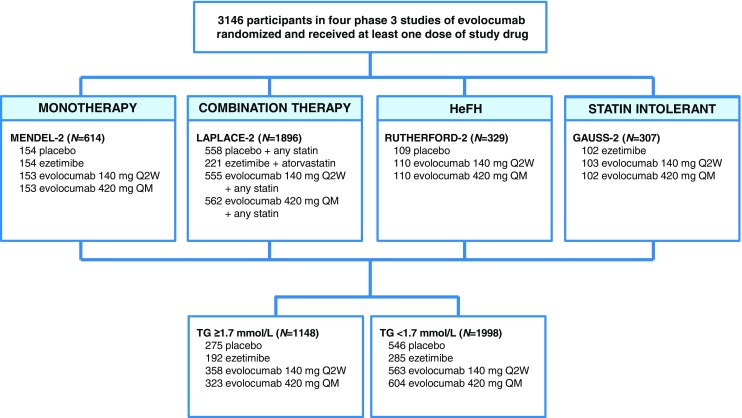
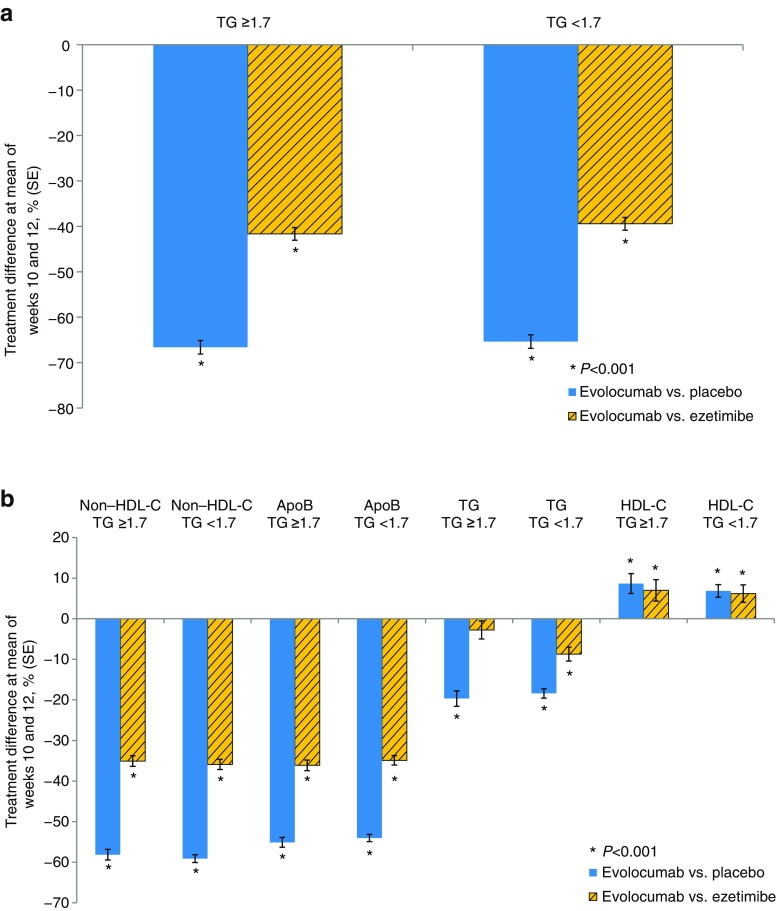
PURPOSE: Evolocumab significantly reduces low-density lipoprotein-cholesterol (LDL-C); we investigated its effects on LDL-C lowering in patients with mixed hyperlipidemia. METHODS: We compared the efficacy and safety of evolocumab in hypercholesterolemic patients selected from the phase 2 and 3 trials who had fasting triglyceride levels ≥1.7 mmol/L (150 mg/dL elevated triglycerides) and <1.7 mmol/L (without elevated triglycerides). Fasting triglyceride level ≥ 4.5 mmol/L at screening was an exclusion criterion for these studies, but post-enrollment triglyceride levels may have exceeded 4.5 mmol/L (400 mg/dL). Efficacy was evaluated in four phase 3 randomized studies (n = 1148) and safety from the phase 2 and 3 studies (n = 2246) and their open-label extension studies (n = 1698). Efficacy analyses were based on 12-week studies, while safety analyses included data from all available studies. Treatment differences were calculated vs. placebo and ezetimibe after pooling dose frequencies. RESULTS: Mean treatment difference in percentage change from baseline in LDL-C for participants with elevated triglycerides and those without elevated triglycerides (mean of weeks 10 and 12) with evolocumab was approximately -67 % vs. placebo and -42 % vs. ezetimibe (all P < 0.001) compared to −65 % vs. placebo and −39 % vs. ezetimibe, [corrected] respectively. Treatment differences for evolocumab vs. placebo and ezetimibe followed a similar pattern for non-high-density lipoprotein (HDL-C) and apolipoprotein B. Evolocumab was well tolerated, with balanced rates of adverse events leading to discontinuation of evolocumab vs. comparator (placebo and/or ezetimibe). CONCLUSION: The significant reductions of atherogenic lipids including LDL-C, non-HDL-C, and apolipoprotein B seen with evolocumab are similar in patients with and without mixed hyperlipidemia.
Overview
The claims and statistics of this paper haven’t been checked yet.
Free: it reads the open-access text and checks the first 5 claims that cite a source we can check. Create a free account to check every claim.
Integrity signals
Registry
Cites
Statistics
Figures
Verification
Claims the paper makes
The claims and statistics of this paper haven’t been checked yet.
Free: it reads the open-access text and checks the first 5 claims that cite a source we can check. Create a free account to check every claim.
Self-check
Percentages, sums and reported differences re-computed from the paper’s own numbers.
The self-check needs the paper’s full text.
Citations
Cites
Stone, N. J., Robinson, J. G., Lichtenstein, A. H., Bairey Merz, C. N., Blum, C. B., Eckel, R. H., Goldberg, A. C., Gordon, D., Levy, D., Lloyd-Jones, D. M., et al. (2014) · Circulation · doi:10.1161/01.cir.0000437738.63853.7a · Cited by 7,081
Efficacy and Safety of Alirocumab in Reducing Lipids and Cardiovascular Events
Robinson, J. G., Farnier, M., Krempf, M., Bergeron, J., Luc, G., Averna, M., Stroes, E. S., Langslet, G., Raal, F. J., El Shahawy, M., et al. (2015) · New England Journal of Medicine · doi:10.1056/nejmoa1501031 · Cited by 2,296 · cited 1×
“Full details of the exclusion criteria have been published elsewhere [16].”
BackgroundTriglycerides and Cardiovascular Disease: A Scientific Statement From the American Heart Association
Miller, M., Stone, N. J., Ballantyne, C., Bittner, V., Criqui, M. H., Ginsberg, H. N., Goldberg, A. C., Howard, W. J., Jacobson, M. S., Kris-Etherton, P. M., et al. (2011) · Circulation · doi:10.1161/cir.0b013e3182160726 · Cited by 1,871
Self-citationEfficacy and Safety of Evolocumab in Reducing Lipids and Cardiovascular Events
Sabatine, M. S., Giugliano, R. P., Wiviott, S. D., Raal, F. J., Blom, D. J., Robinson, J., Ballantyne, C. M., Somaratne, R., Legg, J., Wasserman, S. M., et al. (2015) · New England Journal of Medicine · doi:10.1056/nejmoa1500858 · Cited by 1,509 · cited 1×
“Full details of the exclusion criteria have been published elsewhere [16].”
BackgroundLamarche, B., Tchernof, A., Moorjani, S., Cantin, B., Dagenais, G. R., Lupien, P. J., & Despre´s, J.-P. (1997) · Circulation · doi:10.1161/01.cir.95.1.69 · Cited by 1,077 · cited 1×
“This leads to higher LDL particle concentrations in patients with elevated triglycerides than would be predicted based on the level of LDL-C [29, 31].”
BackgroundBoekholdt, S. M., Arsenault, B. J., Mora, S., Pedersen, T. R., LaRosa, J. C., Nestel, P. J., Simes, R. J., Durrington, P., Hitman, G. A., Welch, K. M. A., et al. (2012) · JAMA · doi:10.1001/jama.2012.366 · Cited by 795
National Lipid Association Recommendations for Patient-Centered Management of Dyslipidemia: Part 2
Jacobson, T. A., Maki, K. C., Orringer, C. E., Jones, P. H., Kris-Etherton, P., Sikand, G., La Forge, R., Daniels, S. R., Wilson, D. P., Morris, P. B., et al. (2015) · Journal of Clinical Lipidology · doi:10.1016/j.jacl.2015.09.002 · Cited by 784
Self-citationJacobson, T. A., Ito, M. K., Maki, K. C., Orringer, C. E., Bays, H. E., Jones, P. H., McKenney, J. M., Grundy, S. M., Gill, E. A., Wild, R. A., et al. (2015) · Journal of Clinical Lipidology · doi:10.1016/j.jacl.2015.02.003 · Cited by 773 · cited 1×
“Consequently, professional societies have endorsed [18, 20, 21] non–HDL-C (LDL-C + VLDL-C) as the preferred target in patients with mixed hyperlipidemia [22].”
BackgroundSelf-citation
Cited by
Langlois, M. R., Chapman, M. J., Cobbaert, C., Mora, S., Remaley, A. T., Ros, E., Watts, G. F., Borén, J., Baum, H., Bruckert, E., et al. (2018) · Clinical Chemistry · doi:10.1373/clinchem.2018.287037 · Cited by 260
“7 mmol/L) followed a similar pattern for LDLC ( 67% and 65% vs placebo), non-HDLC ( 53% and 54%), and apoB ( 49% and 50%) (133).”
BackgroundMethodNordestgaard, B. G., Langlois, M. R., Langsted, A., Chapman, M. J., Aakre, K. M., Baum, H., Borén, J., Bruckert, E., Catapano, A., Cobbaert, C., et al. (2020) · Atherosclerosis · doi:10.1016/j.atherosclerosis.2019.12.005 · Cited by 246
Langlois, M. R., Nordestgaard, B. G., Langsted, A., Chapman, M. J., Aakre, K. M., Baum, H., Borén, J., Bruckert, E., Catapano, A., Cobbaert, C., et al. (2020) · Clinical Chemistry and Laboratory Medicine (CCLM) · doi:10.1515/cclm-2019-1253 · Cited by 211
Clinical Pharmacokinetics and Pharmacodynamics of Evolocumab, a PCSK9 Inhibitor
Kasichayanula, S., Grover, A., Emery, M. G., Gibbs, M. A., Somaratne, R., Wasserman, S. M., & Gibbs, J. P. (2018) · Clinical Pharmacokinetics · doi:10.1007/s40262-017-0620-7 · Cited by 135
“Across those studies, evolocumab reduced triglycerides less effectively than it reduced other lipids, but evolocumab has similar effects on LDL-C in patients with or without mixed dyslipidemia due to elevated triglycerides [43].”
BackgroundRay, K. K., Leiter, L. A., Müller‐Wieland, D., Cariou, B., Colhoun, H. M., Henry, R. R., Tinahones, F. J., Bujas‐Bobanovic, M., Domenger, C., Letierce, A., et al. (2018) · Diabetes, Obesity and Metabolism · doi:10.1111/dom.13257 · Cited by 102
Langlois, M. R., & Sniderman, A. D. (2020) · Current Cardiology Reports · doi:10.1007/s11886-020-01323-z · Cited by 79
Tang, Y., Li, S.-L., Hu, J.-H., Sun, K.-J., Liu, L.-L., & Xu, D.-Y. (2020) · Cardiovascular Diabetology · doi:10.1186/s12933-020-01009-4 · Cited by 51
Beyond LDL: What Role for PCSK9 in Triglyceride-Rich Lipoprotein Metabolism?
Dijk, W., May, C. L., & Cariou, B. (2018) · Trends in Endocrinology and Metabolism · doi:10.1016/j.tem.2018.03.013 · Cited by 53
Effects of PCSK9 Inhibitors on Other than Low-Density Lipoprotein Cholesterol Lipid Variables
Filippatos, T. D., Kei, A., Rizos, C. V., & Elisaf, M. S. (2018) · Journal of Cardiovascular Pharmacology and Therapeutics · doi:10.1177/1074248417724868 · Cited by 41
PCSK9 in Myocardial Infarction and Cardioprotection: Importance of Lipid Metabolism and Inflammation
Andreadou, I., Tsoumani, M. E., Vilahur, G., Ikonomidis, I., Badimón, L., Varga, Z. V., Ferdinandy, P., & Schulz, R. (2020) · Frontiers in Physiology · doi:10.3389/fphys.2020.602497 · Cited by 42
“Same reduction levels were observed for patients with mixed hyperlipidaemia (Rosenson et al., 2016).”
BackgroundSu, Z., Hang, P., Hu, J., Zheng, Y., Sun, H., Guo, J., Liu, K., & Du, Z. (2020) · Acta Pharmacologica Sinica · doi:10.1038/s41401-020-0392-8 · Cited by 37
Baragetti, A., Grejtáková, D., Casula, M., Olmastroni, E., Jotti, G. S., Norata, G. D., Catapano, A. L., & Bellosta, S. (2018) · Pharmacological Research · doi:10.1016/j.phrs.2018.01.025 · Cited by 36
“3a)), further supporting this hypothesis [95,96].”
Taskinen, M., Prato, S. D., Bujas‐Bobanovic, M., Louie, M. J., Letierce, A., Thompson, D. E., & Colhoun, H. M. (2018) · Atherosclerosis · doi:10.1016/j.atherosclerosis.2018.07.017 · Cited by 34
Gonna, H., & Ray, K. K. (2019) · Diabetes Obesity and Metabolism · doi:10.1111/dom.13691 · Cited by 33
Taskinen, M.-R., Björnson, E., Kahri, J., Söderlund, S., Matikainen, N., Porthan, K., Ainola, M., Hakkarainen, A., Lundbom, N., Fermanelli, V., et al. (2021) · Arteriosclerosis, Thrombosis, and Vascular Biology · doi:10.1161/atvbaha.120.315446 · Cited by 30
Efficacy and safety of PCSK9 monoclonal antibodies: an evidence-based review and update
Kaddoura, R., Orabi, B., & Salam, A. M. (2020) · Journal of Drug Assessment · doi:10.1080/21556660.2020.1801452 · Cited by 34
Familial combined hyperlipidemia is a polygenic trait
Gill, P. K., & Hegele, R. A. (2021) · Current Opinion in Lipidology · doi:10.1097/mol.0000000000000796 · Cited by 28
Langlois, M. R., & Nordestgaard, B. G. (2018) · Current Cardiology Reports · doi:10.1007/s11886-018-1036-1 · Cited by 19
Shaik, A., & Rosenson, R. S. (2021) · Cardiovascular Drugs and Therapy · doi:10.1007/s10557-021-07168-0 · Cited by 16
Self-citationCurrent Drugs and Nutraceuticals for the Treatment of Patients with Dyslipidemias
Scognamiglio, M., Costa, D., Sorriento, A., & Napoli, C. (2019) · Current Pharmaceutical Design · doi:10.2174/1381612825666190130101108 · Cited by 18
Langlois, M. R., Nordestgaard, B. G., Langsted, A., Chapman, M. J., Aakre, K. M., Baum, H. H. E., Borén, J., Bruckert, É., Catapano, A. L., Cobbaert, C. M., et al. (2021) · Laboratory Service · doi:10.17116/labs20211001145 · Cited by 13
Jiang, Y., Wang, Y., Ma, S., Qian, L., Jing, Y., Chen, X., & Yang, J. (2025) · Frontiers in Cardiovascular Medicine · doi:10.3389/fcvm.2024.1415668 · Cited by 20
A review on the efficacy and safety of lipid-lowering drugs in neurodegenerative disease
Rajabian, A., McCloskey, A. P., Jamialahmadi, T., Moallem, S. A., & Sahebkar, A. (2023) · Reviews in the Neurosciences · doi:10.1515/revneuro-2023-0005 · Cited by 7
Miller, M. (2024) · Current Opinion in Cardiology · doi:10.1097/hco.0000000000001136 · Cited by 7
Self-citationDuprez, D. A., Handelsman, Y., & Koren, M. J. (2020) · Vascular Health and Risk Management · doi:10.2147/vhrm.s261719 · Cited by 9
Alakbarzade, V., & Pereira, A. C. (2019) · Journal of Stroke and Cerebrovascular Diseases · doi:10.1016/j.jstrokecerebrovasdis.2019.104457 · Cited by 5
IDOL Deficiency Inhibits Cholesterol-Rich Diet–Induced Atherosclerosis in Rabbits
Koike, T., Koike, Y., Niimi, M., Guo, Y., Yang, D., Song, J. W., Xu, J., Tang, X., Ren, Z., Kong, X., et al. (2025) · Arteriosclerosis Thrombosis and Vascular Biology · doi:10.1161/atvbaha.125.322417 · Cited by 3
Lipid-lowering effect of evolocumab in hypertriglyceridemia-induced acute pancreatitis
Chen, H., Li, X., Chen, J., Zhao, Y., Zhang, W., Li, H., & Qi, X. (2025) · European Journal of Pharmacology · doi:10.1016/j.ejphar.2025.178148 · Cited by 2
Јаnkovic, S., Tešić, D., Anđelković, J., & Kostić, M. (2018) · Expert Review of Pharmacoeconomics & Outcomes Research · doi:10.1080/14737167.2018.1501679 · Cited by 2
“Evolocumab is efficient in lowering non–HDL-C (LDL-C + VLDL-C) and ApoB in hypercholesterolemic participants [20].”
BackgroundThe therapeutic effect of PCSK9 inhibitors on dyslipidemia: one-year follow up
Farahani, M. M., Nasiri, A., Salari, M., & Shamsedini, A. (2024) · European Journal of Translational Myology · doi:10.4081/ejtm.2024.12937 · Cited by 2
Review on PCSK9: A Pertinent Therapeutic Target in Cardiovascular Disease
Singh, S. K., & Jha, M. K. (2023) · Current Bioactive Compounds · doi:10.2174/0115734072270060230921093431 · Cited by 1
Chan, P., Shao, L., Tomlinson, B., & Liu, Z.-M. (2017) · Annals of Translational Medicine · doi:10.21037/atm.2017.10.26 · Cited by 1
Drugs That Affect Lipid Metabolism
Ali, A. N., Kim, J. J., Pisano, M. E., & Goad, N. T. (2017) · Side effects of drugs annual · doi:10.1016/bs.seda.2017.06.033 · Cited by 1
Apolipoprotein B in Primary Prevention: Ready for Time Prime?
Quispe, R., Varghese, B. T., & Martin, S. S. (2022) · Contemporary cardiology · doi:10.1007/978-3-030-98824-1_18
Kozárová, M., Jankurová, J., Tomčová, Z., Kozárová, Z., Blichová, L. Š., & Kozelová, Z. (2026) · Journal of Clinical and Translational Endocrinology Case Reports · doi:10.1016/j.jecr.2026.100223
Metadata
- Authors
- Rosenson, R. S., Jacobson, T. A., Preiss, D., Djedjos, C. S., Dent, R., Bridges, I., & Miller, M.
- Affiliations
- Icahn School of Medicine at Mount Sinai (US)
- Emory University (US)
- University of Oxford (GB)
- Amgen (United States) (US)
- Amgen (Switzerland) (CH)
- Amgen (United Kingdom) (GB)
- University of Maryland, Baltimore (US)
- Corresponding author
- Rosenson, Robert S.
- Venue
- Cardiovascular Drugs and Therapy
- Published
- 2016-05-30
- Volume
- 30
- Issue
- 3
- Pages
- 305-313
- ISSN
- 0920-3206 (ISSN-L)
- 1573-7241
- PMC
- PMC4919379
- OpenAlex
- W2410117169
- Cited by
- 36
- References
- 36
- Citations by year
- 2026: 1 · 2025: 3 · 2024: 2 · 2023: 2 · 2022: 1 · 2021: 3 · 2020: 8 · 2019: 4 · 2018: 9 · 2017: 3
- FWCI
- 5.91
- Type
- journal article
- Language
- en
- Update notices
- correction (2016-08-06)
- Open access
- hybrid
- doi.org
- Locations
- Cardiovascular Drugs and Therapy (publishedVersion, cc-by)
- PubMed Central (publishedVersion, cc-by)
- PubMed (publishedVersion)
- Funders
- Amgen Inc.
- Topics
- Health Sciences › Medicine › Cardiology and Cardiovascular Medicine › Lipoproteins and Cardiovascular Health
- Health Sciences › Medicine › Cardiology and Cardiovascular Medicine › Lipid metabolism and disorders
- Life Sciences › Biochemistry, Genetics and Molecular Biology › Biochemistry › Cholesterol and Lipid Metabolism
- Keywords
- evolocumab, PCSK9 inhibitors, mixed dyslipidemia, LDL cholesterol lowering, hypertriglyceridemia, non-HDL cholesterol, apolipoprotein B, ezetimibe, atherogenic lipids, drug safety, treatment discontinuation
- MeSH terms
- Ezetimibe, Proprotein Convertase 9, PCSK9 Inhibitors, Adolescent, Adult, Aged, Aged, 80 and over, Antibodies, Monoclonal, Anticholesteremic Agents, Apolipoproteins B, Cholesterol, Double-Blind Method, Female, Humans, Hypercholesterolemia, Male, Middle Aged, Triglycerides, Treatment Outcome, Young Adult, Antibodies, Monoclonal, Humanized
About these checks
Registry, retraction, Cites and statistics results are computed, not judged, with one exception: a printed reference that no index lists is read once by a model before it counts as a citation error. Claims are extracted by a model and kept only when their quote appears verbatim in the text; each cited source is then checked, with a model’s help, for whether it says what the claim relies on. Those verdicts can be wrong — read the claim’s quote and the cited source before relying on one.
Statistics and arithmetic are recomputed, not judged.
Confidence bands are shown only for fields calibrated on our annotated test set. None is calibrated yet, so no band is shown.
What counts as a claim ›How we measure confidence ›How we check this ›
Are you an author, or do you see a problem with this page? Request a review
Data sources
Bibliographic data: Semantic Scholar, OpenAlex, Crossref.
Contains information from the Semantic Scholar Academic Graph Datasets, made available under the ODC Attribution License (ODC-BY 1.0).
Semantic Scholar’s data is described in: Kinney, R., et al. (2023). The Semantic Scholar Open Data Platform. arXiv:2301.10140.
