

Efficacy and Safety of the PCSK9 Inhibitor Evolocumab in Patients with Mixed Hyperlipidemia
Open accessThe DOI matches its Crossref record; 35 of the 36 references it cites were found in a registry or an index.
Abstract
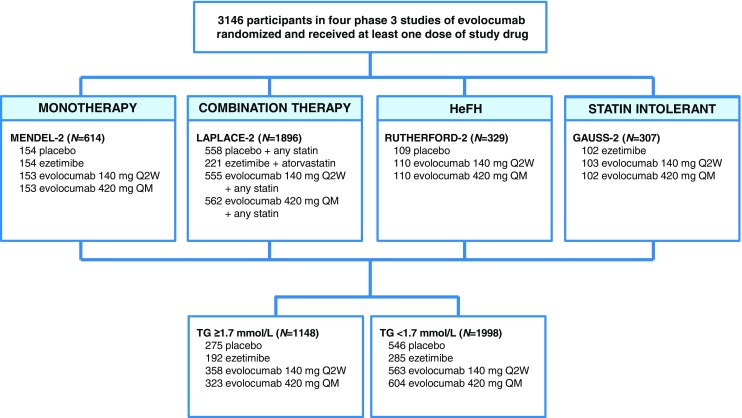
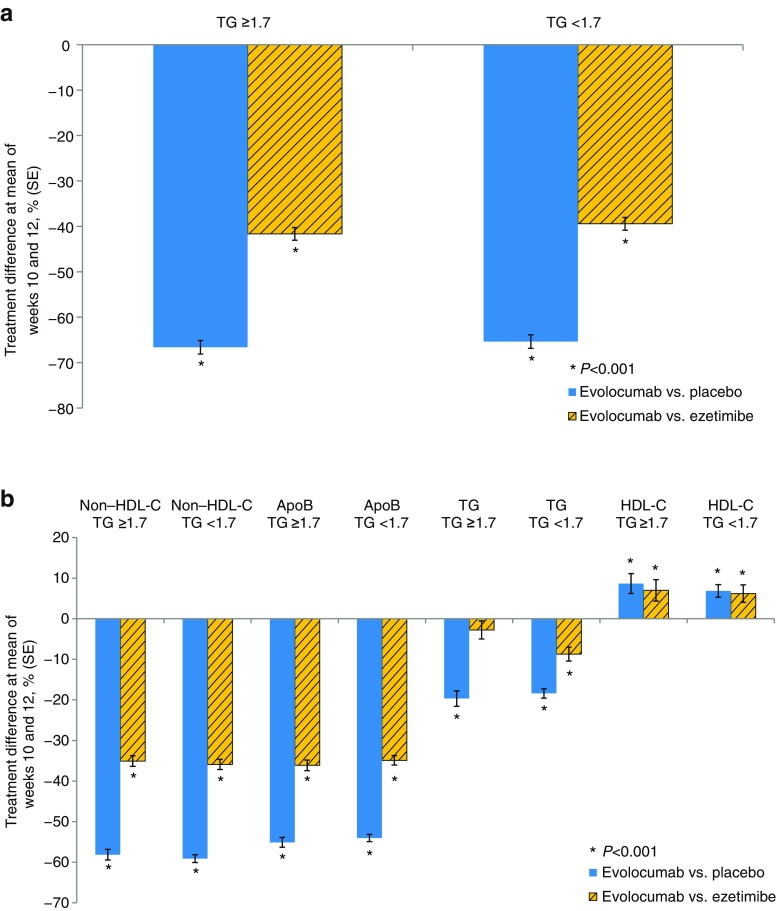
PURPOSE: Evolocumab significantly reduces low-density lipoprotein-cholesterol (LDL-C); we investigated its effects on LDL-C lowering in patients with mixed hyperlipidemia. METHODS: We compared the efficacy and safety of evolocumab in hypercholesterolemic patients selected from the phase 2 and 3 trials who had fasting triglyceride levels ≥1.7 mmol/L (150 mg/dL elevated triglycerides) and <1.7 mmol/L (without elevated triglycerides). Fasting triglyceride level ≥ 4.5 mmol/L at screening was an exclusion criterion for these studies, but post-enrollment triglyceride levels may have exceeded 4.5 mmol/L (400 mg/dL). Efficacy was evaluated in four phase 3 randomized studies (n = 1148) and safety from the phase 2 and 3 studies (n = 2246) and their open-label extension studies (n = 1698). Efficacy analyses were based on 12-week studies, while safety analyses included data from all available studies. Treatment differences were calculated vs. placebo and ezetimibe after pooling dose frequencies. RESULTS: Mean treatment difference in percentage change from baseline in LDL-C for participants with elevated triglycerides and those without elevated triglycerides (mean of weeks 10 and 12) with evolocumab was approximately -67 % vs. placebo and -42 % vs. ezetimibe (all P < 0.001) compared to −65 % vs. placebo and −39 % vs. ezetimibe, [corrected] respectively. Treatment differences for evolocumab vs. placebo and ezetimibe followed a similar pattern for non-high-density lipoprotein (HDL-C) and apolipoprotein B. Evolocumab was well tolerated, with balanced rates of adverse events leading to discontinuation of evolocumab vs. comparator (placebo and/or ezetimibe). CONCLUSION: The significant reductions of atherogenic lipids including LDL-C, non-HDL-C, and apolipoprotein B seen with evolocumab are similar in patients with and without mixed hyperlipidemia.
Overview
The claims and statistics of this paper haven’t been checked yet.
Free: it reads the open-access text and checks the first 5 claims that cite a source we can check. Create a free account to check every claim.
Integrity signals
Registry
Cites
Statistics
Figures
Verification
Claims the paper makes
The claims and statistics of this paper haven’t been checked yet.
Free: it reads the open-access text and checks the first 5 claims that cite a source we can check. Create a free account to check every claim.
Self-check
Percentages, sums and reported differences re-computed from the paper’s own numbers.
The self-check needs the paper’s full text.
Citations
Cites
Stone, N. J., Robinson, J. G., Lichtenstein, A. H., Bairey Merz, C. N., Blum, C. B., Eckel, R. H., Goldberg, A. C., Gordon, D., Levy, D., Lloyd-Jones, D. M., et al. (2014) · Circulation · doi:10.1161/01.cir.0000437738.63853.7a · Cited by 7,081
Efficacy and Safety of Alirocumab in Reducing Lipids and Cardiovascular Events
Robinson, J. G., Farnier, M., Krempf, M., Bergeron, J., Luc, G., Averna, M., Stroes, E. S., Langslet, G., Raal, F. J., El Shahawy, M., et al. (2015) · New England Journal of Medicine · doi:10.1056/nejmoa1501031 · Cited by 2,296 · cited 1×
“Full details of the exclusion criteria have been published elsewhere [16].”
BackgroundTriglycerides and Cardiovascular Disease: A Scientific Statement From the American Heart Association
Miller, M., Stone, N. J., Ballantyne, C., Bittner, V., Criqui, M. H., Ginsberg, H. N., Goldberg, A. C., Howard, W. J., Jacobson, M. S., Kris-Etherton, P. M., et al. (2011) · Circulation · doi:10.1161/cir.0b013e3182160726 · Cited by 1,871
Self-citationEfficacy and Safety of Evolocumab in Reducing Lipids and Cardiovascular Events
Sabatine, M. S., Giugliano, R. P., Wiviott, S. D., Raal, F. J., Blom, D. J., Robinson, J., Ballantyne, C. M., Somaratne, R., Legg, J., Wasserman, S. M., et al. (2015) · New England Journal of Medicine · doi:10.1056/nejmoa1500858 · Cited by 1,509 · cited 1×
“Full details of the exclusion criteria have been published elsewhere [16].”
BackgroundLamarche, B., Tchernof, A., Moorjani, S., Cantin, B., Dagenais, G. R., Lupien, P. J., & Despre´s, J.-P. (1997) · Circulation · doi:10.1161/01.cir.95.1.69 · Cited by 1,077 · cited 1×
“This leads to higher LDL particle concentrations in patients with elevated triglycerides than would be predicted based on the level of LDL-C [29, 31].”
BackgroundBoekholdt, S. M., Arsenault, B. J., Mora, S., Pedersen, T. R., LaRosa, J. C., Nestel, P. J., Simes, R. J., Durrington, P., Hitman, G. A., Welch, K. M. A., et al. (2012) · JAMA · doi:10.1001/jama.2012.366 · Cited by 795
National Lipid Association Recommendations for Patient-Centered Management of Dyslipidemia: Part 2
Jacobson, T. A., Maki, K. C., Orringer, C. E., Jones, P. H., Kris-Etherton, P., Sikand, G., La Forge, R., Daniels, S. R., Wilson, D. P., Morris, P. B., et al. (2015) · Journal of Clinical Lipidology · doi:10.1016/j.jacl.2015.09.002 · Cited by 784
Self-citationJacobson, T. A., Ito, M. K., Maki, K. C., Orringer, C. E., Bays, H. E., Jones, P. H., McKenney, J. M., Grundy, S. M., Gill, E. A., Wild, R. A., et al. (2015) · Journal of Clinical Lipidology · doi:10.1016/j.jacl.2015.02.003 · Cited by 773 · cited 1×
“Consequently, professional societies have endorsed [18, 20, 21] non–HDL-C (LDL-C + VLDL-C) as the preferred target in patients with mixed hyperlipidemia [22].”
BackgroundSelf-citationRaal, F. J., Stein, E. A., Dufour, R., Turner, T., Civeira, F., Burgess, L., Langslet, G., Scott, R., Olsson, A. G., Sullivan, D., et al. (2015) · The Lancet · doi:10.1016/s0140-6736(14)61399-4 · Cited by 756 · cited 2×
“Efficacy analyses were based on 12-week phase 3 studies [5, 9, 11, 12].”
BackgroundMethodSelf-citationA 52-Week Placebo-Controlled Trial of Evolocumab in Hyperlipidemia
Blom, D. J., Hala, T., Bolognese, M., Lillestol, M. J., Toth, P. D., Burgess, L., Ceska, R., Roth, E., Koren, M. J., Ballantyne, C. M., et al. (2014) · New England Journal of Medicine · doi:10.1056/nejmoa1316222 · Cited by 720 · cited 2×
“1) [3–13].”
BackgroundLipoprotein Management in Patients With Cardiometabolic Risk
Brunzell, J. D., Davidson, M., Furberg, C. D., Goldberg, R. B., Howard, B. V., Stein, J. H., & Witztum, J. L. (2008) · Journal of the American College of Cardiology · doi:10.1016/j.jacc.2008.02.034 · Cited by 529 · cited 1×
“Thus, several consensus documents propose a tiered approach for the assessment of treatment targets (LDL-C, non–HDL-C, and ApoB, or LDL particles) [32, 33].”
BackgroundAnti-PCSK9 Antibody Effectively Lowers Cholesterol in Patients With Statin Intolerance
Stroes, E., Colquhoun, D., Sullivan, D., Civeira, F., Rosenson, R. S., Watts, G. F., Bruckert, E., Cho, L., Dent, R., Knusel, B., et al. (2014) · Journal of the American College of Cardiology · doi:10.1016/j.jacc.2014.03.019 · Cited by 526 · cited 2×
“Efficacy analyses were based on 12-week phase 3 studies [5, 9, 11, 12].”
BackgroundMethodSelf-citationRaal, F., Scott, R., Somaratne, R., Bridges, I., Li, G., Wasserman, S. M., & Stein, E. A. (2012) · Circulation · doi:10.1161/circulationaha.112.144055 · Cited by 508
Self-citationRobinson, J. G., Nedergaard, B. S., Rogers, W. J., Fialkow, J., Neutel, J. M., Ramstad, D., Somaratne, R., Legg, J. C., Nelson, P., Scott, R., et al. (2014) · JAMA · doi:10.1001/jama.2014.4030 · Cited by 496 · cited 2×
“Efficacy analyses were based on 12-week phase 3 studies [5, 9, 11, 12].”
BackgroundMethodLambert (2012) · doi:10.1194/jlr.r026658 · Cited by 448 · cited 1×
“, Thousand Oaks, CA), a fully human immunoglobulin G2 monoclonal antibody, inhibits proprotein convertase subtilisin/kexin type 9 (PCSK9)–mediated proteolytic degradation of hepatic lowdensity lipoprotein (LDL) receptors resulting in more efficient clearance of apolipoprotein B (ApoB)–containing lipoproteins [1, 2].”
BackgroundSullivan, D., Olsson, A. G., Scott, R., Kim, J. B., Xue, A., Gebski, V., Wasserman, S. M., & Stein, E. A. (2012) · JAMA · doi:10.1001/jama.2012.25790 · Cited by 447
Giugliano, R. P., Desai, N. R., Kohli, P., Rogers, W. J., Somaratne, R., Huang, F., Liu, T., Mohanavelu, S., Hoffman, E. B., McDonald, S. T., et al. (2012) · The Lancet · doi:10.1016/s0140-6736(12)61770-x · Cited by 428 · cited 2×
“1) [3–13].”
BackgroundAnti-PCSK9 Monotherapy for Hypercholesterolemia
Koren, M. J., Lundqvist, P., Bolognese, M., Neutel, J. M., Monsalvo, M. L., Yang, J., Kim, J. B., Scott, R., Wasserman, S. M., & Bays, H. (2014) · Journal of the American College of Cardiology · doi:10.1016/j.jacc.2014.03.018 · Cited by 411 · cited 2×
“Efficacy analyses were based on 12-week phase 3 studies [5, 9, 11, 12].”
BackgroundMethodKoren, M. J., Scott, R., Kim, J. B., Knusel, B., Liu, T., Lei, L., Bolognese, M., & Wasserman, S. M. (2012) · The Lancet · doi:10.1016/s0140-6736(12)61771-1 · Cited by 366 · cited 2×
“1) [3–13].”
BackgroundKuller, L., Arnold, A., Tracy, R., Otvos, J., Burke, G., Psaty, B., Siscovick, D., Freedman, D. S., & Kronmal, R. (2002) · Arteriosclerosis, Thrombosis, and Vascular Biology · doi:10.1161/01.atv.0000022015.97341.3a · Cited by 310 · cited 2×
“Furthermore, patients with an elevated triglyceride concentration have smaller LDL particles resulting in less efficient clearance via hepatic LDL receptors [29, 30].”
BackgroundGenetics and causality of triglyceride-rich lipoproteins in atherosclerotic cardiovascular disease
Rosenson, R. S., Davidson, M. H., Hirsh, B. J., Kathiresan, S., & Gaudet, D. (2014) · Journal of the American College of Cardiology · doi:10.1016/j.jacc.2014.09.042 · Cited by 260 · cited 1×
“, VLDL) also increase the risk of CVD, and the combination of high LDL-C coupled with high triglycerides represents a particularly atherogenic phenotype [18–20].”
BackgroundSelf-citationLow-Density Lipoprotein Size and Cardiovascular Disease: A Reappraisal
Sacks, F. M., & Campos, H. (2003) · The Journal of Clinical Endocrinology & Metabolism · doi:10.1210/jc.2003-030636 · Cited by 241 · cited 1×
“Furthermore, patients with an elevated triglyceride concentration have smaller LDL particles resulting in less efficient clearance via hepatic LDL receptors [29, 30].”
BackgroundKoren, M. J., Giugliano, R. P., Raal, F. J., Sullivan, D., Bolognese, M., Langslet, G., Civeira, F., Somaratne, R., Nelson, P., Liu, T., et al. (2014) · Circulation · doi:10.1161/circulationaha.113.007012 · Cited by 218 · cited 2×
“1) [3–13].”
BackgroundBoekholdt, S. M., Arsenault, B. J., Hovingh, G. K., Mora, S., Pedersen, T. R., LaRosa, J. C., Welch, K. M. A., Amarenco, P., DeMicco, D. A., Tonkin, A. M., et al. (2013) · Circulation · doi:10.1161/circulationaha.113.002670 · Cited by 196
Desai, N. R., Kohli, P., Giugliano, R. P., O’Donoghue, M. L., Somaratne, R., Zhou, J., Hoffman, E. B., Huang, F., Rogers, W. J., Wasserman, S. M., et al. (2013) · Circulation · doi:10.1161/circulationaha.113.001969 · Cited by 183
Thanassoulis, G., Williams, K., Ye, K., Brook, R., Couture, P., Lawler, P. R., de Graaf, J., Furberg, C. D., & Sniderman, A. (2014) · Journal of the American Heart Association · doi:10.1161/jaha.113.000759 · Cited by 148 · cited 1×
“Also, in statin-treated subjects, some studies have shown that ApoB provides equivalent or superior discrimination of risk [24–28].”
ResultCharlton-Menys, V., Betteridge, D. J., Colhoun, H., Fuller, J., France, M., Hitman, G. A., Livingstone, S. J., Neil, H. A. W., Newman, C. B., Szarek, M., et al. (2009) · Clinical Chemistry · doi:10.1373/clinchem.2008.111401 · Cited by 94 · cited 1×
“Thus, several consensus documents propose a tiered approach for the assessment of treatment targets (LDL-C, non–HDL-C, and ApoB, or LDL particles) [32, 33].”
BackgroundPotential of Proprotein Convertase Subtilisin/Kexin Type 9 Based Therapeutics
Stein, E. A., & Swergold, G. D. (2013) · Current Atherosclerosis Reports · doi:10.1007/s11883-013-0310-3 · Cited by 90 · cited 1×
“, Thousand Oaks, CA), a fully human immunoglobulin G2 monoclonal antibody, inhibits proprotein convertase subtilisin/kexin type 9 (PCSK9)–mediated proteolytic degradation of hepatic lowdensity lipoprotein (LDL) receptors resulting in more efficient clearance of apolipoprotein B (ApoB)–containing lipoproteins [1, 2].”
BackgroundPathophysiology of hypertriglyceridemia
Hassing, H. C., Surendran, R. P., Mooij, H. L., Stroes, E. S. G., Nieuwdorp, M., & Dallinga‐Thie, G. M. (2011) · Biochimica et Biophysica Acta (BBA) - Molecular and Cell Biology of Lipids · doi:10.1016/j.bbalip.2011.11.010 · Cited by 86 · cited 1×
“Clearance of remnant lipoproteins is complex and occurs through a variety of receptors, including the LDL-receptor [15].”
BackgroundPostprandial Remnant-like Lipoproteins in Hypertriglyceridemia1
Ooi, T. C., Cousins, M., Ooi, D. S., Steiner, G., Uffelman, K. D., Nakajima, K., & Simo, I. E. (2001) · The Journal of Clinical Endocrinology & Metabolism · doi:10.1210/jcem.86.7.7627 · Cited by 55 · cited 1×
“In patients with mixed hyperlipidemia (characterized by elevated triglyceride and cholesterol levels), increased serum concentrations of remnant-like particles derived from either chylomicrons or very low– density lipoprotein (VLDL) are observed [14].”
BackgroundManaging diabetic dyslipidemia: Beyond statin therapy
Neeli, H., Gadi, R., & Rader, D. J. (2009) · Current Diabetes Reports · doi:10.1007/s11892-009-0004-y · Cited by 25 · cited 1×
“Also, in statin-treated subjects, some studies have shown that ApoB provides equivalent or superior discrimination of risk [24–28].”
ResultSamson, C. E., Galia, A., Llave, K. I. C., Zacarias, M. B., & MERCADO-ASIS, L. B. (2012) · Intern J Endocrinol Metab · doi:10.5812/ijem.4783 · Cited by 23
Soran, H., France, M. W., Kwok, S., Dissanayake, S., Charlton-Menys, V., Younis, N. N., & Durrington, P. N. (2011) · Annals of Clinical Biochemistry: International Journal of Laboratory Medicine · doi:10.1258/acb.2011.010277 · Cited by 20 · cited 1×
“Also, in statin-treated subjects, some studies have shown that ApoB provides equivalent or superior discrimination of risk [24–28].”
Result
Cited by
Langlois, M. R., Chapman, M. J., Cobbaert, C., Mora, S., Remaley, A. T., Ros, E., Watts, G. F., Borén, J., Baum, H., Bruckert, E., et al. (2018) · Clinical Chemistry · doi:10.1373/clinchem.2018.287037 · Cited by 260
“7 mmol/L) followed a similar pattern for LDLC ( 67% and 65% vs placebo), non-HDLC ( 53% and 54%), and apoB ( 49% and 50%) (133).”
BackgroundMethodNordestgaard, B. G., Langlois, M. R., Langsted, A., Chapman, M. J., Aakre, K. M., Baum, H., Borén, J., Bruckert, E., Catapano, A., Cobbaert, C., et al. (2020) · Atherosclerosis · doi:10.1016/j.atherosclerosis.2019.12.005 · Cited by 246
Langlois, M. R., Nordestgaard, B. G., Langsted, A., Chapman, M. J., Aakre, K. M., Baum, H., Borén, J., Bruckert, E., Catapano, A., Cobbaert, C., et al. (2020) · Clinical Chemistry and Laboratory Medicine (CCLM) · doi:10.1515/cclm-2019-1253 · Cited by 211
Clinical Pharmacokinetics and Pharmacodynamics of Evolocumab, a PCSK9 Inhibitor
Kasichayanula, S., Grover, A., Emery, M. G., Gibbs, M. A., Somaratne, R., Wasserman, S. M., & Gibbs, J. P. (2018) · Clinical Pharmacokinetics · doi:10.1007/s40262-017-0620-7 · Cited by 135
“Across those studies, evolocumab reduced triglycerides less effectively than it reduced other lipids, but evolocumab has similar effects on LDL-C in patients with or without mixed dyslipidemia due to elevated triglycerides [43].”
BackgroundRay, K. K., Leiter, L. A., Müller‐Wieland, D., Cariou, B., Colhoun, H. M., Henry, R. R., Tinahones, F. J., Bujas‐Bobanovic, M., Domenger, C., Letierce, A., et al. (2018) · Diabetes, Obesity and Metabolism · doi:10.1111/dom.13257 · Cited by 102
Metadata
- Authors
- Rosenson, R. S., Jacobson, T. A., Preiss, D., Djedjos, C. S., Dent, R., Bridges, I., & Miller, M.
- Affiliations
- Icahn School of Medicine at Mount Sinai (US)
- Emory University (US)
- University of Oxford (GB)
- Amgen (United States) (US)
- Amgen (Switzerland) (CH)
- Amgen (United Kingdom) (GB)
- University of Maryland, Baltimore (US)
- Corresponding author
- Rosenson, Robert S.
- Venue
- Cardiovascular Drugs and Therapy
- Published
- 2016-05-30
- Volume
- 30
- Issue
- 3
- Pages
- 305-313
- ISSN
- 0920-3206 (ISSN-L)
- 1573-7241
- PMC
- PMC4919379
- OpenAlex
- W2410117169
- Cited by
- 36
- References
- 36
- Citations by year
- 2026: 1 · 2025: 3 · 2024: 2 · 2023: 2 · 2022: 1 · 2021: 3 · 2020: 8 · 2019: 4 · 2018: 9 · 2017: 3
- FWCI
- 5.91
- Type
- journal article
- Language
- en
- Update notices
- correction (2016-08-06)
- Open access
- hybrid
- doi.org
- Locations
- Cardiovascular Drugs and Therapy (publishedVersion, cc-by)
- PubMed Central (publishedVersion, cc-by)
- PubMed (publishedVersion)
- Funders
- Amgen Inc.
- Topics
- Health Sciences › Medicine › Cardiology and Cardiovascular Medicine › Lipoproteins and Cardiovascular Health
- Health Sciences › Medicine › Cardiology and Cardiovascular Medicine › Lipid metabolism and disorders
- Life Sciences › Biochemistry, Genetics and Molecular Biology › Biochemistry › Cholesterol and Lipid Metabolism
- Keywords
- evolocumab, PCSK9 inhibitors, mixed dyslipidemia, LDL cholesterol lowering, hypertriglyceridemia, non-HDL cholesterol, apolipoprotein B, ezetimibe, atherogenic lipids, drug safety, treatment discontinuation
- MeSH terms
- Ezetimibe, Proprotein Convertase 9, PCSK9 Inhibitors, Adolescent, Adult, Aged, Aged, 80 and over, Antibodies, Monoclonal, Anticholesteremic Agents, Apolipoproteins B, Cholesterol, Double-Blind Method, Female, Humans, Hypercholesterolemia, Male, Middle Aged, Triglycerides, Treatment Outcome, Young Adult, Antibodies, Monoclonal, Humanized
About these checks
Registry, retraction, Cites and statistics results are computed, not judged, with one exception: a printed reference that no index lists is read once by a model before it counts as a citation error. Claims are extracted by a model and kept only when their quote appears verbatim in the text; each cited source is then checked, with a model’s help, for whether it says what the claim relies on. Those verdicts can be wrong — read the claim’s quote and the cited source before relying on one.
Statistics and arithmetic are recomputed, not judged.
Confidence bands are shown only for fields calibrated on our annotated test set. None is calibrated yet, so no band is shown.
What counts as a claim ›How we measure confidence ›How we check this ›
Are you an author, or do you see a problem with this page? Request a review
Data sources
Bibliographic data: Semantic Scholar, OpenAlex, Crossref.
Contains information from the Semantic Scholar Academic Graph Datasets, made available under the ODC Attribution License (ODC-BY 1.0).
Semantic Scholar’s data is described in: Kinney, R., et al. (2023). The Semantic Scholar Open Data Platform. arXiv:2301.10140.
