

Do Parents Enhance Cognitive Behavior Therapy for Youth Anxiety? An Overview of Systematic Reviews Over Time
Open accessThe DOI matches its Crossref record; 54 of the 55 references it cites were found in a registry or an index.
Abstract
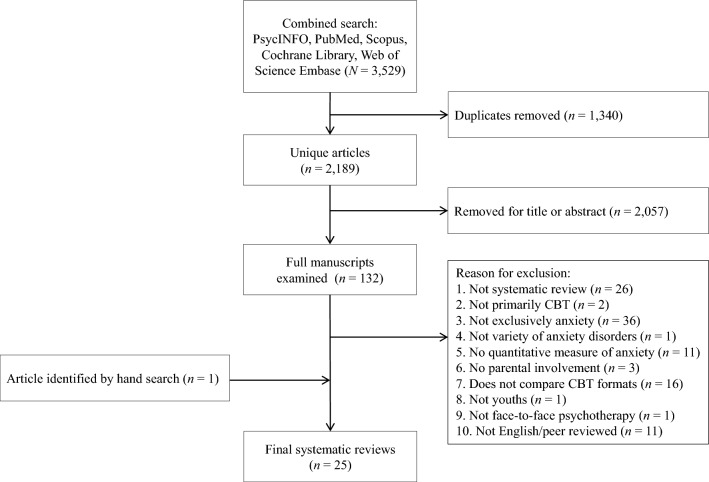
The last 20 years has seen debate regarding the merits of involving parents in cognitive behavior therapy (CBT) for youth anxiety played out across systematic reviews which have high impact. These reviews examined varying treatment formats in relation to parent involvement, including youth only CBT (Y-CBT), parent only CBT (P-CBT) and family CBT (youth and parent; F-CBT). This is a novel overview of systematic reviews examining evidence for parental involvement in CBT for youth anxiety over the period this was studied. Two independent coders systematically searched for studies in medical and psychological databases using the categories “Review”, “Youth”, “Anxiety”, “Cognitive Behavior Therapy” and “Parent/Family”. Of the 2,189 unique articles identified, there were 25 systematic reviews since 2005 which compared the effects of CBT for youth anxiety with varying parent involvement. Despite systematically studying the same phenomenon, the reviews were heterogeneous in outcome, design, inclusion criteria and often had methodological limitations. Of the 25 reviews, 21 found no difference between formats and 22 reviews were considered inconclusive. Yet while there were typically no statistical differences, consistent patterns in the direction of effects were detected over time. P-CBT was less effective than other formats, suggesting the importance of directly treating anxious youths. Early reviews favored F-CBT over Y-CBT, however, later reviews did not show this trend. We consider the effects of moderators including exposure therapy, long-term outcomes and the child’s age. We consider how to manage heterogeneity in primary studies and reviews to better detect treatment differences where they exist. Trial registration This protocol is registered with the Open Science Framework: osf.io/2u58t.
Overview
The claims and statistics of this paper haven’t been checked yet.
Free: it reads the open-access text and checks the first 5 claims that cite a source we can check. Create a free account to check every claim.
Integrity signals
Registry
Cites
Statistics
Figures
Verification
Claims the paper makes
The claims and statistics of this paper haven’t been checked yet.
Free: it reads the open-access text and checks the first 5 claims that cite a source we can check. Create a free account to check every claim.
Claims other papers make about this one
Each is checked against this paper’s own text: does it say what the citing paper says it does?
The source backs part of the claim, not all of it — or backs it for a different population, condition or comparison.
In the citing paper
“Families are not typically centralized in SUD services for adolescents [163] despite the compelling empirical rationale that family-based treatment is a first-line option for adolescent SUD [164], is well established for adolescent depression [165], and is a useful adjunct for adolescent anxiety [166].”
From Family Support Protocol for Adolescent Internalizing Disorders: Protocol for a Pre-Post Quantitative Treatment Development Study (2024) · cites this paper as [166]
Experimental — accuracy not yet measured
Self-check
Percentages, sums and reported differences re-computed from the paper’s own numbers.
The self-check needs the paper’s full text.
Citations
Cites
Diagnostic and Statistical Manual of Mental Disorders
American Psychiatric Association (2013) · doi:10.1176/appi.books.9780890425596 · Cited by 116,369
Shea, B. J., Reeves, B. C., Wells, G., Thuku, M., Hamel, C., Moran, J., Moher, D., Tugwell, P., Welch, V., Kristjansson, E., et al. (2017) · BMJ · doi:10.1136/bmj.j4008 · Cited by 10,636
Defining empirically supported therapies.
Chambless, D. L., & Hollon, S. D. (1998) · Journal of Consulting and Clinical Psychology · doi:10.1037/0022-006x.66.1.7 · Cited by 3,067
Systematic review finds overlapping reviews were not mentioned in every other overview
Pieper, D., Antoine, S.-L., Mathes, T., Neugebauer, E. A. M., & Eikermann, M. (2014) · Journal of Clinical Epidemiology · doi:10.1016/j.jclinepi.2013.11.007 · Cited by 1,318 · cited 1×
“2 CCA classifies overlap as low (0–5%), moderate (5–10%) or high (10–15%; Pieper et al., 2014).”
Background1. Family Therapy: An Overview
(1995) · How Good is Family Therapy? A Reassessment · doi:10.3138/9781487580377-003 · Cited by 916
Cognitive behavioural therapy for anxiety disorders in children and adolescents
James, A. C., James, G., Cowdrey, F. A., Soler, A., & Choke, A. (2015) · Cochrane Database of Systematic Reviews · doi:10.1002/14651858.cd004690.pub4 · Cited by 876
Anxiety Disorders During Childhood and Adolescence: Origins and Treatment
Rapee, R. M., Schniering, C. A., & Hudson, J. L. (2009) · Annual Review of Clinical Psychology · doi:10.1146/annurev.clinpsy.032408.153628 · Cited by 821
Family enhancement of cognitive style in anxious and aggressive children
Barrett, P. M., Rapee, R. M., Dadds, M. M., & Ryan, S. M. (1996) · Journal of Abnormal Child Psychology · doi:10.1007/bf01441484 · Cited by 784 · cited 3×
“They reported larger controlled effect sizes for F-CBT for some studies and on some indices (e.g., Barrett, 1998; Barrett et al., 1996).”
BackgroundInfluentialTen simple rules for conducting umbrella reviews
Fusar-Poli, P., & Radua, J. (2018) · Evidence Based Mental Health · doi:10.1136/ebmental-2018-300014 · Cited by 724
Evidence-based psychosocial treatments for phobic and anxiety disorders in children and adolescents
Silverman, W. K., Pina, A. A., & Viswesvaran, C. (2008) · Journal of Clinical Child & Adolescent Psychology · doi:10.1080/15374410701817907 · Cited by 660
Research works printed but not linked: 1
- National Collaborating Centre for Mental Health Social anxiety disorder: Recognition 2013 British Psychological Society 25577940
Cited by
Klein, A. M., Hagen, A., Mobach, L., Zimmermann, R., Baartmans, J. M. D., Rahemenia, J., de Gier, E., Schneider, S., & Ollendick, T. H. (2024) · Clinical Child and Family Psychology Review · doi:10.1007/s10567-024-00476-5 · Cited by 21
“Although the inclusion of parental involvement has not led to better treatment outcomes on the treatment level (see for a systematic review, Byrne et al., 2023) for childhood anxiety, involving parents could enhance the likelihood of completing homework exercises.”
BackgroundRienks, K., Salemink, E., Sigurðardóttir, L. B. L., Meléndez‐Torres, G. J., Staaks, J. P. C., & Leijten, P. H. O. (2025) · Behaviour Research and Therapy · doi:10.1016/j.brat.2025.104692 · Cited by 14
Grajdan, M. M. V., Etel, E., Farrell, L. J., & Donovan, C. L. (2024) · Clinical Child and Family Psychology Review · doi:10.1007/s10567-024-00505-3 · Cited by 13
“A long-debated question in child anxiety research has been whether involving parents in treatment yields superior outcomes over exclusively targeting the child (for an overview, refer to Byrne et al., 2023).”
Parental cognitions and child anxiety: A systematic review
Fox, J. K., & Fleming, L. E. (2025) · Journal of Anxiety Disorders · doi:10.1016/j.janxdis.2025.103021 · Cited by 14
Klein, C. S., Hollmann, K., Kühnhausen, J., Alt, A. K., Pascher, A., Seizer, L., Primbs, J., Ilg, W., Thierfelder, A., Severitt, B., et al. (2024) · Frontiers in Digital Health · doi:10.3389/fdgth.2024.1384540 · Cited by 7
“Recently published systematic reviews have shown no signi fi cant difference between CBT treatments with and without parental involvement (103).”
Background
Metadata
- Authors
- Byrne, S., Cobham, V., Richardson, M., & Imuta, K.
- Affiliations
- The University of Queensland (AU)
- Corresponding author
- Byrne, S.
- Venue
- Clinical Child and Family Psychology Review
- Published
- 2023-05-22
- Volume
- 26
- Issue
- 3
- Pages
- 773-788
- ISSN
- 1096-4037 (ISSN-L)
- 1573-2827
- PMC
- PMC10465628
- OpenAlex
- W4377224189
- Cited by
- 23
- References
- 55
- Citations by year
- 2026: 9 · 2025: 7 · 2024: 6 · 2023: 1
- FWCI
- 0.97
- Type
- journal article
- Language
- en
- Open access
- hybrid
- doi.org
- Licence
- cc-by
- creativecommons.org/licenses/by/4.0 (tdm)
- creativecommons.org/licenses/by/4.0 (vor)
- Locations
- Clinical Child and Family Psychology Review (publishedVersion, cc-by)
- PubMed Central (publishedVersion, cc-by)
- PubMed (publishedVersion)
- Funders
- The University of Queensland
- Topics
- Social Sciences › Psychology › Experimental and Cognitive Psychology › Anxiety, Depression, Psychometrics, Treatment, Cognitive Processes
- Social Sciences › Psychology › Clinical Psychology › Child and Adolescent Psychosocial and Emotional Development
- Social Sciences › Psychology › Clinical Psychology › Psychological Treatments and Assessments
- Keywords
- cognitive behavioral therapy, youth anxiety, parental involvement, systematic reviews, exposure therapy, long-term outcomes, child age
- MeSH terms
- Systematic Reviews as Topic, Adolescent, Anxiety Disorders, Child, Cognition, Humans, Parents, Cognitive Behavioral Therapy
About these checks
Registry, retraction, Cites and statistics results are computed, not judged, with one exception: a printed reference that no index lists is read once by a model before it counts as a citation error. Claims are extracted by a model and kept only when their quote appears verbatim in the text; each cited source is then checked, with a model’s help, for whether it says what the claim relies on. Those verdicts can be wrong — read the claim’s quote and the cited source before relying on one.
Statistics and arithmetic are recomputed, not judged.
Confidence bands are shown only for fields calibrated on our annotated test set. None is calibrated yet, so no band is shown.
What counts as a claim ›How we measure confidence ›How we check this ›
Are you an author, or do you see a problem with this page? Request a review
How to cite
Cite CoChat for the checks on this page, and the paper for its own findings.
- This page
- CoChat. (2026). Citation check: Do Parents Enhance Cognitive Behavior Therapy for Youth Anxiety? An Overview of Systematic Reviews Over Time. https://app.cochat.ai/papers/10.1007/s10567-023-00436-5
- The paper
- Byrne, S., Cobham, V., Richardson, M., & Imuta, K. (2023). Do Parents Enhance Cognitive Behavior Therapy for Youth Anxiety? An Overview of Systematic Reviews Over Time. Clinical Child and Family Psychology Review. https://doi.org/10.1007/s10567-023-00436-5
Data sources
Bibliographic data: Semantic Scholar, OpenAlex, Crossref.
Contains information from the Semantic Scholar Academic Graph Datasets, made available under the ODC Attribution License (ODC-BY 1.0).
Semantic Scholar’s data is described in: Kinney, R., et al. (2023). The Semantic Scholar Open Data Platform. arXiv:2301.10140.
