

Do Parents Enhance Cognitive Behavior Therapy for Youth Anxiety? An Overview of Systematic Reviews Over Time
Open accessThe DOI matches its Crossref record; 54 of the 55 references it cites were found in a registry or an index.
Abstract
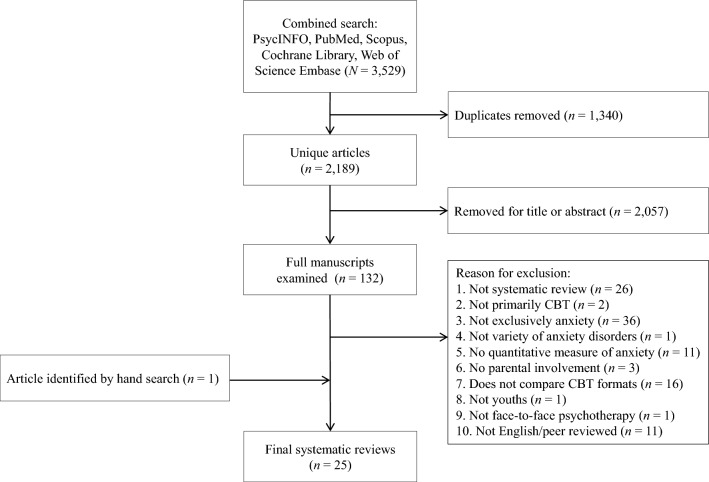
The last 20 years has seen debate regarding the merits of involving parents in cognitive behavior therapy (CBT) for youth anxiety played out across systematic reviews which have high impact. These reviews examined varying treatment formats in relation to parent involvement, including youth only CBT (Y-CBT), parent only CBT (P-CBT) and family CBT (youth and parent; F-CBT). This is a novel overview of systematic reviews examining evidence for parental involvement in CBT for youth anxiety over the period this was studied. Two independent coders systematically searched for studies in medical and psychological databases using the categories “Review”, “Youth”, “Anxiety”, “Cognitive Behavior Therapy” and “Parent/Family”. Of the 2,189 unique articles identified, there were 25 systematic reviews since 2005 which compared the effects of CBT for youth anxiety with varying parent involvement. Despite systematically studying the same phenomenon, the reviews were heterogeneous in outcome, design, inclusion criteria and often had methodological limitations. Of the 25 reviews, 21 found no difference between formats and 22 reviews were considered inconclusive. Yet while there were typically no statistical differences, consistent patterns in the direction of effects were detected over time. P-CBT was less effective than other formats, suggesting the importance of directly treating anxious youths. Early reviews favored F-CBT over Y-CBT, however, later reviews did not show this trend. We consider the effects of moderators including exposure therapy, long-term outcomes and the child’s age. We consider how to manage heterogeneity in primary studies and reviews to better detect treatment differences where they exist. Trial registration This protocol is registered with the Open Science Framework: osf.io/2u58t.
Overview
The claims and statistics of this paper haven’t been checked yet.
Free: it reads the open-access text and checks the first 5 claims that cite a source we can check. Create a free account to check every claim.
Integrity signals
Registry
Cites
Statistics
Figures
Verification
Claims the paper makes
The claims and statistics of this paper haven’t been checked yet.
Free: it reads the open-access text and checks the first 5 claims that cite a source we can check. Create a free account to check every claim.
Claims other papers make about this one
Each is checked against this paper’s own text: does it say what the citing paper says it does?
The source backs part of the claim, not all of it — or backs it for a different population, condition or comparison.
In the citing paper
“Families are not typically centralized in SUD services for adolescents [163] despite the compelling empirical rationale that family-based treatment is a first-line option for adolescent SUD [164], is well established for adolescent depression [165], and is a useful adjunct for adolescent anxiety [166].”
From Family Support Protocol for Adolescent Internalizing Disorders: Protocol for a Pre-Post Quantitative Treatment Development Study (2024) · cites this paper as [166]
Experimental — accuracy not yet measured
Self-check
Percentages, sums and reported differences re-computed from the paper’s own numbers.
The self-check needs the paper’s full text.
Citations
Cites
Diagnostic and Statistical Manual of Mental Disorders
American Psychiatric Association (2013) · doi:10.1176/appi.books.9780890425596 · Cited by 116,369
Shea, B. J., Reeves, B. C., Wells, G., Thuku, M., Hamel, C., Moran, J., Moher, D., Tugwell, P., Welch, V., Kristjansson, E., et al. (2017) · BMJ · doi:10.1136/bmj.j4008 · Cited by 10,636
Defining empirically supported therapies.
Chambless, D. L., & Hollon, S. D. (1998) · Journal of Consulting and Clinical Psychology · doi:10.1037/0022-006x.66.1.7 · Cited by 3,067
Systematic review finds overlapping reviews were not mentioned in every other overview
Pieper, D., Antoine, S.-L., Mathes, T., Neugebauer, E. A. M., & Eikermann, M. (2014) · Journal of Clinical Epidemiology · doi:10.1016/j.jclinepi.2013.11.007 · Cited by 1,318 · cited 1×
“2 CCA classifies overlap as low (0–5%), moderate (5–10%) or high (10–15%; Pieper et al., 2014).”
Background1. Family Therapy: An Overview
(1995) · How Good is Family Therapy? A Reassessment · doi:10.3138/9781487580377-003 · Cited by 916
Cognitive behavioural therapy for anxiety disorders in children and adolescents
James, A. C., James, G., Cowdrey, F. A., Soler, A., & Choke, A. (2015) · Cochrane Database of Systematic Reviews · doi:10.1002/14651858.cd004690.pub4 · Cited by 876
Anxiety Disorders During Childhood and Adolescence: Origins and Treatment
Rapee, R. M., Schniering, C. A., & Hudson, J. L. (2009) · Annual Review of Clinical Psychology · doi:10.1146/annurev.clinpsy.032408.153628 · Cited by 821
Family enhancement of cognitive style in anxious and aggressive children
Barrett, P. M., Rapee, R. M., Dadds, M. M., & Ryan, S. M. (1996) · Journal of Abnormal Child Psychology · doi:10.1007/bf01441484 · Cited by 784 · cited 3×
“They reported larger controlled effect sizes for F-CBT for some studies and on some indices (e.g., Barrett, 1998; Barrett et al., 1996).”
BackgroundInfluentialTen simple rules for conducting umbrella reviews
Fusar-Poli, P., & Radua, J. (2018) · Evidence Based Mental Health · doi:10.1136/ebmental-2018-300014 · Cited by 724
Evidence-based psychosocial treatments for phobic and anxiety disorders in children and adolescents
Silverman, W. K., Pina, A. A., & Viswesvaran, C. (2008) · Journal of Clinical Child & Adolescent Psychology · doi:10.1080/15374410701817907 · Cited by 660
Kendall, P. C., Hudson, J. L., Gosch, E., Flannery-Schroeder, E., & Suveg, C. (2008) · Journal of Consulting and Clinical Psychology · doi:10.1037/0022-006x.76.2.282 · Cited by 579 · cited 1×
“, 1996), then moved away from F-CBT, particularly with the publication of several studies in 2008 (Bodden et al., 2008; Kendall et al., 2008; Silverman et al., 2008).”
BackgroundEvidence Base Update: 50 Years of Research on Treatment for Child and Adolescent Anxiety
Higa-McMillan, C. K., Francis, S. E., Rith-Najarian, L., & Chorpita, B. F. (2016) · Journal of Clinical Child & Adolescent Psychology · doi:10.1080/15374416.2015.1046177 · Cited by 557
Parent Management Training: Evidence, Outcomes, and Issues
KAZDIN, A. E. (1997) · Journal of the American Academy of Child & Adolescent Psychiatry · doi:10.1097/00004583-199710000-00016 · Cited by 531 · cited 1×
“Keywords Anxiety · Youth · Review · Meta-analysis · Cognitive behavior therapy · Parent Psychotherapy often assumes an important role for parents and families in the maintenance and remission of a youth’s mental disorder (e.g., Goldenberg & Goldenberg, 2012; Kazdin, 1997; Wei & Kendall, 2014).”
MethodThe role of parental anxiety in the treatment of childhood anxiety.
Cobham, V. E., Dadds, M. R., & Spence, S. H. (1998) · Journal of Consulting and Clinical Psychology · doi:10.1037//0022-006x.66.6.893 · Cited by 518 · cited 4×
“Fjermestad et al. (2009) examined parent–child relationship factors on youth anxiety treatments (RCTs and aged ≤ 21 years).”
BackgroundInfluentialSelf-citationEffects of psychotherapy for anxiety in children and adolescents: A meta-analytic review
Reynolds, S., Wilson, C., Austin, J., & Hooper, L. (2012) · Clinical Psychology Review · doi:10.1016/j.cpr.2012.01.005 · Cited by 483
Evaluation of cognitive-behavioral group treatments for childhood anxiety disorders
Barrett, P. M. (1998) · Journal of Clinical Child Psychology · doi:10.1207/s15374424jccp2704_10 · Cited by 399 · cited 2×
“, Barrett, 1998; Barrett et al., 1996), then moved away from F-CBT, particularly with the publication of several studies in 2008 (Bodden et al., 2008; Kendall et al., 2008; Silverman et al., 2008). The more recent reviews have the greatest sample to detect differences, with a large and rigorous study by James et al. (…”
BackgroundResultPsychotherapy of Childhood Anxiety Disorders: A Meta-Analysis
In-Albon, T., & Schneider, S. (2007) · Psychotherapy and Psychosomatics · doi:10.1159/000096361 · Cited by 373
Cognitive behavioural therapy for anxiety disorders in children and adolescents
James, A. C., Reardon, T., Soler, A., James, G., & Creswell, C. (2020) · Cochrane Database of Systematic Reviews · doi:10.1002/14651858.cd013162.pub2 · Cited by 344
Cognitive behavioural therapy for anxiety disorders in children and adolescents
James, A. C., James, G., Cowdrey, F. A., Soler, A., & Choke, A. (2013) · Cochrane Database of Systematic Reviews · doi:10.1002/14651858.cd004690.pub3 · Cited by 337 · cited 6×
“, 2015) and two favoring Y-CBT over F-CBT (James et al., 2020; Öst & Ollendick, 2017).”
BackgroundMethodInfluentialHunt, H., Pollock, A., Campbell, P., Estcourt, L., & Brunton, G. (2018) · Systematic Reviews · doi:10.1186/s13643-018-0695-8 · Cited by 314 · cited 1×
“Yet a single systematic review or meta-analysis only provides a snapshot that is colored by different methodologies and outcomes of primary studies at a particular time, by contrast an overview, or a systematic review of systematic reviews, can provide a higher-level view (Fusar-Poli & Radua, 2018; Hunt et al., 2018;…”
BackgroundLebowitz, E. R., Marin, C., Martino, A., Shimshoni, Y., & Silverman, W. K. (2020) · Journal of the American Academy of Child & Adolescent Psychiatry · doi:10.1016/j.jaac.2019.02.014 · Cited by 268
Southam-Gerow, M. A., & Prinstein, M. J. (2014) · Journal of Clinical Child & Adolescent Psychology · doi:10.1080/15374416.2013.855128 · Cited by 255
Gagnier, J. J., Moher, D., Boon, H., Beyene, J., & Bombardier, C. (2012) · BMC Medical Research Methodology · doi:10.1186/1471-2288-12-111 · Cited by 222 · cited 4×
“In another review published in 2007, a meta-analysis by In-Albon and Schneider (2007) reported F-CBT had a slightly higher recovery rate than Y-CBT (76.”
BackgroundResultInfluentialShould Parents Be Co-Clients in Cognitive-Behavioral Therapy for Anxious Youth?
Barmish, A. J., & Kendall, P. C. (2005) · Journal of Clinical Child & Adolescent Psychology · doi:10.1207/s15374424jccp3403_12 · Cited by 209
Öst, L.-G., & Ollendick, T. H. (2017) · Behaviour Research and Therapy · doi:10.1016/j.brat.2017.07.008 · Cited by 207
Types of parental involvement in CBT with anxious youth: a preliminary meta-analysis
Manassis, K., Lee, T. C., Bennett, K., Zhao, X. Y., Mendlowitz, S., Duda, S., Saini, M., Wilansky, P., Baer, S., Barrett, P., et al. (2014) · Journal of Consulting and Clinical Psychology · doi:10.1037/a0036969 · Cited by 199
Self-citationCognitive behavioural therapy for anxiety disorders in children and adolescents
James, A. A., Soler, A., & Weatherall, R. R. (2005) · Cochrane Database of Systematic Reviews · doi:10.1002/14651858.cd004690.pub2 · Cited by 197
Pollock, M., Fernandes, R. M., Becker, L. A., Featherstone, R., & Hartling, L. (2016) · Systematic Reviews · doi:10.1186/s13643-016-0367-5 · Cited by 195 · cited 1×
“Yet a single systematic review or meta-analysis only provides a snapshot that is colored by different methodologies and outcomes of primary studies at a particular time, by contrast an overview, or a systematic review of systematic reviews, can provide a higher-level view (Fusar-Poli & Radua, 2018; Hunt et al., 2018;…”
BackgroundBreinholst, S., Esbjørn, B. H., Reinholdt-Dunne, M. L., & Stallard, P. (2012) · Journal of Anxiety Disorders · doi:10.1016/j.janxdis.2011.12.014 · Cited by 188 · cited 9×
“Similarly, Breinholst et al. (2012) reported that more than half of the reported studies found a trend or superior efficacy of F-CBT on at least one outcome, yet concluded that the outcomes were “ambiguous and inconsistent” (p. 416). Carnes et al. (2019) found the addition of both parents did not improve F-CBT vs. Y-C…”
ResultInfluentialCognitive behavioural therapy for anxiety disorders in children and adolescents: a meta-analysis
Ishikawa, S., Okajima, I., Matsuoka, H., & Sakano, Y. (2007) · Child and Adolescent Mental Health · doi:10.1111/j.1475-3588.2006.00433.x · Cited by 176 · cited 1×
“Early reviews trend towards the superiority of F-CBT (e.g., Creswell & Cartwright-Hatton, 2007; Ishikawa et al., 2007), later reviews suggest no difference (e.”
BackgroundFamily Treatment of Child Anxiety: Outcomes, Limitations and Future Directions
Creswell, C., & Cartwright‐Hatton, S. (2007) · Clinical Child and Family Psychology Review · doi:10.1007/s10567-007-0019-3 · Cited by 155
Sigurvinsdóttir, A. L., Jensínudóttir, K. B., Baldvinsdóttir, K. D., Smárason, O., & Skarphedinsson, G. (2020) · Nordic Journal of Psychiatry · doi:10.1080/08039488.2019.1686653 · Cited by 130 · cited 1×
“For example, different authors arrived at different conclusions at similar times (James et al., 2020; Sigurvinsdóttir et al., 2020) and the same authors arrived at different conclusions over time (e.”
Parental Involvement: Contribution to Childhood Anxiety and Its Treatment
Wei, C., & Kendall, P. C. (2014) · Clinical Child and Family Psychology Review · doi:10.1007/s10567-014-0170-6 · Cited by 129
The Effect of Parent Involvement in the Treatment of Anxiety Disorders in Children: A Meta-Analysis
Thulin, U., Svirsky, L., Serlachius, E., Andersson, G., & Öst, L.-G. (2014) · Cognitive Behaviour Therapy · doi:10.1080/16506073.2014.923928 · Cited by 124 · cited 2×
“Several researchers have noted the heterogeneity of methodologies and outcomes in studies investigating parent involvement in CBT for youth anxiety (e.g., Barmish & Kendall, 2005; James et al., 2020; Thulin et al., 2014).”
BackgroundOllendick, T. H., Halldorsdottir, T., Fraire, M. G., Austin, K. E., Noguchi, R. J. P., Lewis, K. M., Jarrett, M. A., Cunningham, N. R., Canavera, K., Allen, K. B., et al. (2015) · Behavior Therapy · doi:10.1016/j.beth.2014.09.004 · Cited by 111
Treating child and adolescent anxiety effectively: Overview of systematic reviews
BENNETT, K. J., Manassis, K., Duda, S. J., Bagnell, A. L., Bernstein, G. A., Garland, E., Miller, L. D., Newton, A. S., Thabane, L., & Wilansky, P. (2016) · Clinical Psychology Review · doi:10.1016/j.cpr.2016.09.006 · Cited by 104
Evidence Base Update on the Treatment of Early Childhood Anxiety and Related Problems
Comer, J. S., Hong, N., Poznanski, B., Silva, K., & Wilson, M. (2019) · Journal of Clinical Child & Adolescent Psychology · doi:10.1080/15374416.2018.1534208 · Cited by 98 · cited 1×
“The youths’ age in reviews also varied significantly between 2 to 21 years, however, two reviews focused exclusively on younger children (Comer et al., 2019; Zhang et al., 2017) and one focused on adolescents (Cardy et al.”
BackgroundThe impact of parent-only interventions on child anxiety: A systematic review and meta-analysis
Jewell, C., Wittkowski, A., & Pratt, D. (2022) · Journal of Affective Disorders · doi:10.1016/j.jad.2022.04.082 · Cited by 87
Zhou, X., Zhang, Y., Furukawa, T. A., Cuijpers, P., Pu, J., Weisz, J. R., Yang, L., Hetrick, S. E., Del Giovane, C., Cohen, D., et al. (2019) · JAMA Psychiatry · doi:10.1001/jamapsychiatry.2018.3070 · Cited by 80
Kreuze, L. J., Pijnenborg, G. H. M., de Jonge, Y. B., & Nauta, M. H. (2018) · Journal of Anxiety Disorders · doi:10.1016/j.janxdis.2018.10.005 · Cited by 69
Peris, T. S., Thamrin, H., & Rozenman, M. S. (2021) · Journal of Affective Disorders · doi:10.1016/j.jad.2021.02.053 · Cited by 57
Costs and Cost-Effectiveness of Family CBT Versus Individual CBT in Clinically Anxious Children
Bodden, D. H. M., Dirksen, C. D., Bögels, S. M., Nauta, M. H., De Haan, E., Ringrose, J., Appelboom, C., Brinkman, A. G., & Appelboom-Geerts, K. C. M. M. J. (2008) · Clinical Child Psychology and Psychiatry · doi:10.1177/1359104508090602 · Cited by 56 · cited 1×
“, 1996), then moved away from F-CBT, particularly with the publication of several studies in 2008 (Bodden et al., 2008; Kendall et al., 2008; Silverman et al., 2008).”
BackgroundCardy, J. L., Waite, P., Cocks, F., & Creswell, C. (2020) · Clinical Child and Family Psychology Review · doi:10.1007/s10567-020-00324-2 · Cited by 53 · cited 9×
“Cardy et al. (2020) identified 23 primary studies where parents were involved in adolescent anxiety treatment (mean age = 13.3–15.8 years), finding parent involvement was effective, however, they were uncertain whether it enhanced outcomes. In a review that focused on younger children (mean age < 7.9 years), Comer et…”
BackgroundInfluentialSilverman, W. K., Marin, C. E., Rey, Y., Kurtines, W. M., Jaccard, J., & Pettit, J. W. (2019) · Clinical Psychological Science · doi:10.1177/2167702619830404 · Cited by 42
Guo, T., Su, J., Hu, J., Aalberg, M., Zhu, Y., Teng, T., & Zhou, X. (2021) · Frontiers in Psychiatry · doi:10.3389/fpsyt.2021.674267 · Cited by 42 · cited 2×
“Furthermore, four reviews examined the efficacy of group versus individual anxiety CBT with varying parental involvement (Guo et al., 2021; Silverman et al., 2008; Yin et al., 2021; Zhou et al., 2019).”
BackgroundManassis, K., Russell, K., & Newton, A. S. (2010) · Evidence-Based Child Health: A Cochrane Review Journal · doi:10.1002/ebch.508 · Cited by 36
Yin, B., Teng, T., Tong, L., Li, X., Fan, L., Zhou, X., & Xie, P. (2021) · BMC Psychiatry · doi:10.1186/s12888-020-03021-0 · Cited by 35 · cited 1×
“Furthermore, four reviews examined the efficacy of group versus individual anxiety CBT with varying parental involvement (Guo et al., 2021; Silverman et al., 2008; Yin et al., 2021; Zhou et al., 2019).”
BackgroundA review of Parent-Child Interaction Therapy (PCIT): Applications for youth anxiety
Phillips, S., & Mychailyszyn, M. (2021) · Children and Youth Services Review · doi:10.1016/j.childyouth.2021.105986 · Cited by 31
Relationship Factors and Outcome in Child Anxiety Treatment Studies
Fjermestad, K. W., Haugland, B. S. M., Heiervang, E. R., & Öst, L. (2009) · Clinical Child Psychology and Psychiatry · doi:10.1177/1359104508100885 · Cited by 27 · cited 1×
“Higa-McMillan et al. (2016) categorized “treatment families”—that is, treatment approaches with similar clinical strategies and theory.”
BackgroundSilverman, W. K., Marin, C. E., Rey, Y., Jaccard, J., & Pettit, J. W. (2021) · Depression and Anxiety · doi:10.1002/da.23210 · Cited by 27
Aguilera‐Martín, Á., Gálvez‐Lara, M., Cuadrado, F., Moreno, E. M., García‐Torres, F., Martínez, J. F. V., Corpas, J., Jurado-González, F. J., Muñoz‐Navarro, R., González‐Blanch, C., et al. (2022) · BMC Psychiatry · doi:10.1186/s12888-022-03726-4 · Cited by 24
The contribution of parents in childhood anxiety treatment: A meta‐analytic review
Carnes, A., Matthewson, M. L., & Boer, O. E. (2019) · Clinical Psychologist · doi:10.1111/cp.12179 · Cited by 21 · cited 1×
“Comer et al. (2019) later examined family-based treatments for children with a mean age under 7.”
BackgroundZhang, H., Zhang, Y., Yang, L., Yuan, S., Zhou, X., Pu, J., Liu, L., Jiang, X., & Xie, P. (2017) · Journal of Nervous & Mental Disease · doi:10.1097/nmd.0000000000000749 · Cited by 18
Byrne, S., Richardson, M., Riba, M., & Imuta, K. (2023) · JMIR Research Protocols · doi:10.2196/48077 · Cited by 1
Self-citation
Research works printed but not linked: 1
- National Collaborating Centre for Mental Health Social anxiety disorder: Recognition 2013 British Psychological Society 25577940
Cited by
Klein, A. M., Hagen, A., Mobach, L., Zimmermann, R., Baartmans, J. M. D., Rahemenia, J., de Gier, E., Schneider, S., & Ollendick, T. H. (2024) · Clinical Child and Family Psychology Review · doi:10.1007/s10567-024-00476-5 · Cited by 21
“Although the inclusion of parental involvement has not led to better treatment outcomes on the treatment level (see for a systematic review, Byrne et al., 2023) for childhood anxiety, involving parents could enhance the likelihood of completing homework exercises.”
BackgroundRienks, K., Salemink, E., Sigurðardóttir, L. B. L., Meléndez‐Torres, G. J., Staaks, J. P. C., & Leijten, P. H. O. (2025) · Behaviour Research and Therapy · doi:10.1016/j.brat.2025.104692 · Cited by 14
Grajdan, M. M. V., Etel, E., Farrell, L. J., & Donovan, C. L. (2024) · Clinical Child and Family Psychology Review · doi:10.1007/s10567-024-00505-3 · Cited by 13
“A long-debated question in child anxiety research has been whether involving parents in treatment yields superior outcomes over exclusively targeting the child (for an overview, refer to Byrne et al., 2023).”
Parental cognitions and child anxiety: A systematic review
Fox, J. K., & Fleming, L. E. (2025) · Journal of Anxiety Disorders · doi:10.1016/j.janxdis.2025.103021 · Cited by 14
Klein, C. S., Hollmann, K., Kühnhausen, J., Alt, A. K., Pascher, A., Seizer, L., Primbs, J., Ilg, W., Thierfelder, A., Severitt, B., et al. (2024) · Frontiers in Digital Health · doi:10.3389/fdgth.2024.1384540 · Cited by 7
“Recently published systematic reviews have shown no signi fi cant difference between CBT treatments with and without parental involvement (103).”
Background
Metadata
- Authors
- Byrne, S., Cobham, V., Richardson, M., & Imuta, K.
- Affiliations
- The University of Queensland (AU)
- Corresponding author
- Byrne, S.
- Venue
- Clinical Child and Family Psychology Review
- Published
- 2023-05-22
- Volume
- 26
- Issue
- 3
- Pages
- 773-788
- ISSN
- 1096-4037 (ISSN-L)
- 1573-2827
- PMC
- PMC10465628
- OpenAlex
- W4377224189
- Cited by
- 23
- References
- 55
- Citations by year
- 2026: 9 · 2025: 7 · 2024: 6 · 2023: 1
- FWCI
- 0.97
- Type
- journal article
- Language
- en
- Open access
- hybrid
- doi.org
- Licence
- cc-by
- creativecommons.org/licenses/by/4.0 (tdm)
- creativecommons.org/licenses/by/4.0 (vor)
- Locations
- Clinical Child and Family Psychology Review (publishedVersion, cc-by)
- PubMed Central (publishedVersion, cc-by)
- PubMed (publishedVersion)
- Funders
- The University of Queensland
- Topics
- Social Sciences › Psychology › Experimental and Cognitive Psychology › Anxiety, Depression, Psychometrics, Treatment, Cognitive Processes
- Social Sciences › Psychology › Clinical Psychology › Child and Adolescent Psychosocial and Emotional Development
- Social Sciences › Psychology › Clinical Psychology › Psychological Treatments and Assessments
- Keywords
- cognitive behavioral therapy, youth anxiety, parental involvement, systematic reviews, exposure therapy, long-term outcomes, child age
- MeSH terms
- Systematic Reviews as Topic, Adolescent, Anxiety Disorders, Child, Cognition, Humans, Parents, Cognitive Behavioral Therapy
About these checks
Registry, retraction, Cites and statistics results are computed, not judged, with one exception: a printed reference that no index lists is read once by a model before it counts as a citation error. Claims are extracted by a model and kept only when their quote appears verbatim in the text; each cited source is then checked, with a model’s help, for whether it says what the claim relies on. Those verdicts can be wrong — read the claim’s quote and the cited source before relying on one.
Statistics and arithmetic are recomputed, not judged.
Confidence bands are shown only for fields calibrated on our annotated test set. None is calibrated yet, so no band is shown.
What counts as a claim ›How we measure confidence ›How we check this ›
Are you an author, or do you see a problem with this page? Request a review
Data sources
Bibliographic data: Semantic Scholar, OpenAlex, Crossref.
Contains information from the Semantic Scholar Academic Graph Datasets, made available under the ODC Attribution License (ODC-BY 1.0).
Semantic Scholar’s data is described in: Kinney, R., et al. (2023). The Semantic Scholar Open Data Platform. arXiv:2301.10140.
