

Energy efficiency in cloud computing data centers: a survey on software technologies
Open accessThe DOI matches its Crossref record; 133 of the 134 references it cites were found in a registry or an index; 14 of the 109 sources its claims cite were checked for support.
Abstract
Cloud computing is a commercial and economic paradigm that has gained traction since 2006 and is presently the most significant technology in IT sector. From the notion of cloud computing to its energy efficiency, cloud has been the subject of much discussion. The energy consumption of data centres alone will rise from 200 TWh in 2016 to 2967 TWh in 2030. The data centres require a lot of power to provide services, which increases CO2 emissions. In this survey paper, software-based technologies that can be used for building green data centers and include power management at individual software level has been discussed. The paper discusses the energy efficiency in containers and problem-solving approaches used for reducing power consumption in data centers. Further, the paper also gives details about the impact of data centers on environment that includes the e-waste and the various standards opted by different countries for giving rating to the data centers. This article goes beyond just demonstrating new green cloud computing possibilities. Instead, it focuses the attention and resources of academia and society on a critical issue: long-term technological advancement. The article covers the new technologies that can be applied at the individual software level that includes techniques applied at virtualization level, operating system level and application level. It clearly defines different measures at each level to reduce the energy consumption that clearly adds value to the current environmental problem of pollution reduction. This article also addresses the difficulties, concerns, and needs that cloud data centres and cloud organisations must grasp, as well as some of the factors and case studies that influence green cloud usage.
Overview
CoChat Summary
TL;DR
This survey reviews software-level technologies for improving energy efficiency in cloud data centers, covering operating system, virtualization, application, container, and data-center-level approaches. It also discusses environmental impact, policies/standards, case studies, and open research challenges for green data centers.
Key findings
- Data center energy consumption is projected to rise from 200 TWh in 2016 to 2967 TWh in 2030; average annual data center PUE was 1.57 in 2021 versus 1.59 in 2020, with an ideal PUE of 1.0.
- Containerization can reduce energy use: Docker configured to a maximum latency of 3000 ms can operate up to 21% more services than KVM while consuming 11.33% less energy than KVM; a container placement method (MLSM) cut energy usage by an average of 12.8% compared with First Fit.
- Other reported software-level gains include VIP reducing power usage and improving CPU-intensive application completion time by up to 27% and 32%, respectively, without breaching latency-sensitive SLAs; a MapReduce configurator improved energy efficiency by up to 50% in two structurally distinct clusters.
- Data centers emitted 3.15 × 10^7 tons CO2-eq in 2018, about 0.5% of total U.S. GHG emissions; many corporate servers are utilized only 10–15%, and 30% are described as “zombies” that are inactive yet still consume electricity.
Methods
- Design: a survey of software-based energy-efficiency techniques in cloud data centers, organized by OS level, virtualization level, application level, operating-system virtualization/containers, data-center-level dynamic power management, problem-solving approaches, environment, and research challenges.
- Data sources: articles collected from IEEE, Springer, and Elsevier, using Web of Science and Scopus; included publications were peer reviewed, mostly published between 2015 and 2020, and focused on software-based methods for data center energy efficiency.
- Analysis: narrative synthesis and taxonomy; excluded non-peer-reviewed papers, pre-2015 publications, non-English studies, and studies without details on software innovations for data center energy savings. No datasets were generated or analyzed.
Limitations
- The paper does not state its own limitations explicitly; it states that prior survey articles are “either incomplete or having limitations,” especially regarding application, virtualization, and OS layers, data-center-level solutions, containers, environmental factors, and case studies.
- Evident from the text: this is a secondary literature survey with no primary experiments or datasets, and its scope is limited to software technologies, excluding hardware technologies covered in the authors’ earlier work.
- Evident from the text: the literature search is mostly limited to 2015–2020 and excludes non-English and non-peer-reviewed sources, so newer or non-indexed work may be missed.
Model-written summary. Check it against the paper before relying on it.
Integrity signals
Registry
Cites
Statistics
Figures



Verification
Claims the paper makes
13 Valid · 18 Not valid · 71 Not checked · 54 Own results and interpretations
Every source the paper cites for this claim was checked and supports it.
In the paper
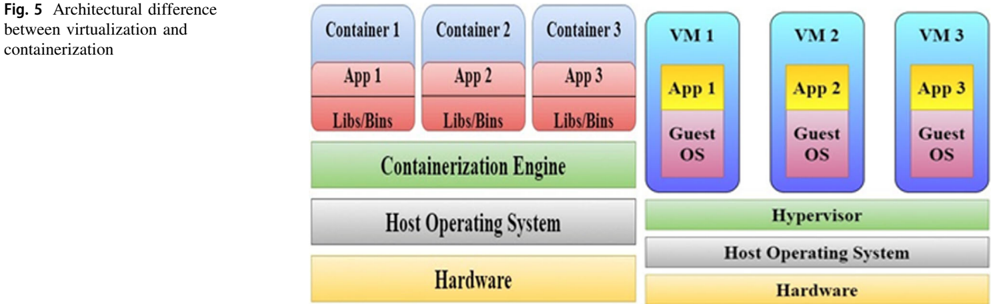
“Container-based systems returned unused memory to the host, resulting in more efficient memory utilisation.”
What the sources say
- Supportedcites [41] 41. Ramchandra Desai, P.A. Survey of Performance Comparison between Virtual Machines and Containers. Int. J. Comput. Sci. Eng. (2016) source
The Memory Performance section (p. of our copy, §B) states directly that 'Container based systems have the ability to return unused memory to the host resulting in better usage,' which is exactly what the citing sentence attributes. The Discussion (§G) reinforces it, crediting container-based virtualization's better CPU and I/O performance to its ability to release unused resources. (LLM, conf=0.90)
plainstates a cause- Asserted: passes — The authors put it forward as true.
- Checkable: passes — It can be checked against evidence.
- Load-bearing: unclear — It is unclear whether the paper’s conclusions depend on it.
- Based: passes — The paper gives a reason why it holds.
- Supported
The cited sources support only part of this claim — read each source’s verdict below.
In the paper
“Virtualization systems suffered from double cache since the host and virtual computer used the same memory blocks.”
What the sources say
- Partly supportedcites [41] 41. Ramchandra Desai, P.A. Survey of Performance Comparison between Virtual Machines and Containers. Int. J. Comput. Sci. Eng. (2016) sourceExperimental — accuracy not yet measured
The Memory Performance section (B) of our copy states the double-cache problem almost verbatim: 'Para virtualization systems suffer from double cache since the same memory blocks are used by the host and the virtual machine.' However, the source restricts this to para-virtualization specifically (the Introduction distinguishes full, partial and para virtualization, and KVM is described as full virtualization), whereas the citing sentence attributes the double-cache drawback to 'virtualization systems' generally. That generalization to all virtualization is the part the source does not support; the mechanism (host and VM sharing the same memory blocks) is confirmed. (LLM, conf=0.72)
plainstates a cause- Asserted: passes — The authors put it forward as true.
- Checkable: passes — It can be checked against evidence.
- Load-bearing: unclear — It is unclear whether the paper’s conclusions depend on it.
- Based: passes — The paper gives a reason why it holds.
- Partly supported
The cited sources support only part of this claim — read each source’s verdict below.
In the paper
“The energy consumption of data centres alone will rise from 200 TWh in 2016 to 2967 TWh in 2030.”
- Also stated in: § 1 Introduction · p. 2 · plain
“The energy consumption of data centres alone will rise from 200 TWh in 2016 to 2967 TWh in 2030 [2].”
What the sources say
- Partly supportedcites [2] 2. Koot, M., Wijnhoven, F.: Usage impact on data center electricity needs: A system dynamic forecasting model. Appl. Energy. 291 , 116798 (2021) sourceExperimental — accuracy not yet measured
The Literature review (section 2) reports the exact 200 TWh-to-2,967 TWh projection, but attributes it to Andrae and Edler and says it was highly uncertain and later revised. The paper’s own conclusion (section 7) instead projects 286 TWh in 2016 rising to 321 TWh in 2030 under unchanged trends, so the unqualified sentence should not be read as this paper’s forecast. (LLM, conf=0.88)
plainstates a cause- Asserted: passes — The authors put it forward as true.
- Checkable: passes — It can be checked against evidence.
- Load-bearing: unclear — It is unclear whether the paper’s conclusions depend on it.
- Based: passes — The paper gives a reason why it holds.
- Also stated in: § 1 Introduction · p. 2 · plain
Every source the paper cites for this claim was checked and supports it.
In the paper
“For achieving energy efficiency especially at the application level, Ho et al. [26] concentrated on batch applications executing on VMs in data centres.”
What the sources say
- Supportedcites [26] 26. Ho, T.T.N., Gribaudo, M., Pernici, B.: Characterizing Energy per Job in Cloud Applications. Electron. 2016. 5 , 90 (2016) source
The Abstract states that the paper focuses on batch applications running on virtual machines in data centers and analyzes their energy consumption and efficiency at the application level. Section 4, “Modeling Application Energy Efficiency,” confirms that focus. The source supports the citing sentence as a description of its research focus, rather than a claim that it achieved a measured efficiency improvement. (LLM, conf=0.94)
plain- Asserted: passes — The authors put it forward as true.
- Checkable: passes — It can be checked against evidence.
- Load-bearing: unclear — It is unclear whether the paper’s conclusions depend on it.
- Based: passes — The paper gives a reason why it holds.
- Supported
In the paper
“Docker, when configured to a maximum latency of 3000ms, can operate up to 21% more services than KVM.”
What the sources say
- Not checked — no full text of the sourcecites [39] 39. Cuadrado-Cordero, I., Orgerie, A.C., Menaud, J.M. Comparative experimental analysis of the quality-of-service and energy-efficiency of VMs and containers' consolidation for cloud applications. 25th International Conference on Software, Telecommunications and Computer Networks, SoftCOM 2017 (2017) https://doi.org/10.23919/SOFTCOM.2017.8115516 source
plainstates a cause- Asserted: passes — The authors put it forward as true.
- Checkable: passes — It can be checked against evidence.
- Load-bearing: unclear — It is unclear whether the paper’s conclusions depend on it.
- Based: passes — The paper gives a reason why it holds.
16 more claims
Create a free account to see all 156 claims and to verify the 9 references still open.
- Probably not a substantial claim. 118
- It may state two separate claims as one. 54
Claims other papers make about this one
Each is checked against this paper’s own text: does it say what the citing paper says it does?
The source backs part of the claim, not all of it — or backs it for a different population, condition or comparison.
In the citing paper
“Studies have shown that green computing initiatives can result in substantial cost savings for organizations through reduced energy bills, lower maintenance costs, and increased operational efficiency (Liu et al ., 2022; Katal et al ., 2023).”
From Advancing green computing: Practices, strategies, and impact in modern software development for environmental sustainability (2024) · cites this paper as Katal et al ., 2023
Experimental — accuracy not yet measuredThe cited source says what the claim attributes to it.
In the citing paper
“In addition to environmental benefits, adopting green computing practices can yield significant economic and societal benefits for organizations and society as a whole.”
From Advancing green computing: Practices, strategies, and impact in modern software development for environmental sustainability (2024) · cites this paper as Katal et al ., 2023
Self-check
Percentages, sums and reported differences re-computed from the paper’s own numbers.
Each contradiction between two passages listed here was confirmed by an independent check.
Rated minor: it would not touch a result — a value no result rests on, a p-value that stays on the same side of the significance level, or a conflict that is clerical, resolved elsewhere in the paper, or outside its own findings.
In the paper
§ Declarations · p. 26
“Ethical approval This paper does not contain any studies with human participants or animals performed by any of the authors.”
§ Declarations · p. 26
“Informed consent Informed consent was obtained from all individual participants included in the study.”
Citations
Cites
Beloglazov, A., & Buyya, R. (2012) · Concurrency and Computation: Practice and Experience · doi:10.1002/cpe.1867 · Cited by 1,864 · cited 1×
“The metric for SLA is calculated as the fraction of the difference among the allocated and the requested CPU for each VM [43].”
Power provisioning for a warehouse-sized computer
Fan, X., Weber, W.-D., & Barroso, L. A. (2007) · Proceedings of the 34th annual international symposium on Computer architecture · doi:10.1145/1250662.1250665 · Cited by 1,797 · cited 1×
“Fan’s [48] energy model of a PM (Eq.”
BackgroundData Center Energy Consumption Modeling: A Survey
Dayarathna, M., Wen, Y., & Fan, R. (2016) · IEEE Communications Surveys & Tutorials · doi:10.1109/comst.2015.2481183 · Cited by 1,165 · cited 1×
“The authors in [14] discussed the different mechanism and architectures for the design of energy efficient data centers.”
Background(2010) · doi:10.5555/1855711.1855728 · Cited by 970
Green Cloud Computing: Balancing Energy in Processing, Storage, and Transport
Baliga, J., Ayre, R. W. A., Hinton, K., & Tucker, R. S. (2011) · Proceedings of the IEEE · doi:10.1109/jproc.2010.2060451 · Cited by 840 · cited 1×
“The authors of [11] presented an analysis on cloud computing energy usage.”
BackgroundA Taxonomy and Survey of Energy-Efficient Data Centers and Cloud Computing Systems
Beloglazov, A., Buyya, R., Lee, Y. C., & Zomaya, A. (2011) · Advances in Computers · doi:10.1016/b978-0-12-385512-1.00003-7 · Cited by 777
Sustainable Computing: Informatics and Systems
Li, K. (2012) · Cited by 486
Post-copy based live virtual machine migration using adaptive pre-paging and dynamic self-ballooning
Hines, M. R., & Gopalan, K. (2009) · Proceedings of the 2009 ACM SIGPLAN/SIGOPS international conference on Virtual execution environments · doi:10.1145/1508293.1508301 · Cited by 409
Usage impact on data center electricity needs: A system dynamic forecasting model
Koot, M., & Wijnhoven, F. (2021) · Applied Energy · doi:10.1016/j.apenergy.2021.116798 · Cited by 403 · cited 1×
“The energy consumption of data centres alone will rise from 200 TWh in 2016 to 2967 TWh in 2030 [2].”
BackgroundUser-priority guided Min-Min scheduling algorithm for load balancing in cloud computing
Chen, H., Wang, F., Helian, N., & Akanmu, G. (2013) · 2013 National Conference on Parallel Computing Technologies (PARCOMPTECH) · doi:10.1109/parcomptech.2013.6621389 · Cited by 287 · cited 9×
“To address the issue of energy usage, the authors of [56] proposed the Energy and Performance-Efficient Task Scheduling Algorithm (EPETTS) in a heterogeneous virtualized cloud.”
MethodInfluentialThe environmental footprint of data centers in the United States
Siddik, M. A. B., Shehabi, A., & Marston, L. (2021) · Environmental Research Letters · doi:10.1088/1748-9326/abfba1 · Cited by 281 · cited 1×
“Total Greenhouse Gas Emissions (GHG) attributed to data centres in 2018 were 3.15 9 107 tons CO2-eq, accounting for about 0.5% of total GHG emissions in the United States [144].”
BackgroundInfluentialDENS: Data Center Energy-Efficient Network-Aware Scheduling
Kliazovich, D., Bouvry, P., & Khan, S. U. (2010) · 2010 IEEE/ACM Int'l Conference on Green Computing and Communications & Int'l Conference on Cyber, Physical and Social Computing · doi:10.1109/greencom-cpscom.2010.31 · Cited by 239
An Efficient Deep Learning Model to Predict Cloud Workload for Industry Informatics
Zhang, Q., Yang, L. T., Yan, Z., Chen, Z., & Li, P. (2018) · IEEE Transactions on Industrial Informatics · doi:10.1109/tii.2018.2808910 · Cited by 231 · cited 1×
“…schemes [111], Random forest-based schemes [106], Artificial neural network-based schemes [112], Bayesian-based schemes [113], Deep learning-based schemes [114]; Stochastic-based workload prediction schemes that includes Hidden Markov model-based schemes [115], Queuing model-based schemes [116].”
MethodSurvey of Techniques and Architectures for Designing Energy-Efficient Data Centers
Shuja, J., Bilal, K., Madani, S. A., Othman, M., Ranjan, R., Balaji, P., & Khan, S. U. (2016) · IEEE Systems Journal · doi:10.1109/jsyst.2014.2315823 · Cited by 218 · cited 1×
“In addition, the authors in [13] highlighted research difficulties connected to the competing needs of enhancing the quality of services (QoSs) supplied by cloud services while lowering energy consumption of data centre resources.”
BackgroundGreen Cloud Computing and Environmental Sustainability
Kumar, S., & Buyya, R. (2012) · Harnessing Green It · doi:10.1002/9781118305393.ch16 · Cited by 211 · cited 1×
“SaaS providers service a variety of businesses by utilising the same infrastructure and software [27].”
BackgroundHybridization of meta-heuristic algorithm for load balancing in cloud computing environment
Jena, U. K., Das, P. K., & Kabat, M. R. (2022) · Journal of King Saud University - Computer and Information Sciences · doi:10.1016/j.jksuci.2020.01.012 · Cited by 206 · cited 1×
“There are various nature inspired algorithms like Swarm behaviour-based algorithm [90]: Ant colony optimization [91], Particle Swarm Optimization (PSO) [92], Artificial bee colony (ABC) optimization [93], modified Particle swarm optimization (MPSO) and improved Q-learning algorithm [94], Bat Algorithm [95], Crow inspi…”
MethodProceedings of the 26th Symposium on Operating Systems Principles
(2017) · doi:10.1145/3132747 · Cited by 203
Virtual Machine Consolidation in Cloud Data Centers Using ACO Metaheuristic
Ferdaus, M. H., Murshed, M., Calheiros, R. N., & Buyya, R. (2014) · Lecture Notes in Computer Science · doi:10.1007/978-3-319-09873-9_26 · Cited by 189 · cited 1×
“The energy consumed for computation is [45]:-”
Li, X., Qian, Z., Lu, S., & Wu, J. (2013) · Mathematical and Computer Modelling · doi:10.1016/j.mcm.2013.02.003 · Cited by 186 · cited 1×
“The techniques include EAGLE algorithm [139], Imperialist competitive algorithm [140], Krill herd algorithm [141].”
MethodVirtual machine consolidated placement based on multi-objective biogeography-based optimization
Zheng, Q., Li, R., Li, X., Shah, N., Zhang, J., Tian, F., Chao, K., & Li, J. (2015) · Future Generation Computer Systems · doi:10.1016/j.future.2015.02.010 · Cited by 163 · cited 1×
“The techniques like Firefly Optimization [74], Particle Swarm Optimization [75], Ant Colony Optimization [76], Biogeography-Based Optimisation [77], Discrete Bacterial Foraging Algorithm [78] are also used for the migration of virtual machines.”
MethodEnergy-aware Virtual Machine Migration for Cloud Computing - A Firefly Optimization Approach
Kansal, N. J., & Chana, I. (2016) · Journal of Grid Computing · doi:10.1007/s10723-016-9364-0 · Cited by 151 · cited 1×
“The techniques like Firefly Optimization [74], Particle Swarm Optimization [75], Ant Colony Optimization [76], Biogeography-Based Optimisation [77], Discrete Bacterial Foraging Algorithm [78] are also used for the migration of virtual machines.”
MethodAbdel‐Basset, M., Shawky, L. A., & Sangaiah, A. K. (2018) · Cluster Computing · doi:10.1007/s10586-018-1769-z · Cited by 142 · cited 1×
“The techniques used are Genetic [133], Ant Colony Optimization (ACO) [134], Memetic [135], Firefly [136], Whale optimization [137], Sine-Cosine Algorithm and the Salp Swarm Algorithm [138].”
MethodA Survey of Virtual Machine Placement Techniques in a Cloud Data Center
Usmani, Z., & Singh, S. (2016) · Procedia Computer Science · doi:10.1016/j.procs.2016.02.093 · Cited by 142 · cited 2×
“A VM placement method may be roughly classified into two categories based on the aim of placement: Power-based [127] and QoS-based [127].”
MethodOptimal Cloud Resource Auto-Scaling for Web Applications
Jiang, J. B., Lü, J., Zhang, G., & Long, G. (2013) · IEEE/ACM International Symposium on Cluster, Cloud and Grid Computing (CCGrid) · doi:10.1109/ccgrid.2013.73 · Cited by 140 · cited 1×
“These include: regression-based schemes that includes ARIMA-based schemes [109], Support vector regression-based schemes [110]; Classifierbased schemes that includes SVM-based schemes [111], Random forest-based schemes [106], Artificial neural network-based schemes [112], Bayesian-based schemes [113], Deep learning-ba…”
MethodEnergy and performance-efficient task scheduling in heterogeneous virtualized cloud computing
Hussain, M., Wei, L.-F., Lakhan, A., Wali, S., Ali, S., & Hussain, A. (2021) · Sustainable Computing: Informatics and Systems · doi:10.1016/j.suscom.2021.100517 · Cited by 136 · cited 1×
“To address the issue of energy usage, the authors of [56] proposed the Energy and Performance-Efficient Task Scheduling Algorithm (EPETTS) in a heterogeneous virtualized cloud.”
MethodA hybrid method based on wavelet, ANN and ARIMA model for short-term load forecasting
Fard, A. K., & Akbari-Zadeh, M.-R. (2014) · Journal of Experimental & Theoretical Artificial Intelligence · doi:10.1080/0952813x.2013.813976 · Cited by 134 · cited 1×
“These include SVR and Kalman filter [124], ARIMA and RNN [125], ARIMA and wavelet decomposition [126] (Fig.”
MethodA Framework and Algorithm for Energy Efficient Container Consolidation in Cloud Data Centers
Piraghaj, S. F., Dastjerdi, A. V., Calheiros, R. N., & Buyya, R. (2015) · 2015 IEEE International Conference on Data Science and Data Intensive Systems · doi:10.1109/dsdis.2015.67 · Cited by 118 · cited 1×
“To minimize the power consumption through container consolidation, Piraghaj et al. [42] have presented the problem of container consolidation and have compared the different algorithms.”
MethodLive Virtual Machine Migration via Asynchronous Replication and State Synchronization
Liu, H., Jin, H., Liao, X., et al. (2011) · IEEE Transactions on Parallel and Distributed Systems · doi:10.1109/tpds.2011.86 · Cited by 107 · cited 1×
“…hybrid VM migration [59], dynamic self-ballooning [60], Adaptive Worst Fit Decreasing [61], Check pointing/ recovery and trace/replay technology [62], Composed Image Cloning (CIC) methodology [63], Memory management based live migration [64], Stable Matching [65], Matrix Bitmap Algorithm [66],…”
MethodJanardhanan, D., & Barrett, E. (2017) · 2017 12th International Conference for Internet Technology and Secured Transactions (ICITST) · doi:10.23919/icitst.2017.8356346 · Cited by 106 · cited 2×
“These include SVR and Kalman filter [124], ARIMA and RNN [125], ARIMA and wavelet decomposition [126] (Fig.”
MethodAn Energy-Efficient Networking Approach in Cloud Services for IIoT Networks
Jiang, D., Wang, Y., Lv, Z., Wang, W., & Wang, H. (2020) · IEEE Journal on Selected Areas in Communications · doi:10.1109/jsac.2020.2980919 · Cited by 106 · cited 1×
“The authors in [36] proposed a multi-constraint optimization framework for improving energy efficiency in cloud computing technology including geographically dispersed data centres linked by cloud networks.”
BackgroundHoney Bee Based Load Balancing in Cloud Computing
Hashem, W., Nashaat, H., & Rizk, R. Y. (2017) · KSII Transactions on Internet and Information Systems · doi:10.3837/tiis.2017.12.001 · Cited by 89
Load Balancing Based Task Scheduling with ACO in Cloud Computing
Gupta, A., & Garg, R. (2017) · 2017 International Conference on Computer and Applications (ICCA) · doi:10.1109/comapp.2017.8079781 · Cited by 88 · cited 1×
“There are various nature inspired algorithms like Swarm behaviour-based algorithm [90]: Ant colony optimization [91], Particle Swarm Optimization (PSO) [92], Artificial bee colony (ABC) optimization [93], modified Particle swarm optimization (MPSO) and improved Q-learning algorithm [94], Bat Algorithm [95], Crow inspi…”
MethodMarahatta, A., Pirbhulal, S., Zhang, F., Parizi, R. M., Choo, K.-K. R., & Liu, Z. (2021) · IEEE Transactions on Cloud Computing · doi:10.1109/tcc.2019.2918226 · Cited by 88 · cited 1×
“Furthermore, the authors in [54] developed the energy-aware fault-tolerant dynamic scheduling system (EFDTS), a dynamic task assignment and scheduling method that uses a fault tolerant mechanism to maximise resource usage and minimize energy consumption.”
BackgroundA load prediction model for cloud computing using PSO-based weighted wavelet support vector machine
Zhong, W., Zhuang, Y., Sun, J., & Gu, J. (2018) · Applied Intelligence · doi:10.1007/s10489-018-1194-2 · Cited by 83 · cited 1×
“…that includes ARIMA-based schemes [109], Support vector regression-based schemes [110]; Classifier-based schemes that includes SVM-based schemes [111], Random forest-based schemes [106], Artificial neural network-based schemes [112], Bayesian-based schemes [113], Deep learning-based schemes…”
MethodRun-time modeling and estimation of operating system power consumption
Li, T., & John, L. K. (2003) · ACM SIGMETRICS Performance Evaluation Review · doi:10.1145/885651.781048 · Cited by 82
AME-WPC: Advanced model for efficient workload prediction in the cloud
Cetinski, K., & Jurič, M. B. (2015) · Journal of Network and Computer Applications · doi:10.1016/j.jnca.2015.06.001 · Cited by 79 · cited 2×
“…techniques there are various other supervised learning techniques like Support Vector Machine (SVM) [103], Stochastic Gradient Descent (SGD) [104], Logistic Regression (LR) [105], Random Forest (RF) [106], Multi-Layer Perceptron (MLP) [107], Backpropagation neural network [108] were used.”
MethodEnergy efficiency in cloud computing data center: a survey on hardware technologies
Katal, A., Dahiya, S., & Choudhury, T. (2021) · Cluster Computing · doi:10.1007/s10586-021-03431-z · Cited by 77 · cited 1×
“This article is an extension of the authors’ earlier work, which provides a study of hardware solutions for establishing green data centres [16].”
BackgroundSelf-citationA Time-Series Based Precopy Approach for Live Migration of Virtual Machines
Hu, B., Lei, Z., Lei, Y., Xu, D., & Li, J. (2011) · 2011 IEEE 17th International Conference on Parallel and Distributed Systems · doi:10.1109/icpads.2011.19 · Cited by 76 · cited 2×
“There are different techniques for the live migration like pre copy migration [57], post copy migration [58], hybrid VM migration [59], dynamic self-ballooning [60], Adaptive Worst Fit Decreasing [61], Check pointing/ recovery and trace/replay technology [62], Composed Image Cloning (CIC) methodology [63], Memory mana…”
MethodA Multiphase Pre-copy Strategy for the Virtual Machine Migration in Cloud
Shukla, R., Gupta, R. K., & Kashyap, R. (2019) · Smart Innovation, Systems and Technologies · doi:10.1007/978-981-13-1921-1_43 · Cited by 71 · cited 1×
“There are different techniques for the live migration like pre copy migration [57], post copy migration [58], hybrid VM migration [59], dynamic self-ballooning [60], Adaptive Worst Fit Decreasing [61], Check pointing/ recovery and trace/replay technology [62], Composed Image Cloning (CIC) methodology [63], Memory mana…”
MethodSmart elastic scheduling algorithm for virtual machine migration in cloud computing
Nashaat, H., Ashry, N., & Rizk, R. Y. (2019) · The Journal of Supercomputing · doi:10.1007/s11227-019-02748-2 · Cited by 71 · cited 1×
“…like pre copy migration [57], post copy migration [58], hybrid VM migration [59], dynamic self-ballooning [60], Adaptive Worst Fit Decreasing [61], Check pointing/ recovery and trace/replay technology [62], Composed Image Cloning (CIC) methodology [63], Memory management based live migration…”
BackgroundMulti-objective Virtual Machine Placement with Service Level Agreement: A Memetic Algorithm Approach
Pires, F. L., & Baran, B. (2013) · 2013 IEEE/ACM 6th International Conference on Utility and Cloud Computing · doi:10.1109/ucc.2013.44 · Cited by 66 · cited 2×
“The techniques used are Genetic [133], Ant Colony Optimization (ACO) [134], Memetic [135], Firefly [136], Whale optimization [137], Sine-Cosine Algorithm and the Salp Swarm Algorithm [138].”
MethodA machine learning approach to live migration modeling
Jo, C., Cho, Y., & Egger, B. (2017) · Proceedings of the 2017 Symposium on Cloud Computing · doi:10.1145/3127479.3129262 · Cited by 66 · cited 1×
“The techniques like autoregressive integrated moving average [71], support vector regression [72], linear regression, SVR with bootstrap aggregation [73] were also used for VM migration.”
MethodWorkload prediction for cloud computing elasticity mechanism
Hu, Y., Deng, B., Peng, F., & Wang, D. (2016) · International Conference on Cloud Computing and Big Data Analytics (ICCCBDA) · doi:10.1109/icccbda.2016.7529565 · Cited by 64 · cited 1×
“Apart from this there are various other approaches like Grey predicting-based schemes [117], Autocorrelation clustering-based schemes [118], Chaosbased schemes [119], Kalman filter model-based schemes [120], Wavelet-based schemes [121], Collaborative filtering-based schemes [122] and Ensemble-based schemes [123] that…”
MethodMulti-step-ahead host load prediction using autoencoder and echo state networks in cloud computing
Yang, Q., Zhou, Y., Yu, Y., Yuan, J., Xing, X., & Du, S. (2015) · The Journal of Supercomputing · doi:10.1007/s11227-015-1426-8 · Cited by 63 · cited 1×
“…[110]; Classifier-based schemes that includes SVM-based schemes [111], Random forest-based schemes [106], Artificial neural network-based schemes [112], Bayesian-based schemes [113], Deep learning-based schemes [114]; Stochastic-based workload prediction schemes that includes Hidden Markov…”
BackgroundAutonomic Power & Performance Management for Large-Scale Data Centers
Khargharia, B., Hariri, S., Szidarovszky, F., Houri, M., El-Rewini, H., Khan, S. U., Ahmad, I., & Yousif, M. S. (2007) · 2007 IEEE International Parallel and Distributed Processing Symposium · doi:10.1109/ipdps.2007.370510 · Cited by 60 · cited 4×
“Load balancers are highly efficient where huge workloads will quickly overload a single computer or SLAs need high levels of service efficiency and response times for certain business processes.”
BackgroundInfluentialGharehpasha, S., Masdari, M., & Jafarian, A. (2020) · Cluster Computing · doi:10.1007/s10586-020-03187-y · Cited by 60
A hybrid heuristic-based tuned support vector regression model for cloud load prediction
Barati, M., & Sharifian, S. (2015) · The Journal of Supercomputing · doi:10.1007/s11227-015-1520-y · Cited by 58 · cited 1×
“These include: regression-based schemes that includes ARIMA-based schemes [109], Support vector regression-based schemes [110]; Classifier-based schemes that includes SVM-based schemes [111], Random forest-based schemes [106], Artificial neural network-based schemes [112], Bayesian-based schemes…”
MethodCzarnul, P., Proficz, J., & Krzywaniak, A. (2019) · Scientific Programming · doi:10.1155/2019/8348791 · Cited by 57 · cited 1×
“New cluster systems are planned to be no more than 20 MW in power [30], with the goal of attaining exascale performance as quickly as possible.”
BackgroundTaming unbalanced training workloads in deep learning with partial collective operations
Li, S., Ben-Nun, T., Girolamo, S. D., Alistarh, D., & Hoefler, T. (2020) · Proceedings of the 25th ACM SIGPLAN Symposium on Principles and Practice of Parallel Programming · doi:10.1145/3332466.3374528 · Cited by 57 · cited 1×
“…techniques there are various other supervised learning techniques like Support Vector Machine (SVM) [103], Stochastic Gradient Descent (SGD) [104], Logistic Regression (LR) [105], Random Forest (RF) [106], Multi-Layer Perceptron (MLP) [107], Backpropagation neural network [108] were used.”
MethodEnergy-Aware Container Consolidation Based on PSO in Cloud Data Centers
Shi, T., Ma, H., & Chen, G. (2018) · 2018 IEEE Congress on Evolutionary Computation (CEC) · doi:10.1109/cec.2018.8477708 · Cited by 53 · cited 1×
“Shi et al. [46] have designed TMPSO, for energy aware consolidation of containers.”
BackgroundA whale optimization system for energy-efficient container placement in data centers
Al-Moalmi, A., Luo, J., Salah, A., Li, K., & Yin, L. (2021) · Expert Systems with Applications · doi:10.1016/j.eswa.2020.113719 · Cited by 52 · cited 1×
“1: Apart from this, Al-Moalmi et al. [50] have addressed the issues related to the placement of container and VM in Container as a Service (CaaS) environment by considering the optimization of the power consumption and resource utilization.”
BackgroundProceedings of the ACM Symposium on Cloud Computing
(2018) · doi:10.1145/3267809 · Cited by 51
A novel VM workload prediction using Grey Forecasting model in cloud data center
Jheng, J.-J., Tseng, F.-H., Chao, H.-C., & Chou, L.-D. (2014) · The International Conference on Information Networking 2014 (ICOIN2014) · doi:10.1109/icoin.2014.6799662 · Cited by 50 · cited 1×
“Apart from this there are various other approaches like Grey predicting-based schemes [117], Autocorrelation clustering-based schemes [118], Chaosbased schemes [119], Kalman filter model-based schemes [120], Wavelet-based schemes [121], Collaborative filtering-based schemes [122] and Ensemble-based schemes [123] that…”
MethodUsing genetic algorithm for load balancing in cloud computing
Makasarwala, H. A., & Hazari, P. (2016) · 2016 8th International Conference on Electronics, Computers and Artificial Intelligence (ECAI) · doi:10.1109/ecai.2016.7861166 · Cited by 50 · cited 1×
“Techniques like Genetic Algorithm (GA) [99] are also used for LB.”
MethodCFaaS: bilaterally agreed evidence collection
Moussa, A. N., Ithnin, N., & Zainal, A. (2018) · Journal of Cloud Computing · doi:10.1186/s13677-017-0102-3 · Cited by 50
CPU load prediction for cloud environment based on a dynamic ensemble model
Cao, J., Fu, J., Li, M., & Chen, J. (2013) · Software Practice and Experience · doi:10.1002/spe.2231 · Cited by 49
Load Balancing Optimization Based on Deep Learning Approach in Cloud Environment
Associate Professor, C. E. C., Kaur, A., Kaur, B., Singh, P., Devgan, M. S., & Toor, H. K. (2020) · International Journal of Information Technology and Computer Science · doi:10.5815/ijitcs.2020.03.02 · Cited by 47
Energy efficient temporal load aware resource allocation in cloud computing datacenters
Vakilinia, S. (2018) · Journal of Cloud Computing Advances Systems and Applications · doi:10.1186/s13677-017-0103-2 · Cited by 46
Virtual Machine Placement Based on Ant Colony Optimization for Minimizing Resource Wastage
Tawfeek, M. A., El-Sisi, A. B., Keshk, A. E., & Torkey, F. A. (2014) · Communications in Computer and Information Science · doi:10.1007/978-3-319-13461-1_16 · Cited by 45 · cited 2×
“The techniques used are Genetic [133], Ant Colony Optimization (ACO) [134], Memetic [135], Firefly [136], Whale optimization [137], Sine-Cosine Algorithm and the Salp Swarm Algorithm [138].”
MethodImproving Virtual Machine Migration in Federated Cloud Environments
Celesti, A., Tusa, F., Villari, M., et al. (2010) · doi:10.1109/internet.2010.20 · Cited by 45 · cited 1×
“There are different techniques for the live migration like pre copy migration [57], post copy migration [58], hybrid VM migration [59], dynamic self-ballooning [60], Adaptive Worst Fit Decreasing [61], Check pointing/ recovery and trace/replay technology [62], Composed Image Cloning (CIC) methodology [63], Memory mana…”
MethodTan, B., Ma, H., & Mei, Y. (2019) · IEEE Congress on Evolutionary Computation (CEC) · doi:10.1109/cec.2019.8790220 · Cited by 43 · cited 1×
“The authors in [47] have addressed the issues of container placement and VM placement in the two stages.”
BackgroundPatel, M., Chaudhary, S., & Garg, S. (2016) · Journal of Engineering · doi:10.1155/2016/3061674 · Cited by 42 · cited 1×
“The techniques like autoregressive integrated moving average [71], support vector regression [72], linear regression, SVR with bootstrap aggregation [73] were also used for VM migration.”
MethodReducing the Operational Cost of Cloud Data Centers through Renewable Energy
Laganà, D., Mastroianni, C., Meo, M., & Renga, D. (2018) · Algorithms · doi:10.3390/a11100145 · Cited by 40 · cited 1×
“The authors in [142] have worked upon the already proposed technique called EcoMultiCloud.”
MethodNetwork-Aware Virtual Machine Placement and Migration in Cloud Data Centers
Ferdaus, M. H., Murshed, M., Calheiros, R. N., & Buyya, R. (2015) · Advances in Systems Analysis, Software Engineering, and High Performance Computing · doi:10.4018/978-1-4666-8213-9.ch002 · Cited by 38
Artificial Bee Colony algorithm used for load balancing in cloud computing: Review
Ullah, A. (2019) · IAES International Journal of Artificial Intelligence (IJ-AI) · doi:10.11591/ijai.v8.i2.pp156-167 · Cited by 36 · cited 1×
“There are various nature inspired algorithms like Swarm behaviour-based algorithm [90]: Ant colony optimization [91], Particle Swarm Optimization (PSO) [92], Artificial bee colony (ABC) optimization [93], modified Particle swarm optimization (MPSO) and improved Q-learning algorithm [94], Bat Algorithm [95], Crow inspi…”
MethodAn Optimal Load Balancing Technique for Cloud Computing Environment using Bat Algorithm
Sharma, S., Luhach, A. K., & Abdhullah, S. S. (2016) · Indian Journal of Science and Technology · doi:10.17485/ijst/2016/v9i28/98384 · Cited by 32 · cited 2×
“There are various nature inspired algorithms like Swarm behaviour-based algorithm [90]: Ant colony optimization [91], Particle Swarm Optimization (PSO) [92], Artificial bee colony (ABC) optimization [93], modified Particle swarm optimization (MPSO) and improved Q-learning algorithm [94], Bat Algorithm [95], Crow inspire…”
MethodA Survey and Taxonomy of Energy Efficiency Relevant Surveys in Cloud-Related Environments
You, X., Li, Y., Zheng, M., Zhu, C. Z., & Yu, L. (2017) · IEEE Access · doi:10.1109/access.2017.2718001 · Cited by 32 · cited 1×
“The authors in [15] conducted research and created a taxonomy based on pre-existing energy efficiency related surveys, i.e., research on energy saving surveys.”
BackgroundForecasting HPC Workload Using ARMA Models and SSA
Kumar, A. S., & Mazumdar, S. (2016) · 2016 International Conference on Information Technology (ICIT) · doi:10.1109/icit.2016.065 · Cited by 30 · cited 1×
“These include: regression-based schemes that includes ARIMA-based schemes [109], Support vector regression-based schemes [110]; Classifierbased schemes that includes SVM-based schemes [111], Random forest-based schemes [106], Artificial neural network-based schemes [112], Bayesian-based schemes [113], Deep learning-ba…”
MethodArtificial neural network-based virtual machine allocation in cloud computing
Shalu, & Singh, D. (2021) · Journal of Discrete Mathematical Sciences and Cryptography · doi:10.1080/09720529.2021.1878626 · Cited by 28 · cited 1×
“Reinforcement Learning [130], Artificial Neural Network [131], and Fuzzy reinforcement learning [132] are some of them.”
Bayesian Optimization of HPC Systems for Energy Efficiency
Miyazaki, T., Sato, I., & Shimizu, N. (2018) · Lecture Notes in Computer Science · doi:10.1007/978-3-319-92040-5_3 · Cited by 27 · cited 1×
“The authors in [33] utilized Bayesian optimization (BO) to optimise a graphics processing unit (GPU) cluster system for the Green500 list, a prominent energy-efficiency rating of supercomputers.”
MethodBenoit, A., Lefèvre, L., Orgerie, A.-C., & Raïs, I. (2018) · The International Journal of High Performance Computing Applications · doi:10.1177/1094342017714530 · Cited by 26 · cited 1×
“Furthermore, the authors in [52] presented different shutdown models that may be utilised under current and future supercomputer limitations, considering the impact of closing down and waking up networks as well as the idle and off states seen after such procedures as they influence power usage of…”
BackgroundRodrigues, T. G., Suto, K., Nishiyama, H., & Kato, N. (2017) · 2017 IEEE International Conference on Communications (ICC) · doi:10.1109/icc.2017.7996358 · Cited by 26 · cited 3×
“There are various nature inspired algorithms like Swarm behaviour-based algorithm [90]: Ant colony optimization [91], Particle Swarm Optimization (PSO) [92], Artificial bee colony (ABC) optimization [93], modified Particle swarm optimization (MPSO) and improved Q-learning algorithm [94], Bat Algorithm [95], Crow inspire…”
MethodA multi-objective krill herd algorithm for virtual machine placement in cloud computing
Baalamurugan, K. M., & Vijay Bhanu, S. (2020) · The Journal of Supercomputing · doi:10.1007/s11227-018-2516-1 · Cited by 26 · cited 1×
“The techniques include EAGLE algorithm [139], Imperialist competitive algorithm [140], Krill herd algorithm [141].”
MethodDatacenter Workload Classification and Characterization: An Empirical Approach
Shekhawat, V. S., Gautam, A., & Thakrar, A. (2018) · IEEE International Conference on Industrial and Information Systems (ICIIS) · doi:10.1109/iciinfs.2018.8721402 · Cited by 26 · cited 1×
“…techniques there are various other supervised learning techniques like Support Vector Machine (SVM) [103], Stochastic Gradient Descent (SGD) [104], Logistic Regression (LR) [105], Random Forest (RF) [106], Multi-Layer Perceptron (MLP) [107], Backpropagation neural network [108] were used.”
MethodEnergy Efficient Indivisible Workload Distribution in Geographically Distributed Data Centers
Khalil, M. I. K., Ahmad, I., & Almazroi, A. A. (2019) · IEEE Access · doi:10.1109/access.2019.2924085 · Cited by 26 · cited 1×
“Furthermore, the authors in [143] have addressed the problem of reducing energy costs for geographically distant data centres while maintaining assured service quality (i.”
BackgroundVirtual machine placement strategy based on discrete firefly algorithm in cloud environments
Li, X.-K., Gu, C., Yang, Z., et al. (2015) · International Computer Conference on Wavelet Active Media Technology and Information Processing (ICCWAMTIP) · doi:10.1109/iccwamtip.2015.7493907 · Cited by 23 · cited 1×
“The techniques used are Genetic [133], Ant Colony Optimization (ACO) [134], Memetic [135], Firefly [136], Whale optimization [137], Sine-Cosine Algorithm and the Salp Swarm Algorithm [138].”
MethodQuantifying the impact of shutdown techniques for energy‐efficient data centers
Raïs, I., Orgerie, A., Quinson, M., & Lefèvre, L. (2018) · Concurrency and Computation: Practice and Experience · doi:10.1002/cpe.4471 · Cited by 23 · cited 1×
“The authors in [51] have evaluated the potential benefits of shutdown procedures by accounting for shut-down and boot up costs in terms of both time and energy.”
BackgroundKSwSVR: A New Load Forecasting Method for Efficient Resources Provisioning in Cloud
Hu, R., Jiang, J., Liu, G., & Wang, L. (2013) · 2013 IEEE International Conference on Services Computing · doi:10.1109/scc.2013.67 · Cited by 22 · cited 1×
“These include SVR and Kalman filter [124], ARIMA and RNN [125], ARIMA and wavelet decomposition [126] (Fig.”
MethodParticle swarm optimization based load balancing in cloud computing
Acharya, J., Mehta, M., & Saini, B. (2016) · 2016 International Conference on Communication and Electronics Systems (ICCES) · doi:10.1109/cesys.2016.7889943 · Cited by 22 · cited 3×
“There are various nature inspired algorithms like Swarm behaviour-based algorithm [90]: Ant colony optimization [91], Particle Swarm Optimization (PSO) [92], Artificial bee colony (ABC) optimization [93], modified Particle swarm optimization (MPSO) and improved Q-learning algorithm [94], Bat Algorithm [95], Crow inspire…”
MethodSha, J. J., Ebadi, A. G., Mavaluru, D., Alshehri, M., Alfarraj, O., & Rajabion, L. (2019) · Concurrency and Computation Practice and Experience · doi:10.1002/cpe.5441 · Cited by 22 · cited 1×
“The techniques like Firefly Optimization [74], Particle Swarm Optimization [75], Ant Colony Optimization [76], Biogeography-Based Optimisation [77], Discrete Bacterial Foraging Algorithm [78] are also used for the migration of virtual machines.”
MethodDynamic Time Quantum Priority Based Round Robin for Load Balancing In Cloud Environment
Ghosh, S., & Banerjee, C. (2018) · 2018 Fourth International Conference on Research in Computational Intelligence and Communication Networks (ICRCICN) · doi:10.1109/icrcicn.2018.8718694 · Cited by 21 · cited 2×
“These are Round Robin [79], Equally Spread Current Execution Algorithm [80], Throttled Load Balancing Algorithm [81], Biased Random Sampling [82], Min-Min Algorithm [83], Max-Min Algorithm [84] and Token Routing [85].”
BackgroundEnergy-aware real-time scheduling in the linux kernel
Scordino, C., Abeni, L., & Lelli, J. (2018) · ACM Symposium on Applied Computing · doi:10.1145/3167132.3167198 · Cited by 20 · cited 1×
“Scordino et al. [19] illustrates how the deadline scheduler and the cpufreq subsystem may be changed to relax the restriction that the frequency scaling technique used only when no real-time processes are running and to create an energy-aware real-time scheduling approach.”
BackgroundA Joint Power Efficient Server and Network Consolidation approach for virtualized data centers
Marotta, A., Avallone, S., & Kassler, A. (2018) · Computer Networks · doi:10.1016/j.comnet.2017.11.003 · Cited by 19 · cited 1×
“The authors in [53] developed a one-of-aform of combined server and network reduction model that considers the power consumption of both switches capable of transmitting traffic and servers hosting virtual machines.”
BackgroundCuadrado-Cordero, I., Orgerie, A.-C., & Menaud, J.-M. (2017) · 2017 25th International Conference on Software, Telecommunications and Computer Networks (SoftCOM) · doi:10.23919/softcom.2017.8115516 · Cited by 18 · cited 1×
“Docker, when configured to a maximum latency of 3000ms, can operate up to 21% more services than KVM. Docker provides this service in this setup while consuming 11.33% less energy than KVM [39].”
BackgroundInfluentialAn energy-efficient VM placement method for cloud data centers using a hybrid genetic algorithm
Kaaouache, M. A., & Bouamama, S. (2018) · Journal of Systems and Information Technology · doi:10.1108/jsit-10-2017-0089 · Cited by 18 · cited 3×
“The techniques used are Genetic [133], Ant Colony Optimization (ACO) [134], Memetic [135], Firefly [136], Whale optimization [137], Sine-Cosine Algorithm and the Salp Swarm Algorithm [138].”
MethodHung, T. C., Ngoc, H. L., Hy, P. T., et al. (2019) · International Conference on Machine Learning and Soft Computing (ICMLSC) · doi:10.1145/3310986.3311017 · Cited by 18 · cited 2×
“These are Round Robin [79], Equally Spread Current Execution Algorithm [80], Throttled Load Balancing Algorithm [81], Biased Random Sampling [82], Min-Min Algorithm [83], Max-Min Algorithm [84] and Token Routing [85].”
MethodWorkload prediction of cloud computing based on SVM and BP neural networks
Sun, Q., Tan, Z., & Zhou, X. (2020) · Journal of Intelligent & Fuzzy Systems · doi:10.3233/jifs-191266 · Cited by 18 · cited 1×
“Apart from the unsupervised clustering techniques there are various other supervised learning techniques like Support Vector Machine (SVM) [103], Stochastic Gradient Descent (SGD) [104], Logistic Regression (LR) [105], Random Forest (RF) [106], Multi-Layer Perceptron (MLP) [107], Backpropagation neural network [108] w…”
MethodConstraint Programming-Based Virtual Machines Placement Algorithm in Datacenter
Yu, Y., & Gao, Y. (2012) · IFIP Advances in Information and Communication Technology · doi:10.1007/978-3-642-32891-6_37 · Cited by 17 · cited 2×
“VM Placement strategies are primarily categorised as under, based on the type of principal strategy employed to achieve a suitable VM-PM mapping: Constraint Programming [128], Stochastic Integer Programming [129].”
MethodSupport vector machine approach for virtual machine migration in cloud data center
Tseng, F.-H., Chen, X., Chou, L.-D., Chao, H.-C., & Chen, S. (2015) · Multimedia Tools and Applications · doi:10.1007/s11042-014-2086-z · Cited by 17 · cited 1×
“The techniques like autoregressive integrated moving average [71], support vector regression [72], linear regression, SVR with bootstrap aggregation [73] were also used for VM migration.”
MethodWorkload Patterns for Quality-Driven Dynamic Cloud Service Configuration and Auto-Scaling
Zhang, L., Zhang, Y., Jamshidi, P., et al. (2014) · IEEE/ACM International Conference on Utility and Cloud Computing (UCC) · doi:10.1109/ucc.2014.24 · Cited by 17 · cited 1×
“…Grey predicting-based schemes [117], Autocorrelation clustering-based schemes [118], Chaos-based schemes [119], Kalman filter model-based schemes [120], Wavelet-based schemes [121], Collaborative filter-ing-based schemes [122] and Ensemble-based schemes [123] that can be used to predict the workload.”
MethodSoftware Consolidation as an Efficient Energy and Cost Saving Solution for a SaaS/PaaS Cloud Model
Tchana, A., Palma, N. D., Safieddine, I., Hagimont, D., Diot, B., & Vuillerme, N. (2015) · Lecture Notes in Computer Science · doi:10.1007/978-3-662-48096-0_24 · Cited by 17 · cited 1×
“The authors in [28] introduced a solution for dynamic software consolidation in order to decrease the number of VMs utilized.”
BackgroundHo, T. T. N., & Pernici, B. (2015) · 2015 IEEE Conference on Technologies for Sustainability (SusTech) · doi:10.1109/sustech.2015.7314320 · Cited by 15 · cited 1×
“To decrease the power usage of data intensive applications in cloud data centers, the authors in [31] have presented an adoption framework for the data intensive applications whose primary goal is to minimize energy usage.”
Proceedings of the 7th ACM SIGOPS Asia-Pacific Workshop on Systems
(2016) · doi:10.1145/2967360 · Cited by 15
Hossain, M. K., Rahman, M., Hossain, A., Rahman, S. Y., & Islam, M. M. (2020) · 2020 Emerging Technology in Computing, Communication and Electronics (ETCCE) · doi:10.1109/etcce51779.2020.9350915 · Cited by 15 · cited 3×
“The techniques used are Genetic [133], Ant Colony Optimization (ACO) [134], Memetic [135], Firefly [136], Whale optimization [137], Sine-Cosine Algorithm and the Salp Swarm Algorithm [138].”
MethodWorkload Classification Model for Specializing Virtual Machine Operating System
Zhao, X., Yin, J., Chen, Z., & He, S. (2013) · 2013 IEEE Sixth International Conference on Cloud Computing · doi:10.1109/cloud.2013.144 · Cited by 14 · cited 1×
“Apart from the unsupervised clustering techniques there are various other supervised learning techniques like Support Vector Machine (SVM) [103], Stochastic Gradient Descent (SGD) [104], Logistic Regression (LR) [105], Random Forest (RF) [106], Multi-Layer Perceptron (MLP) [107], Backpropagation…”
MethodAn imperialist competitive algorithm for virtual machine placement in cloud computing
Jamali, S., Malektaji, S., & Analoui, M. (2017) · Journal of Experimental & Theoretical Artificial Intelligence · doi:10.1080/0952813x.2016.1212101 · Cited by 14 · cited 1×
“The techniques include EAGLE algorithm [139], Imperialist competitive algorithm [140], Krill herd algorithm [141].”
MethodA Reinforcement Learning-Based Virtual Machine Placement Strategy in Cloud Data Centers
Long, S., Li, Z., Xing, Y., Tian, S., Li, D., & Yu, R. (2020) · 2020 IEEE 22nd International Conference on High Performance Computing and Communications; IEEE 18th International Conference on Smart City; IEEE 6th International Conference on Data Science and Systems (HPCC/SmartCity/DSS) · doi:10.1109/hpcc-smartcity-dss50907.2020.00028 · Cited by 14 · cited 2×
“Reinforcement Learning [130], Artificial Neural Network [131], and Fuzzy reinforcement learning [132] are some of them.”
Workload-Aware Runtime Energy Management for HPC Systems
Reddy Basireddy, K., Wachter, E. W., Al-Hashimi, B. M., & Merrett, G. (2018) · 2018 International Conference on High Performance Computing & Simulation (HPCS) · doi:10.1109/hpcs.2018.00057 · Cited by 13 · cited 1×
“The authors in [34] proposed a workload-aware runtime power-control strategy for effective V-f control.”
BackgroundAutomated Selection of Energy-efficient Operating System Configurations
Herzog, B., Hügel, F., Reif, S., Hönig, T., & Schröder‐Preikschat, W. (2021) · ACM International Conference on Future Energy Systems (e-Energy) · doi:10.1145/3447555.3465327 · Cited by 13 · cited 1×
“Herzog et al. [18] offers PolaR, a method for automatically determining energy-efficient setups, as well as a Linux implementation.”
MethodAn Efficient Workload Clustering Framework for Large-Scale Data Centers
Ismaeel, S., Al-Khazraji, A., & Miri, A. (2019) · 2019 8th International Conference on Modeling Simulation and Applied Optimization (ICMSAO) · doi:10.1109/icmsao.2019.8880305 · Cited by 12 · cited 1×
“For better categorization of work-load, different types of clustering like Hierarchical clustering [101], Density based clustering [102] etc. were used.”
MethodThe Container Deployment Strategy Based on Stable Matching
Chen, F., Zhou, X., & Shi, C. (2019) · 2019 IEEE 4th International Conference on Cloud Computing and Big Data Analysis (ICCCBDA) · doi:10.1109/icccbda.2019.8725707 · Cited by 11 · cited 2×
“Furthermore, Chen et al. [49] presented many-to-one stable matching method and a container placement technique MLSM.”
MethodECoST: Energy-Efficient Co-Locating and Self-Tuning MapReduce Applications
Malik, M., Ghasemzadeh, H., Mohsenin, T., Cammarota, R., Zhao, L., Sasan, A., Homayoun, H., & Rafatirad, S. (2019) · Proceedings of the 48th International Conference on Parallel Processing · doi:10.1145/3337821.3337834 · Cited by 11 · cited 1×
“Furthermore, Malik et al. [32] have developed ECoST, a method for optimising energy efficiency and self-tuning for data-intensive workloads.”
MethodGreen Containerized Service Consolidation in Cloud
Nath, S. B., Addya, S. K., Chakraborty, S., & Ghosh, S. K. (2020) · ICC 2020 - 2020 IEEE International Conference on Communications (ICC) · doi:10.1109/icc40277.2020.9149173 · Cited by 11 · cited 1×
“[44] have designed an energy efficient service based on the consolidation of the containers.”
BackgroundAn Analysis of Swarm Intelligence based Load Balancing Algorithms in a Cloud Computing Environment
Singhal, U., & Jain, S. (2015) · International Journal of Hybrid Information Technology · doi:10.14257/ijhit.2015.8.1.22 · Cited by 10 · cited 1×
“There are various nature inspired algorithms like Swarm behaviour-based algorithm [90]: Ant colony optimization [91], Particle Swarm Optimization (PSO) [92], Artificial bee colony (ABC) optimization [93], modified Particle swarm optimization (MPSO) and improved Q-learning algorithm [94], Bat…”
MethodDynamic Workload Prediction for Soft Real-Time Applications
Kluge, F., Uhrig, S., Mische, J., Satzger, B., & Ungerer, T. (2010) · 2010 10th IEEE International Conference on Computer and Information Technology · doi:10.1109/cit.2010.317 · Cited by 9 · cited 1×
“Apart from this there are various other approaches like Grey predicting-based schemes [117], Autocorrelation clustering-based schemes [118], Chaosbased schemes [119], Kalman filter model-based schemes [120], Wavelet-based schemes [121], Collaborative filtering-based schemes [122] and Ensemble-based schemes [123] that…”
MethodPerformance enhancement in live migration for cloud computing environments
Sagana, C., Geetha, M., & Suganthe, R. C. (2013) · International Conference on Information Communication and Embedded Systems · doi:10.1109/icices.2013.6508339 · Cited by 9 · cited 2×
“There are different techniques for the live migration like pre copy migration [57], post copy migration [58], hybrid VM migration [59], dynamic self-ballooning [60], Adaptive Worst Fit Decreasing [61], Check pointing/ recovery and trace/replay technology [62], Composed Image Cloning (CIC) methodology [63], Memory mana…”
MethodOptimal VM Placement Approach Using Fuzzy Reinforcement Learning for Cloud Data Centers
Jumnal, A., & Dilip Kumar, S. M. (2021) · 2021 Third International Conference on Intelligent Communication Technologies and Virtual Mobile Networks (ICICV) · doi:10.1109/icicv50876.2021.9388424 · Cited by 9 · cited 1×
“Reinforcement Learning [130], Artificial Neural Network [131], and Fuzzy reinforcement learning [132] are some of them.”
Methodology for energy aware adaptive management of virtualized data centers
Cioara, T., Anghel, I., & Salomie, I. (2017) · Energy Efficiency · doi:10.1007/s12053-016-9467-2 · Cited by 8 · cited 1×
“Apart from this, the authors in [55] presented an energy-conscious management method for virtualized data centres that is based on dynamically adjusting and scaling computer capability to workload factors.”
MethodBloch, T. A., Sridaran, R., & Prashanth, C. S. R. (2017) · Advances in intelligent systems and computing · doi:10.1007/978-981-10-6620-7_47 · Cited by 8 · cited 1×
“…Check pointing/ recovery and trace/replay technology [62], Composed Image Cloning (CIC) methodology [63], Memory management based live migration [64], Stable Matching [65], Matrix Bitmap Algorithm [66], Time Series based Pre-Copy Approach [67], Memory Ballooning [68], WSClock Replacement…”
MethodVCSP: virtual CPU scheduling for post-copy live migration of virtual machines
Jalaei, N., & Safi-Esfahani, F. (2021) · International Journal of Information Technology · doi:10.1007/s41870-020-00483-z · Cited by 8 · cited 1×
“There are different techniques for the live migration like pre copy migration [57], post copy migration [58], hybrid VM migration [59], dynamic self-ballooning [60], Adaptive Worst Fit Decreasing [61], Check pointing/ recovery and trace/replay technology [62], Composed Image Cloning (CIC)…”
MethodCharacterizing Energy per Job in Cloud Applications
Ho, T., Gribaudo, M., & Pernici, B. (2016) · Electronics · doi:10.3390/electronics5040090 · Cited by 8
An improved biased random sampling algorithm for load balancing in cloud based systems
Manakattu, S. S., & Kumar, S. D. M. (2012) · International Conference on Advances in Computing, Communications and Informatics (ICACCI) · doi:10.1145/2345396.2345472 · Cited by 7 · cited 1×
“These are Round Robin [79], Equally Spread Current Execution Algorithm [80], Throttled Load Balancing Algorithm [81], Biased Random Sampling [82], Min-Min Algorithm [83], Max-Min Algorithm [84] and Token Routing [85].”
MethodTian, C., Wang, Y., Luo, Y., et al. (2015) · IEEE Transactions on Services Computing · doi:10.1109/tsc.2015.2416733 · Cited by 7 · cited 1×
“…that includes SVM-based schemes [111], Random forest-based schemes [106], Artificial neural network-based schemes [112], Bayesian-based schemes [113], Deep learning-based schemes [114]; Stochastic-based workload prediction schemes that includes Hidden Markov model-based schemes [115], Queuing…”
MethodOptimal Allocation of Virtual Machines in Cloud Computing
Lin, M.-H., Tsai, J.-F., Hu, Y.-C., & Su, T.-H. (2018) · Symmetry · doi:10.3390/sym10120756 · Cited by 7 · cited 1×
“VM Placement strategies are primarily cate-gorised as under, based on the type of principal strategy employed to achieve a suitable VM-PM mapping: Constraint Programming [128], Stochastic Integer Programming [129].”
MethodPoWER: prediction of workload for energy efficient relocation of virtual machines
Qazi, K., Li, Y., & Sohn, A. (2013) · Proceedings of the 4th annual Symposium on Cloud Computing · doi:10.1145/2523616.2525938 · Cited by 6 · cited 1×
“…there are various other approaches like Grey predicting-based schemes [117], Autocorrelation clustering-based schemes [118], Chaos-based schemes [119], Kalman filter model-based schemes [120], Wavelet-based schemes [121], Collaborative filter-ing-based schemes [122] and Ensemble-based schemes…”
MethodMostafavi, M., & Kabiri, P. (2018) · Iran Journal of Computer Science · doi:10.1007/s42044-018-0006-5 · Cited by 6 · cited 1×
“While Xen lacks adequate protection countermeasures against tampering and exploitation threats, several techniques exist, that can be used to mitigate these problems [149].”
BackgroundEnergy-aware device drivers for embedded operating systems
Buschhoff, M., Falkenberg, R., & Spinczyk, O. (2019) · ACM SIGBED Review · doi:10.1145/3373400.3373401 · Cited by 6 · cited 1×
“Buschhof et al. [21] presented an idea that enables the modelling of hardware energy usage and the creation of energy-aware device drivers for the embedded OS.”
BackgroundComponent based energy aware multi-tenant application in software as-a service
Samrajesh, M. D., & Gopalan, N. P. (2013) · 2013 15th International Conference on Advanced Computing Technologies (ICACT) · doi:10.1109/icact.2013.6710502 · Cited by 5 · cited 1×
“The authors of [29] proposed an energy-aware application element migration technique that calculates the load of data centre servers by taking the number of components connected to the servers, the number of rental people attempting to access the software applications, the component strike rate, and various other impo…”
BackgroundCluster Based Intelligent Load Balancing Algorithm Applied in Cloud Computing Using KNN
Banerjee, A., Chatterjee, G., Chakraborty, D., & Majumder, S. (2020) · doi:10.2139/ssrn.3503518 · Cited by 5 · cited 1×
“There are various machine learning algorithms like K-Nearest Neighbors [86], deep neural networks [87], multi-layer perceptron [88], Simulated Annealing [89] that were used for LB in cloud environments.”
MethodBarrett, D., & Kipper, G. (2010) · Virtualization and Forensics · doi:10.1016/b978-1-59749-557-8.00001-1 · Cited by 4 · cited 1×
“The code of the operating system remains unchanged, that is why it is not aware of the fact that it does not have the required permissions to run privileged instructions [38].”
BackgroundPrabhakaran, G., & Selvakumar, S. (2021) · Journal of Ambient Intelligence and Humanized Computing · doi:10.1007/s12652-021-03013-2 · Cited by 4 · cited 1×
“[25] introduced VM resource calibration.”
Improving the energy-efficiency of virtual machines by I/O compensation
Xiao, P., Ni, Z., Liu, D., & Hu, Z. (2021) · The Journal of Supercomputing · doi:10.1007/s11227-021-03678-8 · Cited by 4 · cited 1×
“Furthermore, Xiao et al. [24] examined the VM scheduling model and the I/O virtualization paradigm in terms of energy-efficiency optimization.”
Load forecast of resource scheduler in cloud architecture
Lyu, H., Li, P., Yan, R., et al. (2016) · doi:10.1109/pic.2016.7949553 · Cited by 3 · cited 1×
“Apart from this there are various other approaches like Grey predicting-based schemes [117], Autocorrelation clustering-based schemes [118], Chaosbased schemes [119], Kalman filter model-based schemes [120], Wavelet-based schemes [121], Collaborative filtering-based schemes [122] and Ensemble-based schemes [123] that…”
MethodResearch on Load Balancing Method in Cloud Computing
Wang, Q., & Liu, D. (2018) · IEEE Advanced Information Technology, Electronic and Automation Control Conference (IAEAC) · doi:10.1109/iaeac.2018.8577591 · Cited by 3 · cited 1×
“There are various nature inspired algorithms like Swarm behaviour-based algorithm [90]: Ant colony optimization [91], Particle Swarm Optimization (PSO) [92], Artificial bee colony (ABC) optimization [93], modified Particle swarm optimization (MPSO) and improved Q-learning algorithm [94], Bat Algorithm [95], Crow inspi…”
MethodLive Migration of Virtual Machines using Mirroring Technique
Ezhilarasie, R., Subramanian, A. V., & Umamakeswari, A. (2020) · Journal of Computer Science · doi:10.3844/jcssp.2020.543.550 · Cited by 3
Optimizing MapReduce for energy efficiency
Tiwari, N., Bellur, U., Sarkar, S., et al. (2018) · Software Practice and Experience · doi:10.1002/spe.2599 · Cited by 3
Tailwal, R., & Katal, A. (2017) · International Journal of Engineering Research and · doi:10.17577/ijertv6is010169 · Cited by 2 · cited 1×
“There are different techniques for the live migration like pre copy migration [57], post copy migration [58], hybrid VM migration [59], dynamic self-ballooning [60], Adaptive Worst Fit Decreasing [61], Check pointing/ recovery and trace/replay technology [62], Composed Image Cloning (CIC) methodology [63], Memory mana…”
MethodSelf-citationA Hybrid Approach for Virtual Machine Migration in Cloud Computing Environment
Kaur, R. (2017) · International Journal of Advanced Research in Computer Science and Software Engineering · doi:10.23956/ijarcsse.v7i9.407 · Cited by 2 · cited 1×
“There are different techniques for the live migration like pre copy migration [57], post copy migration [58], hybrid VM migration [59], dynamic self-ballooning [60], Adaptive Worst Fit Decreasing [61], Check pointing/ recovery and trace/replay technology [62], Composed Image Cloning (CIC) methodology [63], Memory mana…”
MethodVM_Mig_Framework: Virtual Machine Migration With and Without Ballooning
Chashoo, S. F., & Malhotra, D. (2018) · International Conference on Parallel, Distributed and Grid Computing (PDGC) · doi:10.1109/pdgc.2018.8745993 · Cited by 2 · cited 2×
“There are different techniques for the live migration like pre copy migration [57], post copy migration [58], hybrid VM migration [59], dynamic self-ballooning [60], Adaptive Worst Fit Decreasing [61], Check pointing/ recovery and trace/replay technology [62], Composed Image Cloning (CIC) methodology [63], Memory mana…”
MethodHuang, D., & Wu, H. (2018) · Mobile Cloud Computing · doi:10.1016/b978-0-12-809641-3.00003-x · Cited by 1
Dataset for "Workload-Aware Runtime Energy Management for HPC Systems"
Basireddy, K. R., Wächter, E., Al‐Hashimi, B. M., & Merrett, G. V. (2018) · ePrints Soton (University of Southampton) · doi:10.5258/soton/d0517
Kella, A., & Belalem, G. (2015) · Cloud Technology · doi:10.4018/978-1-4666-6539-2.ch028
Kella, A., & Belalem, G. (2014) · International Journal of Cloud Applications and Computing · doi:10.4018/ijcac.2014040102
A Survey of Performance Comparison between Virtual Machines and Containers
Desai, P. (2016) · Zenodo · doi:10.5281/zenodo.60081
Research works printed but not linked: 8
- 1. Fiona, B., Ballarat, C.: International Review of Energy Efficiency in Data Centres Acknowledgements. (2021)
- 10. SRCMap: Energy Proportional Storage Using Dynamic Consolidation. https://www.researchgate.net/publication/ 221353706\_SRCMap\_Energy\_Proportional\_Storage\_Using\_ Dynamic\_Consolidation
- 80. Falisha, I.N., Purboyo, T.W., Latuconsina, R.: Experimental model for load balancing in cloud computing using equally spread current execution load algorithm. Int. J. Appl. Eng. Res. 13 , 1134-1138 (2018)
- 81. Patel, D., Rajawat, A. Efficient Throttled Load Balancing Algorithm in Cloud Environment.International Journal of Modern Trends in Engineering and Research (2015)
- 96. Crow Search based Scheduling Algorithm for Load Balancing in Cloud Environment: Int. J. Innovative Technol. Exploring Eng. 8 , 1058-1064 (2019)
- 100. Derdus, K.M., Omwenga, V., Ogao, P. Statistical Techniques for Characterizing Cloud Workloads: A Survey.International Journal of Computer and Information Technology2279-0764(2019)
- 101. Ismaeel, S., Al-Khazraji, A., Miri, A. An efficient workload clustering framework for large-scale data centers. 8th International Conference on Modeling Simulation and Applied
- 102. Yousif, S.A., Al-Dulaimy, A. Clustering Cloud Workload Traces to Improve the Performance of Cloud Data Centers. Proceedings of the World Congress on Engineering (2017)
Cited by
Industrial Internet of Things Intelligence Empowering Smart Manufacturing: A Literature Review
Hu, Y., Jia, Q., Yao, Y., Lee, Y., Lee, M., Wang, C., Zhou, X., Xie, R., & Yu, F. R. (2024) · IEEE Internet of Things Journal · doi:10.1109/jiot.2024.3367692 · Cited by 256
“Current network is the product of the deep integration of the new generation of information, communication, and modern industrial technologies.”
BackgroundModern computing: Vision and challenges
Gill, S. S., Wu, H., Patros, P., Ottaviani, C., Arora, P., Pujol, V. C., Haunschild, D., Parlikad, A. K., Cetinkaya, O., Lutfiyya, H., et al. (2024) · Telematics and Informatics Reports · doi:10.1016/j.teler.2024.100116 · Cited by 197
“This pattern has been pushing cloud systems to the limits of their computational and, by extension, energy consumption capacities [302].”
BackgroundIslam, M. T., & Ali, A. (2024) · Next Energy · doi:10.1016/j.nxener.2024.100161 · Cited by 173
Meinhold, R., Wagner, C., & Dhar, B. K. (2024) · Sustainable Development · doi:10.1002/sd.3240 · Cited by 136
Goel, A., Masurkar, S., & Pathade, G. R. (2024) · Sustainability · doi:10.3390/su162411079 · Cited by 190
Metadata
- Authors
- Katal, A., Dahiya, S., & Choudhury, T.
- Affiliations
- University of Petroleum and Energy Studies (IN)
- Corresponding author
- Katal, Avita
- Choudhury, Tanupriya
- Venue
- Cluster Computing
- Published
- 2022-08-30
- Volume
- 26
- Issue
- 3
- Pages
- 1845-1875
- ISSN
- 1386-7857 (ISSN-L)
- 1573-7543
- PMC
- PMC9424070
- OpenAlex
- W4293770403
- Cited by
- 516
- References
- 126
- Citations by year
- 2026: 110 · 2025: 171 · 2024: 172 · 2023: 55 · 2022: 8
- FWCI
- 100.30
- Type
- journal article
- Language
- en
- Open access
- hybrid
- doi.org
- Licence
- cc-by
- www.springernature.com/gp/researchers/text-and-data-mining (tdm)
- www.springernature.com/gp/researchers/text-and-data-mining (vor)
- Locations
- Cluster Computing (publishedVersion, cc-by)
- PubMed Central (publishedVersion)
- PubMed (publishedVersion)
- Topics
- Physical Sciences › Computer Science › Information Systems › Cloud Computing and Resource Management
- Physical Sciences › Computer Science › Hardware and Architecture › Energy Efficiency in Computing
- Physical Sciences › Engineering › Electrical and Electronic Engineering › Green IT and Sustainability
- Keywords
- energy efficiency, cloud computing, data centers, green data centers, power management, containers, virtualization, operating systems, CO2 emissions, electronic waste, energy consumption
About these checks
Registry, retraction, Cites and statistics results are computed, not judged, with one exception: a printed reference that no index lists is read once by a model before it counts as a citation error. Claims are extracted by a model and kept only when their quote appears verbatim in the text; each cited source is then checked, with a model’s help, for whether it says what the claim relies on. Those verdicts can be wrong — read the claim’s quote and the cited source before relying on one.
The claim verdicts this report counts are experimental: their accuracy is not yet measured.
A language model drew the claims from the paper on 2026-10-10, under version 3 of the claim definition (model deepseek-v4.1-flash, prompt extract-v3).
A second model labelled each claim on 2026-10-10 (model jev-1.13-20260917, definition revision gold-guideline-v0.2).
Cited sources are checked with a language model’s help (qwen3.8-omni-flash and gpt-6-sol).
Statistics and arithmetic are recomputed, not judged.
Confidence bands are shown only for fields calibrated on our annotated test set. None is calibrated yet, so no band is shown.
What counts as a claim ›How we measure confidence ›How we check this ›
Are you an author, or do you see a problem with this page? Request a review
Data sources
Bibliographic data: Semantic Scholar, OpenAlex, Crossref.
Contains information from the Semantic Scholar Academic Graph Datasets, made available under the ODC Attribution License (ODC-BY 1.0).
Semantic Scholar’s data is described in: Kinney, R., et al. (2023). The Semantic Scholar Open Data Platform. arXiv:2301.10140.
