

Energy efficiency in cloud computing data centers: a survey on software technologies
Open accessThe DOI matches its Crossref record; 133 of the 134 references it cites were found in a registry or an index; 14 of the 109 sources its claims cite were checked for support.
Abstract
Cloud computing is a commercial and economic paradigm that has gained traction since 2006 and is presently the most significant technology in IT sector. From the notion of cloud computing to its energy efficiency, cloud has been the subject of much discussion. The energy consumption of data centres alone will rise from 200 TWh in 2016 to 2967 TWh in 2030. The data centres require a lot of power to provide services, which increases CO2 emissions. In this survey paper, software-based technologies that can be used for building green data centers and include power management at individual software level has been discussed. The paper discusses the energy efficiency in containers and problem-solving approaches used for reducing power consumption in data centers. Further, the paper also gives details about the impact of data centers on environment that includes the e-waste and the various standards opted by different countries for giving rating to the data centers. This article goes beyond just demonstrating new green cloud computing possibilities. Instead, it focuses the attention and resources of academia and society on a critical issue: long-term technological advancement. The article covers the new technologies that can be applied at the individual software level that includes techniques applied at virtualization level, operating system level and application level. It clearly defines different measures at each level to reduce the energy consumption that clearly adds value to the current environmental problem of pollution reduction. This article also addresses the difficulties, concerns, and needs that cloud data centres and cloud organisations must grasp, as well as some of the factors and case studies that influence green cloud usage.
Overview
CoChat Summary
TL;DR
This survey reviews software-level technologies for improving energy efficiency in cloud data centers, covering operating system, virtualization, application, container, and data-center-level approaches. It also discusses environmental impact, policies/standards, case studies, and open research challenges for green data centers.
Key findings
- Data center energy consumption is projected to rise from 200 TWh in 2016 to 2967 TWh in 2030; average annual data center PUE was 1.57 in 2021 versus 1.59 in 2020, with an ideal PUE of 1.0.
- Containerization can reduce energy use: Docker configured to a maximum latency of 3000 ms can operate up to 21% more services than KVM while consuming 11.33% less energy than KVM; a container placement method (MLSM) cut energy usage by an average of 12.8% compared with First Fit.
- Other reported software-level gains include VIP reducing power usage and improving CPU-intensive application completion time by up to 27% and 32%, respectively, without breaching latency-sensitive SLAs; a MapReduce configurator improved energy efficiency by up to 50% in two structurally distinct clusters.
- Data centers emitted 3.15 × 10^7 tons CO2-eq in 2018, about 0.5% of total U.S. GHG emissions; many corporate servers are utilized only 10–15%, and 30% are described as “zombies” that are inactive yet still consume electricity.
Methods
- Design: a survey of software-based energy-efficiency techniques in cloud data centers, organized by OS level, virtualization level, application level, operating-system virtualization/containers, data-center-level dynamic power management, problem-solving approaches, environment, and research challenges.
- Data sources: articles collected from IEEE, Springer, and Elsevier, using Web of Science and Scopus; included publications were peer reviewed, mostly published between 2015 and 2020, and focused on software-based methods for data center energy efficiency.
- Analysis: narrative synthesis and taxonomy; excluded non-peer-reviewed papers, pre-2015 publications, non-English studies, and studies without details on software innovations for data center energy savings. No datasets were generated or analyzed.
Limitations
- The paper does not state its own limitations explicitly; it states that prior survey articles are “either incomplete or having limitations,” especially regarding application, virtualization, and OS layers, data-center-level solutions, containers, environmental factors, and case studies.
- Evident from the text: this is a secondary literature survey with no primary experiments or datasets, and its scope is limited to software technologies, excluding hardware technologies covered in the authors’ earlier work.
- Evident from the text: the literature search is mostly limited to 2015–2020 and excludes non-English and non-peer-reviewed sources, so newer or non-indexed work may be missed.
Model-written summary. Check it against the paper before relying on it.
Integrity signals
Registry
Cites
Statistics
Figures



Verification
Claims the paper makes
13 Valid · 18 Not valid · 71 Not checked · 54 Own results and interpretations
Every source the paper cites for this claim was checked and supports it.
In the paper
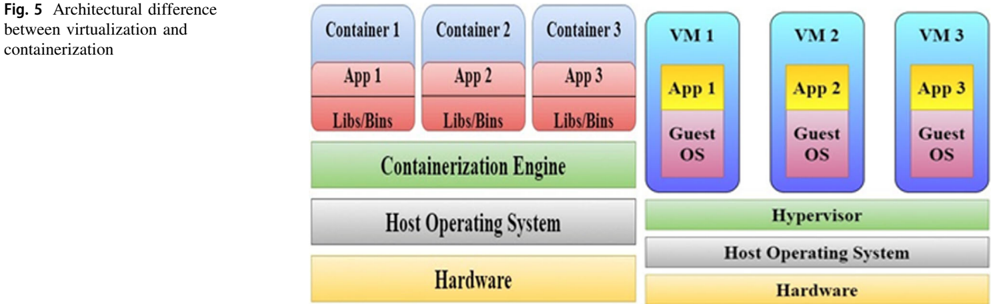
“Container-based systems returned unused memory to the host, resulting in more efficient memory utilisation.”
What the sources say
- Supportedcites [41] 41. Ramchandra Desai, P.A. Survey of Performance Comparison between Virtual Machines and Containers. Int. J. Comput. Sci. Eng. (2016) source
The Memory Performance section (p. of our copy, §B) states directly that 'Container based systems have the ability to return unused memory to the host resulting in better usage,' which is exactly what the citing sentence attributes. The Discussion (§G) reinforces it, crediting container-based virtualization's better CPU and I/O performance to its ability to release unused resources. (LLM, conf=0.90)
plainstates a cause- Asserted: passes — The authors put it forward as true.
- Checkable: passes — It can be checked against evidence.
- Load-bearing: unclear — It is unclear whether the paper’s conclusions depend on it.
- Based: passes — The paper gives a reason why it holds.
- Supported
The cited sources support only part of this claim — read each source’s verdict below.
In the paper
“Virtualization systems suffered from double cache since the host and virtual computer used the same memory blocks.”
What the sources say
- Partly supportedcites [41] 41. Ramchandra Desai, P.A. Survey of Performance Comparison between Virtual Machines and Containers. Int. J. Comput. Sci. Eng. (2016) sourceExperimental — accuracy not yet measured
The Memory Performance section (B) of our copy states the double-cache problem almost verbatim: 'Para virtualization systems suffer from double cache since the same memory blocks are used by the host and the virtual machine.' However, the source restricts this to para-virtualization specifically (the Introduction distinguishes full, partial and para virtualization, and KVM is described as full virtualization), whereas the citing sentence attributes the double-cache drawback to 'virtualization systems' generally. That generalization to all virtualization is the part the source does not support; the mechanism (host and VM sharing the same memory blocks) is confirmed. (LLM, conf=0.72)
plainstates a cause- Asserted: passes — The authors put it forward as true.
- Checkable: passes — It can be checked against evidence.
- Load-bearing: unclear — It is unclear whether the paper’s conclusions depend on it.
- Based: passes — The paper gives a reason why it holds.
- Partly supported
The cited sources support only part of this claim — read each source’s verdict below.
In the paper
“The energy consumption of data centres alone will rise from 200 TWh in 2016 to 2967 TWh in 2030.”
- Also stated in: § 1 Introduction · p. 2 · plain
“The energy consumption of data centres alone will rise from 200 TWh in 2016 to 2967 TWh in 2030 [2].”
What the sources say
- Partly supportedcites [2] 2. Koot, M., Wijnhoven, F.: Usage impact on data center electricity needs: A system dynamic forecasting model. Appl. Energy. 291 , 116798 (2021) sourceExperimental — accuracy not yet measured
The Literature review (section 2) reports the exact 200 TWh-to-2,967 TWh projection, but attributes it to Andrae and Edler and says it was highly uncertain and later revised. The paper’s own conclusion (section 7) instead projects 286 TWh in 2016 rising to 321 TWh in 2030 under unchanged trends, so the unqualified sentence should not be read as this paper’s forecast. (LLM, conf=0.88)
plainstates a cause- Asserted: passes — The authors put it forward as true.
- Checkable: passes — It can be checked against evidence.
- Load-bearing: unclear — It is unclear whether the paper’s conclusions depend on it.
- Based: passes — The paper gives a reason why it holds.
- Also stated in: § 1 Introduction · p. 2 · plain
Every source the paper cites for this claim was checked and supports it.
In the paper
“For achieving energy efficiency especially at the application level, Ho et al. [26] concentrated on batch applications executing on VMs in data centres.”
What the sources say
- Supportedcites [26] 26. Ho, T.T.N., Gribaudo, M., Pernici, B.: Characterizing Energy per Job in Cloud Applications. Electron. 2016. 5 , 90 (2016) source
The Abstract states that the paper focuses on batch applications running on virtual machines in data centers and analyzes their energy consumption and efficiency at the application level. Section 4, “Modeling Application Energy Efficiency,” confirms that focus. The source supports the citing sentence as a description of its research focus, rather than a claim that it achieved a measured efficiency improvement. (LLM, conf=0.94)
plain- Asserted: passes — The authors put it forward as true.
- Checkable: passes — It can be checked against evidence.
- Load-bearing: unclear — It is unclear whether the paper’s conclusions depend on it.
- Based: passes — The paper gives a reason why it holds.
- Supported
In the paper
“Docker, when configured to a maximum latency of 3000ms, can operate up to 21% more services than KVM.”
What the sources say
- Not checked — no full text of the sourcecites [39] 39. Cuadrado-Cordero, I., Orgerie, A.C., Menaud, J.M. Comparative experimental analysis of the quality-of-service and energy-efficiency of VMs and containers' consolidation for cloud applications. 25th International Conference on Software, Telecommunications and Computer Networks, SoftCOM 2017 (2017) https://doi.org/10.23919/SOFTCOM.2017.8115516 source
plainstates a cause- Asserted: passes — The authors put it forward as true.
- Checkable: passes — It can be checked against evidence.
- Load-bearing: unclear — It is unclear whether the paper’s conclusions depend on it.
- Based: passes — The paper gives a reason why it holds.
16 more claims
Create a free account to see all 156 claims and to verify the 9 references still open.
- Probably not a substantial claim. 118
- It may state two separate claims as one. 54
Claims other papers make about this one
Each is checked against this paper’s own text: does it say what the citing paper says it does?
The source backs part of the claim, not all of it — or backs it for a different population, condition or comparison.
In the citing paper
“Studies have shown that green computing initiatives can result in substantial cost savings for organizations through reduced energy bills, lower maintenance costs, and increased operational efficiency (Liu et al ., 2022; Katal et al ., 2023).”
From Advancing green computing: Practices, strategies, and impact in modern software development for environmental sustainability (2024) · cites this paper as Katal et al ., 2023
Experimental — accuracy not yet measuredThe cited source says what the claim attributes to it.
In the citing paper
“In addition to environmental benefits, adopting green computing practices can yield significant economic and societal benefits for organizations and society as a whole.”
From Advancing green computing: Practices, strategies, and impact in modern software development for environmental sustainability (2024) · cites this paper as Katal et al ., 2023
Self-check
Percentages, sums and reported differences re-computed from the paper’s own numbers.
Each contradiction between two passages listed here was confirmed by an independent check.
Rated minor: it would not touch a result — a value no result rests on, a p-value that stays on the same side of the significance level, or a conflict that is clerical, resolved elsewhere in the paper, or outside its own findings.
In the paper
§ Declarations · p. 26
“Ethical approval This paper does not contain any studies with human participants or animals performed by any of the authors.”
§ Declarations · p. 26
“Informed consent Informed consent was obtained from all individual participants included in the study.”
Citations
Cites
Beloglazov, A., & Buyya, R. (2012) · Concurrency and Computation: Practice and Experience · doi:10.1002/cpe.1867 · Cited by 1,864 · cited 1×
“The metric for SLA is calculated as the fraction of the difference among the allocated and the requested CPU for each VM [43].”
Power provisioning for a warehouse-sized computer
Fan, X., Weber, W.-D., & Barroso, L. A. (2007) · Proceedings of the 34th annual international symposium on Computer architecture · doi:10.1145/1250662.1250665 · Cited by 1,797 · cited 1×
“Fan’s [48] energy model of a PM (Eq.”
BackgroundData Center Energy Consumption Modeling: A Survey
Dayarathna, M., Wen, Y., & Fan, R. (2016) · IEEE Communications Surveys & Tutorials · doi:10.1109/comst.2015.2481183 · Cited by 1,165 · cited 1×
“The authors in [14] discussed the different mechanism and architectures for the design of energy efficient data centers.”
Background(2010) · doi:10.5555/1855711.1855728 · Cited by 970
Green Cloud Computing: Balancing Energy in Processing, Storage, and Transport
Baliga, J., Ayre, R. W. A., Hinton, K., & Tucker, R. S. (2011) · Proceedings of the IEEE · doi:10.1109/jproc.2010.2060451 · Cited by 840 · cited 1×
“The authors of [11] presented an analysis on cloud computing energy usage.”
BackgroundA Taxonomy and Survey of Energy-Efficient Data Centers and Cloud Computing Systems
Beloglazov, A., Buyya, R., Lee, Y. C., & Zomaya, A. (2011) · Advances in Computers · doi:10.1016/b978-0-12-385512-1.00003-7 · Cited by 777
Sustainable Computing: Informatics and Systems
Li, K. (2012) · Cited by 486
Post-copy based live virtual machine migration using adaptive pre-paging and dynamic self-ballooning
Hines, M. R., & Gopalan, K. (2009) · Proceedings of the 2009 ACM SIGPLAN/SIGOPS international conference on Virtual execution environments · doi:10.1145/1508293.1508301 · Cited by 409
Usage impact on data center electricity needs: A system dynamic forecasting model
Koot, M., & Wijnhoven, F. (2021) · Applied Energy · doi:10.1016/j.apenergy.2021.116798 · Cited by 403 · cited 1×
“The energy consumption of data centres alone will rise from 200 TWh in 2016 to 2967 TWh in 2030 [2].”
BackgroundUser-priority guided Min-Min scheduling algorithm for load balancing in cloud computing
Chen, H., Wang, F., Helian, N., & Akanmu, G. (2013) · 2013 National Conference on Parallel Computing Technologies (PARCOMPTECH) · doi:10.1109/parcomptech.2013.6621389 · Cited by 287 · cited 9×
“To address the issue of energy usage, the authors of [56] proposed the Energy and Performance-Efficient Task Scheduling Algorithm (EPETTS) in a heterogeneous virtualized cloud.”
MethodInfluential
Research works printed but not linked: 8
- 1. Fiona, B., Ballarat, C.: International Review of Energy Efficiency in Data Centres Acknowledgements. (2021)
- 10. SRCMap: Energy Proportional Storage Using Dynamic Consolidation. https://www.researchgate.net/publication/ 221353706\_SRCMap\_Energy\_Proportional\_Storage\_Using\_ Dynamic\_Consolidation
- 80. Falisha, I.N., Purboyo, T.W., Latuconsina, R.: Experimental model for load balancing in cloud computing using equally spread current execution load algorithm. Int. J. Appl. Eng. Res. 13 , 1134-1138 (2018)
- 81. Patel, D., Rajawat, A. Efficient Throttled Load Balancing Algorithm in Cloud Environment.International Journal of Modern Trends in Engineering and Research (2015)
- 96. Crow Search based Scheduling Algorithm for Load Balancing in Cloud Environment: Int. J. Innovative Technol. Exploring Eng. 8 , 1058-1064 (2019)
- 100. Derdus, K.M., Omwenga, V., Ogao, P. Statistical Techniques for Characterizing Cloud Workloads: A Survey.International Journal of Computer and Information Technology2279-0764(2019)
- 101. Ismaeel, S., Al-Khazraji, A., Miri, A. An efficient workload clustering framework for large-scale data centers. 8th International Conference on Modeling Simulation and Applied
- 102. Yousif, S.A., Al-Dulaimy, A. Clustering Cloud Workload Traces to Improve the Performance of Cloud Data Centers. Proceedings of the World Congress on Engineering (2017)
Cited by
Industrial Internet of Things Intelligence Empowering Smart Manufacturing: A Literature Review
Hu, Y., Jia, Q., Yao, Y., Lee, Y., Lee, M., Wang, C., Zhou, X., Xie, R., & Yu, F. R. (2024) · IEEE Internet of Things Journal · doi:10.1109/jiot.2024.3367692 · Cited by 256
“Current network is the product of the deep integration of the new generation of information, communication, and modern industrial technologies.”
BackgroundModern computing: Vision and challenges
Gill, S. S., Wu, H., Patros, P., Ottaviani, C., Arora, P., Pujol, V. C., Haunschild, D., Parlikad, A. K., Cetinkaya, O., Lutfiyya, H., et al. (2024) · Telematics and Informatics Reports · doi:10.1016/j.teler.2024.100116 · Cited by 197
“This pattern has been pushing cloud systems to the limits of their computational and, by extension, energy consumption capacities [302].”
BackgroundIslam, M. T., & Ali, A. (2024) · Next Energy · doi:10.1016/j.nxener.2024.100161 · Cited by 173
Meinhold, R., Wagner, C., & Dhar, B. K. (2024) · Sustainable Development · doi:10.1002/sd.3240 · Cited by 136
Goel, A., Masurkar, S., & Pathade, G. R. (2024) · Sustainability · doi:10.3390/su162411079 · Cited by 190
Post-growth Human–Computer Interaction
Sharma, V., Kumar, N., & Nardi, B. A. (2023) · ACM Transactions on Computer-Human Interaction · doi:10.1145/3624981 · Cited by 133
“Consumption is growing with the increasing number of data centers [162].”
BackgroundA review of the potential opportunities and challenges of the digital economy for sustainability
Raihan, A. (2024) · Innovation and Green Development · doi:10.1016/j.igd.2024.100174 · Cited by 143
Amin, A., Bhuiyan, M. R. I., Hossain, R., Molla, C., Poli, T. A., & Milon, M. N. U. (2024) · Business Strategy & Development · doi:10.1002/bsd2.363 · Cited by 86
GREENER principles for environmentally sustainable computational science
Lannelongue, L., Aronson, H. G., Bateman, A. G., Birney, E., Caplan, T., Juckes, M. N., McEntyre, J., Morris, A. D., Reilly, G., & Inouye, M. (2023) · Nature Computational Science · doi:10.1038/s43588-023-00461-y · Cited by 116
“Since then, continuous improvements have been made by developing new hardware, building lower-energy data centers and implementing more efficient HPC systems 17,18 .”
BackgroundYang, S., Wang, J., Dong, K. Y., & Jiang, Q. (2023) · Energy Economics · doi:10.1016/j.eneco.2023.107056 · Cited by 76
Hou, H., Jawaddi, S. N. A., & Ismail, A. B. (2023) · Future Generation Computer Systems · doi:10.1016/j.future.2023.10.002 · Cited by 87
A comprehensive survey of energy-efficient computing to enable sustainable massive IoT networks
Alsharif, M. H., Kelechi, A. H., Jahid, A., Kannadasan, R., Singla, M. K., Gupta, J., & Geem, Z. W. (2024) · Alexandria Engineering Journal · doi:10.1016/j.aej.2024.01.067 · Cited by 107
A systematic review on effective energy utilization management strategies in cloud data centers
Panwar, S. S., Rauthan, M. M. S., & Barthwal, V. (2022) · Journal of Cloud Computing · doi:10.1186/s13677-022-00368-5 · Cited by 65
“The authors of [36] has conducted a systematic examination of the present status of software solution that helps in reduction of energy consumption in data centers and also stated the impact of data centers on the environment.”
BackgroundReview of energy efficiency and technological advancements in data center power systems
Khosravi, A., Sandoval, O. R., Taslimi, M. S., Sahrakorpi, T., Amorim, G., & Pabón, J. J. G. (2024) · Energy and Buildings · doi:10.1016/j.enbuild.2024.114834 · Cited by 93
Impact of Data Centers on Climate Change: A Review of Energy Efficient Strategies
Ewim, D. R. E., Ninduwezuor-Ehiobu, N., Orikpete, O. F., Egbokhaebho, B. A., Fawole, A. A., & Onunka, C. (2023) · The Journal of Engineering and Exact Sciences · doi:10.18540/jcecvl9iss6pp16397-01e · Cited by 64
“Based on findings by Katal et al .”
BackgroundMethodAI-driven job scheduling in cloud computing: a comprehensive review
Sanjalawe, Y. K., Al-E’mari, S., Fraihat, S., & Makhadmeh, S. N. (2025) · Artificial Intelligence Review · doi:10.1007/s10462-025-11208-8 · Cited by 97
The Impact of Digital Business on Energy Efficiency in EU Countries
Kwilinski, A. S., Lyulyov, O. V., & Pimonenko, T. (2023) · Information · doi:10.3390/info14090480 · Cited by 66
Enhancement in performance of cloud computing task scheduling using optimization strategies
Sandhu, R., Faiz, M., Kaur, H., Srivastava, A. K., & Narayan, V. (2024) · Cluster Computing · doi:10.1007/s10586-023-04254-w · Cited by 63
A holistic approach to environmentally sustainable computing
Pazienza, A., Baselli, G., Vinci, D. C., & Trussoni, M. V. (2024) · Innovations in Systems and Software Engineering · doi:10.1007/s11334-023-00548-9 · Cited by 76
Li, J., Zhang, E., Han, J., Zhang, Y., & Shen, J. (2024) · IEEE Internet of Things Journal · doi:10.1109/jiot.2024.3468018 · Cited by 55
Arcas, G. I., Cioara, T., Anghel, I. M., Lazea, D., & Hângan, A. (2024) · Smart Cities · doi:10.3390/smartcities7010028 · Cited by 82
Doo, F. X., Kulkarni, P., Siegel, E. L., Toland, M., Yi, P. H., Carlos, R. C., & Parekh, V. S. (2023) · Journal of the American College of Radiology · doi:10.1016/j.jacr.2023.11.011 · Cited by 50
Impact of Data Centers on Power Consumption, Climate Change, and Sustainability
Thangam, D., Muniraju, H., Ramesh, R., Narasimhaiah, R., Khan, M. A., Booshan, S., S., B. B. M., Manickam, T., & Ganesh, R. S. (2024) · Advances in computational intelligence and robotics book series · doi:10.4018/979-8-3693-1552-1.ch004 · Cited by 70
GREEN DATA CENTERS: SUSTAINABLE PRACTICES FOR ENERGY-EFFICIENT IT INFRASTRUCTURE
Chidolue, O., Ohenhen, P. E., Umoh, A. A., Ngozichukwu, B., Fafure, A. V., & Ibekwe, K. I. (2024) · Engineering Science & Technology Journal · doi:10.51594/estj.v5i1.730 · Cited by 60
GEECO: Green Data Centers for Energy Optimization and Carbon Footprint Reduction
Mondal, S., Faruk, F. B., Rajbongshi, D., Efaz, M. M. K., & Islam, M. M. (2023) · Sustainability · doi:10.3390/su152115249 · Cited by 66
Challenges and Opportunities in Fog Computing Scheduling: A Literature Review
Chuan, W. C., Laghari, S. U. A., Manickam, S., Ashraf, E., & Karuppayah, S. (2025) · IEEE Access · doi:10.1109/access.2024.3525261 · Cited by 74
“This layer is designed to handle tasks that require substantial data processing or computational power [24].”
Kar, D., & Dhal, S. B. (2025) · Environmental Monitoring and Assessment · doi:10.1007/s10661-025-13650-1 · Cited by 51
“• Energy‑efficient data storage: Exploring more energy-efficient data storage solutions, such as using renewable energy sources for cloud computing, can help reduce the environmental impact of storing and processing large datasets (Bharany et al., 2022; Katal et al., 2023).”
Decarbonising digital infrastructure and urban sustainability in the case of data centres
Liu, F. H. M., Lai, K. P. Y., Seah, B., & Chow, W. (2025) · npj Urban Sustainability · doi:10.1038/s42949-025-00203-1 · Cited by 59
Corigliano, O., Algieri, A., & Fragiacomo, P. (2024) · Applied Sciences · doi:10.3390/app14146046 · Cited by 53
Bhuiyan, M. R. I. (2024) · Human Behavior and Emerging Technologies · doi:10.1155/hbe2/8830228 · Cited by 65
Shao, K., Fu, H., & Wang, B. (2023) · Electronics · doi:10.3390/electronics12163450 · Cited by 38
Engineering Sustainable Data Architectures for Modern Financial Institutions
Ionescu, S.-A., Dıaconıța, V., & Radu, A.-O. (2025) · Electronics · doi:10.3390/electronics14081650 · Cited by 73
“As such, energy modeling and prediction for data centers are essential [68].”
Energy-Efficient Graph Reinforced vNFC Deployment in Elastic Optical Inter-DC Networks
Zhu, R., Zhang, W., Wang, P., Chen, J., Wang, J., & Yu, S. (2023) · IEEE Transactions on Network Science and Engineering · doi:10.1109/tnse.2023.3325828 · Cited by 28
“The energy consumption of data centres alone will rise from200TWhin2016to2967TWhin2030[4].”
BackgroundTELECOMMUNICATIONS ENERGY EFFICIENCY: OPTIMIZING NETWORK INFRASTRUCTURE FOR SUSTAINABILITY
Ezeigweneme, C. A., Umoh, A. A., Ilojianya, V. I., et al. (2024) · Computer Science & IT Research Journal · doi:10.51594/csitrj.v5i1.700 · Cited by 28
Analyzing Threats and Attacks in Edge Data Analytics within IoT Environments
Mahadevappa, P., Al-amri, R., Alkawsi, G. A., Alkahtani, A. A., Alghenaim, M. F., & Alsamman, M. (2024) · IoT · doi:10.3390/iot5010007 · Cited by 46
“Compared to traditional data processing environments, such as data centers or cloud platforms, security measures in edge data analytics primarily focus on centralized servers and network infrastructure [55].”
BackgroundA systematic review of green-aware management techniques for sustainable data center
Lin, W., Lin, J., Peng, Z., Huang, H., Lin, W., & Li, K. (2024) · Sustainable Computing Informatics and Systems · doi:10.1016/j.suscom.2024.100989 · Cited by 62
An Energy-Efficient Tuning Method for Cloud Servers Combining DVFS and Parameter Optimization
Lin, W., Luo, X., Li, C., Liang, J., Wu, G., & Li, K. (2023) · IEEE Transactions on Cloud Computing · doi:10.1109/tcc.2023.3308927 · Cited by 27
“Clouddatacentersarescalingfurthertomeettheseincreasingly complexbusinessneeds,whichbringsasignificantincrease in cluster deployment and maintenance costs [1].”
BackgroundAlkasmoul, F. S., Almogbel, A. M., Shahzad, M. W., & Al‐damook, A. (2024) · Results in Engineering · doi:10.1016/j.rineng.2024.103699 · Cited by 29
Atadoga, A., Umoga, U. J., Lottu, O. A., & Sodiya, E. O. (2024) · World Journal of Advanced Engineering Technology and Sciences · doi:10.30574/wjaets.2024.11.1.0051 · Cited by 49
“Eco-friendly architectures are designed with principles aimed at minimizing environmental impact, such as modular design, distributed computing, and green data storage (Katal, 2023; Ukoba and Jen, 2023).”
BackgroundNambi, S., & Thanapal, P. (2025) · IEEE Access · doi:10.1109/access.2025.3527031 · Cited by 38
Ghasemi, A., & Keshavarzi, A. (2024) · Cluster Computing · doi:10.1007/s10586-024-04657-3 · Cited by 32
Ahmed, A., Adnan, M., Abdullah, S., Ahmad, I., Alturki, N. M., & Jamel, L. (2024) · IEEE Access · doi:10.1109/access.2024.3371693 · Cited by 31
“Virtual machine-based central cloud facilities have various advantages for lowering scheduling [20] costs and enhancing service accessibility and availability.”
BackgroundAtadoga, A., Umoga, U. J., Lottu, O. A., & Sodiya, E. O. (2024) · World Journal of Advanced Engineering Technology and Sciences · doi:10.30574/wjaets.2024.11.1.0052 · Cited by 22
“Studies have shown that green computing initiatives can result in substantial cost savings for organizations through reduced energy bills, lower maintenance costs, and increased operational efficiency (Liu et al ., 2022; Katal et al ., 2023).”
BackgroundBergougui, B. (2025) · Borsa Istanbul Review · doi:10.1016/j.bir.2025.07.012 · Cited by 26
Deep Learning-Driven Anomaly Detection for Green IoT Edge Networks
Bushehri, A. S., Amirnia, A., Belkhiri, A., Keivanpour, S., de Magalhães, F. G., & Nicolescu, G. (2023) · IEEE Transactions on Green Communications and Networking · doi:10.1109/tgcn.2023.3335342 · Cited by 31
“The first is called Dynamic Power Management (DPM) [11].”
BackgroundEnergy and QoS-aware virtual machine placement approach for IaaS cloud datacenter
Elsedimy, E. I., Herajy, M., & Abohashish, S. M. M. (2025) · Neural Computing and Applications · doi:10.1007/s00521-024-10872-1 · Cited by 28
Nawi, M. N. M., Fauzi, M. A., Ting, I. W. K., Wider, W., & Amaka, G. B. (2024) · Kybernetes · doi:10.1108/k-10-2023-2139 · Cited by 32
Energy Consumption in Microservices Architectures: A Systematic Literature Review
Araújo, G., Barbosa, V., Lima, L. N., Sabino, A., de Brito, C. E. F., Fé, I., Rêgo, P. A. L., Choi, E., Min, D., Nguyễn, T. A., et al. (2024) · IEEE Access · doi:10.1109/access.2024.3389064 · Cited by 22
“Data centers need a lot of energy to provide services, which also increases CO2 emissions [58].”
EETS: An energy-efficient task scheduler in cloud computing based on improved DQN algorithm
Hou, H., & Ismail, A. B. (2024) · Journal of King Saud University - Computer and Information Sciences · doi:10.1016/j.jksuci.2024.102177 · Cited by 30
“Data centers are a significant energy consumption is significant and beneficial for cloud providers, cloud subscribers, and the environment (Katal et al., 2023).”
Evolution of computing energy efficiency: Koomey's law revisited
Prieto, A., Prieto, B., Escobar, J. J., Lampert, T. A., & Gonzalez, J. (2024) · Cluster Computing · doi:10.1007/s10586-024-04767-y · Cited by 33
Wang, Y., Zhang, P., Wang, B., et al. (2024) · Cluster Computing · doi:10.1007/s10586-024-04851-3 · Cited by 20
Towards a sustainable future: developing a cybersecurity framework for manufacturing
Alqudhaibi, A., Deshpande, S., Jagtap, S., & Salonitis, K. (2023) · Technological Sustainability · doi:10.1108/techs-05-2023-0022 · Cited by 38
Ugonnia, J. C., Olaniyi, O. O., Olaniyi, F. G., Arigbabu, A. A., & Oladoyinbo, T. O. (2024) · Journal of Engineering Research and Reports · doi:10.9734/jerr/2024/v26i51151 · Cited by 20
Adaptive Energy Optimization in Cloud Computing Through Containerization
Beena, B. M., Ranga, P. C., Holimath, V., Sridhar, S., Kamble, S. S., Shendre, S. P., & Priya, M. Y. (2025) · IEEE Access · doi:10.1109/access.2025.3606932 · Cited by 21
“Pheromone updates are performed using Equation (10). for t = 1 to T do 6: for each particle i = 1 to N do 7: Compute [1]).”
InfluentialAlazab, M., Awajan, A. W., Obeidat, A., Faruqui, N., Bere, A., Ali, S., & Wei, W. (2025) · Engineering Applications of Artificial Intelligence · doi:10.1016/j.engappai.2025.110750 · Cited by 17
William, P., Mishra, V. P., Khalaf, O. I., et al. (2025) · Computers, materials & continua/Computers, materials & continua (Print) · doi:10.32604/cmc.2025.065840 · Cited by 15
Shi, L., Zhao, J., Du, X., Tan, Y., Lei, T., Ming, X., & Shen, Y. (2025) · Frontiers in Earth Science · doi:10.3389/feart.2025.1618999 · Cited by 15
Cloud Servers: Resource Optimization Using Different Energy Saving Techniques
Hijji, M., Ahmad, B., Alam, G., Alwakeel, A. M., Alwakeel, M. M., Alharbi, L. A., Aljarf, A., & Khan, M. U. (2022) · Sensors · doi:10.3390/s22218384 · Cited by 20
Matthew, U. O., Asuni, O. H., & Fatai, L. O. (2024) · Advances in systems analysis, software engineering, and high performance computing book series · doi:10.4018/979-8-3693-3502-4.ch018 · Cited by 25
Game theory-based virtual machine migration for energy sustainability in cloud data centers
Carrascosa, F. J. M., Galán, S. G., Valverde, M., et al. (2024) · Applied Energy · doi:10.1016/j.apenergy.2024.123798 · Cited by 15
Soongpol, B., Netinant, P., & Rukhiran, M. (2024) · Sustainability · doi:10.3390/su16135738 · Cited by 37
Optimization of resource-aware parallel and distributed computing: a review
Czarnul, P., Antal, M., Baniata, H., Griebler, D., Kertész, A., Keßler, C. W., Kouloumpris, A., Kovačić, S., Márkus, A., Michael, M. K., et al. (2025) · The Journal of Supercomputing · doi:10.1007/s11227-025-07295-7 · Cited by 25
Efficient resource allocation in cloud environment using SHO-ANN-based hybrid approach
Sharma, S., & Rawat, P. S. (2024) · Sustainable Operations and Computers · doi:10.1016/j.susoc.2024.07.001 · Cited by 16
Biswas, D., Jahan, S., Saha, S., & Samsuddoha, M. (2024) · Sustainable Computing Informatics and Systems · doi:10.1016/j.suscom.2024.101036 · Cited by 34
Impact of computing infrastructure on carbon emissions in China
Mao, F., Wei, Y., & Wang, Y. (2024) · Scientific Reports · doi:10.1038/s41598-024-81677-4 · Cited by 27
“Although the energy demand of computing infrastructure is increasing, advancements in hardware and software technology are improving energy efficiency 47 .”
Reducing Environmental Impact with Sustainable Serverless Computing
Akour, M., & Alenezi, M. (2025) · Sustainability · doi:10.3390/su17072999 · Cited by 13
Ebirim, W., Usman, F. O., Montero, D. J. P., Ninduwesuor-Ehiobu, N., Olu-lawal, K. A., & Ani, E. C. (2024) · World Journal of Advanced Research and Reviews · doi:10.30574/wjarr.2024.21.2.0621 · Cited by 18
“In this context, effective project management strategies play a crucial role in the successful implementation of energy-efficient cooling solutions (Katal, Dahiya & Choudhury, 2023, Manganelli, et. al., 2021).”
Energy-efficient communication-aware VM placement in cloud datacenter using hybrid ACO–GWO
Keshri, R., & Vidyarthi, D. P. (2024) · Cluster Computing · doi:10.1007/s10586-024-04623-z · Cited by 24
Benchmarking and revisiting time series forecasting methods in cloud workload prediction
Lin, S., Lin, W., Zhao, F., & Chen, H. (2024) · Cluster Computing · doi:10.1007/s10586-024-04827-3 · Cited by 16
Enabling coastal analytics at planetary scale
Calkoen, F., Luijendijk, A. P., Vos, K., Kras, E., & Baart, F. (2024) · Environmental Modelling & Software · doi:10.1016/j.envsoft.2024.106257 · Cited by 15
A Comprehensive Review on Performance Analysis of Enterprise Cloud Computing Architecture
Moharana, B., Singh, V. K., Sarkar, T., Maan, A., Rakhra, M., & Chakrabarty, P. (2024) · International Conference on Cybernation and Computation (CYBERCOM) · doi:10.1109/cybercom63683.2024.10803178 · Cited by 13
The promise of neuromorphic edge AI for rural environmental monitoring
Aral, A. (2024) · Environmental Data Science · doi:10.1017/eds.2024.36 · Cited by 26
Yuan, H., Wang, T., Fu, M., & Shi, Y. (2025) · IEEE Transactions on Mobile Computing · doi:10.1109/tmc.2025.3547339 · Cited by 16
“Moreover,existingstudiesoftenprioritizeend-to-endla-tency,overlookingothercriticalfactorssuchaspowercon-sumption(PC),whichisequallyvitalforsustainabilityand cost-effectivenessinmicroservices[21],[22],[23],[24],[25].”
Mikram, H., & Kafhali, S. E. (2025) · Journal of Grid Computing · doi:10.1007/s10723-025-09803-8 · Cited by 12
“However, this approach typically leads to higher relative energy consumption and operational costs due to low server utilization rates [1].”
Alsanie, G. (2025) · Sustainability · doi:10.3390/su17094073 · Cited by 26
Souri, A., Mood, S. E., Gao, M., et al. (2024) · Cluster Computing · doi:10.1007/s10586-024-04489-1 · Cited by 11
“One of the reasons for the high service cost of cloud com - puting is the energy consumption cost in cloud data cen - ters [ 6 ].”
A novel virtual machine placement algorithm based on grey wolf optimization
Feng, H., Li, H., Liu, Y., Cao, K., & Zhou, X. (2025) · Journal of Cloud Computing Advances Systems and Applications · doi:10.1186/s13677-025-00730-3 · Cited by 17
Peng, Y., Wang, X., & Gao, W. (2025) · Sustainability · doi:10.3390/su17094099 · Cited by 15
Cloud Computing: Transformations, Opportunities, and Challenges
Amudha, G., Gopika, P., Saranya, G., et al. (2025) · International Conference on Self Sustainable Artificial Intelligence Systems (ICSSAS) · doi:10.1109/icssas66150.2025.11080697 · Cited by 11
Bouaouda, A., Afdel, K., & Abounacer, R. (2024) · Sustainability · doi:10.3390/su16114438 · Cited by 12
“This centrality has contributed to the surge in energy consumption, underscoring the need for a comprehensive approach to address this growing challenge [1–3].”
BackgroundMethodInfluentialA review of simulation software for energy systems: Design, functionality, and applications
Liu, Z., Luo, H., Zhang, Y., Luo, T., & Yang, X. (2024) · Thermal Science and Engineering Progress · doi:10.1016/j.tsep.2024.102760 · Cited by 13
EELB: an energy-efficient load balancing model for cloud environment using Markov decision process
Kotteswari, K., Dhanaraj, R. K., Balusamy, B., Nayyar, A., & Sharma, A. K. (2025) · Computing · doi:10.1007/s00607-025-01439-6 · Cited by 18
Cicco, N. D., Pittalà, G. F., Davoli, G., Borsatti, D., Cerroni, W., Raffaelli, C., & Tornatore, M. (2025) · IEEE Transactions on Network and Service Management · doi:10.1109/tnsm.2025.3574131 · Cited by 16
“This phenomenon can be attributed to several factors related to how modern processors manage power and performance, such as Dynamic Voltage and Frequency Scaling (DVFS) [36] and advanced power management techniques [37], dynamically adjusting the voltage and frequency of a CPU based on the workload.”
Adaptive Multi-Objective Virtual Machine Consolidation for Energy-Efficient Cloud Data Centers
Goyal, S., & Awasthi, L. K. (2025) · Journal of Grid Computing · doi:10.1007/s10723-025-09808-3 · Cited by 15
“More concerning, data centers are responsible for approximately 3% of global energy consumption, which is expected to grow as cloud users and services increase [4].”
Cai, Y., Guo, J., & Shen, C. (2026) · International Review of Economics & Finance · doi:10.1016/j.iref.2026.104927 · Cited by 12
Prakasam, P., Ujwala, R., Srikar, K., et al. (2024) · Connection Science · doi:10.1080/09540091.2024.2350755 · Cited by 9
“Within the domain of data centres, one of the primary challenges is the management of energy consumption, which is a crucial factor that affects the operation and maintenance of Cloud computing (Katal et al., 2023).”
Importance of Variable Turbine Efficiency in Run‐Of‐River Hydropower Design Under Deep Uncertainty
Yildiz, V., Brown, S., & Rougé, C. (2024) · Water Resources Research · doi:10.1029/2023wr035713 · Cited by 19
“This proportion is expected to rise in the future (Katal et al., 2022), posing an additional, significant challenge to global climate change mitigation efforts.”
BackgroundKokate, R., & Park, C. (2024) · Applied Thermal Engineering · doi:10.1016/j.applthermaleng.2024.124549 · Cited by 10
Optimizing LLM Inference Clusters for Enhanced Performance and Energy EfficiencyPreprint
Hisaharo, S., Nishimura, Y., & Takahashi, A. (2024) · doi:10.36227/techrxiv.172348951.12175366/v1 · Cited by 9
Marwan, M., Temghart, A. A., Ouhmi, S., & Lazaar, M. (2024) · Results in Engineering · doi:10.1016/j.rineng.2024.102902 · Cited by 11
Wang, G., Wen, B., He, J., & Meng, Q. (2025) · Cluster Computing · doi:10.1007/s10586-024-04695-x · Cited by 9
Hyperdimensional computing in biomedical sciences: a brief review
Cumbo, F., & Chicco, D. (2025) · PeerJ Computer Science · doi:10.7717/peerj-cs.2885 · Cited by 16
High-frequency bending-actuated elastocaloric cooler with enhanced cooling performance
Li, X., Hua, P., Yang, L., Hu, J. P., Su, C., Yao, S., & Sun, Q. (2025) · Cell Reports Physical Science · doi:10.1016/j.xcrp.2025.102669 · Cited by 10
Energy efficiency enhancement in two European data centers through CFD modeling
Sarikaya, O. M., Kuzay, M., Demirel, E., et al. (2025) · Scientific Reports · doi:10.1038/s41598-025-11048-0 · Cited by 8
Maximizing waste heat recovery from a building-integrated edge data center
Kuzay, M., Demirel, E., Yilmaz, C., Koirala, B. P., & Heer, P. (2025) · Scientific Reports · doi:10.1038/s41598-025-22498-x · Cited by 9
“The flow rate of air supplied by the fans of the cooling system is typically measured using flow meters located at specific positions of DCs 45,46 .”
Hiremath, T. C., & Rekha, K. S. (2023) · Advances in Engineering Software · doi:10.1016/j.advengsoft.2023.103496 · Cited by 9
A Systematic Literature Review of Cloud Brokers for Autonomic Service Distribution
Khan, M. H., Habaebi, M. H., & Islam, M. R. (2024) · IEEE Access · doi:10.1109/access.2024.3458829 · Cited by 14
“The API-based integrations, machine learning algorithms, and data processing services are included as a few of the offerings under the application as a service [8].”
BackgroundMethodInfluentialThe butterfly effect of cloud computing on the low-carbon economy
Chen, Y., Zhang, R., Lyu, J., & Ma, X. (2024) · Technological Forecasting and Social Change · doi:10.1016/j.techfore.2024.123433 · Cited by 8
A Comprehensive Monitoring, Visualization, and Management System for Green Data Centers
Hojati, E., Sill, A. F., Mengel, S. A., et al. (2025) · IEEE Systems Journal · doi:10.1109/jsyst.2025.3528748 · Cited by 7
“Avita et al. [9] conducted a survey focusing on energy efficiency in cloud computing environments.”
Toward Sustainable 6G Leveraging Digital Twin and Artificial Intelligence: Framework and Case Study
Xu, D., Su, X. J., Tarkoma, S., & Hui, P. (2025) · IEEE Communications Magazine · doi:10.1109/mcom.003.2400389 · Cited by 8
Metadata
- Authors
- Katal, A., Dahiya, S., & Choudhury, T.
- Affiliations
- University of Petroleum and Energy Studies (IN)
- Corresponding author
- Katal, Avita
- Choudhury, Tanupriya
- Venue
- Cluster Computing
- Published
- 2022-08-30
- Volume
- 26
- Issue
- 3
- Pages
- 1845-1875
- ISSN
- 1386-7857 (ISSN-L)
- 1573-7543
- PMC
- PMC9424070
- OpenAlex
- W4293770403
- Cited by
- 516
- References
- 126
- Citations by year
- 2026: 110 · 2025: 171 · 2024: 172 · 2023: 55 · 2022: 8
- FWCI
- 100.30
- Type
- journal article
- Language
- en
- Open access
- hybrid
- doi.org
- Licence
- cc-by
- www.springernature.com/gp/researchers/text-and-data-mining (tdm)
- www.springernature.com/gp/researchers/text-and-data-mining (vor)
- Locations
- Cluster Computing (publishedVersion, cc-by)
- PubMed Central (publishedVersion)
- PubMed (publishedVersion)
- Topics
- Physical Sciences › Computer Science › Information Systems › Cloud Computing and Resource Management
- Physical Sciences › Computer Science › Hardware and Architecture › Energy Efficiency in Computing
- Physical Sciences › Engineering › Electrical and Electronic Engineering › Green IT and Sustainability
- Keywords
- energy efficiency, cloud computing, data centers, green data centers, power management, containers, virtualization, operating systems, CO2 emissions, electronic waste, energy consumption
About these checks
Registry, retraction, Cites and statistics results are computed, not judged, with one exception: a printed reference that no index lists is read once by a model before it counts as a citation error. Claims are extracted by a model and kept only when their quote appears verbatim in the text; each cited source is then checked, with a model’s help, for whether it says what the claim relies on. Those verdicts can be wrong — read the claim’s quote and the cited source before relying on one.
The claim verdicts this report counts are experimental: their accuracy is not yet measured.
A language model drew the claims from the paper on 2026-10-10, under version 3 of the claim definition (model deepseek-v4.1-flash, prompt extract-v3).
A second model labelled each claim on 2026-10-10 (model jev-1.13-20260917, definition revision gold-guideline-v0.2).
Cited sources are checked with a language model’s help (qwen3.8-omni-flash and gpt-6-sol).
Statistics and arithmetic are recomputed, not judged.
Confidence bands are shown only for fields calibrated on our annotated test set. None is calibrated yet, so no band is shown.
What counts as a claim ›How we measure confidence ›How we check this ›
Are you an author, or do you see a problem with this page? Request a review
Data sources
Bibliographic data: Semantic Scholar, OpenAlex, Crossref.
Contains information from the Semantic Scholar Academic Graph Datasets, made available under the ODC Attribution License (ODC-BY 1.0).
Semantic Scholar’s data is described in: Kinney, R., et al. (2023). The Semantic Scholar Open Data Platform. arXiv:2301.10140.
