

The Role of Cognitive Factors in Childhood Social Anxiety: Social Threat Thoughts and Social Skills Perception
Open accessThe DOI matches its Crossref record; 59 of the 59 references it cites were found in a registry or an index.
Abstract
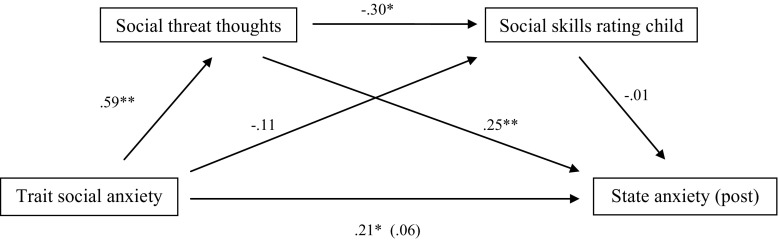
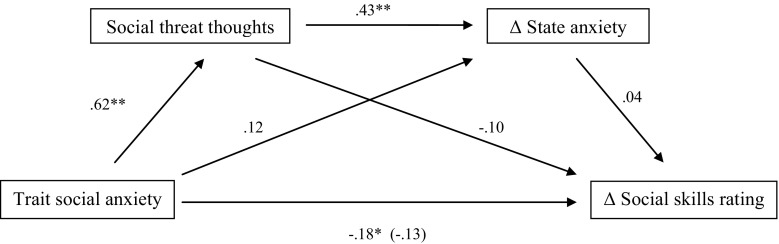
Models of cognitive processing in anxiety disorders state that socially anxious children display several distorted cognitive processes that maintain their anxiety. The present study investigated the role of social threat thoughts and social skills perception in relation to childhood trait and state social anxiety. In total, 141 children varying in their levels of social anxiety performed a short speech task in front of a camera and filled out self-reports about their trait social anxiety, state anxiety, social skills perception and social threat thoughts. Results showed that social threat thoughts mediated the relationship between trait social anxiety and state anxiety after the speech task, even when controlling for baseline state anxiety. Furthermore, we found that children with higher trait anxiety and more social threat thoughts had a lower perception of their social skills, but did not display a social skills deficit. These results provide evidence for the applicability of the cognitive social anxiety model to children.
Overview
The claims and statistics of this paper haven’t been checked yet.
Free: it reads the open-access text and checks the first 5 claims that cite a source we can check. Create a free account to check every claim.
Integrity signals
Registry
Cites
Statistics
Figures
Verification
Claims the paper makes
The claims and statistics of this paper haven’t been checked yet.
Free: it reads the open-access text and checks the first 5 claims that cite a source we can check. Create a free account to check every claim.
Self-check
Percentages, sums and reported differences re-computed from the paper’s own numbers.
The self-check needs the paper’s full text.
Citations
Cites
Baron, R. M., & Kenny, D. A. (1986) · Journal of Personality and Social Psychology · doi:10.1037/0022-3514.51.6.1173 · Cited by 91,532 · cited 1×
“This program is preferable over the causal steps approach of Baron and Kenny (1986), for it is a more advanced method of quantifying the intervening variable models (Hayes 2009).”
(2013) · Cited by 44,563
SPSS and SAS procedures for estimating indirect effects in simple mediation models
Preacher, K. J., & Hayes, A. F. (2004) · Behavior Research Methods, Instruments, & Computers · doi:10.3758/bf03206553 · Cited by 17,383 · cited 2×
“bootstrap resamples to generate estimates of indirect effects (Preacher and Hayes 2004).”
Kessler, R. C., Chiu, W. T., Demler, O., & Walters, E. E. (2005) · Archives of General Psychiatry · doi:10.1001/archpsyc.62.6.617 · Cited by 12,052 · cited 1×
“In addition, anxiety that starts in childhood often persists into adulthood when left untreated (Kessler et al. 2005).”
Beyond Baron and Kenny: Statistical Mediation Analysis in the New Millennium
Hayes, A. F. (2009) · Communication Monographs · doi:10.1080/03637750903310360 · Cited by 9,757 · cited 2×
“method of quantifying the intervening variable models (Hayes 2009).”
Introduction to mediation, moderation, and conditional process analysis :
Hayes, A. F., & names (2015) · Cited by 7,004
A cognitive-behavioral model of anxiety in social phobia
Rapee, R. M., & Heimberg, R. G. (1997) · Behaviour Research and Therapy · doi:10.1016/s0005-7967(97)00022-3 · Cited by 2,987 · cited 5×
“The present study provides evidence that two important aspects of the most influential social anxiety theories are applicable to children (Clark and Wells 1995; Hofmann 2007; Rapee and Heimberg 1997).”
InfluentialA cognitive model of social phobia
Adrian Wells, A. (1995) · Research Explorer (The University of Manchester) · Cited by 2,701
Maximizing exposure therapy: An inhibitory learning approach
Craske, M. G., Treanor, M., Conway, C. C., Zbozinek, T., & Vervliet, B. (2014) · Behaviour Research and Therapy · doi:10.1016/j.brat.2014.04.006 · Cited by 2,339 · cited 2×
“important component in treatment, as evidence suggests that change of threat expectancies regarding the likelihood of aversive events could be the working mechanism in anxiety treatments, as opposed to habituation (Craske et al. 2014).”
A cognitive-motivational analysis of anxiety.
Mogg, K., & Bradley, B. P. (1998) · Behaviour Research and Therapy · doi:10.1016/s0005-7967(98)00063-1 · Cited by 1,642 · cited 1×
“It is possible that children with a social anxiety disorder are even more vigilant for threat and therefore their social threat thoughts might be triggered by milder threats (Mogg and Bradley 1998).”
Cited by
Seddon, J. A., Rodriguez, V. J., Provencher, Y., Raftery-Helmer, J., Hersh, J., Labelle, P. R., & Thomassin, K. (2020) · Psychoneuroendocrinology · doi:10.1016/j.psyneuen.2020.104582 · Cited by 117
Sülter, R. E., Ketelaar, P. E., & Lange, W.-G. (2022) · Computers & Education · doi:10.1016/j.compedu.2021.104384 · Cited by 52
Social Chatbot: My Friend in My Distress
Ali, F., Zhang, Q., Tauni, M. Z., & Shahzad, K. (2024) · International Journal of Human–Computer Interaction · doi:10.1080/10447318.2022.2150745 · Cited by 52
“This concurs with the notion of the cognitive theory of social anxiety, which asserts that individuals with high SIA overrate the negative aspects of social interactions and underrate the positive ones (Cuhadar, 2012; Van Niekerk et al., 2017).”
ResultMiller, M. K., Dechant, M., & Mandryk, R. L. (2021) · CHI Conference on Human Factors in Computing Systems · doi:10.1145/3411764.3445664 · Cited by 48
“Social situations are interpreted as a threat and lead to a chain of cognitive, afective and behavioral responses [102, 108, 116]; these”
BackgroundTemperamental Shyness, Frontal EEG Theta/Beta Ratio, and Social Anxiety in Children
Poole, K. L., Hassan, R., & Schmidt, L. A. (2021) · Child Development · doi:10.1111/cdev.13564 · Cited by 27
A Review of Behavioral Observation Coding Approaches for the Trier Social Stress Test for Children
Thomassin, K., Raftery‐Helmer, J. N., & Hersh, J. (2018) · Frontiers in Psychology · doi:10.3389/fpsyg.2018.02610 · Cited by 18
“, 2008), modifying the duration of the preparation and delivery phase of the speech (e.g., Jordan, 2008; Niekerk et al., 2017), and using video-recording rather than live judges (e.”
BackgroundHoffmȧnn, J., Hobbs, C., Moutoussis, M., & Button, K. S. (2024) · Scientific Reports · doi:10.1038/s41598-024-72749-6 · Cited by 26
Social anxiety and perceptions of likeability by peers in children
Baartmans, J. M. D., van Steensel, F. J. A., Mobach, L., Lansu, T. A. M., Bijsterbosch, G., Verpaalen, I. A. M., Rapee, R. M., Magson, N. R., Bögels, S. M., Rinck, M., et al. (2020) · British Journal of Developmental Psychology · doi:10.1111/bjdp.12324 · Cited by 25
Self-citationAre Socially Anxious Children Really Less Liked, or Do They Only Think So?
Baartmans, J. M. D., Rinck, M., Hudson, J. L., Lansu, T. A. M., van Niekerk, R. E., Bögels, S. M., & Klein, A. M. (2019) · Cognitive Therapy and Research · doi:10.1007/s10608-019-10028-9 · Cited by 16
Self-citationKırca, B., Saruhan, V., Aydoğdu, B. N., & Avcu, A. (2023) · Current Psychology · doi:10.1007/s12144-023-04495-3 · Cited by 15
“Adapting to new social environments and efficiently responding to interactional stimuli is a crucial part of the dynamics of cognitive flexibility (van Niekerk et al., 2017; Morea & Calvete, 2021).”
Klein, A. M., Flokstra, E., van Niekerk, R. E., Klein, S., Rapee, R. M., Hudson, J. L., Bögels, S. M., Becker, E. S., & Rinck, M. (2018) · Child Psychiatry & Human Development · doi:10.1007/s10578-018-0804-x · Cited by 18
Self-citationKlein, A. M., Bakens, R. J. J. M., van Niekerk, R. E., Ouwens, M. A., Rapee, R. M., Bögels, S. M., Becker, E. S., & Rinck, M. (2018) · Journal of Behavior Therapy and Experimental Psychiatry · doi:10.1016/j.jbtep.2018.06.011 · Cited by 15
Self-citationEsbjørn, B. H., Falch, A., Walczak, M., Normann, N., & Breinholst, S. (2020) · Behavioural and Cognitive Psychotherapy · doi:10.1017/s1352465820000430 · Cited by 15
“Although originally developed for understanding generalised anxiety disorder (GAD; Wells, 1995), the metacognitive model may be applicable to other emotional disorders, including SAD (Fisak and Hammond, 2013; Nordahl and Wells, 2017).”
BackgroundResultKlein, A. M., Liber, J. M., van Lang, N. D. J., Reichart, C. G., Nauta, M. H., van Widenfelt, B. M., & Utens, E. M. W. J. (2021) · Research on Child and Adolescent Psychopathology · doi:10.1007/s10802-021-00824-x · Cited by 15
Self-citationLidle, L. R., & Schmitz, J. (2022) · Child Psychiatry & Human Development · doi:10.1007/s10578-022-01383-y · Cited by 15
Hoffmȧnn, J., Hobbs, C., Moutoussis, M., & Button, K. S. (2023) · doi:10.31234/osf.io/h6ety · Cited by 9
Executive attention control impairments and social anxiety symptoms in children
Reinholdt‐Dunne, M. L., Blicher, A., Rinck, M., & Klein, A. M. (2022) · Journal of Experimental Psychopathology · doi:10.1177/20438087221094969 · Cited by 7
“The current sample partly overlapped with three other studies that focused on the specificity of interpretation biases (Klein et al., 2018), on biases in spider fear (Klein, van Niekerk, ten Brink et al., 2017), and on the relation between state and trait anxiety (van Niekerk et al., 2017).”
ResultSelf-citationChen, Y., & Deng, X. (2024) · Behavioral Sciences · doi:10.3390/bs14060457 · Cited by 6
“As a result, socially avoidant individuals engage in avoidance behavior in social contexts to keep away from distressing social outcomes [6].”
BackgroundThe risks versus the benefits of pharmacological intervention in social anxiety disorder in children
Hofmann, S. G., Kasch, C., Pereira, B., Barbosa, C., & Andreoli, G. (2025) · Expert Review of Neurotherapeutics · doi:10.1080/14737175.2025.2461763 · Cited by 2
O'Brien, K. A., Sukovieff, A., & Johnson, E. A. (2021) · Journal of Social and Clinical Psychology · doi:10.1521/jscp.2021.40.6.534 · Cited by 3
Seo, Y., & Cho, K. A. (2025) · BMC Nursing · doi:10.1186/s12912-025-04051-3 · Cited by 2
Stage Fright Scale – Children & Youth: Development and Validation of a New Questionnaire
Jaros, K., & Gajda, A. (2023) · Journal of Psychoeducational Assessment · doi:10.1177/07342829231219785 · Cited by 3
Ooi, L. L. (2018) · Carleton University's Institutional Repository (MacOdrum Library, Carleton University) · doi:10.22215/etd/2018-12961 · Cited by 4
McKirahan, J., Lease, A. M., Neuharth-Pritchett, S. M., & Kwon, K. (2023) · The Elementary School Journal · doi:10.1086/725729 · Cited by 2
PERSONALITY, COGNITION AND LIFE EVENTS AS PREDICTORS OF EMOTIONAL DISTRESS IN ADOLESCENCE
Marić, M. R., & Sakač, M. (2018) · TEME · doi:10.22190/teme1803727j
“The appearance of negative emotional reactions in adolescents is largely under the influence of cognition and perception of the situation (Lazarus & Folkamn, 1984; Silver & Worthman, 1979; Tucker, 1996; van Niekerk et al., 2016).”
BackgroundCholabi, S. S., Javadi, M. H., & Shal, R. S. (2020) · Quarterly Journal of Child Mental Health · doi:10.29252/jcmh.7.1.4 · Cited by 3
Child and Adolescent Anxiety as a Result of the COVID-19 Pandemic
Luo, J., & Shaw, A. (2021) · IntechOpen eBooks · doi:10.5772/intechopen.98503
“Motor restlessness associated with longterm limited activity may lead to attention deficit hyperactivity disorder problems [39], continuous lack of interpersonal communication may lead to the development of social disorders [40], persistent increased anxiety is more likely to induce depression, serious suicidal though…”
BackgroundThe relationship between shyness and cyberbullying victimization: A moderated mediation model
Zhao, J., Bao, L., Wang, P., & Geng, J. (2022) · Children and Youth Services Review · doi:10.1016/j.childyouth.2022.106603 · Cited by 4
Jaros, K. (2024) · Journal of Voice · doi:10.1016/j.jvoice.2024.05.002
Frisch, M., Canale, R. R., Yantz, C. L., & Barton, M. L. (2024) · Applied Neuropsychology Child · doi:10.1080/21622965.2024.2418447 · Cited by 1
“Children with social anxiety may have adequate social skills when assessed by impartial observers, but their expectations about social interactions may result in significant social difficulties (van Niekerk et al., 2017).”
Jongman-Sereno, K. P., & Leary, M. R. (2025) · Elsevier eBooks · doi:10.1016/b978-0-443-14146-1.00009-7
Metadata
- Authors
- van Niekerk, R. E., Klein, A. M., Allart-van Dam, E., Hudson, J. L., Rinck, M., Hutschemaekers, G. J. M., & Becker, E. S.
- Affiliations
- Radboud University Nijmegen (NL)
- Macquarie University (AU)
- Venue
- Cognitive Therapy and Research
- Published
- 2016-11-17
- Volume
- 41
- Issue
- 3
- Pages
- 489-497
- ISSN
- 0147-5916 (ISSN-L)
- 1573-2819
- PMC
- PMC5410201
- OpenAlex
- W2557135399
- Cited by
- 31
- References
- 59
- Citations by year
- 2025: 3 · 2024: 4 · 2023: 5 · 2022: 3 · 2021: 6 · 2020: 4 · 2019: 1 · 2018: 5
- FWCI
- 2.84
- Type
- journal article
- Language
- en
- Open access
- hybrid
- doi.org
- Locations
- Cognitive Therapy and Research (publishedVersion, cc-by)
- PubMed Central (publishedVersion, cc-by)
- PubMed (publishedVersion)
- UvA-DARE (University of Amsterdam) (submittedVersion, cc-by)
- Radboud Repository (Radboud University) (submittedVersion)
- Radboud Repository (Radboud University) (submittedVersion, other-oa)
- Data Archiving and Networked Services (DANS) (submittedVersion, other-oa)
- Topics
- Social Sciences › Psychology › Experimental and Cognitive Psychology › Anxiety, Depression, Psychometrics, Treatment, Cognitive Processes
- Social Sciences › Psychology › Clinical Psychology › Child and Adolescent Psychosocial and Emotional Development
- Social Sciences › Psychology › Clinical Psychology › Psychological Treatments and Assessments
- Keywords
- trait social anxiety, state anxiety, speaking tasks, children
About these checks
Registry, retraction, Cites and statistics results are computed, not judged, with one exception: a printed reference that no index lists is read once by a model before it counts as a citation error. Claims are extracted by a model and kept only when their quote appears verbatim in the text; each cited source is then checked, with a model’s help, for whether it says what the claim relies on. Those verdicts can be wrong — read the claim’s quote and the cited source before relying on one.
Statistics and arithmetic are recomputed, not judged.
Confidence bands are shown only for fields calibrated on our annotated test set. None is calibrated yet, so no band is shown.
What counts as a claim ›How we measure confidence ›How we check this ›
Are you an author, or do you see a problem with this page? Request a review
Data sources
Bibliographic data: Semantic Scholar, OpenAlex, Crossref.
Contains information from the Semantic Scholar Academic Graph Datasets, made available under the ODC Attribution License (ODC-BY 1.0).
Semantic Scholar’s data is described in: Kinney, R., et al. (2023). The Semantic Scholar Open Data Platform. arXiv:2301.10140.
