

GAD-Specific Cognitive Behavioral Treatment for Children and Adolescents: A Pilot Randomized Controlled Trial
Open accessThe DOI matches its Crossref record; 54 of the 55 references it cites were found in a registry or an index; 1 of the 67 sources its claims cite were checked for support.
Abstract
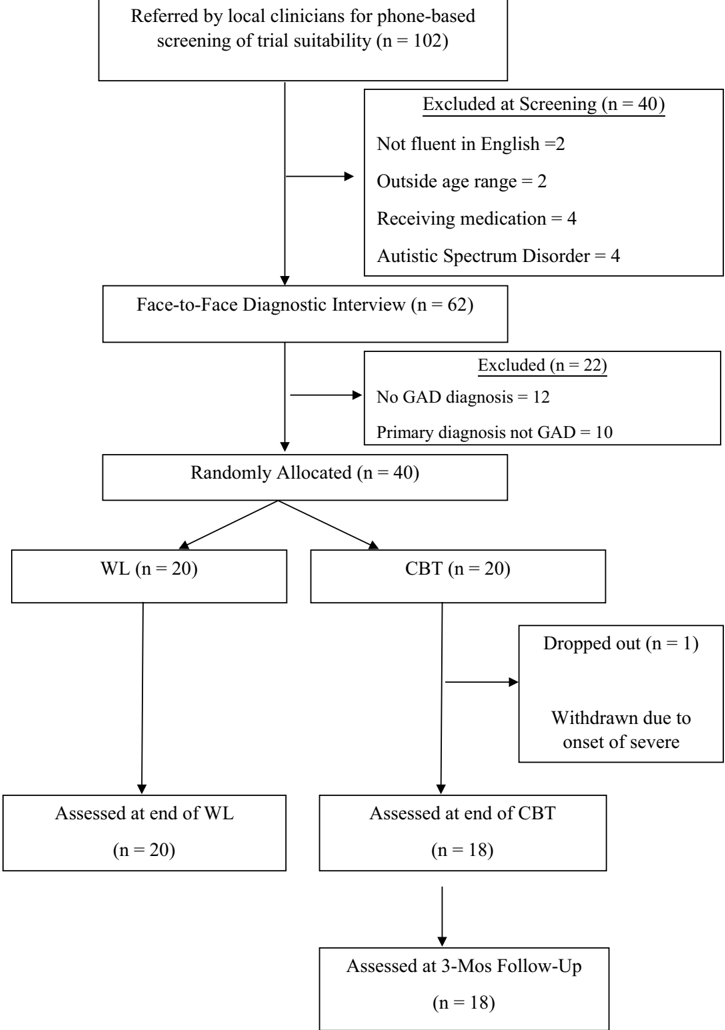
Cognitive behavioral therapy (CBT) designed to target generalized anxiety disorder (GAD) in youth was examined in a pilot feasibility trial. Participants (aged 10–18 years) were randomized to either 10 weeks of individual CBT (n = 20) or supported wait-list (n = 20). Diagnostic status (primary outcome) was assessed blindly at post-treatment for both groups, and at a 3-month follow-up for treated participants. Two participants failed to complete CBT and retained their GAD during the trial. Intention-to-treat analyses revealed large between-group differences in favor of CBT at post-treatment for remission from GAD (80% vs 0%) and comorbid disorders (83% vs 0%), and for all secondary outcomes (child and parent-reported). All gains were maintained at 3-month follow-up in the CBT group. Consistent with the treatment model, significant pre- to post-treatment reductions in several cognitive processes were found for CBT but not wait-listed participants, with these gains maintained at follow-up. Further investigations are warranted. Trial registry: ISRCTN.com Identifier ISRCTN50951795. © 2019, The Author(s).
Overview
CoChat Summary
## TL;DR
This pilot randomized controlled trial found that a 10-week individual CBT program for youth with primary GAD produced large improvements versus wait-list, with 80% remission from GAD at post-treatment compared with 0% in the wait-list group. Gains in GAD, comorbid disorders, secondary symptoms, and several cognitive processes were maintained at 3-month follow-up in the treated group.
## Key findings
- In intention-to-treat analyses, remission from GAD at post-treatment was 80% vs 0% for CBT versus wait-list; remission from comorbid disorders was 83% vs 0%.
- At post-treatment, CBT participants showed large between-group benefits on clinician/assessor-rated outcomes, including GAD severity and global functioning (CGAS), with the paper reporting large effects (η² > .26).
- Child- and parent-report outcomes also favored CBT at post-treatment, including worry, anxiety, depression, quality of life, peer problems, and overall impairment; the paper reports significant large effects for these outcomes.
- The targeted cognitive processes improved for CBT participants: significant reductions were found for intolerance of uncertainty (F(2,18)=19.9, η²=.62), cognitive avoidance (F(2,18)=10.9, η²=.41), and negative problem orientation (F(2,18)=19.4, η²=.61), but not for positive beliefs about worry (F(2,18)=7.1, p=.06, η²=.27).
## Methods
- Design: Phase 0/1 randomized controlled pilot feasibility trial; participants were randomized equally to 10 weeks of individual GAD-specific CBT or a supported wait-list, with CBT participants reassessed at 3 months.
- Sample/data: 40 youth aged 10–18 years recruited from child and adolescent mental health services and a specialist anxiety clinic in the UK; inclusion required a current primary DSM-IV GAD diagnosis and no more urgent psychiatric needs.
- Analysis: Intention-to-treat analyses using last observation carried forward for 2 CBT noncompleters; chi-square tests for categorical outcomes and ANCOVA for continuous post-treatment secondary outcomes, with within-CBT repeated-measures analyses across pre-, post-, and follow-up.
## Limitations
- The paper states that the study was a pilot feasibility trial and says that active treatment and placebo controls and longer follow-ups are needed to better estimate efficacy.
- The paper states that no formal treatment adherence protocol was followed and interrater reliability ratings were not obtained for diagnostic assessments.
- The paper states that the treatment credibility and cognitive process measures were developed specifically for this trial and need further validation in clinical samples.
- Evident from the text: the trial was conducted in a specialist anxiety disorders clinic with experienced therapists and supervision, so generalizability to routine care settings is uncertain; the paper explicitly says it should be evaluated in routine care settings.
Model-written summary. Check it against the paper before relying on it.
Integrity signals
Registry
Cites
Statistics
Figures
Verification
Claims the paper makes
1 Valid · 2 Not valid · 50 Not checked · 115 Own results and interpretations
The cited sources support only part of this claim — read each source’s verdict below.
In the paper
“GAD was assessed with the Anxiety Disorders Interview Schedule for DSM-IV, Child and Parent Report Version (ADIS-C/P;”
What the sources say
- Partly supportedcites Silverman and Nelles 1998 matched to “The Anxiety Disorders Interview Schedule for Children” (1988) sourceExperimental — accuracy not yet measured
The Description of the ADIS-C and ADIS-P identifies child and parent interviews that assess anxiety symptoms, including those associated with generalized anxiety disorder. But it says these versions were organized around DSM-III and DSM-III-R, not DSM-IV; the cited paper therefore does not identify the specific version named in the claim. (LLM, conf=0.89)
plain- Asserted: passes — The authors put it forward as true.
- Checkable: passes — It can be checked against evidence.
- Load-bearing: passes — The paper’s conclusions depend on it.
- Based: passes — The paper gives a reason why it holds.
- Partly supported
A result the paper reports from its own data — it cites no other source for it, so there is none to check. The quote shows it is in the paper.
In the paper
“and comorbid disorders (83% vs 0%)”
plainstates a causen = 20- Asserted: passes — The authors put it forward as true.
- Checkable: passes — It can be checked against evidence.
- Load-bearing: passes — The paper’s conclusions depend on it.
- Based: passes — The paper gives a reason why it holds.
A result the paper reports from its own data — it cites no other source for it, so there is none to check. The quote shows it is in the paper.
In the paper
“All gains were maintained at 3-month follow-up in the CBT group.”
plainn = 20- Asserted: passes — The authors put it forward as true.
- Checkable: passes — It can be checked against evidence.
- Load-bearing: passes — The paper’s conclusions depend on it.
- Based: passes — The paper gives a reason why it holds.
A result the paper reports from its own data — it cites no other source for it, so there is none to check. The quote shows it is in the paper.
In the paper
“and for all secondary outcomes (child and parent-reported).”
plainstates a causen = 20- Asserted: passes — The authors put it forward as true.
- Checkable: passes — It can be checked against evidence.
- Load-bearing: passes — The paper’s conclusions depend on it.
- Based: passes — The paper gives a reason why it holds.
A result the paper reports from its own data — it cites no other source for it, so there is none to check. The quote shows it is in the paper.
In the paper
“Consistent with the treatment model, significant pre- to post-treatment reductions in several cognitive processes were found for CBT but not wait-listed participants”
plainstates a causen = 20- Asserted: passes — The authors put it forward as true.
- Checkable: passes — It can be checked against evidence.
- Load-bearing: passes — The paper’s conclusions depend on it.
- Based: passes — The paper gives a reason why it holds.
71 more claims
Create a free account to see all 168 claims and every source verdict.
- Probably not a substantial claim. 59
- The quote only partly states this claim. 1
- It may state two separate claims as one. 55
Statistics recomputed
Every reported test result, recomputed from its test statistic and degrees of freedom. A result shows as not adding up only once an independent check has confirmed it.
- Consistentχ²(1) = 4.8reported p = .028 · recomputed p = .028
“χ 2 (1) = 4.8, p = .028”
- ConsistentF(2, 18) = 44.8reported p = 0 · recomputed p < .001
“F(2,18) = 44.8, p = .000”
- ConsistentF(2, 18) = 34.6reported p = 0 · recomputed p < .001
“F(2,18) = 34.6, p = .000”
- ConsistentF(2, 18) = 61.1reported p = 0 · recomputed p < .001
“F(2, 18) = 61.1, p = .000”
- ConsistentF(2, 38) = 39.8reported p = 0 · recomputed p < .001
“F(2, 38) = 39.8, p = .000”
12 more recomputed tests
Create a free account to see every test the Stats check recomputed.
Self-check
Percentages, sums and reported differences re-computed from the paper’s own numbers.
Each contradiction between two passages listed here was confirmed by an independent check.
Rated major: it would touch a result — a value a result rests on, reported and recomputed p-values on opposite sides of the significance level, two passages that conflict with no sign which is right, or a cited work retracted before this paper was published.
In the paper
“There was a slight but non-significant increase in the proportion of CBT participants with GAD at follow-up (85%), suggesting that improvements at the diagnostic threshold level were largely maintained.”
Reported 85 · recomputed 15
Rated minor: it would not touch a result — a value no result rests on, a p-value that stays on the same side of the significance level, or a conflict that is clerical, resolved elsewhere in the paper, or outside its own findings.
In the paper
§ Discussion
“There was a slight but non-significant increase in the proportion of CBT participants with GAD at follow-up (85%), suggesting that improvements at the diagnostic threshold level were largely maintained.”
§ Secondary Outcomes (Child/Parent-Report)
“| GAD diagnosis present, % (n) | 100 (20) | 20 (4) | 15 (3) | 100 (20) | 100 (20) | | 26.7*** | |”
Citations
Cites
Diagnostic and Statistical Manual of Mental Disorders
American Psychiatric Association (2013) · doi:10.1176/appi.books.9780890425596 · Cited by 116,369
Diagnostic and Statistical Manual of Mental Disorders
Williams, J. B. W., & First, M. (2013) · Encyclopedia of Social Work · doi:10.1093/acrefore/9780199975839.013.104 · Cited by 109,519
Statistical Power Analysis for the Behavioral Sciences
Muller, K. (1989) · Technometrics · doi:10.1080/00401706.1989.10488618 · Cited by 99,167
Statistical power analysis for the behavioral sciences
(1990) · Computers, Environment and Urban Systems · doi:10.1016/0198-9715(90)90050-4 · Cited by 65,269
Diagnostic and Statistical Manual of Mental Disorders
(2012) · SpringerReference · doi:10.1007/springerreference_121117 · Cited by 20,570
Diagnostic and Statistical Manual of Mental Disorders, 5th ed.
Carter, M. J. (2014) · Therapeutic Recreation Journal · Cited by 15,169
The Strengths and Difficulties Questionnaire: A research note
Goodman, R. (1997) · Journal of Child Psychology and Psychiatry · doi:10.1111/j.1469-7610.1997.tb01545.x · Cited by 14,908 · cited 2×
“1995); (4) Conduct Problems, Peer Difficulties, Overall Impairment (parent-report): Strengths and Difficulties Questionnaire-Parent Version (SDQ-P; Goodman 1997); (5) Global Functioning (clinician-report): Children’s Global Assessment Scale (CGAS; Shaffer et al.”
BackgroundA Children's Global Assessment Scale (CGAS)
Shaffer, D. (1983) · Archives of General Psychiatry · doi:10.1001/archpsyc.1983.01790100074010 · Cited by 3,716 · cited 2×
“1995); (4) Conduct Problems, Peer Difficulties, Overall Impairment (parent-report): Strengths and Difficulties Questionnaire-Parent Version (SDQ-P; Goodman 1997); (5) Global Functioning (clinician-report): Children’s Global Assessment Scale (CGAS; Shaffer et al.”
BackgroundBIRMAHER, B., KHETARPAL, S., BRENT, D., CULLY, M., BALACH, L., KAUFMAN, J., & NEER, S. M. (1997) · Journal of the American Academy of Child & Adolescent Psychiatry · doi:10.1097/00004583-199704000-00018 · Cited by 2,846 · cited 4×
“1997); (2) Anxiety/ GAD Symptoms (child and parent-report): Screen for Child Anxiety Related Emotional Disorders—Child and Parent Report Version (SCARED-C/P; Birmaher et al.”
BackgroundInfluentialPsychometric properties of the credibility/expectancy questionnaire
Devilly, G. J., & Borkovec, T. D. (2000) · Journal of Behavior Therapy and Experimental Psychiatry · doi:10.1016/s0005-7916(00)00012-4 · Cited by 2,295 · cited 1×
“The measure was developed for the purpose of this trial and based on the widely-used, 6-item Credibility Expectancy Questionnaire developed by Devilly and Borkovec (2000) used in clinical trials with adults.”
Method
Research works printed but not linked: 4
- Dugas, M., & Robichaud, M. (2007). Cognitive-behavioural therapy for generalized anxiety disorder . New York: Routledge.
- Fialko, L. (2009). Cognitive variables associated with worry in young people aged 7-18 (Doctoral dissertation). Institute of Psychiatry, Psychology & Neuroscience, King's College London.
- Kendall, P. C. (1990). The coping cat manual . Ardmore PA: Workbook Publishing.
- Lyneham, H. J., Abbott, M. J., Wignall, A., & Rapee, R. M. (2003). The cool kids anxiety treatment program . Sydney, Australia: MUARU, Macquarie University. - Mufson, L., Moreau, D., & Weissman, M. M. (1994). Modification of interpersonal psychotherapy with depressed adolescents (IPT-A): Phase I and phase II studies. Journal of the American Academy of Child and Adolescent Psychiatry, 33 (5), 695-705.
Cited by
Cognitive behavioural therapy for anxiety disorders in children and adolescents
James, A. C., Reardon, T., Soler, A., James, G., & Creswell, C. (2020) · Cochrane Database of Systematic Reviews · doi:10.1002/14651858.cd013162.pub2 · Cited by 344
Miller, M. L., & McGuire, J. F. (2023) · Journal of Affective Disorders · doi:10.1016/j.jad.2023.08.132 · Cited by 63
Wahlund, T., Andersson, E., Jolstedt, M., Perrin, S., Vigerland, S., & Serlachius, E. (2020) · Cognitive and Behavioral Practice · doi:10.1016/j.cbpra.2019.06.002 · Cited by 49
Self-citationViswanathan, M., Wallace, I., Middleton, J. C., Kennedy, S. M., McKeeman, J. L., Hudson, K. N., Rains, C. B., Schaaf, E. B. V., & Kahwati, L. C. (2022) · JAMA · doi:10.1001/jama.2022.16303 · Cited by 47
Kajastus, K., Haravuori, H., Kiviruusu, O. H., MARTTUNEN, M. J., & Ranta, K. (2023) · Journal of Adolescence · doi:10.1002/jad.12275 · Cited by 47
Dickson, S. J., Kuhnert, R., Lavell, C. H., & Rapee, R. M. (2022) · Clinical Child and Family Psychology Review · doi:10.1007/s10567-022-00402-7 · Cited by 55
Intolerance of uncertainty as a transdiagnostic vulnerability to anxiety disorders in youth
Zemestani, M., Heshmati, R., Comer, J. S., & Kendall, P. C. (2023) · Current Psychology · doi:10.1007/s12144-022-03645-3 · Cited by 20
Lodewyk, K., Bagnell, A. L., Courtney, D., & Newton, A. S. (2023) · Child and Adolescent Mental Health · doi:10.1111/camh.12661 · Cited by 22
Zemestani, M., Ezzati, S., Nasiri, F., Gallagher, M. W., Barlow, D. H., & Kendall, P. C. (2024) · Psychological Medicine · doi:10.1017/s0033291723001903 · Cited by 19
Egan, S. J., Greene, D., Callaghan, T., Raghav, S., Funk, J., Badenbach, T., Talam, S., Kemp, G., McEvoy, P. M., Ehring, T. W., et al. (2024) · Cognitive Behaviour Therapy · doi:10.1080/16506073.2024.2369936 · Cited by 30
“For example, one study we did not include and is relevant that showed promising results was a pilot feasibility trial based on the Laval model of Dugas et al. (1998) of intolerance of uncertainty in adults applied to a child and adolescent sample (Perrin et al., 2019).”
Zemestani, M., Didehban, R., Comer, J. S., & Kendall, P. C. (2022) · Assessment · doi:10.1177/1073191121998769 · Cited by 13
“Specifically, it was indicated by a number of studies that IU was affected by unified protocols when targeting multiple emotional psychopathologies in adults (Boswell et al., 2013; Hebert & Dugas, 2018; McEvoy & Erceg-Hurn, 2016), as well as in youth (Perrin et al., 2019; Wahlund et al., 2019).”
BackgroundWhat if we have too many models of worry and GAD?
Freeston, M. H. (2023) · Behavioural and Cognitive Psychotherapy · doi:10.1017/s1352465822000649 · Cited by 20
“This rapid scoping review for the current article (single filtering, single rater extraction and single coding) with publication from 2016 to 2022 retrieved 28 non-redundant RCTs ( n = 3031) that may be eligible according to the Carl et al .”
BackgroundEtkin, R. G., Juel, E. K., Lebowitz, E. R., & Silverman, W. K. (2023) · Clinical Child and Family Psychology Review · doi:10.1007/s10567-023-00454-3 · Cited by 30
“In addition to non-SoAD samples (e.g., Perrin et al., 2019), moderation studies will be helpful to answer these questions (i.e., comparing treat-ment response among youth with and without SoAD; Suveg et al., 2017).”
BackgroundInfluentialWahlund, T., Jolstedt, M., Andersson, E., Vigerland, S., Perrin, S. G., Öst, L., Högström, J., & Serlachius, E. (2020) · mHealth · doi:10.21037/mhealth.2019.09.10 · Cited by 14
“The notion that worrying is a central aspect of psychopathology, and that targeting worry can help reduce other anxiety and depressive symptoms, and improve overall functioning has received support in previous studies (21,34, 42).”
BackgroundMethodResultInfluentialSelf-citationShipp, L., Leigh, E., Laverton, A., Percy, R., & Waite, P. (2025) · Child Psychiatry & Human Development · doi:10.1007/s10578-025-01809-3 · Cited by 14
“Furthermore, studies are often limited by their use of community populations (e.g., [25, 30, 32, 34]), or inclusion of clinical samples with broad age ranges spanning childhood and adolescence (e.g., [35, 36]).”
Ludlow, C., Wardle, B., & Nedeljkovic, M. (2024) · Australian Psychologist · doi:10.1080/00050067.2023.2257864 · Cited by 4
“The Goal-Based Outcomes tool (Law & Jacob, 2015) and a child version of the Negative Problem Orientation scale (Perrin et al., 2019) were employed for clinical purposes, specifically for treat-ment planning and client feedback.”
MethodWahlund, T., Perrin, S. G., Lauri, K. O., Burman, M., Dagerborn, S., Meregalli, M., Västhagen, M., Jolstedt, M., Nord, M., Serlachius, E., et al. (2025) · Cognitive Behaviour Therapy · doi:10.1080/16506073.2025.2515196 · Cited by 4
“…that incorporated more interventions targeting positive and negative beliefs about worry, cognitive avoidance and problem solving achieved slightly superior gains, albeit in face-to-face delivered formats with weekly therapist contact (Holmes et al., 2014; Payne et al., 2011; Perrin et al., 2019).”
InfluentialSelf-citationCervin, M., Andrén, P., & Perrin, S. G. (2025) · Clinical Psychology & Psychotherapy · doi:10.1002/cpp.70184 · Cited by 4
Self-citationYe, H., Liu, Y., Cai, Z., Jiang, N., He, S., Yu, W., Zhao, R., Cheng, T., Wang, D., & Fan, F. (2024) · International Journal of Mental Health and Addiction · doi:10.1007/s11469-024-01420-y · Cited by 3
“…psychopathology (Gillett et al., 2018; Osmanağaoğlu et al., 2018; Rosser, 2019) and a process of change across multiple emotional psychopathologies in both adults (Boswell et al., 2013; Hebert & Dugas, 2019; McEvoy & Erceg-Hurn, 2016) and youths (Perrin et al., 2019; Wahlund et al., 2020).”
Wahlund, T., Wallhem, M., Serlachius, E., & Engberg, H. (2021) · The Cognitive Behaviour Therapist · doi:10.1017/s1754470x21000027 · Cited by 3
“Pilot trials of these interventions have shown promising results (Payne et al ., 2011; Perrin et al ., 2019; Wahlund et al ., 2020a).”
Shipp, L., Leigh, E., Rajesh, S., & Waite, P. (2025) · JCPP Advances · doi:10.1002/jcv2.70056 · Cited by 3
“Of the studies with waitlist controls, 85% and 89% of those who received CBT were in remission from GAD at the 3 - month assessment (Perrin et al., 2019; Holmes et al., 2014, respectively).”
InfluentialGeneralized Anxiety Disorder (GAD) in Children and Adolescents
In‐Albon, T., Wahlund, T., & Perrin, S. G. (2020) · Wiley eBooks · doi:10.1002/9781119189909.ch16 · Cited by 3
Self-citationEnglish, A. C., Brady, M., Sanchez, A. L., & Becker‐Haimes, E. M. (2026) · Children · doi:10.3390/children13030413 · Cited by 1
Gabinet terapii psychologicznej, N., Meslin-Kuźniak, A., & Nowicka‐Sauer, K. (2020) · Psychiatria i Psychologia Kliniczna · doi:10.15557/pipk.2020.0034
Evaluating the Effectiveness of Cognitive Behaviour Therapy for General Anxiety Disorder
Peng, J. (2023) · International Journal of Biology and Life Sciences · doi:10.54097/ijbls.v4i1.01
“For instance, Perrin, Bevan, Payne, and Bolton (2019) compared the effective of CBT for GAD among children and adolescents through randomized control trails.”
Hoff, H. U., Hjemdal, O., Steinsbekk, S., & Nordahl, H. (2026) · Child Psychiatry & Human Development · doi:10.1007/s10578-026-01983-y
Borthwick, C., Norton, A., Trenoska Basile, V., & Wootton, B. (2026) · British Journal of Clinical Psychology · doi:10.1111/bjc.70089
Metadata
- Authors
- Perrin, S., Bevan, D., Payne, S., & Bolton, D.
- Affiliations
- King's College London (GB)
- South London and Maudsley NHS Foundation Trust (GB)
- Corresponding author
- Perrin, Sean
- Venue
- Cognitive Therapy and Research
- Published
- 2019-04-25
- Volume
- 43
- Issue
- 6
- Pages
- 1051-1064
- ISSN
- 0147-5916 (ISSN-L)
- 1573-2819
- OpenAlex
- W2940663296
- Semantic Scholar
- c622d4037b0867b9c24e95f3e0f369aa14e31821
- Cited by
- 26
- References
- 55
- Citations by year
- 2026: 2 · 2025: 4 · 2024: 2 · 2023: 8 · 2022: 3 · 2021: 2 · 2020: 4 · 2019: 1
- FWCI
- 2.95
- Type
- journal article
- Language
- en
- Open access
- hybrid
- doi.org
- Licence
- cc-by
- creativecommons.org/licenses/by/4.0 (tdm)
- Locations
- Cognitive Therapy and Research (publishedVersion, cc-by)
- Research Portal (King's College London) (submittedVersion, cc-by)
- Lund University Publications (Lund University) (submittedVersion, other-oa)
- Funders
- National Institute of Health Research (0808-17094)
- Topics
- Social Sciences › Psychology › Experimental and Cognitive Psychology › Anxiety, Depression, Psychometrics, Treatment, Cognitive Processes
- Social Sciences › Psychology › Clinical Psychology › Child and Adolescent Psychosocial and Emotional Development
- Social Sciences › Psychology › Clinical Psychology › Psychological Treatments and Assessments
- Keywords
- generalized anxiety disorder, children and adolescents, cognitive behavioral therapy, youth anxiety, treatment feasibility, remission, comorbidities, cognitive processes, maintenance of treatment gains
About these checks
Registry, retraction, Cites and statistics results are computed, not judged, with one exception: a printed reference that no index lists is read once by a model before it counts as a citation error. Claims are extracted by a model and kept only when their quote appears verbatim in the text; each cited source is then checked, with a model’s help, for whether it says what the claim relies on. Those verdicts can be wrong — read the claim’s quote and the cited source before relying on one.
The claim verdicts this report counts are experimental: their accuracy is not yet measured.
A language model drew the claims from the paper on 2026-10-11, under version 3 of the claim definition (model deepseek-v4.1-flash, prompt extract-v3).
A second model labelled each claim on 2026-10-11 (model jev-1.13-20260917, definition revision gold-guideline-v0.2).
Cited sources are checked with a language model’s help (gpt-6-sol).
Statistics and arithmetic are recomputed, not judged.
Confidence bands are shown only for fields calibrated on our annotated test set. None is calibrated yet, so no band is shown.
What counts as a claim ›How we measure confidence ›How we check this ›
Are you an author, or do you see a problem with this page? Request a review
Data sources
Bibliographic data: Semantic Scholar, OpenAlex, Crossref.
Contains information from the Semantic Scholar Academic Graph Datasets, made available under the ODC Attribution License (ODC-BY 1.0).
Semantic Scholar’s data is described in: Kinney, R., et al. (2023). The Semantic Scholar Open Data Platform. arXiv:2301.10140.
