

The emergency (crisis) e-learning as a challenge for teachers in Poland
Open accessThe DOI matches its Crossref record; 39 of the 39 references it cites were found in a registry or an index.
Abstract
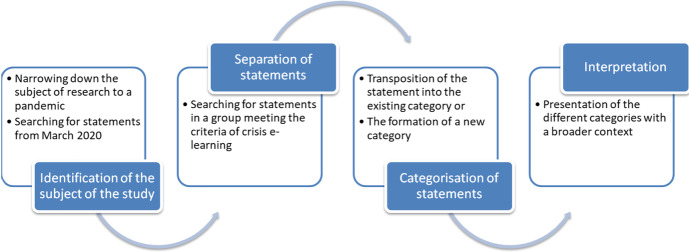
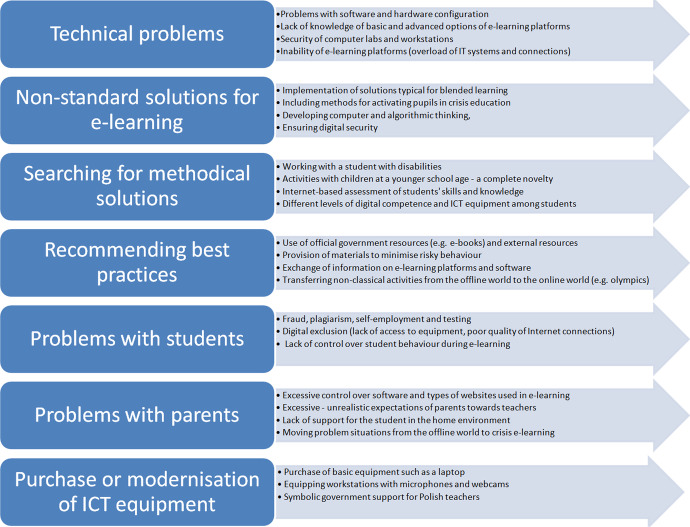
The article was written as a consequence of the COVID-19 pandemic in Poland, which had an impact not only on public health, but also on the functioning of the educational sector. The text is an attempt to summarize the challenges of crisis e-learning from the perspective of the challenges faced by teachers in Poland in the period of March-December 2020. The article reveals a number of new phenomena not present in the literature in the context of e-learning implemented in an intuitive, non-linear way, without methodological support, and thus referred to as crisis e-learning. The aim of the research was to explore the characteristics of crisis e-learning in Poland from the perspective of teachers' experiences. Due to epidemiological limitations, the research area was narrowed down to cyberspace. This text presents the results of research relating to statements made by teachers posting in the largest Polish discussion group on education. The group currently consists of over four thousand people. The study uses an analysis of several thousand posts and then identifies and categorizes statements related to crisis e-learning along with a phenomenological interpretation. The analyses made it possible to identify seven categories of challenges attributed to crisis e-learning, such as: technical problems, use of non-standard solutions, the search for solutions to increase the effectiveness of e-learning, the transfer of proven applications and programmes, problems with students, problems with parents, and the modernisation of workstations. The data presented show teacher micro-worlds in the time of the pandemic in Poland. The article is a response to the need to understand the processes occurring in the Polish educational system under the influence of crisis events related to the pandemic. The text may prove valuable for educating future generations of teachers in the field of e-learning and increasing the effectiveness of training activities aimed at strengthening the digital competence of current teachers.
Overview
The claims and statistics of this paper haven’t been checked yet.
Free: it reads the open-access text and checks the first 5 claims that cite a source we can check. Create a free account to check every claim.
Integrity signals
Registry
Cites
Statistics
Figures
Verification
Claims the paper makes
The claims and statistics of this paper haven’t been checked yet.
Free: it reads the open-access text and checks the first 5 claims that cite a source we can check. Create a free account to check every claim.
Claims other papers make about this one
Each is checked against this paper’s own text: does it say what the citing paper says it does?
The source backs part of the claim, not all of it — or backs it for a different population, condition or comparison.
In the citing paper
“Additionally, many programs offer limited ongoing support after the initial training, leaving teachers needing more resources or guidance to refine their online teaching practices over time (Pozas & Letzel, 2023;Tomczyk & Walker, 2021).”
From Transforming Online Teacher Training Through Expansive Learning: A Case Study Applying Cultural-Historical Activity Theory and the Change Laboratory Method (2025) · cites this paper as Tomczyk & Walker, 2021
Experimental — accuracy not yet measured
Self-check
Percentages, sums and reported differences re-computed from the paper’s own numbers.
The self-check needs the paper’s full text.
Citations
Cites
Online Learning: A Panacea in the Time of COVID-19 Crisis
Dhawan, S. (2020) · Journal of Educational Technology Systems · doi:10.1177/0047239520934018 · Cited by 5,083 · cited 1×
“…as well as extensive open educational resources, investing in teacher preparation for the use of digital media in education (Arteaga et al., 2020; Dhawan, 2020) proved to be much less vulnerable to disruptions resulting from the rapid transformation of educational systems due to COVID (Lestari…”
BackgroundAlmaiah, M. A., Al-Khasawneh, A., & Althunibat, A. (2020) · Education and Information Technologies · doi:10.1007/s10639-020-10219-y · Cited by 1,205 · cited 1×
“Crisis e-learning should therefore not be considered dual-istically but should take into account broader contexts linked to the microcosms of teachers’ and learners’ experiences (Adarkwah, 2020; Almaiah et al., 2020).”
BackgroundHasan, N., & Bao, Y. (2020) · Children and Youth Services Review · doi:10.1016/j.childyouth.2020.105355 · Cited by 638 · cited 1×
“These include: strengthening digital competences, retrofitting ICT equipment, encouraging experimentation with educational software, and conducting in-depth analyses of the changes in the lives of modern societies through digital media (Minghat et al., 2020; Hasan & Bao, 2020).”
Background"I'm not against online teaching, but what about us?": ICT in Ghana post Covid-19
Adarkwah, M. A. (2021) · Education and Information Technologies · doi:10.1007/s10639-020-10331-z · Cited by 416 · cited 1×
“Crisis e-learning should therefore not be considered dual-istically but should take into account broader contexts linked to the microcosms of teachers’ and learners’ experiences (Adarkwah, 2020; Almaiah et al., 2020).”
BackgroundHome Learning in Times of COVID: Experiences of Parents
Bhamani, S., Makhdoom, A. Z., Bharuchi, V., Ali, N., Kaleem, S., & Ahmed, D. (2020) · Journal of Education and Educational Development · doi:10.22555/joeed.v7i1.3260 · Cited by 345 · cited 1×
“Achieving the intended learning outcomes is not a simple sum of teacher-student relationships plus activities, but should take into account the wider ecosystem contexts, including the parents (Bhamani et al., 2020).”
BackgroundOsman, M. E. (2020) · Journal of Education for Teaching · doi:10.1080/02607476.2020.1802583 · Cited by 259 · cited 1×
“The processes discussed are not limited to one country or region, but appear to have a global character (Osman, 2020).”
BackgroundBond, M. (2021) · Adelaide Research & Scholarship (AR&S) (University of Adelaide) · doi:10.5281/zenodo.4425683 · Cited by 241 · cited 2×
“Based on an in-depth analysis of the available data on crisis e-learning, Bond (2020) noted that the full and successful transposition of crisis e-learning into methodical and therefore correctly implemented e-learning requires consideration of the following factors: ICT skills & knowledge;…”
BackgroundCOVID-19 Emergency eLearning and Beyond: Experiences and Perspectives of University Educators
Müller, A. M., Goh, C., Lim, L. Z., & Gao, X. (2021) · Education Sciences · doi:10.3390/educsci11010019 · Cited by 240 · cited 1×
“A number of researchers clearly indicate that the vast majority of teachers were not prepared to implement e-learning at such short notice and with limited hardware resources (Müller et al., 2021).”
BackgroundBond, M. (2021) · Adelaide Research & Scholarship (AR&S) (University of Adelaide) · doi:10.5281/zenodo.4425682 · Cited by 238
Defining digital literacy development: An examination of pre-service teachers’ beliefs
List, A. (2019) · Computers & Education · doi:10.1016/j.compedu.2019.03.009 · Cited by 224 · cited 1×
“…poor experience in e-learning (Pyżalski, 2020), as well as the level of digital competence of the teachers (Borthwick & Hansen, 2017; Stošić & Stošić, 2015), and also revealed the level of preparation of young teachers for their profession in the era of the information society (List, 2019).”
Background
Research works printed but not linked: 2
- Konieczek, M. (2017). E-learning-nowoczesna forma edukacji (E-learning - a modern form of education). Rynek-Społeczeństwo-Kultura,1(22), 36–40.
- Lestari PAS Gunawan G Yulianci S Effectiveness of online lectures using digital platform during the pandemic Covid-19 Indonesian Journal of Applied Science and Technology 2020 1 3 107 115
Cited by
Saturation in Qualitative Educational Technology Research
Daher, W. M. (2023) · Education Sciences · doi:10.3390/educsci13020098 · Cited by 124
Indicators to assess preservice teachers’ digital competence in security: A systematic review
Torres-Hernández, N., & Arrufat, M. J. G. (2022) · Education and Information Technologies · doi:10.1007/s10639-022-10978-w · Cited by 56
“This scenario has led to the putting into practice of skills related to the search for, selection and use of information; and types of organization, use and communication among professors, parents and alumni (Tomczyk & Walker, 2021) that involve secure, ethical, legal responsible Internet use.”
BackgroundRETRACTED: Developing critical thinking skills in a digital educational environment
Varenina, L., Vecherinina, E. A., Shchedrina, E. V., Valiev, I., & Islamov, A. (2021) · Thinking Skills and Creativity · doi:10.1016/j.tsc.2021.100906 · Cited by 49
RetractedComparison of Landfill Leachate Properties by LPI and Phytotoxicity-A Case Study
Wdowczyk, A., & Szymańska–Pulikowska, A. (2021) · Frontiers in Environmental Science · doi:10.3389/fenvs.2021.693112 · Cited by 44
Bartosiewicz, A., Łuszczki, E., Zaręba, L., Kuchciak, M., Bobula, G., Dereń, K., & Król, P. (2022) · PeerJ · doi:10.7717/peerj.13349 · Cited by 53
Nicklin, L. L., Wilsdon, L., Chadwick, D. D., Rhoden, L., Ormerod, D., Allen, D., Witton, G., & Lloyd, J. (2022) · Education and Information Technologies · doi:10.1007/s10639-022-10899-8 · Cited by 36
“Educators have faced many challenges in delivering ‘crisis e-learning’ during the pandemic (e.g. Tomczyk & Walker, 2021), and in addition to the burden on staff, the quality and capability of educators to operate within a digital realm can impact student satisfaction and perceived performance…”
BackgroundSustainable Distance Online Educational Process for Dental Students during COVID-19 Pandemic
Αντωνιάδου, Μ., Rahiotis, C., & Kakaboura, A. (2022) · International Journal of Environmental Research and Public Health · doi:10.3390/ijerph19159470 · Cited by 27
“Technical problems can also be a source of annoyance and discouragement, as mentioned in other studies [51].”
ResultThe Effect of the Covid-19 Pandemic on ICT Usage by Academics
Ziemba, E. W., & Eisenbardt, M. (2021) · Journal of Computer Information Systems · doi:10.1080/08874417.2021.1992806 · Cited by 25
“Most existing studies analyze the usage of particular ICTs in teaching during the pandemic, 7,8,18,25 whereas only few of them examine the usage of some ICTs in research during the pandemic.”
BackgroundEstrella, F. (2022) · International Journal of Educational Research Open · doi:10.1016/j.ijedro.2022.100141 · Cited by 28
“Finally, the one thing that most respondents complained about was that students get distracted easily during the class and the problems they have experienced with learners not keeping their cameras on (Mukhtar et al. 2020; Tomczyk and Walker 2021).”
BackgroundNew realities for Polish primary school informatics education affected by COVID-19
Panskyi, T., Korzeniewska, E., Serwach, M., & Grudzień, K. (2021) · Education and Information Technologies · doi:10.1007/s10639-021-10778-8 · Cited by 26
“…self-efficiency, mental health and crisis, coping with stress, digital fatigue, cyberbullying, online abuse and numerous other consequences and e-threats of crisis-prompted distance education (Tomczyk & Walker, 2021; Lazarinis et al., 2020; Rothe et al., 2021; Sinko et al., 2021; Zuo et al., 2021).”
BackgroundResearch Trends in Media Pedagogy: Between the Paradigm of Risk and the Paradigm of Opportunity
Tomczyk, Ł. (2021) · International Journal of Cognitive Research in Science Engineering and Education · doi:10.23947/2334-8496-2021-9-3-399-406 · Cited by 25
“The effective use of digital media by teaching staff and students has been particularly noticed in the period since March 2020, when most of the processes related to education and upbringing were involuntarily “digitized” (Potyrała et al., 2021; Tomczyk and Walker, 2021).”
BackgroundSelf-citationAsfani, K., & Chen, H. (2024) · Education and Information Technologies · doi:10.1007/s10639-024-13125-9 · Cited by 24
“Furthermore, apart from researching student learning outcomes, learning using technology can also be implemented to investigate student digital maturity (Tomczyk & Walker, 2021).”
Maqbool, S., Maqbool, S., Zafeer, H. M. I., & Qihui, H. (2024) · Asian Women · doi:10.14431/aw.2024.9.40.3.113 · Cited by 13
Panskyi, T., & Korzeniewska, E. (2022) · Education and Information Technologies · doi:10.1007/s10639-022-11436-3 · Cited by 16
“…(Serra et al., 2021), cyberbullying (Yang et al., 2022), cyberstalking (Dhillon & Smith, 2017), cyberscams (Whitty, 2020) and numerous other consequences and e-threats of Internet-related post-pandemic education (Tomczyk & Walker, 2021; Lazarinis et al., 2019; Rothe et al., 2021; Zuo et al., 2021).”
BackgroundThe Role of a Ministry of Education in Addressing Distance Education during Emergency Education
Daher, W. M., & Salameh, H. (2022) · European Journal of Investigation in Health Psychology and Education · doi:10.3390/ejihpe12050036 · Cited by 11
“Tomczyk and Walker [3] argue that generally, emergency e-learning due to the COVID-19 pandemic took many by surprise, but in particular it was hard in communities and groups with fewer resources and weak Internet infrastructure.”
BackgroundEducational technology research during the COVID-19 pandemic
Xue, S., & Crompton, H. (2022) · Interactive Technology and Smart Education · doi:10.1108/itse-05-2022-0067 · Cited by 13
Panskyi, T., Biedroń, S., Grudzień, K., & Korzeniewska, E. (2021) · Sensors · doi:10.3390/s21227511 · Cited by 9
Xiao, X., & Gao-da, H. (2023) · Frontiers in Psychology · doi:10.3389/fpsyg.2022.1109370 · Cited by 20
“In particular, improvement of the game-based training group was driven by significant performance increases in (Tomczyk and Walker, 2021).”
BackgroundZakharova, N., Викторовна, Ф. С., Lobuteva, L., & Alwaely, S. A. (2024) · Heliyon · doi:10.1016/j.heliyon.2024.e38740 · Cited by 17
Topler, J. P., & Lukančić, M. K. (2022) · doi:10.18690/um.fvv.6.2022.6 · Cited by 6
Alazzam, N. M. A., & Mohammad, I. (2022) · Journal for Educators Teachers and Trainers · doi:10.47750/jett.2022.13.04.050 · Cited by 6
Universitat Autònoma de Barcelona, S., Chalkiadakis, L., Noguera, I., & Universitat Autònoma de Barcelona, S. (2024) · International Journal of Instruction · doi:10.29333/iji.2024.17122a · Cited by 12
“According to Seabra et al (2021) and Tomczyk & Walker (2021), many teachers questioned the viability of assessing students’ learning remotely, highlighting the issue of authenticity.”
BackgroundDigital Literacy Among Students of Pedagogical Faculties in Poland—A Systematic Literature Analysis
Tomczyk, Ł. (2022) · Lecture notes in educational technology · doi:10.1007/978-981-19-1738-7_20 · Cited by 6
Self-citationKuo, Y., Kuo, T., Wang, J., & Ho, L. (2022) · Sustainability · doi:10.3390/su142416794 · Cited by 6
Chen, K.-Z., Tseng, J.-Y., & Oakley, B. (2025) · The Asia-Pacific Education Researcher · doi:10.1007/s40299-024-00954-y · Cited by 5
“Additionally, many programs offer limited ongoing support after the initial training, leaving teachers needing more resources or guidance to refine their online teaching practices over time (Pozas & Letzel, 2023; Tomczyk & Walker, 2021).”
Adamczak, B. B., Kosendiak, A. A., Kuźnik, Z., Makles, S., & Hariasz, W. (2025) · Obesities · doi:10.3390/obesities5010002 · Cited by 4
The Digital Literacy Instruments for University Students
Fitroh, I., Disman, D., Komalasari, K., & Ruhimat, M. (2024) · Journal of Education Technology · doi:10.23887/jet.v7i4.67099 · Cited by 9
“After the instrument’s assessment done, then, the validity and reliability analysis was carried out to determine feasibility level of the develop instrument (Tomczyk & Walker, 2021).”
MethodOliveira, W., Tenório, K., & Isotani, S. (2022) · Hawaii International Conference on System Sciences (HICSS) · doi:10.24251/hicss.2022.008 · Cited by 8
“Due to the emergence of Covid-19, this digital transformation had to be accelerated, and technology was a powerful tool to help combat this pandemic and support the continuation of work in different fields, including medicine, entertainment, finance, and education [3, 4].”
BackgroundMotives and barriers in Emergency Remote Teaching: insights from the Greek experience
Nikiforos, S., Anastasopoulou, E., Pappa, A., Tzanavaris, S., & Kermanidis, K. L. (2024) · Discover Education · doi:10.1007/s44217-024-00383-5 · Cited by 3
“Another research conducted through questionnaires showed that technology infrastructure was an obstacle for e-learning motivation of undergraduate students [72].”
Alonso, A. C., de Carvalho, A. O. M., de Lira, J. O., Paixão, V., Modenes, R. D., Ernandes, R. D. C., da Silva, V. C., Júnior, G. S., Passos, K. G., Lino, M. H. D. S., et al. (2025) · Heliyon · doi:10.1016/j.heliyon.2025.e42256 · Cited by 8
A pilot study on individual and contextual factors influencing teachers’ digitalisation process
Cataudella, S., Mascia, M. L., Agus, M., Ifenthaler, D., Tomczyk, Ł., & Penna, M. P. (2024) · Contemporary Educational Technology · doi:10.30935/cedtech/15189 · Cited by 12
Self-citationLanguage for Specific Purposes in the Framework of Criminal Justice and Security
Lukančić, M. K. (2022) · doi:10.18690/um.fvv.6.2022 · Cited by 5
Cooper, H. B., Ewing, M. T., Jayasinghe, L., Niemann‐Struweg, I., & Wait, M. (2023) · Journal of Marketing Communications · doi:10.1080/13527266.2023.2208131 · Cited by 5
“Emergency remote learning has been labelled ‘emergency crisis e-learning’ (Tomczyk and Walker 2021), ‘rapid online-learning transfer’ (Nicklin et al. 2022); ‘unstructured, emergency remote education’ (Oliveira et al. 2021); and the ‘new normal’ (Gupta and Ishida 2022).”
BackgroundUsing mobile applications for language learning as part of language classes
Slavuj, V. (2023) · Zbornik Veleučilišta u Rijeci · doi:10.31784/zvr.11.1.12 · Cited by 8
“…ones was done ad-hoc, so most teachers (and institutions, for that matter) preferred synchronous communication in organising their class time and individual activities, or did not have the time, skill, or means to organize activities involving mobile applications (e.g., Tomczyk, Walker, 2021).”
BackgroundSalehpoor-Emran, M., Ghorbani, A., Dolatabadi, Z. A., & Delkhosh, M. (2024) · Nursing Forum · doi:10.1155/2024/9698711 · Cited by 2
Schools’ Challenges in Distance Learning during Emergency Education: Focus Group Methodology
Daher, W. M. (2024) · Education Sciences · doi:10.3390/educsci14040383 · Cited by 4
“Tomczyk and Walker [10] identified seven categories of challenges attributed to what they called crisis e-learning.”
BackgroundVynoslavska, O., Kononets, M., & Mazurek, E. (2024) · Communications in computer and information science · doi:10.1007/978-3-031-63235-8_16 · Cited by 2
Estrella, F. (2022) · SN Social Sciences · doi:10.1007/s43545-022-00365-0 · Cited by 5
“Tomczyk and Walker (2021) performed research in Poland, while Juárez-Díaz and Perales (2021) researched 26 English teachers and 32 pre-service English teachers in Mexico.”
InfluentialRetractedE-LEARNING CHALLENGES IN POLAND DURING THE COVID-19 PANDEMIC
Parlińska, A. (2022) · Zeszyty Naukowe SGGW Polityki Europejskie Finanse i Marketing · doi:10.22630/pefim.2022.27.76.7 · Cited by 2
School Principal Role In Handling Online Learning Issues During Covid-19 Pandemic
Utama, G. A., & Sunu, I. G. K. A. (2022) · International Journal of Educational Management and Innovation · doi:10.12928/ijemi.v3i2.5790 · Cited by 2
“For this reason, teachers and parents must collaborate to support each other (Álvarez-Guerrero et al., 2021; Öçal et al., 2021; Tomczyk & Walker, 2021).”
BackgroundArdiansyah, W., Risnawati, R., Zakaria, Asyari, L., & Abdurrahmansyah, A. (2023) · JPI (Jurnal Pendidikan Indonesia) · doi:10.23887/jpiundiksha.v12i4.60678 · Cited by 3
“Another moral value crisis suffered by students in online learning is a lack of responsibility value the students complete their academic assignments by committing academic theft (Johnson, 2015; Tomczyk & Walker, 2021; Muassomah et al., 2022; Sin & Cahyani, 2022).”
BackgroundEdukacja uczniów cudzoziemskich w polskich szkołach w czasie pandemii – przegląd badań
Stankiewicz, K., & Żurek, A. (2022) · Studia BAS · doi:10.31268/studiabas.2022.07 · Cited by 1
Tomczyk, Ł., Kielar, I., Daş, A., & Daş, N. (2023) · Lecture notes in educational technology · doi:10.1007/978-981-99-7645-4_20 · Cited by 2
Self-citationTomczyk, Ł. (2022) · Iberian Conference on Information Systems and Technologies (CISTI) · doi:10.23919/cisti54924.2022.9820091 · Cited by 1
Self-citationAnalysis of approaches to evaluate the quality of distant educational services
Kolbina, A. D., Юрьевна, Ч. Н., & Nizamieva, M. (2022) · AIP conference proceedings · doi:10.1063/5.0104353 · Cited by 1
Kusumaningtyas, P. S., Parmiti, D. P., & Setemen, K. (2023) · Jurnal Pendidikan dan Pengajaran · doi:10.23887/jpp.v56i2.64758 · Cited by 1
Baiti, M., Khoerunnisha, Bujuri, D. A., Handayani, T., Oviyanti, F., & Shami, A. N. (2024) · International Journal of Elementary Education · doi:10.23887/ijee.v8i4.82262 · Cited by 3
“In addition to the involvement at home, a strong partnership was also observed between teachers and parents (Tomczyk & Walker, 2021; Tong et al., 2021).”
Felhőbe fel! Szakirodalmazás oktatása az Állatorvostudományi Egyetemen COVID-19 előtt és alatt
Júlia, B. K. (2021) · Műszaki könyvtárosok tájékoztatója/Tudományos és műszaki tájékoztatás · doi:10.3311/tmt.13115
Online teaching during Covid-19 Pandemic – challenges and solutions around the world
Bonta, E., & Galița, R. (2022) · Studies in Linguistics Culture and FLT · doi:10.46687/xodk6156
Medical Undergraduate Students’ Viewpoint on Online Learning During COVID-19 Pandemic
Rathoria, E., Rathoria, R., Singal, U., Singh, A. P., Bansal, U., & Agrawal, P. (2022) · Journal of Nepal Paediatric Society · doi:10.3126/jnps.v42i3.46062 · Cited by 1
Life online during the pandemic : How university students feel about abrupt mediatization
Żyliński, S., Davis, C. H., & Vladica, F. (2024) · Communications · doi:10.1515/commun-2023-0024 · Cited by 2
Metadata
- Authors
- Tomczyk, Ł., & Walker, C.
- Affiliations
- Uniwersytet Komisji Edukacji Narodowej w Krakowie (PL)
- Corresponding author
- Tomczyk, Łukasz
- Venue
- Education and Information Technologies
- Published
- 2021-04-17
- Volume
- 26
- Issue
- 6
- Pages
- 6847-6877
- ISSN
- 1360-2357 (ISSN-L)
- 1573-7608
- PMC
- PMC8052202
- OpenAlex
- W3153080917
- Cited by
- 62
- References
- 39
- Citations by year
- 2025: 2 · 2024: 12 · 2023: 9 · 2022: 32 · 2021: 7
- FWCI
- 26.35
- Type
- journal article
- Language
- en
- Open access
- hybrid
- doi.org
- Licence
- cc-by
- creativecommons.org/licenses/by/4.0 (tdm)
- creativecommons.org/licenses/by/4.0 (vor)
- Locations
- Education and Information Technologies (publishedVersion, cc-by)
- PubMed Central (publishedVersion, cc-by)
- PubMed (publishedVersion)
- Funders
- Polish National Agency for Academic Exchange (Bekker programme Grant - PPN/BEK/2020/1/00176)
- Topics
- Social Sciences › Education › Education during COVID-19 pandemic
- Social Sciences › Education › Educational Innovations and Technology
- Social Sciences › Education › E-Learning and COVID-19
- Keywords
- COVID-19 pandemic, teacher experiences, online teaching challenges, technical problems in online learning, digital competence of teachers, Polish education system, online forums
About these checks
Registry, retraction, Cites and statistics results are computed, not judged, with one exception: a printed reference that no index lists is read once by a model before it counts as a citation error. Claims are extracted by a model and kept only when their quote appears verbatim in the text; each cited source is then checked, with a model’s help, for whether it says what the claim relies on. Those verdicts can be wrong — read the claim’s quote and the cited source before relying on one.
Statistics and arithmetic are recomputed, not judged.
Confidence bands are shown only for fields calibrated on our annotated test set. None is calibrated yet, so no band is shown.
What counts as a claim ›How we measure confidence ›How we check this ›
Are you an author, or do you see a problem with this page? Request a review
Data sources
Bibliographic data: Semantic Scholar, OpenAlex, Crossref.
Contains information from the Semantic Scholar Academic Graph Datasets, made available under the ODC Attribution License (ODC-BY 1.0).
Semantic Scholar’s data is described in: Kinney, R., et al. (2023). The Semantic Scholar Open Data Platform. arXiv:2301.10140.
