

Efficacy of an Adaptive Game-Based Math Learning App to Support Personalized Learning and Improve Early Elementary School Students’ Learning
Open accessThe DOI matches its Crossref record; 91 of the 94 references it cites were found in a registry or an index, and 2 are not checked yet; none of the 30 sources its claims cite is checked for support yet.
Abstract
Study of My Math Academy with kindergarten and first grade students (N = 505 treatment, 481 control).
Checked 2026-11-22 · 2 references not checked yet
Overview
CoChat Summary
## TL;DR
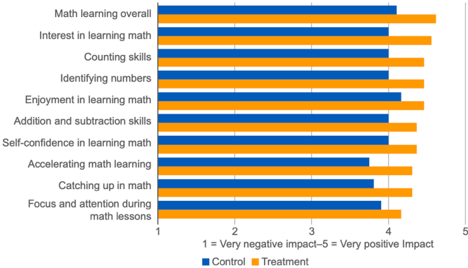
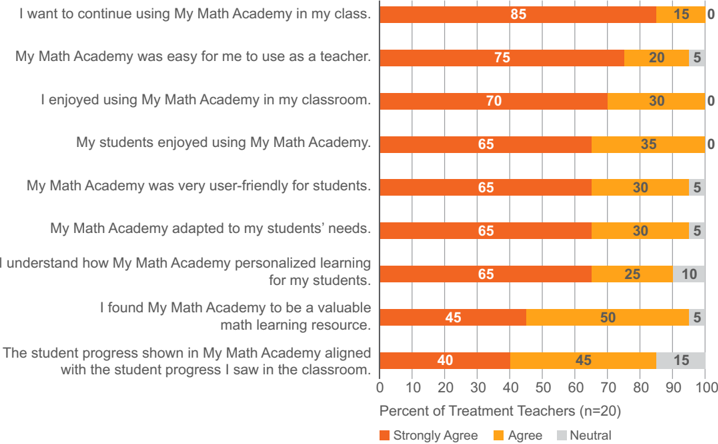
This cluster-randomized study found that kindergarten and first-grade students using My Math Academy made small but statistically significant gains in math relative to controls, with stronger effects for kindergarteners and for more advanced skills. Teachers also reported that the app was easy to use and helpful for engagement, motivation, and personalization.
## Key findings
- In the main student outcome analysis, treatment students outperformed controls on the post-test: adjusted means 20.97 vs. 20.08, difference = 0.89, p = 0.026, effect size = 0.11, with an unweighted student sample size of 922.
- Kindergarten subgroup results were significant: 20.14 vs. 19.23, p = 0.01, effect size = 0.16; first grade differences were not significant: 21.37 vs. 20.80, p = 0.36, effect size = 0.09.
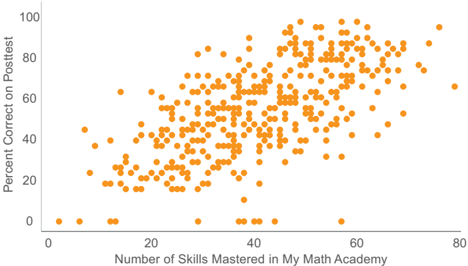
- Skills mastered in My Math Academy were strongly related to post-test performance: the correlation between post-test score and cumulative number of skills mastered was 0.73, while the correlation with average weekly use was 0.18.
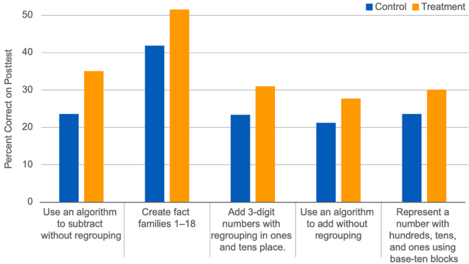
- Among assessment items, treatment students performed better on several harder skills, including subtracting without regrouping (34% vs. 22%, χ² = 17.49, p < 0.001), adding three-digit numbers with regrouping in ones and tens (31% vs. 23%, χ² = 6.73, p < 0.01), and representing three-digit numbers with base-ten blocks (29% vs. 21%, χ² = 6.37, p < 0.05).
## Methods
- Blocked cluster randomized design conducted between February and June 2019 across 41 classrooms in 11 high-needs elementary schools in two Southern California districts; teachers were randomized within school and grade to treatment (21 classrooms) or business-as-usual control (20 classrooms).
- Sample included 988 students total (507 treatment, 481 control); analytic sample was 886 students in kindergarten and first grade who completed both pre- and post-assessments.
- Main impact analysis used a two-level hierarchical linear model in Stata 16, regression-adjusted for baseline score and demographics; qualitative teacher surveys, interviews, and classroom observations were also analyzed using thematic coding in NVivo.
## Limitations
- The paper states that treatment teachers used other interventions despite instructions not to, and some control teachers also used digital math programs similar to the intervention; the authors say this may have diluted the treatment contrast.
- The paper states that the outcome assessment was not a standardized test but a researcher-developed measure, which may limit how well it captured student learning from My Math Academy.
- The paper states that much of the sample was Latinx and language data were incomplete; several assessment items required reading short sentences, so post-test scores may partly reflect English proficiency rather than math knowledge.
- Evident from the text: the study ran for only about 12 weeks due to a strike, which likely limited exposure and may have reduced observed effects.
Model-written summary. Check it against the paper before relying on it.
Integrity signals
Registry
Cites
Statistics
Figures

Verification
Claims the paper makes
0 Valid · 1 Not valid · 18 Not checked · 86 Own results and interpretations
A result the paper reports from its own data — it cites no other source for it, so there is none to check. The quote shows it is in the paper.
In the paper
“The overall quality of math instruction was also rated similarly at 2.65 and 2.85 for the treatment and control classrooms respectively.”
plain- Asserted: passes — The authors put it forward as true.
- Checkable: passes — It can be checked against evidence.
- Load-bearing: unclear — It is unclear whether the paper’s conclusions depend on it.
- Based: passes — The paper gives a reason why it holds.
A result the paper states — it cites no source for it, so there is none to check. The quote shows it is in the paper.
In the paper
“and on the most difficult skills”
plainstates a cause- Asserted: passes — The authors put it forward as true.
- Checkable: passes — It can be checked against evidence.
- Load-bearing: unclear — It is unclear whether the paper’s conclusions depend on it.
- Based: passes — The paper gives a reason why it holds.
- Rests on an assumption not shown here.
A result the paper reports from its own data — it cites no other source for it, so there is none to check. The quote shows it is in the paper.
In the paper
“The overall quality of theMy Math Academy game play for the treatment group was 2.67”
plain- Asserted: passes — The authors put it forward as true.
- Checkable: passes — It can be checked against evidence.
- Load-bearing: unclear — It is unclear whether the paper’s conclusions depend on it.
- Based: passes — The paper gives a reason why it holds.
A result the paper reports from its own data — it cites no other source for it, so there is none to check. The quote shows it is in the paper.
In the paper
“Observation data indicated that teachers in both groups had strong classroom management with respective average ratings of 2.74 and 2.85 (on a 3.00 scale).”
hedged- Asserted: passes — The authors put it forward as true.
- Checkable: passes — It can be checked against evidence.
- Load-bearing: unclear — It is unclear whether the paper’s conclusions depend on it.
- Based: passes — The paper gives a reason why it holds.
A result the paper reports from its own data — it cites no other source for it, so there is none to check. The quote shows it is in the paper.
In the paper
“Survey and observation data also revealed that teachers were able to implement My Math Academy with very few hinderances related to technology”
plain- Asserted: passes — The authors put it forward as true.
- Checkable: passes — It can be checked against evidence.
- Load-bearing: unclear — It is unclear whether the paper’s conclusions depend on it.
- Based: passes — The paper gives a reason why it holds.
45 more claims
Create a free account to see all 105 claims and every source verdict.
- Probably not a substantial claim. 28
- It may state two separate claims as one. 35
Citations
Cites
(1978) · Medical Entomology and Zoology · Cited by 53,488
Qualitative Data Analysis: A Methods Sourcebook
Miles, M. B., Huberman, A. M., & Saldaña, J. (1988) · Cited by 20,701
Cognitive Load During Problem Solving: Effects on Learning
Sweller, J. (1988) · Cognitive Science · doi:10.1016/0364-0213(88)90023-7 · Cited by 11,048 · cited 1×
“Research on cognitive load (e.g., Sweller, 1988) informs how to implement visual and audio elements so as not to overwhelm the learner nor to distract them from the core learning interactions.”
BackgroundWhat Video Games Have to Teach Us about Learning and Literacy
(2004) · Education + Training · doi:10.1108/et.2004.00446dae.002 · Cited by 6,674
What video games have to teach us about learning and literacy
Gee, J. P. (2003) · Computers in Entertainment · doi:10.1145/950566.950595 · Cited by 5,735 · cited 2×
“…incorporates key principles such as mathematical learning trajectories (Cle-ments & Sarama, 2004, 2014) and personalized, adaptive challenges that are generated through formative assessments (Gee, 2003), set in game-based learning contexts that are developmentally appropriate for young learners.”
BackgroundShute, V. J. (2008) · Review of Educational Research · doi:10.3102/0034654307313795 · Cited by 4,631
Design-Based Research: An Emerging Paradigm for Educational Inquiry
Collective, T. D.-B. R. (2003) · Educational Researcher · doi:10.3102/0013189x032001005 · Cited by 2,681
Bredekamp, S. (1987) · National Association for the Education of Young Children eBooks · Cited by 2,604
Foundations of Game-Based Learning
Plass, J. L., Homer, B. D., & Kinzer, C. K. (2015) · Educational Psychologist · doi:10.1080/00461520.2015.1122533 · Cited by 1,697
Reconstructing Mathematics Pedagogy from a Constructivist Perspective
Simon, M. A. (1995) · Journal for Research in Mathematics Education · doi:10.2307/749205 · Cited by 1,474
Research works printed but not linked: 5
- Clements, D. H. & Wright, T. S. (2022). Teaching content in early childhood education. In NAEYC (2022). Developmentally appropriate practice in early childhood programs serving children from birth through age 8. 4th edn, (pp. 69–72). Washington, DC: NAEYC.
- Dietze, B., & Kashin, D., (2011). Playing and Learning in Early Childhood . Pearson Education Canada.
- Friedman, S., Masterson, M., & Wright, B. L. (2022). Context matters: Reframing teaching in early childhood education. In NAEYC (2022). Developmentally appropriate practice in early childhood programs serving children from birth through age 8. 4th ed, (pp. 48–51). Washington. DC: NAEYC.
- Higgins, P. S., Xiao, Z., & Katsipataki, M. (2012). The Impact of Digital Technology on Learning: A Summary for the Education Endowment Foundation (p. 52). Education Endowment Foundation.
- Levine, M.H. (April, 2018). What does the research say about tech and kids' learning? Part 1 & 2. New York: NY: The Joan Ganz Cooney Center at Sesame Street Workshop.https:// urlde fense. com/ v3/ joang anzco oneyc enter. org/ blog/ F8LM3 WSaiT gsDg!2DF0X 64sZ9 - X6Zan Nq4mO M2\_ 7xsCq 3YXim yxC15 6ZfcV 6k6ji gOICk 3lS6l OL191r$ . https://urldefense.com/v3/joanganzcooneycenter.org/blog/F8LM3WSaiTgsDg!2DF0X64sZ9X6ZanNq4mOM2_7xsCq3YXimyxC156ZfcV6k6jigOICk3lS6lOL191r
Cited by
Artificial intelligence for teaching and learning in schools: The need for pedagogical intelligence
Díaz, B., & Nussbaum, M. (2024) · Computers & Education · doi:10.1016/j.compedu.2024.105071 · Cited by 148
Jing, Y., Zhao, L., Zhu, K., Wang, H., Wang, C., & Xia, Q. (2023) · Sustainability · doi:10.3390/su15043115 · Cited by 102
A systematic literature review of teacher scaffolding in game-based learning in primary education
Sun, L., Kangas, M., Ruokamo, H., & Siklander, P. (2023) · Educational Research Review · doi:10.1016/j.edurev.2023.100546 · Cited by 173
“In addition, games afford strong motivation for student engagement in learning, thus affecting their emotional, social, and cognitive development (Bang et al., 2023; Bragg, 2012; DeVries, 2002).”
BackgroundCastro, A., Díaz, B., Aguilera, C., Prat, M., & Herting, D. C. (2025) · Sustainability · doi:10.3390/su17062748 · Cited by 92
“For example, in different educational levels, the literature offers experiences, such as Bang et al. [53], who developed a math tutoring system to deliver exercises in early education.”
Chen, W. (2024) · Journal of the Knowledge Economy · doi:10.1007/s13132-023-01557-6 · Cited by 30
“Bang et al. (2023) discussed in their study about the role of introducing math in students’ early age for the long-term success and improving the development of different levels of skills among the students by considering adaptive digital learning resource; through this, they analyze the strength…”
Omarov, N., Omarov, B., Azhibekova, Z., & Omarov, B. S. (2024) · Retos · doi:10.47197/retos.v60.109170 · Cited by 84
Đan, N. N., Trung, L. T. B. T., Ngà, N. T., & Tăng, M. D. (2024) · Eurasia Journal of Mathematics Science and Technology Education · doi:10.29333/ejmste/14377 · Cited by 109
“…only classroom observations (directly or via video records) but also game log data that can provide rich information like the number of completed tasks, total score, play speed, incorrect and correct answers by players … (Bang et al., 2023; Bui et al., 2020; Kärki et al., 2022; Lee & Choi, 2020).”
BackgroundYoung learners’ motivation, self-regulation and performance in personalized learning
Ackermans, K., Bakker, M., van Loon, A., Kral, M., & Camp, G. (2024) · Computers & Education · doi:10.1016/j.compedu.2024.105208 · Cited by 45
Zuo, R., Li, W., & Zhang, X. (2025) · Frontiers in Psychology · doi:10.3389/fpsyg.2025.1540169 · Cited by 59
Adewusi, O. E., Hamad, N. M. A., Adeleke, I. J., Nwankwo, U. C., & Nwokocha, G. C. (2023) · International Journal of Applied Research in Social Sciences · doi:10.51594/ijarss.v5i8.580 · Cited by 14
Liu, Y., Zha, S., Zhang, Y., Wang, Y., Zhang, Y., Xin, Q., Nie, L. Y., Zhang, C., & Xu, Y. (2025) · Proceedings of the 2025 CHI Conference on Human Factors in Computing Systems · doi:10.1145/3706598.3714212 · Cited by 13
“Research shows personalized learning experiences can significantly improve children’s engagement and learning outcomes, particularly in early education [2, 4].”
Gilbert, J. B., Himmelsbach, Z., Soland, J. G., Joshi, M., & Domingue, B. W. (2025) · Journal of Policy Analysis and Management · doi:10.1002/pam.70025 · Cited by 33
Learn with M.E.—Let Us Boost Personalized Learning in K-12 Math Education!
Annuš, N., & Kmeť, T. (2024) · Education Sciences · doi:10.3390/educsci14070773 · Cited by 27
Screpnik, C. (2024) · UTE Teaching & techonology Universitas Tarraconsensis · doi:10.17345/ute.2024.3664 · Cited by 33
Xu, Z., Lin, H., & Wu, M. (2023) · International Journal of Information Technology and Web Engineering · doi:10.4018/ijitwe.333603 · Cited by 10
Gong, Y., Wang, M.-K., Tu, Y.-F., Huang, C.-Q., & Zhang, D. (2026) · Entertainment Computing · doi:10.1016/j.entcom.2026.101082 · Cited by 7
Kucirkova, N. I., Uppstad, P. H., Holeton, R., Lin, D., Clark‐Wilson, A., & Chigeda, A. (2025) · Computers & Education · doi:10.1016/j.compedu.2025.105467 · Cited by 5
Azizah, A. A., Azizah, N., Baharudin, B., et al. (2025) · Jurnal Pendidikan dan Pembelajaran Indonesia (JPPI) · doi:10.53299/jppi.v5i1.939 · Cited by 4
“…with previous studies by Breien & Wasson, Winatha and Setiawan, Bang, Ardakani, Umami, Millah (Breien & Wasson, 2021; Winatha and Setiawan, 2020; Bang et al., 2023; Ardakani, 2024; Umami et al., 2023; Millah et al., 2024) which similarly highlight the effectiveness of these models in fostering…”
Riyandi, M. A. O., Santoso, H. B., & Putra, P. O. H. (2023) · Jurnal RESTI (Rekayasa Sistem dan Teknologi Informasi) · doi:10.29207/resti.v7i4.4928 · Cited by 10
“Other than the platform, the game that applied game-based learning also advanced in terms of features, from offline [19]– [22] to support online activity [14], [23]–[25].”
BackgroundA q‐Rung Orthopair Fuzzy Set Extension of the DEMATEL and Its Application in the Education Sector
Revalde, H. O., Almerino, P., Rodriguez, M., Hortelano, P., Revalde, M., Chan, C.-C. H., Sabellano, S. K., Sevare, G., Fortela, J., Cacha, L., et al. (2024) · Advances in Fuzzy Systems · doi:10.1155/2024/5593966 · Cited by 5
Nguyen, N. D., Nguyen, V. T. T., & Tăng, M. D. (2025) · Journal of Information Technology Education Research · doi:10.28945/5489 · Cited by 9
“Studies indicate that DGBL can enhance learning effectiveness, student motivation, and engagement in mathematics education by facilitating behavioral changes (Bang et al., 2022; Hussein et al., 2022).”
How do Canadian parents evaluate numeracy content in math apps for young children?
Urquhart, N., Lee, J., & Wood, E. (2024) · Journal of Children and Media · doi:10.1080/17482798.2024.2365186 · Cited by 4
“A growing body of evidence supports the use of math apps as a way to promote math skills in young children (Bang et al., 2023; Griffith et al., 2019; Outhwaite et al., 2023), with some studies finding that educational apps may be especially effective for teaching math over other subjects (Griffith…”
Personalized Learning with AI, Eye-Tracking Studies and Precision Education
Khine, M. S. (2024) · Springer eBooks · doi:10.1007/978-981-97-9350-1_2 · Cited by 5
A systematic review of digital game‐based learning studies focusing on K‐12 educators
Đan, N. N., Trung, L. T. B. T., Ngà, N. T., & Tăng, M. D. (2025) · Review of Education · doi:10.1002/rev3.70051 · Cited by 3
Jafari, S., Sabaghi, A., & Ebrahimi, B. (2024) · International Journal of Adolescence and Youth · doi:10.1080/02673843.2024.2435274 · Cited by 6
“A learning model to improve the motoric development of children can be provided with a game-based learning method as the basis (Bang et al., 2023; Erizal & Ihsan, 2020; Gudadappanavar et al., 2021).”
Joers, J. M., & Luca, E. W. D. (2024) · Technology Knowledge and Learning · doi:10.1007/s10758-024-09805-7 · Cited by 2
“We can build a bridge to personalized system approaches and thus to personalized learning environments (Bang et al., 2022; Haworth, 2016; Dabbagh & Kitsantas, 2012).”
Major, L., Daltry, R., Otieno, M. A., Otieno, K., Zhao, A., Sun, C., Hinks, J., & Friedberg, A. (2026) · Research Papers in Education · doi:10.1080/02671522.2025.2605645 · Cited by 8
Suwandayani, B. I., Ananda, L. J., Elvierayani, R. R., Yayuk, E., Ekowati, D. W., Trisniawati, & Mohamed, Z. B. (2026) · Primary Jurnal Pendidikan Guru Sekolah Dasar · doi:10.33578/jpfkip.v15i1.1-14 · Cited by 4
“These results indicate that, at the end of the instructional period, students in the experimental group achieve higher numeracy scores than students in the control group (Bang et al., 2022; Risdiyanti & Prahmana, 2020).”
Jeon, M., & Schweinberger, M. (2024) · The Annals of Applied Statistics · doi:10.1214/24-aoas1873 · Cited by 2
“We present an application to online educational assessments, using the My Math Academy data (Bang et al., 2022).”
Zhang, Y., & Zhang, Y. (2025) · Education and Information Technologies · doi:10.1007/s10639-025-13563-z · Cited by 7
“The personalized learning experience offered by these apps, with adaptive algorithms that modify content to the user’s proficiency level, ensures that learners are continually challenged and engaged (Bang et al., 2023).”
Thai, K.-P., Buchan, S., Kates, A., Blinder, E. B., Zierath, C., & Betts, A. L. (2023) · Springer eBooks · doi:10.1007/978-3-319-17461-7_192 · Cited by 2
Videojuegos aplicados a la enseñanza de las matemáticas iniciales: una revisión sistemática
Screpnik, C., Cabrera, J., Bennásar, F. N., & Salinas, J. (2023) · Revista Interuniversitaria de Investigación en Tecnología Educativa · doi:10.6018/riite.558751 · Cited by 11
Teaching preschool children to increase learning by using games
Tuyen, D. T., & Huong, D. D. (2024) · Cadernos de Educação Tecnologia e Sociedade · doi:10.14571/brajets.v17.n1.396-404 · Cited by 3
Clements, D. H., Guss, S. S., Sarama, J. H., & Alvarez-Vargas, D. (2024) · Computers in the Schools · doi:10.1080/07380569.2024.2410903 · Cited by 8
“When the three components of LTs are used, the apps have been documented to be successful (Bang et al., 2022; Can, 2020; Clements & Sarama, 2021; Ginsburg et al., 2019).”
Marx, C., Roesch, S., Moeller, K., & Benz, C. (2024) · International Electronic Journal of Mathematics Education · doi:10.29333/iejme/15677 · Cited by 3
Lu, Z., & Rosli, M. S. (2025) · International Journal of Academic Research in Business and Social Sciences · doi:10.6007/ijarbss/v15-i5/25408 · Cited by 2
“Games not only provide them with opportunities to solve complex problems, but also guide them to develop innovative thinking (Bang et al., 2023; Ilten-Gee & Hilliard, 2021).”
Katyshev, D. A. (2025) · Modelling and Data Analysis · doi:10.17759/mda.2025150211 · Cited by 1
Online learning platform based on AI adaptive learning and collaborative filtering algorithm
Yong, L., Jia, W., & Lin, M. (2025) · Journal of Computational Methods in Sciences and Engineering · doi:10.1177/14727978251361823 · Cited by 1
Li, J., Shin, J., Xue, J., Dawson, K., & Antonenko, P. (2025) · Mind Brain and Education · doi:10.1111/mbe.70012 · Cited by 3
“…conducting cognitive training (Rahman et al., 2024), promoting computational thinking (Hooshyar et al., 2021), stimulating motivation in mathematics (Bang et al., 2023; for a most recent meta-analysis, please refer to Fadda, Pellegrini, Vivanet, & Zandonella Callegher, 2022), and relieving math…”
Gilbert, J. B., Himmelsbach, Z., Miratrix, L. W., Ho, A. D., & Domingue, B. W. (2025) · Journal of Educational and Behavioral Statistics · doi:10.3102/10769986251393339 · Cited by 11
A Systematic Review of the Effectiveness of Adaptive Learning Systems in K-12 Education
Song, Y. (2025) · International Conference on Educational Technology (ICET) · doi:10.1109/icet67421.2025.11380751 · Cited by 1
Impact of streak feature in gamified app on kindergarten numeracy skills
Sepúlveda, F., Varas-Pavez, A., & Peake, C. (2026) · Education and Information Technologies · doi:10.1007/s10639-026-13920-6 · Cited by 1
“Likewise, an experiment with young students in vulnerable contexts found that autonomous software use significantly boosted mathematical achievement and motivation (Bang et al., 2023).”
Zourmpakis, A.-I. (2026) · Computers · doi:10.3390/computers15070464 · Cited by 6
“Vygotsky’s Zone of Proximal Development (ZPD) and scaffolding theory was the framework that appeared to be used the most, as it was referenced explicitly or implicitly in six studies [26,36,41,66,78,80].”
InfluentialTamur, M., & Pantaleon, K. V. (2023) · Suska Journal of Mathematics Education · doi:10.24014/sjme.v9i2.24932 · Cited by 8
Education transformation: strategies and challenges in implementing educational technology
Purnawanto, A. T., Purwaningsih, S., Sutama, S., Sutopo, A., & Murtiyasa, B. (2023) · JURNAL JPSD (Jurnal Pendidikan Sekolah Dasar) · doi:10.26555/jpsd.v10i2.a28473 · Cited by 1
Kadın Araştırmacıların Sosyal Bilimler Çalışmaları III
Baykan, P., Ünal, E. S., Erkal, E. A., Yıldırım, P., AKDOĞAN, E. M., Aktemur, A., Yellice, B., Altun, E., Polat, Ş., Altunbay, T. M., et al. (2024) · Akademisyen Kitabevi eBooks · doi:10.37609/akya.3199 · Cited by 1
Thai, K.-P., Buchan, S., Kates, A., Blinder, E. B., Zierath, C., & Betts, A. L. (2022) · Springer eBooks · doi:10.1007/978-3-319-17727-4_192-1 · Cited by 1
Widodo, B., Nurhasan, N., Suroto, S., et al. (2023) · IJORER International Journal of Recent Educational Research · doi:10.46245/ijorer.v4i4.337 · Cited by 1
“A learning model to improve the motoric development of fourth-grade elementary school students can be provided with a gamebased learning method as the basis (Bang et al., 2022; Gusnani et al., 2020; Hafeez, 2021; Israel-Fishelson & Hershkovitz, 2020).”
MethodMajor, L., & Daltry, R. (2023) · doi:10.53832/edtechhub.0176 · Cited by 3
Mapping Boundaries: Variations in Digital Devices and Years' Online Privacy Concerns
Dhabliya, D., Gupta, A., Dari, S. S., Soni, M., Kumar, J. R. R., Ikhar, S., & Pramanik, S. (2024) · Advances in medical technologies and clinical practice book series · doi:10.4018/979-8-3693-1906-2.ch016
El-Sofany, H. F., El-Seoud, S. A., & El-Sofany, A. E. H. (2025) · Lecture notes in networks and systems · doi:10.1007/978-3-031-85652-5_49
Reasoning, Argumentation, and Mathematical Learning: How ChatGPT and AI Can Knowledge Build
Costa, S. A. (2025) · Mathematics in mind · doi:10.1007/978-3-031-80696-4_6 · Cited by 2
Feng, M., Li, L., Huang, C., et al. (2025) · Communications in computer and information science · doi:10.1007/978-3-031-99267-4_21
Self-citationJAVINEZ, J. R., & Doronio, F. I. R. (2025) · Cognizance Journal of Multidisciplinary Studies · doi:10.47760/cognizance.2025.v05i07.049
Mardati, A., Machbub, A. D. Z., & Febrilia, Y. (2025) · Al-Jabar Jurnal Pendidikan Matematika · doi:10.24042/ajpm.v16i2.27541
Online Learning of Chinese as a Second Language: Impacts on Learners’ Learning Interaction
Ren, Q., Samah, N. A., & Yafie, E. (2025) · doi:10.1109/iceeie66203.2025.11252484
“This finding is consistent with the research of Bang et al. [31].”
Enhancing Learning Efficiency Using AI-Driven Adaptive Agents
Bhimavarapu, U. (2025) · Advances in computational intelligence and robotics book series · doi:10.4018/979-8-3373-4621-2.ch013
An Affordable AI-Driven Adaptive Learning Framework for Rural Indian Schools
Venugopal, L., & Juliet, A. H. (2025) · International Conference on Intelligent Cyber Physical Systems and Internet of Things (ICoICI) · doi:10.1109/icoici65217.2025.11254835 · Cited by 1
Supporting Designers in the Personalization of Educational Video Games: A Dashboard-Based Instrument
Dankov, Y. (2026) · Lecture notes in networks and systems · doi:10.1007/978-3-032-10827-2_5
Négyesi, P., Téglási, I. O., Molnár, T. L., & Racsko, R. (2026) · Education Sciences · doi:10.3390/educsci16010127 · Cited by 2
“Prior studies highlight the importance of scaffolding and dynamic task sequencing—elements reflected in the positive evaluations of the present environment (Bang et al., 2023).”
Mutua, P., Mulwa, P. K., & Ngaruiya, B. N. (2026) · Higher Education Research · doi:10.11648/j.her.20261101.11
The Sensitivity of Value‐Added Estimates to Test Scoring Decisions
Gilbert, J. B., Soland, J. G., & Domingue, B. W. (2026) · Educational Measurement Issues and Practice · doi:10.1111/emip.70011 · Cited by 3
Pengembangan Media Berbasis AI “Kiko Kancil” untuk Meningkatkan Kemandirian Anak Usia Dini
Anggraini, K., Susilaningsih, C. Y., & Ariyanti, G. (2026) · Jurnal Obsesi Jurnal Pendidikan Anak Usia Dini · doi:10.31004/obsesi.v10i1.7632 · Cited by 4
Kuncoro, K. S., Fitriasari, P., Erlangga, S. Y., Ario, M., & Kartika, D. L. (2026) · F1000Research · doi:10.12688/f1000research.176098.1 · Cited by 3
de Lima, K. M., Nunes, R. D. S., Salustiano, A. F., et al. (2026) · Revista Brasileira de Informática na Educação · doi:10.5753/rbie.2026.6079
Ying, W. J., Phon, D. N. E., Zulkifli, N. S. A., et al. (2025) · doi:10.1109/icaides67265.2025.11404033
“AI technologies have been widely recognized for their ability to personalize instruction, respond to learner variability, and provide real-time feedback [9].”
Muneer, S., Elzayyat, M., Khawaja, R., Naeim, J., Mohamed, L. A., Bukhari, S. A., Taha, A., Hassan, M., Tiah, A., Alsaodi, D., et al. (2026) · Social Sciences & Humanities Open · doi:10.1016/j.ssaho.2026.102637
Marx, C., Moeller, K., Roesch, S., Rudzewitz, B., & Benz, C. (2026) · Springer eBooks · doi:10.1007/978-3-032-16065-2_5
Making Learning Count: The Effects of Computer-Assisted Instruction on Early Math and Literacy
Shamir, H., Yoder, E., Pocklington, D., et al. (2026) · Smart innovation, systems and technologies · doi:10.1007/978-3-032-20458-5_2
Generative AI and adaptive systems for customising help-seeking scaffolds: A systematic review
Jecha, J., Igweani, C. C., Banaras, A., Liang, Y., & Mwalyego, F. M. (2026) · Information Services & Use · doi:10.1177/18758789261486037
Implementing personality-developing technologies in teacher training for primary education
Syzdykova, L., Khasenova, A., Karabalaeva, G., kyzy, G. A., & Soodanbekova, A. (2026) · Acta Scientiarum Education · doi:10.4025/actascieduc.v48i1.77449
Kim, J. S., Yu Jung, H. A. N., Park, J., Kim, S. M., & Han, D. H. (2026) · The Journal of Educational Research · doi:10.1080/00220671.2026.2675477
Veysi, N. M., Sabaghi, A., & Ebrahimi, B. (2026) · BioMed Research International · doi:10.1155/bmri/5244454 · Cited by 2
“Pleasurable instructional paradigms can markedly propel motor maturation in primary-aged children and satisfactorily fulfill motor requisites [89, 90].”
Chen, J. Z. (2026) · Educational Technology Research and Development · doi:10.1007/s11423-026-10626-x · Cited by 3
“The ways to integrate tablet-based DGBL involve using tablet games as supplements to the existing curriculum (Aunio & Mononen, 2018; Bang et al., 2023; Bower et al., 2022; Cary et al., 2020; Foster et al., 2018; Lin, 2022; Outhwaite et al., 2017, 2019; Ramani et al., 2020; Reeves et al., 2017; Thai…”
InfluentialAlam, S. S., & Ansari, D. (2026) · Journal of Research in Childhood Education · doi:10.1080/02568543.2026.2657313 · Cited by 1
The Role of Artificial Intelligence in Personalized Learning From a Psychological Perspective
Wang, Y. (2026) · Education for Information · doi:10.1177/01678329261463736 · Cited by 2
Ding, F. (2026) · Discover Internet of Things · doi:10.1007/s43926-026-00410-x
“The adaptive platform, which incorporates reinforcement and individualized testing [29], significantly improved adolescents’ mathematical skills; however, their interest increased only marginally and within a very limited domain.”
Dynamic Difficulty Adjustment in Educational Video Games
Ivanov, H., & Bontchev, B. (2026) · Lecture notes in networks and systems · doi:10.1007/978-3-032-32029-2_18
Gilbert, J. B., & Soland, J. G. (2026) · Multivariate Behavioral Research · doi:10.1080/00273171.2026.2707650 · Cited by 1
Liu, W., Chen, X., & Razak, R. A. (2026) · Computers · doi:10.3390/computers15080485 · Cited by 2
Defining Game-Based Learning: Addressing Terminological Variations
Grāvelsiņa, E., & Daniela, L. (2026) · International Journal of Game-Based Learning · doi:10.4018/ijgbl.420202 · Cited by 1
Effectiveness of digital game-based learning in elementary education: A systematic literature review
Hasanah, F., Iriawan, S. B., Mulyasari, E., & Alivia, Z. P. (2026) · Primary Jurnal Pendidikan Guru Sekolah Dasar · doi:10.33578/jpfkip.v15i4.1036-1052 · Cited by 1
Okul Öncesi Dönemde Dijital Oyunlaştırmanın Sayı Duyusu ve Problem Çözme Stratejilerine Etkisi
Sipahi, Ş., & Sezgin, S. (2026) · Anadolu Journal Of Educational Sciences International · doi:10.18039/ajesi.1911040
Digital Game-Based Learning in Early Childhood: Trends, Gaps, and Future Directions
Gao, Q. (2026) · International Journal of Early Childhood · doi:10.1007/s13158-026-00550-9
A rubric for assessing teachers’ game pedagogical content knowledge in teaching mathematics
Đan, N. N., Duong, N.-A.-T., & Tăng, M. D. (2026) · Contemporary Educational Technology · doi:10.30935/cedtech/19470
Latha, R. H., & Shekhar, S. K. (2026) · Frontiers in Education · doi:10.3389/feduc.2026.1939666 · Cited by 1
MathEase: A Game-Based Digital Learning System for Enhancing Numeracy Skills of Grade 1 Pupils
Jacosalem, N. P., Cuartero, J. G., Estandarte, E. E., Arcos, J. R. D., Bustillo, J. C. M., & Balighot, B. S. (2026) · International Conference on Soft Computing for Security Applications (ICSCSA) · doi:10.1109/icscsa69367.2026.11708367
“Children using interactive math applications demonstrated higher achievement and enthusiasm compared to peers taught using traditional methods [16].”
Metadata
- Authors
- Bang, H. J., Li, L., & Flynn, K.
- Affiliations
- Wested (US)
- Corresponding author
- Bang, Hee Jin
- Venue
- Early Childhood Education Journal
- Published
- 2022-04-01
- Volume
- 51
- Issue
- 4
- Pages
- 717-732
- ISSN
- 1082-3301 (ISSN-L)
- 1573-1707
- OpenAlex
- W4221067548
- Cited by
- 91
- References
- 83
- Citations by year
- 2026: 37 · 2025: 24 · 2024: 18 · 2023: 11 · 2022: 1
- FWCI
- 4.44
- Type
- journal article
- Language
- en
- Open access
- hybrid
- doi.org
- Licence
- cc-by
- creativecommons.org/licenses/by/4.0 (tdm)
- creativecommons.org/licenses/by/4.0 (vor)
- Locations
- Early Childhood Education Journal (publishedVersion, cc-by)
- Topics
- Physical Sciences › Computer Science › Artificial Intelligence › Intelligent Tutoring Systems and Adaptive Learning
- Social Sciences › Psychology › Developmental and Educational Psychology › Educational Games and Gamification
- Social Sciences › Education › Mathematics Education and Teaching Techniques
- Keywords
- adaptive learning, game-based learning, personalized learning, early elementary mathematics, kindergarten children, first grade students, embedded assessment, student engagement, student motivation, student self-confidence in mathematics
About these checks
Registry, retraction, Cites and statistics results are computed, not judged, with one exception: a printed reference that no index lists is read once by a model before it counts as a citation error. Claims are extracted by a model and kept only when their quote appears verbatim in the text; each cited source is then checked, with a model’s help, for whether it says what the claim relies on. Those verdicts can be wrong — read the claim’s quote and the cited source before relying on one.
A language model drew the claims from the paper on 2026-10-10, under version 3 of the claim definition (model deepseek-v4.1-flash, prompt extract-v3).
A second model labelled each claim on 2026-10-10 (model jev-1.13-20260917, definition revision gold-guideline-v0.2).
Statistics and arithmetic are recomputed, not judged.
Confidence bands are shown only for fields calibrated on our annotated test set. None is calibrated yet, so no band is shown.
What counts as a claim ›How we measure confidence ›How we check this ›
Are you an author, or do you see a problem with this page? Request a review
Data sources
Bibliographic data: Semantic Scholar, OpenAlex, Crossref.
Contains information from the Semantic Scholar Academic Graph Datasets, made available under the ODC Attribution License (ODC-BY 1.0).
Semantic Scholar’s data is described in: Kinney, R., et al. (2023). The Semantic Scholar Open Data Platform. arXiv:2301.10140.
