

The DOI matches its Crossref record; 220 of the 220 references it cites were found in a registry or an index.
A Systematic Meta-analysis of the Reliability and Validity of Subjective Cognitive Load Questionnaires in Experimental Multimedia Learning Research
Abstract
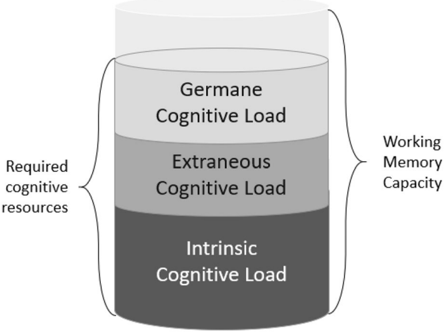
For more than three decades, cognitive load theory has been addressing learning from a cognitive perspective. Based on this instructional theory, design recommendations and principles have been derived to manage the load on working memory while learning. The increasing attention paid to cognitive load theory in educational science quickly culminated in the need to measure its types of cognitive load — intrinsic, extraneous, and germane cognitive load which additively contribute to the overall load. In this meta-analysis, four frequently used cognitive load questionnaires were examined concerning their reliability (internal consistency) and validity (construct validity and criterion validity). Results revealed that the internal consistency of the subjective cognitive load questionnaires can be considered satisfactory across all four questionnaires. Moreover, moderator analyses showed that reliability estimates of the cognitive load questionnaires did not differ between educational settings, domains of the instructional materials, presentation modes, or number of scale points. Correlations among the cognitive load types partially contradict theory-based assumptions, whereas correlations with learning-related variables support assumptions derived from cognitive load theory. In particular, results seem to support the three-factor model consisting of intrinsic cognitive load, extraneous cognitive load, and germane cognitive load. Results are discussed in relation to current trends in cognitive load theory and recommendations for the future use of cognitive load questionnaires in experimental research are suggested.
Overview
The claims and statistics of this paper haven’t been checked yet.
Run the check — free, no account needed. It reads the open-access text and checks the sources it cites.
Integrity signals
Registry
Cites
Statistics
Figures
Verification
Claims the paper makes
The claims and statistics of this paper haven’t been checked yet.
Run the check — free, no account needed. It reads the open-access text and checks the sources it cites.
Claims other papers make about this one
Each is checked against this paper’s own text: does it say what the citing paper says it does?
In the citing paper
“Cognitive load was assessed using an adapted version of the validated German-language multidimensional cognitive load questionnaire developed by Krieglstein et al. (2022), which is grounded in Cognitive Load Theory.”
From Generative AI and Learning Dynamics in Higher Education: A Longitudinal Empirical Study (2026) · cites this paper as Krieglstein et al. (2022)
Self-check
Percentages, sums and reported differences re-computed from the paper’s own numbers.
The self-check needs the paper’s full text.
Citations
Cites
Coefficient Alpha and the Internal Structure of Tests
Cronbach, L. J. (1951) · Psychometrika · doi:10.1007/bf02310555 · Cited by 43,931
The magical number seven, plus or minus two: Some limits on our capacity for processing information.
Miller, G. A. (1956) · Psychological Review · doi:10.1037/h0043158 · Cited by 17,812
Convergent and discriminant validation by the multitrait-multimethod matrix.
Campbell, D. T., & Fiske, D. W. (1959) · Psychological Bulletin · doi:10.1037/h0046016 · Cited by 17,116
Operating characteristics of a rank correlation test for publication bias
Begg, C. B., & Mazumdar, M. (1994) · Biometrics · doi:10.2307/2533446 · Cited by 16,955
Making sense of cronbach’s alpha.
Tavakol, M., & Dennick, R. (2011) · International Journal of Medical Education · doi:10.5116/ijme.4dfb.8dfd · Cited by 15,126
Construct validity in psychological tests.
Cronbach, L. J., & Meehl, P. E. (1955) · Psychological Bulletin · doi:10.1037/h0040957 · Cited by 11,195
Cognitive Load During Problem Solving: Effects on Learning
Sweller, J. (1988) · Cognitive Science · doi:10.1016/0364-0213(88)90023-7 · Cited by 11,048
The Use of Cronbach’s Alpha When Developing and Reporting Research Instruments in Science Education
Taber, K. S. (2018) · Research in Science Education · doi:10.1007/s11165-016-9602-2 · Cited by 10,679
Borenstein, M., Hedges, L. V., Higgins, J. P. T., & Rothstein, H. R. (2021) · doi:10.1002/9781119558378 · Cited by 9,799
What is coefficient alpha? An examination of theory and applications
Cortina, J. M. (1993) · Journal of Applied Psychology · doi:10.1037/0021-9010.78.1.98 · Cited by 8,810 · cited 1×
“The alpha value represents the average of all split-half reliabilities (Cortina, 1993; Ferketich, 1990).”
Background
Research works printed but not linked: 9
- Artino, A. R. (2008). Cognitive load theory and the role of learner experience. An abbreviated review for educational practitioners. AACE Journal, 16, 425–439.
- Baddeley, A. (1986). Working memory. Oxford University Press.
- *Beege, M., Wirzberger, M., Nebel, S., Schneider, S., Schmidt, N., & Rey, G. D. (2019b). Spatial continuity effect vs. spatial contiguity failure. Revising the effects of spatial proximity between related and unrelated representations. Frontiers in Education, 4, 86. https://doi.org/10.3389/feduc.2019b.00086 · DOI
- Glass, G. V., McGaw, B., & Smith, M. L. (1981). Meta-analysis in social research. Sage Publications.
- Leahy, W. (2018). Case studies in cognitive load measurement. In R. Z. Zheng (Ed.), Cognitive load measurement and application: A theoretical framework for meaningful research and practice (pp. 199–223). Routledge/Taylor & Francis Group.
- Messick, S. (1989). Validity. In R. L. Linn (Ed.), Educational measurement (pp. 13–103). American Council on Education and Macmillan.
- *Schneider, S., Nebel, S., Beege, M., & Rey, G. D. (2018d). The autonomy-enhancing effects of choice on cognitive load, motivation and learning with digital media. Learning and Instruction, 58, 161–172. https://doi.org/10.1016/j.learninstruc.2018d.06.006 · DOI
- Weidenmann, B. (2002). Multicodierung und Multimodalität im Lernprozess [Multicoding and multimodality in the learning process]. In L. J. Issing & P. Klimsa (Eds.), Information und Lernen mit Multimedia (3rd edition, pp. 45–62). Beltz PVU.
- Zavgorodniaia, A., Duran, R., Hellas, A., Seppala, O., & Sorva, J. (2020, September). Measuring the cognitive load of learning to program: A replication study. In J. Maguire, & Q. Cutts (Eds.), United Kingdom & Ireland Computing Education Research Conference (pp. 3–9). https://doi.org/10.1145/3416465.34164 · DOI
Cited by
Does ChatGPT enhance student learning? A systematic review and meta-analysis of experimental studies
Deng, R., Jiang, M., Yu, X., Lu, Y., & Liu, S. (2025) · Computers & Education · doi:10.1016/j.compedu.2024.105224 · Cited by 531
Gkintoni, E., Antonopoulou, H., Sortwell, A., & Halkiopoulos, C. (2025) · Brain Sciences · doi:10.3390/brainsci15020203 · Cited by 309
Cognitive load theory and its relationships with motivation: A self-determination theory perspective
Evans, P., Vansteenkiste, M., Parker, P., Kingsford-Smith, A., & Zhou, S. (2024) · Educational Psychology Review · doi:10.1007/s10648-023-09841-2 · Cited by 200
Krieglstein, F., Beege, M., Rey, G. D., Sanchez-Stockhammer, C., & Schneider, S. (2023) · Educational Psychology Review · doi:10.1007/s10648-023-09738-0 · Cited by 139
Self-citationEndres, T., Lovell, O., Morkunas, D., Rieß, W., & Renkl, A. (2023) · British Journal of Educational Psychology · doi:10.1111/bjep.12563 · Cited by 57
Metadata
- Authors
- Krieglstein, F., Beege, M., Rey, G. D., Ginns, P., Krell, M., & Schneider, S.
- ORCID
- Krieglstein, Felix
- Venue
- Educational Psychology Review
- Published
- 2022-05-20
- Volume
- 34
- Issue
- 4
- Pages
- 2485-2541
- ISSN
- 1040-726X
- 1573-336X
- Cited by
- 118
- References
- 220
- Language
- en
- Licence
- creativecommons.org/licenses/by/4.0 (tdm)
- creativecommons.org/licenses/by/4.0 (vor)
- Funders
- Technische Universität Chemnitz
About these checks
Registry, retraction, Cites and statistics results are computed, not judged, with one exception: a printed reference that no index lists is read once by a model before it counts as a citation error. Claims are extracted by a model and kept only when their quote appears verbatim in the text; each cited source is then checked, with a model’s help, for whether it says what the claim relies on. Those verdicts can be wrong — read the claim’s quote and the cited source before relying on one.
Statistics and arithmetic are recomputed, not judged.
Confidence bands are shown only for fields calibrated on our annotated test set. None is calibrated yet, so no band is shown.
What counts as a claim ›How we measure confidence ›How we check this ›
Are you an author, or do you see a problem with this page? Request a review
How to cite
Cite CoChat for the checks on this page, and the paper for its own findings.
- This page
- CoChat. (2026). Citation check: A Systematic Meta-analysis of the Reliability and Validity of Subjective Cognitive Load Questionnaires in Experimental Multimedia Learning Research. https://app.cochat.ai/papers/10.1007/s10648-022-09683-4
- The paper
- Krieglstein, F., Beege, M., Rey, G. D., Ginns, P., Krell, M., & Schneider, S. (2022). A Systematic Meta-analysis of the Reliability and Validity of Subjective Cognitive Load Questionnaires in Experimental Multimedia Learning Research. Educational Psychology Review. https://doi.org/10.1007/s10648-022-09683-4
Data sources
Bibliographic data: Semantic Scholar, OpenAlex, Crossref.
Contains information from the Semantic Scholar Academic Graph Datasets, made available under the ODC Attribution License (ODC-BY 1.0).
Semantic Scholar’s data is described in: Kinney, R., et al. (2023). The Semantic Scholar Open Data Platform. arXiv:2301.10140.
