

Learning a Language Through Reading: A Meta-analysis of Studies on the Effects of Extensive Reading on Second and Foreign Language Learning
Open accessThe DOI matches its Crossref record; 83 of the 83 references it cites were found in a registry or an index; 7 of the 26 sources its claims cite were checked for support.
Abstract
Research on extensive reading (ER) has quite consistently highlighted its impact on second/foreign language learning. However, it remains unclear what the exact components of ER are that make it profitable. In practice, there appears to be variation in the application of key elements of ER, and programs vary in the kinds of additions they make to these elements. The aim of this meta-analysis was to assess the impact of ER on second/foreign language learning and to examine which key elements and additions to ER contribute to its success. The effects of ER proved to be positive across all included language domains (reading comprehension, vocabulary, decoding/fluency, motivation, writing, oral proficiency, general language proficiency) and target populations, with effect sizes ranging from small to medium. Variability in effect sizes was affected by two intervention characteristics: when learners’ text choice was limited and when some form of accountability was included, effects were larger than when these elements were absent. Additionally, effect sizes were larger when the members of a sample had different first languages. This meta-analysis supports the assumption that encouraging second/foreign language learners to engage in sustained, independent, and self-selected reading promotes a range of second/foreign language skills. Since ER seems to be underutilized as an educational approach in second/foreign language teaching, our outcomes can be taken as a stimulus to promote its use. At the same time, further research is needed, both in the context of second language learning and in younger populations.
Overview
CoChat Summary
TL;DR
This meta-analysis of 73 studies (82 interventions, 86 experimental comparisons) finds that extensive reading produces small-to-medium positive effects on second/foreign language learning across reading comprehension, vocabulary, decoding/fluency, motivation, writing, oral proficiency, and general language proficiency. Effects were larger when learners’ text choice was limited, when accountability was included, and when samples had different first languages.
Key findings
- The overall effect of extensive reading was small and significant: Cohen’s d = 0.41 (SE = 0.07) across 86 experimental comparisons; for immediate effects only, d = 0.38 (SE = 0.07, k = 82).
- Effects were positive across all language domains: reading comprehension d = 0.31 (k = 52), vocabulary d = 0.50 (k = 31), decoding/fluency d = 0.38 (k = 23), motivation d = 0.34 (k = 17), writing d = 0.31 (k = 14), oral proficiency d = 0.42 (k = 11), and general language proficiency d = 0.53 (k = 9).
- Significant moderators were text limitation and accountability: interventions limiting students’ text choice and those holding students accountable for reading had larger effects. First language was also significant: mixed-L1 samples showed d = 1.03 (k = 5) versus d = 0.33 (k = 77) for same-L1 samples.
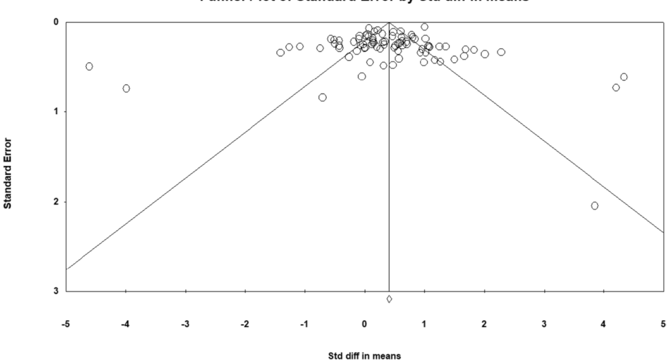
- Intervention duration in weeks was not significant (β = -0.002, SE = 0.004, p = .669), and study quality was not significant (β = 0.06, SE = 0.06, p = .346). Publication bias appeared limited: Egger’s test intercept β = -0.50, p = .466.
Methods
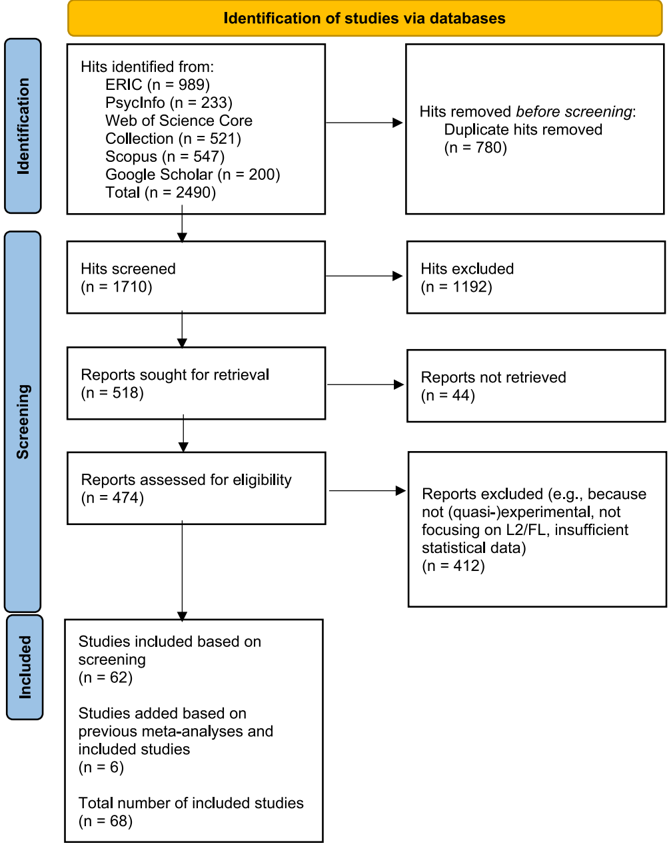
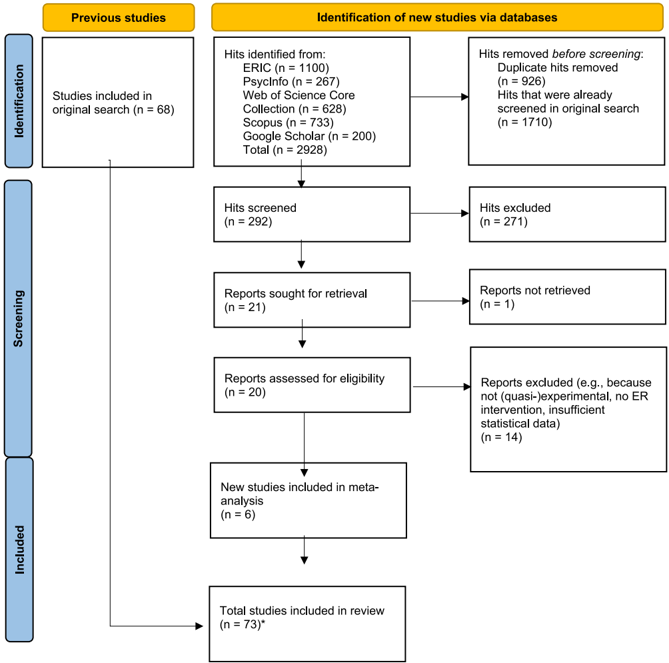
- Meta-analysis of studies with an experimental and control group, published in English, assessing extensive reading for second/foreign language learning; searches were run in ERIC, PsycINFO, Web of Science Core Collection, Scopus, and Google Scholar on 26 January 2023, with an update on 14 April 2025.
- The final dataset comprised 73 studies, 82 interventions, and 86 experimental comparisons; most were peer reviewed (k = 67, 92%), quasi-experimental (k = 56, 77%), and focused on university students (k = 46, 56%).
- Analyses used random-effects models in Comprehensive Meta-Analysis 4.0; moderator analyses used subgroup analysis for categorical variables and meta-regression for continuous variables. Coding was double-coded, with interrater agreement 87% (range 77–99%, Cohen’s κ = .479–.871).
Limitations
- The paper states that the underlying research overrepresents foreign language learners and university students: only 4 of 82 interventions assessed L2 contexts, and primary education had 7 interventions and secondary education 19, compared with 46 for tertiary education.
- The paper states that long-term effects could not be established because only three studies (four experimental comparisons) included retention tests; it also notes geographic bias (most studies in Asian countries), a focus on English, and incomplete reporting that led to excluded studies and missing analyses, including insufficient data on actual time on task.
- Evident from the text: heterogeneity was high across outcomes (I² = 78.94–90.48), implementation fidelity was low (M = 0.38, SD = 0.49; 45 of 73 studies did not report fidelity), and most studies were quasi-experimental, limiting causal certainty.
Model-written summary. Check it against the paper before relying on it.
Integrity signals
Registry
Cites
Statistics
Figures

Verification
Claims the paper makes
7 Valid · 2 Not valid · 10 Not checked · 70 Own results and interpretations
Every source the paper cites for this claim was checked and supports it.
In the paper
“A selection of studies available shows quite a number of deviations in the use of the key elements suggested by Day and Bamford (2002).”
§ Learning a Language Through Reading: A Meta-analysis of Studies on the Effects of Extensive Reading on Second and Foreign Language Learning > Variability in the Implementation of Extensive Reading
What the sources say
- Supportedcites Day and Bamford (2002) matched to “Top Ten Principles for Teaching Extensive Reading” (2002) source
The Abstract says the paper puts forward ten principles for extensive reading, and the Conclusion calls them the authors’ ten principles. The sentence attributes those key elements to Day and Bamford; its observation about deviations across other studies is not a finding attributed to this source. (LLM, conf=0.91)
plain- Asserted: passes — The authors put it forward as true.
- Checkable: passes — It can be checked against evidence.
- Load-bearing: unclear — It is unclear whether the paper’s conclusions depend on it.
- Based: passes — The paper gives a reason why it holds.
- Supported
Every source the paper cites for this claim was checked and supports it.
In the paper
“Consistent with the first assumption, in their meta-analysis, Jeon and Day (2016) found ER to yield larger effects for EFL than for ESL students, but also noticed an imbalance in research attention: there were considerably more studies on the former than the latter learners.”
§ Learning a Language Through Reading: A Meta-analysis of Studies on the Effects of Extensive Reading on Second and Foreign Language Learning > Possible Moderators of Extensive Reading Effects
What the sources say
- Supportedcites Jeon and Day (2016) matched to “The effectiveness of ER on reading proficiency: A meta-analysis” (2016) source
The moderator analyses report a significantly larger effect for EFL than ESL settings (d = 0.65 versus 0.38). The same section notes that the EFL comparison included more studies (37 versus 14) and cautions that this imbalance may have influenced the estimate. No page number is available in our copy. (LLM, conf=0.94)
plainstates a cause- Asserted: passes — The authors put it forward as true.
- Checkable: passes — It can be checked against evidence.
- Load-bearing: unclear — It is unclear whether the paper’s conclusions depend on it.
- Based: passes — The paper gives a reason why it holds.
- Supported
The cited sources support only part of this claim — read each source’s verdict below.
In the paper
“Since extensive reading seems to be underutilized as an educational approach in second/foreign language teaching (Ewert, 2017;Ng et al., 2019), our outcomes can be taken as a stimulus to promote its use.”
§ Learning a Language Through Reading: A Meta-analysis of Studies on the Effects of Extensive Reading on Second and Foreign Language Learning > Conclusion and Implications
What the sources say
- Supportedcites Ewert, 2017 matched to “Getting ER Into the Curriculum: No More Excuses!” (2017) sourceExperimental — accuracy not yet measured
The Abstract says extensive reading is a language-teaching approach whose implementation remains limited. It also describes implementation as limited globally, especially in English-dominant contexts (p. 6), supporting the claim that it seems underutilized in second- and foreign-language teaching. (LLM, conf=0.93)
- Not matchedcites Ng et al., 2019
This doesn’t read as a citation we can look up.
hedged- Asserted: passes — The authors put it forward as true.
- Checkable: passes — It can be checked against evidence.
- Load-bearing: passes — The paper’s conclusions depend on it.
- Based: passes — The paper gives a reason why it holds.
- Supported
The cited sources support only part of this claim — read each source’s verdict below.
In the paper
“Erbeli and Rice (2022), for instance, reviewed 14 experimental and quasi-experimental studies on the effects of Independent Silent Reading (ISR) but found no support for the presence of its effects on reading outcomes.”
- Also stated in: § Interpretation of Findings · plain
“Bus et al.'s (2024) meta-analysis of 47 (quasi-)experiments revealed only a marginal overall effect of ISR (Hedge's g = 0.08); specific effects varied from small in the case of word reading skills (Hedges' g = 0.21) to negative in the case of reading comprehension (Hedges' g = -0.14).”
§ Learning a Language Through Reading: A Meta-analysis of Studies on the Effects of Extensive Reading on Second and Foreign Language Learning > Interpretation of Findings
What the sources say
- Not checked — no full text of the sourcecites Erbeli and Rice (2022) matched to “Examining the Effects of Silent Independent Reading on Reading Outcomes: A Narrative Synthesis Review from 2000 to 2020” (2022) source
- Partly supportedcites Bus et al. (2024) matched to “Building a Stronger Case for Independent Reading at School” (2024) sourceExperimental — accuracy not yet measured
The Abstract reports that Erbeli and Rice’s review found many studies without statistically significant results, supporting the claim’s general point. But it also says their forest plots suggested a positive trend; it does not characterize their finding as no support for any effect. The Abstract attributes the figure of 14 studies to the National Reading Panel’s review, not to Erbeli and Rice. (LLM, conf=0.87)
plain- Asserted: passes — The authors put it forward as true.
- Checkable: passes — It can be checked against evidence.
- Load-bearing: passes — The paper’s conclusions depend on it.
- Based: passes — The paper gives a reason why it holds.
- Also stated in: § Interpretation of Findings · plain
A result the paper reports from its own data — it cites no other source for it, so there is none to check. The quote shows it is in the paper.
In the paper
“Of the categorical intervention characteristics, only text limitation and accountability were significant moderators.”
- Also stated in: § Summary of Findings · plain
“Variability in effect sizes was affected by two intervention characteristics: when students' choice of texts was limited and when some form of accountability was included, effects were generally larger than when these elements were absent.”
§ Learning a Language Through Reading: A Meta-analysis of Studies on the Effects of Extensive Reading on Second and Foreign Language Learning > Sample Characteristics
plainstates an association- Asserted: passes — The authors put it forward as true.
- Checkable: passes — It can be checked against evidence.
- Load-bearing: passes — The paper’s conclusions depend on it.
- Based: passes — The paper gives a reason why it holds.
- Also stated in: § Summary of Findings · plain
33 more claims
Create a free account to see all 89 claims and every source verdict.
- Probably not a substantial claim. 35
- It may state two separate claims as one. 28
- The quote only partly states this claim. 1
Self-check
Percentages, sums and reported differences re-computed from the paper’s own numbers.
Each contradiction between two passages listed here was confirmed by an independent check.
Rated minor: it would not touch a result — a value no result rests on, a p-value that stays on the same side of the significance level, or a conflict that is clerical, resolved elsewhere in the paper, or outside its own findings.
In the paper
§ Learning a Language Through Reading: A Meta-analysis of Studies on the Effects of Extensive Reading on Second and Foreign Language Learning > 3. Statistical analyses:
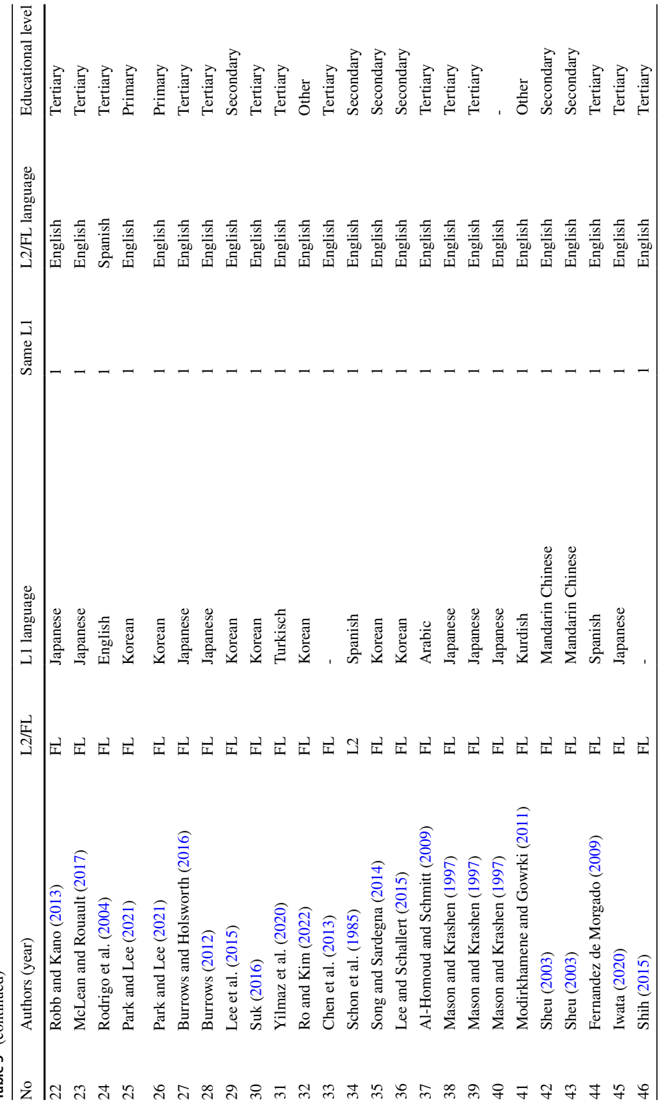
“25 Park and Lee (2021) Yes Experimental Yes Class 5 26 Park and Lee (2021) Yes Experimental Yes Class 5 27 Burrows and Holsworth (2016) Yes Experimental Yes Class 5”
§ Learning a Language Through Reading: A Meta-analysis of Studies on the Effects of Extensive Reading on Second and Foreign Language Learning > Study Characteristics
“Studies were only coded as an experiment if randomization was applied at the individual level.If classes or schools were randomly assigned to the experimental or control condition, the design was considered quasi-experimental.”
Citations
Cites
Bias in meta-analysis detected by a simple, graphical test
Egger, M., Smith, G. D., Schneider, M., & Minder, C. (1997) · BMJ · doi:10.1136/bmj.315.7109.629 · Cited by 56,722 · cited 1×
“Finally, we conducted Egger’s regression test (Egger et al., 1997), which revealed a non-significant intercept (β = − 0.50, p =.466), additionally suggesting a lack of publication bias.”
InfluentialRyan, R. M., & Deci, E. L. (2000) · American Psychologist · doi:10.1037//0003-066x.55.1.68 · Cited by 54,599
Borenstein, M., Hedges, L. V., Higgins, J. P. T., & Rothstein, H. R. (2021) · doi:10.1002/9781119558378 · Cited by 9,799
Principles and Practice in Second Language Acquisition
Higgs, T. V., & Krashen, S. D. (1983) · The Modern Language Journal · doi:10.2307/328293 · Cited by 5,339
Stanovich, K. E. (1986) · Reading Research Quarterly · doi:10.1598/rrq.21.4.1 · Cited by 5,222
Mediterranean journal of social sciences
(2020) · Mediterranean Journal of Social Sciences · doi:10.5901/mjss · Cited by 3,221
To read or not to read: a meta-analysis of print exposure from infancy to early adulthood
Mol, S. E., & Bus, A. G. (2011) · Psychological Bulletin · doi:10.1037/a0021890 · Cited by 1,299 · cited 1×
“Increasing students’ reading volume can be assumed to incite a process of reciprocal causation (Mol & Bus, 2011; Stanovich, 1986): more frequent reading allows students more reading practice, more practice supports reading proficiency, increased proficiency results in more self-confidence in…”
Extensive Reading in the Second Language Classroom
Day, R. R., Bamford, J., Renandya, W. A., Jacobs, G. M., & Yu, V. W.-S. (1998) · RELC Journal · doi:10.1177/003368829802900211 · Cited by 1,276 · cited 1×
“During extensive reading sessions, learners read at their own pace, individually and silently (Day & Bamford, 1998, 2002), and the focus is on reading for enjoyment.”
We Acquire Vocabulary and Spelling by Reading: Additional Evidence for the Input Hypothesis
KRASHEN, S. (1989) · The Modern Language Journal · doi:10.1111/j.1540-4781.1989.tb05325.x · Cited by 1,274 · cited 1×
“Second, it is assumed that language is acquired by understanding messages and, consequently, that language learners should be exposed to comprehensible input (Krashen, 1989), an assumption that is central to Krashen’s Input Hypothesis (IH; 1981, 1982, 1992).”
Borenstein, M., Hedges, L. V., Higgins, J. P. T., Rothstein, H. R., & Ben Van Den, A. (2020) · International Coaching Psychology Review · doi:10.53841/bpsicpr.2020.15.2.121 · Cited by 1,215
Dimensions of Reading Motivation and Their Relation to Reading Behavior and Competence
Schiefele, U., Schaffner, E., Möller, J., & Wigfield, A. (2012) · Reading Research Quarterly · doi:10.1002/rrq.030 · Cited by 694 · cited 1×
“Alternatively, at-risk status might impede the effects of ER because struggling readers are generally less prone to engage in reading (Schiefele et al., 2012; Toste et al., 2020) and might thus benefit less from ER.”
(2017) · Arab World English Journal · doi:10.24093/awej · Cited by 624
Teaching ESL/EFL Reading and Writing
Nation, I. S. P. (2008) · Routledge eBooks · doi:10.4324/9780203891643 · Cited by 609 · cited 1×
“Frequent exposure supports automatic word recognition: it allows the strengthening and stabilization of lexical entries and networks (Nation, 2009).”
The Impact of Reading on Second Language Learning
Elley, W. B., & Mangubhai, F. (1983) · Reading Research Quarterly · doi:10.2307/747337 · Cited by 507
Top Ten Principles for Teaching Extensive Reading
Day, R., & Bamford, J. (2002) · Reading in a Foreign Language · doi:10.64152/10125/66761 · Cited by 439 · cited 3×
“During extensive reading sessions, learners read at their own pace, individually and silently (Day & Bamford, 1998, 2002), and the focus is on reading for enjoyment.”
Reading in a Second Language: Moving from Theory to Practice
Grabe, W. (2008) · Cambridge University Press eBooks · doi:10.1017/cbo9781139150484 · Cited by 416
Extensive reading in English as a foreign language
Mason, B., & Krashen, S. (1997) · System · doi:10.1016/s0346-251x(96)00063-2 · Cited by 401
A Meta-Analytic Review of the Relations Between Motivation and Reading Achievement for K–12 Students
Toste, J. R., Didion, L., Peng, P., Filderman, M. J., & McClelland, A. M. (2020) · Review of Educational Research · doi:10.3102/0034654320919352 · Cited by 269 · cited 1×
“Alternatively, at-risk status might impede the effects of ER because struggling readers are generally less prone to engage in reading (Schiefele et al., 2012; Toste et al., 2020) and might thus benefit less from ER.”
Kontopantelis, E., & Reeves, D. (2012) · Statistical Methods in Medical Research · doi:10.1177/0962280210392008 · Cited by 264 · cited 1×
“We excluded this variable from further moderator analyses, as the number of studies ( k = 4) did not reach the threshold of five (Kontopantelis & Reeves, 2010).”
The Effects of Extensive Reading on Reading Comprehension, Reading Rate, and Vocabulary Acquisition
Suk, N. (2017) · Reading Research Quarterly · doi:10.1002/rrq.152 · Cited by 188 · cited 2×
“First, extensive reading is expected to promote reading fluency by supporting implicit learning (Suk, 2016): it is assumed that the development of automa-tized processing of text involves “the tacit learning of co-occurrence patterns” (Suk, 2016, p. 74) and that this necessitates frequent exposure…”
A Meta-Analysis of Extensive Reading Research
Nakanishi, T. (2015) · TESOL Quarterly · doi:10.1002/tesq.157 · Cited by 184 · cited 8×
“…of our meta-analysis—but also of previous meta-analyses of extensive reading studies (Jeon & Day, 2016; Kim, 2012; Krashen, 2011; Liu & Zhang, 2018; Nakanishi, 2015)—is that the underlying research is focused on specific populations: foreign language learners and university students were…”
InfluentialAl-Homoud, F., & Schmitt, N. (2009) · Language Teaching Research · doi:10.1177/1362168809341508 · Cited by 180
Modern Journal of Language Teaching Methods
(2017) · Modern Journal of Language Teaching Methods · doi:10.26655/suffix · Cited by 180
Taguchi, E., Takayasu-Maass, M., & Gorsuch, G. J. (2004) · Reading in a Foreign Language · doi:10.64152/10125/66783 · Cited by 166
Was Krashen right? Forty years later
Lichtman, K., & VanPatten, B. (2021) · Foreign Language Annals · doi:10.1111/flan.12552 · Cited by 165 · cited 1×
“Although the IH has been criticized for being untestable—Krashen has not clarified how to operationalize i + 1—, many theories since have acknowledged the fundamental role of input in language learning (Lichtman & VanPatten, 2021).”
Implicit and Explicit Knowledge about Language
Ellis, N. C. (2008) · Springer eBooks · doi:10.1007/978-0-387-30424-3_143 · Cited by 163
Effectiveness of Interventions that Foster Reading Motivation: a Meta-analysis
van der Sande, L., van Steensel, R., Fikrat‐Wevers, S., & Arends, L. R. (2023) · Educational Psychology Review · doi:10.1007/s10648-023-09719-3 · Cited by 151 · cited 1×
“Although this drawback is characteristic of much reading promotion research (Merke et al., 2024; Van der Sande et al., 2023), the question whether long-term effects occur is highly relevant.”
Self-citationThe Effect of Pleasure Reading on Japanese University EFL Learners’ Reading Rates
Beglar, D., Hunt, A., & Kite, Y. (2012) · Language Learning · doi:10.1111/j.1467-9922.2011.00651.x · Cited by 148
The effectiveness and efficiency of extensive reading at developing reading rates
McLean, S., & Rouault, G. (2017) · System · doi:10.1016/j.system.2017.09.003 · Cited by 148
Comparing the Effects of Reading and Writing on Writing Performance
TSANG, W.-K. (1996) · Applied Linguistics · doi:10.1093/applin/17.2.210 · Cited by 147
Krashen, S. D. (2011) · doi:10.5040/9798400653810 · Cited by 133 · cited 5×
“The overall positive effects we found support the assumed benefits of extensive reading for second and foreign language learning (Ng et al., 2019), and corroborate the outcomes of earlier meta-analyses (Jeon & Day, 2016; Kim, 2012; Krashen, 2011; Liu & Zhang, 2018; Nakanishi, 2015).”
InfluentialRodrigo, V., Krashen, S. D., & Gribbons, B. C. (2003) · System · doi:10.1016/j.system.2003.08.003 · Cited by 126
Lee, J., Schallert, D. L., & Kim, E. (2015) · System · doi:10.1016/j.system.2015.04.016 · Cited by 115
Improving EFL learners' writing through enhanced extensive reading
Mermelstein, A. D. (2015) · Reading in a Foreign Language · doi:10.64152/10125/66890 · Cited by 114
Exploration of the Core and Variable Dimensions of Extensive Reading Research and Pedagogy
Waring, R., & McLean, S. (2015) · Reading in a Foreign Language · doi:10.64152/10125/66708 · Cited by 110 · cited 1×
“Although there is variability in the conceptualization of extensive reading (Waring & McLean, 2015), the regularly cited top ten principles of extensive reading published by Day and Bamford (2002) provide an overview of elements that seem to be central to the implementation of extensive reading in…”
Reading rate gains during a one-semester extensive reading course
Huffman, J. (2014) · Reading in a Foreign Language · doi:10.64152/10125/66879 · Cited by 105
EXTENSIVE READING: THEORY, RESEARCH AND IMPLEMENTATION
Ng, Q. R., Renandya, W. A., & Chong, M. Y. C. (2019) · TEFLIN Journal - A publication on the teaching and learning of English · doi:10.15639/teflinjournal.v30i2/171-186 · Cited by 102 · cited 3×
“…disagreement on the question whether larger effects of extensive reading can be expected for younger or older learners: while Nakanishi (2015) and Ng et al. (2019) suggest that learners have a much better chance of taking advantage of the benefits of extensive reading if they start early, Jeon…”
Effective extensive reading outside the classroom: A large-scale experiment
Robb, T., & Kano, M. (2013) · Reading in a Foreign Language · doi:10.64152/10125/66870 · Cited by 101
Lee, J., & Schallert, D. L. (2015) · Reading Research Quarterly · doi:10.1002/rrq.132 · Cited by 97 · cited 2×
“…while in other programs teachers provided learners with help during reading—for example by answering questions and by guiding leaners who had difficulty recognizing words (Lituanas et al., 2001)—or wrote brief comments to learners’ written responses to the books they read (Lee & Schallert, 2015).”
The Benefits of Sustained Silent Reading: Scientific Research and Common Sense Converge
Garan, E. M., & DeVoogd, G. (2008) · The Reading Teacher · doi:10.1598/rt.62.4.6 · Cited by 75 · cited 1×
“Extensive reading is assumed to elicit the same mechanisms as approaches such as Independent Silent Reading (ISR) do (Garan & DeVoogd, 2008).”
The effectiveness of ER on reading proficiency: A meta-analysis
Jeon, E.-Y., & Day, R. R. (2016) · Reading in a Foreign Language · doi:10.64152/10125/66901 · Cited by 73 · cited 8×
“The overall positive effects we found support the assumed benefits of extensive reading for second and foreign language learning (Ng et al., 2019), and corroborate the outcomes of earlier meta-analyses (Jeon & Day, 2016; Kim, 2012; Krashen, 2011; Liu & Zhang, 2018; Nakanishi, 2015).”
InfluentialThe Effects of Extensive Reading on English Vocabulary Learning: A Meta-analysis
Liu, J., & Zhang, J. (2018) · English Language Teaching · doi:10.5539/elt.v11n6p1 · Cited by 67 · cited 4×
“Finally, a meta-analysis by Liu and Zhang (2018) of 21 studies demonstrated an impact of extensive reading on foreign language learners’ vocabulary learning; learners in ER programs scored better on posttests compared to pretests ( d = 3.26 based on k = 21) and outperformed learners in control…”
InfluentialSong, J., & Sardegna, V. G. (2014) · RELC Journal · doi:10.1177/0033688214522623 · Cited by 67 · cited 1×
“That is, some but not all programs asked learners to account for their reading, for instance in the form of book reports (Lee & Schallert, 2015), quizzes about the book’s content (Milliner, 2019), and/or reading logs (Song & Sardegna, 2014).”
Reading performance of Japanese high school learners following a one-year extensive reading program
Aka, N. (2019) · Reading in a Foreign Language · doi:10.64152/10125/66747 · Cited by 67
Revelations from Three Consecutive Studies on Extensive Reading
Lee, S.-Y. (2007) · RELC Journal · doi:10.1177/0033688207079730 · Cited by 62
Reading motivation in two languages: an examination of EFL college students in Korea
Kim, K. J. (2011) · Reading and Writing · doi:10.1007/s11145-010-9229-z · Cited by 61 · cited 1×
“Kim (2011), for instance, examined the components of EFL reading motivation among Korean college students.”
Text difficulty in extensive reading: Reading comprehension and reading motivation
Yang, Y.-H., Chu, H.-C. J., & Tseng, W. (2021) · Reading in a Foreign Language · doi:10.64152/10125/67394 · Cited by 59 · cited 1×
“In attuning text choice to learners’ reading level, some programs also promoted the use of the aforementioned graded readers (Yang et al., 2021).”
Linguistics and language pedagogy : the state of the art
Alatis, J. E. (1991) · DigitalGeorgetown (Georgetown University Library) · Cited by 52
Incidental and Intentional Learning of Vocabulary among Young ESL Learners
Meganathan, P. M., Yap, N. T., Paramasivam, S., & Jalaluddin, I. B. (2019) · 3L The Southeast Asian Journal of English Language Studies · doi:10.17576/3l-2019-2504-04 · Cited by 39
Park, J., & Lee, J. (2021) · English Teaching · doi:10.15858/engtea.76.3.202109.35 · Cited by 32
An investigation of extensive reading with remedial students in a Philippines secondary school
Lituanas, P. M., Jacobs, G. M., & Renandya, W. A. (2001) · International Journal of Educational Research · doi:10.1016/s0883-0355(01)00018-0 · Cited by 30 · cited 1×
“…while in other programs teachers provided learners with help during reading—for example by answering questions and by guiding leaners who had difficulty recognizing words (Lituanas et al., 2001)—or wrote brief comments to learners’ written responses to the books they read (Lee & Schallert, 2015).”
Park, A. Y., Isaacs, T., & Woodfield, H. (2018) · Applied Linguistics Review · doi:10.1515/applirev-2017-0025 · Cited by 30
Erbeli, F., & Rice, M. (2022) · Reading & Writing Quarterly · doi:10.1080/10573569.2021.1944830 · Cited by 28
Alavi, S., & Keyvanshekouh, A. (2012) · English Language Teaching · doi:10.5539/elt.v5n6p135 · Cited by 28
Austin, C. R., Wanzek, J., Scammacca, N. K., Vaughn, S., Gesel, S. A., Donegan, R. E., & Engelmann, M. L. (2019) · Exceptional Children · doi:10.1177/0014402918796164 · Cited by 25 · cited 1×
“Finally, we assessed the quality of the included studies, based on guidelines by Austin et al. (2019) and following the quality assessment of Merke et al. (2024).”
Development of Argumentative Writing Ability in EFL Middle School Students
Lee, J., & Lee, J. (2023) · Reading & Writing Quarterly · doi:10.1080/10573569.2022.2161438 · Cited by 24
Does the freedom of reader choice affect second language incidental vocabulary acquisition?
Reynolds, B. L., & Bai, Y. L. (2013) · British Journal of Educational Technology · doi:10.1111/j.1467-8535.2012.01322.x · Cited by 22
Comparing the effects of reading and writing on writing performance
Tsang, W.-K. (1996) · Applied Linguistics · doi:10.1093/applin/17.2.208 · Cited by 20
Matsui, T., & Noro, T. (2010) · ARELE: Annual Review of English Language Education in Japan · doi:10.20581/arele.21.0_71 · Cited by 19
Rezaee, M., Farahian, M., & Mansooji, H. (2020) · Journal of Applied Research in Higher Education · doi:10.1108/jarhe-09-2020-0304 · Cited by 19 · cited 1×
“This category included the outcomes of tests that provided an overall score by determining the combined proficiency for two or more domains, such as the TOEIC test for listening and reading (e.g., Goto, 2021; Rezaee et al., 2021).”
Kim, H., & Ro, E. (2023) · Journal of Second Language Writing · doi:10.1016/j.jslw.2023.101040 · Cited by 18
Hamada, A. (2020) · Frontiers in Psychology · doi:10.3389/fpsyg.2020.00617 · Cited by 17
The effects of extensive reading on young Korean students’ construction development
Ro, E., & Kim, H. (2021) · IRAL - International Review of Applied Linguistics in Language Teaching · doi:10.1515/iral-2019-0076 · Cited by 16
Merke, S., Ganushchak, L., & van Steensel, R. (2024) · Educational Research Review · doi:10.1016/j.edurev.2023.100572 · Cited by 15 · cited 5×
“Recently, Merke et al. (2024) conducted a meta-analysis to test whether additions to ISR that are aimed to overcome such barriers contribute to its effects: they examined the impact of limiting and supporting book selection, of measures to increase accountability (particularly, student–teacher…”
InfluentialSchön, I., Hopkins, K. D., & Vojir, C. P. (1985) · Journal of Psycholinguistic Research · doi:10.1007/bf01067474 · Cited by 14
Reading for Pleasure as a Means of Improving Reading Comprehension Skills
Abdullah, S., Rahim, P. R. M. A., Setia, R., et al. (2012) · Asian Social Science · doi:10.5539/ass.v8n13p233 · Cited by 13
The Effect of Graded Readers on Reading Comprehension Skill of EFL Students
Kara, B. (2019) · Language Teaching and Educational Research · doi:10.35207/later.554716 · Cited by 13
MinneTESOL/WITESOL Journal, 2000-2001.
Upton, J. (2001) · Cited by 12
Scaffolded Silent Reading: Improving the Conditions of Silent Reading Practice in Classrooms
Reutzel, R., Jones, C., & Newman, T. (2010) · International Reading Association eBooks · doi:10.1598/0833.08 · Cited by 12
Jafarpour, M. (2014) · Advances in Language and Literary Studies · doi:10.7575/aiac.alls.v.5n.3p.162 · Cited by 10
Does Extensive Reading Improve EFL learners‟ Processing Ability?
Rezaee, A. A., & Nourzadeh, S. (2011) · Theory and Practice in Language Studies · doi:10.4304/tpls.1.9.1167-1175 · Cited by 9
Savaşçı, M., & Akyel, A. (2022) · TEFLIN Journal - A publication on the teaching and learning of English · doi:10.15639/teflinjournal.v33i1/173-200 · Cited by 9
Adult Hispanic ESL Students and Graded Readers
Martinez, L. E. (2017) · The CATESOL journal. · doi:10.5070/b5.35993 · Cited by 8 · cited 1×
“In some programs, teachers assisted students in book selection (Martinez, 2017), while in other programs teachers provided learners with help during reading—for example by answering questions and by guiding leaners who had difficulty recognizing words (Lituanas et al., 2001)—or wrote brief comments…”
Building a Stronger Case for Independent Reading at School
Bus, A. G., Shang, Y., & Roskos, K. (2024) · AERA Open · doi:10.1177/23328584241267843 · Cited by 7 · cited 1×
“…populations differ in initial reading motivation (Briggs & Walter, 2016): while our meta-analysis mostly included university students learning English as a foreign language, the reviews by Erbeli and Rice (2022) and Bus et al. (2024) targeted younger students (K-12) learning their native language.”
Extensive Reading in a Formal English Reading Class
Jeon, J. (2008) · English Teaching · doi:10.15858/engtea.63.4.200812.49 · Cited by 6
Getting ER Into the Curriculum: No More Excuses!
Ewert, D. (2017) · The CATESOL Journal · doi:10.5070/b5.35991 · Cited by 6
Shimono, T. R. (2023) · Reading in a Foreign Language · doi:10.64152/10125/67447 · Cited by 5
Hsu, Y.-Y., & Lee, S.-Y. (2009) · doi:10.25170/ijelt.v5i1.151 · Cited by 5
Nguyễn, M. C., & Baker, J. R. (2023) · International Journal of Language Education · doi:10.26858/ijole.v7i4.28140 · Cited by 4
Incorporating Extensive Reading into EFL Classroom Lessons
Misikir, S., & Simegn, B. (2024) · The International Journal of Literacies · doi:10.18848/2327-0136/cgp/v32i01/115-130 · Cited by 3
Samutkao, W., & Chaturongakul, P. (2025) · LEARN Journal : Language Education and Acquisition Research Network · doi:10.70730/pkrr3121 · Cited by 2
Park, A. Y. (2017) · Studies in English Education · doi:10.22275/see.22.3.03
Modirkhamene, S., & Gowrki, F. (2011) · Modern Journal of Language Teaching Methods · doi:10.26655/mjltm.2011.1.3.1
Research works printed but not linked: 28
- 2. Ahour, T., & Zarei, M. (2016). The effect of task-based extensive reading on Iranian EFL learners' writ- ing accuracy. The Journal of Teaching English for Specific and Academic Purposes, 4(3), 573-580. https:// doi. org/ 10. 22190/ JTESA P1603 573A * · doi:10.22190/jtesap1603573a
- 4. Alahirsh, H. (2014). Exploring the effectiveness of extensive reading on incidental vocabulary acquisi- tion by EFL learners: An experimental case study in a Libyan university [Doctoral dissertation, University of Nottingham].
- 7. Al-Jarf, R. (2021). Collaborative mobile ebook reading for struggling EFL college readers. IOSR Jour- nal of Research & Method in Education, 11(6), 32-42.
- 8. Assi, M. M. (2016). Impact of self-selected versus prescribed level reading on Arabis speaking ELL stu- dents: A mixed methods study [Doctoral dissertation, Wayne State University].
- 13. Briggs, J. G., & Walter, C. (2016). Read on! Extensive reading and young second language learners' motivation and attitudes [Report]. Oxford University Press.
- 14. Burrows, L. (2012). The effects of extensive reading and reading strategies on reading self-efficacy [Doctoral dissertation, Temple University].
- 15. Burrows, L., & Holsworth, M. (2016). The effects of explicit word recognition training on Japanese EFL learners. The Reading Matrix, 16(2), 81-97.
- 17. Chen, C.-N., Chen, S-C., Chen, S-H. E., & Wey, S-C. (2013). The effects of extensive reading via e-books on tertiary level EFL students' reading attitude, reading comprehension and vocabulary. TOJET: The Turkish Online Journal of Educational Technology, 12(2), 303-312.
- 18. Cohen, J. (1988). Statistical power analysis for the behavioral sciences (2nd ed.). Lawrence Erlbaum Associates.
- 21. Dulay, H., & Burt, M. (1977). Remarks on creativity in language acquisition. In M. Burt, H. Dulay, & M. Finocchiaro (Eds.), Viewpoints on English as a second language (pp. 95-126).
- 27. Fernandez de Morgado, N. (2009). Extensive reading: Students' performance and perception. The Read- ing Matrix, 9(1), 31-43.
- 28. Fiedler-Vierma, G. S. (1991). The effect of second language pleasure reading on second language acquisition. A quasi-experimental study [Doctoral dissertation, University of Southern California].
- 29. French, E. L. (1995). Reading lab: From pleasure to reading to proficiency? MinneTESOL/WITESOL Journal, 13, 53-76.
- 31. Goto, T. (2021). The effect of 20-minute extensive reading activities on TOEIC IP scores. The Reading Matrix, 21(2), 145-152.
- 36. Huffman, J. (2021). Development of reading fluency during an extensive reading course incorporating reading fluency tasks [Doctoral dissertation, Temple University].
- 37. Iwata, A. (2020). How extensively do we need to read to improve EFL reading ability? A comparison of two different instructional methodologies. The Reading Matrix, 20(1), 66-83.
- 38. Iwata, A. (2022). The effectiveness of extensive reading (ER) on the development of EFL learners' sight vocabulary size and reading fluency. The Reading Matrix, 22(2), 74-91.
- 45. Kim, J.-R. (2012). A meta-study of extensive English reading researches. English Language & Literature Teaching, 18(2), 85-106.
- 53. Lai, E. F. K. (1993). Effect of extensive reading on English learning in Hong Kong. Educational Jour- nal, 21(1), 23-36.
- 54. Lake, J. (2014). Curious readers and interesting reads: Developing a positive L2 reading self and moti- vation through extensive reading. Journal of Extensive Reading, 2, 13-27.
- 68. Mermelstein, A. D. (2014). Improving EFL learners' reading levels through extensive reading. Reading Matrix, 14(2), 227-242.
- 70. Milliner, B. (2019). Comparing extensive reading to extensive reading-while-listening on smartphones: Impacts on listening and reading performances for beginning students. Reading Matrix, 19(1), 1-19.
- 71. Mirzaii, M. (2012). Implicit vs. explicit vocabulary learning: Which approach serves long-term recall bet- ter? The Southeast Asian Journal of English Language Studies, 18(2), 1-12.
- 80. O'Neill, B. (2012). Investigating the effects of extensive reading on TOEIC reading section scores. Exten- sive Reading World Congress Proceedings, 1, 30-33.
- 95. Sheu, S. P. H. (2003). Extensive reading with EFL learners at beginning level. TESL Reporter, 36(2), 8-26.
- 96. Shih, Y.-C.I. (2015). The impact of extensive reading on college business majors in Taiwan. The Reading Matrix, 15(1), 220-233.
- 103. Tan, D. A. L., & Kasuma, S. A. A. (2019). Reading and vocabulary knowledge development: Sustained independent reading (SIR) among Malaysian tertiary students. Pertanika Journal of Social Sciences & Humanities, 27(1), 83-99.
- 112. Yamamoto, Y. M. (2011). Bridging the gap between receptive and productive vocabulary size. The Reading Matrix, 11(3), 226-241.
Cited by
Between Decline and Revival: A Case Study of Reading Habits in Võro and Seto
Faster, M., & Plado, H. (2026) · Languages · doi:10.3390/languages11090183
Sahila, R. A., Ali, & Firmansyah (2026) · Indonesian Journal Of Educational Research and Review · doi:10.23887/ijerr.v9i1.106597
Umaya, S., Hernawan, A. H., & Dewi, L. (2026) · JPI (Jurnal Pendidikan Indonesia) · doi:10.23887/jpi-undiksha.v15i1.105231 · Cited by 2
Extensive reading with literature circles in an advanced CFL classroom
Li, X., & Zhou, W. (2026) · Reading in a Foreign Language · doi:10.64152/10125/67534
Metadata
- Authors
- Sangers, N. L., van der Sande, L., Welie, C., Dobber, M., & van Steensel, R.
- Affiliations
- Vrije Universiteit Amsterdam (NL)
- Corresponding author
- Sangers, Nina L.
- Venue
- Educational Psychology Review
- Published
- 2025-09-26
- Volume
- 37
- Issue
- 4
- ISSN
- 1040-726X (ISSN-L)
- 1573-336X
- OpenAlex
- W4414531884
- Cited by
- 6
- References
- 77
- Citations by year
- 2026: 6
- FWCI
- 4.25
- Type
- journal article
- Language
- en
- Open access
- hybrid
- doi.org
- Licence
- cc-by
- creativecommons.org/licenses/by/4.0 (tdm)
- creativecommons.org/licenses/by/4.0 (vor)
- Locations
- Educational Psychology Review (publishedVersion, cc-by)
- EUR Research Repository (Erasmus University Rotterdam) (acceptedVersion, cc-by)
- VU Research Portal (submittedVersion, cc-by)
- Funders
- Erasmus Universitair Medisch Centrum Rotterdam
- Topics
- Social Sciences › Arts and Humanities › Language and Linguistics › EFL/ESL Teaching and Learning
- Social Sciences › Psychology › Developmental and Educational Psychology › Second Language Acquisition and Learning
- Social Sciences › Psychology › Developmental and Educational Psychology › Reading and Literacy Development
- Keywords
- extensive reading, second language acquisition, foreign language learning, reading comprehension, vocabulary acquisition, student motivation, writing skills, speaking skills, text selection, accountability, self-selected reading, language proficiency
About these checks
Registry, retraction, Cites and statistics results are computed, not judged, with one exception: a printed reference that no index lists is read once by a model before it counts as a citation error. Claims are extracted by a model and kept only when their quote appears verbatim in the text; each cited source is then checked, with a model’s help, for whether it says what the claim relies on. Those verdicts can be wrong — read the claim’s quote and the cited source before relying on one.
The claim verdicts this report counts are experimental: their accuracy is not yet measured.
A language model drew the claims from the paper on 2026-10-02, under version 3 of the claim definition (model deepseek-v4.1-flash, prompt extract-v3).
A second model labelled each claim on 2026-10-02 (model jev-1.13-20260917, definition revision gold-guideline-v0.2).
Cited sources are checked with a language model’s help (gpt-6-sol).
Statistics and arithmetic are recomputed, not judged.
Confidence bands are shown only for fields calibrated on our annotated test set. None is calibrated yet, so no band is shown.
What counts as a claim ›How we measure confidence ›How we check this ›
Are you an author, or do you see a problem with this page? Request a review
Data sources
Bibliographic data: Semantic Scholar, OpenAlex, Crossref.
Contains information from the Semantic Scholar Academic Graph Datasets, made available under the ODC Attribution License (ODC-BY 1.0).
Semantic Scholar’s data is described in: Kinney, R., et al. (2023). The Semantic Scholar Open Data Platform. arXiv:2301.10140.
