

Global, regional and time-trend prevalence of central obesity: a systematic review and meta-analysis of 13.2 million subjects
Open accessThe DOI matches its Crossref record; 55 of the 55 references it cites were found in a registry or an index.
Abstract
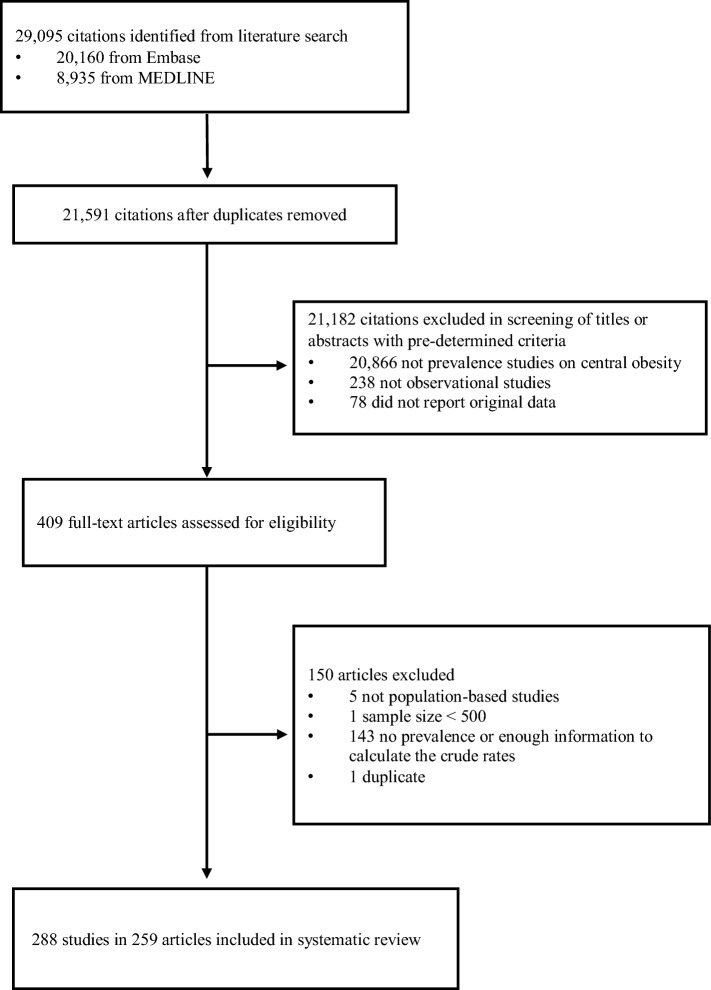
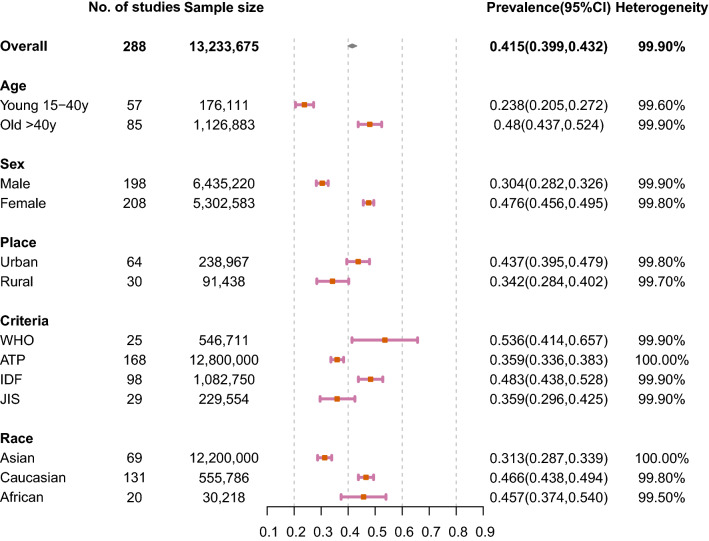
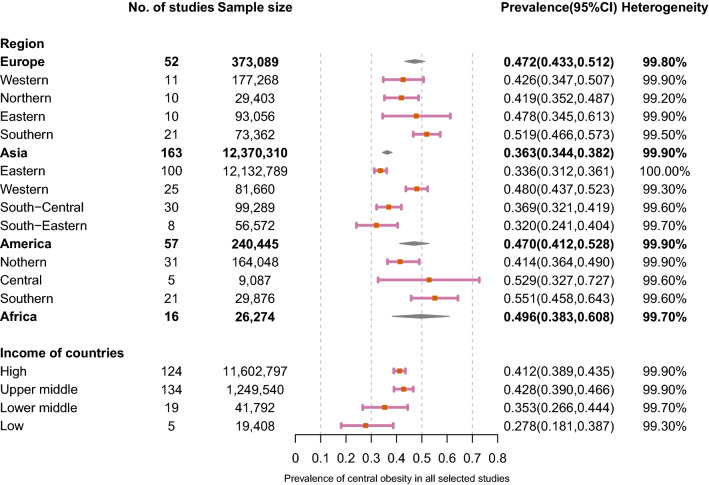
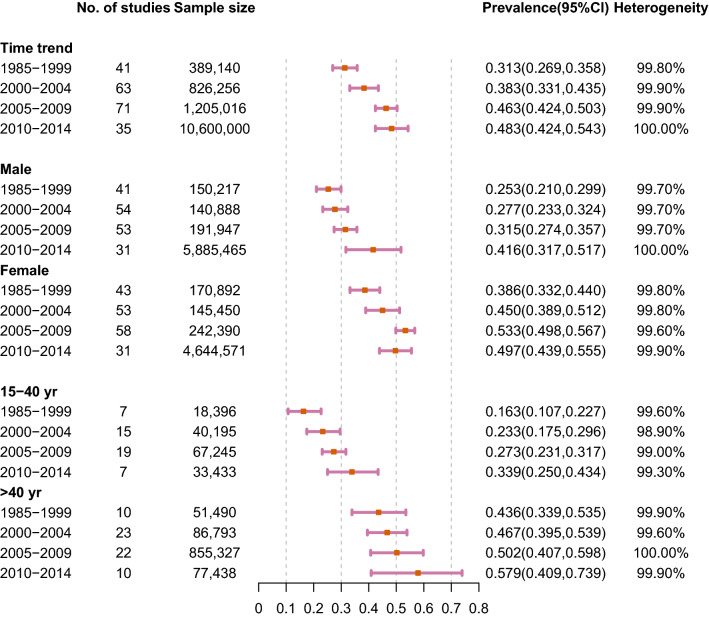
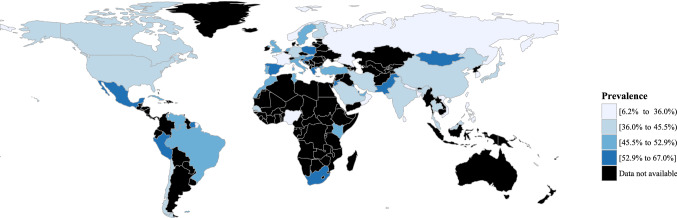
We aimed to examine the global prevalences of central obesity according to age, sex, race, place of residence, geographical region, national income level, and the definitions of central obesity. MEDLINE and Embase were searched. Studies with sample size of ≥ 500 and investigated individuals aged ≥ 15 years were included. Metaprop (a Stata command) was adopted to conduct a meta-analysis of prevalence, and the Freeman-Tukey Double Arcsine Transformation was used to stabilize the variances. A random-effects model was used to evaluate the prevalence and 95% confidence intervals (CI) of central obesity. There were 288 studies involving 13,233,675 individuals in this analysis. The overall prevalence of central obesity was 41.5% (95% CI 39.9–43.2%). A higher prevalence was found in older individuals, female subjects, urban residents, Caucasians, and populations of higher income level countries. Regarding regional variations, the highest prevalence was found in Sothern America (55.1%, 95% CI 45.8–64.3%) and Central American (52.9%, 95% CI 32.7–72.7%). Its prevalence was rapidly rising from 1985 to 2014. From 1985–1999 to 2010–2014, younger subjects aged 15–40 years showed a more drastic rise in prevalence (16.3 to 33.9%) than subjects aged > 40 years (43.6 to 57.9%). Male individuals have a more drastic rise (25.3 to 41.6%) than females (38.6 to 49.7%). Major increasing in prevalence of the condition in the past three decades, particularly in certain subgroups. These findings could act as a useful reference to inform public health strategies to minimize the impact of central obesity on population health.
Overview
The claims and statistics of this paper haven’t been checked yet.
Free: it reads the open-access text and checks the first 5 claims that cite a source we can check. Create a free account to check every claim.
Integrity signals
Registry
Cites
Statistics
Figures
Verification
Claims the paper makes
The claims and statistics of this paper haven’t been checked yet.
Free: it reads the open-access text and checks the first 5 claims that cite a source we can check. Create a free account to check every claim.
Claims other papers make about this one
Each is checked against this paper’s own text: does it say what the citing paper says it does?
In the citing paper
“Global estimates indicate that nearly one in four (23·8%) people aged 15–40 years meet the criteria for obesity.50”
Self-check
Percentages, sums and reported differences re-computed from the paper’s own numbers.
The self-check needs the paper’s full text.
Citations
Cites
Dermyshi, E., Wang, Y., Yan, C., Hong, W., Qiu, G., Gong, X., & Zhang, T. (2017) · Neonatology · doi:10.1159/000454668 · Cited by 24,451
Meta-analysis of Observational Studies in Epidemiology<SUBTITLE>A Proposal for Reporting</SUBTITLE>
Stroup, D. F. (2000) · JAMA · doi:10.1001/jama.283.15.2008 · Cited by 20,623
Stang, A. (2010) · European Journal of Epidemiology · doi:10.1007/s10654-010-9491-z · Cited by 17,396
Global nutrition transition and the pandemic of obesity in developing countries
Popkin, B. M., Adair, L. S., & Ng, S. W. (2012) · Nutrition Reviews · doi:10.1111/j.1753-4887.2011.00456.x · Cited by 4,313
Guthold, R., Stevens, G. A., Riley, L. M., & Bull, F. C. (2020) · The Lancet Child & Adolescent Health · doi:10.1016/s2352-4642(19)30323-2 · Cited by 4,033
Metaprop: a Stata command to perform meta-analysis of binomial data
Nyaga, V. N., Arbyn, M., & Aerts, M. (2014) · Archives of Public Health · doi:10.1186/2049-3258-72-39 · Cited by 2,139
Waist circumference and not body mass index explains obesity-related health risk
Janssen, I., Katzmarzyk, P. T., & Ross, R. (2004) · The American Journal of Clinical Nutrition · doi:10.1093/ajcn/79.3.379 · Cited by 2,013
Diabetes in Asia: Epidemiology, Risk Factors, and Pathophysiology
Chan, J. C. N., Malik, V., Jia, W., Kadowaki, T., Yajnik, C. S., Yoon, K.-H., & Hu, F. B. (2009) · JAMA · doi:10.1001/jama.2009.726 · Cited by 1,997
Chronic stress at work and the metabolic syndrome: prospective study
Chandola, T., Brunner, E., & Marmot, M. (2006) · BMJ · doi:10.1136/bmj.38693.435301.80 · Cited by 1,075
Commentary: Heterogeneity in meta-analysis should be expected and appropriately quantified
Higgins, J. P. T. (2008) · International Journal of Epidemiology · doi:10.1093/ije/dyn204 · Cited by 995
Research works printed but not linked: 1
- 8. James W, Jackson‐Leach R, et al. Overweight and obesity (high body mass index). In: Zzati J, Lopez A (eds) Comparative quantification of health risks: global and regional burden of disease attributable to selected major risk factors. World Health Organization, Geneva; 2004: 497–596
Cited by
Items 301–327 of 327
Association of Central Obesity and Hypertension in an Urban Area
Simanjorang, C., Sudrajat, D. A. C., & Karima, U. Q. (2026) · Jurnal Keperawatan Indonesia · doi:10.7454/jki.v29i1.1554
“…development and urbanization which could lead to an unfavorable change in dietary habits (consumption of high-calorie foods and sweetened beverages), physical inactivity, sedentary behaviours (smartphone use, computer use, TV or video viewing), stress and cortisol secretion (Wong et al., 2020).”
InfluentialZheng, Y., Tan, N., Teng, Y., Li, T., Wang, J., Wu, Y., Li, Q., Cao, M., He, S., Zuo, T., et al. (2026) · Journal of the National Cancer Center · doi:10.1016/j.jncc.2026.03.005 · Cited by 3
Self-citationCorrelation between waist-to-height ratio and other anthropometric indices in the Bosnian elderly
Začiragić, A., Dervišević, A., Lepara, O., Huremović, A., & Valjevac, A. (2026) · Central European Journal of Public Health · doi:10.21101/cejph.a8533
Huang, Z., Cai, J., Liu, Y., Wang, J., Huang, Y., Liu, J., Wu, L., Yuan, H., Bai, J., Zhao, G., et al. (2026) · Frontiers in Nutrition · doi:10.3389/fnut.2026.1818427
Self-citationShin, Y.-A., Baek, G., Kim, Y.-U., & Cha, E. (2026) · The Asian Journal of Kinesiology · doi:10.15758/jk.2026.28.2.50
Kharkwal, Y., Kharkwal, D., & Chauhan, B. G. (2026) · Research Square · doi:10.21203/rs.3.rs-9402665/v1
Sharma, P., & Chauhan, M. (2026) · Cureus · doi:10.7759/cureus.109516
“The AO prevalence was estimated to be 41.5%, indicating that approximately two in five adults are affected worldwide [7].”
InfluentialMonteiro, R. F., Pires, V. C., Onzi, T. R., Duca, G. F. D., & Benedet, J. (2026) · Obesity Surgery · doi:10.1007/s11695-026-08750-x · Cited by 1
Patil, M., Piccinini, F., Johnstone, E. K. M., Casari, I., & Falasca, M. (2026) · Bioscience Reports · doi:10.1042/bsr20250114 · Cited by 1
“Their rising global prevalence poses a critical public health challenge [6–9].”
Urban-Rural Disparities in Fruit and Vegetable Consumption in IndonesiaPreprint
Farsyat, B. A., & Pandin, M. G. R. (2026) · Research Square · doi:10.21203/rs.3.rs-10055169/v1
Panait, L., Teodorescu, S., & Panait, C. (2026) · Discobolul · doi:10.35189/dpeskj.2026.65.1.1
Liu, C., Soh, K. G., Saad, H., Meikahani, R., & Prayadi, H. Y. (2025) · International Journal of Education and Training (InjET) · doi:10.47836/injet.11.2.07
Serum Magnesium and Adiposity in Saudi Adults: Sex-Stratified Analysis
Almadani, F. A., Al-Musharaf, S., Aldhwayan, M., & Aljuraiban, G. S. (2026) · International Journal for Vitamin and Nutrition Research · doi:10.31083/ijvnr49974
Zhumadilova, A., Zhakupova, T., Kossumov, A., Kushugulova, A., Zhumadilov, Z., Terrera, G. M., Haile, Z. T., & Supiyev, A. (2026) · Frontiers in Public Health · doi:10.3389/fpubh.2026.1895120 · Cited by 2
“A higher prevalence of central obesity worldwide was observed among older subjects, females, urban residents, and people from higher-income countries (37).”
Liang, W., Li, X., Jing, F., Xie, Z., Zhao, X., Chen, Q., Zhao, Y. W., & Lu, G. (2026) · International Journal of Obesity · doi:10.1038/s41366-026-02165-5
Masrouri, S., Hadaegh, P., Ebrahimi, N., Abdi, A., Azizi, F., & Hadaegh, F. (2026) · American Journal of Preventive Cardiology · doi:10.1016/j.ajpc.2026.101766
“The greater prevalence of anthropometric-only obesity in older adults is in line with previous studies showing that, with advancing age and particularly around menopause, central fat accumulation becomes more pronounced [22,35 – 37].”
Association of Arterial Stiffness and Prefrontal Cortex Activity in Women with Central Obesity
Taranikanti, M., Medala, K., Varatharajan, S., Athira, M., & Chandrasekaran, K. (2026) · Indian Journal of Cardiovascular Disease in Women · doi:10.25259/ijcdw_108_2025
Rao, E. S., Patel, K. K., Chandorkar, S., Ahmed, S., Vijay, J., Balam, D., Behera, S. K., Bhattacharjee, P., Kanabur, V., Kantawala, S., et al. (2026) · Nutrition & Food Science · doi:10.1108/nfs-02-2026-0043
Ashtary‐Larky, D. (2026) · Current Obesity Reports · doi:10.1007/s13679-026-00751-2
“Crucially, all of these regions, despite their divergent dietary patterns, experienced significant rises in obesity prevalence in recent decades [70 , 71 ].”
Abbaspour, F., Heshmat, R., Birjandi, S. M., Gohari, K., Sheidaei, A., & Shafiee, G. (2026) · International Journal of Preventive Medicine · doi:10.4103/ijpvm.ijpvm_189_25
Reliability of anthropometric indicators for assessing abdominal obesity
Ghosh, P., & Bhatia, S. (2026) · Discover Public Health · doi:10.1186/s12982-026-02701-8
Ünal, E. (2026) · Acibadem Universitesi Saglik Bilimleri Dergisi · doi:10.31067/acusaglik.1944747
Boz, A. N., & Akçay, S. (2026) · Current Psychology · doi:10.1007/s12144-026-10010-1
“Women, however, are at a higher risk of obesity-related conditions compared to men (Wong et al., 2020; Muyulema et al., 2024; Khaleghi et al., 2025).”
Migraine and Obesity: From Shared Mechanisms to Therapeutic Strategies
Waliszewska‐Prosół, M., Raffaelli, B., Pellesi, L., Raggi, A., Onan, D., Marschollek, K., Montisano, D. A., Tana, C., & Martelletti, P. (2026) · Neurology and Therapy · doi:10.1007/s40120-026-01050-7 · Cited by 2
Saputri, C. F., Elvandari, M., & Andriani, E. (2026) · Bina Generasi Jurnal Kesehatan · doi:10.35907/bgjk.v17i2.437
Aychiluhm, S. B., Isaac, V., Ross, A. G., Thapa, S., & Ahmed, K. Y. (2026) · EClinicalMedicine · doi:10.1016/j.eclinm.2026.104282
Subclinical target organ damage and composite systemic inflammation indices in abdominal obesity
Filippov, K. G., Олеговна, Е. С., Timofeev, Y. S., Khatri, D. N., Валерьевна, Д. Н., Dzhioeva, O. N., & Drapkina, O. M. (2026) · Rational Pharmacotherapy in Cardiology · doi:10.20996/1819-6446-2026-3362
Metadata
- Authors
- Wong, M. C. S., Huang, J., Wang, J., Chan, P. S. F., Lok, V., Chen, X., Leung, C., Wang, H. H. X., Lao, X. Q., & Zheng, Z.-J.
- Affiliations
- Chinese University of Hong Kong (HK)
- Peking University (CN)
- Corresponding author
- Wong, Martin C. S.
- Zheng, Zhi-Jie
- ORCID
- Venue
- European Journal of Epidemiology
- Published
- 2020-05-24
- Volume
- 35
- Issue
- 7
- Pages
- 673-683
- ISSN
- 0393-2990 (ISSN-L)
- 1573-7284
- PMC
- PMC7387368
- OpenAlex
- W3028494703
- Cited by
- 327
- References
- 55
- Citations by year
- 2026: 51 · 2025: 85 · 2024: 73 · 2023: 47 · 2022: 45 · 2021: 22 · 2020: 4
- FWCI
- 4.93
- Type
- journal article
- Language
- en
- Open access
- hybrid
- doi.org
- Licence
- cc-by
- creativecommons.org/licenses/by/4.0 (tdm)
- creativecommons.org/licenses/by/4.0 (vor)
- Locations
- European Journal of Epidemiology (publishedVersion, cc-by)
- PubMed Central (publishedVersion, cc-by)
- PubMed (publishedVersion)
- ENLIGHTEN (Jurnal Bimbingan dan Konseling Islam) (acceptedVersion, cc-by-sa)
- Topics
- Health Sciences › Medicine › Public Health, Environmental and Occupational Health › Obesity, Physical Activity, Diet
- Health Sciences › Medicine › Endocrinology, Diabetes and Metabolism › Diabetes, Cardiovascular Risks, and Lipoproteins
- Health Sciences › Medicine › Endocrinology, Diabetes and Metabolism › Adipokines, Inflammation, and Metabolic Diseases
- Keywords
- abdominal obesity, prevalence, temporal trends, regional variation, sex differences, age differences, urban-rural differences, race, income level, global burden of disease
- MeSH terms
- Adolescent, Adult, Age Factors, Aged, Developing Countries, Humans, Middle Aged, Residence Characteristics, Risk Factors, Sex Factors, Prevalence, Developed Countries, Racial Groups, Waist Circumference, Young Adult, Obesity, Abdominal
About these checks
Registry, retraction, Cites and statistics results are computed, not judged, with one exception: a printed reference that no index lists is read once by a model before it counts as a citation error. Claims are extracted by a model and kept only when their quote appears verbatim in the text; each cited source is then checked, with a model’s help, for whether it says what the claim relies on. Those verdicts can be wrong — read the claim’s quote and the cited source before relying on one.
Statistics and arithmetic are recomputed, not judged.
Confidence bands are shown only for fields calibrated on our annotated test set. None is calibrated yet, so no band is shown.
What counts as a claim ›How we measure confidence ›How we check this ›
Are you an author, or do you see a problem with this page? Request a review
Data sources
Bibliographic data: Semantic Scholar, OpenAlex, Crossref.
Contains information from the Semantic Scholar Academic Graph Datasets, made available under the ODC Attribution License (ODC-BY 1.0).
Semantic Scholar’s data is described in: Kinney, R., et al. (2023). The Semantic Scholar Open Data Platform. arXiv:2301.10140.
