

Estimating the Impact of Temperature and Rainfall on Malaria Incidence in Ghana from 2012 to 2017
The DOI matches its Crossref record; 16 of the 16 references it cites were found in a registry or an index.
Abstract
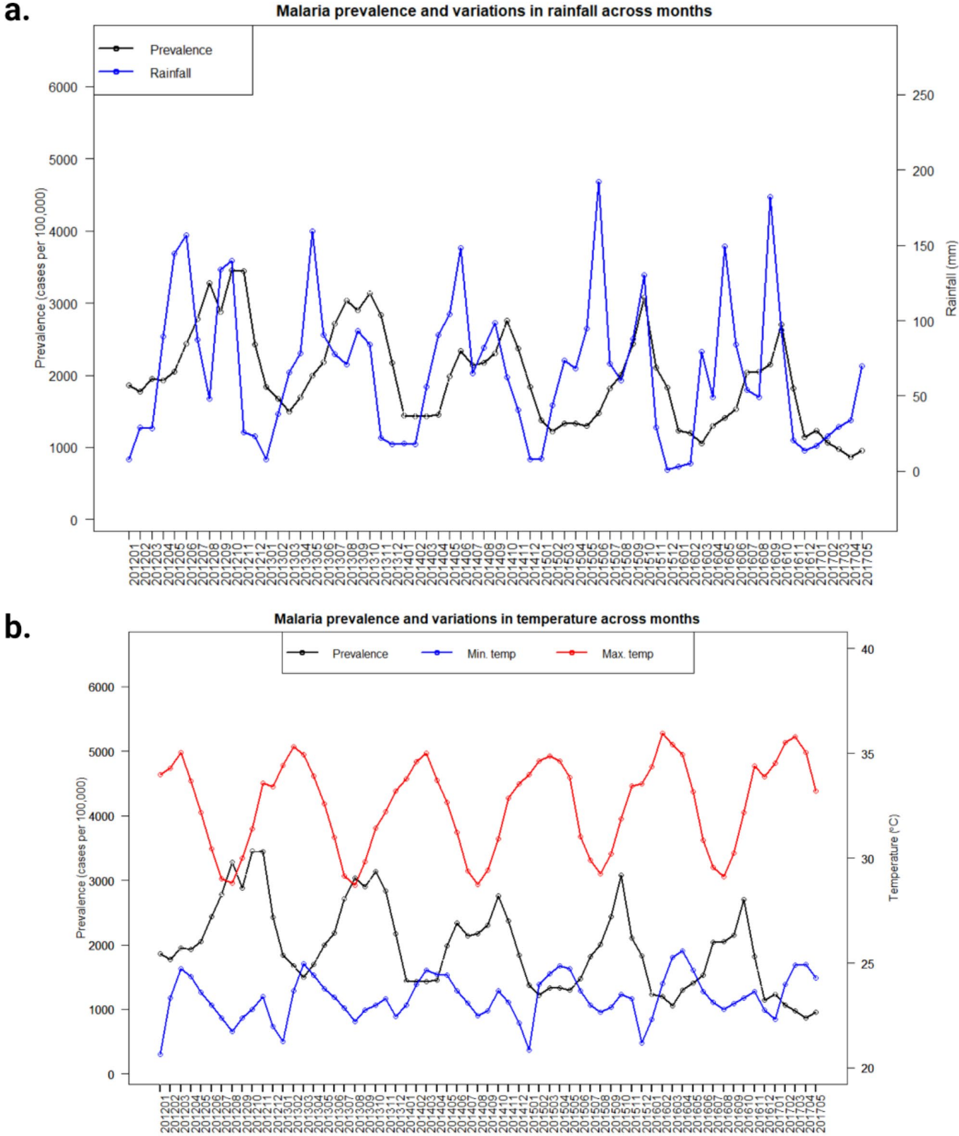
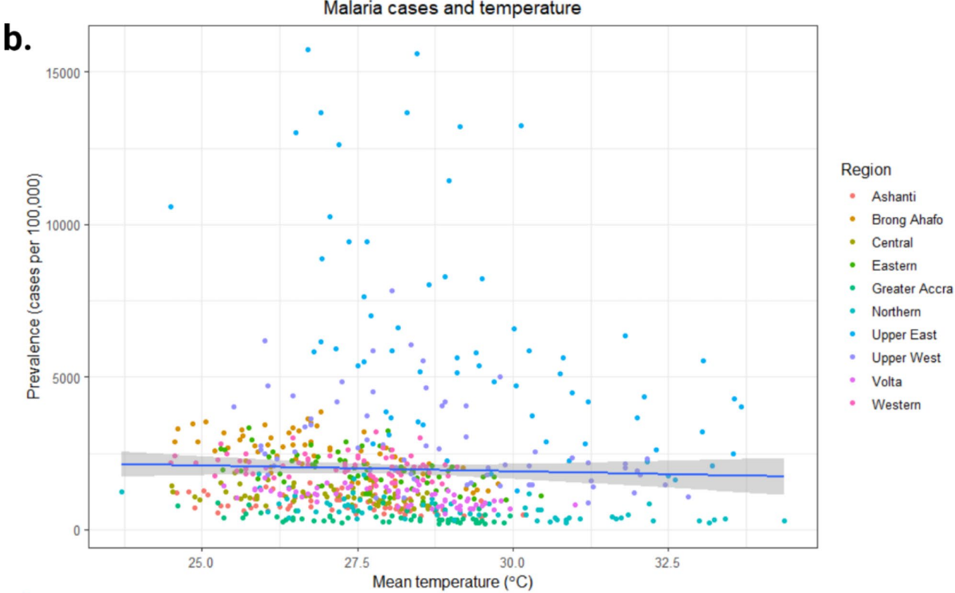
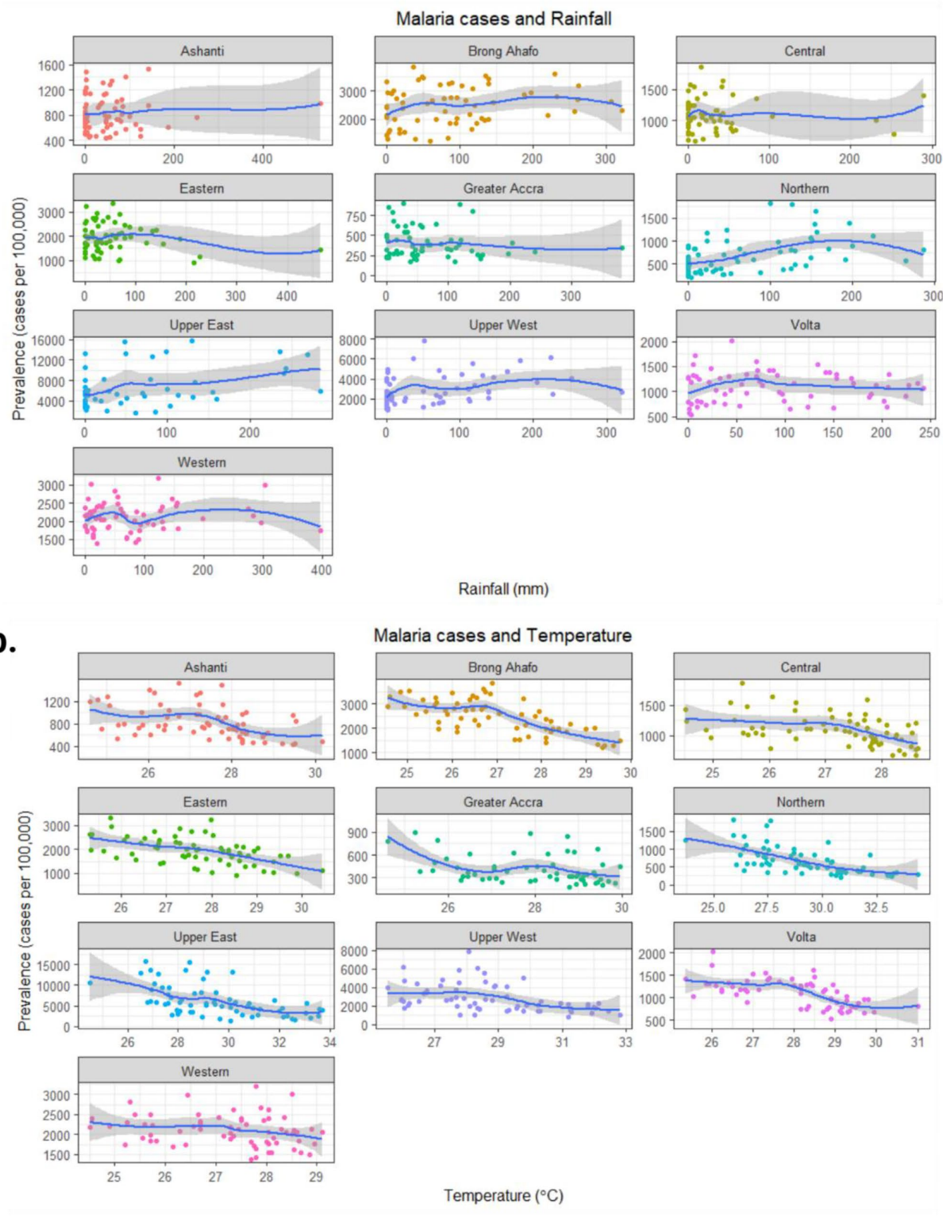
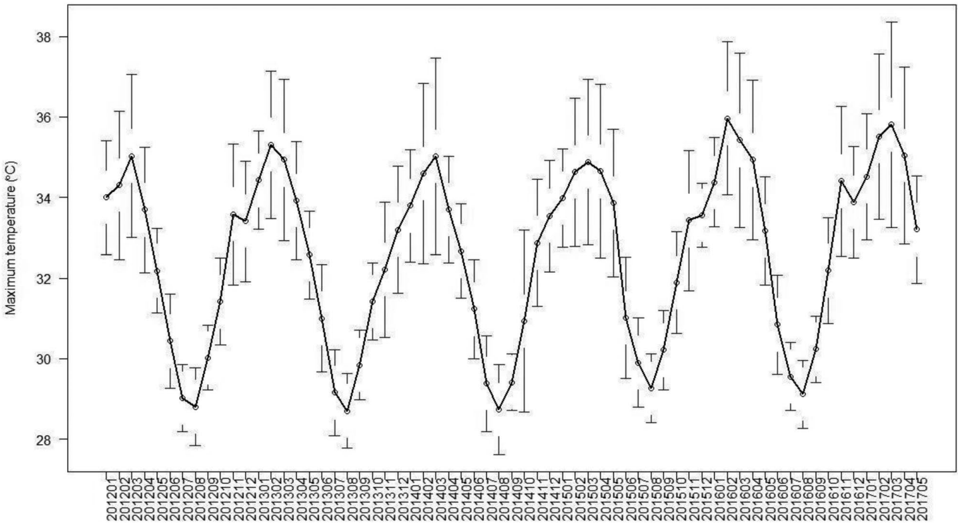
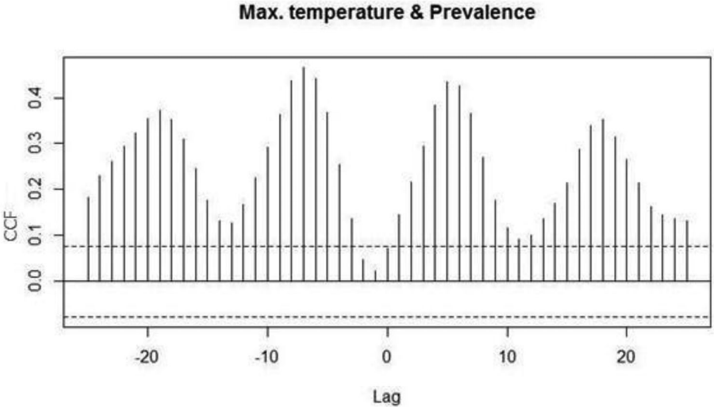
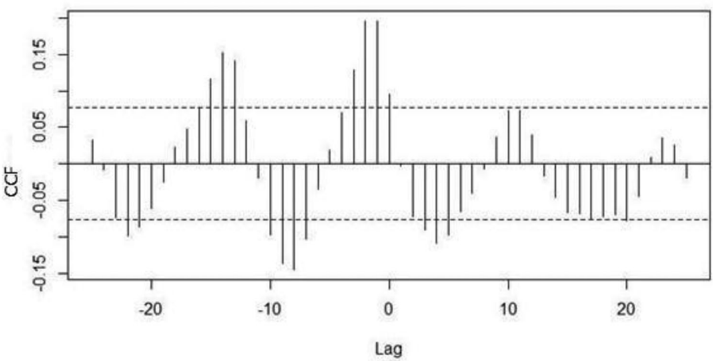
Malaria has a significant impact on the lives of many in Ghana. It is one of the key causes of mortality and morbidity, resulting in 32.5% of outpatient visits and 48.8% of under 5-year-old hospital admissions. Future climate change may impact on this risk. This study aims at estimating the impact of climate variables and health facilities on malaria prevalence in Ghana using regional data from January 2012 to May 2017. This study links data at a regional level on malaria cases with weather data to evaluate the impact that changes in weather may have on malaria prevalence in Ghana. The results of fixed-effect modelling show that the maximum temperature has a statistically significant negative impact on malaria in the context of Ghana, and rainfall with a lag of two months has a positive statistically significant impact. Adapting to climate change in Ghana requires a better understanding of the climate-malaria relationship and this paper attempts to bridge this gap.
Overview
The claims and statistics of this paper haven’t been checked yet.
Free: it reads the open-access text and checks the first 5 claims that cite a source we can check. Create a free account to check every claim.
Integrity signals
Registry
Cites
Statistics
Figures
Verification
Claims the paper makes
The claims and statistics of this paper haven’t been checked yet.
Free: it reads the open-access text and checks the first 5 claims that cite a source we can check. Create a free account to check every claim.
Claims other papers make about this one
Each is checked against this paper’s own text: does it say what the citing paper says it does?
The source backs part of the claim, not all of it — or backs it for a different population, condition or comparison.
In the citing paper
“In Ghana, studies have shown strong associations between climatic variables, such as rainfall and temperature, and malaria incidence, including evidence of delayed and lagged relationships [8][9][10].”
From Modeling the association between lagged climatic factors and malaria incidence in Ghana (2026) · cites this paper as [10]
Experimental — accuracy not yet measuredIn the citing paper
“another study found that rainfall lagged by two months has a significant positive effect on malaria incidence across regions [10]”
From Modeling the association between lagged climatic factors and malaria incidence in Ghana (2026) · cites this paper as [10]
In the citing paper
“This window reflects the combined duration of the extrinsic incubation period of Plasmodium falciparum within Anopheles mosquitoes (approximately 10-18 days at typical Ghanaian ambient temperatures), the aquatic developmental stages of Anopheles from egg to adult (approximately 7-14 days depending on temperature), and multiple overlapping gonotrophic cycles and mosquito generations that can occur”
From Modeling the association between lagged climatic factors and malaria incidence in Ghana (2026) · cites this paper as [10]
Self-check
Percentages, sums and reported differences re-computed from the paper’s own numbers.
The self-check needs the paper’s full text.
Citations
Cites
Panel data and unobservable individual effects
Hausman, J., & Taylor, W. (1981) · Journal of Econometrics · doi:10.1016/0304-4076(81)90085-3 · Cited by 2,309
Panel Data Econometrics in R : The plm Package
Croissant, Y., & Millo, G. (2008) · Journal of Statistical Software · doi:10.18637/jss.v027.i02 · Cited by 1,243 · cited 2×
“2010 Region Population × Annual growth rate × 100, 000 To estimate the impact of temperature and rainfall on malaria prevalence, we applied panel data analysis, using procedures outlined by Torres-Reyna [28] and Croissant and Millo [29].”
MethodA Climate-based Distribution Model of Malaria Transmission in Sub-Saharan Africa
Craig, M. H., Snow, R. W., & le Sueur, D. (1999) · Parasitology Today · doi:10.1016/s0169-4758(99)01396-4 · Cited by 854 · cited 3×
“Temperatures between 20 and 30 °C have been found to be ideal for adult mosquito survival [15, 18, 19] while the parasite has optimum temperatures of 32–33 °C [14].”
BackgroundChemical Ecology and Behavioral Aspects of Mosquito Oviposition
Bentley, M. D., & Day, J. F. (1989) · Annual Review of Entomology · doi:10.1146/annurev.en.34.010189.002153 · Cited by 588
Urbanization, malaria transmission and disease burden in Africa
Hay, S. I., Guerra, C. A., Tatem, A. J., Atkinson, P. M., & Snow, R. W. (2005) · Nature Reviews Microbiology · doi:10.1038/nrmicro1069 · Cited by 586
Association between climate variability and malaria epidemics in the East African highlands
Zhou, G., Minakawa, N., Githeko, A. K., & Yan, G. (2004) · Proceedings of the National Academy of Sciences · doi:10.1073/pnas.0308714100 · Cited by 498 · cited 7×
“Our model also showed that malaria prevalence at a lag time of 1 month has a significant effect on malaria prevalence, similar to a previous study in the East African Highlands [16].”
BackgroundResultInfluentialPotential effect of climate change on malaria transmission in Africa
Tanser, F. C., Sharp, B., & le Sueur, D. (2003) · The Lancet · doi:10.1016/s0140-6736(03)14898-2 · Cited by 447 · cited 1×
“Climate change is expected to increase malaria exposure by up to 28% in person-months [12] by 2100 especially in high-altitude areas in Africa [13].”
BackgroundBeck-Johnson, L. M., Nelson, W. A., Paaijmans, K. P., Read, A. F., Thomas, M. B., & Bjørnstad, O. N. (2013) · PLoS ONE · doi:10.1371/journal.pone.0079276 · Cited by 386
The evidence for improving housing to reduce malaria: a systematic review and meta-analysis
Tusting, L. S., Ippolito, M. M., Willey, B. A., Kleinschmidt, I., Dorsey, G., Gosling, R. D., & Lindsay, S. W. (2015) · Malaria Journal · doi:10.1186/s12936-015-0724-1 · Cited by 355
Impact of urban agriculture on malaria vectors in Accra, Ghana
Klinkenberg, E., McCall, P., Wilson, M. D., Amerasinghe, F. P., & Donnelly, M. J. (2008) · Malaria Journal · doi:10.1186/1475-2875-7-151 · Cited by 179
Urbanization and the global malaria recession
Tatem, A. J., Gething, P. W., Smith, D. L., & Hay, S. I. (2013) · Malaria Journal · doi:10.1186/1475-2875-12-133 · Cited by 151
Climatic Variables and Transmission of Malaria: A 12-Year Data Analysis in Shuchen County, China
Bi, P., Tong, S., Donald, K., Parton, K. A., & Ni, J. (2003) · Public Health Reports · doi:10.1016/s0033-3549(04)50218-2 · Cited by 141
Effect of climatic variability on malaria trends in Baringo County, Kenya
Kipruto, E. K., Ochieng, A. O., Anyona, D. N., Mbalanya, M., Mutua, E. N., Onguru, D., Nyamongo, I. K., & Estambale, B. B. A. (2017) · Malaria Journal · doi:10.1186/s12936-017-1848-2 · Cited by 61
Assessing Climate Driven Malaria Variability in Ghana Using a Regional Scale Dynamical Model
Asare, E., & Amekudzi, L. (2017) · Climate · doi:10.3390/cli5010020 · Cited by 35 · cited 5×
“Unlike other malaria-endemic countries, such as Uganda and Kenya, where the relationship between malaria and climate has been studied extensively, fewer studies have been conducted in Ghana [9, 23, 25].”
BackgroundResultInfluentialAssessment of Patterns of Climate Variables and Malaria Cases in Two Ecological Zones of Ghana
Klutse, N. A. B., Aboagye-Antwi, F., Owusu, K., & Ntiamoa-Baidu, Y. (2014) · Open Journal of Ecology · doi:10.4236/oje.2014.412065 · Cited by 27
Economic Analysis of Climate Variability Impact on Malaria Prevalence: The Case of Ghana
Akpalu, W., & Codjoe, S. (2013) · Sustainability · doi:10.3390/su5104362 · Cited by 21 · cited 2×
“Variations in prevalence across the regions may also be attributed to additional regional differences in socio-economic — such as urban–rural distribution [9], income [23] — and environmental factors including vector and parasite distribution [44, 45], and land use and agriculture [46].”
Background
Research works printed but not linked: 32
- World Health Organization. (2017). WHO | Malaria. WHO.
- Ghana Health Service. (2016). Malaria 1st Quarter Bulletin-2016.
- Nonvignon, J., Aryeetey, G. C., Malm, K. L., Agyemang, S. A., Aubyn, V. N. A., Peprah, N. Y., … & Aikins, M. (2016). Economic burden of malaria on businesses in Ghana: a case for private sector investment in malaria control. Malaria Journal, 15. https:// doi. org/ 10. 1186/ s12936-016-1506-0 · DOI
- Patz, J., & Olson, S. (2006). Climate change and health: Global to local influences on disease risk. Annals of Tropical Medicine and Parasitol- ogy, 100, 535-549. https:// doi. org/ 10. 1179/ 13648 5906X 97426 · DOI · Paper page
- Parham, P. E., & Michael, E. (2010). Modeling the effects of weather and climate change on malaria transmission. Environ- mental Health Perspectives, 118(5), 620-626. https:// doi. org/ 10. 1289/ ehp. 09012 56 · DOI · Paper page
- Leedale, J., Tompkins, A. M., Caminade, C., Jones, A. E., Nikulin, G., & Morse, A. P. (2016). Projecting malaria hazard from climate change in eastern Africa using large ensembles to estimate uncertainty. Geospatial Health, 11(1S). https:// doi. org/ 10. 4081/ gh. 2016. 393 · DOI · Paper page
- Ferrão, J. L., Mendes, J. M., Painho, M., & Zacarias, S. (2017). Malaria mortality characterization and the relationship between malaria mortality and climate in Chimoio, Mozambique. Malaria Journal, 16. https:// doi. org/ 10. 1186/ s12936-017-1866-0 · DOI
- Yadav, K., Dhiman, S., Rabha, B., Saikia, P., & Veer, V. (2014). Socio-economic determinants for malaria transmission risk in an endemic primary health centre in Assam, India. Infectious Dis- eases of Poverty, 3, 19. https:// doi. org/ 10. 1186/ 2049-9957-3-19 · DOI
- Agomo, C. O., & Oyibo, W. A. (2013). Factors associated with risk of malaria infection among pregnant women in Lagos Nige- ria. Infectious Diseases of Poverty, 2, 19. https:// doi. org/ 10. 1186/ 2049-9957-2-19 · DOI
- Frees, E. W. (2003). Longitudinal and panel data: analysis and applications for the social sciences. · DOI · Paper page
- Hausman, J. A. (1978). Specification tests in econometrics. Econometrica, 46(6), 1251-1271. · DOI · Paper page
- Arellano, M., & Bond, S. (1991). Some tests of specification for panel data: Monte Carlo evidence and an application to employ- ment equations. Review of Economic Studies, 58, 277-297. Retrieved from https:// acade mic. oup. com/ restud/ artic le/ 58/2/ 277/ 15633 54 · DOI · Paper page
- Peel, M. C., Finlayson, B. L., & Mcmahon, T. A. (2007). Updated world map of the Köppen-Geiger climate classification. Hydrol- ogy and Earth System Sciences, 11, 1633-1644. · doi:10.5194/hess-11-1633-2007
- Issahaku, A.-R., Campion, B. B., & Edziyie, R. (2016). Rainfall and temperature changes and variability in the Upper East Region of Ghana. Earth and Space Science, 3(8), 284-294. https:// doi. org/ 10. 1002/ 2016E A0001 61 · doi:10.1002/2016ea000161
- Karuri, S. W., & Snow, R. W. (2016). Forecasting paediatric malaria admissions on the Kenya Coast using rainfall. Global Health Action, 9. https:// doi. org/ 10. 3402/ gha. v9. 29876 · DOI
- Opoku, A., & Ansa-Asare, O. (2009). The occurrences and habi- tat characteristics of mosquitoes in Accra, Ghana. West African Journal of Applied Ecology, 11(1). https:// doi. org/ 10. 4314/ wajae. v11i1. 45730 · DOI
- Sunahara, T., Ishizuka, K., & Mogi, M. (2002). Habitat size: A factor deterormining the opportunity f encounters between mos- quito larvae and aquatic predators. J. Vect. Ecol., 27, 820.
- Washburn, J. Q. (1995). Regulation of factors affecting larval mosquito population in container and pool habitats: Implication for biological control. Journal of the American Mosquito Control Association, 11, 279-283.
- Wu, Y., Qiao, Z., Wang, N., Yu, H., Feng, Z., Li, X., & Zhao, X. (2017). Describing interaction effect between lagged rainfalls on malaria: an epidemiological study in south-west China. Malaria Journal, 16. https:// doi. org/ 10. 1186/ s12936-017-1706-2 · DOI
- Yamana, T. K., & Eltahir, E. A. B. (2013). Incorporating the effects of humidity in a mechanistic model of Anopheles gambiae mosquito population dynamics in the Sahel region of Africa. Par- asites & Vectors, 6, 1. https:// doi. org/ 10. 1186/ 1756-3305-6-235 · DOI
- De Souza, D., Kelly-Hope, L., Lawson, B., Wilson, M., & Boakye, D. (2010). Environmental factors associated with the distribution of Anopheles gambiae ss in Ghana; an important vector of lym- phatic filariasis and malaria. PLoS One, 5, e9927. · DOI · Paper page
- Dinko, B., Oguike, M. C., Larbi, J. A., Bousema, T., & Sutherland, C. J. (2013). Persistent detection of Plasmodium falciparum, P. malariae, P. ovale curtisi and P. ovale wallikeri after ACT treat- ment of asymptomatic Ghanaian school-children. International Journal for Parasitology: Drugs and Drug Resistance, 3, 45-50.
- Frank, C., Krumkamp, R., Sarpong, N., Sothmann, P., Fobil, J. N., Foli, G., … & Kreuels, B. (2016). Spatial heterogeneity of malaria in Ghana: a cross-sectional study on the association between urbanicity and the acquisition of immunity. Malar J, 15. https:// doi. org/ 10. 1186/ s12936-016-1138-4 · DOI
- Teklehaimanot, A., & Mejia, P. (2008). Malaria and poverty. Annals of the New York Academy of Sciences, 1136(1), 32-37. https:// doi. org/ 10. 1196/ annals. 1425. 037 · DOI · Paper page
- Caulfield, L. E., Richard, S. A., & Black, R. E. (2004). Undernu- trition as an underlying cause of malaria morbidity and mortality in children less than five years old. The American journal of tropi- cal medicine and hygiene, 71(2_suppl), 55-63. · DOI · Paper page
- Crookston, B. T., Alder, S. C., Boakye, I., Merrill, R. M., Amuasi, J. H., Porucznik, C. A., & Ansong, D. (2010). Exploring the relationship between chronic undernutrition and asymptomatic malaria in Ghanaian children. Malaria Journal, 9, 39. · DOI
- Friedman, J. F., Kwena, A. M., Mirel, L. B., Kariuki, S. K., Terlouw, D. J., Phillips-Howard, P. A., Hawley, W. A., ... & ter Kuile, F. O. (2005). Malaria and nutritional status among pre- school children: Results from cross-sectional surveys in western Kenya. American Journal of Tropical Medicine and Hygiene, 73, 698-704. · DOI
- Almeida, M., Alexandre, A., Benzecry, S. G., Siqueira, A. M., Vitor-Silva, S., Melo, G. C., & Alecrim, G. C. (2015). The asso- ciation between nutritional status and malaria in children from a rural community in the Amazonian Region: A longitudinal study. PLoS Neglected Tropical Diseases, 9(4), 1-15. https:// doi. org/ 10. 1371/ journ al. pntd. 00037 43. · DOI
- Ghana Health Service and National Malaria Control Programme. (2013). Ghana Malaria Programme Review Final Report.
- World Health Organization. (2016). WHO | Fact Sheet: World Malaria Report 2015. WHO.
- Chirombo, J., Ceccato, P., Lowe, R., Terlouw, D. J., Thomson, M. C., Gumbo, A., ... & Read, J. M. (2020). Childhood malaria case incidence in Malawi between 2004 and 2017: Spatio-temporal modelling of climate and non-climate factors. Malaria Journal, 19(1), 1-13. https:// doi. org/ 10. 1186/ s12936-019-3097-z · DOI
- Savitz, D. A. (2012). Commentary: A niche for ecologic studies in environmental epidemiology. Epidemiology, 23(1), 53-54. https:// doi. org/ 10. 1097/ EDE. 0B013 E3182 3B5633 · doi:10.1097/ede.0b013e31823b5633
Cited by
Bayesian Spatio-Temporal Modeling and Hotspot Mapping of Malaria Risk in Ghana
Antwi, P., Muhua, G., & Nyarko, E. (2026) · doi:10.64898/2026.05.19.26353586 · Cited by 2
Modeling the association between lagged climatic factors and malaria incidence in Ghana
Antwi, P., Muhua, G., & Nyarko, E. (2026) · Scientific African · doi:10.1016/j.sciaf.2026.e03554
Metadata
- Authors
- Oheneba-Dornyo, T. V., Amuzu, S., Maccagnan, A., & Taylor, T.
- ORCID
- Maccagnan, Anna
- Venue
- Environmental Modeling & Assessment
- Published
- 2022-04-01
- Volume
- 27
- Issue
- 3
- Pages
- 473-489
- ISSN
- 1420-2026
- 1573-2967
- Cited by
- 34
- References
- 16
- Language
- en
- Licence
- creativecommons.org/licenses/by/4.0 (tdm)
- creativecommons.org/licenses/by/4.0 (vor)
About these checks
Registry, retraction, Cites and statistics results are computed, not judged, with one exception: a printed reference that no index lists is read once by a model before it counts as a citation error. Claims are extracted by a model and kept only when their quote appears verbatim in the text; each cited source is then checked, with a model’s help, for whether it says what the claim relies on. Those verdicts can be wrong — read the claim’s quote and the cited source before relying on one.
Statistics and arithmetic are recomputed, not judged.
Confidence bands are shown only for fields calibrated on our annotated test set. None is calibrated yet, so no band is shown.
What counts as a claim ›How we measure confidence ›How we check this ›
Are you an author, or do you see a problem with this page? Request a review
Data sources
Bibliographic data: Semantic Scholar, OpenAlex, Crossref.
Contains information from the Semantic Scholar Academic Graph Datasets, made available under the ODC Attribution License (ODC-BY 1.0).
Semantic Scholar’s data is described in: Kinney, R., et al. (2023). The Semantic Scholar Open Data Platform. arXiv:2301.10140.
