

Spatial expansion of avocado in Mexico: Could the energy use of pruning residues offset orchard GHG emissions?
Open accessPublished version of a preprint
The DOI matches its Crossref record; 56 of the 59 references it cites were found in a registry or an index.
Abstract
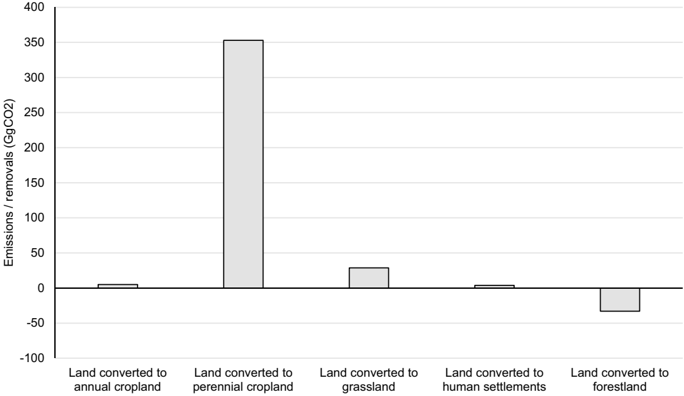
Avocado orchards ( Persea americana ) in Mexico are constantly being expanded to meet the increasing demand for the fruit in the national and international markets. The land-use change (LUC) caused by this expansion has numerous negative impacts, including greenhouse gas (GHG) emissions due to the loss of forest cover and the burning of pruning residues. To generate a comprehensive evaluation of this complex environmental issue, we calculate emissions from LUC and from residue burning between 1974 and 2017 at a local scale (1:20,000), and the energy potential of pruning residues was estimated as an alternative to revalue a waste product and mitigate the negative impacts of avocado cultivation. Our results show that land-use conversions emitted 390.5 GgCO 2 , of which 91% came from conversions to avocado orchards. Emissions of GHG from biomass burning amounted to an additional 20.68 GgCO 2 e released per year. Given that around 12,600 tons of dry avocado pruning residues are generated annually in the study region, their use for energy generation could replace 240 TJ/year of fossil fuels in rural industries and could mitigate around 31 GgCO 2 e per year. This study provides decision-makers with a concrete example of how to establish multiple-impact strategies at local scales.
Overview
The claims and statistics of this paper haven’t been checked yet.
Free: it reads the open-access text and checks the first 5 claims that cite a source we can check. Create a free account to check every claim.
Integrity signals
Registry
Cites
Statistics
Figures
Verification
Claims the paper makes
The claims and statistics of this paper haven’t been checked yet.
Free: it reads the open-access text and checks the first 5 claims that cite a source we can check. Create a free account to check every claim.
Claims other papers make about this one
Each is checked against this paper’s own text: does it say what the citing paper says it does?
The source backs part of the claim, not all of it — or backs it for a different population, condition or comparison.
In the citing paper
“However, the greatest impacts on ecosystems would probably come from excessive land-use change that lacks planning and environmental assessments [32].”
From Forest Supply Chain for Bioenergy: An Approach for Biomass Study in the Framework of a Circular Bioeconomy (2023) · cites this paper as [32]
Experimental — accuracy not yet measuredThe check wasn’t confident either way, so it gives no verdict — never disputed.
In the citing paper
“Remote sensing allows estimating biomass at the landscape scale, but regardless of the sensor or satellite used, field measurements are essential to adjust the observed/measured relationships [31,32].”
From Forest Supply Chain for Bioenergy: An Approach for Biomass Study in the Framework of a Circular Bioeconomy (2023) · cites this paper as [32]
Experimental — accuracy not yet measured
Self-check
Percentages, sums and reported differences re-computed from the paper’s own numbers.
The self-check needs the paper’s full text.
Citations
Cites
Photogrammetric Engineering and Remote Sensing
Nicol, J., King, B., Quattrochi, D., Dowman, I. J., Ehlers, M., & Xiaoli, D. (2007) · UCL Discovery (University College London) · Cited by 9,325
2006 IPCC Guidelines for National Greenhouse Gas Inventories
Paustian, K. H., Ravindranath, N. H., & van Amstel, A. R. (2006) · Socio-Environmental Systems Modeling · Cited by 6,706
Emission of trace gases and aerosols from biomass burning
Andreae, M. O., & Merlet, P. (2001) · Global Biogeochemical Cycles · doi:10.1029/2000gb001382 · Cited by 3,902 · cited 1×
“Here, we considered the following end-user (Andreae & Merlet, 2001); l = default value for maize agricultural residues (post-harvest burning; (IPCC, 2006)) assuming that 100% of residues are burned; m = average default value for perennial shrub-like crops (IPCC, 2006; Sagarpa, 2015).”
Re-evaluation of forest biomass carbon stocks and lessons from the world's most carbon-dense forests
Keith, H., Mackey, B. G., & Lindenmayer, D. B. (2009) · Proceedings of the National Academy of Sciences · doi:10.1073/pnas.0901970106 · Cited by 889 · cited 1×
“However, it is important to consider that forest growth within conserved sites is not unlimited, given that the carbon sequestration capacity of an ecosystem decreases as it reaches carrying capacity or climax (Keith et al., 2009).”
Design and Analysis for Thematic Map Accuracy Assessment
Stehman, S. V., & Czaplewski, R. L. (1998) · Remote Sensing of Environment · doi:10.1016/s0034-4257(98)00010-8 · Cited by 710 · cited 1×
“We then cartographically validated our classification following the guidelines for evaluation of thematic maps by Congalton (1988) and Stehman and Czaplewski (1998), assigning 50 verification points for each type of land use.”
A global meta-analysis of yield stability in organic and conservation agriculture
Knapp, S., & van der Heijden, M. G. A. (2018) · Nature Communications · doi:10.1038/s41467-018-05956-1 · Cited by 530 · cited 1×
“There is therefore a prevailing need to reduce the environmental impact of agriculture (Knapp & Heijden, 2018).”
(1977) · Australian Forestry · doi:10.1080/00049158.1977.10675659 · Cited by 505
Historical carbon dioxide emissions caused by land-use changes are possibly larger than assumed
Arneth, A., Sitch, S., Pongratz, J., Stocker, B. D., Ciais, P., Poulter, B., Bayer, A. D., Bondeau, A., Calle, L., Chini, L. P., et al. (2017) · Nature Geoscience · doi:10.1038/ngeo2882 · Cited by 491 · cited 1×
“However, as Arneth et al. (2017) point out, land-cover simulation models underestimate CO 2 emissions from LUC because they do not consider processes such as tree felling and land-clearing for crop change.”
Valuation of the ecosystem services: A psycho-cultural perspective
Kumar, M., & Kumar, P. (2008) · Ecological Economics · doi:10.1016/j.ecolecon.2007.05.008 · Cited by 406 · cited 1×
“In addition, the consensus in ecology research is that each ecosystem represents a unique combination of biodiversity and biophysical characteristics (Kumar & Kumar, 2008; UNEP, 2019), rendering them irreplaceable and not interchangeable (Bordt & Saner, 2019; Mengist & Soromessa, 2019).”
(2017) · Revista de Ciencias Sociales · doi:10.26489/rvs.v30i41 · Cited by 370
Research works printed but not linked: 4
- Ávila-Ortega, D. I. (2018). Tracking avocado production in Michoacan, Mexico. A twenty-years land use analysis. Conference: IX Simposio Internacional del Carbono en México, Project: Avocado sustainability series. Sonora, México.
- IPCC: Climate Change. (2014). Synthesis Report. Contribution of Working Groups I, II and III to the Fifth Assessment Report of the Intergovernmental Panel on Climate Change. [Core Writing Team, R.K. Pachauri and L.A. Meyer (eds.)]. IPCC, Geneva, Switzerland.
- Soria-González, J. A. (2019). Estudio del potencial biomásico de residuos de podas del árbol de aguacate para la producción de biocombustibles sólidos en el municipio de Salvador Escalante, Michoacán. [Bachelor's thesis]. Universidad Michoacana de San Nicolás de Hidalgo. México.
- Villanueva-Tomas, L., & Zepeda-Anaya, J. A. (2016). The Production of Avocado in Michoacan State and its effects on poverty rates, land use change and migration. Revista Mexicana Sobre Desarrollo Local, 2, 1-12s.
Cited by
Lara, C. O. D., Vargas, D., Sacramento‐Rivero, J. C., Baz-Rodríguez, S. A., Espinoza, J. E. R., Aguilera-Cauich, E. A., Baas-López, J. M., & Pacheco-Catalán, D. E. (2025) · Recycling · doi:10.3390/recycling10030084 · Cited by 8
“Such issues are particularly evident in rural areas, where proper waste management strategies are lacking, and practices like open burning or dumping are common [63].”
Manrique, S. M., Subelza, C. R., Toro, M. A., Quintero Bertel, Q. R., & Tauro, R. J. (2023) · Energies · doi:10.3390/en16207140 · Cited by 5
Self-citationTrends and Drivers of Avocado Production in Ethiopia: A Review
Asfaw, E., & Nigussie, Z. (2024) · World Journal of Food Science and Technology · doi:10.11648/j.wjfst.20240804.11 · Cited by 4
Pyrolysis of Persea americana Pruning Residues: Kinetic and Thermodynamic Analyses
Soria-González, J. A., Alvarado-Flores, J. J., Rutiaga-Quiñones, J. G., Vera, J. V. A., Herrera‐Bucio, R., Rodríguez, M. L. Á., López-Sosa, L. B., & Guzmán-Mejía, E. (2025) · Processes · doi:10.3390/pr13123993 · Cited by 1
Self-citationHuang, Y., Xu, W., Hong, C., Fang, Y., Sun, K., & Liu, J. (2026) · Biomass Futures · doi:10.1016/j.bmf.2026.100024 · Cited by 1
Metadata
- Authors
- Tauro, R., Manrique, S., Franch-Pardo, I., Charre-Medellin, J. F., Ortega-Riascos, C. E., Soria-González, J. A., & Armendáriz-Arnez, C.
- Affiliations
- Secretaría de Ciencia, Humanidades, Tecnología e Innovación (MX)
- National University of Salta (AR)
- Universidad Nacional Autónoma de México (MX)
- Universidad Michoacana de San Nicolás de Hidalgo (MX)
- Corresponding author
- Armendáriz-Arnez, Cynthia
- Venue
- Environment, Development and Sustainability
- Published
- 2023-08-19
- Volume
- 26
- Issue
- 11
- Pages
- 27325-27350
- ISSN
- 1387-585X (ISSN-L)
- 1573-2975
- OpenAlex
- W4385970488
- Cited by
- 5
- References
- 59
- Citations by year
- 2026: 1 · 2025: 2 · 2024: 1 · 2023: 1
- FWCI
- 1.82
- Type
- journal article
- Language
- en
- Open access
- hybrid
- doi.org
- Licence
- cc-by
- creativecommons.org/licenses/by/4.0 (tdm)
- creativecommons.org/licenses/by/4.0 (vor)
- Locations
- Environment Development and Sustainability (publishedVersion, cc-by)
- Research Square (acceptedVersion, cc-by)
- RePEc: Research Papers in Economics (submittedVersion)
- CONICET Digital (CONICET) (submittedVersion, cc-by-nc-sa)
- Greater South Information System
- Funders
- Dirección General de Asuntos del Personal Académico, Universidad Nacional Autónoma de México
- Topics
- Life Sciences › Agricultural and Biological Sciences › Forestry › Wood Residue Utilization and Solid Biofuels
- Physical Sciences › Energy › Renewable Energy, Sustainability and the Environment › Forest Biomass Utilization and Management
- Life Sciences › Agricultural and Biological Sciences › Agronomy and Crop Science › Bioenergy crop production and management
- Keywords
- avocado orchards, avocado, land use change, greenhouse gas emissions, pruning residues, biomass burning, bioenergy, energy consumption, forest cover loss, Mexico, rural energy, carbon mitigation
About these checks
Registry, retraction, Cites and statistics results are computed, not judged, with one exception: a printed reference that no index lists is read once by a model before it counts as a citation error. Claims are extracted by a model and kept only when their quote appears verbatim in the text; each cited source is then checked, with a model’s help, for whether it says what the claim relies on. Those verdicts can be wrong — read the claim’s quote and the cited source before relying on one.
Statistics and arithmetic are recomputed, not judged.
Confidence bands are shown only for fields calibrated on our annotated test set. None is calibrated yet, so no band is shown.
What counts as a claim ›How we measure confidence ›How we check this ›
Are you an author, or do you see a problem with this page? Request a review
Data sources
Bibliographic data: Semantic Scholar, OpenAlex, Crossref.
Contains information from the Semantic Scholar Academic Graph Datasets, made available under the ODC Attribution License (ODC-BY 1.0).
Semantic Scholar’s data is described in: Kinney, R., et al. (2023). The Semantic Scholar Open Data Platform. arXiv:2301.10140.
