

Assessing Short-Term Fertility Intentions and Their Realisation Using the Generations and Gender Survey: Pitfalls and Challenges
Open accessThe DOI matches its Crossref record; 21 of the 21 references it cites were found in a registry or an index.
Abstract
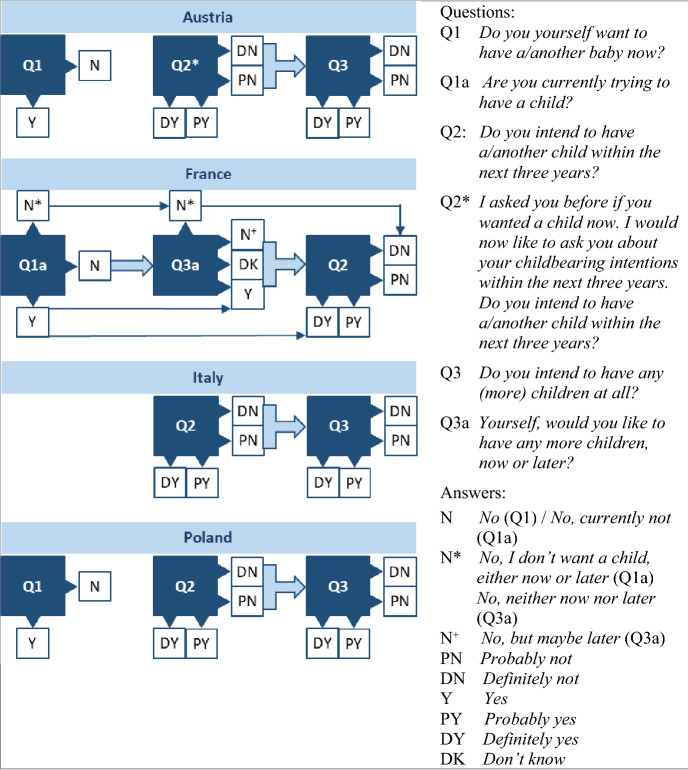
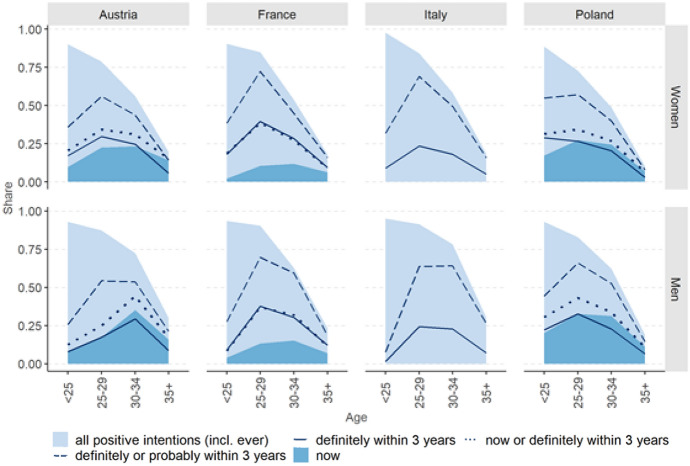
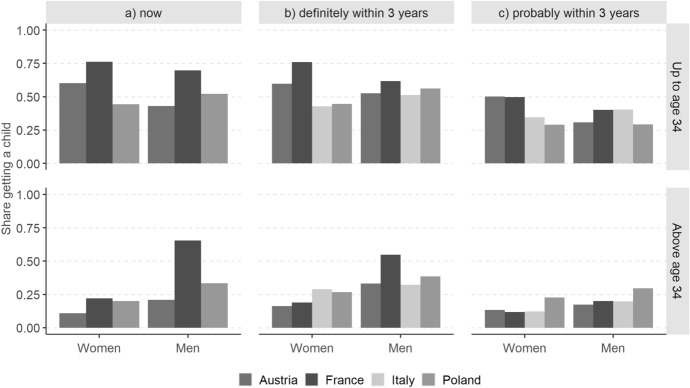
The use of fertility intention questions to study individual childbearing behaviour has developed rapidly in recent decades. In Europe, the Generations and Gender Surveys are the main sources of cross-national data on fertility intentions and their realisation. This study investigates how an inconsistent implementation of a question about wanting a child now affects the cross-country comparability of intentions to have a child within the next three years and their realisation. We conduct our analysis separately for women and men at prime and late reproductive ages in Austria, France, Italy and Poland. The results show that the overall share of respondents intending to have a child at some point in their life is similar in all four analysed countries. However, once the time horizon and the degree of certainty of fertility intentions are included, substantial cross-country differences appear, particularly in terms of proceptive behaviour and, consequently, the realisation of fertility intentions. We conclude that the inconsistent questionnaire adaptation makes it very difficult to assess the role of country context in the realisation of childbearing intentions.
Overview
The claims and statistics of this paper haven’t been checked yet.
Free: it reads the open-access text and checks the first 5 claims that cite a source we can check. Create a free account to check every claim.
Integrity signals
Registry
Cites
Statistics
Figures
Verification
Claims the paper makes
The claims and statistics of this paper haven’t been checked yet.
Free: it reads the open-access text and checks the first 5 claims that cite a source we can check. Create a free account to check every claim.
Self-check
Percentages, sums and reported differences re-computed from the paper’s own numbers.
The self-check needs the paper’s full text.
Citations
Cites
Couple childbearing desires, intentions, and births
Thomson, E. (1997) · Demography · doi:10.2307/3038288 · Cited by 380 · cited 2×
“The economic, cultural and institutional constraints that govern both the formation and the realisation of short-term fertility intentions have become one of the core subjects of fertility studies (e.g. Billingsley and Ferrarini 2014; Dommermuth et al. 2015; Hanappi et al. 2017; HohmannMarriott 2015; Ní Bhrolcháin and…”
BackgroundBehavioral Intentions: Which Ones Predict Fertility Behavior in Married Couples?1
Miller, W. B., & Pasta, D. J. (1995) · Journal of Applied Social Psychology · doi:10.1111/j.1559-1816.1995.tb01766.x · Cited by 213 · cited 1×
“Several theoretical approaches have been developed, which mostly see short-term fertility intentions as direct predecessors of reproductive behaviour (Miller and Pasta 1995).”
BackgroundPhilipov, D., Spéder, Z., & Billari, F. C. (2006) · Population Studies · doi:10.1080/00324720600896080 · Cited by 209
Miller, W. B. (2012) · Vienna Yearbook of Population Research · doi:10.1553/populationyearbook2011s75 · Cited by 143 · cited 1×
“…want”) and intentions (“to intend”): “the former simply reflect a wish to achieve a goal through some sort of action, whereas intentions involve a specific decision to pursue an actionable goal, with an associated commitment and, commonly, a plan for implementing the decision” (Miller 2011, p. 78).”
BackgroundA new estimate of permanent sterility by age: Sterility defined as the inability to conceive
Leridon, H. (2008) · Population Studies · doi:10.1080/00324720701804207 · Cited by 130 · cited 1×
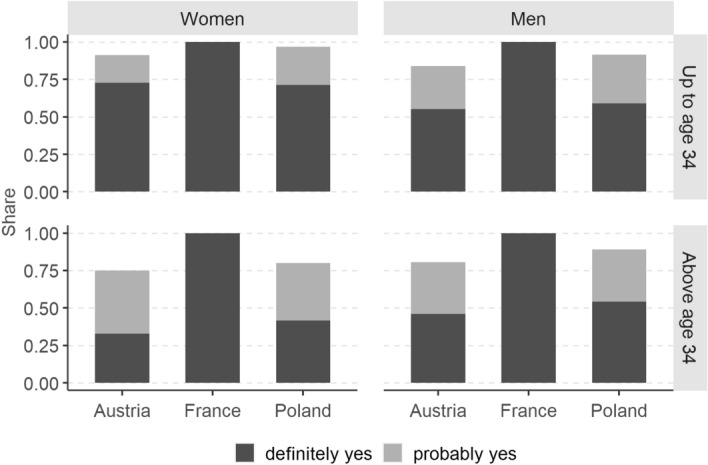
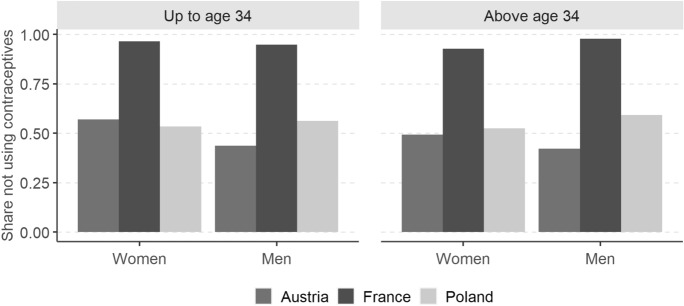
“414 Z. Brzozowska, E. Beaujouan 1 3 Second, among women aged 35+ wanting a child now (Austria and Poland) and trying to have one (France), the share who actually give birth remains far below the estimated biological fecundity at this age (Leridon 2008).”
BackgroundFamily Policy and Fertility Intentions in 21 European Countries
Billingsley, S., & Ferrarini, T. (2014) · Journal of Marriage and Family · doi:10.1111/jomf.12097 · Cited by 128 · cited 1×
“The economic, cultural and institutional constraints that govern both the formation and the realisation of short-term fertility intentions have become one of the core subjects of fertility studies (e.g. Billingsley and Ferrarini 2014; Dommermuth et al.”
BackgroundFertility Intentions and Obstacles to their Realization in France and Italy
Régnier-Loilier, A., Vignoli, D., & Dutreuilh, C. (2011) · Population (english edition) · doi:10.3917/pope.1102.0361 · Cited by 118
Comaparison of Two Question Sequences for Assessing Pregnancy Intentions
Kaufmann, R. B., Morris, L., & Spitz, A. M. (1997) · American Journal of Epidemiology · doi:10.1093/oxfordjournals.aje.a009174 · Cited by 94
Realization of fertility intentions by different time frames
Dommermuth, L., Klobas, J. E., & Lappegård, T. (2015) · Advances in Life Course Research · doi:10.1016/j.alcr.2015.02.001 · Cited by 89
Hanappi, D., Ryser, V.-A., Bernardi, L., & Le Goff, J.-M. (2017) · European Journal of Population · doi:10.1007/s10680-016-9408-y · Cited by 86 · cited 1×
“The economic, cultural and institutional constraints that govern both the formation and the realisation of short-term fertility intentions have become one of the core subjects of fertility studies (e.g. Billingsley and Ferrarini 2014; Dommermuth et al. 2015; Hanappi et al. 2017; HohmannMarriott 2015; Ní Bhrolcháin and…”
BackgroundGenerations and Gender Survey study profile
Gauthier, A. H., Cabaço, S. L. F., & Emery, T. (2018) · Longitudinal and Life Course Studies · doi:10.14301/llcs.v9i4.500 · Cited by 80 · cited 1×
“Despite the efforts made by the GGP team to harmonise the data (Gauthier et al. 2018), the decision heavily compromised data comparability, and questions on fertility intentions were particularly affected.”
Differences between fertility desires and intentions: implications for theory, research and policy 1
Miller, W. B. (2011) · Cited by 71
Do People Have Reproductive Goals? Constructive Preferences and the Discovery of Desired Family Size
Bhrolcháin, M. N., & Beaujouan, É. (2019) · The Springer Series on Demographic Methods and Population Analysis · doi:10.1007/978-3-319-93227-9_3 · Cited by 59 · cited 1×
“2017; HohmannMarriott 2015; Ní Bhrolcháin and Beaujouan 2019; Philipov et al.”
BackgroundSelf-citationUncertainty in fertility intentions in Britain, 1979-2007
Bhrolcháin, M. N. (2012) · Vienna Yearbook of Population Research · doi:10.1553/populationyearbook2011s99 · Cited by 58 · cited 1×
“These questions were originally designed to inform forecasting, and the extension of their use to individual studies has led to the emergence of a new strand of population research (Ní Bhrolcháin and Beaujouan 2011).”
BackgroundWagner, M., Huinink, J., & Liefbroer, A. C. (2019) · Demographic Research · doi:10.4054/demres.2019.40.1 · Cited by 40
Maddow‐Zimet, I., & Kost, K. (2020) · Public Health Reports · doi:10.1177/0033354920914344 · Cited by 30 · cited 1×
“1997; Maddow-Zimet and Kost 2019; Mathews et al.”
Smallwood, S. (2020) · Population Studies · doi:10.1080/00324728.2020.1720175 · Cited by 19
COUNTING HOW MANY CHILDREN PEOPLE WANT: THE INFLUENCE OF QUESTION FILTERS AND PRE-CODES
Beaujouan, É. (2013) · Demográfia English Edition · Cited by 18
Involvement With Past‐Union Children and Couple Childbearing Intentions
Hohmann‐Marriott, B. E. (2015) · Journal of Marriage and the Family · doi:10.1111/jomf.12167 · Cited by 5
Do preceding questions influence the reporting of childbearing intentions in social surveys
Mathews, P., Sear, R., Coast, E., & Iacovou, M. (2012) · London School of Economics and Political Science Research Online (London School of Economics and Political Science) · Cited by 5
Maddow‐Zimet, I., & Kost, K. (2019) · SocArXiv (OSF Preprints) · doi:10.31235/osf.io/t6pqr · Cited by 4 · cited 1×
“1997; Maddow-Zimet and Kost 2019; Mathews et al.”
Cited by
The Formation and Realization of Fertility Goals Among a US Cohort in the Post‐Recession Years
Guzzo, K. B. (2022) · Population and Development Review · doi:10.1111/padr.12509 · Cited by 139
Delayed first births and completed fertility across the 1940–1969 birth cohorts
Beaujouan, E., Zeman, K., & Nathan, M. (2023) · Demographic Research · doi:10.4054/demres.2023.48.15 · Cited by 29
“Although at the individual level wanting a child at an older age is associated with a lower probability of having a child (Beaujouan et al. 2019; Brzozowska and Beaujouan 2021), a positive association between age at first birth and childlessness is not confirmed by an aggregate cross-country…”
BackgroundDelayed Fertility as a Driver of Fertility Decline?
Beaujouan, E. (2023) · The Springer Series on Demographic Methods and Population Analysis · doi:10.1007/978-3-031-29666-6_4 · Cited by 21
Luppi, F., Arpino, B., & Rosina, A. (2022) · PLoS ONE · doi:10.1371/journal.pone.0271384 · Cited by 23
“Because fertility intentions are strong predictors of fertility behaviours [45–49], especially among younger individuals [50], our research sheds light on how the increased economic and occupational uncertainty due to the COVID crisis has compromised young Italians’ fertility plans which are behind this birth rate dec…”
BackgroundUncertainty and flexibility of fertility intentions
Barker, R., & Buber‐Ennser, I. (2024) · Advances in Life Course Research · doi:10.1016/j.alcr.2024.100618 · Cited by 25
Metadata
- Authors
- Brzozowska, Z., & Beaujouan, E.
- Affiliations
- Vienna University of Economics and Business (AT)
- Corresponding author
- Brzozowska, Zuzanna
- Venue
- European Journal of Population
- Published
- 2020-12-24
- Volume
- 37
- Issue
- 2
- Pages
- 405-416
- ISSN
- 0168-6577 (ISSN-L)
- 1572-9885
- PMC
- PMC8035360
- OpenAlex
- W3116960272
- Cited by
- 13
- References
- 21
- Citations by year
- 2025: 1 · 2024: 2 · 2023: 4 · 2022: 3 · 2021: 3
- FWCI
- 3.77
- Type
- journal article
- Language
- en
- Open access
- hybrid
- doi.org
- Licence
- cc-by
- creativecommons.org/licenses/by/4.0 (tdm)
- creativecommons.org/licenses/by/4.0 (vor)
- Locations
- European Journal of Population / Revue européenne de Démographie (publishedVersion, cc-by)
- PubMed Central (publishedVersion, cc-by)
- PubMed (publishedVersion)
- ePubWU Institutional Repository (Wirtschaftsuniversität Wien) (submittedVersion, cc-by)
- WU Research (submittedVersion, cc-by)
- RePEc: Research Papers in Economics (submittedVersion)
- Funders
- Austrian Science Fund (P31171-G29)
- Vienna University of Economics and Business
- Topics
- Social Sciences › Demography › Family Dynamics and Relationships
- Health Sciences › Medicine › Public Health, Environmental and Occupational Health › Reproductive Health and Contraception
- Social Sciences › Sociology and Political Science › Survey Methodology and Nonresponse
- Keywords
- fertility intentions, Generations and Gender Survey, international comparability, questionnaire adaptation, reproductive behavior, men and women, Austria, France, Italy, Poland
About these checks
Registry, retraction, Cites and statistics results are computed, not judged, with one exception: a printed reference that no index lists is read once by a model before it counts as a citation error. Claims are extracted by a model and kept only when their quote appears verbatim in the text; each cited source is then checked, with a model’s help, for whether it says what the claim relies on. Those verdicts can be wrong — read the claim’s quote and the cited source before relying on one.
Statistics and arithmetic are recomputed, not judged.
Confidence bands are shown only for fields calibrated on our annotated test set. None is calibrated yet, so no band is shown.
What counts as a claim ›How we measure confidence ›How we check this ›
Are you an author, or do you see a problem with this page? Request a review
Data sources
Bibliographic data: Semantic Scholar, OpenAlex, Crossref.
Contains information from the Semantic Scholar Academic Graph Datasets, made available under the ODC Attribution License (ODC-BY 1.0).
Semantic Scholar’s data is described in: Kinney, R., et al. (2023). The Semantic Scholar Open Data Platform. arXiv:2301.10140.
