

The DOI matches its Crossref record; 68 of the 69 references it cites were found in a registry or an index; none of the 35 sources its claims cite is checked for support yet.
Elaborating Team Roles for Artificial Intelligence-based Teammates in Human-AI Collaboration
Open accessAbstract
The increasing importance of artificial intelligence (AI) in everyday work also means that new insights into team collaboration must be gained. It is important to research how changes in team composition affect joint work, as previous theories and insights on teams are based on the knowledge of pure human teams. Especially, when AI-based systems act as coequal partners in collaboration scenarios, their role within the team needs to be defined. With a multi-method approach including a quantitative and a qualitative study, we constructed four team roles for AI-based teammates. In our quantitative survey based on existing team role concepts (n = 1.358), we used exploratory and confirmatory factor analysis to construct possible roles that AI-based teammates can fulfill in teams. With nine expert interviews, we discussed and further extended our initially identified team roles, to construct consistent team roles for AI-based teammates. The results show four consistent team roles: the coordinator, creator, perfectionist and doer. The new team roles including their skills and behaviors can help to better design hybrid human-AI teams and to better understand team dynamics and processes.
Overview
CoChat Summary
TL;DR
The paper uses a sequential multi-method design to identify and refine team roles that AI-based teammates can fulfill in human-AI collaboration. It reports four consistent roles—coordinator, creator, perfectionist, and doer—derived from a quantitative survey and extended through expert interviews.
Key findings
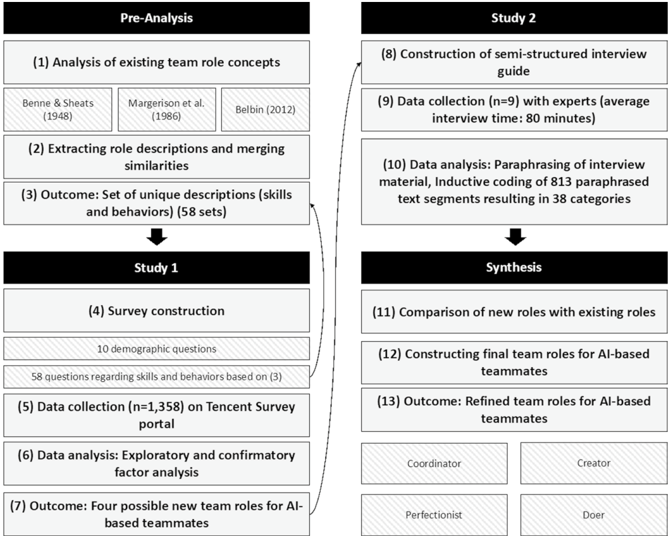
- A quantitative study with 1,358 participants yielded four factors explaining 60.614% of the variance, interpreted as AI-based team roles: coordinator, creator, perfectionist, and doer; factor reliabilities ranged from 0.770 to 0.796 and AVE from 0.529 to 0.565.
- Nine expert interviews confirmed and extended the roles: the coordinator was associated with motivating, leading, assigning tasks, discussing, capturing emotions/social dynamics, and conflict resolution; the creator with finding new solutions, research, novel patterns/associations, innovative problem-solving, and expert knowledge; the perfectionist with detail, optimal solutions, analytical thinking, structuring, and validation; the doer with concrete action, practical solutions, prioritization, and distinguishing important from unimportant.
- Experts emphasized emotional and social capabilities across roles, plus analytical thinking, multitasking, knowledge contribution, decision-making, conflict resolution, time management, assessing human capabilities, and structuring results; they also warned that AI-based teammates should not take roles that are too powerful, because humans may rest on the AI’s skills.
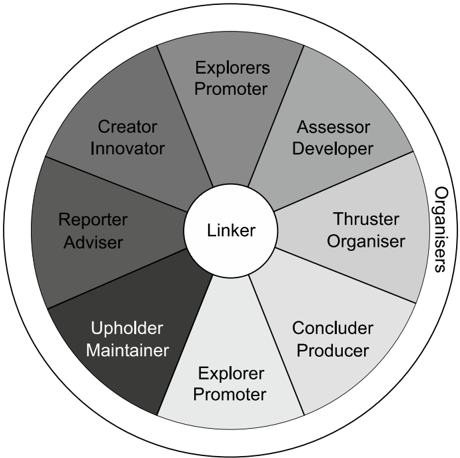
- The paper reports similarities between the four AI-based roles and existing role concepts by Belbin, Margerison et al., and Benne and Sheats.
Methods
- Study 1: a questionnaire operationalized from Belbin (2012), Margerison et al. (1986), and Benne and Sheats (1948), containing 58 AI-teammate items plus demographic and open questions (68 total), answered on a 5-point Likert scale; it was translated into Chinese and distributed via the Tencent Survey portal between November 2019 and January 2020.
- From 2,582 collected responses, 1,358 were used after data cleansing (52% recall rate); analysis used exploratory factor analysis (principal component analysis, varimax rotation, split sample) followed by confirmatory factor analysis.
- Study 2: semi-structured interviews with nine experts selected for more than 5 years of practical experience in AI and/or team composition; all were male, German, aged 34–58; interviews took place in January–March 2021, averaged 80 min (minimum 63, maximum 95), were transcribed and coded in MaxQDA, producing 38 categories and 813 paraphrased text segments; data saturation was reached.
Limitations
- Stated in the paper: the samples are narrow; quantitative participants represent a specific target group who do not necessarily have many years of teamwork experience; cultural and national habits limit generalization; the expert panel is limited by small number and demographics (all male, one nationality, German); further experimental research is needed and is hardly feasible at this stage.
- Evident from the text: the quantitative sample is largely young (740 aged 18–24; 45% students) and was collected through a Chinese survey portal, which may further constrain generalizability; the roles are based on attitudes/perceptions and expert discussion rather than observed team behavior or experimental validation.
Model-written summary. Check it against the paper before relying on it.
Integrity signals
Registry
Cites
Statistics
Figures
Verification
Claims the paper makes
0 Valid · 19 Not valid · 21 Not checked · 112 Own results and interpretations
A result the paper reports from its own data — it cites no other source for it, so there is none to check. The quote shows it is in the paper.
In the paper
“The analysis yielded four factors explaining a total of 60.614% of the variance for the entire set of variables.”
§ Elaborating Team Roles for Artificial Intelligence-based Teammates in Human-AI Collaboration > 4.1.2 Results
plain- Asserted: passes — The authors put it forward as true.
- Checkable: passes — It can be checked against evidence.
- Load-bearing: passes — The paper’s conclusions depend on it.
- Based: passes — The paper gives a reason why it holds.
- Rests on an assumption not shown here.
A result the paper reports from its own data — it cites no other source for it, so there is none to check. The quote shows it is in the paper.
In the paper
“With nine expert interviews, we discussed and further extended our initially identified team roles, to construct consistent team roles for AI-based teammates.”
- Also stated in: § 1 Introduction · plain
“With the results of the interviews, we refined and extended our team roles.”
§ Elaborating Team Roles for Artificial Intelligence-based Teammates in Human-AI Collaboration > Abstract
plainstates a cause- Asserted: passes — The authors put it forward as true.
- Checkable: passes — It can be checked against evidence.
- Load-bearing: passes — The paper’s conclusions depend on it.
- Based: passes — The paper gives a reason why it holds.
- Also stated in: § 1 Introduction · plain
None of the sources cited for this claim have been checked yet.
In the paper
“In order to determine whether the different indicators are unrelated, we measure discriminant validity with inter-correlations between factors, which indicate low and very low correlations between each factor (see Table 6) (Rummel 1988;Raithel 2008).”
§ Elaborating Team Roles for Artificial Intelligence-based Teammates in Human-AI Collaboration > 4.1.2 Results
What the sources say
- Not matchedcites Rummel 1988
Couldn’t be matched to a paper in Crossref, so it can’t be checked.
- Not checked yetcites Raithel 2008 source
hedgedstates an association- Asserted: passes — The authors put it forward as true.
- Checkable: passes — It can be checked against evidence.
- Load-bearing: passes — The paper’s conclusions depend on it.
- Based: passes — The paper gives a reason why it holds.
- Rests on an assumption not shown here.
- Not matched
A result the paper reports from its own data — it cites no other source for it, so there is none to check. The quote shows it is in the paper.
In the paper
“The results show four consistent team roles: the coordinator, creator, perfectionist and doer.”
- Also stated in: § Abstract · plain
“we constructed four team roles for AIbased teammates.”
- Also stated in: § 1 Introduction · plain
“We identified four desired new team roles for AIbased team members, which we compared to existing team role concepts.”
§ Elaborating Team Roles for Artificial Intelligence-based Teammates in Human-AI Collaboration > Abstract
plainn = 1,358- Asserted: passes — The authors put it forward as true.
- Checkable: passes — It can be checked against evidence.
- Load-bearing: passes — The paper’s conclusions depend on it.
- Based: passes — The paper gives a reason why it holds.
- Also stated in: § Abstract · plain
None of the sources cited for this claim have been checked yet.
In the paper
“The MSA-value of each item is on the diagonal of the anti-image-correlation matrix and the MSA-value of the items is between 0.722 and 0.959 (Rummel 1988;Mair 2018).”
§ Elaborating Team Roles for Artificial Intelligence-based Teammates in Human-AI Collaboration > 4.1.2 Results
What the sources say
- Not matchedcites Rummel 1988
Couldn’t be matched to a paper in Crossref, so it can’t be checked.
- Not checked yetcites Mair 2018 source
plain- Asserted: passes — The authors put it forward as true.
- Checkable: passes — It can be checked against evidence.
- Load-bearing: passes — The paper’s conclusions depend on it.
- Based: passes — The paper gives a reason why it holds.
- Rests on an assumption not shown here.
- Not matched
35 more claims
Create a free account to see all 152 claims and to verify the 20 references still open.
- It may state two separate claims as one. 52
- Probably not a substantial claim. 92
- The quote only partly states this claim. 1
Self-check
Percentages, sums and reported differences re-computed from the paper’s own numbers.
Each contradiction between two passages listed here was confirmed by an independent check.
Rated minor: it would not touch a result — a value no result rests on, a p-value that stays on the same side of the significance level, or a conflict that is clerical, resolved elsewhere in the paper, or outside its own findings.
In the paper
§ Elaborating Team Roles for Artificial Intelligence-based Teammates in Human-AI Collaboration > 4.2.1 Data collection and data analysis
“more than 5 years of practical experience in the field of AI and/or teamwork and composition of teams.”
§ Elaborating Team Roles for Artificial Intelligence-based Teammates in Human-AI Collaboration > 1 3
“His experience is based on two years of practical experience as a project manager with team responsibility and working in the field of AI in a mediumsized company”
Rated minor: it would not touch a result — a value no result rests on, a p-value that stays on the same side of the significance level, or a conflict that is clerical, resolved elsewhere in the paper, or outside its own findings.
In the paper
§ Elaborating Team Roles for Artificial Intelligence-based Teammates in Human-AI Collaboration > 4 Methodology
“We excluded the nine individual roles of Benne and Sheats (1948)”
§ Elaborating Team Roles for Artificial Intelligence-based Teammates in Human-AI Collaboration > 3.3 Team Roles
“The third category cover individual roles, which are eight”
Citations
Cites
Artificial intelligence: A modern approach
Nilsson, N. J. (1996) · Artificial Intelligence · doi:10.1016/0004-3702(96)00007-0 · Cited by 10,583
Ali, E. M. (2016) · Cited by 4,441
On seeing human: A three-factor theory of anthropomorphism
Epley, N., Waytz, A., & Cacioppo, J. T. (2007) · Psychological Review · doi:10.1037/0033-295x.114.4.864 · Cited by 4,069 · cited 2×
“Such AI-based systems become not only more intelligent but also more human-like with characteristics such as personality, autonomy, empathy, and emotion (Nass and Moon 2000; Epley et al. 2007; Qiu and Benbasat 2009; Ahmad et al. 2021).”
BackgroundMachines and Mindlessness: Social Responses to Computers
Nass, C., & Moon, Y. (2000) · Journal of Social Issues · doi:10.1111/0022-4537.00153 · Cited by 4,022 · cited 9×
“Today, computers are no longer perceived as mere tools, but as interaction and collaboration partners in mutual value creation (Nass and Moon 2000; Seeber et al. 2020; Mirbabaie et al. 2021).”
BackgroundInfluentialKaplan, A., & Haenlein, M. (2019) · Business Horizons · doi:10.1016/j.bushor.2018.08.004 · Cited by 3,140
Artificial intelligence and the future of work: Human-AI symbiosis in organizational decision making
Jarrahi, M. H. (2018) · Business Horizons · doi:10.1016/j.bushor.2018.03.007 · Cited by 2,772
Venkatesh, V., Brown, S. A., & Bala, H. (2013) · MIS Quarterly · doi:10.25300/misq/2013/37.1.02 · Cited by 2,363
Qualitative Content Analysis: Theoretical Background and Procedures
Mayring, P. (2015) · Advances in Mathematics Education · doi:10.1007/978-94-017-9181-6_13 · Cited by 2,263
Social loafing: a meta-analytic review and theoretical integration.
Karau, S. J., & Williams, K. D. (1993) · Journal of Personality and Social Psychology · doi:10.1037/0022-3514.65.4.681 · Cited by 2,196
Araujo, T. (2018) · Computers in Human Behavior · doi:10.1016/j.chb.2018.03.051 · Cited by 1,156
Research works printed but not linked: 18
- Berente N, Gu B, Recker J, Santhanam R (2021) Managing artificial intelligence. MIS Q 45:1433–1450
- Cohen SG, Bailey DE (1997) What makes teams work: group effectiveness research from the shop floor to the executive suite. J Manag 23(3):239–290
- Daugherty PR, Wilson HJ (2018) Human+ machine: reimagining work in the age of AI, Harvard Business Press.
- Fusch PI, Ness LR (2015) Are we there yet? Data saturation in qualitative research. Qual Rep 20(9):1408
- Gnewuch U, Morana S, Maedche A (2017) Towards designing cooperative and social conversational agents for customer service. In: ICIS 2017 Proceedings. retrieved: https://aisel.aisnet.org/icis2017/HCI/Presentations/1. Accessed
- Horwitz SK, Horwitz IB (2007) The effects of team diversity on team outcomes: a meta-analytic review of team demography. J Manag 33(6):987–1015
- Jackson SE (1991) Team composition in organizational settings: issues in managing an increasingly diverse work force. Group process and productivity. Sage, Thousands Oaks, Ca, pp 138–173
- Katzenbach JR, Smith DK (2015) The wisdom of teams: creating the high-performance organization, Harvard Business Review Press.
- Krämer NC, von der Pütten A, Eimler S (2012) Human-agent and human-robot interaction theory: similarities to and differences from human-human interaction. In: Zacarias M, de Oliveira JV (eds) Human-Computer Interaction: The Agency Perspective, Studies in Computational Intelligence. Springer, Berlin, pp 215–240
- Maher ML, Fisher DH (2012) Using AI to evaluate creative designs. In: DS 73–1 Proceedings of the 2nd international conference on design creativity Volume 1,
- McCarthy J, Minsky ML, Rochester N, Shannon CE (1955) A proposal for the Dartmouth summer research project on artificial intelligence. AI Mag 27(4):12
- Randrup N, Druckenmiller D, Briggs RO (2018) Toward a philosophy of collaboration. Int J e-Collab (IJeC) 14(2):19–36
- Reeves B, Nass CI (1996) The media equation: how people treat computers, television, and new media like real people and places. Cambridge University Press
- Rummel RJ (1988) Applied factor analysis, Northwestern University Press.
- Schwartz J, Hagel J III, Wooll M, Monahan K (2019) Reframing the future of work. MIT Sloan Manag Rev 60(3):1–6
- Shaughnessy JJ, Zechmeister EB, Zechmeister JS (2000) Research methods in psychology. McGraw-Hill
- Siemon D, Strohmann T, Robra-Bissantz S (2018) The virtual collaborator - a definition and research agenda. Int J e-Collab (IJeC) 14(4):24–43
- Strohmann T, Fischer S, Siemon D, Brachten F, Lattemann C, Robra-Bissantz S, Stieglitz S (2018) Virtual moderation assistance: creating design guidelines for virtual assistants supporting creative workshops. In: Proceedings of the 22nd pacific asia conference on information systems, Yokohama
Cited by
Items 101–180 of 180
Towards Human-AI Collaborative Networks in Industry
Camarinha-Matos, L. M. (2026) · Studies in Informatics and Control · doi:10.24846/v35i2y202601 · Cited by 1
Design and evaluation of an AI-based application to enhance creativity in design thinking workshops
Akaki, M., Katayama, K., & Nishioka, R. (2026) · Proceedings of the Design Society · doi:10.1017/pds.2026.10574 · Cited by 1
Adil, M., Fronza, I., Mikkonen, T., Ihantola, P., & Iaccarino, G. (2026) · Automated Software Engineering · doi:10.1007/s10515-026-00648-3 · Cited by 1
Task Allocation and Role Distribution in Humane-AI Ecosystems
Nowak, A., Ziembowicz, K., Pitt, J. V., Biesaga, M., Boros, A., Bartkowski, W., Lewandowska, W. M., Borkowski, W., & Mertzani, A. (2026) · Springer eBooks · doi:10.1007/978-3-031-61050-9_24-1 · Cited by 1
Lenz, U. (2023) · Springer eBooks · doi:10.1007/978-3-658-42092-5_18 · Cited by 1
AI and Human Relationship in the Workplace: A Literature Review and Future Research Agenda
Trinh, N. T. T., & Elbanna, A. R. (2023) · IFIP advances in information and communication technology · doi:10.1007/978-3-031-50192-0_14 · Cited by 1
Generative AI in content SEO processes
Havia, M. (2024) · Aaltodoc (Aalto University) · Cited by 1
AI Assisting Individuals as Team Members
Gibson, D., & Ifenthaler, D. (2024) · Advances in analytics for learning and teaching · doi:10.1007/978-3-031-65898-3_10
A Need to Balance Between Human Behaviour & Artificial Intelligence
Priyanka (2024) · International Journal For Multidisciplinary Research · doi:10.36948/ijfmr.2024.v06i06.34018
Grace, R., Son, C., Pang, F., Parker, K., & Hernandez, J. (2025) · Proceedings of the ... International ISCRAM Conference · doi:10.59297/1v67zn37
Exploring AI Applications in Business: Case Studies on Key Competencies for Professionals
Kopyto, A., Afsari, M., & Wachnik, B. (2025) · Lecture notes in computer science · doi:10.1007/978-3-031-97573-8_22
The Impact of Artificial Intelligence on Virtual Teams
Gündoğan, A., & Runco, M. A. (2025) · IGI Global eBooks · doi:10.4018/979-8-3373-6102-4.ch001
Logemann, M. (2025) · IGI Global eBooks · doi:10.4018/979-8-3373-6102-4.ch003
Adaptive Emotional Intelligence in Human-AI Collaboration: A Fuzzy Logic Perspective
Sadikoglu, F. M., & Imamguluyev, R. (2025) · Lecture notes in networks and systems · doi:10.1007/978-3-031-98565-2_61
Investigating the State of Human-Machine Teams: Bibliometric Analysis from a Management Perspective
Cvetkoska, V., Čiković, K. F., & Kitanovikj, B. (2025) · Lecture notes in networks and systems · doi:10.1007/978-3-032-08093-6_9
How to form groups? Optimizing group formation of university students
Müller, A. (2024) · Gutenberg Open Science · doi:10.25358/openscience-10242
Collaboration with Robots : Roles of American Employees in an Automated Work Environment
Ojajärvi, L. (2025) · Osuva (University of Vaasa)
Effects of AI Teammates on Job Crafting: A Self-Determination Theory Perspective
Liu, M., Ke, W., & Xu, D. (. (2025) · Journal of the Association for Information Systems
Bjelobrk, I., & Martinsson, W. (2024) · KTH Publication Database DiVA (KTH Royal Institute of Technology)
Bailey, M. E. (2025) · Enlighten: Theses (The University of Glasgow) · doi:10.5525/gla.thesis.85469
Tekoäly tiimin jäsenenä - Haasteiden arviointi tilannetietoisuuden viitekehyksissä
Mylläri, N. (2025) · Aaltodoc (Aalto University)
AI assistance in software development
Bohm, E. (2025) · DiVA (Luleå University of Technology)
Human-Centered Service Design with AI Collaboration
Letheren, K. (2025) · Springer eBooks · doi:10.1007/978-3-031-75316-9_34-1
Collective intelligence: Conceptualization, mechanism, and measurement
Chu, G., Zhimou, W. A. N. G., Jing, H. U., & Zhan, P. (2026) · Advances in Psychological Science · doi:10.3724/sp.j.1042.2026.0515
Guiding Ethical Review of AI Applications in Health Research: A Ugandan Perspective
Tan, D. M. L., Lim, W. M., & Ho, D. (2021) · Asian Journal of Ethics in Health and Medicine · doi:10.51847/c4e4fgpmcx
Jeffs, S. P., McFadzean, J. K., Xavier, P., & Evans, B. (2026) · Journal of Further and Higher Education · doi:10.1080/0309877x.2026.2625371
Belbin Team Toles in the Age of Artificial Intelligence
Bujor, A. L. (2026) · Anuarul Universitatii Petre Andrei din Iasi - Fascicula Drept Stiinte Economice Stiinte Politice · doi:10.63331/upalaw/36/11
Tekoäly työkaluna käyttöliittymäkehityksessä : Suunnittelijan rooli tekoälyn aikakaudella
Kariniemi, K. (2024) · Tampere University Institutional Repository (Tampere University)
Data-Informed, Not Data-Driven: Leadership Practices for Responsible AI Integration in K-12 Schools
Ragab, K. (2026) · Advances in computational intelligence and robotics book series · doi:10.4018/979-8-3373-4908-4.ch011
Modeling the Dynamic Agency in Human-AI Collaboration
Liou, S., Chiu, C.-Y., Sibo, I. P. H., Chen, Y.-C., Wang, I., Lin, S.-B., Ai, S.-T., & Chang, C.-Y. (2025) · International Association of Societies of Design Research Congress (IASDR) · doi:10.21606/iasdr.2025.469
Zhou, L., Miao, H., Zijlstra, T., & Wang, Z. (2026) · Information Research · doi:10.47989/ir31iconf64182
Filatova, A., & Victorino, G. (2026) · Creativity Studies · doi:10.3846/cs.2026.22135
Yuan, T., Yang, M., Yu, D., & Rau, P. P. (2026) · Wiley eBooks · doi:10.1002/9781394266401.ch7
Perez-Torrents, J. (2024) · theses.fr (ABES) · doi:10.70675/97d0e67ez9ba4z4494z98d7z5a282887792f
Cracking the Case Together: Role Perceptions in Human-AI Mystery Solving Dialogues
Breckner, K., Schönböck, J., Kovacs, C., Hirschmann, F., Neumayr, T., Reyskens, E., & Augstein, M. (2026) · CHI Conference on Human Factors in Computing Systems · doi:10.1145/3772318.3791013
The Role of Role: How AI teammates’ Function and Operational Context Shape Human Perceptions
Basappa, R., Flathmann, C., Wang, Y., Duan, W., & McNeese, N. J. (2026) · International Journal of Human-Computer Interaction · doi:10.1080/10447318.2026.2652601
Zhang, K., Khan, M., & Khan, S. (2026) · Future of business and finance · doi:10.1007/978-3-032-06604-6_15
Liu, Y., Vahidov, R. M., & Saadé, R. G. (2026) · International Journal of Technology and Human Interaction · doi:10.4018/ijthi.410592
Tekoäly kulttuuriperinnön tulkitsijana : puhuva tekoäly näyttelykokemuksessa
Lehtonen, T. (2026) · Theseus (Ammattikorkeakoulujen)
Characterizing the Roles of AI-Enabled Non-Human Agents in Service Systems
Wilga, M., Hajjam-Demir, L., Lugmair, N., Schymanietz, M., & Roth, A. (2026) · Lecture notes in information systems and organisation · doi:10.1007/978-3-032-08483-5_10
AZEEZ, A. A., Tsobaza, M. K., AROME, J. O., JOHN, E. B., Folorunsho, O. S., YAKUBU, A., & ATIDOGA, D. B. (2026) · International Journal of Educational Research and Library Science · doi:10.70382/tijerls.v12i8.093
Saidi, H., & Rhouiri, M. (2026) · Advances in computational intelligence and robotics book series · doi:10.4018/979-8-3373-7966-1.ch003
Lakshmi, D. V., Rajeshwari, D. S., Rajalakshmi, V., Samanta, D. P. S., Prakash, D. T., & Monica, D. S. (2026) · Journal of Internet Services and Information Security · doi:10.58346/jisis.2026.i2.031
AI as creative partner: exploring perceived roles in human-AI co-creation
Dreyer, S., McTeague, C. P., & Thoring, K. (2026) · Proceedings of the Design Society · doi:10.1017/pds.2026.10459
Khosrawi-Rad, B., & Schlimbach, R. (2026) · Lecture notes in computer science · doi:10.1007/978-3-032-30089-8_5
Wang, Z., & Zhou, L. (2026) · Journal of Librarianship and Information Science · doi:10.1177/09610006261462964
The Effect of The Use of AI on Creativity in Creative Companies
Bami, H., Jingzhao, Y., Xun, Z., & Ali, M. (2026) · Journal of Information Systems Engineering and Business Intelligence · doi:10.20473/jisebi.12.2.361-373
Organisational and individual determinants of human-AI collaboration
Panasiewicz, L. (2026) · Engineering Management in Production and Services · doi:10.2478/emj-2026-0009
Team-on-team negotiation: How internal structure shapes what teams can do at the table
Shi, L., He, T., Lount, R. B., Schaerer, M., & Swaab, R. I. (2026) · Current Opinion in Psychology · doi:10.1016/j.copsyc.2026.102367
Xiong, X., & An, F. (2026) · Journal of Intelligence · doi:10.3390/jintelligence14080155
Lukito, N. A., & Sabila, N. (2026) · International Journal Administration Business and Organization · doi:10.61242/ijabo.26.641
Controlling Time or Controlled by Time? AI-Mediated Workflows as an Occasion for Structuring
Law, K. K., Lim, R., & Yang, G. Y. (2026) · Organizational Psychology Review · doi:10.1177/20413866261475337
Human-artificial intelligence for organizational hyper-performance: a systematic literature review
Vīcupe, J., Stibe, A., & Tambovceva, T. (2026) · Business and management · doi:10.3846/bm.2026.2406
The Mediating Role of AI-Enabled Work Support in Increasing Agile Team Effectiveness
Dayanandhan, S., & Sujatha, R. (2026) · Lecture notes in networks and systems · doi:10.1007/978-3-032-34772-5_24
Mwesigye, J., Kubanja, M., Wemesa, R., & Busingye, K. (2026) · Journal of Scientific Reports · doi:10.58970/jsr.1196
Li, W., Gou, J., Camarinha-Matos, L. M., Zhang, Z., & Zhang, F. (2026) · Systems Research and Behavioral Science · doi:10.1002/sres.70146
Jariwala, M. (2024) · Umsida Repository (Universitas Muhammadiyah Sidoarjo)
From Potential to Reality: Gaps in Realizing Human–AI Complementarity in Educational Tasks
Jiang, B., Wang, J., Lu, Y., Liu, J., & Jiang, Y. (2026) · International Journal of Human-Computer Interaction · doi:10.1080/10447318.2026.2732482
GENERATIVE AI AS TEAM PARTNER: A TAXONOMY OF ROLES FROM A SYSTEMATIC LITERATURE REVIEW
de Melo, M. C., Rocha, M. A. D., Brandão, S. S., & Dias, J. L. A. (2026) · Revista de Geopolítica · doi:10.56238/revgeov17n5-156
Cui, H., Yu, P., & Tao, H. (2026) · Aslib Journal of Information Management · doi:10.1108/ajim-10-2025-0800
de Melo, M. C., Rocha, M. A. D., Brandão, S. S., & Dias, J. L. A. (2026) · Revista de Geopolítica · doi:10.56238/revgeov17n5-158
Reddy, S., Malipatil, A. R., Sikhakolli, S. S., Meghrajani, M., Hassen, S. M., Sharma, V., Ansari, M. S. A., & Aarif, M. (2026) · Journal of Advances in Information Technology · doi:10.12720/jait.17.9.1783-1797
AI at Work: Working Arrangements and Human–AI Collaboration
Hautaniemi, A. (2026) · Athens Journal of Social Sciences · doi:10.30958/ajss.13-4-3
AI as Fifth Team Member: Differentiated Roles in Design Education
Hanzl, R., & Johansen, J. (2026) · Ubiquity Proceedings · doi:10.5334/uproc.245
When AI Joins the Team: Exploring Team Development Interventions in Human-AI Teaming
Bell, L. (2026) · TigerPrints (Clemson University)
Schin, I., Neculiță, M., Schin, G. C., Isai, V. M., & Razlog, A.-M. (2026) · European Journal of Innovation Management · doi:10.1108/ejim-06-2026-0877
The Centaur Situation: The Grounds and Limits of the Cognitive Alliance
Игоревич, З. Д., Gruzdev, I., Nikolskiy, V. S., Ganzha, R. M., Startsev, S., & Александрович, Т. А. (2026) · Высшее образование в России · doi:10.31992/0869-3617-2026-35-8-9-21-44
Unity of Knowledge and Action: A Multi-agent Human-AI Collaborative System
Gou, J., Shang, Y., Shen, K. N., Chen, Y., & Wang, Z. (2026) · IFIP advances in information and communication technology · doi:10.1007/978-3-032-41230-0_3
Deniz, V. (2026) · Özgür Yayınları eBooks · doi:10.58830/ozgur.pub1517.c6107
Emerging Trends in Management and Organization: Strategic Adaptation in Volatile Global Markets
(2026) · Özgür Yayınları eBooks · doi:10.58830/ozgur.pub1517
Yin, X., Wang, J., & Jiang, G. (2026) · Decision Support Systems · doi:10.1016/j.dss.2026.114781
From Decision Support to Decision Partner: The Evolution of AI in Group Decision and Negotiation
Elshan, E., Kaya, M.-F., & Siemon, D. (2026) · Group Decision and Negotiation · doi:10.1007/s10726-026-10028-7
Self-citationСитуация кентавра: основания и границы познавательного союза
Игоревич, З. Д., Gruzdev, I., Святославович, Н. В., Михайлович, Г. Р., Вячеславович, С. С., & Александрович, Т. А. (2026) · Высшее образование в России
THE SILENT COWORKER: EXPLORING THE IMPACT OF AGENTIC AI ON TEAM DYNAMICS AND PRODUCTIVITY
Bazar, M. M. M. A., Ismail, N. A., Azmi, M. A. A. M., Zamri, M. N., & Islam, T. (2026) · International Journal of Entrepreneurship and Management Practices · doi:10.35631/ijemp.935066
Human–AI Cognitive Division of Labor: A Structured Narrative Review and Integrative Framework
Chen, C., Li, G., Yuan, S., Xu, Q., & Cai, C. (2026) · Applied Sciences · doi:10.3390/app162110970
Design•AI: a study of practice-based integration of AI as a creative partner in design
Lim, S., & Camburn, B. (2026) · Design Science · doi:10.1017/dsj.2026.10085
DESIGNING HYBRID AI-NATIVE ENGINEERING TEAMS: ROLE SPECIALIZATION AND SHARED-CONTEXT COORDINATION
Косован, В., Мельник, Г., & Мельник, В. (2023) · Modern engineering and innovative technologies · doi:10.30890/2567-5273.2026-46-01-001
Steiger, T., Durani, K., Hutter, K., Just, J., & Eckhardt, A. (2026) · Electronic Markets · doi:10.1007/s12525-026-00942-8
Generative AI and Agentic Systems in Accounting: Implications for Practice, Education, and Research
Ng, C., & Cohen, E. E. (2026) · Routledge eBooks · doi:10.4324/9781003687474
Metadata
- Authors
- Siemon, D.
- Affiliations
- Lappeenranta-Lahti University of Technology (FI)
- Corresponding author
- Siemon, Dominik
- ORCID
- Siemon, Dominik
- Venue
- Group Decision and Negotiation
- Published
- 2022-07-20
- Volume
- 31
- Issue
- 5
- Pages
- 871-912
- ISSN
- 0926-2644 (ISSN-L)
- 1572-9907
- OpenAlex
- W4286008004
- Cited by
- 179
- References
- 69
- Citations by year
- 2026: 83 · 2025: 45 · 2024: 35 · 2023: 14 · 2022: 1
- FWCI
- 16.17
- Type
- journal article
- Language
- en
- Open access
- hybrid
- doi.org
- Licence
- cc-by
- creativecommons.org/licenses/by/4.0 (tdm)
- creativecommons.org/licenses/by/4.0 (vor)
- Locations
- Group Decision and Negotiation (publishedVersion, cc-by)
- RePEc: Research Papers in Economics (submittedVersion)
- LUTPub (LUT University) (submittedVersion, cc-by)
- Funders
- LUT University (previously Lappeenranta University of Technology
- Topics
- Social Sciences › Psychology › Social Psychology › Team Dynamics and Performance
- Social Sciences › Human Factors and Ergonomics › Human-Automation Interaction and Safety
- Social Sciences › Business, Management and Accounting › Organizational Behavior and Human Resource Management › AI and HR Technologies
- Keywords
- team roles, human-AI collaboration, team composition, team dynamics, coordinators, creators
About these checks
Registry, retraction, Cites and statistics results are computed, not judged, with one exception: a printed reference that no index lists is read once by a model before it counts as a citation error. Claims are extracted by a model and kept only when their quote appears verbatim in the text; each cited source is then checked, with a model’s help, for whether it says what the claim relies on. Those verdicts can be wrong — read the claim’s quote and the cited source before relying on one.
A language model drew the claims from the paper on 2026-11-14, under version 3 of the claim definition (model deepseek-v4.1-flash, prompt extract-v3).
A second model labelled each claim on 2026-11-14 (model jev-1.13-20260917, definition revision gold-guideline-v0.2).
Statistics and arithmetic are recomputed, not judged.
Confidence bands are shown only for fields calibrated on our annotated test set. None is calibrated yet, so no band is shown.
What counts as a claim ›How we measure confidence ›How we check this ›
Are you an author, or do you see a problem with this page? Request a review
Data sources
Bibliographic data: Semantic Scholar, OpenAlex, Crossref.
Contains information from the Semantic Scholar Academic Graph Datasets, made available under the ODC Attribution License (ODC-BY 1.0).
Semantic Scholar’s data is described in: Kinney, R., et al. (2023). The Semantic Scholar Open Data Platform. arXiv:2301.10140.
