

From Research to Practice: Are Multimedia Principles Present in Instructional Videos Used by Teachers in Science and History?
Open accessThe DOI matches its Crossref record; 76 of the 77 references it cites were found in a registry or an index; 2 of the 36 sources its claims cite were checked for support.
Abstract
Over the past decades, researchers have investigated the effects of multimedia design principles to enhance learning. These evidence-based principles are known to enable students to learn from multimedia resources and support cognitive processing. However, it is unclear if and which of these multimedia design principles are implemented in instructional videos selected by teachers. The purpose of this study is to investigate whether the videos screened by secondary school teachers in their classroom are consistent with the multimedia design principles based on the cognitive theory of multimedia learning. For this study a design review of 78 videos was conducted. The findings indicate variations in the application of multimedia principles. While most of the multimedia design principles were present, some were transgressed or absent. Moreover, the presence of the three different groups of principles, based on their impact on the cognitive load (i.e., reducing extraneous processing, managing essential processing, and fostering generative processing) were rarely present in the same video. Finally, this study also revealed that the teachers were actively implementing the multimedia design principles when they screened the videos in the classroom. Indeed, they frequently applied the pre-training principle (e.g., by introducing new words to the students before the screening), the segmentation principle (e.g., by pausing the video during the screening), and the generative activity principle (e.g., by asking students to complete a task during or right after the screening). Thus, the present study not only provides an insight on the design of authentic instructional videos but also highlights the addition of multimedia principles by teachers during the screening.
Overview
CoChat Summary
TL;DR
This design review of 78 authentic instructional videos used by secondary science and history teachers found that most videos followed at least one CTML multimedia principle, but few combined principles from all three cognitive-load groups. Teachers themselves added principles during screening, especially pre-training, teacher-paced segmentation, and generative activities.
Key findings
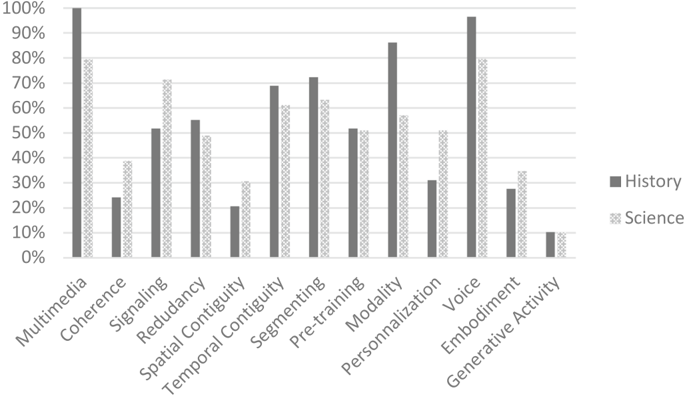
- Overall, 91% of videos followed the multimedia principle; all CTML principles except immersion appeared at least once, and one video followed no multimedia design principles. At least one principle from each of Mayer’s three groups was present in 30.8% of videos, rising to 70.5% when teacher-added segmentation and generative activities were included.
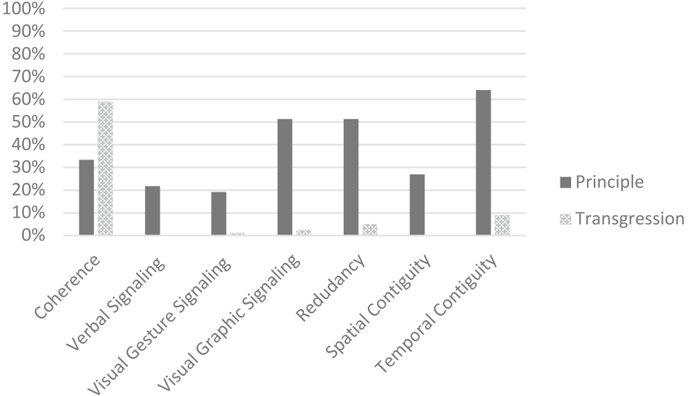
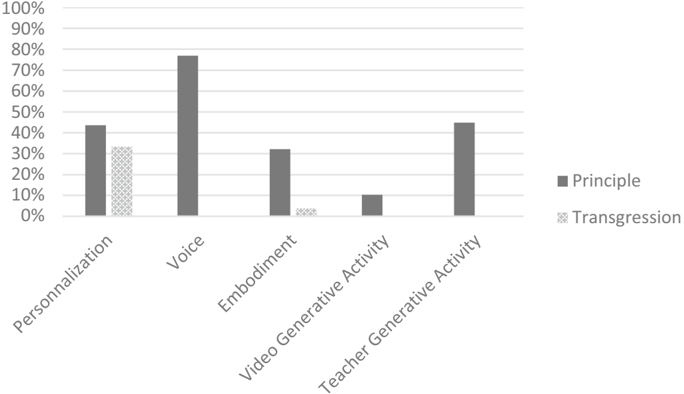
- By group: reducing extraneous processing was present in 88.5%; managing essential processing in 93.6% (94.9% with teacher-paced segmentation); fostering generative processing in 78.2% (87.2% with teacher-added generative activities). Coherence was present in 33.3% but transgressed in 59% (90% of those involved background music); the SSW combination was found in 2.6%, rising to 16.7% with teacher-paced segmentation.
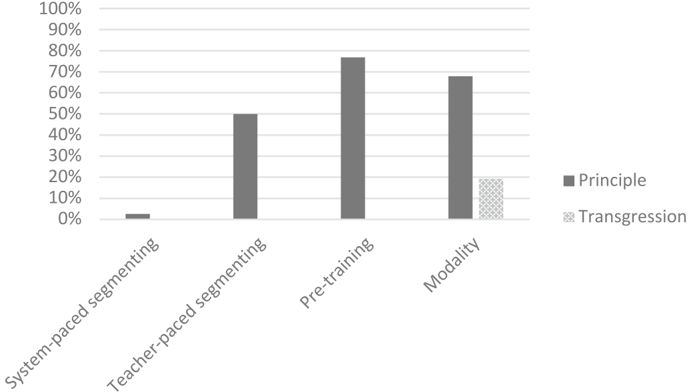
- Teachers actively implemented principles: pre-training in 76.9% of videos, teacher-paced segmentation in 44.9%, and teacher-added generative activities in 44.9%. Video length did not significantly influence teacher-paced segmenting (χ²(1, N = 78) = 0.033, p = 0.856).
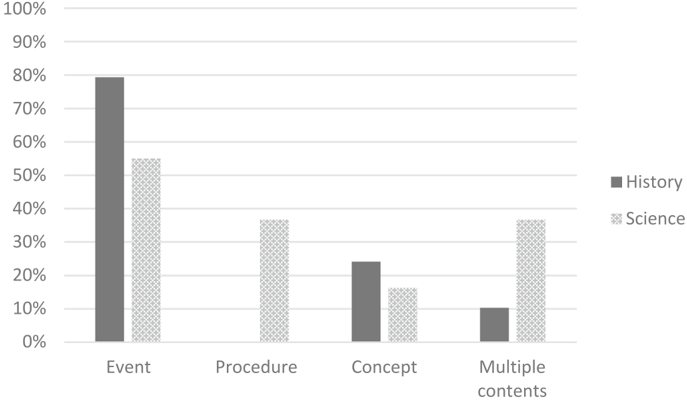
- Content types differed by discipline: modeling (n = 13) and demonstrations (n = 11) were used only in science; documentaries were almost exclusively history (history n = 23, science n = 1); explanations of procedures were exclusively science, while events and concepts occurred in both subjects.
Methods
- Qualitative design review of 78 instructional videos (29 history, 49 science) selected by secondary teachers; snowball sampling yielded 12 consenting teachers, 8 valid respondents, 91 videos shared, 13 excluded, final N = 78; videos had been watched by students in the 18 months preceding the study.
- Data included video metadata (teacher-added principles, timing, track, source), teacher demographics, TAM technology acceptance, and multimedia-principle alignment; videos were coded with a CTML-based codebook (23 deductive codes plus 13 inductive codes) in Atlas.ti, with >90% inter-coder agreement on 14.11% (n = 11) before independent coding.
- Descriptive analyses were computed in Jamovi; cross-tabs, chi-square, and Fisher’s exact tests examined relationships such as teacher-paced segmenting and video length.
Limitations
- Stated: the sample limits generalization to the participating teachers’ subjects and grade levels, and the study should be repeated with other subjects and schooling levels. Coding was sometimes difficult with yes/no options, especially for coherence and background music; the study does not test the validity of the principles in authentic materials or their effects on learning outcomes or cognitive load.
- Evident from the text: only 8 teachers provided valid data, sampling was snowball-based, and teacher-added principle data rely on self-report; no student learning outcomes or cognitive load measures were collected, so the alignment findings are descriptive rather than causal.
Model-written summary. Check it against the paper before relying on it.
Integrity signals
Registry
Cites
Statistics
Figures

Verification
Claims the paper makes
1 Valid · 1 Not valid · 21 Not checked · 78 Own results and interpretations
At least one cited source doesn’t support this claim or points to a different paper, and none confirmed it — see the verdicts below.
In the paper
“The immersion principle, which is inherent to virtual reality (Mayer, 2020) and 3D, was absent from all the videos.”
§ From Research to Practice: Are Multimedia Principles Present in Instructional Videos Used by Teachers in Science and History? > 3.3.3 Fostering Generative Processing
What the sources say
- Disputedcites Mayer, 2020 matched to “Multimedia Learning” (2020) sourceExperimental — accuracy not yet measured
Our copy of Mayer's 'Multimedia Learning' (section: Multimedia Learning) states a closed list — 'Our research provides evidence for nine principles of multimedia design: multimedia, spatial contiguity, temporal contiguity, coherence, modality, redundancy, pre-training, signaling, and personalization' — and each is then defined (e.g., Signaling/Personalization in 'Additional information'); no immersion principle appears, so the copy is contrary to attributing one to this work. The same copy defines multimedia as 'the presentation of material using both words and pictures,' describable in terms of delivery media, presentation mode, or sensory modalities — never immersion, virtual reality, or 3D (searched: 'immersion principle virtual reality', 'virtual reality immersive 3D head-mounted display presence', 'list of principles of multimedia design'). The remainder of the citing sentence (that the principle was absent from all the videos) is the citing authors' own assessment and not judged here. (LLM, conf=0.65)
Checked by a reasoning model — may be wrong.
plain- Asserted: passes — The authors put it forward as true.
- Checkable: passes — It can be checked against evidence.
- Load-bearing: unclear — It is unclear whether the paper’s conclusions depend on it.
- Based: passes — The paper gives a reason why it holds.
- Disputed
The cited sources support only part of this claim — read each source’s verdict below.
In the paper
“However, our qualitative analysis also identified that there was a cumulative presence of at least one principle per category, in only approximately 30% of the videos, although this should theoretically be the aim of instructional videos (Mayer, 2020).”
§ From Research to Practice: Are Multimedia Principles Present in Instructional Videos Used by Teachers in Science and History? > 4.1 Correspondence Between the Video Sample and Multimedia Design Principles
What the sources say
- Partly supportedcites Mayer, 2020 matched to “Multimedia Learning” (2020) sourceExperimental — accuracy not yet measured
Our copy of Mayer's Multimedia Learning supports the general normative half of the attribution: in the 'Multimedia Learning' section it defines a multimedia instructional message as 'a communication using words and pictures that is intended to promote learning' (with computer examples given as narration and animation) and states that 'Multimedia messages that are designed in light of how the human mind works are more likely to lead to meaningful learning that those that are not,' followed by nine evidence-based design principles (multimedia, spatial/temporal contiguity, coherence, modality, redundancy, pre-training, signaling, personalization) each with theoretical and empirical rationale. But it never addresses instructional videos as a medium, never organises the principles into 'categories,' and never frames principle-compliance as the aim a video should meet — the citing sentence's 'at least one principle per category ... the aim of instructional videos' is the authors' own extension of the book's guidance for multimedia messages generally. Searches for 'instructional video', 'categories' of principles and 'aim of instruction' returned only the same principle-summary passages, so the video/category framing is absent from our copy. (LLM, conf=0.66)
plain- Asserted: passes — The authors put it forward as true.
- Checkable: passes — It can be checked against evidence.
- Load-bearing: passes — The paper’s conclusions depend on it.
- Based: passes — The paper gives a reason why it holds.
- Partly supported
A result the paper reports from its own data — it cites no other source for it, so there is none to check. The quote shows it is in the paper.
In the paper
“Reports (history n = 1, science n = 1) and popularization programs (history n = 5, science n = 23) were used in both subjects.”
§ From Research to Practice: Are Multimedia Principles Present in Instructional Videos Used by Teachers in Science and History? > 3.2 Videos' Overall Descriptive
plainn = 2- Asserted: passes — The authors put it forward as true.
- Checkable: passes — It can be checked against evidence.
- Load-bearing: unclear — It is unclear whether the paper’s conclusions depend on it.
- Based: passes — The paper gives a reason why it holds.
A result the paper reports from its own data — it cites no other source for it, so there is none to check. The quote shows it is in the paper.
In the paper
“In this case, the principle was followed in 76.9% of the videos in the sample.”
§ From Research to Practice: Are Multimedia Principles Present in Instructional Videos Used by Teachers in Science and History? > 3.3.2 Managing Essential Processing
plainn = 78- Asserted: passes — The authors put it forward as true.
- Checkable: passes — It can be checked against evidence.
- Load-bearing: unclear — It is unclear whether the paper’s conclusions depend on it.
- Based: passes — The paper gives a reason why it holds.
A result the paper reports from its own data — it cites no other source for it, so there is none to check. The quote shows it is in the paper.
In the paper
“The analyses showed that at least one of these principles was present in 88.5% of the videos.”
§ From Research to Practice: Are Multimedia Principles Present in Instructional Videos Used by Teachers in Science and History? > 3.3.1 Reducing Extraneous Processing
plain- Asserted: passes — The authors put it forward as true.
- Checkable: passes — It can be checked against evidence.
- Load-bearing: passes — The paper’s conclusions depend on it.
- Based: passes — The paper gives a reason why it holds.
34 more claims
Create a free account to see all 101 claims and to verify the 29 references still open.
- Probably not a substantial claim. 31
- It may state two separate claims as one. 33
- The quote only partly states this claim. 1
Statistics recomputed
Every reported test result, recomputed from its test statistic and degrees of freedom. A result shows as not adding up only once an independent check has confirmed it.
- Consistentχ²(1) = 0.033reported p = .856 · recomputed p = .856
“X 2 (1, N = 78) = 0.033, p = .856”
Self-check
Percentages, sums and reported differences re-computed from the paper’s own numbers.
Each contradiction between two passages listed here was confirmed by an independent check.
Rated minor: it would not touch a result — a value no result rests on, a p-value that stays on the same side of the significance level, or a conflict that is clerical, resolved elsewhere in the paper, or outside its own findings.
In the paper
§ From Research to Practice: Are Multimedia Principles Present in Instructional Videos Used by Teachers in Science and History? > 4.1 Correspondence Between the Video Sample and Multimedia Design Principles
“Our research shows the same results with approximatively 90% of the analyzed sample following at least one of the multimedia design principles.”
§ From Research to Practice: Are Multimedia Principles Present in Instructional Videos Used by Teachers in Science and History? > 3.3 Multimedia Principles in Videos
“Finally, one video did not follow any multimedia design principles.”
Rated minor: it would not touch a result — a value no result rests on, a p-value that stays on the same side of the significance level, or a conflict that is clerical, resolved elsewhere in the paper, or outside its own findings.
In the paper
§ From Research to Practice: Are Multimedia Principles Present in Instructional Videos Used by Teachers in Science and History? > 3.3 Multimedia Principles in Videos
“Seven of the videos did not follow the multimedia principle, as they contained images without any written or oral text.”
§ From Research to Practice: Are Multimedia Principles Present in Instructional Videos Used by Teachers in Science and History? > 3.3.2 Managing Essential Processing
“The principle was considered absent in 12.9% of the videos; these particular videos only featured a single medium (pictorial).”
Rated minor: it would not touch a result — a value no result rests on, a p-value that stays on the same side of the significance level, or a conflict that is clerical, resolved elsewhere in the paper, or outside its own findings.
In the paper
§ From Research to Practice: Are Multimedia Principles Present in Instructional Videos Used by Teachers in Science and History? > 3.1 Teachers' Demographic Data
“used it often [3.67;5.00], and were willing to use it in the future [3.50; 5.00].Ease of use showed greater variability between teachers [2.75; 4.50].Although overall lower, their attitudes toward technology were positive [3.25; 4.00].”
§ From Research to Practice: Are Multimedia Principles Present in Instructional Videos Used by Teachers in Science and History? > Appendix 1 Codebook (translated from original version)
“Teacher Perceived utility Perceived ease of use Attitude toward use Behavioral intention Use 1 5.00 3.00 2.00 4.00 4.00 2 4.00 4.00 4.00 5.00 4.00 3 5.00 4.00 4.00 5.00 4.00 4 4.00 3.00 2.00 5.00 3.00 5 4.00 4.00 4.00 4.00 3.00 6 4.00 4.00 3.00 4.00 4.00 7 4.00 4.00 3.00 5.00 3.00 8 4.00 3.00 3.00 5.00 4.00”
Citations
Cites
(2001) · Cited by 13,930
Baddeley, A. D., & Hitch, G. (1974) · Psychology of Learning and Motivation · doi:10.1016/s0079-7421(08)60452-1 · Cited by 9,860
Mayer, R. E. (2009) · doi:10.1017/cbo9780511811678 · Cited by 7,800 · cited 2×
“These principles are part of the cognitive theory of multimedia learning (CTML) (Mayer, 2001, 2009, 2020).”
Mayer, R. (2020) · doi:10.1017/9781316941355 · Cited by 7,777
The episodic buffer: a new component of working memory?
Baddeley, A. (2000) · Trends in Cognitive Sciences · doi:10.1016/s1364-6613(00)01538-2 · Cited by 7,359 · cited 1×
“…is built on three assumptions based on cognitive science: (a) information is processed simultaneously through an auditory and a visual channel (Baddeley, 2000; Clark & Paivio, 1991) (b) working memory has a limited capacity (Baddeley, 2012; Bad-deley & Hitch, 1974), and (c) generative…”
Multimedia Learning. Second Edition.
Mayer, R. E. (2009) · Cambridge University Press eBooks · Cited by 4,587
Working Memory: Theories, Models, and Controversies
Baddeley, A. (2012) · Annual Review of Psychology · doi:10.1146/annurev-psych-120710-100422 · Cited by 4,271
Nine Ways to Reduce Cognitive Load in Multimedia Learning
Mayer, R. E., & Moreno, R. (2003) · Educational Psychologist · doi:10.1207/s15326985ep3801_6 · Cited by 4,207
Cognitive load theory, learning difficulty, and instructional design
Sweller, J. (1994) · Learning and Instruction · doi:10.1016/0959-4752(94)90003-5 · Cited by 3,801 · cited 1×
“According to the CTML (Mayer, 2020) and the cognitive load theory (Paas & Sweller, 2021; Sweller, 1994), it is essential that multimedia materials incorporate elements that support the process that leads to meaningful learning and avoids overloading learners’ working memory.”
Mayer, R. E. (2001) · doi:10.1017/cbo9781139164603 · Cited by 2,304
Research works printed but not linked: 1
- Désiron, J. C., & Petko, D. (2022). Liens entre l'alignement des enseignants avec les principes multimédias et compétence perçue dans l'utilisation des technologies [Conference presentation]. Actualité de la Recherche en Education et en Formation, Lausanne, Suisse. https:// wp. unil. ch/ sief/
Cited by
Désiron, J. C., Schmitz, M.-L., & Petko, D. (2024) · Technology Knowledge and Learning · doi:10.1007/s10758-024-09770-1 · Cited by 55
Self-citationAchmad, N., Pomalato, S. W. D., Rahim, M., Djafri, N., & Hulukati, E. (2025) · Jurnal Konseling dan Pendidikan · doi:10.29210/1188400 · Cited by 8
Alpionita, I., & Baihaqi, M. (2025) · Journal of Elementary Education Research and Practice · doi:10.70376/b6hqvk31 · Cited by 4
The impact of video on military engineering learning in wartime
ЧИЖ, О., СМОЛІНСЬКИЙ, Ю., Винту, А., КІРЕТОВ, В., & Chmyr, V. (2024) · Revista Amazonia Investiga · doi:10.34069/ai/2024.81.09.20 · Cited by 3
Harefa, E., & Zega, N. A. (2026) · Jurnal Penelitian dan Pengkajian Ilmu Pendidikan e-Saintika · doi:10.36312/e-saintika.v10i1.3602 · Cited by 2
Désiron, J. C., Endres, T., & Schneider, S. (2026) · Frontiers in Psychology · doi:10.3389/fpsyg.2026.1795142 · Cited by 2
Self-citationYıldırım, Ş. U., & Sönmez, D. (2026) · Education and Information Technologies · doi:10.1007/s10639-026-14102-0 · Cited by 2
Lestari, S. W., Irfani, K. S., Lestari, W. F., Aristanti, W., & Khomidah, T. N. (2025) · Jurnal Pengabdian Masyarakat PGSD · doi:10.17509/jpm.v5i2.89630 · Cited by 2
Linking multimodal cohesion, gaze behaviour and learning outcome in educational videos
Schmidt-Borcherding, F., Thiele, L., & Bateman, J. A. (2025) · Visual Communication · doi:10.1177/14703572251332837 · Cited by 1
Dukewich, K. R., Garvin, K. A., & Symonds, C. I. (2025) · The Canadian Journal for the Scholarship of Teaching and Learning · doi:10.5206/cjsotlrcacea.2025.1.15078 · Cited by 1
Wahdaniyah, N., Husain, A., & Handayani, G. S. (2025) · Madako Elementary School · doi:10.56630/mes.v4i2.335
Sistematización para la Innovación: Aportes desde el aula
Jarrín, A. P. C., & Peralta, M. A. C. (2025) · doi:10.63624/risei.book-978-9942-596-45-1
Saludo, I. H., & Villanueva, H. D. (2026) · International Journal of Research and Innovation in Social Science · doi:10.47772/ijriss.2026.100300509
Cruz, N. H. C. D., Diaz, L. A. A. A., Diaz, J. G. G., Ibanita, E. M., Domingo, E. G., Santos, J. M., Faustino, J. B., & Perillo, A. E. (2026) · International Journal of Research Publication and Reviews · doi:10.55248/gengpi.07.0526.c1102
Pu, W., Park, S., Dore, R. A., Bonus, J. A., & Hassinger‐Das, B. (2026) · Computers & Education · doi:10.1016/j.compedu.2026.105673
Instructional video design in the process of developing massive open online courses
Lymarenko, V. (2026) · Pedagogical education theory and practice Psychology Pedagogy · doi:10.28925/2311-2409.2026.4510
Irsan, M., Husamah, & Restian, A. (2026) · Women Education and Social Welfare · doi:10.70211/wesw.v3i2.483
Nandiyanto, A. B. D., Susilawati, A., Farobie, O., Ximmateliyev, D., & Gayupova, S. K. (2026) · Journal of Technical Education and Training · doi:10.30880/jtet.2026.18.01.008
Christoforaki, M., Mavrikaki, E., & Galani, A. (2025) · Journal of Educational Innovations & Practices · doi:10.65933/25798f67
Martínez, M., & Rubio, J. C. M. (2026) · Retos · doi:10.47197/retos.v85.119976
Adekeye, B. A. (2026) · The Journal of Deaf Studies and Deaf Education · doi:10.1093/jdsade/enag069
F. MAIZIANI, M. (2025) · TPM Testing, psychometrics, methodology in applied psychology
Strategi Komunikasi Visual melalui Video Company Profile Khadijah Islamic School
Sholehah, U. I. A., & Nuryadi, N. (2025) · Jurnal Inosains (Desain Industri)
Pradipta, R. R., Mustaji, M., Setyaedhi, H. S., Diningrat, S. W. M., & Dewi, U. (2026) · EDUTECH Jurnal Inovasi Pendidikan Berbantuan Teknologi · doi:10.51878/edutech.v6i4.16190
AINI, T. A. N., & Febriana, M. (2026) · Digital Perspectives Journal on Education · doi:10.64780/dpje.v2i2.273
Metadata
- Authors
- La Torre, S., & Désiron, J. C.
- Affiliations
- University of Zurich (CH)
- Venue
- Technology, Knowledge and Learning
- Published
- 2024-07-08
- Volume
- 29
- Issue
- 4
- Pages
- 1993-2016
- ISSN
- 2211-1662 (ISSN-L)
- 2211-1670
- OpenAlex
- W4400428372
- Semantic Scholar
- a5711b1b554d405dde04ae195f4d107dfdab5eea
- Cited by
- 25
- References
- 76
- Citations by year
- 2026: 13 · 2025: 10 · 2024: 2
- FWCI
- 6.22
- Type
- journal article
- Language
- en
- Open access
- hybrid
- doi.org
- Licence
- cc-by
- creativecommons.org/licenses/by/4.0 (tdm)
- creativecommons.org/licenses/by/4.0 (vor)
- Locations
- Technology Knowledge and Learning (publishedVersion, cc-by)
- Archive ouverte UNIGE (University of Geneva) (submittedVersion, cc-by)
- Funders
- The University of Teacher Education, State of Vaud
- Topics
- Social Sciences › Psychology › Experimental and Cognitive Psychology › Visual and Cognitive Learning Processes
- Social Sciences › Psychology › Developmental and Educational Psychology › Innovative Teaching and Learning Methods
- Physical Sciences › Computer Science › Information Systems › Educational Technology and E-Learning
- Keywords
- multimedia design principles, educational videos, cognitive theory of multimedia learning, cognitive load, generative processing, secondary school teachers, science education, history education
About these checks
Registry, retraction, Cites and statistics results are computed, not judged, with one exception: a printed reference that no index lists is read once by a model before it counts as a citation error. Claims are extracted by a model and kept only when their quote appears verbatim in the text; each cited source is then checked, with a model’s help, for whether it says what the claim relies on. Those verdicts can be wrong — read the claim’s quote and the cited source before relying on one.
The claim verdicts this report counts are experimental: their accuracy is not yet measured.
A language model drew the claims from the paper on 2026-11-17, under version 3 of the claim definition (model deepseek-v4.1-flash, prompt extract-v3).
A second model labelled each claim on 2026-11-17 (model jev-1.13-20260917, definition revision gold-guideline-v0.2).
Cited sources are checked with a language model’s help (qwen3.8-omni-flash).
Statistics and arithmetic are recomputed, not judged.
Confidence bands are shown only for fields calibrated on our annotated test set. None is calibrated yet, so no band is shown.
What counts as a claim ›How we measure confidence ›How we check this ›
Are you an author, or do you see a problem with this page? Request a review
Data sources
Bibliographic data: Semantic Scholar, OpenAlex, Crossref.
Contains information from the Semantic Scholar Academic Graph Datasets, made available under the ODC Attribution License (ODC-BY 1.0).
Semantic Scholar’s data is described in: Kinney, R., et al. (2023). The Semantic Scholar Open Data Platform. arXiv:2301.10140.
