

Sleep Problems in Childhood and Borderline Personality Disorder Symptoms in Early Adolescence
Open accessThe DOI matches its Crossref record; 74 of the 76 references it cites were found in a registry or an index.
Abstract
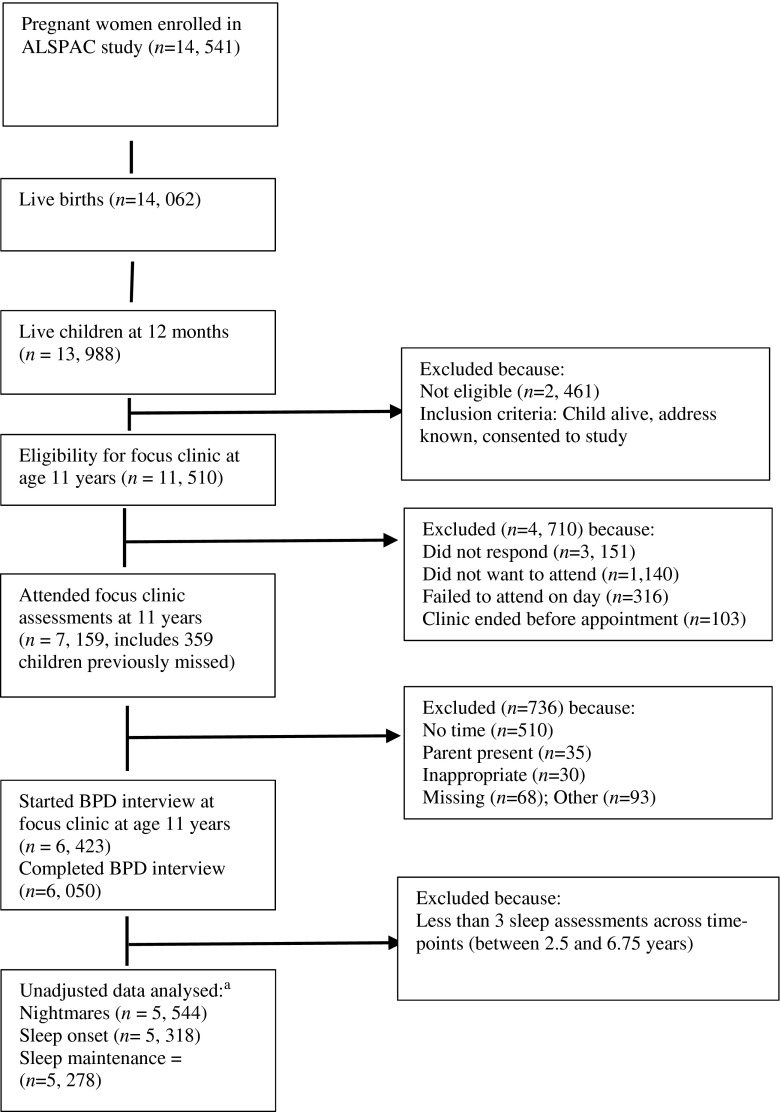
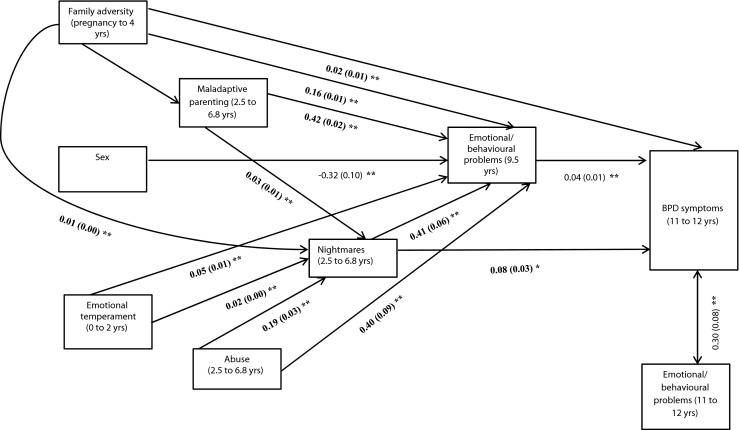
Sleep disorders, such as insomnia and nightmares, are commonly associated with Borderline Personality Disorder (BPD) in adulthood. Whether nightmares and sleep-onset and maintenance problems predate BPD symptoms earlier in development is unknown. We addressed this gap in the literature using data from the Avon Longitudinal Study of Parents and Children (ALSPAC). Participants included 6050 adolescents (51.4 % female) who completed the UK Childhood Interview for DSM-IV BPD at 11 to 12 years of age. Nightmares and sleep onset and maintenance problems were prospectively assessed via mother report when children were 2.5, 3.5, 4.8 and 6.8 years of age. Psychopathological (i.e., emotional temperament; psychiatric diagnoses; and emotional and behavioural problems) and psychosocial (i.e., abuse, maladaptive parenting, and family adversity) confounders were assessed via mother report. In logistic regressions, persistent nightmares (i.e., regular nightmares at 3 or more time-points) were significantly associated with BPD symptoms following adjustment for sleep onset and maintenance problems and all confounders (Adjusted Odds Ratio = 1.62; 95 % Confidence Interval = 1.12 to 2.32). Persistent sleep onset and maintenance problems were not significantly associated with BPD symptoms. In path analysis controlling for all associations between confounders, persistent nightmares independently predicted BPD symptoms (Probit co-efficient [β] = 0.08, p = 0.013). Emotional and behavioural problems significantly mediated the association between nightmares and BPD (β =0.016, p < 0.001), while nightmares significantly mediated associations between emotional temperament (β = 0.001, p = 0.018), abuse (β = 0.015, p = 0.018), maladaptive parenting (β = 0.002, p = 0.021) and subsequent BPD. These findings tentatively support that childhood nightmares may potentially increase the risk of BPD symptoms in early adolescence via a number of aetiological pathways. If replicated, the current findings could have important implications for early intervention, and assist clinicians in the identification of children at risk of developing BPD.
Overview
The claims and statistics of this paper haven’t been checked yet.
Free: it reads the open-access text and checks the first 5 claims that cite a source we can check. Create a free account to check every claim.
Integrity signals
Registry
Cites
Statistics
Figures
Verification
Claims the paper makes
The claims and statistics of this paper haven’t been checked yet.
Free: it reads the open-access text and checks the first 5 claims that cite a source we can check. Create a free account to check every claim.
Claims other papers make about this one
Each is checked against this paper’s own text: does it say what the citing paper says it does?
The cited source says what the claim attributes to it.
In the citing paper
“It also revealed a link between early child temperament and persistent nightmares, a finding that replicates a longitudinal study of 987 Quebec children (61) in which mother ratings of the child’s difficult temperament at 5 months and anxiety at 17 months predicted bad dreams at 29 months—bad dreams which then largely persisted until 6 years of age.”
From The Stress Acceleration Hypothesis of Nightmares (2017) · cites this paper as [60]
The cited source says what the claim attributes to it.
In the citing paper
“One longitudinal study of 6,050 UK children (60) demonstrated robust links between family adversity occurring from pregnancy to age 4 and later nightmares at ages 2.5–6.8 years.”
From The Stress Acceleration Hypothesis of Nightmares (2017) · cites this paper as [60]
Self-check
Percentages, sums and reported differences re-computed from the paper’s own numbers.
The self-check needs the paper’s full text.
Citations
Cites
Psychometric properties of the strengths and difficulties questionnaire
GOODMAN, R. (2001) · Journal of the American Academy of Child & Adolescent Psychiatry · doi:10.1097/00004583-200111000-00015 · Cited by 6,813
Equivalence of the Mediation, Confounding and Suppression Effect
MacKinnon, D. P., Krull, J. L., & Lockwood, C. M. (2000) · Prevention Science · doi:10.1023/a:1026595011371 · Cited by 4,188
Boyd, A., Golding, J., Macleod, J., Lawlor, D. A., Fraser, A., Henderson, J., Molloy, L., Ness, A., Ring, S., & Davey Smith, G. (2013) · International Journal of Epidemiology · doi:10.1093/ije/dys064 · Cited by 2,996
Salivary cortisol as a biomarker in stress research
Hellhammer, D. H., Wüst, S., & Kudielka, B. M. (2009) · Psychoneuroendocrinology · doi:10.1016/j.psyneuen.2008.10.026 · Cited by 1,925 · cited 5×
“In the first, traumatic events in childhood (i.e., abuse and harsh parenting) could alter Hypothalamic Pituitary Axis (HPA) functioning (Hellhammer et al. 2009) heightening the likelihood of nightmares (van Liempt et al. 2013) and subsequent BPD (Rinne et al. 2002).”
BackgroundInfluentialGoodman, R., Ford, T., Richards, H., Gatward, R., & Meltzer, H. (2000) · Journal of Child Psychology and Psychiatry · doi:10.1111/j.1469-7610.2000.tb02345.x · Cited by 1,755
Grant, B. F., Chou, S. P., Goldstein, R. B., Huang, B., Stinson, F. S., Saha, T. D., Smith, S. M., Dawson, D. S., Pulay, A. J., Pickering, R. P., et al. (2008) · The Journal of Clinical Psychiatry · doi:10.4088/jcp.v69n0404 · Cited by 1,618
Direct and Indirect Effects: Classical and Bootstrap Estimates of Variability
Bollen, K. A., & Stine, R. (1990) · Sociological Methodology · doi:10.2307/271084 · Cited by 1,305
Crowell, S. E., Beauchaine, T. P., & Linehan, M. M. (2009) · Psychological Bulletin · doi:10.1037/a0015616 · Cited by 1,292 · cited 14×
“In the second, an emotional temperament could increase the risk of nightmares, which if persistent, could potentiate dysregulation across time (Selby et al. 2013) until it becomes a trait-like constellation of BPD symptoms (Crowell et al. 2009).”
BackgroundMethodInfluentialComparing Logit and Probit Coefficients Across Groups
ALLISON, P. D. (1999) · Sociological Methods & Research · doi:10.1177/0049124199028002003 · Cited by 1,047
Revision of the Infant Temperament Questionnaire
Carey, W. B., & McDevitt, S. C. (1978) · Pediatrics · doi:10.1542/peds.61.5.735 · Cited by 742
Research works printed but not linked: 3
- Geiger T Crick N Ingram RE Price JM Developmental pathways to personality disorders Vulnerability to psychopathology, second edition: Risk across the lifespan 2010 New York Guilford Press 57 102
- Zanarini M Frankenburg F Sickel A Yong L The Diagnostic Interview for DSM-IV Personality Disorders (DIPD-IV) 1996 Belmont, MA McLean Hospital
- Zanarini M Horwood J Waylen A Wolke D The UK version of the childhood interview for DSM-IV borderline personality disorder (UK-CI-BPD) 2004 Bristol University of Bristol
Cited by
Borderline personality disorder
Bohus, M., Stoffers-Winterling, J., Sharp, C., Krause-Utz, A., Schmahl, C., & Lieb, K. (2021) · The Lancet · doi:10.1016/s0140-6736(21)00476-1 · Cited by 306
Dissociation and its disorders: competing models, future directions, and a way forward
Lynn, S. J., Maxwell, R., Merckelbach, H., Lilienfeld, S. O., Kloet, D. V. H.-V. D., & Miskovic, V. (2019) · Clinical Psychology Review · doi:10.1016/j.cpr.2019.101755 · Cited by 134
Winsper, C. (2018) · Current Opinion in Psychology · doi:10.1016/j.copsyc.2017.10.005 · Cited by 108
Self-citationSleep, screen time and behaviour problems in preschool children: an actigraphy study
Kahn, M., Schnabel, O., Gradisar, M., Rozen, G. S., Slone, M., Atzaba‐Poria, N., Tikotzky, L., & Sadeh, A. (2020) · European Child & Adolescent Psychiatry · doi:10.1007/s00787-020-01654-w · Cited by 91
The sleep phenotype of Borderline Personality Disorder: A systematic review and meta-analysis
Winsper, C., Tang, N. K. Y., Marwaha, S., Lereya, S. T., Gibbs, M., Thompson, A. D., & Singh, S. P. (2016) · Neuroscience & Biobehavioral Reviews · doi:10.1016/j.neubiorev.2016.12.008 · Cited by 81
Self-citation
Metadata
- Authors
- Lereya, S. T., Winsper, C., Tang, N. K. Y., & Wolke, D.
- Affiliations
- University of Warwick (GB)
- Corresponding author
- Winsper, Catherine
- Venue
- Journal of Abnormal Child Psychology
- Published
- 2016-04-25
- Volume
- 45
- Issue
- 1
- Pages
- 193-206
- ISSN
- 0091-0627 (ISSN-L)
- 1573-2835
- PMC
- PMC5219009
- OpenAlex
- W2343059447
- Cited by
- 65
- References
- 76
- Citations by year
- 2026: 2 · 2025: 5 · 2024: 7 · 2023: 4 · 2022: 7 · 2021: 14 · 2020: 9 · 2019: 7 · 2018: 4 · 2017: 4 · 2016: 2
- FWCI
- 7.99
- Type
- journal article
- Language
- en
- Open access
- hybrid
- doi.org
- Locations
- Research on Child and Adolescent Psychopathology (publishedVersion, cc-by)
- Europe PMC (PubMed Central) (publishedVersion, cc-by)
- PubMed Central (publishedVersion, cc-by)
- PubMed (publishedVersion)
- Warwick Research Archive Portal (University of Warwick) (acceptedVersion, cc-by)
- UCL Discovery (University College London) (submittedVersion)
- Funders
- Welcome Trust (102215/2/13/2)
- UK Medical Research Council
- Topics
- Social Sciences › Psychology › Experimental and Cognitive Psychology › Sleep and related disorders
- Social Sciences › Psychology › Clinical Psychology › Personality Disorders and Psychopathology
- Social Sciences › Psychology › Clinical Psychology › Child and Adolescent Psychosocial and Emotional Development
- Keywords
- borderline personality disorder, sleep disorders, insomnia, early adolescence, emotional and behavioral problems, emotional temperament, child abuse, maladaptive parenting, family adversity, risk factors, mediation
- MeSH terms
- Adolescent, Borderline Personality Disorder, Child, Dreams, England, Female, Humans, Longitudinal Studies, Male, Sleep Wake Disorders
About these checks
Registry, retraction, Cites and statistics results are computed, not judged, with one exception: a printed reference that no index lists is read once by a model before it counts as a citation error. Claims are extracted by a model and kept only when their quote appears verbatim in the text; each cited source is then checked, with a model’s help, for whether it says what the claim relies on. Those verdicts can be wrong — read the claim’s quote and the cited source before relying on one.
Statistics and arithmetic are recomputed, not judged.
Confidence bands are shown only for fields calibrated on our annotated test set. None is calibrated yet, so no band is shown.
What counts as a claim ›How we measure confidence ›How we check this ›
Are you an author, or do you see a problem with this page? Request a review
Data sources
Bibliographic data: Semantic Scholar, OpenAlex, Crossref.
Contains information from the Semantic Scholar Academic Graph Datasets, made available under the ODC Attribution License (ODC-BY 1.0).
Semantic Scholar’s data is described in: Kinney, R., et al. (2023). The Semantic Scholar Open Data Platform. arXiv:2301.10140.
