

Cognitive Bias Modification Reduces Social Anxiety Symptoms in Socially Anxious Adolescents with Mild Intellectual Disabilities: A Randomized Controlled Trial
Open accessThe DOI matches its Crossref record; 42 of the 42 references it cites were found in a registry or an index.
Abstract
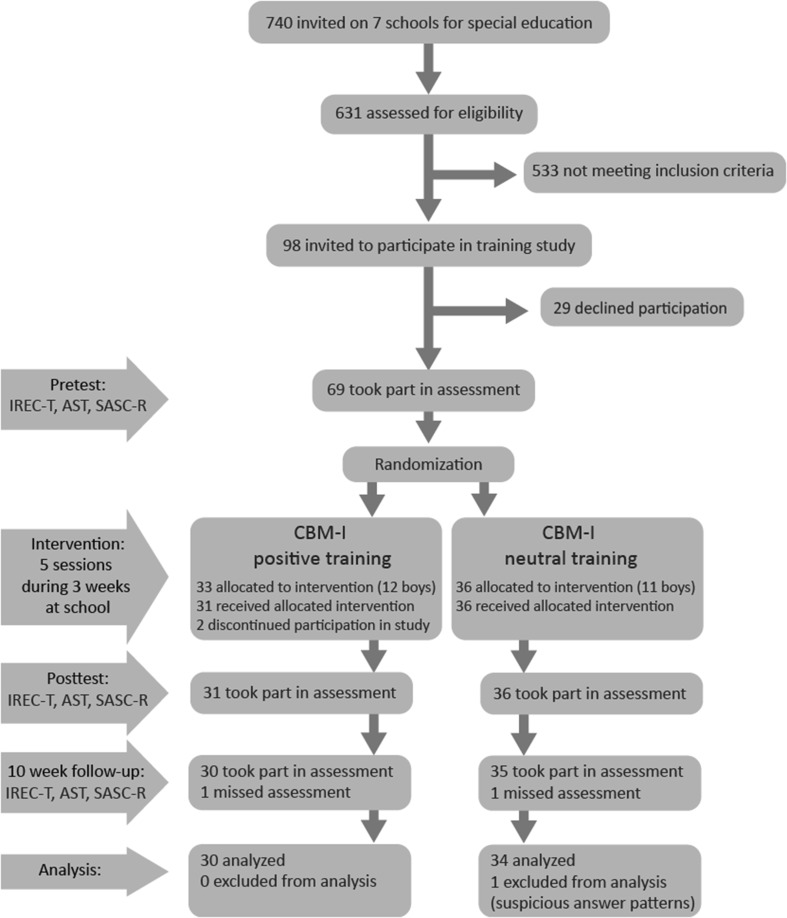
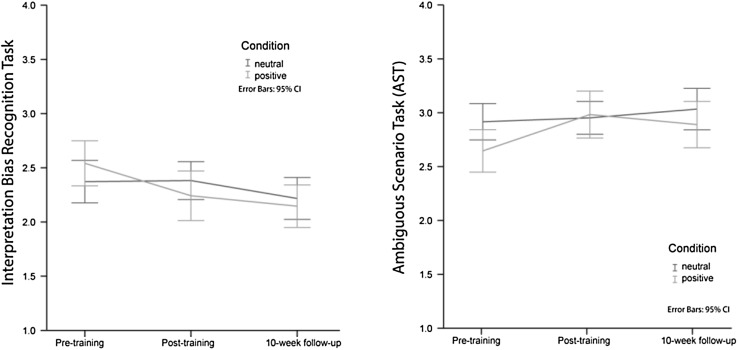
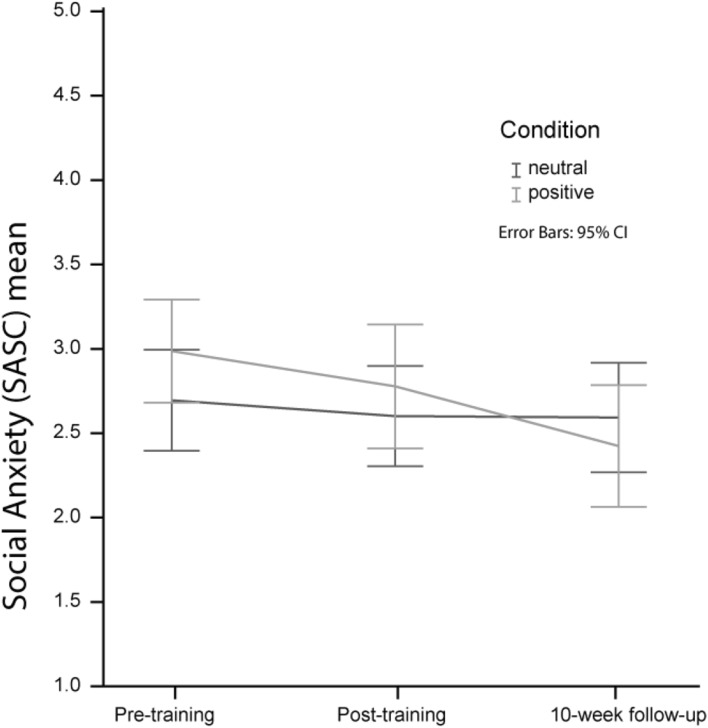
The goal of this study was to examine the effects of Cognitive Bias Modification training for Interpretation (CBM-I) in socially anxious adolescents with Mild Intellectual Disabilities (MID). A total of 69 socially anxious adolescents with MID were randomly assigned to either a positive or a neutral control-CMB-I-training. Training included five sessions in a 3-week period, and each session consisted of 40 training items. Adolescents in the positive training group showed a significant reduction in negative interpretation bias on the two interpretation bias tasks after training compared to adolescents in the control-training group. Furthermore, in contrast to the control-training group, adolescents in the positive training reported a significant reduction of their social anxiety symptoms 10 weeks post-training.
Overview
The claims and statistics of this paper haven’t been checked yet.
Free: it reads the open-access text and checks the first 5 claims that cite a source we can check. Create a free account to check every claim.
Integrity signals
Registry
Cites
Statistics
Figures
Verification
Claims the paper makes
The claims and statistics of this paper haven’t been checked yet.
Free: it reads the open-access text and checks the first 5 claims that cite a source we can check. Create a free account to check every claim.
Self-check
Percentages, sums and reported differences re-computed from the paper’s own numbers.
The self-check needs the paper’s full text.
Citations
Cites
Diagnostic and Statistical Manual of Mental Disorders
American Psychiatric Association (2013) · doi:10.1176/appi.books.9780890425596 · Cited by 116,369
Diagnostic and Statistical Manual of Mental Disorders
Williams, J. B. W., & First, M. (2013) · Encyclopedia of Social Work · doi:10.1093/acrefore/9780199975839.013.104 · Cited by 109,519
Kessler, R. C., Berglund, P., Demler, O., Jin, R., Merikangas, K. R., & Walters, E. E. (2005) · Archives of General Psychiatry · doi:10.1001/archpsyc.62.6.593 · Cited by 20,391 · cited 2×
“Social anxiety disorder is highly prevalent in adolescents and is reported as one of the most common forms of social distress in this population, also in adolescents with Mild Intellectual Disabilities (MID; Dekker and Koot 2003; Kessler et al.”
BackgroundA cognitive-behavioral model of anxiety in social phobia
Rapee, R. M., & Heimberg, R. G. (1997) · Behaviour Research and Therapy · doi:10.1016/s0005-7967(97)00022-3 · Cited by 2,987
(1985) · Cited by 2,882
A cognitive model of social phobia
Adrian Wells, A. (1995) · Research Explorer (The University of Manchester) · Cited by 2,701
Cognitive vulnerability to emotional disorders
Mathews, A., & MacLeod, C. (2005) · Annual Review of Clinical Psychology · doi:10.1146/annurev.clinpsy.1.102803.143916 · Cited by 2,100 · cited 1×
“Several underlying processes have been defined as maintaining and possibly causing anxiety disorders, including cognitive processes (for a review, see Mathews and MacLeod 2005).”
BackgroundAnxiety Disorders and Phobias: A Cognitive Perspective
Dietch, J. T. (1986) · Psychosomatics · doi:10.1016/s0033-3182(86)72726-6 · Cited by 1,505
Social Phobia: Diagnosis, Assessment, and Treatment
Amada, G. (1996) · American Journal of Psychotherapy · doi:10.1176/appi.psychotherapy.1996.50.3.373 · Cited by 1,248
Cognitive behavioural therapy for anxiety disorders in children and adolescents
James, A. C., James, G., Cowdrey, F. A., Soler, A., & Choke, A. (2015) · Cochrane Database of Systematic Reviews · doi:10.1002/14651858.cd004690.pub4 · Cited by 876
Research works printed but not linked: 3
- De Wit M Moonen X Douma J Richtlijn effectieve interventies LVB [Guideline Effective Treatments MID] 2012 Utrecht Landelijk Kenniscentrum LVB
- Klein, A. M. (2016). Unravelling the web of cognitions: Cognitive biases and fear-related behavior in childhood anxiety (doctoral thesis). Retrieved from Radboud. http://hdl.handle.net/2066/150188.
- Van Rijswijk CM Kool E van der Ploeg JD Het special onderwijs met zevenmijlslaarzen Orthopedagoagische werkvelden in Nederland 2002 Leuven/Apeldoorn Garant
Cited by
Siegel, M. S., McGuire, K., Veenstra-VanderWeele, J. M., Stratigos, K. A., King, B. H., Bellonci, C., Hayek, M., Keable, H., Rockhill, C., Bukstein, O. G., et al. (2019) · Journal of the American Academy of Child & Adolescent Psychiatry · doi:10.1016/j.jaac.2019.11.018 · Cited by 81
Mou, Q., Zhuang, J., Wu, Q., Zhong, Y., Dai, Q., Cao, X., Gao, Y., Lu, Q., & Zhao, M. (2024) · BMC Psychology · doi:10.1186/s40359-024-01635-7 · Cited by 47
Feng, T., Wang, B., Mi, M., Ren, L., Wu, L., Wang, H., Liu, X., & Wang, X. (2025) · Heliyon · doi:10.1016/j.heliyon.2025.e41869 · Cited by 43
Tapp, K., Vereenooghe, L., Hewitt, O. M., Scripps, E., Gray, K. M., & Langdon, P. E. (2023) · Comprehensive Psychiatry · doi:10.1016/j.comppsych.2023.152372 · Cited by 48
Klein, A. M., Houtkamp, E. O., Salemink, E., Baartmans, J. M. D., Rinck, M., & van der Molen, M. J. (2018) · Research in Developmental Disabilities · doi:10.1016/j.ridd.2018.05.016 · Cited by 27
Self-citationSchmidt, N. B., & Vereenooghe, L. (2021) · Behaviour Research and Therapy · doi:10.1016/j.brat.2021.103949 · Cited by 21
Rogers, J., & Sicouri, G. (2022) · Behavior Therapy · doi:10.1016/j.beth.2022.04.006 · Cited by 19
Subar, A. R., Humphrey, K., & Rozenman, M. S. (2021) · European Child & Adolescent Psychiatry · doi:10.1007/s00787-021-01740-7 · Cited by 22
“In contrast, two of those 12 studies used a forced-choice reaction time task—during which participants had to respond quickly (200–36,500 ms), 1 Seven studies met inclusion criteria 1 through 4 described above, but did not provide sufficient data to calculate effect sizes and were therefore excluded: [25–31] Two studi…”
ResultMao, N., Li, T., Li, C., Ding, R., Zhang, Q., & Cui, L. (2023) · Journal of Child and Family Studies · doi:10.1007/s10826-023-02619-8 · Cited by 10
“Several studies have revealed the significant effect of CBM-I on social anxiety (Klein et al., 2018; Lau & Eley, 2010; Reuland & Teachman, 2014).”
BackgroundA systematic review of treatments targeting cognitive biases in socially anxious adolescents
Biagianti, B., Conelea, C. A., Brambilla, P., & Bernstein, G. A. (2019) · Journal of Affective Disorders · doi:10.1016/j.jad.2019.12.002 · Cited by 10
“Two out of three of the studies reported an improvement in SA symptoms after CBMT-I (Klein et al., 2018; Reuland and Teachman, 2014), However, the small sample size (n = 18) in the Reuland and Teachman study and the inclusion of adolescents with mild intellectual disability in Klein and colleagues’s sample are factors…”
BackgroundLau, J. Y. F., Watkins-Muleba, R., Lee, I., Pile, V., & Hirsch, C. R. (2021) · BMC Psychiatry · doi:10.1186/s12888-021-03320-0 · Cited by 15
Schmidt, N. B., & Vereenooghe, L. (2020) · International Journal of Developmental Disabilities · doi:10.1080/20473869.2020.1720156 · Cited by 12
“In contrast, Klein et al. (2018) not only found evidence for near and far transfer of CBM-I treatment effects, as shown by interpretation bias improvements on two different bias measures, but also found self-reported social anxiety improvements at tenweek follow-up.”
BackgroundMethodResultInfluentialBiased Maintenance of Attention on Sad Faces in Clinically Depressed Youth: An Eye-Tracking Study
Buhl, C., Sfärlea, A., Löchner, J., Starman‐Wöhrle, K., Salemink, E., Schulte‐Körne, G., & Platt, B. (2021) · Child Psychiatry & Human Development · doi:10.1007/s10578-021-01229-z · Cited by 16
Self-citationWestera, J. J., van der Molen, M. J., & Schuengel, C. (2023) · Journal of Mental Health Research in Intellectual Disabilities · doi:10.1080/19315864.2023.2240732 · Cited by 8
“The materials reported here are part of a larger community-based project on anxiety in adolescents with MBID (Houtkamp, 2017; Klein et al., 2018a, 2018b).”
BackgroundPsychophysiological characteristics of anxiety and intellectual activity in childhood (review)
Gribanov, A. V., Депутат, И. С., Нехорошкова, А. Н., Кожевникова, И. С., Панков, М. Н., Iordanova, Y. A., Старцева, Л. Ф., & Ikonnikova, I. V. (2019) · Экология человека · doi:10.33396/1728-0869-2019-9-50-58 · Cited by 11
Wu, Z., Li, S., Chen, Z., & Nie, Y. (2024) · Behaviour Research and Therapy · doi:10.1016/j.brat.2024.104616 · Cited by 6
Remote W.A.R.A. Compared With Face-to-Face W.A.R.A.: A Pilot Study
Weerkamp-Bartholomeus, P., Marazziti, D., & van Amelsvoort, T. (2021) · Frontiers in Psychology · doi:10.3389/fpsyg.2020.620027 · Cited by 14
“, 2019), Cognitive Bias Modification (Klein et al., 2018; Kemps et al., 2019; Zhang et al., 2019), Mindfulness-Based Cognitive Therapy (Tickell et al.”
BackgroundSalemink, E., Hagen, A., de Haan, E., & Wolters, L. H. (2023) · Journal of Obsessive-Compulsive and Related Disorders · doi:10.1016/j.jocrd.2023.100809 · Cited by 4
Self-citationSocial Anxiety and Study Engagement in Adolescents: The Role of Self Cognition Model
Zhou, A., Yanbing, H., Guan, X., Chen, X., Lu, X., & Pan, T. (2019) · 2019 International Joint Conference on Information, Media and Engineering (IJCIME) · doi:10.1109/ijcime49369.2019.00049 · Cited by 3
“SA is considered the most frequent form of social distress among adolescents, and SA disorder is highly prevalent in adolescents [2].”
BackgroundMiller, M., Steuber, E. R., & Mcguire, J. F. (2024) · Psychiatric Clinics of North America · doi:10.1016/j.psc.2024.04.010 · Cited by 4
Dhakal, S., Gupta, S., Sharma, N. P., Upadhyay, A., Oliver, A., Sumich, A. L., Kumari, V., Niraula, S., Pandey, R., & Lau, J. Y. F. (2023) · Behaviour Research and Therapy · doi:10.1016/j.brat.2023.104267 · Cited by 3
Interpretation and Attentional Bias Training
Salemink, E., Wolters, L. H., & de Haan, E. (2019) · Cambridge University Press eBooks · doi:10.1017/9781108235655.018 · Cited by 4
Self-citationSchmidt, N. B., & Vereenooghe, L. (2021) · Current Developmental Disorders Reports · doi:10.1007/s40474-021-00239-9 · Cited by 3
Daniel, E. K., Johnco, C. J., & Sicouri, G. (2025) · Journal of Affective Disorders Reports · doi:10.1016/j.jadr.2025.100937 · Cited by 3
Conducting mental health assessments of people with learning disabilities
Kupara, D., & Woodward, P. R. (2023) · Learning Disability Practice · doi:10.7748/ldp.2023.e2218 · Cited by 1
Guidry, J., Ellison, K. S., Castagna, P. J., & Davis, T. E. (2020) · Autism and child psychopathology series · doi:10.1007/978-3-030-46835-4_27
Zhang, M. W., Chow, A., Vallabhajosyula, R., & Fung, D. S. S. (2020) · International Journal of Environmental Research and Public Health · doi:10.3390/ijerph17114028 · Cited by 1
“Of the three studies, one study [14] included 69 participants with mild to borderline intellectual impairments and another study [15] included 75 participants with a mixture of ADHD, ADHD and ASD, and ADHD and oppositional defiant disorder (ODD).”
BackgroundCONTRIBUIÇÃO DA CINOTERAPIA PARA PSICOTERAPIA EM IDOSOS INSTITUCIONALIZADOS
Corrêa, G. T., Araujo, M. N., Lourenço, C. H. L., Costa, D. B., Pereira, J. D. A., Serra, R. D. C. E. S., Fonteles, T. F., & Santana, L. N. (2021) · doi:10.22533/at.ed.63721070712
A IMPORTÂNCIA DA PSICOLOGIA JURÍDICA NOS PROCESSOS JUDICIAIS DE ALIENAÇÃO PARENTAL
da Silveira, F. M., Castro, A. B. S., Barbosa, E. D. L., da Silva, V. A., & Santos, V. L. S. (2021) · doi:10.22533/at.ed.63721070715
PSICOSES, FAMÍLIA E ARTE: MEIOS PARA PSICOEDUCAÇÃO DE FAMILIARES PELA ARTE
dos Santos, B. L., Nogueira, A. A., & de Meis, C. (2021) · doi:10.22533/at.ed.63721070716
LUTO PERINATAL: OS DANOS PSICOLÓGICOS CAUSADOS PELAS PERDAS GESTACIONAL E NEONATAL
Santos, L. D. S., Damasceno, R. A., de Farias, R. R. S., & Souza, S. C. (2021) · doi:10.22533/at.ed.63721070713
Docasar, D., Silva, A. D. S., Silva, D. C. D. S., Lima, G. V. D. S., & Barboza, R. M. (2021) · doi:10.22533/at.ed.63721070719
(2020) · Al-Mağallah Al-ʿilmiyyaẗ Li Kulliyyaẗ Al-Tarbiyyaẗ - Ǧāmiʿaẗ Awadī Al-Ǧadīd/Al-Mağallah Al-ʿilmiyyaẗ Li Kulliyyaẗ Al-Tarbiyyaẗ - Ǧāmiʿaẗ El-Wadī Al-Ǧadīd · doi:10.21608/sjsw.2020.209113
Westera, J. J., van der Molen, M. J., & Schuengel, C. (2025) · Journal of Intellectual Disability Research · doi:10.1111/jir.13242 · Cited by 2
Vrinzen, S., Everaert, J., & Salemink, E. (2026) · Behavior Therapy · doi:10.1016/j.beth.2026.01.004
Self-citation
Metadata
- Authors
- Klein, A. M., Salemink, E., de Hullu, E., Houtkamp, E., Papa, M., & van der Molen, M.
- Affiliations
- Vrije Universiteit Amsterdam (NL)
- University of Amsterdam (NL)
- Corresponding author
- Klein, Anke M.
- Venue
- Journal of Autism and Developmental Disorders
- Published
- 2018-04-21
- Volume
- 48
- Issue
- 9
- Pages
- 3116-3126
- ISSN
- 0162-3257 (ISSN-L)
- 1573-3432
- PMC
- PMC6096836
- OpenAlex
- W2802172266
- Cited by
- 35
- References
- 42
- Citations by year
- 2026: 1 · 2025: 3 · 2024: 3 · 2023: 6 · 2022: 1 · 2021: 11 · 2020: 4 · 2019: 5 · 2018: 1
- FWCI
- 6.88
- Type
- journal article
- Language
- en
- Open access
- hybrid
- doi.org
- Licence
- cc-by
- creativecommons.org/licenses/by/4.0 (tdm)
- Locations
- Journal of Autism and Developmental Disorders (publishedVersion, cc-by)
- Europe PMC (PubMed Central) (publishedVersion, cc-by)
- PubMed Central (publishedVersion, cc-by)
- PubMed (publishedVersion)
- DSpace (Open University in the Netherlands) (publishedVersion, cc-by)
- VU Research Portal (publishedVersion, other-oa)
- Data Archiving and Networked Services (DANS) (submittedVersion, cc-by)
- UvA-DARE (University of Amsterdam) (submittedVersion, cc-by)
- Utrecht University Repository (Utrecht University) (submittedVersion, other-oa)
- DSpace (Open University in the Netherlands) (submittedVersion, cc-by)
- Data Archiving and Networked Services (DANS) (submittedVersion, other-oa)
- Funders
- Vrije Universiteit Amsterdam
- Fonds Psychische Gezondheid
- ‘s HeerenLoo
- Topics
- Social Sciences › Psychology › Experimental and Cognitive Psychology › Anxiety, Depression, Psychometrics, Treatment, Cognitive Processes
- Social Sciences › Psychology › Clinical Psychology › Psychological Treatments and Assessments
- Life Sciences › Neuroscience › Cognitive Neuroscience › Autism Spectrum Disorder Research
- Keywords
- cognitive bias modification, interpretation bias, social anxiety, adolescents, mild intellectual disability, social anxiety symptoms, cognitive training
- MeSH terms
- Adolescent, Anxiety, Cognition, Fear, Female, Humans, Male, Intellectual Disability, Motivation, Netherlands, Cognitive Behavioral Therapy
About these checks
Registry, retraction, Cites and statistics results are computed, not judged, with one exception: a printed reference that no index lists is read once by a model before it counts as a citation error. Claims are extracted by a model and kept only when their quote appears verbatim in the text; each cited source is then checked, with a model’s help, for whether it says what the claim relies on. Those verdicts can be wrong — read the claim’s quote and the cited source before relying on one.
Statistics and arithmetic are recomputed, not judged.
Confidence bands are shown only for fields calibrated on our annotated test set. None is calibrated yet, so no band is shown.
What counts as a claim ›How we measure confidence ›How we check this ›
Are you an author, or do you see a problem with this page? Request a review
Data sources
Bibliographic data: Semantic Scholar, OpenAlex, Crossref.
Contains information from the Semantic Scholar Academic Graph Datasets, made available under the ODC Attribution License (ODC-BY 1.0).
Semantic Scholar’s data is described in: Kinney, R., et al. (2023). The Semantic Scholar Open Data Platform. arXiv:2301.10140.
