

The DOI matches its Crossref record; 39 of the 39 references it cites were found in a registry or an index.
Algal cultivation in urban wastewater: an efficient way to reduce pharmaceutical pollutants
Open accessAbstract
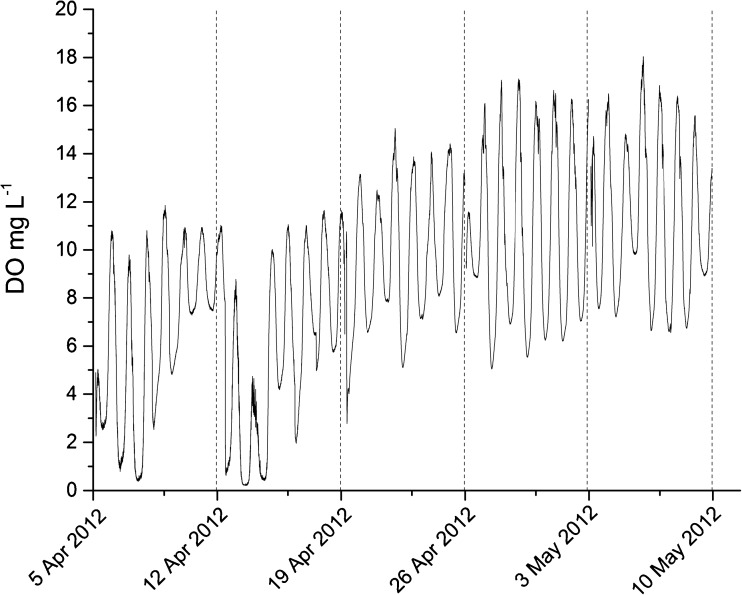
The purpose of this study was to investigate whether pharmaceutical pollutants in urban wastewater can be reduced during algal cultivation. A mixed population of wild freshwater green algal species was grown on urban wastewater influent in a 650 L photobioreactor under natural light and with the addition of flue gases. Removal efficiencies were very high (>90 %), moderate (50-90 %), low (10-50 %), and very low or non-quantifiable (<10 %) for 9, 14, 11, and 18 pharmaceuticals, respectively, over a 7-day period. High reduction was found in the following pharmaceuticals: the beta-blockers atenolol, bispropol, and metoprolol; the antibiotic clarithromycine; the antidepressant bupropion; the muscle relaxant atracurium; hypertension drugs diltiazem and terbutaline used to relive the symptoms of asthma. Regression analysis did not detect any relationship between the reduction in pharmaceutical contents and light intensity reaching the water surface of the algal culture. However, the reduction was positively correlated with light intensity inside the culture and stronger when data collected during the night were excluded. Algae cultivation can remove partially or totally pharmaceutical pollutants from urban wastewater, and this opens up new possibilities for treating urban wastewater.
Overview
The claims and statistics of this paper haven’t been checked yet.
Run the check — free, no account needed. It reads the open-access text and checks the sources it cites.
Integrity signals
Registry
Cites
Statistics
Figures
Verification
Claims the paper makes
The claims and statistics of this paper haven’t been checked yet.
Run the check — free, no account needed. It reads the open-access text and checks the sources it cites.
Claims other papers make about this one
Each is checked against this paper’s own text: does it say what the citing paper says it does?
In the citing paper
“In addition, several studies have explored the integration of algal cultivation with wastewater [130,131] and CO 2 -rich waste gases [132,133] to enhance algal biomass accumulation and improve carbon capture efficiency while mitigating environmental impacts.”
From A Review of Algae-Based Carbon Capture, Utilization, and Storage (Algae-Based CCUS) (2024) · cites this paper as [130]
Self-check
Percentages, sums and reported differences re-computed from the paper’s own numbers.
The self-check needs the paper’s full text.
Citations
Cites
Verlicchi, P., Al Aukidy, M., & Zambello, E. (2012) · Science of The Total Environment · doi:10.1016/j.scitotenv.2012.04.028 · Cited by 2,183
Collapse of a fish population after exposure to a synthetic estrogen
Kidd, K. A., Blanchfield, P. J., Mills, K. H., Palace, V. P., Evans, R. E., Lazorchak, J. M., & Flick, R. W. (2007) · Proceedings of the National Academy of Sciences · doi:10.1073/pnas.0609568104 · Cited by 2,102
Ecotoxicological aspects related to the presence of pharmaceuticals in the aquatic environment
Santos, L. H. M. L. M., Araújo, A. N., Fachini, A., Pena, A., Delerue-Matos, C. M., & Montenegro, M. C. B. S. M. (2009) · Journal of Hazardous Materials · doi:10.1016/j.jhazmat.2009.10.100 · Cited by 1,638
The Potential of Sustainable Algal Biofuel Production Using Wastewater Resources
Pittman, J. K., Dean, A. P., & Osundeko, O. (2011) · Bioresource Technology · doi:10.1016/j.biortech.2010.06.035 · Cited by 1,526
Pharmaceuticals and Personal Care Products in the Environment: What Are the Big Questions?
Boxall, A. B. A., Rudd, M. A., Brooks, B. W., Caldwell, D. J., Choi, K., Hickmann, S., Innes, E., Ostapyk, K., Staveley, J. P., Verslycke, T. A., et al. (2012) · Environmental Health Perspectives · doi:10.1289/ehp.1104477 · Cited by 1,418
Radjenović, J., Petrović, M., & Barceló, . (2008) · Water Research · doi:10.1016/j.watres.2008.11.043 · Cited by 1,290
CO2 bio-mitigation using microalgae
Wang, B., Li, Y., Wu, N., & Lan, C. Q. (2008) · Applied Microbiology and Biotechnology · doi:10.1007/s00253-008-1518-y · Cited by 1,271
Loos, R., Carvalho, R., António, D. C., Comero, S., Locoro, G., Tavazzi, S., Paracchini, B., Ghiani, M., Lettieri, T., Blaha, L., et al. (2013) · Water Research · doi:10.1016/j.watres.2013.08.024 · Cited by 1,193
Self-citationRawat, I., Ranjith Kumar, R., Mutanda, T., & Bux, F. (2011) · Applied Energy · doi:10.1016/j.apenergy.2010.11.025 · Cited by 1,185
Wastewater treatment high rate algal ponds for biofuel production
Park, J. B. K., Craggs, R. J., & Shilton, A. N. (2010) · Bioresource Technology · doi:10.1016/j.biortech.2010.06.158 · Cited by 1,155
Cited by
Sorted by citations
Samal, K., Mahapatra, S., & Ali, M. H. (2022) · Energy Nexus · doi:10.1016/j.nexus.2022.100076 · Cited by 804
Microalgal bioremediation of emerging contaminants-Opportunities and challenges
Sutherland, D. L., & Ralph, P. J. (2019) · Water Research · doi:10.1016/j.watres.2019.114921 · Cited by 524
Removal of emerging contaminants from wastewater using advanced treatments. A review
Morin‐Crini, N., Lichtfouse, É., Fourmentin, M., Ribeiro, A. R., Noutsopoulos, C., Mapelli, F., Fenyvesi, É., Vieira, M. G. A., Picos‐Corrales, L. A., Moreno‐Piraján, J. C., et al. (2022) · Environmental Chemistry Letters · doi:10.1007/s10311-021-01379-5 · Cited by 447
Hejna, M., Kapuścińska, D., & Aksmann, A. (2022) · International Journal of Environmental Research and Public Health · doi:10.3390/ijerph19137717 · Cited by 303
Mustafa, S., Bhatti, H. N., Maqbool, M., & Iqbal, M. (2021) · Journal of Water Process Engineering · doi:10.1016/j.jwpe.2021.102009 · Cited by 256
Metadata
- Authors
- Gentili, F. G., & Fick, J.
- Affiliations
- Swedish University of Agricultural Sciences (SE)
- Umeå University (SE)
- Corresponding author
- Gentili, Francesco G.
- Venue
- Journal of Applied Phycology
- Published
- 2016-09-03
- Volume
- 29
- Issue
- 1
- Pages
- 255-262
- ISSN
- 0921-8971 (ISSN-L)
- 1573-5176
- PMC
- PMC5346144
- OpenAlex
- W2510704615
- Cited by
- 168
- References
- 39
- Citations by year
- 2026: 11 · 2025: 12 · 2024: 25 · 2023: 18 · 2022: 15 · 2021: 33 · 2020: 26 · 2019: 16 · 2018: 6 · 2017: 6
- FWCI
- 5.10
- Type
- journal article
- Language
- en
- Open access
- hybrid
- doi.org
- Locations
- Journal of Applied Phycology (publishedVersion, cc-by)
- PubMed Central (publishedVersion, cc-by)
- PubMed (publishedVersion)
- Funders
- Swedish Energy Agency
- Topics
- Physical Sciences › Environmental Science › Pollution › Pharmaceutical and Antibiotic Environmental Impacts
- Physical Sciences › Energy › Renewable Energy, Sustainability and the Environment › Algal biology and biofuel production
- Physical Sciences › Environmental Science › Waste Management and Disposal › Constructed Wetlands for Wastewater Treatment
- Keywords
- pharmaceutical pollutants, municipal wastewater, algae cultivation, wastewater treatment, photobioreactors, freshwater green algae, light intensity, flue gas, beta-blockers, clarithromycin, bupropion, atracurium, diltiazem, terbutaline, atenolol, metoprolol, pollutant removal
About these checks
Registry, retraction, Cites and statistics results are computed, not judged, with one exception: a printed reference that no index lists is read once by a model before it counts as a citation error. Claims are extracted by a model and kept only when their quote appears verbatim in the text; each cited source is then checked, with a model’s help, for whether it says what the claim relies on. Those verdicts can be wrong — read the claim’s quote and the cited source before relying on one.
Statistics and arithmetic are recomputed, not judged.
Confidence bands are shown only for fields calibrated on our annotated test set. None is calibrated yet, so no band is shown.
What counts as a claim ›How we measure confidence ›How we check this ›
Are you an author, or do you see a problem with this page? Request a review
