

Enhanced single-diode model parameter extraction method for photovoltaic cells and modules based on integrating genetic algorithm, particle swarm optimization, and comparative objective functions
Open accessThe DOI matches its Crossref record; 46 of the 46 references it cites were found in a registry or an index.
Abstract
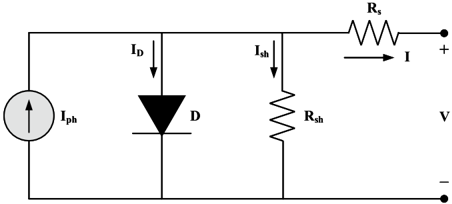
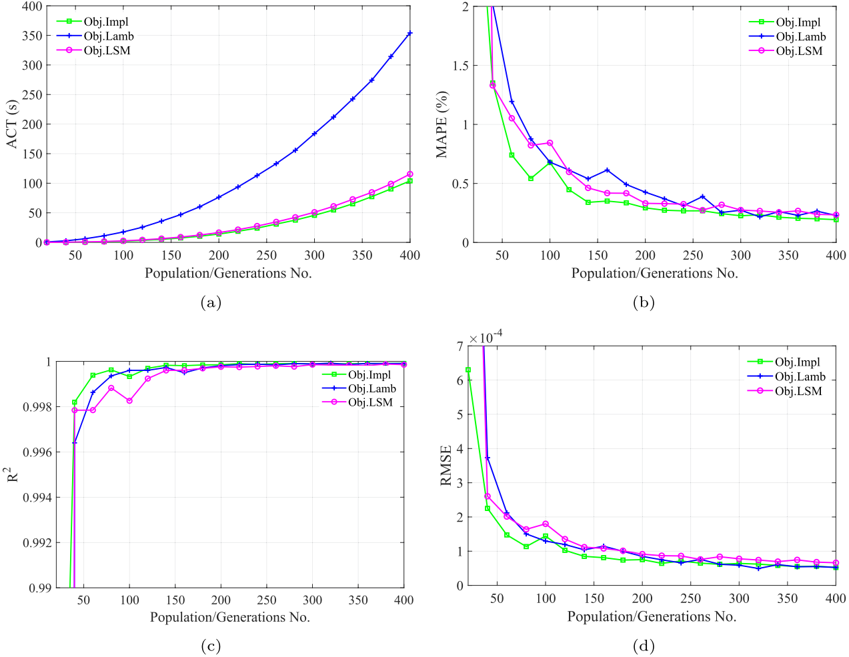
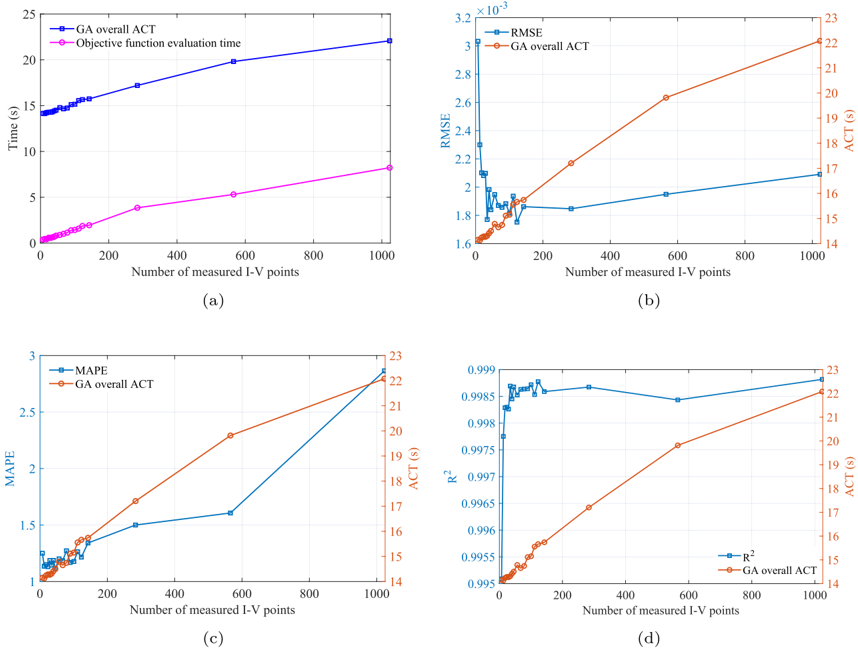
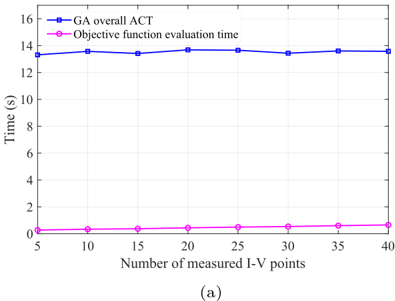
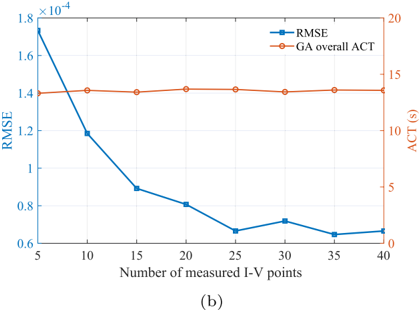
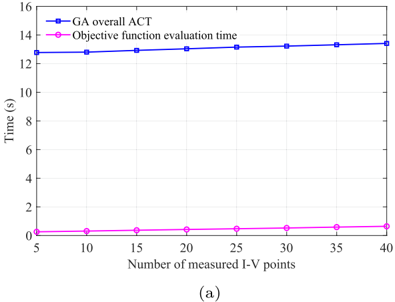
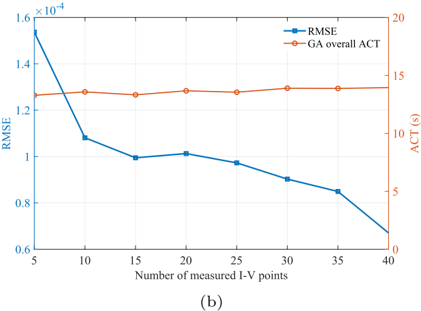
Accurate modeling of the operational behavior of photovoltaic systems is crucial to optimizing and predicting system performance. One of the well-established and widely used modeling techniques is the single-diode equivalent circuit that delivers a sufficiently accurate description of the electric behavior of both photovoltaic cells and modules under various operational conditions. The single-diode model uses five parameters to reproduce the I-V curve for specific operational conditions. However, these five parameters must be extracted from measured or simulated I-V curves. This paper proposes a novel, accurate, and fast method for extracting the single-diode model’s five parameters from measured I-V curves based on a genetic algorithm combined with particle swarm optimization to find the optimal controlling parameters of the genetic algorithm. This approach results in a significant performance improvement in accuracy and convergence speed. The paper also proposes a concept for determining the optimum number of current–voltage data points in the I-V curve, enabling an optimum trade-off between a sufficiently high accuracy and computational costs. Finally, the effect of different objective function formulations on the result has been investigated by comparing the usage of three different objective functions: the implicit form of the single-diode model, the Lambert W-function-based formulation of the explicit single-diode model, and a system of equations based on least square fitting. From the results, it could be concluded that the implicit formulation of the single-diode model delivered the best results compared to the two other formulations. Performance evaluations showed significantly lower error values than recent literature, with mean percent errors of 0.038%, 0.34%, and 0.87% received for the investigated monocrystalline cell, poly-crystalline module, and amorphous module, respectively. The computational cost was reduced by more than 60% after determining the optimum number of I-V points per curve, which was in the range of 20–30 points for each measured curve.
Overview
The claims and statistics of this paper haven’t been checked yet.
Free: it reads the open-access text and checks the first 5 claims that cite a source we can check. Create a free account to check every claim.
Integrity signals
Registry
Cites
Statistics
Figures
Verification
Claims the paper makes
The claims and statistics of this paper haven’t been checked yet.
Free: it reads the open-access text and checks the first 5 claims that cite a source we can check. Create a free account to check every claim.
Self-check
Percentages, sums and reported differences re-computed from the paper’s own numbers.
The self-check needs the paper’s full text.
Citations
Cites
An Algorithm for Least-Squares Estimation of Nonlinear Parameters
Marquardt, D. W. (1963) · Journal of the Society for Industrial and Applied Mathematics · doi:10.1137/0111030 · Cited by 30,728 · cited 1×
“One of the most well-regarded curve fitting and error quantifying techniques is the least square method (LSM) [41].”
A Fast Elitist Non-dominated Sorting Genetic Algorithm for Multi-objective Optimization: NSGA-II
Deb, K., Agrawal, S., Pratap, A., & Meyarivan, T. (2000) · Lecture Notes in Computer Science · doi:10.1007/3-540-45356-3_83 · Cited by 5,289
Parameter selection in particle swarm optimization
Shi, Y., & Eberhart, R. C. (1998) · Lecture Notes in Computer Science · doi:10.1007/bfb0040810 · Cited by 3,538
Chan, D. S. H., & Phang, J. C. H. (1987) · IEEE Transactions on Electron Devices · doi:10.1109/t-ed.1987.22920 · Cited by 694 · cited 1×
“In the DDM, two diodes are used to model two phenomena separately [4–7].”
Exact analytical solutions of the parameters of real solar cells using Lambert W-function
Jain, A. (2004) · Solar Energy Materials and Solar Cells · doi:10.1016/j.solmat.2003.11.018 · Cited by 560 · cited 1×
“It expresses the current as a function of the voltage and other physical parameters [37–39].”
Zagrouba, M., Sellami, A., Bouaïcha, M., & Ksouri, M. (2010) · Solar Energy · doi:10.1016/j.solener.2010.02.012 · Cited by 445
ORTIZCONDE, A., GARCIASANCHEZ, F., & MUCI, J. (2006) · Solar Energy Materials and Solar Cells · doi:10.1016/j.solmat.2005.04.023 · Cited by 433 · cited 1×
“Researchers sometimes consider the functional expression derived from the original transcendental format as a practical and efficient computational substitute [40]. where W is the principal branch of the Lambert W-func-tion.”
Characterization of PV panel and global optimization of its model parameters using genetic algorithm
Ismail, M. S., Moghavvemi, M., & Mahlia, T. M. I. (2013) · Energy Conversion and Management · doi:10.1016/j.enconman.2013.03.033 · Cited by 337
Particle Swarm Optimization and Intelligence: Advances and Applications
Parsopoulos, K. E., & Vrahatis, M. N. (2010) · Advances in Computational Intelligence and Robotics · doi:10.4018/978-1-61520-666-7 · Cited by 333 · cited 1×
“PSO is an effective solving algorithm widely used in both academia and the industry [44–46].”
Solar photovoltaic system modeling and performance prediction
Ma, T., Yang, H., & Lu, L. (2014) · Renewable and Sustainable Energy Reviews · doi:10.1016/j.rser.2014.04.057 · Cited by 323 · cited 1×
“The number of cells in a PV module connected in series and parallel should be included in the mathematical expression as follows [14–16]: where N s and N p are the number of cells connected in series or parallel, respectively.”
Nishioka, K., Sakitani, N., Uraoka, Y., & Fuyuki, T. (2007) · Solar Energy Materials and Solar Cells · doi:10.1016/j.solmat.2007.04.009 · Cited by 301 · cited 1×
“[ 8, 9].”
A new hybrid bee pollinator flower pollination algorithm for solar PV parameter estimation
Ram, J. P., Babu, T. S., Dragicevic, T., & Rajasekar, N. (2017) · Energy Conversion and Management · doi:10.1016/j.enconman.2016.12.082 · Cited by 263
On the Parameter Extraction of a Five-Parameter Double-Diode Model of Photovoltaic Cells and Modules
Hejri, M., Mokhtari, H., Azizian, M. R., Ghandhari, M., & Soder, L. (2014) · IEEE Journal of Photovoltaics · doi:10.1109/jphotov.2014.2307161 · Cited by 261
Sandrolini, L., Artioli, M., & Reggiani, U. (2010) · Applied Energy · doi:10.1016/j.apenergy.2009.07.022 · Cited by 231
Cubas, J., Pindado, S., & De Manuel, C. (2014) · Energies · doi:10.3390/en7074098 · Cited by 207 · cited 1×
“Power estimation of photovoltaic (PV) systems using accurate and reliable electrical modeling under different environmental conditions is essential to ensure system performance and cost-effectiveness [1–3].”
Genetic Algorithm: Theory, Literature Review, and Application in Image Reconstruction
Mirjalili, S., Song Dong, J., Sadiq, A. S., & Faris, H. (2020) · Studies in Computational Intelligence · doi:10.1007/978-3-030-12127-3_5 · Cited by 196 · cited 1×
“The genetic algorithm is widely recognized as one of the fastest and most highly regarded evolutionary algorithms in the literature [42, 43].”
Parameter estimation of photovoltaic system using imperialist competitive algorithm
Fathy, A., & Rezk, H. (2017) · Renewable Energy · doi:10.1016/j.renene.2017.04.014 · Cited by 189
Gao, X., Cui, Y., Hu, J., Xu, G., & Yu, Y. (2016) · Energy Conversion and Management · doi:10.1016/j.enconman.2016.09.005 · Cited by 159 · cited 1×
“This equation’s implicit transcendental nature is based on the fact that neither the cell current nor its voltage can be explicitly expressed as a function of elementary terms [36].”
Parameters extraction of solar cells – A comparative examination of three methods
Appelbaum, J., & Peled, A. (2014) · Solar Energy Materials and Solar Cells · doi:10.1016/j.solmat.2013.11.011 · Cited by 151
A genetic algorithm for identifying the single diode model parameters of a photovoltaic panel
Bastidas‐Rodríguez, J. D., Petrone, G., Ramos‐Paja, C. A., & Spagnuolo, G. (2015) · Mathematics and Computers in Simulation · doi:10.1016/j.matcom.2015.10.008 · Cited by 149 · cited 4×
“• In none of the reviewed papers did the authors mention or address the impact of the number of points in each I-V curve on the computational cost, except for [30].”
InfluentialEt-Torabi, K., Nassar-Eddine, I., Obbadi, A., Errami, Y., Rmaily, R., Sahnoun, S., Fajri, A. E., & Agunaou, M. (2017) · Energy Conversion and Management · doi:10.1016/j.enconman.2017.06.064 · Cited by 149
Parameter Estimation of Three Diode Photovoltaic Model Using Grasshopper Optimization Algorithm
Elazab, O. S., Hasanien, H. M., Alsaidan, I. S., Abdelaziz, A. Y., & Muyeen, S. M. (2020) · Energies · doi:10.3390/en13020497 · Cited by 139 · cited 1×
“[ 8, 9].”
Parameter estimation of solar PV models with a new proposed war strategy optimization algorithm
Ayyarao, T. S. L. V., & Kumar, P. P. (2022) · International Journal of Energy Research · doi:10.1002/er.7629 · Cited by 134
A new explicit double-diode modeling method based on Lambert W-function for photovoltaic arrays
Lun, S., Wang, S., Yang, G.-H., & Guo, T. (2015) · Solar Energy · doi:10.1016/j.solener.2015.03.043 · Cited by 124 · cited 1×
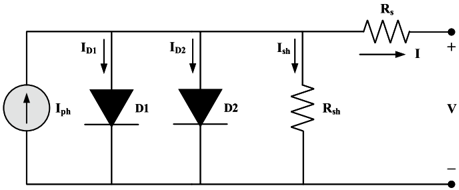
“In the DDM, two diodes are used to model two phenomena separately [4–7].”
Qais, M. H., Hasanien, H. M., & Alghuwainem, S. (2020) · Energy Conversion and Management · doi:10.1016/j.enconman.2020.112904 · Cited by 116 · cited 1×
“…s e d op ti m i ze r T h e a dop t e d t h r ee m od i fi e d e qu i v a l e n t c i r c u it s s ho w m o r e acc u r a t e r e s u lt s t h a n t h e t r a d iti on a l on e s [ 20 ] T D M T h e ob j ec ti v e f un c ti on i s f o r m u l a t e d b a s e d on t h e d a t a - s h ee t v a l u e s”
Dizqah, A. M., Maheri, A., & Busawon, K. (2014) · Renewable Energy · doi:10.1016/j.renene.2014.07.014 · Cited by 109
A simple method for extracting the parameters of the PV cell single-diode model
Rhouma, M. B. H., Gastli, A., Ben‐Brahim, L., Touati, F., & Benammar, M. A. (2017) · Renewable Energy · doi:10.1016/j.renene.2017.06.064 · Cited by 109 · cited 2×
“• Our reported average results are better than the best results presented in the references [10, 29, 30, 32, 48] and comparable to the best of the other references.”
Toledo, F. J., & Blanes, J. M. (2016) · Renewable Energy · doi:10.1016/j.renene.2016.02.012 · Cited by 87 · cited 1×
“However, the Lambert W-function itself is implicitly defined; therefore, a numerical iterative method or optimization algorithm is required to minimize such an objective function [11].”
Ridha, H. M., Hizam, H., Mirjalili, S., Othman, M. L., Ya’acob, M. E., & Ahmadipour, M. (2022) · Renewable and Sustainable Energy Reviews · doi:10.1016/j.rser.2022.112436 · Cited by 82 · cited 1×
“Power estimation of photovoltaic (PV) systems using accurate and reliable electrical modeling under different environmental conditions is essential to ensure system performance and cost-effectiveness [1–3].”
Abbassi, A., Gammoudi, R., Dami, M. A., Hasnaoui, O., & Jemli, M. (2017) · Solar Energy · doi:10.1016/j.solener.2017.06.057 · Cited by 81 · cited 1×
“• Our reported average results are better than the best results presented in the references [10, 29, 30, 32, 48] and comparable to the best of the other references.”
An Efficient Heap-Based Optimizer for Parameters Identification of Modified Photovoltaic Models
AbdElminaam, D. S., Houssein, E. H., Said, M., Oliva, D. A., & Nabil, A. M. (2022) · Ain Shams Engineering Journal · doi:10.1016/j.asej.2022.101728 · Cited by 69
Chenche, L. E. P., Mendoza, O. S. H., & Filho, Ê. P. B. (2017) · Renewable and Sustainable Energy Reviews · doi:10.1016/j.rser.2017.06.089 · Cited by 59
Tifidat, K., Maouhoub, N., Benahmida, A., & Salah, F. E. A. (2022) · Energy Conversion and Management X · doi:10.1016/j.ecmx.2022.100205 · Cited by 57
Evaluation of different methods for solar cells/modules parameters extraction
Abdulrazzaq, A. K., Bognár, G., & Plesz, B. (2019) · Solar Energy · doi:10.1016/j.solener.2019.12.010 · Cited by 56 · cited 1×
“A comprehensive review of the existing extraction methods can be found in [17, 18].”
Self-citationAccurate method for PV solar cells and modules parameters extraction using I–V curves
Abdulrazzaq, A. K., Bognár, G., & Plesz, B. (2020) · Journal of King Saud University - Engineering Sciences · doi:10.1016/j.jksues.2020.07.008 · Cited by 51 · cited 3×
“Comparing the results presented in our current paper to the values reported in [18], (shown in Table 6), the following points can be noted: • Considering the ACT, our current presented method shows a significant improvement compared to the reference.”
Self-citationParameter identification of solar photovoltaic cell and module models via supply demand optimizer
Shaheen, A. M., El-Sehiemy, R. A., Xiong, G., Elattar, E. E., & Ginidi, A. R. (2022) · Ain Shams Engineering Journal · doi:10.1016/j.asej.2022.101705 · Cited by 51
Ridha, H. M., Hizam, H., Mirjalili, S., Othman, M. L., Ya’acob, M. E., Ahmadipour, M., & Ismaeel, N. Q. (2022) · Energy Conversion and Management · doi:10.1016/j.enconman.2022.115403 · Cited by 46
Parameter extraction of solar cell using intelligent grey wolf optimizer
Saxena, A., Sharma, A., & Shekhawat, S. (2020) · Evolutionary Intelligence · doi:10.1007/s12065-020-00499-1 · Cited by 45
Comparative analysis of old, recycled and new PV modules
Ashfaq, H., Hussain, I., & Giri, A. (2014) · Journal of King Saud University - Engineering Sciences · doi:10.1016/j.jksues.2014.08.004 · Cited by 41 · cited 1×
“The number of cells in a PV module connected in series and parallel should be included in the mathematical expression as follows [14–16]: where N s and N p are the number of cells connected in series or parallel, respectively.”
Liu, B., Liu, X., Li, D., Shi, Y., Fernandez, G., & Wang, Y. (2020) · ISPRS International Journal of Geo-Information · doi:10.3390/ijgi9040251 · Cited by 37 · cited 1×
“• Ramer-Douglas-Peucker (R-D-P) Algorithm: As outlined in the literature [47], the R-D-P algorithm keeps more data points in areas with sharp curves and fewer points in relatively straight sections.”
A non-iterative MPPT of PV array with online measured short circuit and open circuit quantities
Vijayakumari, A. (2020) · Journal of King Saud University - Engineering Sciences · doi:10.1016/j.jksues.2020.04.007 · Cited by 32
Identification study of solar cell/module using recent optimization techniques
El‐Dabah, M. A., El-Sehiemy, R. A., Ebrahim, M. A., Alaas, Z. M., & Ramadan, M. M. (2022) · International Journal of Power Electronics and Drive Systems/International Journal of Electrical and Computer Engineering · doi:10.11591/ijece.v12i2.pp1189-1198 · Cited by 18
Gude, S., Jana, K. C., Laudani, A., & Thanikanti, S. B. (2022) · Solar Energy · doi:10.1016/j.solener.2022.05.007 · Cited by 18 · cited 1×
“…w t h a t e x t r ac ti ng t h e p a r a m e t e r s o f t h e S D M u s i ng t h e P S O - b a s e d m e t hod i m p r ov e s p e rf o r m a n ce [ 22 ] T h e i m p li c it f o r m o f t h e S D M GA m od e l ou t p e rf o r m s t h e o t h e r m e t hod s , w it h a f a vo r a b l e b a l a n ce…”
A New Soft Computing-Based Parameter Estimation of Solar Photovoltaic System
Bisht, R., & Sikander, A. (2021) · Arabian Journal for Science and Engineering · doi:10.1007/s13369-021-06209-y · Cited by 17
Muhammadsharif, F. F., & Hashim, S. (2023) · Arabian Journal for Science and Engineering · doi:10.1007/s13369-023-07860-3 · Cited by 13 · cited 1×
“The SDM balances solution complexity and precision by reducing the number of parameters required by increasing the number of diodes [10–13].”
Five PV Model Parameters Determination Through PSO and Genetic Algorithm, a Comparative Study
Rezki, M., Bensaid, S., Griche, I., & Houassine, H. (2019) · Lecture notes in networks and systems · doi:10.1007/978-3-030-37207-1_2 · Cited by 4 · cited 1×
“• Our reported average results are better than the best results presented in the references [10, 29, 30, 32, 48] and comparable to the best of the other references.”
Research works printed but not linked: 5
- 12. Ayodele, T., Ogunjuyigbe, A., Ekoh, E.: Evaluation of numeri- cal algorithms used in extracting the parameters of a single- diode photovoltaic model. Sustain. Energy Technol. Assess. 13, 51-59 (2016)
- 21. Abdalla, A.O.M., Ibrahim, A.A.Z.: Modeling single diode pv using particle swarm optimization (pso ) techniques. Gaziosmanpaşa Bilimsel Araştırma Derg. 11(1), 44-56 (2022)
- 38. Plesz, B.: Investigation of the Temperature Dependence of Thin Photoactive Layer Crystalline Silicon Solar Cells. PhD thesis, Budapest University of Technology and Economics (2016)
- 39. Abdulrazzaq, A.K.: Electro-thermal modeling of photovoltaic (PV) systems. In: Spring Wind 2018, pp. 17-29. Association of Hungarian PhD and DLA students, Györ (2018)
- 45. Jarboui, B., Damak, N., Siarry, P., Rebai, A.: A combinatorial particle swarm optimization for solving multi-mode resource- constrained project scheduling problems. Appl. Math. Comput. 195(1), 299-308 (2008)
Cited by
Polymer–Perovskite Microcrystal Heterojunction for Self-Powered Optical Sensing and Communication
Sathyanarayana, S., & Das, B. C. (2026) · Advanced Materials · doi:10.1002/adma.202517950 · Cited by 7
Chaves, R. R., Oliveira, A. F., Rubinger, R. M., & da Silva, A. J. (2025) · Electronics · doi:10.3390/electronics14173342 · Cited by 7
Malik, M. N., Zhao, Q., & Wang, S. (2026) · Energies · doi:10.3390/en19030754 · Cited by 6
Predictive Energy Storage Management with Redox Flow Batteries in Demand-Driven Microgrids
Benavides, D., Arévalo-Cordero, P., Ochoa-Correa, D., Valverde, L. D. T., & Ríos, A. (2025) · Sustainability · doi:10.3390/su17198915 · Cited by 5
Tummala, A. S. L. V., Kishore, G. I., Dev, A., & Siddaraj, U. (2026) · Scientific Reports · doi:10.1038/s41598-025-32437-5 · Cited by 5
“To address the drawbacks of the basic genetic algorithm and PSO, an enhanced hybrid algorithm combining the genetic algorithm and PSO is proposed in 11 for accurate parameter estimation.”
Metadata
- Authors
- Abdulrazzaq, A. K., Bognár, G., & Plesz, B.
- Affiliations
- Thi Qar University (IQ)
- Budapest University of Technology and Economics (HU)
- Corresponding author
- Abdulrazzaq, Ali Kareem
- Venue
- Journal of Computational Electronics
- Published
- 2025-02-10
- Volume
- 24
- Issue
- 2
- ISSN
- 1569-8025 (ISSN-L)
- 1572-8137
- OpenAlex
- W4407305893
- Semantic Scholar
- 8553fa1980614bb6263c67c67a8d7732e3109256
- Cited by
- 25
- References
- 46
- Citations by year
- 2026: 18 · 2025: 7
- FWCI
- 3.47
- Type
- journal article
- Language
- en
- Open access
- hybrid
- doi.org
- Licence
- cc-by
- creativecommons.org/licenses/by/4.0 (tdm)
- creativecommons.org/licenses/by/4.0 (vor)
- Locations
- Journal of Computational Electronics (publishedVersion, cc-by)
- Funders
- Technische Universität Chemnitz
- Topics
- Physical Sciences › Energy › Renewable Energy, Sustainability and the Environment › Photovoltaic System Optimization Techniques
- Physical Sciences › Energy › Renewable Energy, Sustainability and the Environment › Solar Radiation and Photovoltaics
- Physical Sciences › Computer Science › Artificial Intelligence › Metaheuristic Optimization Algorithms Research
- Keywords
- single-diode model, parameter extraction, solar cells, photovoltaic modules, current-voltage characteristics, genetic algorithm, particle swarm optimization, hybrid optimization, objective function, Lambert W function, least squares fitting
About these checks
Registry, retraction, Cites and statistics results are computed, not judged, with one exception: a printed reference that no index lists is read once by a model before it counts as a citation error. Claims are extracted by a model and kept only when their quote appears verbatim in the text; each cited source is then checked, with a model’s help, for whether it says what the claim relies on. Those verdicts can be wrong — read the claim’s quote and the cited source before relying on one.
Statistics and arithmetic are recomputed, not judged.
Confidence bands are shown only for fields calibrated on our annotated test set. None is calibrated yet, so no band is shown.
What counts as a claim ›How we measure confidence ›How we check this ›
Are you an author, or do you see a problem with this page? Request a review
Data sources
Bibliographic data: Semantic Scholar, OpenAlex, Crossref.
Contains information from the Semantic Scholar Academic Graph Datasets, made available under the ODC Attribution License (ODC-BY 1.0).
Semantic Scholar’s data is described in: Kinney, R., et al. (2023). The Semantic Scholar Open Data Platform. arXiv:2301.10140.
