

The DOI matches its Crossref record; 28 of the 28 references it cites were found in a registry or an index.
A Model for Creating a Supportive Trauma-Informed Culture for Children in Preschool Settings
Open accessAbstract
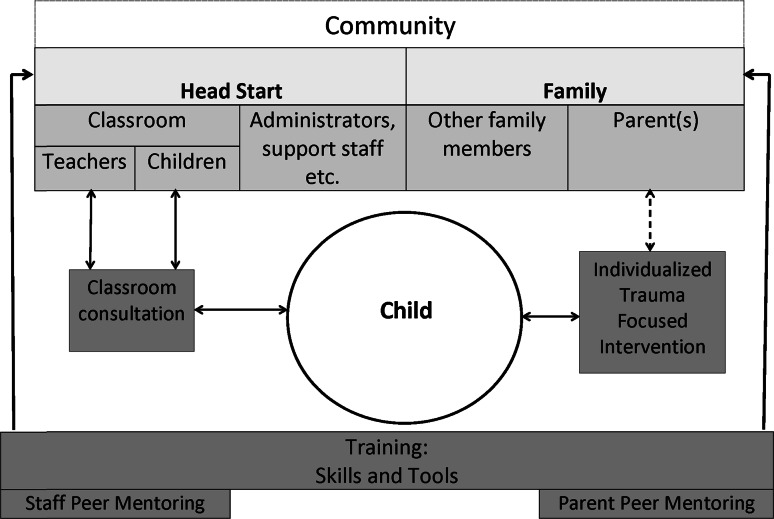
The all too common exposure of young children to traumatic situations and the life-long consequences that can result underscore the need for effective, developmentally appropriate interventions that address complex trauma. This paper describes Head Start Trauma Smart (HSTS), an early education/mental health cross-systems partnership designed to work within the child's natural setting-in this case, Head Start classrooms. The goal of HSTS is to decrease the stress of chronic trauma, foster age-appropriate social and cognitive development, and create an integrated, trauma-informed culture for young children, parents, and staff. Created from a community perspective, the HSTS program emphasizes tools and skills that can be applied in everyday settings, thereby providing resources to address current and future trauma. Program evaluation findings indicate preliminary support for both the need for identification and intervention and the potential to positively impact key outcomes.
Overview
The claims and statistics of this paper haven’t been checked yet.
Run the check — free, no account needed. It reads the open-access text and checks the sources it cites.
Integrity signals
Registry
Cites
Statistics
Figures
Verification
Claims the paper makes
The claims and statistics of this paper haven’t been checked yet.
Run the check — free, no account needed. It reads the open-access text and checks the sources it cites.
Self-check
Percentages, sums and reported differences re-computed from the paper’s own numbers.
The self-check needs the paper’s full text.
Citations
Cites
Felitti, V. J., Anda, R. F., Nordenberg, D., Williamson, D. F., Spitz, A. M., Edwards, V., Koss, M. P., & Marks, J. S. (1998) · American Journal of Preventive Medicine · doi:10.1016/s0749-3797(98)00017-8 · Cited by 18,943
Child abuse: Adolescent records vs. adult recall
Femina, D. D., Yeager, C. A., & Lewis, D. O. (1990) · Child Abuse & Neglect · doi:10.1016/0145-2134(90)90033-p · Cited by 8,820
Complex Trauma in Children and Adolescents
Cook, A., Spinazzola, J., Ford, J., Lanktree, C., Blaustein, M., Cloitre, M., DeRosa, R., Hubbard, R., Kagan, R., Liautaud, J., et al. (2005) · Psychiatric Annals · doi:10.3928/00485713-20050501-05 · Cited by 1,619
Treating Trauma and Traumatic Grief in Children and Adolescents
Cohen, J. A., Mannarino, A. P., & Deblinger, E. (2006) · Cited by 1,199
Violence, Abuse, and Crime Exposure in a National Sample of Children and Youth
Finkelhor, D., Turner, H. A., Ormrod, R. K., & Hamby, S. L. (2009) · PEDIATRICS · doi:10.1542/peds.2009-0467 · Cited by 1,105
A Mental Health Intervention for Schoolchildren Exposed to Violence: A Randomized Controlled Trial
Stein, B. D., Jaycox, L. H., Kataoka, S. H., Wong, M., Tu, W., Elliott, M. N., & Fink, A. (2003) · JAMA · doi:10.1001/jama.290.5.603 · Cited by 751 · cited 1×
“Minority children in inner-city environments are particularly vulnerable to experiencing trauma due to high community rates of poverty, drug use, and crime (Stein et al. 2003; Ghosh Ippen et al. 2011).”
BackgroundEvidence-Based Psychosocial Treatments for Children and Adolescents Exposed to Traumatic Events
Silverman, W. K., Ortiz, C. D., Viswesvaran, C., Burns, B. J., Kolko, D. J., Putnam, F. W., & Amaya-Jackson, L. M. (2008) · Journal of Clinical Child & Adolescent Psychology · doi:10.1080/15374410701818293 · Cited by 689
(2005) · Cited by 385
Yule, W. (2011) · Child and Adolescent Mental Health · doi:10.1111/j.1475-3588.2011.00617_9.x · Cited by 250
Trauma in early childhood: Empirical evidence and clinical implications
Lieberman, A. F., Chu, A. T., Horn, P. V., & Harris, W. W. (2011) · Development and Psychopathology · doi:10.1017/s0954579411000137 · Cited by 228
Research works printed but not linked: 3
- Achenbach, T., & Rescorla, L. (2000). An integrated system of multi-informant assessment. Excerpt from Manual for the ASEBA Preschool Forms & Profiles. Burlington, VT: University of Vermont, Research Center for Children, Youth, & Families, pp. 74–100. Retrieved from http://www.aseba.org/ordering/ASEBA%20Reliability%20&%20Validity-Pre-school%20.pdf .
- Resource Development Institute. (2012a). Head Start Trauma Smart 2011–2012 evaluation report. Kansas City: MO: Author.
- Resource Development Institute. (2012b). Head Start Trauma Smart evaluation report. MO: Author: Kansas City.
Cited by
Sorted by citations
Trauma-Informed Practices in Schools Across Two Decades: An Interdisciplinary Review of Research
Thomas, M. S., Crosby, S., & Vanderhaar, J. (2019) · Review of Research in Education · doi:10.3102/0091732x18821123 · Cited by 483
Effects of trauma-informed approaches in schools: A systematic review
Maynard, B. R., Farina, A., Dell, N. A., & Kelly, M. S. (2019) · Campbell Systematic Reviews: Better Evidence for a Better World · doi:10.1002/cl2.1018 · Cited by 266
Multi-tiered Approaches to Trauma-Informed Care in Schools: A Systematic Review
Berger, E. (2019) · School Mental Health · doi:10.1007/s12310-019-09326-0 · Cited by 236
Hardcastle, K., Bellis, M. A., Ford, K., Hughes, K. E., Garner, J., & Rodriguez, G. (2018) · Public Health · doi:10.1016/j.puhe.2018.09.014 · Cited by 173
Trauma‐Informed Programs Based in Schools: Linking Concepts to Practices and Assessing the Evidence
Herrenkohl, T. I., Hong, S. H., & Verbrugge, B. (2019) · American Journal of Community Psychology · doi:10.1002/ajcp.12362 · Cited by 166
Metadata
- Authors
- Holmes, C., Levy, M., Smith, A., Pinne, S., & Neese, P.
- Affiliations
- University of Kansas (US)
- Corresponding author
- Smith, Avis
- Venue
- Journal of Child and Family Studies
- Published
- 2014-05-20
- Volume
- 24
- Issue
- 6
- Pages
- 1650-1659
- ISSN
- 1062-1024 (ISSN-L)
- 1573-2843
- PMC
- PMC4419190
- OpenAlex
- W2083845914
- Cited by
- 148
- References
- 28
- Citations by year
- 2026: 12 · 2025: 10 · 2024: 20 · 2023: 21 · 2022: 12 · 2021: 15 · 2020: 13 · 2019: 20 · 2018: 7 · 2017: 12 · 2016: 5 · 2015: 1
- FWCI
- 7.10
- Type
- journal article
- Language
- en
- Open access
- hybrid
- doi.org
- Locations
- Journal of Child and Family Studies (publishedVersion, cc-by)
- Europe PMC (PubMed Central) (publishedVersion, cc-by)
- PubMed Central (publishedVersion, cc-by)
- PubMed (publishedVersion)
- Funders
- Health Care Foundation of Greater Kansas City
- Hall Family Foundation
- REACH Healthcare Foundation
- Topics
- Social Sciences › Psychology › Clinical Psychology › Child Abuse and Trauma
- Social Sciences › Education › Early Childhood Education and Development
- Social Sciences › Psychology › Clinical Psychology › Child Therapy and Development
- Keywords
- complex trauma, preschool children, Head Start, early childhood mental health, early education, chronic stress, social and cognitive development
About these checks
Registry, retraction, Cites and statistics results are computed, not judged, with one exception: a printed reference that no index lists is read once by a model before it counts as a citation error. Claims are extracted by a model and kept only when their quote appears verbatim in the text; each cited source is then checked, with a model’s help, for whether it says what the claim relies on. Those verdicts can be wrong — read the claim’s quote and the cited source before relying on one.
Statistics and arithmetic are recomputed, not judged.
Confidence bands are shown only for fields calibrated on our annotated test set. None is calibrated yet, so no band is shown.
What counts as a claim ›How we measure confidence ›How we check this ›
Are you an author, or do you see a problem with this page? Request a review
