

Relationship satisfaction in couples confronted with colorectal cancer: the interplay of past and current spousal support
Open accessThe DOI matches its Crossref record; 52 of the 52 references it cites were found in a registry or an index.
Abstract
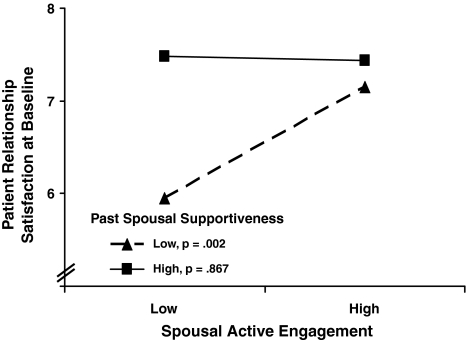
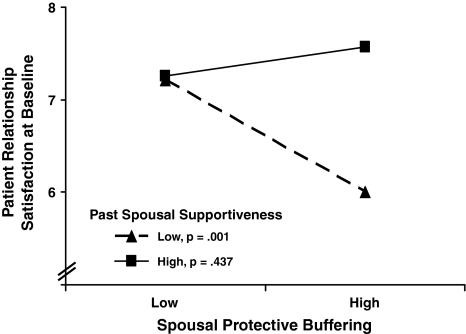
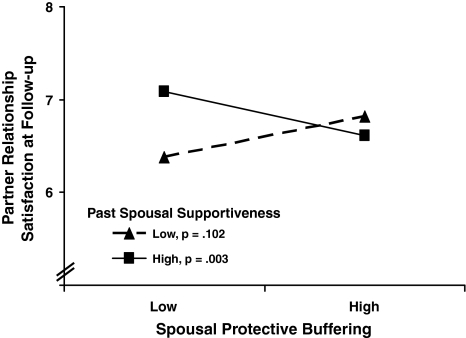
Based on attribution theory, this study hypthesized that past spousal supportiveness may act as a moderator of the link between one partner's current support behavior and the other partner's relationship satisfaction. A sample of 88 patients with colorectal cancer and their partners completed questionnaires approximately 3 and 9 months after diagnosis. The data were analyzed employing dyadic data analytic approaches. In the short-term, spousal active engagement--which involved discussing feelings and engaging in joint problem solving--was positively associated with relationship satisfaction in patients as well as in partners, but only when past spousal support was relatively low. Spousal protective buffering--which involved hiding worries and fears and avoiding talking about the disease--was negatively associated with relationship satisfaction in patients, again only when past spousal support was relatively low. If past spousal support was high, participants rated the quality of their relationship relatively high, regardless of their partner's current support behavior. Over time, past spousal supportiveness was not found to mitigate the negative association between spousal protective buffering and relationship satisfaction. Overall, our results indicate that relationship satisfaction can be maintained if past spousal supportiveness is high even if the partner is currently not very responsive to the individual's needs, at least in the short-term.
Overview
The claims and statistics of this paper haven’t been checked yet.
Free: it reads the open-access text and checks the first 5 claims that cite a source we can check. Create a free account to check every claim.
Integrity signals
Registry
Cites
Statistics
Figures
Verification
Claims the paper makes
The claims and statistics of this paper haven’t been checked yet.
Free: it reads the open-access text and checks the first 5 claims that cite a source we can check. Create a free account to check every claim.
Claims other papers make about this one
Each is checked against this paper’s own text: does it say what the citing paper says it does?
The cited source says what the claim attributes to it.
In the citing paper
“The Active engagement scale has shown good psychometric properties [46].”
From A web-based self-help intervention for partners of cancer patients based on Acceptance and Commitment Therapy: a protocol of a randomized controlled trial. (2015) · cites this paper as [46]
Self-check
Percentages, sums and reported differences re-computed from the paper’s own numbers.
The self-check needs the paper’s full text.
Citations
Cites
Hierarchical Linear Models: Applications and Data Analysis Methods.
Longford, N. T., Bryk, A. S., & Raudenbush, S. W. (1993) · Contemporary Sociology · doi:10.2307/2075823 · Cited by 18,724 · cited 2×
“Participants completed the Mutual Communal Behaviors Scale (MCBS; Williamson and Schulz 1995; Williamson et al. 1998).”
MethodHierarchical Linear Models: Applications and Data Analysis Methods
Davidian, M. (2003) · Journal of the American Statistical Association · doi:10.1198/jasa.2003.s288 · Cited by 13,723
The psychology of interpersonal relations.
Heider, F. (1958) · doi:10.1037/10628-000 · Cited by 13,457
The Psychology of Interpersonal Relations.
Newcomb, T., & Heider, F. (1958) · American Sociological Review · doi:10.2307/2089062 · Cited by 11,822
(2006) · Cited by 3,705
Research on the Nature and Determinants of Marital Satisfaction: A Decade in Review
Bradbury, T. N., Fincham, F. D., & Beach, S. R. H. (2000) · Journal of Marriage and Family · doi:10.1111/j.1741-3737.2000.00964.x · Cited by 1,220 · cited 2×
“…has been recognized that a behavior displayed by one partner in a marital interaction may vary in its effect on the other partner and the relationship as a function of how this latter partner understands or perceives the behavior (for reviews, see Bradbury and Fincham 1990; Bradbury et al. 2000).”
BackgroundAttributions in marriage: Review and critique.
Bradbury, T. N., & Fincham, F. D. (1990) · Psychological Bulletin · doi:10.1037//0033-2909.107.1.3 · Cited by 921
A developmental-contextual model of couples coping with chronic illness across the adult life span.
Berg, C. A., & Upchurch, R. (2007) · Psychological Bulletin · doi:10.1037/0033-2909.133.6.920 · Cited by 877 · cited 4×
“Coping with cancer is considered to be a dyadic affair, meaning that patients’ adjustment is affected by their partners’ behavior and adjustment, and vice versa ( Berg and Upchurch 2007; Coyne and DeLongis 1986; Hagedoorn et al. 2008; Manne and Badr 2008).”
BackgroundInfluentialGender and social structure in the demand/withdraw pattern of marital conflict.
Christensen, A., & Heavey, C. L. (1990) · Journal of Personality and Social Psychology · doi:10.1037//0022-3514.59.1.73 · Cited by 862 · cited 2×
“Research on close relationships has shown that couples’ behavior during their interactions has an influence on a variety of important relationship outcomes, including relationship satisfaction (e.g., Bradbury et al. 1995; Christensen and Heavey 1990; Henry et al. 2007; Manne et al. 2004) (For a review, see Bradbury an…”
BackgroundThe Effect of Different Forms of Centering in Hierarchical Linear Models
Kreft, I. G. G., de Leeuw, J., & Aiken, L. S. (1995) · Multivariate Behavioral Research · doi:10.1207/s15327906mbr3001_1 · Cited by 850
Cited by
Dyadic coping and relationship satisfaction: A meta-analysis
Falconier, M. K., Jackson, J. B., Hilpert, P., & Bodenmann, G. (2015) · Clinical Psychology Review · doi:10.1016/j.cpr.2015.07.002 · Cited by 462
“Internal consistencies for subscales in the RFCS and the WPS range from .60 to .94 (e.g., Hagedoorn et al., 2011; Hinnen et al., 2008).”
Dyadic coping and relationship functioning in couples coping with cancer: A systematic review
Traa, M. J., De Vries, J., Bodenmann, G., & Den Oudsten, B. L. (2015) · British Journal of Health Psychology · doi:10.1111/bjhp.12094 · Cited by 367
“Three months after treatment, relationship functioning was maintained if past spousal supportiveness was high, even if the partner was currently not very responsive to the individual’s needs (Hagedoorn et al., 2011).”
BackgroundMethodInfluentialDyadic Coping in Couples: A Conceptual Integration and a Review of the Empirical Literature
Falconier, M. K., & Kuhn, R. (2019) · Frontiers in Psychology · doi:10.3389/fpsyg.2019.00571 · Cited by 303
Informal caregiving for cancer patients
Romito, F., Goldzweig, G., Cormio, C., Hagedoorn, M., & Andersen, B. L. (2013) · Cancer · doi:10.1002/cncr.28057 · Cited by 232
Self-citationCommunal Coping and Adjustment to Chronic Illness: Theory Update and Evidence
Helgeson, V. S., Jakubiak, B., Van Vleet, M., & Zajdel, M. (2018) · Personality and Social Psychology Review · doi:10.1177/1088868317735767 · Cited by 221
Adjusting to Chronic Health Conditions
Helgeson, V. S., & Zajdel, M. (2017) · Annual Review of Psychology · doi:10.1146/annurev-psych-010416-044014 · Cited by 182
Regan, T. W., Lambert, S. D., Kelly, B., McElduff, P., Girgis, A., Kayser, K., & Turner, J. (2014) · Patient Education and Counseling · doi:10.1016/j.pec.2014.04.010 · Cited by 134
“This is consistent with previous studies of the STM of dyadic coping in cancer [19,45], and with other studies exploring the influence of similar types of dyadic coping among couples facing cancer [46–48].”
ResultDeeds matter: Daily enacted responsiveness and intimacy in couples' daily lives.
Debrot, A., Cook, W. L., Perrez, M., & Horn, A. B. (2012) · Journal of Family Psychology · doi:10.1037/a0028666 · Cited by 120
“It would be interesting to investigate in more detail the short- and long-term dynamics of these processes (i.e., Canevello & Crocker, 2010; Hagedoom et al., 2011).”
BackgroundCouples coping with cancer: exploration of theoretical frameworks from dyadic studies
Regan, T. W., Lambert, S. D., Kelly, B., Falconier, M., Kissane, D., & Levesque, J. V. (2015) · Psycho-Oncology · doi:10.1002/pon.3854 · Cited by 105
“RFC, Relationship Intimacy model, and the Communication Models all emphasised communication and engagement with the partner to enhance closeness.”
BackgroundInfluentialAcquati, C., & Kayser, K. (2019) · Frontiers in Psychology · doi:10.3389/fpsyg.2019.00404 · Cited by 87
Kayser, K., Acquati, C., Reese, J. B., Mark, K. P., Wittmann, D. A., & Karam, E. A. (2016) · Psycho-Oncology · doi:10.1002/pon.4339 · Cited by 78
“depressive symptoms were the most common outcome variables examined, being used in 4 of the articles.(28,30,31,33) Seven different standardized instruments were used to measure depression, anxiety, and psychological adjustment.”
BackgroundMethodŞtefǎnuţ, A. M., Vintilă, M., & Tudorel, O. I. (2021) · Frontiers in Psychology · doi:10.3389/fpsyg.2020.594015 · Cited by 77
Is self-disclosure in couples coping with cancer associated with improvement in depressive symptoms?
Hagedoorn, M., Puterman, E. M., Sanderman, R., Wiggers, T., Baas, P. C., van Haastert, M., & DeLongis, A. (2011) · Health Psychology · doi:10.1037/a0024374 · Cited by 69
Self-citationCoping with cancer: The perspective of patients’ relatives
Hagedoorn, M., Kreicbergs, U. C., & Appel, C. (2011) · Acta Oncologica · doi:10.3109/0284186x.2010.536165 · Cited by 80
Self-citationSchokker, M. C., Stuive, I., Bouma, J., Keers, J. C., Links, T. P., Wolffenbuttel, B. H. R., Sanderman, R., & Hagedoorn, M. (2010) · Journal of Family Psychology · doi:10.1037/a0021009 · Cited by 54
“Finally, our findings and argumentation are supported by a study of couples dealing with colorectal cancer (Hagedoorn et al,, submitted) that showed that inadequate support (ie, low levels of active engagement and high levels of protective buffering) was associated with less relationship satisfaction especially when t…”
ResultSelf-citationDagan, M., Sanderman, R., Schokker, M. C., Wiggers, T., Baas, P. C., van Haastert, M., & Hagedoorn, M. (2011) · Journal of Family Psychology · doi:10.1037/a0022887 · Cited by 47
“These couples (n 70) took part in a longitudinal study on “couples’ adaptation to cancer” and filled out questionnaires at two assessment points: approximately 3 (at baseline) and 9 months (at follow-up) after diagnosis (Hagedoorn et al., 2011).”
BackgroundSelf-citationKöhle, N., Drossaert, C. H. C., ten Klooster, P. M., Schreurs, K. M. G., Hagedoorn, M., Van Uden-Kraan, C. F., Verdonck-de Leeuw, I. M., & Bohlmeijer, E. T. (2021) · Supportive Care in Cancer · doi:10.1007/s00520-021-06051-w · Cited by 45
“, [1, 4, 28]) examining the effects of cancer on the partner’s life and relationships.”
BackgroundSelf-citationBenoit-Piau, J., Bergeron, S., Brassard, A., Dumoulin, C., Khalifé, S., Waddell, G., & Morin, M. (2018) · The Clinical Journal of Pain · doi:10.1097/ajp.0000000000000604 · Cited by 45
Almont, T., Bouhnik, A., Charif, A. B., Bendiane, M., Couteau, C., Manceau, C., Mancini, J., & Huyghe, É. (2019) · The Journal of Sexual Medicine · doi:10.1016/j.jsxm.2018.11.008 · Cited by 66
Thomson, M. D., Genderson, M. W., & Siminoff, L. A. (2021) · Patient Education and Counseling · doi:10.1016/j.pec.2021.10.014 · Cited by 53
A new perspective on dyadic regulation in chronic illness: the dyadic regulation connectivity model
Karademas, E. C. (2021) · Health Psychology Review · doi:10.1080/17437199.2021.1874471 · Cited by 53
Köhle, N., Drossaert, C. H., Schreurs, K. M., Hagedoorn, M., Verdonck-de Leeuw, I. M., & Bohlmeijer, E. T. (2015) · BMC Public Health · doi:10.1186/s12889-015-1656-y · Cited by 38
“The Active engagement scale has shown good psychometric properties [46].”
MethodSelf-citation(Unmet) Standards for emotional support and their short- and medium-term consequences
Joseph, A., Afifi, T. D., & Denes, A. (2015) · Communication Monographs · doi:10.1080/03637751.2015.1068432 · Cited by 44
Dyadic Interdependence in Non-spousal Caregiving Dyads’ Wellbeing: A Systematic Review
Ferraris, G., Dang, S., Woodford, J., & Hagedoorn, M. (2022) · Frontiers in Psychology · doi:10.3389/fpsyg.2022.882389 · Cited by 45
Self-citationDagan, M., Sanderman, R., Hoff, C., Meijerink, W. J. H. J., Baas, P. C., van Haastert, M., & Hagedoorn, M. (2013) · Journal of Behavioral Medicine · doi:10.1007/s10865-013-9543-4 · Cited by 41
“Procedure This investigation is part of a larger study examining support processes in couples coping with colorectal cancer (Dagan et al., 2011; Hagedoorn et al., 2011a, b).”
BackgroundResultSelf-citationKroemeke, A., & Kubicka, E. (2018) · PLoS ONE · doi:10.1371/journal.pone.0200124 · Cited by 42
Fasse, L., Flahault, C., Vioulac, C., Lamore, K., van Wersch, A., Quintard, B., & Untas, A. (2017) · British Journal of Health Psychology · doi:10.1111/bjhp.12228 · Cited by 42
Beyond “being open about it”: A systematic review on cancer related communication within couples
Hasson‐Ohayon, I., Goldzweig, G., Braun, M., & Hagedoorn, M. (2022) · Clinical Psychology Review · doi:10.1016/j.cpr.2022.102176 · Cited by 43
Self-citationA Dyadic and Longitudinal Investigation of Adjustment in Couples Coping with Multiple Sclerosis
Samios, C., Pakenham, K. I., & O’Brien, J. (2014) · Annals of Behavioral Medicine · doi:10.1007/s12160-014-9633-8 · Cited by 37
“This finding is consistent with research on couples coping with colorectal cancer in which better relationship satisfaction was predicted by past spousal support regardless of their partner’s current support behaviour [33].”
ResultTalking but not always understanding: couple communication about infertility concerns after cancer
Hawkey, A., Ussher, J. M., Perz, J., & Parton, C. (2021) · BMC Public Health · doi:10.1186/s12889-021-10188-y · Cited by 38
Götze, H., Friedrich, M., Brähler, E., Romer, G., Mehnert-Theuerkauf, A., & Ernst, J. (2016) · Supportive Care in Cancer · doi:10.1007/s00520-016-3411-z · Cited by 43
“Similar mean scores for anxiety and depression were reported in a study with patients living with myeloma and their partners [20].”
BackgroundHawkey, A., Ussher, J. M., Perz, J., Parton, C., Patterson, P., Bateson, D. J., Hobbs, K., & Kirsten, L. T. (2020) · European Journal of Cancer Care · doi:10.1111/ecc.13348 · Cited by 35
Chen, M., Gong, J., Lin, C., Luo, H., & Li, Q. (2022) · European Journal of Oncology Nursing · doi:10.1016/j.ejon.2022.102226 · Cited by 33
Traa, M. J., Braeken, J., Vries, J. D., Roukema, J. A., Slooter, G. D., Crolla, R. M. P. H., Borremans, M. P. M., & Oudsten, B. L. D. (2015) · Psycho-Oncology · doi:10.1002/pon.3801 · Cited by 32
“Even though this is a fairly good result compared with previous research focusing (partly) on sexuality after colorectal cancer (e.g., Hagedoorn et al. 2011 [14]), there still were considerable refusal rates.”
BackgroundResultLedderer, L., la Cour, K., Mogensen, O. E., Jakobsen, E. H., Christensen, R. D., Kragstrup, J., & Hansen, H. P. (2013) · Patient · doi:10.1007/s40271-013-0019-y · Cited by 29
Krok, D., Telka, E., & Moroń, M. (2023) · Psycho-Oncology · doi:10.1002/pon.6174 · Cited by 31
“Chronic illness is assessed in the context of previous marital satisfaction.(13,14) Patients with higher marital quality perceive their spouse as being involved in joint coping with the illness, which aids in accepting and adjusting to their health condition.”
BackgroundTraa, M. J., Vries, J. D., Roukema, J. A., & Oudsten, B. L. D. (2012) · The Journal of Sexual Medicine · doi:10.1111/j.1743-6109.2012.02938.x · Cited by 24
A dynamic state-space analysis of interpersonal emotion regulation in couples who smoke
Butler, E. A., Hollenstein, T., Shoham, V., & Rohrbaugh, M. J. (2013) · Journal of Social and Personal Relationships · doi:10.1177/0265407513508732 · Cited by 25
“…1999; Kuijer et al., 2000; Vilchinsky et al., 2011) as well as to relationship satisfaction and distress for both partners (Coyne & Smith, 1991; Hagedoorn et al., 2011; Manne et al., 2007; Suls, Green, Rose, Lounsbury, & Gordon, 1997), but specific findings are inconsistent and often difficult…”
BackgroundDiMillo, J., Hall, N. C., Ezer, H., Schwarzer, R., & Körner, A. (2017) · Journal of Health Psychology · doi:10.1177/1359105317700968 · Cited by 22
“These findings are consistent with existing literature showing significant associations between relationship satisfaction and social support (Hagedoorn et al., 2011), with the magnitude of the correlations underscoring the construct validity of the Canadian BSSS-RS.”
ResultWalker, L. M., Santos‐Iglesias, P., & Robinson, J. W. (2018) · Supportive Care in Cancer · doi:10.1007/s00520-018-4251-9 · Cited by 23
Should I Tell You How I Feel? A Mixed Method Analysis of Couples’ Talk about Cancer
Goldsmith, D. J., & Miller, G. A. (2015) · Journal of Applied Communication Research · doi:10.1080/00909882.2015.1052832 · Cited by 19
“Unfortunately, research in this context provides surprisingly little empirical support for the benefits of talking about feelings (Goldsmith, Miller, & Caughlin, 2008; Hagedoorn et al., 2011) and many of the relevant studies have conceptual and methodological limitations (Goldsmith & Miller, 2013).”
BackgroundKroemeke, A., Knoll, N., & Sobczyk‐Kruszelnicka, M. (2019) · Journal of Consulting and Clinical Psychology · doi:10.1037/ccp0000398 · Cited by 20
Hoeck, B., Ledderer, L., & Hansen, H. P. (2014) · Patient · doi:10.1007/s40271-014-0076-x · Cited by 15
Shared possible selves, other-focus, and perceived wellness of couples with prostate cancer.
Wilson, S. J., Barrineau, M. J., Butner, J., & Berg, C. A. (2014) · Journal of Family Psychology · doi:10.1037/fam0000015 · Cited by 12
Langer, S. L., Ghosh, N., Todd, M. W., Randall, A. K., Romano, J. M., Bricker, J. B., Bolger, N. P., Burns, J. W., Hagan, R. C., & Porter, L. S. (2020) · JMIR Formative Research · doi:10.2196/14161 · Cited by 11
“On the contrary, avoidance behaviors such as holding back have been found to be associated with lower intimacy, lower relationship satisfaction, and greater distress [5-13].”
BackgroundOutcome of Supportive Talks in a Hospital Setting: Insights from Cancer Patients and Their Relatives
Ledderer, L., la Cour, K., & Hansen, H. P. (2014) · Patient · doi:10.1007/s40271-014-0047-2 · Cited by 13
Dyadic Function of Couples with Cancer: A Review
Rajaei, A., Jensen, J. F., Brimhall, A. S., Torres, E., & Schwartz, A. (2020) · Journal of Couple & Relationship Therapy · doi:10.1080/15332691.2020.1841055 · Cited by 11
“…patient and partner (Hagedoorn et al., 2008; Traa et al., 2015) makes it important to adopt a dyadic perspective, few studies focused specifically on patients with cancer and incorporated dyadic aspects in their study and analyses (Hagedoorn et al., 2011; Milbury et al., 2013; Porter et al., 2012).”
BackgroundSpousal Support and Relationship Happiness in Adults With Type 2 Diabetes and Their Spouses
Lafontaine, M., Bélanger, C., Jolin, S., Sabourin, S., & Nouwen, A. (2020) · Canadian Journal of Diabetes · doi:10.1016/j.jcjd.2020.05.006 · Cited by 9
Interpretations of partners’ responses to pain behaviours: Perspectives of patients and partners
Akbari, F., Mohammadi, S., Dehghani, M., Sanderman, R., & Hagedoorn, M. (2020) · British Journal of Health Psychology · doi:10.1111/bjhp.12490 · Cited by 11
“…(e.g., attributing negative behaviours of a partner to his or her lack of love vs attributing ones own negative behaviour to stress at work; Bradbury & Fincham, 1990; Bradbury, Fincham, & Beach, 2000; Hagedoorn et al., 2011), to date this issue has rarely been taken into account in pain models.”
BackgroundSelf-citationStulz, A., Favez, N., & Flahault, C. (2022) · Frontiers in Psychology · doi:10.3389/fpsyg.2022.802603 · Cited by 11
Perceived sexual satisfaction among women with drug-dependent husbands in Iran
Jafari, F., Noori, R., Moazen, B., Khoddami-Vishteh, H.-R., Narenjiha, H., & Mirabi, P. (2014) · Journal of Substance Use · doi:10.3109/14659891.2013.840685 · Cited by 8
Dekel, R., Siegel, A., Fridkin, S., & Svetlitzky, V. (2018) · Journal of Traumatic Stress · doi:10.1002/jts.22343 · Cited by 13
Hopeful Woman, Happy Couple: A Dyadic Model of Hope, Partner Support, and Relationship Satisfaction
Laslo‐Roth, R., & George‐Levi, S. (2022) · Journal of Happiness Studies · doi:10.1007/s10902-021-00494-y · Cited by 8
Kroemeke, A., & Sobczyk‐Kruszelnicka, M. (2019) · Frontiers in Psychology · doi:10.3389/fpsyg.2019.02195 · Cited by 8
Mittinty, M. M., Mittinty, M., Buchbinder, R., Lassere, M. N., Chand, V., Whittle, S., MARCH, L. M., & Hill, C. L. (2022) · The Journal of Rheumatology · doi:10.3899/jrheum.2023-0664 · Cited by 6
“35-38 Our sample contained an insufficient amount of evidence and failed to conclude the hypothesis.”
Rajaei, A., Heshmati, S., & Giesemann, X. (2022) · American Journal of Family Therapy · doi:10.1080/01926187.2022.2106460 · Cited by 7
“The effective use of adaptive factors is linked with numerous positive outcomes including less cancer-related distress, elevated levels of relationship satisfaction and support, and improved physical and mental health (Hagedoorn et al., 2011b).”
BackgroundDiMillo, J., Brosseau, D. C., Gomez-Garibello, C. A., Hall, N. C., Ezer, H., Wang, B., & Körner, A. (2017) · Health Education Research · doi:10.1093/her/cyx037 · Cited by 6
“Relationship quality and partner support are strongly related constructs, but independently predict patients’ adherence to medical advice [31, 32].”
BackgroundRegan, T. W., Acquati, C., & Zimmerman, T. K. (2018) · Springer eBooks · doi:10.1007/978-3-319-77432-9_14 · Cited by 6
Donato, S., & Bertoni, A. (2016) · Advances in medical diagnosis, treatment, and care (AMDTC) book series · doi:10.4018/978-1-4666-9992-2.ch005 · Cited by 5
The Interplay Between Individual and Dyadic/Common Coping in Female Patients With Cancer
Paschali, A., Palli, A., Thomadakis, C., & Karademas, E. C. (2021) · European Journal of Psychology Open · doi:10.1024/2673-8627/a000012 · Cited by 10
Chen, M., Gong, J., Cao, Q., & Li, Q. (2022) · Asia-Pacific Journal of Oncology Nursing · doi:10.1016/j.apjon.2022.03.002 · Cited by 5
Men with cancer and their experiences of marital relationships: a struggle for control and balance
Hansen, H. P., & Tjørnhøj‐Thomsen, T. (2020) · Anthropology and Medicine · doi:10.1080/13648470.2019.1688611 · Cited by 6
Couples Facing Skin Cancer in Old Age: A Dyadic Investigation of Partner Support and Quality of Life
Butner-Kozimor, L. M., & Savla, J. T. (2020) · The International Journal of Aging and Human Development · doi:10.1177/0091415020940193 · Cited by 7
Rajaei, A. (2021) · The Family Journal · doi:10.1177/10664807211009803 · Cited by 5
“Effectively utilizing adaptive processes is linked with numerous positive outcomes including relationship satisfaction and support and improved physical and mental health (Hagedoorn et al., 2011).”
BackgroundGeorge‐Levi, S., Fait, K., Hod, H., Matezky, S., & Vilchinsky, N. (2022) · Journal of Social and Personal Relationships · doi:10.1177/02654075221131902 · Cited by 4
Kroemeke, A., & Kubicka, E. (2017) · Health Psychology Report · doi:10.5114/hpr.2017.67853 · Cited by 8
“Importantly, coping congruence, marital satisfaction, or past spousal supportiveness may modify the relations between partner coping and adjustment (Hagedoorn et al., 2011; Revenson & DeLongis, 2011), so these variables should be taken into consideration in future studies.”
BackgroundDebrot, A. (2016) · reroDoc Digital Library · doi:10.13140/rg.2.1.2216.4246 · Cited by 4
“However, because of the complexity of the data gathering and of the analyses, only a relatively small amount of studies have truly investigated mutual influences (i.e. Canevello & Crocker, 2010; Hagedoorn et al., 2011) or partner effects (Campbell & Kashy, 2002).”
BackgroundPredicting Daily Satisfaction with Spouse Responses Among People with Rheumatoid Arthritis
Beggs, R. T., Holtzman, S., & DeLongis, A. (2015) · Annals of Behavioral Medicine · doi:10.1007/s12160-015-9728-x · Cited by 7
“Future research can also consider possible moderating effects, as past research has shown that the effectiveness of certain types of support may vary depending on the marital context in which they occur [55].”
BackgroundSelf-citationThe role of relationship with God in couples’ adjustment to the threat of breast cancer.
Gall, T. L., & Bilodeau, C. (2018) · Psychology of Religion and Spirituality · doi:10.1037/rel0000224 · Cited by 3
Emotion Regulation and Relationship Satisfaction in Clinical Couples
Rick, J. (2015) · VTechWorks (Virginia Tech) · Cited by 6
Sınmaz, T., Çiydem, E., & Çi̇men, M. (2025) · Supportive Care in Cancer · doi:10.1007/s00520-025-09802-1 · Cited by 1
Karademas, E. C. (2026) · Journal of Health Psychology · doi:10.1177/13591053251408599 · Cited by 1
“…needs (e.g. overprotectiveness) are associated with the patient physical and emotional well-being and coping behaviours (e.g. Bertoni et al., 2015; Hagedoorn et al., 2011; Johnson et al., 2015; Vilchinsky et al., 2011), while patient and partner common efforts to cope with illness and its impact…”
“Don’t be so Harsh”: Influence Tactics, Support Transactions, and Relationship Satisfaction
George‐Levi, S., & Laslo‐Roth, R. (2021) · The Family Journal · doi:10.1177/10664807211061818 · Cited by 1
“The importance of a supportive relationship to partners’ relationship satisfaction has been well-documented (e.g., Cramer, 2006; Hagedoorn et al., 2011; Lorenzo et al., 2018).”
BackgroundMartins, A., Canavarro, M. C., & Pereira, M. (2022) · Sexuality & Culture · doi:10.1007/s12119-022-09982-6 · Cited by 2
“In addition, studies in the context of cancer demonstrating no differences in relationship satisfaction between patients and their partners corroborated our results (Hagedoorn et al., 2011; Northouse et al., 2000).”
ResultDonato, S., & Bertoni, A. (2017) · IGI Global eBooks · doi:10.4018/978-1-5225-3926-1.ch001 · Cited by 3
Wong, A. G. (2013) · OpenCommons - UConn (University of Connecticut) · Cited by 1
Psychosocial outcomes in diabetes: the interplay of intra- and interpersonal factors
Schokker, M. C. (2010) · University of Groningen research database (University of Groningen / Centre for Information Technology)
Sexuality After Colorectal Cancer Treatment: A Narrative Synthesis
Bourque, M. (2014) · DalSpace (Dalhousie University)
Relation entre ajustement marital et santé mentale dans des couples faisant face au cancer du sein
Caillot-Ranjeva, S., Segrestan-Crouzet, C., Gourlain, S., Bergua, V., & Rascle, N. (2021) · Psycho-Oncologie · doi:10.3166/pson-2021-0150 · Cited by 1
Stulz, A., Favez, N., & Flahault, C. (2022) · Psycho-Oncologie · doi:10.3166/pson-2022-0206
Yang, X., Sun, Z., Chen, X., Qiu, X., Mao, J., Wang, C., Li, Q., & Zhao, J. (2025) · European Journal of Oncology Nursing · doi:10.1016/j.ejon.2025.102899 · Cited by 1
Hawkey, A., Ussher, J. M., Perz, J., & Parton, C. (2021) · Figshare · doi:10.6084/m9.figshare.13612233
Hawkey, A., Ussher, J. M., Perz, J., & Parton, C. (2021) · Figshare · doi:10.6084/m9.figshare.13612230
Hawkey, A., Ussher, J. M., Perz, J., & Parton, C. (2021) · Figshare · doi:10.6084/m9.figshare.13612224
Hawkey, A., Ussher, J. M., Perz, J., & Parton, C. (2021) · Figshare · doi:10.6084/m9.figshare.13612227
Lamore, K. (2018) · theses.fr (ABES) · doi:10.70675/d7b0434dz9959z4e78z81e5z09ae57893804 · Cited by 1
Wu, X., Chan, R. W., Tang, H., & Li, Y. (2026) · Journal of Patient-Reported Outcomes · doi:10.1186/s41687-026-01090-5
“Patients may be more likely to perceive a lack of support from their partners when family caregivers under-estimate their symptoms [64].”
Hayat, S. U. (2026) · Research Square · doi:10.21203/rs.3.rs-10418592/v1
Metadata
- Authors
- Hagedoorn, M., Dagan, M., Puterman, E., Hoff, C., Meijerink, W. J. H. J., DeLongis, A., & Sanderman, R.
- Affiliations
- University Medical Center Groningen (NL)
- University of California, San Francisco (US)
- Medisch Centrum Leeuwarden (NL)
- University of British Columbia (CA)
- Corresponding author
- Hagedoorn, Mariët
- Venue
- Journal of Behavioral Medicine
- Published
- 2011-01-11
- Volume
- 34
- Issue
- 4
- Pages
- 288-297
- ISSN
- 0160-7715 (ISSN-L)
- 1573-3521
- PMC
- PMC3141841
- OpenAlex
- W2134563037
- Cited by
- 90
- References
- 50
- Citations by year
- 2026: 3 · 2025: 2 · 2024: 3 · 2023: 1 · 2022: 10 · 2021: 13 · 2020: 7 · 2019: 5 · 2018: 7 · 2017: 7 · 2016: 4 · 2015: 8 · 2014: 8 · 2013: 5 · 2012: 2
- FWCI
- 7.86
- Type
- journal article
- Language
- en
- Open access
- hybrid
- doi.org
- Licence
- cc-by-nc
- Locations
- Journal of Behavioral Medicine (publishedVersion, cc-by-nc)
- PubMed Central (publishedVersion, cc-by-nc)
- PubMed (publishedVersion)
- Pure Amsterdam UMC (publishedVersion, other-oa)
- Amsterdam UMC (VU Amsterdam) - Institutional Repository (publishedVersion, other-oa)
- Digital Academic REpository of VU University Amsterdam (Vrije Universiteit Amsterdam) (submittedVersion)
- University of Groningen research database (University of Groningen / Centre for Information Technology) (submittedVersion, cc-by)
- Data Archiving and Networked Services (DANS) (submittedVersion, other-oa)
- Funders
- KWF Kankerbestrijding (RUG 02-2581)
- Topics
- Social Sciences › Psychology › Social Psychology › Attachment and Relationship Dynamics
- Health Sciences › Medicine › Oncology › Cancer survivorship and care
- Health Sciences › Nursing › Research and Theory › Nursing care and research
- Keywords
- relationship satisfaction, spousal support, colorectal cancer, couples, attribution theory, dyadic analysis, marital communication
- MeSH terms
- Adaptation, Psychological, Adolescent, Adult, Aged, Female, Humans, Interpersonal Relations, Male, Middle Aged, Personal Satisfaction, Social Support, Time Factors, Colorectal Neoplasms, Spouses
About these checks
Registry, retraction, Cites and statistics results are computed, not judged, with one exception: a printed reference that no index lists is read once by a model before it counts as a citation error. Claims are extracted by a model and kept only when their quote appears verbatim in the text; each cited source is then checked, with a model’s help, for whether it says what the claim relies on. Those verdicts can be wrong — read the claim’s quote and the cited source before relying on one.
Statistics and arithmetic are recomputed, not judged.
Confidence bands are shown only for fields calibrated on our annotated test set. None is calibrated yet, so no band is shown.
What counts as a claim ›How we measure confidence ›How we check this ›
Are you an author, or do you see a problem with this page? Request a review
Data sources
Bibliographic data: Semantic Scholar, OpenAlex, Crossref.
Contains information from the Semantic Scholar Academic Graph Datasets, made available under the ODC Attribution License (ODC-BY 1.0).
Semantic Scholar’s data is described in: Kinney, R., et al. (2023). The Semantic Scholar Open Data Platform. arXiv:2301.10140.
