

Mental Health of Refugees and Non-refugees from War-Conflict Countries: Data from Primary Healthcare Services and the Norwegian Prescription Database
Open accessThe DOI matches its Crossref record; 23 of the 23 references it cites were found in a registry or an index.
Abstract
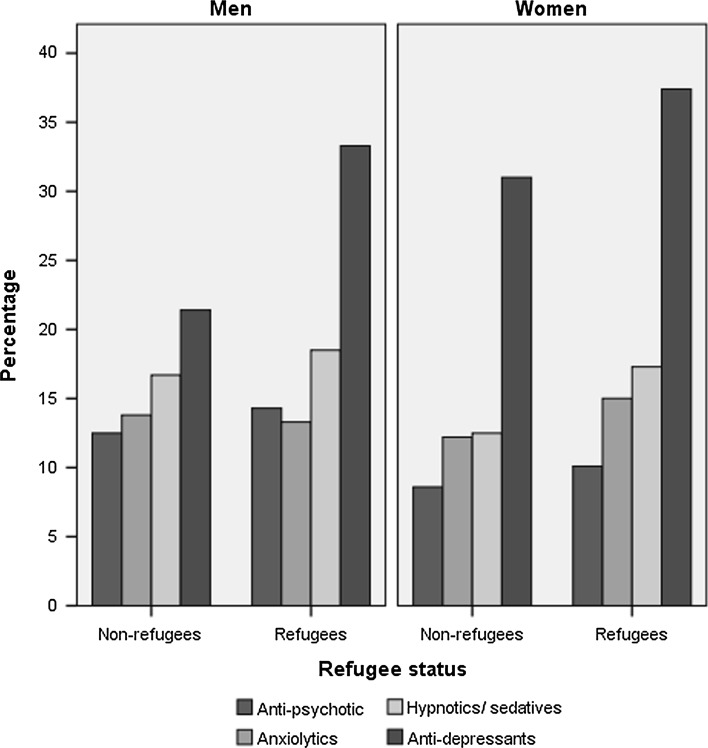
High rates of mental health problems are consistently found among immigrants from refugee generating countries. While refugees and their family members may have experienced similar traumas, refugees are more likely to have undergone a stressful asylum period. This study aims to determine whether their mental health differs. Using national registry data, refugees and non-refugees from the same countries were compared on primary healthcare service use for mental health problems and purchase of psychotropic medicine. Refugees had higher odds of using primary health care services than non-refugees. Refugee women were more likely to purchase psychotropic medicine than non-refugee women. Refugee men were more likely to purchase anti-depressants. The findings suggest that refugees have poorer mental health than non-refugees. This may be due to a combination of greater pre-migration trauma and post-migration stressors such as enduring a difficult asylum period.
Overview
The claims and statistics of this paper haven’t been checked yet.
Free: it reads the open-access text and checks the first 5 claims that cite a source we can check. Create a free account to check every claim.
Integrity signals
Registry
Cites
Statistics
Figures
Verification
Claims the paper makes
The claims and statistics of this paper haven’t been checked yet.
Free: it reads the open-access text and checks the first 5 claims that cite a source we can check. Create a free account to check every claim.
Claims other papers make about this one
Each is checked against this paper’s own text: does it say what the citing paper says it does?
The source backs part of the claim, not all of it — or backs it for a different population, condition or comparison.
In the citing paper
“A Danish register based study (N ø rredam, 2015) found that family reunified persons and refugees had respectively a lower and higher risk of mental illness compared to native Danes which was confirmed by a Norwegian study (Straiton et al., 2017).”
From Refugees versus persons family reunified to a refugee: A comparison of sociodemographic factors, trauma history, baseline psychopathology and treatment effectiveness (2023) · cites this paper as Straiton et al., 2017
Experimental — accuracy not yet measured
Self-check
Percentages, sums and reported differences re-computed from the paper’s own numbers.
The self-check needs the paper’s full text.
Citations
Cites
Steel, Z., Chey, T., Silove, D., Marnane, C., Bryant, R. A., & van Ommeren, M. (2009) · JAMA · doi:10.1001/jama.2009.1132 · Cited by 2,246 · cited 2×
“Cumulative exposure to trauma and the experience of torture are strong predictors of subsequent depression among refugees [7] but we were unable to account for pre-migration factors.”
BackgroundDepression and anxiety in labor migrants and refugees – A systematic review and meta-analysis
Lindert, J., Ehrenstein, O. S. V., Priebe, S., Mielck, A., & Brähler, E. (2009) · Social Science & Medicine · doi:10.1016/j.socscimed.2009.04.032 · Cited by 703 · cited 1×
“High rates of mental health problems, such as posttraumatic stress, depression and anxiety have been consistently found among those with a refugee background [6, 7], presenting a challenge to the health service as the number of refugees grow.”
BackgroundDoes a higher educational level protect against anxiety and depression? The HUNT study
Bjelland, I., Krokstad, S., Mykletun, A., Dahl, A. A., Tell, G. S., & Tambs, K. (2008) · Social Science & Medicine · doi:10.1016/j.socscimed.2007.12.019 · Cited by 655 · cited 1×
“Although higher education is considered protective for mental health problems [22], education level has also been found to be positively related to help-seeking among those with a mental health problem [23].”
BackgroundImpact of immigration detention and temporary protection on the mental health of refugees
Steel, Z., Silove, D., Brooks, R., Momartin, S., Alzuhairi, B., & Susljik, I. (2006) · British Journal of Psychiatry · doi:10.1192/bjp.bp.104.007864 · Cited by 473 · cited 1×
“Longer periods in reception centres are associated with greater severity of mental health problems [27].”
BackgroundGerritsen, A. A. M., Bramsen, I., Devillé, W., van Willigen, L. H. M., Hovens, J. E., & van der Ploeg, H. M. (2006) · Social Psychiatry and Psychiatric Epidemiology · doi:10.1007/s00127-005-0003-5 · Cited by 444 · cited 5×
“Use of health care services by Afghan, Iranian, and Somali refugees and asylum seekers living in The Netherlands.”
BackgroundResultInfluentialde Lusignan, S., & van Weel, C. (2006) · Family Practice · doi:10.1093/fampra/cmi106 · Cited by 326 · cited 1×
“Diagnoses are made based on the ICPC-2 for administrative claims and are reliable at the chapter level for investigation purposes [29] but cannot give an indication of the prevalence of particular disorders [30].”
BackgroundLindencrona, F., Ekblad, S., & Hauff, E. (2008) · Social Psychiatry and Psychiatric Epidemiology · doi:10.1007/s00127-007-0280-2 · Cited by 281 · cited 2×
“Indeed, post-migration stress including discrimination, economic difficulties and language difficulties can contribute to mental health problems [15, 24].”
BackgroundSaechao, F., Sharrock, S., Reicherter, D., Livingston, J. D., Aylward, A., Whisnant, J., Koopman, C., & Kohli, S. (2012) · Community Mental Health Journal · doi:10.1007/s10597-011-9419-4 · Cited by 222 · cited 1×
“stigma, a barrier to help-seeking [19], may improve helpseeking among immigrants.”
BackgroundCoffey, G. J., Kaplan, I., Sampson, R. C., & Tucci, M. M. (2010) · Social Science & Medicine · doi:10.1016/j.socscimed.2010.02.042 · Cited by 213 · cited 1×
“Uncertainty of the future, deprivation and feelings of powerlessness are commonly reported by asylum-seekers [25, 26].”
BackgroundMental health of refugees and asylum-seekers
Tribe, R. (2002) · Advances in Psychiatric Treatment · doi:10.1192/apt.8.4.240 · Cited by 198 · cited 1×
“Those who come as refugees however, are more likely to have endured a difficult and life-threatening migration, in addition to a long, stressful and uncertain period in an asylum centre [16].”
Background
Cited by
Bibliometric analysis of global migration health research in peer-reviewed literature (2000–2016)
Sweileh, W. M., Wickramage, K., Pottie, K., Hui, C., Roberts, B., Sawalha, A. F., & Zyoud, S. H. (2018) · BMC Public Health · doi:10.1186/s12889-018-5689-x · Cited by 260
Abebe, D., Lien, L., & Elstad, J. I. (2017) · Social Psychiatry and Psychiatric Epidemiology · doi:10.1007/s00127-017-1381-1 · Cited by 116
“In Norway, immigrant women are found to be less likely to consult with their general practitioner for mental health problems than non-immigrant women [10], but refugees have more mental health contacts in primary healthcare services than non-refugee immigrants from the same country [11].”
BackgroundParental income and mental disorders in children and adolescents: prospective register-based study
Kinge, J. M., Øverland, S., Flatø, M., Dieleman, J., Røgeberg, O., Magnus, M. C., Evensen, M., Tesli, M., Skrondal, A., Stoltenberg, C., et al. (2021) · International Journal of Epidemiology · doi:10.1093/ije/dyab066 · Cited by 101
Immigrants’ mental health service use compared to that of native Finns: a register study
Kieseppä, V., Torniainen‐Holm, M., Jokela, M. M., Suvisaari, J., Gissler, M., Markkula, N., & Lehti, V. (2019) · Social Psychiatry and Psychiatric Epidemiology · doi:10.1007/s00127-019-01774-y · Cited by 73
Markova, V., Sandal, G. M., & Pallesen, S. (2020) · BMC Health Services Research · doi:10.1186/s12913-020-05478-x · Cited by 38
Mental disorders among young adults of immigrant background: a nationwide register study in Norway
Ekeberg, K. A., & Abebe, D. (2020) · Social Psychiatry and Psychiatric Epidemiology · doi:10.1007/s00127-020-01980-z · Cited by 38
Bauer, J. M., Brand, T., & Zeeb, H. (2020) · PLoS Medicine · doi:10.1371/journal.pmed.1003093 · Cited by 30
“Sex heterogeneity has also been observed among refugees in Norway, where male refugees showed a higher likelihood to purchase antidepressants than non-refugee men, while differences among women were more pronounced for psychotropic medicine [40].”
BackgroundMassag, J., Diexer, S., Klee, B., Costa, D., Gottschick, C., Broda, A., Purschke, O., Opel, N., Binder, M., Sedding, D., et al. (2023) · Frontiers in Psychiatry · doi:10.3389/fpsyt.2023.1167615 · Cited by 35
Mental health, risk and resilience among refugee families in Europe
Gewirtz, A. H., Muldrew, L., & Sigmarsdóttir, M. (2022) · Current Opinion in Psychology · doi:10.1016/j.copsyc.2022.101428 · Cited by 24
Hussein, M. F., Saleeb, M., Tolba, B., Mohamed, Y. Y., Gebreal, A., Mohamed, A., Al-Qahtani, F. S., Yasin, F. M. O., Alawed, O. A., & Ghazy, R. M. (2025) · BMC Psychology · doi:10.1186/s40359-025-02542-1 · Cited by 19
Lehti, V., Suvisaari, J., Gissler, M., & Markkula, N. (2020) · European Journal of Public Health · doi:10.1093/eurpub/ckaa117 · Cited by 12
Øien-Ødegaard, C., Reneflot, A., & Hauge, L. J. (2019) · BMC Health Services Research · doi:10.1186/s12913-019-4246-3 · Cited by 11
Self-citationRefugees’ admission to mental health institutions in Norway: Is there an ethnic density effect?
Finnvold, J. E., & Ugreninov, E. (2018) · Social Science & Medicine · doi:10.1016/j.socscimed.2018.05.029 · Cited by 9
Markova, V., Sandal, G. M., & Guribye, E. (2020) · Frontiers in Psychology · doi:10.3389/fpsyg.2020.01599 · Cited by 9
“However, previous studies have shown ethnic differences in the use of public health services (Straiton et al., 2017) and that Frontiers in Psychology | www.frontiersin.org 1 July 2020 | Volume 11 | Article 1599 some immigrant groups are less frequently referred to mental health specialists than…”
BackgroundResultKieseppä, V., Markkula, N., Taipale, H. T., Torniainen‐Holm, M., Jokela, M. M., Suvisaari, J., Tanskanen, A. J., Gissler, M., & Lehti, V. (2021) · Journal of Affective Disorders · doi:10.1016/j.jad.2021.12.071 · Cited by 7
Psychological distress among Afghan refugees in Norway as a function of their integration
Larios, D. B., Sam, D. L., & Sandal, G. M. (2023) · Frontiers in Psychology · doi:10.3389/fpsyg.2023.1143681 · Cited by 11
“Distinctly, among the migrant groups, Afghan refugees reported more significant psychological distress and living conditions pitfalls and more mental health problems than other migrant groups (Jakobsen et al., 2017; Straiton et al., 2017; Barstad, 2018; Tronstad et al., 2018).”
BackgroundPsychopathology in refugees subjected to the Dublin Regulation: an Italian study
Caroppo, E., Lanzotti, P., & Janiri, L. (2020) · CNS Spectrums · doi:10.1017/s1092852920001248 · Cited by 6
“Association between migration and psychopathological vulnerability has been strongly documented in the last decades.(4-6) Furthermore, several epidemiological studies(7-10) and a recent metaanalysis(11) confirmed the association between social status and affective disorders (increased anxiety and depressive symptomato…”
BackgroundOnyeka, I. N., O’Reilly, D., & Maguire, A. (2021) · SSM - Population Health · doi:10.1016/j.ssmph.2021.100749 · Cited by 6
Straiton, M., Hynek, K. A., Reneflot, A., & Hauge, L. J. (2022) · SSM - Population Health · doi:10.1016/j.ssmph.2022.101022 · Cited by 9
Self-citationChanges in health-related rehabilitation trajectories following a major Norwegian welfare reform
Wittlund, S., & Lorentzen, T. (2023) · BMC Public Health · doi:10.1186/s12889-023-16272-9 · Cited by 8
“Furthermore, refugees are more likely to consult their general practitioners about mental disorders than the general population [60].”
BackgroundIncorporating Evidence of Migrant Women with Schizophrenia into a Women’s Clinic
González-Rodríguez, A., Palacios-Hernández, B., Natividad, M., Susser, L. C., Cobo, J., Rial, E., Cachinero, H., Izquierdo, E., Salvador, M., Balagué, A., et al. (2024) · Women · doi:10.3390/women4040032 · Cited by 4
“The most prevalent mental health disorders include the following: depression [13,18,28–35], anxiety [13,18,28,30–34, 36],”
Refugees and healthcare services
Laue, J., & Risør, T. (2017) · Tidsskrift for Den norske legeforening · doi:10.4045/tidsskr.17.0628 · Cited by 4
“Even though we lack a comprehensive understanding of refugees’ health status (4, 5), we know that they carry a greater risk of suffering from or developing complex somatic and mental health problems (4, 6).”
BackgroundLange, A. B., Mortensen, E. L., Palic, S., Sonne, C. K., & Carlsson, J. (2023) · Journal of Affective Disorders Reports · doi:10.1016/j.jadr.2023.100586 · Cited by 3
Kobayashi, T., Maeda, M., Horikoshi, N., Mizuki, R., Momoi, M., Ohira, T., Yabe, H., & Yasumura, S. (2025) · BMC Public Health · doi:10.1186/s12889-025-23199-w · Cited by 4
“We proposed hypotheses such as labor demand associated with reconstruction projects [4] and accompanying family member [35], however, these remain speculative.”
Hynek, K. A., Straiton, M., Hauge, L. J., Corbett, K., & Abebe, D. (2020) · SSM - Population Health · doi:10.1016/j.ssmph.2020.100631 · Cited by 4
Self-citationPark, S., Lee, J. S., Kim, H., Lee, H., Lee, M., Kim, S., & Choi, H. N. (2023) · Adolescents · doi:10.3390/adolescents3010011 · Cited by 5
Psychological Well-Being Assessment of Afghan Refugees in Pakistan
Rehman, A. U., Zakar, R., & Hani, U. (2023) · Pakistan Social Sciences Review · doi:10.35484/pssr.2023(7-iii)25 · Cited by 3
Mental disorder and subsequent marital separation among migrant and non-migrant women
Straiton, M., Reneflot, A., Hynek, K. A., Liefbroer, A. C., & Hauge, L. J. (2022) · Health Care For Women International · doi:10.1080/07399332.2021.2007926 · Cited by 3
Self-citationSong, X. (2022) · International Transactions on Electrical Energy Systems · doi:10.1155/2022/7545726 · Cited by 2
Retractedde Oliveira, A. P., Loesch, R., Conceição, C., & Fronteira, I. (2026) · Journal of Migration and Health · doi:10.1016/j.jmh.2026.100404 · Cited by 1
“…al., 2016; Sohail et al., 2020; Davidson et al., 2008; Meffert and Marmar, 2009; Hollander et al., 2011; Beiser and Hou, 2017; Smith et al., 2019; Straiton et al., 2017; Galina et al., 2017; Loebel, 2020; Blight et al., 2006; Ng and Zhang, 2020; Gillespie et al., 2020), categorized as…”
InfluentialMigration, Displacement and Health
Siriwardhana, C., & Wickramage, K. P. (2019) · Cited by 2
Lehti, V., Salama, E., Niemelä, S., Tanskanen, A. J., Gissler, M., Suvisaari, J., & Taipale, H. T. (2022) · Scandinavian Journal of Public Health · doi:10.1177/14034948221112470 · Cited by 2
de Looper, M., Chen, Y. O., Mankauskienė, D., Hodáková, S., Okulska, U., Stachowiak-Szymczak, K., Gutiérrez, R. L., Radeva, S. D., Gualco, C., Muzi, S., et al. (2024) · PsyArXiv (OSF Preprints) · doi:10.31234/osf.io/523u7 · Cited by 1
Neuropsychiatrische Erkrankungen bei Flüchtlingen in Deutschland
Azizi, M. (2017) · Nervenheilkunde · doi:10.1055/s-0038-1627496
“Die Kriegserlebnisse und die Flucht an sich haben bei vielen dieser Flüchtlinge zu psychischen Erkrankungen geführt (1, 2).”
BackgroundKieseppä, V., & Lehti, V. (2021) · Sosiaalilääketieteellinen Aikakauslehti · doi:10.23990/sa.91149 · Cited by 15
Randall, K. M. (2021) · VTechWorks (Virginia Tech)
How do doctors engage with refugees with mental disorders?
Harris, S., Díaz, E., Binder, P., & Sandal, G. M. (2022) · Tidsskrift for Den norske legeforening · doi:10.4045/tidsskr.22.0165
Dang, T. (2024) · SSRN Electronic Journal · doi:10.2139/ssrn.4825467
Wittlund, S., & Lorentzen, T. (2023) · Figshare · doi:10.6084/m9.figshare.23803105
Thorsteinsen, K., & Gleditsch, R. N. (2025) · Journal of Migration and Health · doi:10.1016/j.jmh.2025.100394 · Cited by 1
“…or during their migration (Tinh ¨ og et al., 2017; Hollander, 2013; Kirmayer et al., 2011), putting them at higher risk of being impacted by mental and somatic health problems (Kirmayer et al., 2011; Bradby et al., 2015; Straiton et al., 2017; Kirmayer and Pedersen, 2014; Steel et al., 2009).”
Nissen, A., & Haag, K. (2026) · European Journal of Psychotraumatology · doi:10.1080/20008066.2026.2633970
“Given that a notably higher proportion of refu-gees are expected to have HCSU at primary care level (Straiton et al., 2017; 2014), the study will most likely have a statistical power >90% for all research questions when using KPR data.”
Glazkova, I., Suchikova, Y., & Tatarin, V. (2026) · Human Rights Education Review · doi:10.1080/25355406.2026.2690211 · Cited by 2
Binder, P., Vase, E. B., Heggen, H., & Sandal, G. M. (2026) · Nordic Psychology · doi:10.1080/19012276.2026.2688074
Ojha, S., Thapa, S. B., Haag, K., Straiton, M., Nickerson, A., & Nissen, A. (2026) · Psychiatry Research · doi:10.1016/j.psychres.2026.117488
Self-citation
Metadata
- Authors
- Straiton, M. L., Reneflot, A., & Diaz, E.
- Affiliations
- Norwegian Institute of Public Health (NO)
- Corresponding author
- Straiton, Melanie L.
- Venue
- Journal of Immigrant and Minority Health
- Published
- 2016-06-21
- Volume
- 19
- Issue
- 3
- Pages
- 582-589
- ISSN
- 1557-1912 (ISSN-L)
- 1557-1920
- PMC
- PMC5399054
- OpenAlex
- W2474579953
- Cited by
- 45
- References
- 23
- Citations by year
- 2026: 5 · 2025: 3 · 2024: 4 · 2023: 7 · 2022: 6 · 2021: 5 · 2020: 7 · 2019: 3 · 2018: 2 · 2017: 3
- FWCI
- 3.57
- Type
- journal article
- Language
- en
- Open access
- hybrid
- doi.org
- Locations
- Journal of Immigrant and Minority Health (publishedVersion, cc-by)
- Europe PMC (PubMed Central) (publishedVersion, cc-by)
- PubMed Central (publishedVersion, cc-by)
- PubMed (publishedVersion)
- Funders
- The Research Council of Norway
- Topics
- Social Sciences › Psychology › Clinical Psychology › Migration, Health and Trauma
- Health Sciences › Medicine › Psychiatry and Mental health › Mental Health Treatment and Access
- Social Sciences › Sociology and Political Science › Migration, Refugees, and Integration
- Keywords
- refugees, mental health, psychotropic drugs, antidepressants, pre-migration trauma, post-migration stressors, gender differences, war-affected countries, immigrant mental health
- MeSH terms
- Adult, Aged, Mental Disorders, Female, Humans, Insurance Claim Review, Male, Mental Health, Middle Aged, Norway, Primary Health Care, Refugees, Socioeconomic Factors, Antipsychotic Agents, Warfare, Emigrants and Immigrants, Young Adult
About these checks
Registry, retraction, Cites and statistics results are computed, not judged, with one exception: a printed reference that no index lists is read once by a model before it counts as a citation error. Claims are extracted by a model and kept only when their quote appears verbatim in the text; each cited source is then checked, with a model’s help, for whether it says what the claim relies on. Those verdicts can be wrong — read the claim’s quote and the cited source before relying on one.
Statistics and arithmetic are recomputed, not judged.
Confidence bands are shown only for fields calibrated on our annotated test set. None is calibrated yet, so no band is shown.
What counts as a claim ›How we measure confidence ›How we check this ›
Are you an author, or do you see a problem with this page? Request a review
Data sources
Bibliographic data: Semantic Scholar, OpenAlex, Crossref.
Contains information from the Semantic Scholar Academic Graph Datasets, made available under the ODC Attribution License (ODC-BY 1.0).
Semantic Scholar’s data is described in: Kinney, R., et al. (2023). The Semantic Scholar Open Data Platform. arXiv:2301.10140.
