

Artificial Intelligence (AI) – Powered Documentation Systems in Healthcare: A Systematic Review
Open accessThe DOI matches its Crossref record; 34 of the 34 references it cites were found in a registry or an index; 25 of the 44 sources its claims cite were checked for support.
Abstract
This systematic review of 11 studies found AI documentation systems improved efficiency, though quality varied and reliability concerns remained.
Overview
CoChat Summary
## TL;DR
This systematic review found that AI-driven documentation systems, especially ChatGPT and ambient AI, consistently improved documentation efficiency across the 11 included studies. However, documentation quality was variable, and concerns about hallucinations, reliability, and validity limit confidence in widespread clinical use.
## Key findings
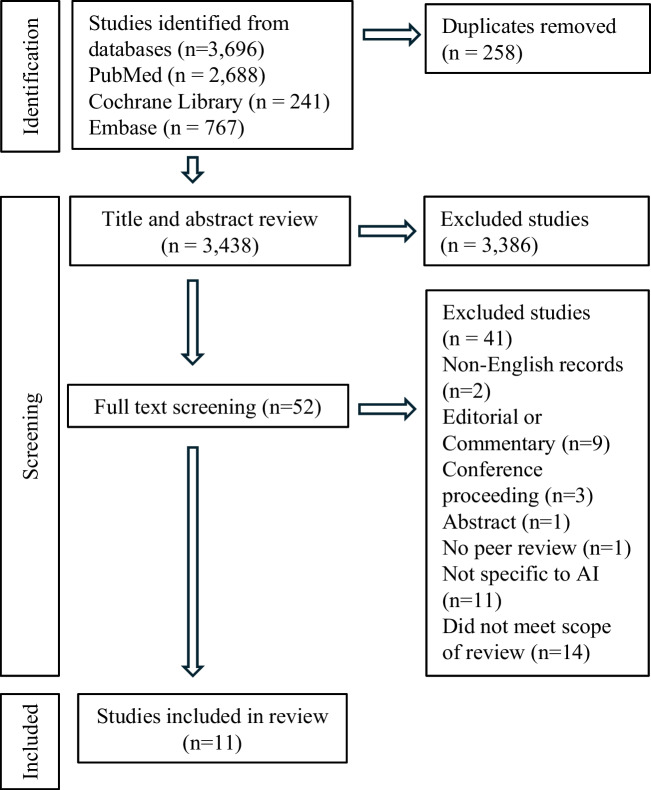
- The review identified 3,969 studies and included 11 eligible studies after screening.
- Efficiency was assessed in 5 of 11 studies, and all five found AI technologies made documentation more efficient; the review notes significant improvement in mean documentation time in hospital and primary care settings.
- Documentation quality was assessed in 9 studies; 6 of 9 reported AI-generated documents meeting or surpassing traditional documentation standards, but 3 of those studies did not screen for hallucinations.
- Stakeholder experience was assessed in 4 studies, and HCPs reported improved ease of documentation with ChatGPT and ambient AI in all four; user opinion was assessed in 3 studies and was generally positive.
- Quality appraisal using MMAT found 5 of 11 studies met 100% of assessed criteria, 4 of 11 met 60%, and no study scored below 60%.
## Methods
- Systematic review conducted according to PRISMA; databases searched were PubMed, Embase, and Cochrane Library, with no publication-year limits.
- Studies were selected using PICOSS criteria; duplicates were removed in Rayyan, with two independent reviewers screening titles/abstracts and then full texts.
- Data extracted included publication year, design, population, AI type, setting, document type, quality, timing, stakeholder opinion, and hallucinations/false information; study quality was assessed with the Mixed Methods Appraisal Tool (MMAT).
## Limitations
- The paper states that the included technologies are relatively new, so their capabilities and limitations may change rapidly as AI evolves.
- The included studies used a wide range of tools and methods to assess outcomes, creating heterogeneity that complicates comparison and interpretation.
- The paper notes that some studies did not screen for hallucinations at all, which may have led to an underestimation of risks.
- Evident from the text: the evidence base is small (11 studies) and concentrated in 2024 (9 of 11 studies), which limits maturity and breadth of the review’s conclusions.
Model-written summary. Check it against the paper before relying on it.
Integrity signals
Registry
Cites
Statistics
Figures
Verification
Claims the paper makes
19 Valid · 1 Not valid · 8 Not checked · 46 Own results and interpretations
At least one cited source doesn’t support this claim or points to a different paper, and none confirmed it — see the verdicts below.
In the paper
“Hallucination rates have been documented to vary between 3% – 28% in current literature [30, 31].”
§ Artificial Intelligence (AI) – Powered Documentation Systems in Healthcare: A Systematic Review > Documentation Quality
What the sources say
- Disputedcites [30] Chelli M, Descamps J, Lavoue V, Trojani C, Azar M, Deckert M, et al. Hallucination Rates and Reference Accuracy of ChatGPT and Bard for Systematic Reviews: Comparative Analysis. J Med Internet Res. 2024;26:e53164. 38776130 PMC11153973 sourceExperimental — accuracy not yet measured
The Results (page unavailable) report hallucination rates of 28.6%, 39.6%, and 91.4% for the models tested. The paper therefore documents rates well above the claimed 28% upper bound; it does not report a 3% rate. (LLM, conf=0.88)
Checked by a reasoning model — may be wrong.
- Not matchedcites [31] Metz C. Chatbots May ‘Hallucinate’ More Often Than Many Realize. The New York Times. 2023 06/11/2023.
Its entry has no title and year that we can search by.
plain- Asserted: passes — The authors put it forward as true.
- Checkable: passes — It can be checked against evidence.
- Load-bearing: passes — The paper’s conclusions depend on it.
- Based: passes — The paper gives a reason why it holds.
- Disputed
Every source the paper cites for this claim was checked and supports it.
In the paper
“Clinical documentation burden and excessive bureaucratic tasks have been cited as leading contributors to HCP burnout [2].”
§ Artificial Intelligence (AI) – Powered Documentation Systems in Healthcare: A Systematic Review > Introduction
What the sources say
- Supportedcites [2] Wu Y, Wu M, Wang C, Lin J, Liu J, Liu S. Evaluating the Prevalence of Burnout Among Health Care Professionals Related to Electronic Health Record Use: Systematic Review and Meta-Analysis. JMIR Medical Informatics. 2024;12:e54811. 38865188 PMC11208837 source
The Results section, under “Main Causes of Burnout and Proposed Solutions,” identifies administrative documentation tasks among workload factors contributing to burnout and says workload factors appeared in 18 of 32 reviewed studies. The Discussion section, under “Solutions,” also reports a robust relationship between workload, time spent using EHRs, and burnout, and recommends reducing clerical and documentation burdens. (LLM, conf=0.88)
plainstates a cause- Asserted: passes — The authors put it forward as true.
- Checkable: passes — It can be checked against evidence.
- Load-bearing: passes — The paper’s conclusions depend on it.
- Based: passes — The paper gives a reason why it holds.
- Supported
Every source the paper cites for this claim was checked and supports it.
In the paper
“AI based tools are poised to improve clinical documentation workflow and efficiency [2].”
§ Artificial Intelligence (AI) – Powered Documentation Systems in Healthcare: A Systematic Review > Introduction
What the sources say
- Supportedcites [2] Wu Y, Wu M, Wang C, Lin J, Liu J, Liu S. Evaluating the Prevalence of Burnout Among Health Care Professionals Related to Electronic Health Record Use: Systematic Review and Meta-Analysis. JMIR Medical Informatics. 2024;12:e54811. 38865188 PMC11208837 source
The Discussion’s “Artificial Intelligence–Based Solutions” section says AI-enabled dictation and note-taking can streamline medical-document creation and increase operational efficiency. It also says GPT-4 and intelligent templates can speed up documentation. These passages support the claim’s prospective wording. (LLM, conf=0.93)
hedgedstates a possible cause- Asserted: passes — The authors put it forward as true.
- Checkable: passes — It can be checked against evidence.
- Load-bearing: passes — The paper’s conclusions depend on it.
- Based: passes — The paper gives a reason why it holds.
- Supported
Every source the paper cites for this claim was checked and supports it.
In the paper
“The administrative burden associated with clinical documentation has been identified as a major contributor to health care professional (HCP) burnout.”
- Also stated in: § Introduction · plain
“Clinical documentation burden and excessive bureaucratic tasks have been cited as leading contributors to HCP burnout [2].”
§ Artificial Intelligence (AI) – Powered Documentation Systems in Healthcare: A Systematic Review > Abstract Artificial Intelligence (AI) driven documentation systems are positioned to enhance documentation efficiency and reduce documentation burden in the healthcare setting. The administrative burden associated with clinical documentation has been identified as a major contributor to health care professional (HCP) burnout. The current systematic review aims to evaluate the efficiency, quality, and stakeholder opinion regarding the use of AI-driven documentation systems. Using the Preferred Reporting Items for Systematic Reviews and Meta-Analyses (PRISMA) guidelines a comprehensive search was conducted across PubMed, Embase and Cochrane library. Two independent reviewers applied inclusion and exclusion criteria to identify eligible studies. Details of AI technology, document type, document quality and stakeholder experience were extracted. The review included 11 studies. All included studies utilised Chat generated pretrained transformer (Chat GPT, Open AI, CA, USA) or an ambient AI technology. Both forms of AI demonstrated significant potential to improve documentation efficiency. Despite efficiency gains, the quality of AI-generated documentation varied across studies. The heterogeneity of methods utilised to assess document quality influenced interpretation of results. HCP opinion was generally positive, users highlighted ease of use and reduced task load as primary benefits. However, HCPs also expressed concerns about the reliability and validity of AI-generated documentation. Chat GPT and ambient AI show promise in enhancing the efficiency and quality of clinical documentation. While the efficiency benefits are clear, the challenges associated with accuracy and consistency need to be addressed. HCP experiences indicate a cautious optimism towards AI integration, however reliability will depend on continued refinement and validation of the technology.
What the sources say
- Supportedcites [2] Wu Y, Wu M, Wang C, Lin J, Liu J, Liu S. Evaluating the Prevalence of Burnout Among Health Care Professionals Related to Electronic Health Record Use: Systematic Review and Meta-Analysis. JMIR Medical Informatics. 2024;12:e54811. 38865188 PMC11208837 source
The Results section identifies administrative documentation tasks as a workload factor contributing to burnout among health care professionals. The Discussion also describes reducing documentation and EHR workload as a strategy for reducing burnout. (LLM, conf=0.90)
plainstates an association- Asserted: passes — The authors put it forward as true.
- Checkable: passes — It can be checked against evidence.
- Load-bearing: passes — The paper’s conclusions depend on it.
- Based: passes — The paper gives a reason why it holds.
- Also stated in: § Introduction · plain
The cited sources support only part of this claim — read each source’s verdict below.
In the paper
“evidence suggests that HCPs spend on average two hours outside the official working day on documentation tasks [8].”
§ Artificial Intelligence (AI) – Powered Documentation Systems in Healthcare: A Systematic Review > Introduction
What the sources say
- Partly supportedcites [8] Gaffney A, Woolhandler S, Cai C, Bor D, Himmelstein J, McCormick D, et al. Medical Documentation Burden Among US Office-Based Physicians in 2019: A National Study. JAMA Intern Med. 2022;182(5):564-6. 35344006 PMC8961402 sourceExperimental — accuracy not yet measured
The results passage and Table 2 report a mean of 1.77 hours per day documenting outside office hours, reasonably rounded to two hours. The study concerns US office-based physicians, however, not HCPs generally, so the claim extends beyond the population studied. (LLM, conf=0.86)
hedged- Asserted: passes — The authors put it forward as true.
- Checkable: passes — It can be checked against evidence.
- Load-bearing: passes — The paper’s conclusions depend on it.
- Based: passes — The paper gives a reason why it holds.
- Partly supported
37 more claims · 7 with their cited sources checked
Create a free account to see all 74 claims and to verify the 1 reference still open.
- It may state two separate claims as one. 14
- Probably not a substantial claim. 19
Claims other papers make about this one
Each is checked against this paper’s own text: does it say what the citing paper says it does?
The source backs part of the claim, not all of it — or backs it for a different population, condition or comparison.
In the citing paper
“Ambient Listening technology, or Ambient AI, may reduce documentation burden by leveraging automated speech recognition (ASR) and large language models (LLMs) to transform real-time clinical conversations into drafted EHR documentation records [11].”
From Protocol for an EHR-embedded pragmatic randomized control trial of Ambient AI to Reduce Nursing Staff Documentation Time (2026) · cites this paper as [11]
Experimental — accuracy not yet measured
Citations
Cites
The PRISMA 2020 statement: An updated guideline for reporting systematic reviews
Page, M. J., McKenzie, J. E., Bossuyt, P. M., Boutron, I., Hoffmann, T. C., Mulrow, C. D., Shamseer, L., Tetzlaff, J. M., Akl, E. A., Brennan, S. E., et al. (2021) · BMJ · doi:10.1136/bmj.n71 · Cited by 108,283
The Mixed Methods Appraisal Tool (MMAT) version 2018 for information professionals and researchers
Hong, Q. N., Fàbregues, S., Bartlett, G., Boardman, F., Cargo, M., Dagenais, P., Gagnon, M.-P., Griffiths, F., Nicolau, B., O’Cathain, A., et al. (2018) · Education for Information · doi:10.3233/efi-180221 · Cited by 4,737 · cited 1×
“1 The mixed methods appraisal tool (MMAT) [16] was used to assess the quality of eligible studies.”
The potential for artificial intelligence in healthcare
Davenport, T., & Kalakota, R. (2019) · Future Healthcare Journal · doi:10.7861/futurehosp.6-2-94 · Cited by 3,800 · cited 2×
“Many barriers have been identified to the widespread implementation of AI technologies in healthcare, however previous literature has emphasised the inevitability of its adoption [3].”
Shanafelt, T. D., Dyrbye, L. N., Sinsky, C., Hasan, O., Satele, D., Sloan, J., & West, C. P. (2016) · Mayo Clinic Proceedings · doi:10.1016/j.mayocp.2016.05.007 · Cited by 1,086 · cited 1×
“This administrative load not only contributes to burnout but also detracts from time that could be spent on direct patient care [9].”
ChatGPT: the future of discharge summaries?
Patel, S. B., & Lam, K. (2023) · The Lancet Digital Health · doi:10.1016/s2589-7500(23)00021-3 · Cited by 728
Boscardin, C. K., Gin, B., Golde, P. B., & Hauer, K. E. (2024) · Academic Medicine · doi:10.1097/acm.0000000000005439 · Cited by 620 · cited 1×
“Chat generated pretrained transformer (Chat GPT) (Open AI, San Francisco, CA, USA) is a form of generative AI which utilises large language model (LLM) algorithms and advanced neural networks to generate human like text responses [4].”
Chelli, M., Descamps, J., Lavoué, V., Trojani, C., Azar, M., Deckert, M., Raynier, J.-L., Clowez, G., Boileau, P., & Ruetsch-Chelli, C. (2024) · Journal of Medical Internet Research · doi:10.2196/53164 · Cited by 602 · cited 1×
“Hallucination rates have been documented to vary between 3% – 28% in current literature [30, 31].”
Johnson, D., Goodman, R., Patrinely, J., Stone, C., Zimmerman, E., Donald, R., Chang, S., Berkowitz, S., Finn, A., Jahangir, E., et al. (2023) · doi:10.21203/rs.3.rs-2566942/v1 · Cited by 598 · cited 1×
“The output generated by Chat GPT is dependent on the complexity and clarity of the input, continuous evaluation of generated output will be required to ensure safe implementation in clinical settings [32, 33].”
Ambient artificial intelligence scribes to alleviate the burden of clinical documentation.
Tierney, A. A., Gayre, G., Hoberman, B., Mattern, B., Ballesca, M., Kipnis, P., Liu, V., & Lee, K. (2024) · NEJM Catalyst · doi:10.1056/cat.23.0404 · Cited by 400 · cited 2×
“Both Chat GPT and ambient AI have shown promise in streamlining clinical documentation in a variety of settings [5–7].”
How to formulate research recommendations
Brown, P., Brunnhuber, K., Chalkidou, K., Chalmers, I., Clarke, M., Fenton, M., Forbes, C., Glanville, J., Hicks, N. J., Moody, J., et al. (2006) · BMJ · doi:10.1136/bmj.38987.492014.94 · Cited by 381 · cited 1×
“Studies that met the population, intervention, comparator, outcome, study design and setting (PICOSS) criteria were included in the review (Table 2) [14].”
Cited by
AI Scribes in Health Care: Balancing Transformative Potential With Responsible Integration
Leung, T. I., Coristine, A. J., & Benis, A. (2025) · JMIR Medical Informatics · doi:10.2196/80898 · Cited by 99
“Results suggest that there is risk for hallucinations or fictitious information [4].”
InfluentialMache, S., Bernburg, M., Würtenberger, A., & Groneberg, D. A. (2025) · Clinics and Practice · doi:10.3390/clinpract15080138 · Cited by 30
“Consistent with previous research [27,41–43], many participants in this study identified tangible benefits of AI, particularly in automating administrative tasks such as documentation and scheduling.”
Cheungpasitporn, W., Athavale, A. M., Ghazi, L., KASHANI, K. B., Colicchio, T. K., Koyner, J. L., Chen, J., Ix, J. H., Nadkarni, G. N., & Neyra, J. A. (2026) · Clinical Kidney Journal · doi:10.1093/ckj/sfag004 · Cited by 42
“As highlighted in Table 2 rigorous validation and real-world testing are foundational requirements for responsible AI deployment in nephrology rather than optional extensions [1 ,3 ,4 ,7 ,11 ,13 ,31 ,37 ,40 –44 , 51 –54 , 65 –67 , 84 , 85 , 107 –152 ].”
Tiem, J. M. V., Cramer, E., Iverson, C., Kennelty, K. A., Andrys, N. R. R., Lee, J., Knake, L. A., Misurac, J. M., Blum, J. M., & Reisinger, H. S. (2025) · Journal of the American Medical Informatics Association · doi:10.1093/jamia/ocaf214 · Cited by 36
“5,8,9,12,23,26,27 In prioritizing efficiency, clinicians may be pointing to what Tracey et al describe as the “logistification of documentation,” or how documentation can function to expedite the movement of people, resources, and/or information, through an infrastructure.”
Ohde, J. W., Thompson, A., Liu, Z., Rost, L. M., Overgaard, J. D., Tan, J. Y. E., Overgaard, S. M., Sarmiento, R. F., Ke, Y., Liew, J. C. K., et al. (2026) · npj Digital Medicine · doi:10.1038/s41746-026-02554-0 · Cited by 23
Cheungpasitporn, W., Thongprayoon, C., & KASHANI, K. B. (2025) · Kidney360 · doi:10.34067/kid.0000001037 · Cited by 13
Harvey, C. J., Wong, V., Huynh, W., Lee, J. P., & Woo, R. K. (2025) · World Journal of Pediatric Surgery · doi:10.1136/wjps-2025-001073 · Cited by 18
“9 Given these factors, billing level may not be a reliable primary metric of ambient AI success, though ongoing algorithm refinements could still improve fidelity in complexity-based coding.”
Rahrisch, A., Braun, J., Ganter, M. T., Roche, T. R., Spahn, D. R., Tscholl, D. W., & Kaserer, A. (2026) · Journal of Clinical Anesthesia · doi:10.1016/j.jclinane.2026.112163 · Cited by 10
Chaudhari, N. B., Bhade, M. W., Havelikar, U. A., & Patel, V. P. (2025) · Intelligent Hospital · doi:10.1016/j.inhs.2025.100010 · Cited by 9
Hier, D. B., Carrithers, M. D., Platt, S. K., Nguyen, A. Q., Giannopoulos, I., & Obafemi-Ajayi, T. (2025) · Information · doi:10.3390/info16060446 · Cited by 15
Exploring an AI-First Healthcare System
Gates, A., Ali, A., Conard, S. E., & Dunn, P. J. (2026) · Bioengineering · doi:10.3390/bioengineering13010112 · Cited by 10
“Early evidence suggests meaningful reductions in documentation time and cognitive load, with potential downstream benefits for clinician satisfaction and patient engagement [18,21].”
InfluentialLipschuetz, M., & Topaz, M. (2026) · International Journal of Nursing Studies · doi:10.1016/j.ijnurstu.2026.105369 · Cited by 9
Nymberg, V. M. (2025) · European Journal of General Practice · doi:10.1080/13814788.2025.2567462 · Cited by 4
“…ambient scribe tools (voice-to notes transcription) have shown strong evidence of reducing administrative burdens and are already being partially implemented in primary care. these tools serve as an excellent example of how AI can enhance the working environment for health care professionals [7,8].”
Sanchez, C. G., Kharko, A., Hägglund, M., Riggare, S. S., & Blease, C. (2025) · JMIR Research Protocols · doi:10.2196/73602 · Cited by 4
“Previous reviews have examined the perspectives of health care professionals (HCPs) on AI use in clinical settings, focusing on its roles in decision-making, efficiency, quality of care, and documentation systems [23,24].”
Artificial intelligence in occupational therapy documentation: Chatbot vs. Occupational Therapists
Lee, S.-A., & Park, J. (2025) · Digital Health · doi:10.1177/20552076251386657 · Cited by 8
Goer, V., & Schwarz, J. (2026) · Die Psychotherapie · doi:10.1007/s00278-026-00842-4 · Cited by 5
Sanchez, C. G., Goer, V., Kharko, A., Hägglund, M., Hagström, J., Schwarz, J., & Blease, C. (2026) · BMJ Open · doi:10.1136/bmjopen-2025-115562 · Cited by 4
“Similarly, Bracken’s et al 25 systematic review evaluated AI-driven documentation systems, including both genAI tools and ambient AI scribes, across various clinical settings and healthcare professions, such as physicians, nurses and allied health professionals.”
Triantafyllidis, A. K., Segkouli, S., Kokkas, S., Alexiadis, A., Lithoxoidou, E. E., Manias, G., Antoniades, A., Votis, K., & Tzovaras, D. (2025) · Healthcare · doi:10.3390/healthcare14010045 · Cited by 8
“By automating report generation, the literature synthesis, and evidence summarisation, they can increase efficiency across clinical research domains [39].”
Vora, J., & Bhimani, Z. (2025) · Home Health Care Management & Practice · doi:10.1177/10848223251381799 · Cited by 3
Schwarz, J., Goer, V., Guzhova, O., Holtz, L., Muehlensiepen, F., & Blease, C. (2025) · doi:10.2196/preprints.83017 · Cited by 2
Blease, C., Sanchez, C. G., Gaab, J., et al. (2026) · Research Square · doi:10.21203/rs.3.rs-9979779/v1 · Cited by 2
Information and Digital Reengineering of Supply Chain Management in the Agro-Industrial Complex
Panfilov, I., Khrapunova, Y., Pechenkin, Z., et al. (2026) · doi:10.1109/infoteh68759.2026.11477700 · Cited by 2
“Empirical evidence indicates that digital SCM systems yield tangible performance improvements: firms report reduced lead times, lower inventory waste, and enhanced product consistency following adoption of e-traceability and AI-driven tools [17, 18].”
Integrating Artificial Intelligence in Systemic Therapy: Strategies for Effective Clinical Practice
Hertlein, K. M., & Rajaei, A. (2026) · International Journal of Systemic Therapy · doi:10.1080/2692398x.2026.2633648 · Cited by 2
Cha, H., & Kim, J. (2025) · Clinical and Experimental Emergency Medicine · doi:10.15441/ceem.25.199 · Cited by 10
“Although skepticism remains regarding its use in domains requiring rigor [45], research and testing are already underway in areas such as medical record summarization [46], clinical decision support [47], medical documentation assistance [48], and patient explanation materials [49].”
Hang, H., Yang, L., Wang, Z., Lin, Z., Li, P., Zhu, J., Liu, R., Pu, S., & Cheng, X. (2025) · Frontiers in Medicine · doi:10.3389/fmed.2025.1618858 · Cited by 4
Expectations, Emotions, and Empowerment
Song, J. (2025) · Nurse Leader · doi:10.1016/j.mnl.2025.102490 · Cited by 3
Artificial Intelligence in Spiritual Care: Modified Delphi Study
Winiger, F., Smith, C. E., Nourriz, S., Szilagyi, C., & Haußmann, A. D. (2026) · Journal of Medical Internet Research · doi:10.2196/97094 · Cited by 3
“…labor, this sentiment warrants further consideration in light of the tendency of generative AI systems used in health care to hallucinate outputs [59,60] and the potentially far-reaching consequences of AI-related errors in clinical settings, even in administrative and informational tasks.”
A Modular Evaluation of AI-Assisted Clinical Documentation
Delaunay, J., Sarkis, M., Solé‐Casals, J., & Cusidó, J. (2026) · Applied Sciences · doi:10.3390/app16146961 · Cited by 1
Lawrence, R. C., Herbert, K., Georghiou, T., Mehta, R., Ng, P. L., Rolewicz, L., Morris, S., & Shand, J. (2026) · BMJ Digital Health & AI · doi:10.1136/bmjdh-2026-000120 · Cited by 3
“28 The tool was applied by individual researchers to qualitative studies (RL), descriptive surveys (RL) and quantitative studies”
A Generative AI Framework for Pharmacokinetic Clinical Study Report Authoring
Samuelsson, J., Blakeman, S., Alexander, E., et al. (2026) · Clinical and Translational Science · doi:10.1111/cts.70644 · Cited by 1
Re-Centering Clinical Documentation in the Age of AI Scribes: Four Aims of the Patient Chart Note
Chen, C. A., Leung, T. I., & Bajra, R. (2026) · JMIR Medical Education · doi:10.2196/95218 · Cited by 1
Hao, X., Zhao, H., Zhu, L., et al. (2026) · Journal of Mechanics in Medicine and Biology · doi:10.1142/s0219519426500302 · Cited by 1
Płaza, M., Płaza, M., Lucińska, M., Młodawski, M., Kęczkowska, J., Deniziak, S. R., Murawska, T., Murawski, K., Wykrota, K., Jaszczyk, D., et al. (2026) · Scientific Reports · doi:10.1038/s41598-026-45879-2 · Cited by 3
Generative AI in health sciences education and practice. Part 1: chatbots and simulation
Reimers, S. J. (2026) · British Journal of Cardiac Nursing · doi:10.12968/bjca.2025.0058 · Cited by 2
Development and Evaluation of an Intelligent Control System in Perioperative Nursing Documentation
Chen, R., Ye, H., Li, C., Du, L., Ou, D., & Zhang, X. (2026) · CIN Computers Informatics Nursing · doi:10.1097/cin.0000000000001442 · Cited by 1
From tear to repair: A systematic review of frequently asked questions before rotator cuff surgery
Quaunine, M., Ahmad, A., Guevel, B., Davis, T. P., Singh, J., & Simpson, A. I. (2025) · Shoulder & Elbow · doi:10.1177/17585732251395212 · Cited by 3
VanHara, A., & Hage, D. S. (2025) · Journal of Evidence-Based Social Work · doi:10.1080/26408066.2025.2571439 · Cited by 4
McCradden, M. D., Tng, S., Jeyaseelan, D., Leane, C., Campbell, M., Braund, T., Earle-Bandaralage, L., Ebrahimi, M., Sharma, A. K., & TANG, J. C. Y. (2025) · medRxiv · doi:10.1101/2025.09.30.25336928 · Cited by 1
“While administrative functions in healthcare are not often considered ‘interventions’ as they are typically used to improve a current standard, it is very clear at this point that AI Scribes may introduce unique and unanticipated risks into clinical environments [6-10].”
Adapa, K., Rajan, S., Venketa, A. Y., & Mazur, L. M. (2025) · Asia-Pacific Journal of Oncology Nursing · doi:10.1016/j.apjon.2025.100737 · Cited by 1
“11 Achieving seamless integration often necessitates extensive EHR system customization, with adoption rates varying considerably, from 20% to 50%, depending on specialty-specific documentation workflows and informatics readiness.”
InfluentialClinical safety evaluation of ambient voice technologies in surgical documentationPreprint
O’Kane, R., Stonehouse‐Smith, D., Shirazi, M. R. A., Hutchinson, R., Seehra, J., Papageorgiou, S. N., & Cobourne, M. T. (2026) · Research Square · doi:10.21203/rs.3.rs-9654603/v1 · Cited by 1
Fu, M. R., Birdashaw, M., Zimmerman, C., Blackwell, V., Spence, J. K., & Roberts, M. J. (2026) · Journal of Transcultural Nursing · doi:10.1177/10436596261489399
Yu, C.-W., & Yang, C. (2026) · Healthcare · doi:10.3390/healthcare14193155
Silva, Á. F. A. Q., Carnaz, A. S., & Akamatsu, T. M. (2026) · RECIMA21 - Revista Científica Multidisciplinar · doi:10.47820/recima21.v7i9.9071
INTELIGÊNCIA ARTIFICIAL NA SAÚDE: Oportunidades e desafios para a equipe multiprofissional
Filho, A. O. D. M., Machado, M. C., Maslinkiewicz, A., Oliveira, R. D., Antunes, A. R. F. D. M., & Silva, M. E. W. D. B. (2026) · Scientia Generalis · doi:10.22289/sg.v7n2a33
Artificial Intelligence Systems in Prosthodontics: Current Applications and Challenges
Faure, M., Millet, C., Richert, R., Rokhshad, R., Tamimi, F., & Ducret, M. (2026) · Australian Dental Journal · doi:10.1111/adj.70065
Bahl, R., Bansal, H., Buchanan, G. R., & Verspoor, K. M. (2026) · doi:10.2196/preprints.110590
Husen, M., Gaidzik, P. W., & Schiltenwolf, M. (2026) · Die Orthopädie · doi:10.1007/s00132-026-04876-z
Artificial Intelligence in Clinical Nutrition: Current Uses, Challenges, and Opportunities
Mauldin, K., Pham, A. D., Dodaballapur, S., & Limketkai, B. N. (2026) · Nutrients · doi:10.3390/nu18162638 · Cited by 1
“The recent integration of AI in healthcare is rising, particularly in the domain related to clinical documentation [101].”
Merlino, A., Blue, A., Boose, E., Meese, B., Owens, J., Vickers, J., Angeloff, A., Arnold, M., Chen, R., Grade, M. M., et al. (2026) · npj Health Systems · doi:10.1038/s44401-026-00144-6
Zhang, C., Mao, W., Chen, H., Dai, Z., Pan, A., & Lin, Z. (2026) · International Journal of Medical Informatics · doi:10.1016/j.ijmedinf.2026.106651
Peer Review in Radiation Oncology: Present and Future Directions
Sajed, S., Ali, A., & Vassil, A. D. (2026) · Applied Radiation Oncology · doi:10.37549/aro-d-26-0005
Launes, C., González‐Grado, C., Codorníu, J., Vinyets, J., Jabalera, M., & Cossio‐Gil, Y. (2026) · Journal of Healthcare Quality Research · doi:10.1016/j.jhqr.2026.101227
Artificial Intelligence and Clinician Burnout in the United States: A Narrative Review
Sucharitrak, C. (2026) · Cureus · doi:10.7759/cureus.112814
Umfrage zur Weiterbildung in Orthopädie und Unfallchirurgie: was wirklich zählt
Euringer, J. (2026) · Arthroskopie · doi:10.1007/s00142-026-00874-7
Ambient AI scribe in pediatric outpatient visits: Documentation burden, quality, and scale-up limits
Vallejo, V., Farreras, J., Valero, L., González‐Grado, C., Peral, I., Cano, I., & Launes, C. (2026) · Medicina Clínica (English Edition) · doi:10.1016/j.medcle.2026.107541 · Cited by 1
Bhosekar, M. S., Lapic, S., Narasimhan, M., Joseph, A., & Madathil, K. C. (2026) · IISE Transactions on Healthcare Systems Engineering · doi:10.1080/24725579.2026.2694491 · Cited by 1
The ethics of listening walls: patient autonomy and consent in the age of ambient clinical AI
Kumah, E., Antwi, J., Boakye, D. S., Botchwey, C. O., & Anyimadu, E. A. (2026) · npj Digital Medicine · doi:10.1038/s41746-026-02973-z · Cited by 4
Regulating Generative AI in Healthcare: Protocol for a Scoping Review (Preprint)Preprint
Ashraf, M., Corso, M.-M., Fleetcroft, C., Menon, V., Mateen, B. A., Denniston, A. K., & Hogg, H. D. J. (2026) · doi:10.2196/preprints.106167
Lünse, S., Wisotzky, E. L., Renz-Kiefel, L., Paasch, C., Hunger, R., & Mantke, R. (2026) · Surgical Endoscopy · doi:10.1007/s00464-026-13044-5 · Cited by 3
Kieffer, M. C., Morris, J., Trabert, B. L., & Tondo-Steele, K. (2026) · Gynecologic Oncology Reports · doi:10.1016/j.gore.2026.102158
McLoughlin, B., Du, J., Tavares, N., Zhu, T., Tiwari, P., Jawad, S., Seeley, A., Swain, S., & Gangannagaripalli, J. (2026) · Age and Ageing · doi:10.64898/2026.06.24.26356103
Amer, A. Y. A., Mohammed, M. H., & Al-Hadi, M. A. (2026) · International Conference on Digital Transformation, Innovation & Sustainable Development (DTISD) · doi:10.1109/dtisd69661.2026.11668266
“After a decade of conflict (2014-present), about 50% of health facilities are damaged or out of service, 60% of the population does not have access to basic health care, and chronic electricity shortages average 16 hours per day [4], [5].”
A Conceptual Model for Ambient AI Adoption: Perspectives From Academia and Industry
Biro, J., Pines, J. M., Jayaraman, S., Chagari, V. R., & Ratwani, R. M. (2026) · JMIR Medical Informatics · doi:10.2196/91098 · Cited by 1
“Early evaluations show mixed results in achieving anticipated benefits, with little explanation for why outcomes are not being consistently realized [6,7].”
Heimbruch, H. H. H., Solomon, W. T., Junaid, S. A., Eke, D. O., Tata, L., Oluwadare, O. E., & Shehu, H. (2026) · Epidemiology and Health Data Insights · doi:10.63946/ehdi/18797
“Studies outside of core documentation pipeline research report that workflows with poor integration into existing EHR interfaces may negate potential efficiency gains, as clinicians spend time reconciling draft text or correcting structure [35].”
Risch, J., Jacobi, D., Kohler, J., et al. (2026) · Urologia Internationalis · doi:10.1159/000553132
Patient and caregiver perspectives on AI scribes: An evidence synthesis
Kumah, E. (2026) · Health Policy and Technology · doi:10.1016/j.hlpt.2026.101273 · Cited by 1
Perceive, Prioritize, Act: Eliciting Alert Design Requirements for Fast-Paced Medical Work
Zhang, Z., Agbugba, V. F., Billings, S., Bai, E., Luo, X., & Adelgais, K. (2026) · International Journal of Human-Computer Interaction · doi:10.1080/10447318.2026.2682917 · Cited by 1
Chen, S.-M., Laksmita, O. D., Lee, M.-L., Han, D., Pan, S., Tsai, Y.-C., & Hsieh, C. (2026) · Musculoskeletal Science and Practice · doi:10.1016/j.msksp.2026.103594
Charting Tomorrow: A Practical Review of Artificial Intelligence in Medical Documentation
Zeitouni, F., Botros, N. E., Khosla, A. S., McKinney, M., Craig, J. N., Alamo-Irizarry, L., & Rao, V. K. (2026) · Plastic & Reconstructive Surgery Global Open · doi:10.1097/gox.0000000000007822
McCradden, M. D., Tng, S., Jeyaseelan, D., Leane, C., Campbell, M., Braund, T., Earle-Bandaralage, L., Ebrahimi, M., Sharma, A., & Tang, J. (2026) · BMJ Open · doi:10.1136/bmjopen-2025-111656
AI in the ED: Six High‐Impact Uses for Clinical Educators
Natesan, S. M., Torres, S., Nash, C. J., Leiman, E. R., & Rivera, M. J. (2026) · AEM Education and Training · doi:10.1002/aet2.70219
When AI outputs become documents: Documentation activity in human– AI dialogue
Donner, S. (2026) · Journal of the Association for Information Science and Technology · doi:10.1002/asi.70090 · Cited by 3
“…through paratext or paradata (structure, timestamps), protocolization (versioning, review), and organizational placement (archives, policies) (Bracken et al., 2025; Cameron et al., 2023; Königstorfer & Thalmann, 2022) and propose frameworks for responsible integration of generative AI in…”
The Challenges and Promise of AI for Clinical Documentation in Pediatric Inpatient Care
Levitties, N., Sinha, A., Cullion, K., Kelly, D. P., Pandiyan, P., Agus, M. S. D., & Cifra, C. L. (2026) · Hospital Pediatrics · doi:10.1542/hpeds.2025-008972
He, L., Do, D., Shet, V. G., Farghaly, O., Deshpande, P., Madiraju, P., Ye, J., & Beestrum, M. (2026) · Journal of the American Medical Informatics Association · doi:10.1093/jamia/ocag089
Bisset, B., Kainkaryam, V., Marhamati, S. H., Moradi, A., Amin, R., & Houman, J. (2026) · Journal of Medical Internet Research · doi:10.2196/81314 · Cited by 1
“In a space where documentation burdens directly contribute to provider burnout, documentation agents can fill a critical need for providers to improve care delivery and health outcomes [79].”
IA générative pour les soins infirmiers : un nouvel outil au service des écrits collaboratifs
Lamer, A., Quindroit, P., & Nonnez, J. (2026) · Soins · doi:10.1016/j.soin.2026.03.010
Generative AI in Admission Notes and Diagnostic Completeness: A Pilot Study
Rodrigues, A. C., Misurac, J. M., Knake, L. A., Barker, K., & Blum, J. M. (2026) · Applied Clinical Informatics · doi:10.1055/a-2876-0998
Freire, S. S. V., Pineda, K. M. E., Freire, M. G. V., & Galarza, C. K. G. (2026) · Revista Científica Episteme & Praxis · doi:10.62451/rep.v4i2.196
Nagarajan, R., Hayakawa, J., Patterson, M., & Martel, S. (2026) · Journal of Medical Systems · doi:10.1007/s10916-026-02371-8
INTEGRATION OF ARTIFICIAL INTELLIGENCE IN MEDICAL LIBRARIES: TRANSFORMING INFORMATION SERVICES
Kumar, S., Kaur, J., Kumari, R., Singh, K., Devi, S., & Mamta (2026) · Journal of Integrative Science and Societal Impact · doi:10.29121/jissi.v2.i1.2026.47 · Cited by 1
Eliminating Nonvalue-Added Tasks in Health Care: Artificial Intelligence in the Orthopedic Office
Doss, T., Aryee, J. N. A., Vitkovska, D., Borole, A., O’Leary, C. J., Viqueira, M., Okoh, D., & Katt, B. M. (2026) · Journal of Hand Surgery Global Online · doi:10.1016/j.jhsg.2026.100992
“5,20 In this study, 6 AI-generated notes (8.8”
InfluentialEvolving and novel applications of artificial intelligence in interventional oncology
Almashni, S. Y., Fayek, F. B., Javens, D. C., Boulis, M. T., & Makary, M. S. (2026) · World Journal of Clinical Oncology · doi:10.5306/wjco.v17.i3.113226
Four Aims of the Patient Chart Note: Medical Education in the Age of AI Scribes (Preprint)Preprint
Chen, C. A., Leung, T. I., & Bajra, R. (2026) · doi:10.2196/preprints.95218
Zou, M., Srinivasan, S., Chin, V., Lo, T. W. S., Loke, W. T., Yang, G. D., Lim, Z. W., Li, K. Z., Wong, W., Lam, J. S. H., et al. (2026) · Eye · doi:10.1038/s41433-026-04325-3 · Cited by 1
“While AI-assisted documentation has the potential to reduce clinician workload, these benefits might be partially offset by the need for substantial post-editing and verification [26, 27].”
AI-Assisted Clinical Documentation in Routine Danish General Practice: Quantitative Pre-Post Study
Olsen, L. N., Harbig, P., Laurberg, A. B., Laurberg, J. M., & Charles, M. (2026) · JMIR Human Factors · doi:10.2196/94431
Irgang, L., Svedberg, P., Nygren, J., & Petersson, L. (2026) · BMJ Open · doi:10.1136/bmjopen-2025-110553 · Cited by 1
Szakonyi, A., & Oris, K. (2026) · Advances in computational intelligence and robotics book series · doi:10.4018/979-8-3373-9918-8.ch006
Acceptance of AI scribes within hospital allied health settings: A mixed methods study
Ryan, L., Hattingh, L., Wall, D., Stanich, H., Ross, N., Cal, J. D., Milne, E., & Wenke, R. (2026) · Digital Health · doi:10.1177/20552076261437234 · Cited by 1
“11, While the present study did not quantify the workflow efficiencies following use of AI scribes, findings support previous studies in allied health.”
Chen, L. A., Yeh, E.-H., Lin, P., Hsieh, M., Lin, C., & Liao, Z.-Y. (2026) · Nurse Education in Practice · doi:10.1016/j.nepr.2026.104715 · Cited by 2
Editorial: Mental health in the age of artificial intelligence
Noble, J. M., Ha, K., & Greenshaw, A. (2026) · Frontiers in Psychiatry · doi:10.3389/fpsyt.2025.1750256
Wang, S.-P., & Liu, Y.-L. (2026) · Digital Health · doi:10.1177/20552076261416808
Akinwumi, P. O., Qian, M., Babatope, O. A., Ogunleye, R. O., & Olorunsogbon, T. A. (2026) · SSRN Electronic Journal · doi:10.2139/ssrn.7454973
Engan, H. K., Landstad, I., Sand, K., Evenshaug, S., & Halsnes, E. H. (2025) · doi:10.2196/preprints.90442
Diaconescu, B. M., Gurzu, B., Sava, C., Sava, C., Sfarghiu, I., Luchian, D., & Gurzu, I. L. (2025) · Romanian Journal of Occupational Medicine · doi:10.2478/rjom-2025-0001
Ambient Artificial Intelligence in Hand Surgery: Insights, Pearls, and Pitfalls From Real-World Use
Unadkat, K. D., Dhupati, P., & Noland, S. S. (2025) · Hand · doi:10.1177/15589447251389661 · Cited by 1
Yousefi, K., Rahnama, M., & Barangi, H. (2025) · International Conference on the Internet of Things (IoT) · doi:10.1109/iot69654.2025.11297670
“These findings underscore the importance of standardized frameworks for AI education and skills assessment, emphasizing the relevance of instruments like the MAILS questionnaire for comprehensive evaluation [24].”
Artificial Intelligence in Biomedicine and Health Care: Hope or Hype?
Suvvari, T. K., & Ingawale, S. (2025) · GLOBAL JOURNAL OF MEDICAL STUDENTS · doi:10.25259/gjms_37_2025
Bisset, B., Kainkaryam, V., Marhamati, S. H., Moradi, A., Amin, R., & Houman, J. (2025) · doi:10.2196/preprints.81314
AI and Cloud Computing: Streamlining Healthcare Operations
Dhanasekaran, R. (2025) · European Journal of Computer Science and Information Technology · doi:10.37745/ejcsit.2013/vol13n4996105
Metadata
- Authors
- Bracken, A., Reilly, C., Feeley, A., Sheehan, E., Merghani, K., & Feeley, I.
- Affiliations
- Royal College of Surgeons in Ireland (IE)
- University College Dublin (IE)
- University of Limerick (IE)
- Midland Regional Hospital at Tullamore (IE)
- Corresponding author
- Bracken, Aisling
- Venue
- Journal of Medical Systems
- Published
- 2025-02-18
- Volume
- 49
- Issue
- 1
- Pages
- 28-28
- ISSN
- 0148-5598 (ISSN-L)
- 1573-689X
- PMC
- PMC11835907
- OpenAlex
- W4407695342
- Cited by
- 113
- References
- 33
- Citations by year
- 2026: 82 · 2025: 31
- FWCI
- 6.67
- Type
- journal article
- Language
- en
- Open access
- hybrid
- doi.org
- Licence
- cc-by
- creativecommons.org/licenses/by/4.0 (tdm)
- creativecommons.org/licenses/by/4.0 (vor)
- Locations
- Journal of Medical Systems (publishedVersion, cc-by)
- PubMed Central (publishedVersion, cc-by)
- PubMed (publishedVersion)
- Funders
- Royal College of Surgeons in Ireland
- Topics
- Health Sciences › Medicine › Health Informatics › Artificial Intelligence in Healthcare and Education
- Health Sciences › Health Professions › Health Information Management › Electronic Health Records Systems
- Health Sciences › Nursing › Research and Theory › Nursing Diagnosis and Documentation
- Keywords
- documentation burden, ChatGPT, ambient AI, stakeholder acceptance, workload
- MeSH terms
- Artificial Intelligence, Documentation, Humans
About these checks
Registry, retraction, Cites and statistics results are computed, not judged, with one exception: a printed reference that no index lists is read once by a model before it counts as a citation error. Claims are extracted by a model and kept only when their quote appears verbatim in the text; each cited source is then checked, with a model’s help, for whether it says what the claim relies on. Those verdicts can be wrong — read the claim’s quote and the cited source before relying on one.
The claim verdicts this report counts are experimental: their accuracy is not yet measured.
A language model drew the claims from the paper on 2026-10-10, under version 3 of the claim definition (model deepseek-v4.1-flash, prompt extract-v3).
A second model labelled each claim on 2026-10-10 (model jev-1.13-20260917, definition revision gold-guideline-v0.2).
Cited sources are checked with a language model’s help (gpt-6-sol).
Statistics and arithmetic are recomputed, not judged.
Confidence bands are shown only for fields calibrated on our annotated test set. None is calibrated yet, so no band is shown.
What counts as a claim ›How we measure confidence ›How we check this ›
Are you an author, or do you see a problem with this page? Request a review
Data sources
Bibliographic data: Semantic Scholar, OpenAlex, Crossref.
Contains information from the Semantic Scholar Academic Graph Datasets, made available under the ODC Attribution License (ODC-BY 1.0).
Semantic Scholar’s data is described in: Kinney, R., et al. (2023). The Semantic Scholar Open Data Platform. arXiv:2301.10140.
