

Work Ability and Functioning Among Individuals with Persistent Indoor Environment-Related Symptoms or Chronic Fatigue: Nine-Month Follow-Up of a Web-Based Randomized Controlled Trial.
Open accessThe DOI matches its Crossref record; 52 of the 52 references it cites were found in a registry or an index; 32 of the 72 sources its claims cite were checked for support.
Abstract
Purpose: Persistent physical symptoms (PPS) can significantly impair work ability and daily functioning, exacerbated by comorbid illness worry (IW). This randomized controlled trial (RCT) examined the effectiveness of guided internet-based treatment on work ability and daily functioning of working-aged individuals with PPS associated with indoor environment (IE) and/or chronic fatigue (CF) with disability. The intervention was based on acceptance and commitment therapy (ACT) combined with individual case formulation, compared to treatment as usual (TAU). IW’s role in moderating effects was explored.In this RCT (Clinicaltrials.gov NCT04532827), 103 individuals with PPS linked to IE, CF or both were assigned to a video-based case conceptualization and 10-week internet-based ACT with TAU (iACT + TAU; n = 50) or TAU alone (n = 53). Self-reported work ability and daily functioning were assessed from pre-intervention to 9-month follow-up, examining the potential moderating effect of baseline IW. Analyses used linear mixed models and Type III ANOVA.Of the 103 participants, 62% completed the 9-month follow-up. Baseline demographics showed no significant differences between treatment groups. Significant positive interaction (treatment group and time) effects for work ability were found in the iACT + TAU group at post-measurement (β = 0.41, p = 0.041), 3-month (β = 0.58, p = 0.004), and 9-month (β = 0.47, p = 0.022) follow-ups. Daily functioning improved significantly at 3-month (β = 0.57, p = 0.007), particularly in the work domain (β = 0.67, p = 0.003). IW and PPS group did not moderate outcomes.Internet-based ACT with individual case formulation was associated with improved work ability for individuals with PPS associated with IE and CF, providing preliminary support for further examination as a potential frontline treatment.Methods: Persistent physical symptoms (PPS) can significantly impair work ability and daily functioning, exacerbated by comorbid illness worry (IW). This randomized controlled trial (RCT) examined the effectiveness of guided internet-based treatment on work ability and daily functioning of working-aged individuals with PPS associated with indoor environment (IE) and/or chronic fatigue (CF) with disability. The intervention was based on acceptance and commitment therapy (ACT) combined with individual case formulation, compared to treatment as usual (TAU). IW’s role in moderating effects was explored.In this RCT (Clinicaltrials.gov NCT04532827), 103 individuals with PPS linked to IE, CF or both were assigned to a video-based case conceptualization and 10-week internet-based ACT with TAU (iACT + TAU; n = 50) or TAU alone (n = 53). Self-reported work ability and daily functioning were assessed from pre-intervention to 9-month follow-up, examining the potential moderating effect of baseline IW. Analyses used linear mixed models and Type III ANOVA.Of the 103 participants, 62% completed the 9-month follow-up. Baseline demographics showed no significant differences between treatment groups. Significant positive interaction (treatment group and time) effects for work ability were found in the iACT + TAU group at post-measurement (β = 0.41, p = 0.041), 3-month (β = 0.58, p = 0.004), and 9-month (β = 0.47, p = 0.022) follow-ups. Daily functioning improved significantly at 3-month (β = 0.57, p = 0.007), particularly in the work domain (β = 0.67, p = 0.003). IW and PPS group did not moderate outcomes.Internet-based ACT with individual case formulation was associated with improved work ability for individuals with PPS associated with IE and CF, providing preliminary support for further examination as a potential frontline treatment.Results: Persistent physical symptoms (PPS) can significantly impair work ability and daily functioning, exacerbated by comorbid illness worry (IW). This randomized controlled trial (RCT) examined the effectiveness of guided internet-based treatment on work ability and daily functioning of working-aged individuals with PPS associated with indoor environment (IE) and/or chronic fatigue (CF) with disability. The intervention was based on acceptance and commitment therapy (ACT) combined with individual case formulation, compared to treatment as usual (TAU). IW’s role in moderating effects was explored.In this RCT (Clinicaltrials.gov NCT04532827), 103 individuals with PPS linked to IE, CF or both were assigned to a video-based case conceptualization and 10-week internet-based ACT with TAU (iACT + TAU; n = 50) or TAU alone (n = 53). Self-reported work ability and daily functioning were assessed from pre-intervention to 9-month follow-up, examining the potential moderating effect of baseline IW. Analyses used linear mixed models and Type III ANOVA.Of the 103 participants, 62% completed the 9-month follow-up. Baseline demographics showed no significant differences between treatment groups. Significant positive interaction (treatment group and time) effects for work ability were found in the iACT + TAU group at post-measurement (β = 0.41, p = 0.041), 3-month (β = 0.58, p = 0.004), and 9-month (β = 0.47, p = 0.022) follow-ups. Daily functioning improved significantly at 3-month (β = 0.57, p = 0.007), particularly in the work domain (β = 0.67, p = 0.003). IW and PPS group did not moderate outcomes.Internet-based ACT with individual case formulation was associated with improved work ability for individuals with PPS associated with IE and CF, providing preliminary support for further examination as a potential frontline treatment.Conclusion: Persistent physical symptoms (PPS) can significantly impair work ability and daily functioning, exacerbated by comorbid illness worry (IW). This randomized controlled trial (RCT) examined the effectiveness of guided internet-based treatment on work ability and daily functioning of working-aged individuals with PPS associated with indoor environment (IE) and/or chronic fatigue (CF) with disability. The intervention was based on acceptance and commitment therapy (ACT) combined with individual case formulation, compared to treatment as usual (TAU). IW’s role in moderating effects was explored.In this RCT (Clinicaltrials.gov NCT04532827), 103 individuals with PPS linked to IE, CF or both were assigned to a video-based case conceptualization and 10-week internet-based ACT with TAU (iACT + TAU; n = 50) or TAU alone (n = 53). Self-reported work ability and daily functioning were assessed from pre-intervention to 9-month follow-up, examining the potential moderating effect of baseline IW. Analyses used linear mixed models and Type III ANOVA.Of the 103 participants, 62% completed the 9-month follow-up. Baseline demographics showed no significant differences between treatment groups. Significant positive interaction (treatment group and time) effects for work ability were found in the iACT + TAU group at post-measurement (β = 0.41, p = 0.041), 3-month (β = 0.58, p = 0.004), and 9-month (β = 0.47, p = 0.022) follow-ups. Daily functioning improved significantly at 3-month (β = 0.57, p = 0.007), particularly in the work domain (β = 0.67, p = 0.003). IW and PPS group did not moderate outcomes.Internet-based ACT with individual case formulation was associated with improved work ability for individuals with PPS associated with IE and CF, providing preliminary support for further examination as a potential frontline treatment.
Overview
CoChat Summary
## TL;DR
This randomized controlled trial found that a 10-week guided internet-based ACT program with individualized case formulation improved self-reported work ability, with benefits persisting to 9 months, compared with treatment as usual. Daily functioning also improved, mainly at 3 months, while baseline illness worry did not moderate any outcomes.
## Key findings
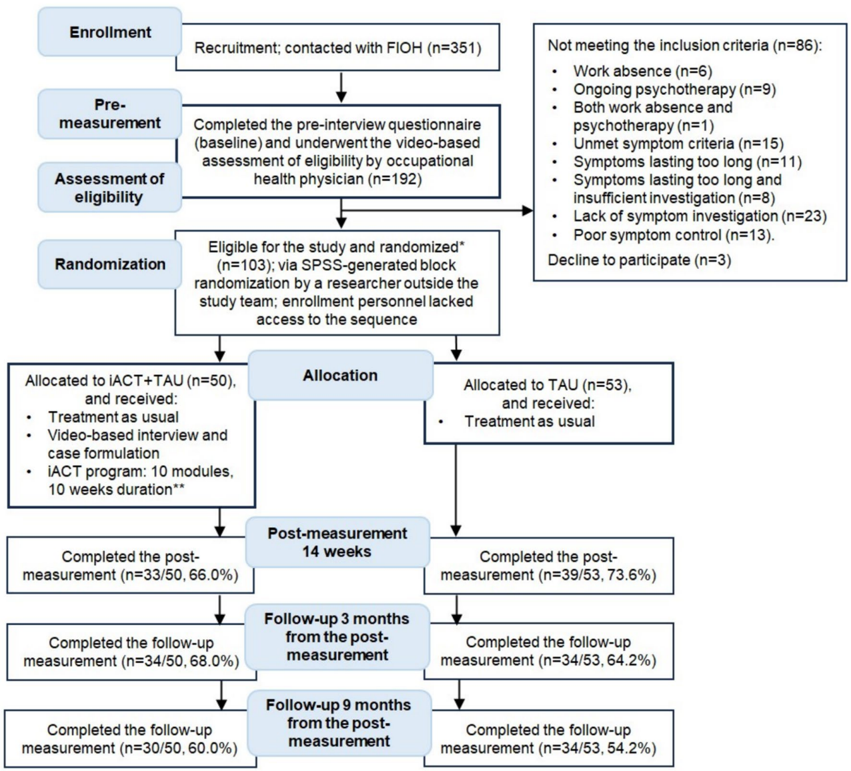
- The study randomized 103 participants with persistent physical symptoms related to indoor environment, chronic fatigue, or both: 50 to iACT + TAU and 53 to TAU.
- Work ability improved more in the intervention group than TAU at all reported post-baseline time points: post-treatment β = 0.41, p = 0.041, g = 0.41; 3 months β = 0.58, p = 0.004, g = 0.69; 9 months β = 0.47, p = 0.022, g = 0.52.
- Daily functioning showed a significant advantage for iACT + TAU at 3 months: β = 0.57, p = 0.007, g = 0.92; the 9-month effect was only a trend (p = 0.054, g = 0.68).
- Subscales showed significant 3-month gains for occupational functioning (β = 0.67, p = 0.003, g = 0.94) and personal functioning (β = 0.52, p = 0.020, g = 0.68), but social functioning did not differ significantly.
- Illness worry (IW) was not associated with work ability or daily functioning and did not moderate treatment effects; the baseline Whiteley Index mean was 18.85 overall, and 64.1% (n = 66) were at or below the median.
## Methods
- Two-arm randomized controlled trial with 9-month follow-up, registered as Clinicaltrials.gov NCT04532827; conducted in Finland.
- Participants were adults aged 18–65 who were working or studying and had persistent symptoms linked to indoor environment (IE) and/or chronic fatigue (CF) with significant daily-life restrictions for at least 6 months but less than 3 years; final sample was 103.
- Intervention: 2 video-based case-formulation meetings plus a 10-week web-based ACT program (10 modules) with eCoach guidance, compared against treatment as usual (TAU).
- Outcomes were self-reported work ability and daily functioning measured at baseline, post-treatment (14 weeks after randomization), 3 months, and 9 months; analyses used linear mixed models and Type III ANOVA.
## Limitations
- The paper states the sample size was relatively small, which limited power for subgroup and moderation analyses.
- The paper states it could not precisely determine the content of TAU, because usual care varied across healthcare districts.
- The paper states there may be selection bias because participation was voluntary and required ability to use the online program; it also notes that outcomes were self-reported and that the Whiteley Index cutoff was median-based rather than clinically validated.
- Evident from the text: the sample was 86.4% women, so generalizability to men is limited; also, the study was not blinded for participants.
Model-written summary. Check it against the paper before relying on it.
Integrity signals
Registry
Cites
Statistics
Figures

Verification
Claims the paper makes
26 Valid · 2 Not valid · 17 Not checked · 77 Own results and interpretations
A result the paper reports from its own data — it cites no other source for it, so there is none to check. The quote shows it is in the paper.
In the paper
“Daily functioning improved significantly at 3-month ( β = 0.57, p = 0.007), particularly in the work domain ( β = 0.67, p = 0.003).”
plainn = 103 ·- Asserted: passes — The authors put it forward as true.
- Checkable: passes — It can be checked against evidence.
- Load-bearing: passes — The paper’s conclusions depend on it.
- Based: passes — The paper gives a reason why it holds.
A result the paper reports from its own data — it cites no other source for it, so there is none to check. The quote shows it is in the paper.
In the paper
“Significant positive interaction (treatment group and time) effects for work ability were found in the iACT + TAU group at post-measurement ( β = 0.41, p = 0.041), 3-month ( β = 0.58, p = 0.004), and 9-month ( β = 0.47, p = 0.022) follow-ups.”
plainstates an associationn = 50 ·- Asserted: passes — The authors put it forward as true.
- Checkable: passes — It can be checked against evidence.
- Load-bearing: passes — The paper’s conclusions depend on it.
- Based: passes — The paper gives a reason why it holds.
A result the paper reports from its own data — it cites no other source for it, so there is none to check. The quote shows it is in the paper.
In the paper
“Daily functioning improved significantly at 3-month ( β = 0.57, p = 0.007), particularly in the work domain ( β = 0.67, p = 0.003).”
plainn = 103 ·- Asserted: passes — The authors put it forward as true.
- Checkable: passes — It can be checked against evidence.
- Load-bearing: passes — The paper’s conclusions depend on it.
- Based: passes — The paper gives a reason why it holds.
A result the paper reports from its own data — it cites no other source for it, so there is none to check. The quote shows it is in the paper.
In the paper
“IW and PPS group did not moderate outcomes.”
plainn = 103- Asserted: passes — The authors put it forward as true.
- Checkable: passes — It can be checked against evidence.
- Load-bearing: unclear — It is unclear whether the paper’s conclusions depend on it.
- Based: passes — The paper gives a reason why it holds.
37 more claims
Create a free account to see all 122 claims and to verify the 1 reference still open.
- It may state two separate claims as one. 47
- Probably not a substantial claim. 63
- The quote only partly states this claim. 1
Statistics recomputed
Every reported test result, recomputed from its test statistic and degrees of freedom. A result shows as not adding up only once an independent check has confirmed it.
- Consistentt(101) = 0.1reported p = .938 · recomputed p = .921
“t(101) = 0.1, p = .938”
Self-check
Percentages, sums and reported differences re-computed from the paper’s own numbers.
Self-check results appear here once an independent check has confirmed them.
Citations
Cites
Acceptance and commitment therapy: model, processes and outcomes
Hayes, S. C., Luoma, J. B., Bond, F. W., Masuda, A., & Lillis, J. (2006) · Behaviour Research and Therapy · doi:10.1016/j.brat.2005.06.006 · Cited by 6,587
Distribution Theory for Glass's Estimator of Effect Size and Related Estimators
Hedges, L. V. (1981) · Journal of Educational Statistics · doi:10.2307/1164588 · Cited by 5,695
Hayes, S. C. (2004) · Behavior Therapy · doi:10.1016/s0005-7894(04)80013-3 · Cited by 2,493
Sheehan, D. V., Harnett-Sheehan, K., & Raj, B. A. (1996) · International Clinical Psychopharmacology · doi:10.1097/00004850-199606003-00015 · Cited by 1,440
Pilowsky, I. (1967) · British Journal of Psychiatry · doi:10.1192/bjp.113.494.89 · Cited by 865
Ahlstrom, L., Grimby-Ekman, A., Hagberg, M., & Dellve, L. (2010) · Scandinavian Journal of Work, Environment & Health · doi:10.5271/sjweh.2917 · Cited by 622
Handling drop‐out in longitudinal studies
Hogan, J. W., Roy, J., & Korkontzelou, C. (2004) · Statistics in Medicine · doi:10.1002/sim.1728 · Cited by 404
Management of functional somatic syndromes and bodily distress
Henningsen, P., Zipfel, S., Sattel, H., & Creed, F. (2018) · Psychotherapy and Psychosomatics · doi:10.1159/000484413 · Cited by 335
Screening for somatization and hypochondriasis in primary care and neurological in-patients
Fink, P., Ewald, H., Jensen, J., Sørensen, L., Engberg, M., Holm, M., & Munk-Jørgensen, P. (1999) · Journal of Psychosomatic Research · doi:10.1016/s0022-3999(98)00092-0 · Cited by 314
van Dessel, N., den Boeft, M., van der Wouden, J. C., Kleinstäuber, M., Leone, S. S., Terluin, B., Numans, M. E., van der Horst, H. E., & van Marwijk, H. (2014) · Cochrane Database of Systematic Reviews · doi:10.1002/14651858.cd011142.pub2 · Cited by 302
Research works printed but not linked: 1
- Tuisku K, Vuokko A, Puustinen N, Laukkala T. Psyykkisen työ-ja toimintakyvyn arviointiin tarvitaan yhtenäisiä käytäntöjä [Assessment of psychiatric function and work ability]. Suom Laakaril. 2022;77(49–50):2093–6.
Metadata
- Authors
- Vuokko, A., Immonen, M., Lappalainen, P., Keinonen, K., Sainio, M., Lappalainen, R., Paunio, T., & Selinheimo, S.
- Affiliations
- Finnish Institute of Occupational Health (FI)
- Helsinki University Hospital (FI)
- University of Jyväskylä (FI)
- University of Helsinki (FI)
- Corresponding author
- Vuokko, Aki
- ORCID
- Venue
- Journal of Occupational Rehabilitation
- Published
- 2026-04-25
- ISSN
- 1053-0487 (ISSN-L)
- 1573-3688
- OpenAlex
- W7155651045
- Cited by
- 0
- References
- 48
- FWCI
- 0.00
- Type
- journal article
- Language
- en
- Open access
- hybrid
- doi.org
- Licence
- cc-by
- creativecommons.org/licenses/by/4.0 (tdm)
- creativecommons.org/licenses/by/4.0 (vor)
- Locations
- Journal of Occupational Rehabilitation (publishedVersion, cc-by)
- PubMed (publishedVersion)
- Työväentutkimus Vuosikirja (submittedVersion)
- Funders
- Social Insurance Institution of Finland (75/331/2019)
- Topics
- Social Sciences › Psychology › Clinical Psychology › Mindfulness and Compassion Interventions
- Health Sciences › Medicine › Psychiatry and Mental health › Psychosomatic Disorders and Their Treatments
- Health Sciences › Health Professions › Physical Therapy, Sports Therapy and Rehabilitation › Musculoskeletal pain and rehabilitation
- Keywords
- persistent physical symptoms, chronic fatigue, work ability, daily functioning, work disability, web-based treatment
About these checks
Registry, retraction, Cites and statistics results are computed, not judged, with one exception: a printed reference that no index lists is read once by a model before it counts as a citation error. Claims are extracted by a model and kept only when their quote appears verbatim in the text; each cited source is then checked, with a model’s help, for whether it says what the claim relies on. Those verdicts can be wrong — read the claim’s quote and the cited source before relying on one.
The claim verdicts this report counts are experimental: their accuracy is not yet measured.
A language model drew the claims from the paper on 2026-10-11, under version 3 of the claim definition (model deepseek-v4.1-flash, prompt extract-v3).
A second model labelled each claim on 2026-10-11 (model jev-1.13-20260917, definition revision gold-guideline-v0.2).
Statistics and arithmetic are recomputed, not judged.
Confidence bands are shown only for fields calibrated on our annotated test set. None is calibrated yet, so no band is shown.
What counts as a claim ›How we measure confidence ›How we check this ›
Are you an author, or do you see a problem with this page? Request a review
How to cite
Cite CoChat for the checks on this page, and the paper for its own findings.
- This page
- CoChat. (2026). Citation check: Work Ability and Functioning Among Individuals with Persistent Indoor Environment-Related Symptoms or Chronic Fatigue: Nine-Month Follow-Up of a Web-Based Randomized Controlled Trial. https://app.cochat.ai/papers/10.1007/s10926-026-10400-z
- The paper
- Vuokko, A., Immonen, M., Lappalainen, P., Keinonen, K., Sainio, M., Lappalainen, R., Paunio, T., & Selinheimo, S. (2026). Work Ability and Functioning Among Individuals with Persistent Indoor Environment-Related Symptoms or Chronic Fatigue: Nine-Month Follow-Up of a Web-Based Randomized Controlled Trial. Journal of Occupational Rehabilitation. https://doi.org/10.1007/s10926-026-10400-z
Data sources
Bibliographic data: Semantic Scholar, OpenAlex, Crossref.
Contains information from the Semantic Scholar Academic Graph Datasets, made available under the ODC Attribution License (ODC-BY 1.0).
Semantic Scholar’s data is described in: Kinney, R., et al. (2023). The Semantic Scholar Open Data Platform. arXiv:2301.10140.
