

Work Ability and Functioning Among Individuals with Persistent Indoor Environment-Related Symptoms or Chronic Fatigue: Nine-Month Follow-Up of a Web-Based Randomized Controlled Trial.
Open accessThe DOI matches its Crossref record; 52 of the 52 references it cites were found in a registry or an index; 32 of the 72 sources its claims cite were checked for support.
Abstract
Purpose: Persistent physical symptoms (PPS) can significantly impair work ability and daily functioning, exacerbated by comorbid illness worry (IW). This randomized controlled trial (RCT) examined the effectiveness of guided internet-based treatment on work ability and daily functioning of working-aged individuals with PPS associated with indoor environment (IE) and/or chronic fatigue (CF) with disability. The intervention was based on acceptance and commitment therapy (ACT) combined with individual case formulation, compared to treatment as usual (TAU). IW’s role in moderating effects was explored.In this RCT (Clinicaltrials.gov NCT04532827), 103 individuals with PPS linked to IE, CF or both were assigned to a video-based case conceptualization and 10-week internet-based ACT with TAU (iACT + TAU; n = 50) or TAU alone (n = 53). Self-reported work ability and daily functioning were assessed from pre-intervention to 9-month follow-up, examining the potential moderating effect of baseline IW. Analyses used linear mixed models and Type III ANOVA.Of the 103 participants, 62% completed the 9-month follow-up. Baseline demographics showed no significant differences between treatment groups. Significant positive interaction (treatment group and time) effects for work ability were found in the iACT + TAU group at post-measurement (β = 0.41, p = 0.041), 3-month (β = 0.58, p = 0.004), and 9-month (β = 0.47, p = 0.022) follow-ups. Daily functioning improved significantly at 3-month (β = 0.57, p = 0.007), particularly in the work domain (β = 0.67, p = 0.003). IW and PPS group did not moderate outcomes.Internet-based ACT with individual case formulation was associated with improved work ability for individuals with PPS associated with IE and CF, providing preliminary support for further examination as a potential frontline treatment.Methods: Persistent physical symptoms (PPS) can significantly impair work ability and daily functioning, exacerbated by comorbid illness worry (IW). This randomized controlled trial (RCT) examined the effectiveness of guided internet-based treatment on work ability and daily functioning of working-aged individuals with PPS associated with indoor environment (IE) and/or chronic fatigue (CF) with disability. The intervention was based on acceptance and commitment therapy (ACT) combined with individual case formulation, compared to treatment as usual (TAU). IW’s role in moderating effects was explored.In this RCT (Clinicaltrials.gov NCT04532827), 103 individuals with PPS linked to IE, CF or both were assigned to a video-based case conceptualization and 10-week internet-based ACT with TAU (iACT + TAU; n = 50) or TAU alone (n = 53). Self-reported work ability and daily functioning were assessed from pre-intervention to 9-month follow-up, examining the potential moderating effect of baseline IW. Analyses used linear mixed models and Type III ANOVA.Of the 103 participants, 62% completed the 9-month follow-up. Baseline demographics showed no significant differences between treatment groups. Significant positive interaction (treatment group and time) effects for work ability were found in the iACT + TAU group at post-measurement (β = 0.41, p = 0.041), 3-month (β = 0.58, p = 0.004), and 9-month (β = 0.47, p = 0.022) follow-ups. Daily functioning improved significantly at 3-month (β = 0.57, p = 0.007), particularly in the work domain (β = 0.67, p = 0.003). IW and PPS group did not moderate outcomes.Internet-based ACT with individual case formulation was associated with improved work ability for individuals with PPS associated with IE and CF, providing preliminary support for further examination as a potential frontline treatment.Results: Persistent physical symptoms (PPS) can significantly impair work ability and daily functioning, exacerbated by comorbid illness worry (IW). This randomized controlled trial (RCT) examined the effectiveness of guided internet-based treatment on work ability and daily functioning of working-aged individuals with PPS associated with indoor environment (IE) and/or chronic fatigue (CF) with disability. The intervention was based on acceptance and commitment therapy (ACT) combined with individual case formulation, compared to treatment as usual (TAU). IW’s role in moderating effects was explored.In this RCT (Clinicaltrials.gov NCT04532827), 103 individuals with PPS linked to IE, CF or both were assigned to a video-based case conceptualization and 10-week internet-based ACT with TAU (iACT + TAU; n = 50) or TAU alone (n = 53). Self-reported work ability and daily functioning were assessed from pre-intervention to 9-month follow-up, examining the potential moderating effect of baseline IW. Analyses used linear mixed models and Type III ANOVA.Of the 103 participants, 62% completed the 9-month follow-up. Baseline demographics showed no significant differences between treatment groups. Significant positive interaction (treatment group and time) effects for work ability were found in the iACT + TAU group at post-measurement (β = 0.41, p = 0.041), 3-month (β = 0.58, p = 0.004), and 9-month (β = 0.47, p = 0.022) follow-ups. Daily functioning improved significantly at 3-month (β = 0.57, p = 0.007), particularly in the work domain (β = 0.67, p = 0.003). IW and PPS group did not moderate outcomes.Internet-based ACT with individual case formulation was associated with improved work ability for individuals with PPS associated with IE and CF, providing preliminary support for further examination as a potential frontline treatment.Conclusion: Persistent physical symptoms (PPS) can significantly impair work ability and daily functioning, exacerbated by comorbid illness worry (IW). This randomized controlled trial (RCT) examined the effectiveness of guided internet-based treatment on work ability and daily functioning of working-aged individuals with PPS associated with indoor environment (IE) and/or chronic fatigue (CF) with disability. The intervention was based on acceptance and commitment therapy (ACT) combined with individual case formulation, compared to treatment as usual (TAU). IW’s role in moderating effects was explored.In this RCT (Clinicaltrials.gov NCT04532827), 103 individuals with PPS linked to IE, CF or both were assigned to a video-based case conceptualization and 10-week internet-based ACT with TAU (iACT + TAU; n = 50) or TAU alone (n = 53). Self-reported work ability and daily functioning were assessed from pre-intervention to 9-month follow-up, examining the potential moderating effect of baseline IW. Analyses used linear mixed models and Type III ANOVA.Of the 103 participants, 62% completed the 9-month follow-up. Baseline demographics showed no significant differences between treatment groups. Significant positive interaction (treatment group and time) effects for work ability were found in the iACT + TAU group at post-measurement (β = 0.41, p = 0.041), 3-month (β = 0.58, p = 0.004), and 9-month (β = 0.47, p = 0.022) follow-ups. Daily functioning improved significantly at 3-month (β = 0.57, p = 0.007), particularly in the work domain (β = 0.67, p = 0.003). IW and PPS group did not moderate outcomes.Internet-based ACT with individual case formulation was associated with improved work ability for individuals with PPS associated with IE and CF, providing preliminary support for further examination as a potential frontline treatment.
Overview
CoChat Summary
## TL;DR
This randomized controlled trial found that a 10-week guided internet-based ACT program with individualized case formulation improved self-reported work ability, with benefits persisting to 9 months, compared with treatment as usual. Daily functioning also improved, mainly at 3 months, while baseline illness worry did not moderate any outcomes.
## Key findings
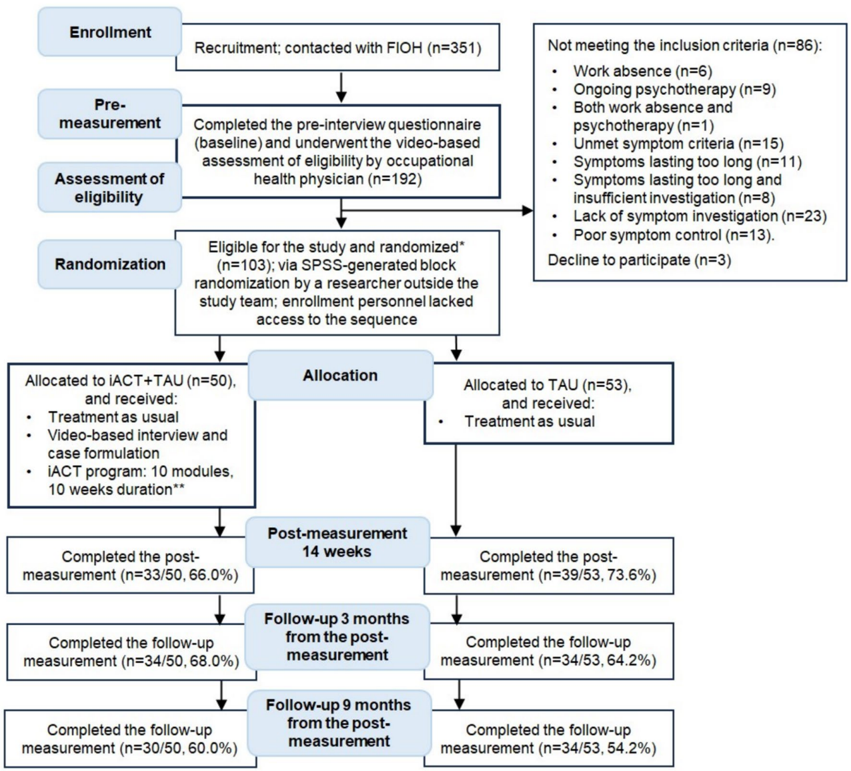
- The study randomized 103 participants with persistent physical symptoms related to indoor environment, chronic fatigue, or both: 50 to iACT + TAU and 53 to TAU.
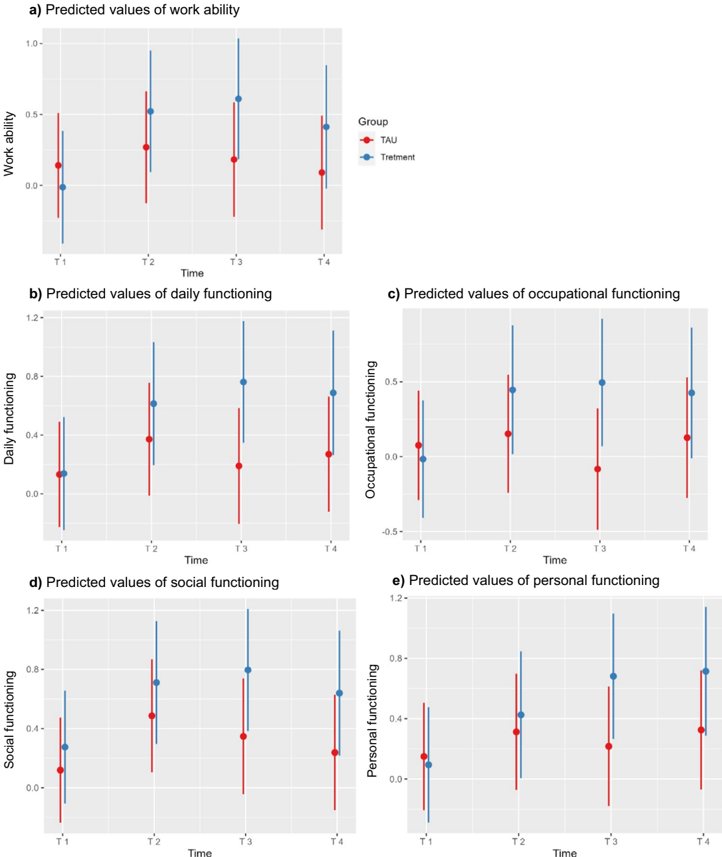
- Work ability improved more in the intervention group than TAU at all reported post-baseline time points: post-treatment β = 0.41, p = 0.041, g = 0.41; 3 months β = 0.58, p = 0.004, g = 0.69; 9 months β = 0.47, p = 0.022, g = 0.52.
- Daily functioning showed a significant advantage for iACT + TAU at 3 months: β = 0.57, p = 0.007, g = 0.92; the 9-month effect was only a trend (p = 0.054, g = 0.68).
- Subscales showed significant 3-month gains for occupational functioning (β = 0.67, p = 0.003, g = 0.94) and personal functioning (β = 0.52, p = 0.020, g = 0.68), but social functioning did not differ significantly.
- Illness worry (IW) was not associated with work ability or daily functioning and did not moderate treatment effects; the baseline Whiteley Index mean was 18.85 overall, and 64.1% (n = 66) were at or below the median.
## Methods
- Two-arm randomized controlled trial with 9-month follow-up, registered as Clinicaltrials.gov NCT04532827; conducted in Finland.
- Participants were adults aged 18–65 who were working or studying and had persistent symptoms linked to indoor environment (IE) and/or chronic fatigue (CF) with significant daily-life restrictions for at least 6 months but less than 3 years; final sample was 103.
- Intervention: 2 video-based case-formulation meetings plus a 10-week web-based ACT program (10 modules) with eCoach guidance, compared against treatment as usual (TAU).
- Outcomes were self-reported work ability and daily functioning measured at baseline, post-treatment (14 weeks after randomization), 3 months, and 9 months; analyses used linear mixed models and Type III ANOVA.
## Limitations
- The paper states the sample size was relatively small, which limited power for subgroup and moderation analyses.
- The paper states it could not precisely determine the content of TAU, because usual care varied across healthcare districts.
- The paper states there may be selection bias because participation was voluntary and required ability to use the online program; it also notes that outcomes were self-reported and that the Whiteley Index cutoff was median-based rather than clinically validated.
- Evident from the text: the sample was 86.4% women, so generalizability to men is limited; also, the study was not blinded for participants.
Model-written summary. Check it against the paper before relying on it.
Integrity signals
Registry
Cites
Statistics
Figures
Verification
Claims the paper makes
26 Valid · 2 Not valid · 17 Not checked · 77 Own results and interpretations
A result the paper reports from its own data — it cites no other source for it, so there is none to check. The quote shows it is in the paper.
In the paper
“Daily functioning improved significantly at 3-month ( β = 0.57, p = 0.007), particularly in the work domain ( β = 0.67, p = 0.003).”
plainn = 103 ·- Asserted: passes — The authors put it forward as true.
- Checkable: passes — It can be checked against evidence.
- Load-bearing: passes — The paper’s conclusions depend on it.
- Based: passes — The paper gives a reason why it holds.
A result the paper reports from its own data — it cites no other source for it, so there is none to check. The quote shows it is in the paper.
In the paper
“Significant positive interaction (treatment group and time) effects for work ability were found in the iACT + TAU group at post-measurement ( β = 0.41, p = 0.041), 3-month ( β = 0.58, p = 0.004), and 9-month ( β = 0.47, p = 0.022) follow-ups.”
plainstates an associationn = 50 ·- Asserted: passes — The authors put it forward as true.
- Checkable: passes — It can be checked against evidence.
- Load-bearing: passes — The paper’s conclusions depend on it.
- Based: passes — The paper gives a reason why it holds.
A result the paper reports from its own data — it cites no other source for it, so there is none to check. The quote shows it is in the paper.
In the paper
“Daily functioning improved significantly at 3-month ( β = 0.57, p = 0.007), particularly in the work domain ( β = 0.67, p = 0.003).”
plainn = 103 ·- Asserted: passes — The authors put it forward as true.
- Checkable: passes — It can be checked against evidence.
- Load-bearing: passes — The paper’s conclusions depend on it.
- Based: passes — The paper gives a reason why it holds.
A result the paper reports from its own data — it cites no other source for it, so there is none to check. The quote shows it is in the paper.
In the paper
“IW and PPS group did not moderate outcomes.”
plainn = 103- Asserted: passes — The authors put it forward as true.
- Checkable: passes — It can be checked against evidence.
- Load-bearing: unclear — It is unclear whether the paper’s conclusions depend on it.
- Based: passes — The paper gives a reason why it holds.
37 more claims
Create a free account to see all 122 claims and to verify the 4 references still open.
- It may state two separate claims as one. 47
- Probably not a substantial claim. 63
- The quote only partly states this claim. 1
Statistics recomputed
Every reported test result, recomputed from its test statistic and degrees of freedom. A result shows as not adding up only once an independent check has confirmed it.
- Consistentt(101) = 0.1reported p = .938 · recomputed p = .921
“t(101) = 0.1, p = .938”
Self-check
Percentages, sums and reported differences re-computed from the paper’s own numbers.
Self-check results appear here once an independent check has confirmed them.
Citations
Cites
Acceptance and commitment therapy: model, processes and outcomes
Hayes, S. C., Luoma, J. B., Bond, F. W., Masuda, A., & Lillis, J. (2006) · Behaviour Research and Therapy · doi:10.1016/j.brat.2005.06.006 · Cited by 6,587
Distribution Theory for Glass's Estimator of Effect Size and Related Estimators
Hedges, L. V. (1981) · Journal of Educational Statistics · doi:10.2307/1164588 · Cited by 5,695
Hayes, S. C. (2004) · Behavior Therapy · doi:10.1016/s0005-7894(04)80013-3 · Cited by 2,493
Sheehan, D. V., Harnett-Sheehan, K., & Raj, B. A. (1996) · International Clinical Psychopharmacology · doi:10.1097/00004850-199606003-00015 · Cited by 1,440
Pilowsky, I. (1967) · British Journal of Psychiatry · doi:10.1192/bjp.113.494.89 · Cited by 865
Ahlstrom, L., Grimby-Ekman, A., Hagberg, M., & Dellve, L. (2010) · Scandinavian Journal of Work, Environment & Health · doi:10.5271/sjweh.2917 · Cited by 622
Handling drop‐out in longitudinal studies
Hogan, J. W., Roy, J., & Korkontzelou, C. (2004) · Statistics in Medicine · doi:10.1002/sim.1728 · Cited by 404
Management of functional somatic syndromes and bodily distress
Henningsen, P., Zipfel, S., Sattel, H., & Creed, F. (2018) · Psychotherapy and Psychosomatics · doi:10.1159/000484413 · Cited by 335
Screening for somatization and hypochondriasis in primary care and neurological in-patients
Fink, P., Ewald, H., Jensen, J., Sørensen, L., Engberg, M., Holm, M., & Munk-Jørgensen, P. (1999) · Journal of Psychosomatic Research · doi:10.1016/s0022-3999(98)00092-0 · Cited by 314
van Dessel, N., den Boeft, M., van der Wouden, J. C., Kleinstäuber, M., Leone, S. S., Terluin, B., Numans, M. E., van der Horst, H. E., & van Marwijk, H. (2014) · Cochrane Database of Systematic Reviews · doi:10.1002/14651858.cd011142.pub2 · Cited by 302
Persistent physical symptoms: definition, genesis, and management
Löwe, B., Toussaint, A., Rosmalen, J. G. M., Huang, W.-L., Burton, C., Weigel, A., Levenson, J. L., & Henningsen, P. (2024) · The Lancet · doi:10.1016/s0140-6736(24)00623-8 · Cited by 280
Principles and Practice of Behavioral Assessment
Haynes, S. N., & O’Brien, W. H. (2000) · Applied Clinical Psychology · doi:10.1007/978-0-306-47469-9 · Cited by 272
The economic impact of chronic fatigue syndrome
Reynolds, K. J., Vernon, S. D., Bouchery, E., & Reeves, W. C. (2004) · Cost Effectiveness and Resource Allocation · doi:10.1186/1478-7547-2-4 · Cited by 259
Jason (2010) · American Journal of Biochemistry and Biotechnology · doi:10.3844/ajbbsp.2010.120.135 · Cited by 180
The prevalence of chronic fatigue syndrome/ myalgic encephalomyelitis: a meta-analysis
Johnston, S., Brenu, Staines, D., & Marshall-Gradisnik (2013) · Clinical Epidemiology · doi:10.2147/clep.s39876 · Cited by 171
Van Dessel, N., Den Boeft, M., van der Wouden, J. C., Kleinstäuber, M., Leone, S. S., Terluin, B., Numans, M. E., van der Horst, H. E., & van Marwijk, H. (2014) · Cochrane Database of Systematic Reviews · doi:10.1002/14651858.cd011142 · Cited by 148
Smith, M. E. B., Haney, E., McDonagh, M., Pappas, M., Daeges, M., Wasson, N., Fu, R., & Nelson, H. D. (2015) · Annals of Internal Medicine · doi:10.7326/m15-0114 · Cited by 142
Houdenhove, B. V., Eede, F. V. D., & Luyten, P. (2009) · Medical Hypotheses · doi:10.1016/j.mehy.2008.11.044 · Cited by 121
Idiopathic Environmental Intolerance: A Comprehensive Model
Van den Bergh, O., Brown, R. J., Petersen, S., & Witthöft, M. (2017) · Clinical Psychological Science · doi:10.1177/2167702617693327 · Cited by 121
Axelsson, E., & Hedman-Lagerlöf, E. (2019) · Expert Review of Pharmacoeconomics & Outcomes Research · doi:10.1080/14737167.2019.1703182 · Cited by 96
Vugts, M. A. P., Joosen, M. C. W., van der Geer, J. E., Zedlitz, A. M. E. E., & Vrijhoef, H. J. M. (2018) · PLOS ONE · doi:10.1371/journal.pone.0196467 · Cited by 85
Rask, M. T., Ørnbøl, E., Rosendal, M., & Fink, P. (2017) · Psychosomatic Medicine · doi:10.1097/psy.0000000000000405 · Cited by 81
Mechanisms underlying nontoxic indoor air health problems: A review
Nordin, S. (2020) · International Journal of Hygiene and Environmental Health · doi:10.1016/j.ijheh.2020.113489 · Cited by 58
Edvardsson, B., Stenberg, B., Bergdahl, J., Eriksson, N., Lindén, G., & Widman, L. (2007) · International Archives of Occupational and Environmental Health · doi:10.1007/s00420-007-0267-z · Cited by 56
Self-Help for Medically Unexplained Symptoms: A Systematic Review and Meta-Analysis
van Gils, A., Schoevers, R. A., Bonvanie, I. J., Gelauff, J. M., Roest, A. M., & Rosmalen, J. G. M. (2016) · Psychosomatic Medicine · doi:10.1097/psy.0000000000000325 · Cited by 55
Hempel, S., Chambers, D., Bagnall, A.-M., & Forbes, C. (2008) · Psychological Medicine · doi:10.1017/s0033291707001602 · Cited by 45
Maas genannt Bermpohl, F., Hülsmann, L., & Martin, A. (2023) · Frontiers in Psychiatry · doi:10.3389/fpsyt.2023.1160908 · Cited by 44
The overlooked burden of persistent physical symptoms: a call for action in European healthcare
Toussaint, A., Weigel, A., Löwe, B., Blanch, J., Bogaerts, K., Boye, B., Burton, C., Cosci, F., Engelmann, P., Fink, P., et al. (2025) · The Lancet Regional Health - Europe · doi:10.1016/j.lanepe.2024.101140 · Cited by 44
Self-citationSampalli, T. (2009) · Journal of Multidisciplinary Healthcare · doi:10.2147/jmdh.s5220 · Cited by 41
RIFD – A brief clinical research interview for functional somatic disorders and health anxiety
Petersen, M. W., Schröder, A., Jørgensen, T., Ørnbøl, E., Dantoft, T. M., Eliasen, M., & Fink, P. (2019) · Journal of Psychosomatic Research · doi:10.1016/j.jpsychores.2019.04.001 · Cited by 38
Eliasen, M., Schröder, A., Fink, P., Kreiner, S., Dantoft, T. M., Poulsen, C. H., Petersen, M. W., Eplov, L. F., Skovbjerg, S., & Jørgensen, T. (2018) · Journal of Psychosomatic Research · doi:10.1016/j.jpsychores.2018.03.002 · Cited by 33
Vuokko, A., Selinheimo, S., Sainio, M., Suojalehto, H., Järnefelt, H., Virtanen, M., Kallio, E., Hublin, C., & Karvala, K. (2015) · NeuroToxicology · doi:10.1016/j.neuro.2015.04.010 · Cited by 27
Self-citationAcceptance & Commitment Therapy for ME/CFS (Chronic Fatigue Syndrome) – A feasibility study
Jonsjö, M. A., Wicksell, R. K., Holmström, L., Andreasson, A., & Olsson, G. L. (2019) · Journal of Contextual Behavioral Science · doi:10.1016/j.jcbs.2019.02.008 · Cited by 27
Daniels, J., Parker, H., & Salkovskis, P. M. (2020) · International Journal of Clinical and Health Psychology · doi:10.1016/j.ijchp.2019.11.003 · Cited by 26
Hauge, C. R., Rasmussen, A., Piet, J., Bonde, J. P., Jensen, C., Sumbundu, A., & Skovbjerg, S. (2015) · Journal of Psychosomatic Research · doi:10.1016/j.jpsychores.2015.06.010 · Cited by 25
Frølund Pedersen, H., Holsting, A., Frostholm, L., Rask, C., Jensen, J. S., Høeg, M. D., & Schröder, A. (2019) · Patient Education and Counseling · doi:10.1016/j.pec.2019.04.016 · Cited by 25
SKOVBJERG, S., HAUGE, C. R., RASMUSSEN, A., WINKEL, P., & ELBERLING, J. (2012) · Scandinavian Journal of Psychology · doi:10.1111/j.1467-9450.2012.00950.x · Cited by 21
Clinical Characteristics of Disability in Patients with Indoor Air–Related Environmental Intolerance
Vuokko, A., Karvala, K., Suojalehto, H., Lindholm, H., Selinheimo, S., Heinonen-Guzejev, M., Leppämäki, S., Cederström, S., Hublin, C., Tuisku, K., et al. (2019) · Safety and Health at Work · doi:10.1016/j.shaw.2019.06.003 · Cited by 21
Self-citationRoche, L., Dawson, D. L., Moghaddam, N. G., Abey, A., & Gresswell, D. M. (2017) · Journal of Contextual Behavioral Science · doi:10.1016/j.jcbs.2017.04.007 · Cited by 20
Frostholm, L., & Rask, C. U. (2019) · Clinical Psychology in Europe · doi:10.32872/cpe.v1i1.32217 · Cited by 18
Selinheimo, S., Vuokko, A., Hublin, C., Järnefelt, H., Karvala, K., Sainio, M., Suojalehto, H., Suvisaari, J., & Paunio, T. (2019) · Journal of Psychosomatic Research · doi:10.1016/j.jpsychores.2019.03.181 · Cited by 17
Self-citationLappalainen, P., Keinonen, K., Lappalainen, R., Selinheimo, S., Vuokko, A., Sainio, M., Liesto, S., Tolvanen, A., & Paunio, T. (2024) · Journal of Psychosomatic Research · doi:10.1016/j.jpsychores.2024.111830 · Cited by 17
Self-citationExpectancies and avoidance: Towards an integrated model of chronic somatic symptoms
Nadinda, P. G., van Laarhoven, A. I. M., Van den Bergh, O., Vlaeyen, J. W. S., Peters, M. L., & Evers, A. W. M. (2024) · Neuroscience & Biobehavioral Reviews · doi:10.1016/j.neubiorev.2024.105808 · Cited by 15
Brugnera, A., Nordstrand Jacobsen, T., Woodhouse, A., Compare, A., & Børsting Jacobsen, H. (2021) · Scandinavian Journal of Psychology · doi:10.1111/sjop.12672 · Cited by 12
Selinheimo, S., Vuokko, A., Hublin, C., Järnefelt, H., Karvala, K., Sainio, M., Suojalehto, H., & Paunio, T. (2020) · Journal of Psychosomatic Research · doi:10.1016/j.jpsychores.2020.109962 · Cited by 9
Self-citationSelinheimo, S., Vuokko, A., Lappalainen, P., Keinonen, K., Sainio, M., Lappalainen, R., & Paunio, T. (2025) · BMC Psychology · doi:10.1186/s40359-025-02549-8 · Cited by 8
Self-citationEidstø, E., Selinheimo, S., Lampi, J., Salmela, A., & Pekkanen, J. (2023) · Journal of Occupational & Environmental Medicine · doi:10.1097/jom.0000000000002884 · Cited by 7
Self-citationSelinheimo, S., Keinonen, K., Vuokko, A., Liesto, S., Sainio, M., Lappalainen, R., & Paunio, T. (2023) · Frontiers in Psychology · doi:10.3389/fpsyg.2022.923532 · Cited by 6
Self-citationKeinonen, K., Lappalainen, P., Lappalainen, R., Selinheimo, S., Vuokko, A., Liesto, S., Sainio, M., & Paunio, T. (2025) · Cognitive and Behavioral Practice · doi:10.1016/j.cbpra.2023.12.012 · Cited by 4
Self-citationAcceptance and commitment therapy for chronic fatigue syndrome: a case series approach
Roche, L. (2016) · Lincoln Repository (University of Lincoln) · doi:10.24385/lincoln.24325627
12 Self-help for medically unexplained symptoms: a systematic review and meta-analysis
van Gils, A., Schoevers, R. A., Bonvanie, I. J., Gelauff, J., Roest, A. M., & Rosmalen, J. G. M. (2017) · Journal of Neurology Neurosurgery & Psychiatry · doi:10.1136/jnnp-2017-bnpa.72
Treatment of Myalgic Encephalomyelitis/Chronic Fatigue Syndrome
Smith, M. E. B., Haney, E., & Nelson, H. D. (2015) · Annals of Internal Medicine · doi:10.7326/l15-5176
Research works printed but not linked: 1
- 44. Tuisku K, Vuokko A, Puustinen N, Laukkala T. Psyykkisen työ-ja toimintakyvyn arviointiin tarvitaan yhtenäisiä käytäntöjä [Assessment of psychiatric function and work ability]. Suom Laakaril. 2022;77(49-50):2093-6.
Metadata
- Authors
- Vuokko, A., Immonen, M., Lappalainen, P., Keinonen, K., Sainio, M., Lappalainen, R., Paunio, T., & Selinheimo, S.
- Affiliations
- Finnish Institute of Occupational Health (FI)
- Helsinki University Hospital (FI)
- University of Jyväskylä (FI)
- University of Helsinki (FI)
- Corresponding author
- Vuokko, Aki
- ORCID
- Venue
- Journal of Occupational Rehabilitation
- Published
- 2026-04-25
- ISSN
- 1053-0487 (ISSN-L)
- 1573-3688
- OpenAlex
- W7155651045
- Cited by
- 0
- References
- 48
- FWCI
- 0.00
- Type
- journal article
- Language
- en
- Open access
- hybrid
- doi.org
- Licence
- cc-by
- creativecommons.org/licenses/by/4.0 (tdm)
- creativecommons.org/licenses/by/4.0 (vor)
- Locations
- Journal of Occupational Rehabilitation (publishedVersion, cc-by)
- PubMed (publishedVersion)
- Työväentutkimus Vuosikirja (submittedVersion)
- Funders
- Social Insurance Institution of Finland (75/331/2019)
- Topics
- Social Sciences › Psychology › Clinical Psychology › Mindfulness and Compassion Interventions
- Health Sciences › Medicine › Psychiatry and Mental health › Psychosomatic Disorders and Their Treatments
- Health Sciences › Health Professions › Physical Therapy, Sports Therapy and Rehabilitation › Musculoskeletal pain and rehabilitation
- Keywords
- persistent physical symptoms, chronic fatigue, work ability, daily functioning, work disability, web-based treatment
About these checks
Registry, retraction, Cites and statistics results are computed, not judged, with one exception: a printed reference that no index lists is read once by a model before it counts as a citation error. Claims are extracted by a model and kept only when their quote appears verbatim in the text; each cited source is then checked, with a model’s help, for whether it says what the claim relies on. Those verdicts can be wrong — read the claim’s quote and the cited source before relying on one.
The claim verdicts this report counts are experimental: their accuracy is not yet measured.
A language model drew the claims from the paper on 2026-10-11, under version 3 of the claim definition (model deepseek-v4.1-flash, prompt extract-v3).
A second model labelled each claim on 2026-10-11 (model jev-1.13-20260917, definition revision gold-guideline-v0.2).
Statistics and arithmetic are recomputed, not judged.
Confidence bands are shown only for fields calibrated on our annotated test set. None is calibrated yet, so no band is shown.
What counts as a claim ›How we measure confidence ›How we check this ›
Are you an author, or do you see a problem with this page? Request a review
Data sources
Bibliographic data: Semantic Scholar, OpenAlex, Crossref.
Contains information from the Semantic Scholar Academic Graph Datasets, made available under the ODC Attribution License (ODC-BY 1.0).
Semantic Scholar’s data is described in: Kinney, R., et al. (2023). The Semantic Scholar Open Data Platform. arXiv:2301.10140.
