

AI4People—An Ethical Framework for a Good AI Society: Opportunities, Risks, Principles, and Recommendations
Open accessThe DOI matches its Crossref record; 6 of the 8 references it cites were found in a registry or an index; 1 of the 33 sources its claims cite were checked for support.
Abstract
This article reports the findings of AI4People, an Atomium-EISMD initiative designed to lay the foundations for a "Good AI Society". We introduce the core opportunities and risks of AI for society; present a synthesis of five ethical principles that should undergird its development and adoption; and offer 20 concrete recommendations-to assess, to develop, to incentivise, and to support good AI-which in some cases may be undertaken directly by national or supranational policy makers, while in others may be led by other stakeholders. If adopted, these recommendations would serve as a firm foundation for the establishment of a Good AI Society.
Overview
CoChat Summary
## TL;DR
AI4People proposes an ethical framework for a “Good AI Society” by synthesizing AI’s major social opportunities and risks, five guiding principles, and 20 policy recommendations. The paper argues that ethics adds a “dual advantage”: it helps organizations capture socially valuable AI opportunities while avoiding costly harms.
## Key findings
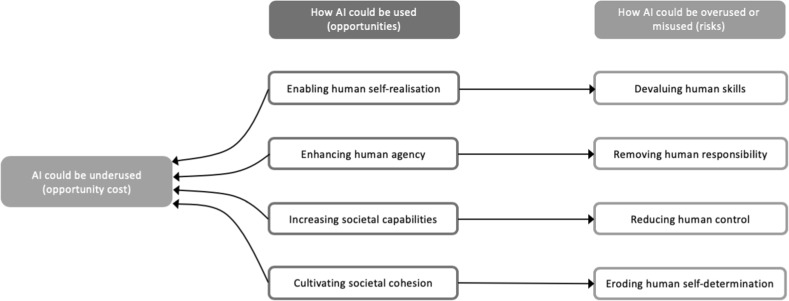
- The authors identify four chief opportunities AI offers society: who we can become, what we can do, what we can achieve, and how we can interact.
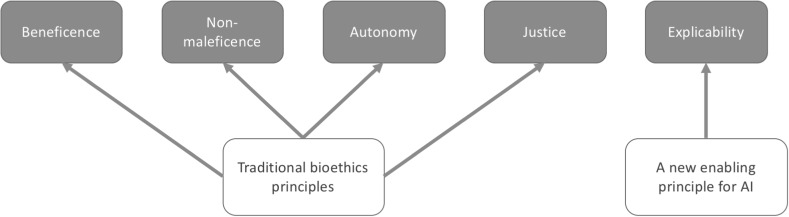
- They synthesize 47 principles from six high-profile AI ethics documents and argue these converge on five principles for AI: beneficence, non-maleficence, autonomy, justice, and explicability.
- The paper argues that AI should be developed to decrease inequality, increase shared benefits, and remain explicable, because explicability is described as critical for public trust and understanding.
- The recommendations section sets out 20 Action Points grouped into assessment, development, incentivisation, and support.
## Methods
- The paper is a conceptual and comparative ethics analysis, not an empirical study.
- It reviews six existing AI ethics documents: Asilomar, Montreal, IEEE, EGE, AIUK, and the Partnership on AI, and compares their principles.
- The authors then synthesize these into a framework and derive 20 recommendations for a Good AI Society.
## Limitations
- The paper states that it presents a European approach meant to be complementary to other approaches, so its recommendations are not claimed to be universally exhaustive or final.
- The text itself makes evident that the analysis is normative and document-based, not based on original empirical data or tested interventions (text-evident limitation).
- The paper also presents the recommendations as a “living document”, implying they are provisional and meant to evolve rather than serve as a definitive endpoint.
Model-written summary. Check it against the paper before relying on it.
Integrity signals
Registry
Cites
Statistics
Figures
Verification
Claims the paper makes
1 Valid · 1 Not valid · 27 Not checked · 35 Own results and interpretations
The cited sources support only part of this claim — read each source’s verdict below.
In the paper
“Everything from email scams to full-scale cyber-warfare may be accelerated or intensified by the malicious use of AI technologies (Taddeo 2018).”
§ AI4People—An Ethical Framework for a Good AI Society: Opportunities, Risks, Principles, and Recommendations > The Opportunities and Risks of AI for Society
What the sources say
- Partly supportedcites Taddeo 2018 matched to “The Limits of Deterrence Theory in Cyberspace” (2018) sourceExperimental — accuracy not yet measured
Section 4.3 (page unavailable) says machine-learning systems deployed for cyber defence can pose risks of unforeseen, disproportionate damage, supporting a narrower concern that AI could intensify harm in cyber conflict. It does not address malicious AI use, email scams, or AI accelerating attacks across that range. (LLM, conf=0.77)
hedgedstates a possible cause- Asserted: passes — The authors put it forward as true.
- Checkable: passes — It can be checked against evidence.
- Load-bearing: unclear — It is unclear whether the paper’s conclusions depend on it.
- Based: passes — The paper gives a reason why it holds.
- Rests on an assumption not shown here.
- Partly supported
None of the sources cited for this claim could be matched to a paper, so there is nothing to check it against.
In the paper
“Taken together, they yield 47 principles.5”
§ AI4People—An Ethical Framework for a Good AI Society: Opportunities, Risks, Principles, and Recommendations > A Unified Framework of Principles for AI in Society
What the sources say
- Not matchedcites Asilomar AI Principles 2017
An author–year citation the paper’s reference list doesn’t settle. We don’t search these by name.
- Not matchedcites Montreal Declaration 2017
An author–year citation the paper’s reference list doesn’t settle. We don’t search these by name.
- Not matchedcites IEEE 2017
An author–year citation the paper’s reference list doesn’t settle. We don’t search these by name.
plainstates a cause- Asserted: passes — The authors put it forward as true.
- Checkable: passes — It can be checked against evidence.
- Load-bearing: passes — The paper’s conclusions depend on it.
- Based: passes — The paper gives a reason why it holds.
- Not matched
A conclusion the paper draws from its own results — it cites no other source for it, so there is none to check. The quote shows it is in the paper.
In the paper
“But they are not exhaustive.”
§ AI4People—An Ethical Framework for a Good AI Society: Opportunities, Risks, Principles, and Recommendations > A Unified Framework of Principles for AI in Society
plain- Asserted: passes — The authors put it forward as true.
- Checkable: passes — It can be checked against evidence.
- Load-bearing: passes — The paper’s conclusions depend on it.
- Based: passes — The paper gives a reason why it holds.
A conclusion the paper draws from its own results — it cites no other source for it, so there is none to check. The quote shows it is in the paper.
In the paper
“On the basis of the following comparative analysis, we argue that one more, new principle is needed in addition: explicability, understood as incorporating both intelligibility and accountability.”
§ AI4People—An Ethical Framework for a Good AI Society: Opportunities, Risks, Principles, and Recommendations > A Unified Framework of Principles for AI in Society
plain- Asserted: passes — The authors put it forward as true.
- Checkable: passes — It can be checked against evidence.
- Load-bearing: passes — The paper’s conclusions depend on it.
- Based: passes — The paper gives a reason why it holds.
A conclusion the paper draws from its own results — it cites no other source for it, so there is none to check. The quote shows it is in the paper.
In the paper
“The four bioethical principles adapt surprisingly well to the fresh ethical challenges posed by artificial intelligence.”
§ AI4People—An Ethical Framework for a Good AI Society: Opportunities, Risks, Principles, and Recommendations > A Unified Framework of Principles for AI in Society
boosted- Asserted: passes — The authors put it forward as true.
- Checkable: passes — It can be checked against evidence.
- Load-bearing: passes — The paper’s conclusions depend on it.
- Based: passes — The paper gives a reason why it holds.
5 more claims
Create a free account to see all 64 claims and every source verdict.
- Probably not a substantial claim. 51
- It may state two separate claims as one. 9
- Not yet classified. 2
- The quote only partly states this claim. 1
Claims other papers make about this one
Each is checked against this paper’s own text: does it say what the citing paper says it does?
The source backs part of the claim, not all of it — or backs it for a different population, condition or comparison.
In the citing paper
“While AI systems can influence learning outcomes through adaptive contributions, they cannot bear responsibility for those outcomes, engage in ethical reflection about educational goals, or possess the experiential understanding that grounds pedagogical wisdom”
From Towards a philosophy of ensemble cognition: Reconceptualising agency and mind in AI-mediated educational environments (2026) · cites this paper as Floridi et al., 2018
Experimental — accuracy not yet measuredThe source backs part of the claim, not all of it — or backs it for a different population, condition or comparison.
In the citing paper
“This trust will be important for the future of AI as a lack of trust could permanently harm the reputation of AI in healthcare, or lead to additional costs through inefficient regulation or repeated amendment (Floridi et al., 2018).”
From Liability for harm caused by AI in healthcare: an overview of the core legal concepts (2023) · cites this paper as Floridi et al., 2018
Experimental — accuracy not yet measuredThe source backs part of the claim, not all of it — or backs it for a different population, condition or comparison.
In the citing paper
“Indeed, the framework played a valuable role in the work of AI 4 People, Europe's first global forum on the social impact of AI, which recently adopted it to propose 20 concrete recommendations for a 'Good AI Society' to the European Commission (Floridi et al., 2018 ).”
From A Unified Framework of Five Principles for AI in Society (2019) · cites this paper as Floridi et al., 2018
Experimental — accuracy not yet measuredThe source backs part of the claim, not all of it — or backs it for a different population, condition or comparison.
In the citing paper
“De manera complementaria, autores como Floridi et al. (2018) abogan por incorporar principios como la justicia, la beneficencia y el respeto por la autonomía en todas las etapas del desarrollo de herramientas basadas en IA [23].”
From Avances, Retos Éticos y Perspectivas de la Inteligencia Artificial (IA) en la Educación de América Latina (2025) · cites this paper as [23]
Experimental — accuracy not yet measuredThe source backs part of the claim, not all of it — or backs it for a different population, condition or comparison.
In the citing paper
“Talos represents ancient human fears about the uncontrollable power of man-made creations, fears that persist into contemporary concerns about AI (Floridi et al., 2018; Sebastian, 2023; Tabassi, 2023b).”
From Delegated agency and moral responsibility in artificial intelligence (2026) · cites this paper as Floridi et al., 2018
Experimental — accuracy not yet measured
30 more claims about this paper
Create a free account to see every claim other papers make about this one.
Citations
Cites
Floridi, L. (2013) · Oxford University Press eBooks · doi:10.1093/acprof:oso/9780199641321.001.0001 · Cited by 651
Self-citationSoft Ethics and the Governance of the Digital
Floridi, L. (2018) · Philosophy & Technology · doi:10.1007/s13347-018-0303-9 · Cited by 325 · cited 2×
“2 The analysis in this and the following two sections is also available in Cowls and Floridi (2018).”
BackgroundSelf-citationArtificial Intelligence Crime: An Interdisciplinary Analysis of Foreseeable Threats and Solutions
King, T. C., Aggarwal, N., Taddeo, M., & Floridi, L. (2020) · Science and Engineering Ethics · doi:10.1007/s11948-018-00081-0 · Cited by 271
Self-citationThe Limits of Deterrence Theory in Cyberspace
Taddeo, M. (2018) · Philosophy & Technology · doi:10.1007/s13347-017-0290-2 · Cited by 98
Prolegomena to a White Paper on an Ethical Framework for a Good AI Society
Cowls, J., & Floridi, L. (2018) · SSRN Electronic Journal · doi:10.2139/ssrn.3198732 · Cited by 76
Self-citationArtificial Intelligence Crime: An Interdisciplinary Analysis of Foreseeable Threats and Solutions
King, T., Aggarwal, N., Taddeo, M., & Floridi, L. (2018) · SSRN Electronic Journal · doi:10.2139/ssrn.3183238 · Cited by 17
Self-citation
Research works printed but not linked: 3
- Asilomar AI Principles. (2017). Principles developed in conjunction with the 2017 Asilomar conference [Benevolent AI 2017]. Retrieved September 18, 2018 from https://futureoflife.org/ai-principles.
- Cowls, J., & Floridi, L. (2018). Prolegomena to a White Paper on Recommendations for the Ethics of AI (June 19, 2018). Available at SSRN: https://ssrn.com/abstract=3198732.
- The IEEE Initiative on Ethics of Autonomous and Intelligent Systems. (2017). Ethically Aligned Design, v2. Retrieved September 18, 2018 from https://ethicsinaction.ieee.org.
Cited by
Items 4,101–4,200 of 4,603
User experience and ethical design for AI-driven behavioral health technologies
Armstrong, C. M., Luxton, D. D., & June, J. D. (2026) · Elsevier eBooks · doi:10.1016/b978-0-443-33151-0.00006-x
Liebherr, M., Yankouskaya, A., Almourad, M. B., Thomas, J., Xu, G., & Ali, R. (2026) · Telematics and Informatics · doi:10.1016/j.tele.2026.102438 · Cited by 2
The Creative Process in AI-Driven Marketing
Stiefenhofer, P. (2026) · Springer eBooks · doi:10.1007/978-3-032-22336-4_7
Sahoo, S., Parida, P., & Panda, M. K. (2026) · Modeling and optimization in science and technologies · doi:10.1007/978-3-032-25190-9_6
The Drivers of Conscious Consumption
Stiefenhofer, P. (2026) · Springer eBooks · doi:10.1007/978-3-032-22336-4_3
Wankhade, S., Sahni, M., León‐Castro, E., Rathod, S., & Chauhan, D. (2026) · Studies in big data · doi:10.1007/978-3-032-31204-4_5
The Role of Artificial Intelligence in Ethical Marketing
Stiefenhofer, P. (2026) · Springer eBooks · doi:10.1007/978-3-032-22336-4_6
The Transformation of the Scientific Landscape
Lichely, K. (2026) · Longevity Horizon · doi:10.65649/7eabe3a1
The Rise of the Ethical Consumer
Stiefenhofer, P. (2026) · Springer eBooks · doi:10.1007/978-3-032-22336-4_2
Kabanda, G. (2026) · Journal of Digital Security and Forensics · doi:10.29121/digisecforensics.v3.i2.2026.113 · Cited by 1
Employees’ Well-being and Mental Health Using AI: A Network Analysis of Global Literature
Rath, N., Sood, V., Sahai, A. K., Sood, S., & Kar, N. (2026) · Emerald Group Publishing Limited eBooks · doi:10.1108/978-1-80686-125-520261010
Liu, X., Pabolu, P., Jiang, Y., Fraser, T., Chen, R., & Gao, H. O. (2026) · Expert Systems with Applications · doi:10.1016/j.eswa.2026.133833 · Cited by 1
Pal, A., Sachdeva, C., Idziak, E., & Virani, F. (2026) · Emerald Group Publishing Limited eBooks · doi:10.1108/978-1-80686-125-520261011
Facilitating System Change With GOSR: Integrating AI and Human Collaboration
Voltan, A., & Kells, K. (2026) · Systems Research and Behavioral Science · doi:10.1002/sres.70125
Rai, Y. H., & Teh, P. L. (2026) · Lecture notes of the Institute for Computer Sciences, Social Informatics and Telecommunications Engineering · doi:10.1007/978-3-032-34792-3_7
Introduction: The Imperative of Hybrid Intelligence in Digital Governance
Alibašić, H. (2026) · Public administration and information technology · doi:10.1007/978-3-032-28086-2_1
Azaiz, M. B., Bouzid, K., & Abdellaziz, I. (2025) · doi:10.1109/icahs66950.2025.11553045
Alyoussef, I. Y., Dahri, N. A., Alhashmi, K. A., Al-Rahmi, W. M., Muzna, P., & Dahri, F. H. (2026) · Frontiers in Artificial Intelligence · doi:10.3389/frai.2026.1833043 · Cited by 3
Co-creating Sustainable Workplace Wellbeing: The Role of Generative AI
Kumaresan, A., & Uden, L. (2026) · Communications in computer and information science · doi:10.1007/978-3-032-34189-1_29
Sinchev, A. B., & Bekmambetova, S. (2026) · Work · doi:10.1177/10519815261473892
An Intelligence Framework for Enhancing Resilience and Cognitive Manufacturing
Magodi, A. Y., Daniyan, I. A., Mpofu, K., Aderoba, O., Ale, F., & Phuluwa, H. S. (2026) · BENTHAM SCIENCE PUBLISHERS eBooks · doi:10.2174/9798898816186126010009
Zhu, Y., Wang, C., & Chu, J. (2026) · International Journal of Human-Computer Interaction · doi:10.1080/10447318.2026.2709241 · Cited by 1
Richardt, C. D. C. L. T., Martins, N. P., Galafassi, C., & do Amaral, É. M. H. (2026) · Anais do Workshop sobre as Implicações da Computação na Sociedade (WICS) · doi:10.5753/wics.2026.23462
“A literatura aponta que a governança da inteligência artificial envolve a definição de estruturas institucionais e mecanismos de supervisão alinhados a princípios éticos e sociais [Floridi et al. 2018; Jobin et al. 2019].”
The Future of Communication: Opportunities and Challenges in Emerging Technologies
Jaisakthivel, T. (2026) · Springer eBooks · doi:10.1007/978-981-95-0393-3_32
The Non-Fakeness of Fake News: when alleged misinformation turns out to be true
Badawy, W. (2026) · AI and Ethics · doi:10.1007/s43681-026-01289-8
“This shift aligns misinformation governance with scientific reasoning, which recognizes uncertainty as an inherent component of knowledge production [ 32 , 49 ].”
The Generative AI Divide on X: Themes, Frames, and Discursive Shifts in High-Visibility Posts
Sezgin, S. (2026) · Open Praxis · doi:10.55982/openpraxis.18.3.1218
“Governance matters because institutions differ in their ability to regulate, guide, and support the ethical and effective use of GenAI (Floridi et al., 2018; Jin et al., 2025; Mittelstadt et al., 2016).”
Carvalho, D. B. F., Souza, E. D. P., Dias, B. P. M., Detomi, G. H. A., Sousa, P. V. F., Dias, W. M., & Viana, M. C. (2026) · Anais do Workshop sobre as Implicações da Computação na Sociedade (WICS) · doi:10.5753/wics.2026.21040
“…de prompt, filtragem de conteúdo e arquiteturas Retrieval-Augmented Generation (Lewis et al. , 2020; Gao et al. , 2023) — quanto estratégias que incorporam normas sociais, limites éticos e expectativas profissionais ao comportamento do sistema (Selbst et al. , 2019; Floridi et al. , 2018).”
Emerging Technologies and Changing Communication Ahead
Goswami, M. P. (2026) · Springer eBooks · doi:10.1007/978-981-95-0393-3_31
Dougherty, J. P., & Gallenstein, R. (2026) · AI & Society · doi:10.1007/s00146-026-03240-1
Mante, J., Abeji, B., Kalutarage, H., Pirie, C., & Senanayake, J. (2026) · AI and Ethics · doi:10.1007/s43681-026-01278-x
“The foundational set (beneficence, non-maleficence (safety), autonomy and justice) is wide in scope and deeply normative [ 42, 44].”
Digital Transformation in Japan: Innovations and Challenges in Creating Smart Society
Kuatova, K., Ogihara, A., & Ashinova, Z. (2026) · Bulletin of Science Technology & Society · doi:10.1177/02704676261475142
Maratsi, M. I., & Charalabidis, Y. K. (2026) · IntechOpen eBooks · doi:10.5772/intechopen.1014904
Hadi, S. A. A., AL-Tkhayneh, K. M., & Boaini, R. A. (2026) · International Conference on Revolutionary Artificial Intelligence and Future Applications (Rev-AI) · doi:10.1109/rev-ai70456.2026.11622245
AI and Internationalization at Home: Transforming Higher Education for a Globalized World
Lamdaghri, N., Belaid, Y. N., & von Korflesch, H. F. O. (2026) · Lecture notes in networks and systems · doi:10.1007/978-3-032-18860-1_21
Cultural asymmetry in generative AI systems through the lens of Kazakh ethical philosophy
Turarbekova, L., Нурышева, Г., Azerbayev, A., & Amrebayeva, Z. (2026) · AI & Society · doi:10.1007/s00146-026-03195-3
“The rapid development and widespread adoption of large language model-powered systems are significantly transforming the processes through which knowledge is produced, disseminated, and interpreted in contemporary society (Bender et al. 2021; Floridi et al. 2018).”
Tenhunen, M.-L. (2026) · International Journal of Economics Finance and Management Sciences · doi:10.11648/j.ijefm.20261404.15
Quem pode ser Nova? O desafio ético da inteligência artificial na concessão de crédito
Oliveira, M. B. D. (2026) · Revista Brasileira de Casos de Ensino em Administração · doi:10.12660/gvcasos.v16.n2.94252
Marya, A., & Selvaraj, S. (2026) · International Dental Journal · doi:10.1016/j.identj.2026.109802 · Cited by 1
Atef, R. (2026) · Journal of Creating Value · doi:10.1177/23949643261472688
Community-Centered AI Biosurveillance: Participatory Models, Trust, and Public Engagement
Waheed, F., Mahmood, S., Aslam, N., Draz, F. U., Ashiq, E., Shabbir, A., Sulman, A., Khan, N., Afzal, A., & Khan, B. (2026) · Advances in computational intelligence and robotics book series · doi:10.4018/979-8-3373-9033-8.ch002
Applications and Challenges of Artificial Intelligence in Medical Care
Msatfa, N., Baidani, A., Chebabe, M., Msatfa, Z., & Hilali, A. (2026) · Lecture notes in networks and systems · doi:10.1007/978-3-032-11411-2_17
Egara, O. W., Oviemuno, B., & ELIJAH, C. (2026) · Mathematics and Computer Science · doi:10.11648/j.mcs.20261103.12
Jain, N., -, D. S. B., & Kanja, R. (2026) · Lecture notes in networks and systems · doi:10.1007/978-3-032-27157-0_44
Digital Storytelling and Narrative Construction in the Age of Artificial Intelligence
Rihan, J. (2026) · Lecture notes in networks and systems · doi:10.1007/978-3-032-27154-9_36
Bridging Technology and Ethics in Dialogue Systems: A Survey of Real-World Challenges
Shah, J., & Thakkar, P. (2026) · Lecture notes in networks and systems · doi:10.1007/978-3-032-27154-9_37
Ugrekhelidze, N. (2026) · Journal of Law · doi:10.60131/jlaw.2.2026.11923
Pradhan, U., Ray, S., Aditya, M. N., & Anand, V. (2026) · Springer eBooks · doi:10.1007/978-3-032-26858-7_19
Research on the Power Mechanisms of Creative Ecosystem and the Transformation of Creator Identity
Deng, P., Chen, X., & Su, X. (2026) · International Conference on Intelligent Engineering and Next-Gen Healthcare Systems (IEHNS) · doi:10.1109/iehns68708.2026.11606778
“The trend of intelligent technologies simulating or even surpassing human creativity challenges the central position of creative workers [1], prompting a reevaluation of their professional identity and value.”
Dash, P., Mohanty, S., & Jena, A. (2026) · Advances in computational intelligence and robotics book series · doi:10.4018/979-8-3373-8282-1.ch008
Southworth, J., Bunting, E., Gibbes, C., & Bennett, M. M. (2026) · Elsevier eBooks · doi:10.1016/b978-0-443-26741-3.00004-0
ÖZKAN, Z., & Sunman, G. (2026) · Kamu Yönetimi ve Teknoloji Dergisi · doi:10.58307/kaytek.1947716
Brain-Based Models for Collaborative Decision Intelligence
Vieira, F. F. P. (2026) · Advances in computational intelligence and robotics book series · doi:10.4018/979-8-3373-8988-2.ch004
Galasso, B. (2026) · Revista de Comunicación de la SEECI · doi:10.15198/seeci.2027.60.e985
AI Platforms for Precision and Personalized Medicine
Kaif, M., Halder, P., & Pandey, N. K. (2026) · Advances in computational intelligence and robotics book series · doi:10.4018/979-8-3373-8904-2.ch011
AI and ML in Marketing: Enhancing Consumer Engagement and Personalization
Borde, A., Jindal, S., Choudhari, A. A., Mangaonkar, M. U., Sane, S., & Shetty, P. S. (2026) · IEEE Global Symposium on Emerging and Communication Technologies (GSEACT) · doi:10.1109/gseact68539.2026.11619938
Re-centering Human Experience in AI-Driven Organizations: An EX–CX–Purpose Alignment Framework
Mann, S., & Mann, S. S. (2026) · Advances in computational intelligence and robotics book series · doi:10.4018/979-8-3373-8282-1.ch002
Singh, R. (2026) · Advances in computational intelligence and robotics book series · doi:10.4018/979-8-3373-8988-2.ch010
Toward Auditable Multi-Agent AI: a Deterministic Framework for End-to-End Execution Traceability
Mohanta, S., Apoorva, P., Jambale, V., Chakraborty, A., Vijaya, K., & Natarajan, S. (2026) · IEEE Global Symposium on Emerging and Communication Technologies (GSEACT) · doi:10.1109/gseact68539.2026.11620004
ULUSLARARASI ÖĞRENCİ HAREKETLİLİĞİ VE GÖÇ YÖNETİŞİMİ: TÜRKİYE ÜZERİNE ANALİTİK BİR DEĞERLENDİRME
Aker, D. Y. (2026) · Göç Araştırmaları Dergisi · doi:10.70972/gad.1903843
Mishra, A., Vedula, V., Mishra, A., & Sharma, S. (2026) · Algorithms · doi:10.3390/a19080653
AI Platforms as Knowledge Infrastructures for Clinical Innovation
Singh, G., Kaur, G., Arora, P., & Gupta, D. S. (2026) · Advances in computational intelligence and robotics book series · doi:10.4018/979-8-3373-8904-2.ch003
Praschk, A., Fischill-Neudeck, V., Caspari, T., & Wiesinger, H. (2026) · Journal of Medical Systems · doi:10.1007/s10916-026-02449-3
“Embedding these properties within governance frameworks such as AI4People’s “Good AI Society” [ 33] and FUTURE-AI’s principles [ 27], and framing them in “Model Facts”-style disclosures, can enhance transparency and support context-appropriate use, ensuring that LLM outputs are treated as inputs…”
Artificial intelligence in Turkish society and ethical concerns
Günay, D., & Uzun, S. (2026) · AI & Society · doi:10.1007/s00146-026-03215-2
“Its applications now extend across diverse domains, including healthcare, education, finance, and public administration, where algorithmic decision-making increasingly interacts with social systems (Floridi et al. 2018; Jobin et al. 2019).”
Oo, M. Z., Tint, S. S., Khaing, K. P. M., Noithanom, T., Hamid, A. A. B. A., Oo, M. K., Dar, H. T., & Intarak, R. (2026) · Frontiers in Artificial Intelligence · doi:10.3389/frai.2026.1871363 · Cited by 1
Who Is Accountable When an Artificial Intelligence Agent Chooses the Next Pharmaceutical Experiment?
Larsson, S., Johansson, E., Nilsson, A., & Andersson, L. (2026) · Pharmacophore · doi:10.51847/vwflqbkl2y
Beyond prohibition and permission: A framework for the ethical use of artificial intelligence
Badaru, K. A. (2026) · Interdisciplinary Journal of Critical Communications · doi:10.51986/ijcc-2026.vol1.10
“The convergence in Jobin et al. (2019) and Floridi et al. (2018) around transparency as a principle, the COPE (2023) and WAME (Zielinski et al., 2023) requirements for AI disclosure in manuscripts, and the editorial policies of leading journals (Stokel-Walker, 2023; Thorp, 2023) collectively…”
InfluentialPerceiving, Predicting, and Personalizing: AI Transformation in Services and Retail
Fuloria, S., & Srivastava, A. (2026) · Springer eBooks · doi:10.1007/978-3-031-75316-9_105-1
Global Implications of AI-Driven Business Models
Magni, D. (2026) · Innovation, technology and knowledge management · doi:10.1007/978-3-032-35262-0_12
Gauthier-Maxence, C., & Milcent, C. (2026) · Lecture notes in computer science · doi:10.1007/978-3-032-35387-0_3
Ethics-Driven AI Innovation in Healthcare Supply Chains: Ethical Risks and Governance Frameworks
Leuba, V., & Piricz, N. (2026) · Information Technology Scientific Research Conference (IIT.SRC) · doi:10.1109/iit.src67760.2026.11628959
Angkawijaya, Y., Setyowibowo, B., Bakhir, N. B. M., Sidharta, & Pranoto, C. J. (2026) · International Conference on Applying New Technology in Green Buildings (ATiGB) · doi:10.1109/atigb70203.2026.11628398
“These include risks of data bias, oversimplification of complex ecological systems, and the marginalization of local knowledge [26].”
From Research Gaps to Strategic Guidance
Magni, D. (2026) · Innovation, technology and knowledge management · doi:10.1007/978-3-032-35262-0_14
Exploring the application of Artificial Intelligence (AI) in forensic psychological practice
Ogunrekun, M. (2026) · Forensic Update · doi:10.53841/bpsfu.2026.1.152.68
Shimpi*, A. M. D. A. D. (2026) · International Journal of Biosciences (IJB) · doi:10.12692/ijb/29.1.1-13
Six major risks in modern society: Research progress and future directions
Zhang, Q., Hu, Y., & Wang, S. (2026) · Risk sciences. · doi:10.1016/j.risk.2026.100060
Awwad, B., Salem, A. Z., & Abdelhaq, R. (2026) · Emerald Group Publishing Limited eBooks · doi:10.1108/978-1-83742-264-720261006
Li, S., & Yu, S. (2026) · Educational Management Administration & Leadership · doi:10.1177/17411432261476651
ALGORITHMIC PUBLIC ADMINISTRATION AND ALGOCRACY: TRANSFORMING GOVERNANCE IN URBAN TRANSPORT SYSTEMS
Demiral, B., EVİN, H., & Demiral, N. (2026) · Adıyaman üniversitesi sosyal bilimler enstitüsü dergisi/Adıyaman üniversitesi sosyal bilimler enstitisü dergisi · doi:10.14520/adyusbd.1946169
Hadebe, N., Xaba, F., Gumede, D., & Mubecua, M. A. (2026) · OIDA International Journal of Sustainable Development · doi:10.64211/oidaijsd190824
Ayotunde, O. O., & Çavuş, N. (2026) · Studies in systems, decision and control · doi:10.1007/978-3-032-23499-5_7
Organisational capabilities to navigate the green and digital transition towards industry 5.0
Dautaj, M., Onar, S. Ç., Sarbazvatan, S., & Terzi, S. (2026) · Journal of Environmental Management · doi:10.1016/j.jenvman.2026.130561 · Cited by 1
Majumdar, S., Awasthi, A., & Szolga, L. A. (2026) · IEEE Access · doi:10.1109/access.2026.3723316
Future Perspectives on Wellbeing
Kawai, N. (2026) · Emerald Group Publishing Limited eBooks · doi:10.1108/s1479-363620260000025014
Sawhney, V., & Morr, C. E. (2026) · Springer eBooks · doi:10.1007/978-3-032-22368-5_6
Dittmar, E. C., & Sposato, M. (2026) · Knowledge and Process Management · doi:10.1002/kpm.70145 · Cited by 1
Otoom, M., & Al-Kilani, M. (2026) · Administrative Sciences · doi:10.3390/admsci16080390
Transforming Business Education in the Digital Age
Hasan, M. A. (2026) · IGI Global eBooks · doi:10.4018/979-8-2600-1001-3.ch001
STEAM 5.0: Foundations for Human-Centred Intelligent Educational Ecosystems
Ruíz-Vanoye, J. A., Trejo-Macotela, F. R., Gutiérrez, M. P. R., Díaz-Parra, O., & Ramos-Fernandez, J. C. (2026) · Advances in computational intelligence and robotics book series · doi:10.4018/979-8-2600-3658-7.ch001
Bridging the Skill Gap: Preparing the Future Workforce With Generative AI Competencies
Nagar, D., Jhawar, N., Vyas, N., Vyas, S., & Jhawar, A. (2026) · IGI Global eBooks · doi:10.4018/979-8-2600-1001-3.ch008
A Curriculum Integration Framework in AI Literacy for Business Students
Boustany, W., & Charles, T. (2026) · IGI Global eBooks · doi:10.4018/979-8-2600-1001-3.ch005
Mahmud, A., Arshed, M., Kazi, A. K., Kiran, M. K., & Ashraf, W. (2026) · Advances in computational intelligence and robotics book series · doi:10.4018/979-8-3373-8402-3.ch005
Role of Responsible AI in Healthcare for Smart Cities
Ganesh, V. S. S. V. S., Mathew, A., Saravanan, C., & Aradhya, M. (2026) · Springer eBooks · doi:10.1007/978-3-032-26901-0_5
Sharma, A., Pandey, A., Dutt, A., et al. (2026) · Springer eBooks · doi:10.1007/978-3-032-26901-0_8
From metrics to morals: evaluating ethical and clinical dimensions of AI in ICU decision-making
Levin, C., Orkaby, B., Suliman, M., & Saban, M. (2026) · Ethics and Information Technology · doi:10.1007/s10676-026-09914-0 · Cited by 1
“…on trustworthy and responsible AI in healthcare, including seminal frameworks addressing transparency, explainabil-ity, bias mitigation, oversight, contextual appropriateness, and consistency in clinical AI systems (Floridi et al., 2018 ; Goktas & Grzybowski, 2025 ; Labkoff et al., 2024).”
Kumari, L., Srivastava, G., & Sharma, A. (2026) · Lecture notes in electrical engineering · doi:10.1007/978-981-92-1030-5_1
AI-Enabled Social Media Content Management for Strategic Digital Diplomacy
Banterng, T. (2026) · Advances in computational intelligence and robotics book series · doi:10.4018/979-8-3373-8084-1.ch006
Implementing Explainable Artificial Intelligence in STEAM Educational Tools
Ramos, M. Y. G., Herrera, L. A. G., & Aguilar-Ortíz, J. (2026) · Advances in computational intelligence and robotics book series · doi:10.4018/979-8-3373-9675-0.ch004
Designing for rhythm: tempo-setting infrastructures and the temporal conditions of digital life
Atkinson, R. (2026) · AI & Society · doi:10.1007/s00146-026-03229-w
Metadata
- Authors
- Floridi, L., Cowls, J., Beltrametti, M., Chatila, R., Chazerand, P., Dignum, V., Luetge, C., Madelin, R., Pagallo, U., Rossi, F., Schafer, B., Valcke, P., & Vayena, E.
- Affiliations
- University of Oxford (GB)
- Centre National de la Recherche Scientifique (FR)
- Digital Europe (BE)
- Umeå University (SE)
- University of Turin (IT)
- IBM (United States) (US)
- Bocconi University (IT)
- ETH Zurich (CH)
- Corresponding author
- Floridi, Luciano
- ORCID
- Venue
- Minds and Machines
- Published
- 2018-11-26
- Volume
- 28
- Issue
- 4
- Pages
- 689-707
- ISSN
- 0924-6495 (ISSN-L)
- 1572-8641
- PMC
- PMC6404626
- OpenAlex
- W2902634493
- Cited by
- 4,774
- References
- 8
- Citations by year
- 2026: 1965 · 2025: 1116 · 2024: 523 · 2023: 413 · 2022: 287 · 2021: 255 · 2020: 145 · 2019: 70
- FWCI
- 234.15
- Type
- journal article
- Language
- en
- Open access
- hybrid
- doi.org
- Licence
- cc-by
- creativecommons.org/licenses/by/4.0 (tdm)
- Locations
- Minds and Machines (publishedVersion, cc-by)
- Europe PMC (PubMed Central) (publishedVersion, other-oa)
- PubMed Central (publishedVersion, cc-by)
- PubMed (publishedVersion)
- Institutional Research Information System University of Turin (University of Turin) (submittedVersion, other-oa)
- Lirias (submittedVersion, cc-by)
- Data Archiving and Networked Services (DANS) (submittedVersion, cc-by)
- DiVA at Umeå University (Umeå University) (submittedVersion, other-oa)
- mediaTUM – the media and publications repository of the Technical University Munich (Technical University Munich) (submittedVersion, other-oa)
- mediaTUM – the media and publications repository of the Technical University Munich (Technical University Munich) (submittedVersion)
- PhilPapers (PhilPapers Foundation) (submittedVersion)
- Edinburgh Research Explorer (University of Edinburgh) (submittedVersion, cc-by)
- Research Repository (Delft University of Technology) (submittedVersion)
- Repository for Publications and Research Data (ETH Zurich) (submittedVersion, cc-by)
- ETH Zürich Research Collection (cc-by)
- Funders
- Atomium
- Topics
- Physical Sciences › Computer Science › Artificial Intelligence › Ethics and Social Impacts of AI
- Social Sciences › Law › Digitalization, Law, and Regulation
- Physical Sciences › Environmental Science › Management, Monitoring, Policy and Law › Innovation, Sustainability, Human-Machine Systems
- Keywords
- AI ethics, ethical principles, AI policy recommendations, AI governance, artificial intelligence adoption
About these checks
Registry, retraction, Cites and statistics results are computed, not judged, with one exception: a printed reference that no index lists is read once by a model before it counts as a citation error. Claims are extracted by a model and kept only when their quote appears verbatim in the text; each cited source is then checked, with a model’s help, for whether it says what the claim relies on. Those verdicts can be wrong — read the claim’s quote and the cited source before relying on one.
The claim verdicts this report counts are experimental: their accuracy is not yet measured.
A language model drew the claims from the paper on 2026-09-28, under version 3 of the claim definition (model deepseek-v4.1-flash, prompt extract-v3).
A second model labelled each claim on 2026-09-28 (model jev-1.13-20260917, definition revision gold-guideline-v0.2).
Cited sources are checked with a language model’s help (gpt-6-sol).
Statistics and arithmetic are recomputed, not judged.
Confidence bands are shown only for fields calibrated on our annotated test set. None is calibrated yet, so no band is shown.
What counts as a claim ›How we measure confidence ›How we check this ›
Are you an author, or do you see a problem with this page? Request a review
Data sources
Bibliographic data: Semantic Scholar, OpenAlex, Crossref.
Contains information from the Semantic Scholar Academic Graph Datasets, made available under the ODC Attribution License (ODC-BY 1.0).
Semantic Scholar’s data is described in: Kinney, R., et al. (2023). The Semantic Scholar Open Data Platform. arXiv:2301.10140.
