

Design of the Novel Protraction Mechanism of Insulin Degludec, an Ultra-long-Acting Basal Insulin
Open accessThe DOI matches its Crossref record; 33 of the 33 references it cites were found in a registry or an index.
Abstract
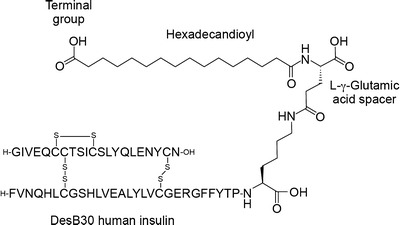
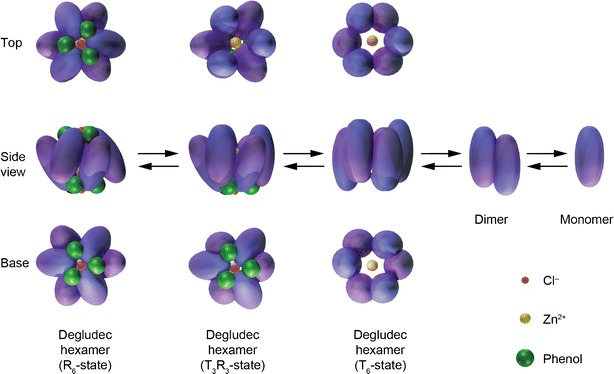
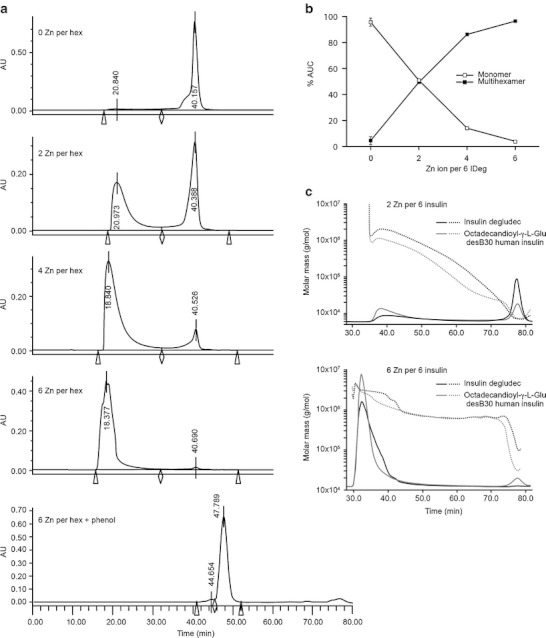
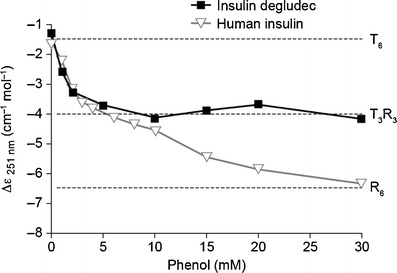
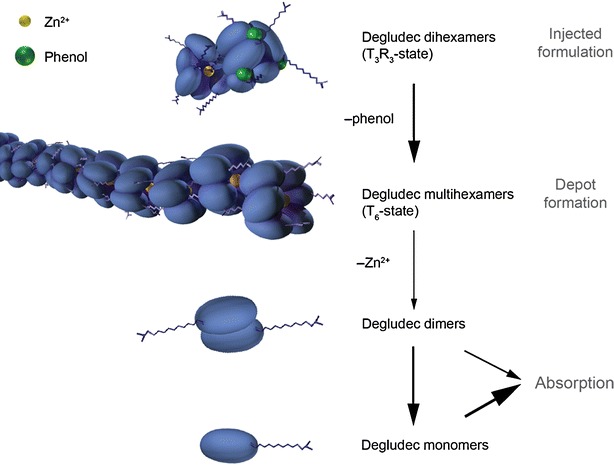
PURPOSE: Basal insulins with improved kinetic properties can potentially be produced using acylation by fatty acids that enable soluble, high-molecular weight complexes to form post-injection. A series of insulins, acylated at B29 with fatty acids via glutamic acid spacers, were examined to deduce the structural requirements. METHODS: Self-association, molecular masses and hexameric conformations of the insulins were studied using size exclusion chromatography monitored by UV or multi-angle light scattering and dynamic light scattering, and circular dichroism spectroscopy (CDS) in environments (changing phenol and zinc concentration) simulating a pharmaceutical formulation and changes following subcutaneous injection. RESULTS: With depletion of phenol, insulin degludec and another fatty diacid-insulin analogue formed high molecular mass filament-like complexes, which disintegrated with depletion of zinc. CDS showed these analogues adopting stable T(3)R(3) conformation in presence of phenol and zinc, changing to T(6) with depletion of phenol. These findings suggest insulin degludec is dihexameric in pharmaceutical formulation becoming multihexameric after injection. The analogues showed weak dimeric association, indicating rapid release of monomers following hexamer disassembly. CONCLUSIONS: Insulins can be engineered that remain soluble but become highly self-associated after injection, slowly releasing monomers; this is critically dependent on the acylation moiety. One such analogue, insulin degludec, has therapeutic potential.
Overview
The claims and statistics of this paper haven’t been checked yet.
Free: it reads the open-access text and checks the first 5 claims that cite a source we can check. Create a free account to check every claim.
Integrity signals
Registry
Cites
Statistics
Figures
Verification
Claims the paper makes
The claims and statistics of this paper haven’t been checked yet.
Free: it reads the open-access text and checks the first 5 claims that cite a source we can check. Create a free account to check every claim.
Claims other papers make about this one
Each is checked against this paper’s own text: does it say what the citing paper says it does?
The source backs part of the claim, not all of it — or backs it for a different population, condition or comparison.
In the citing paper
“In the pharmaceutical formulation, i.e. in the presence of phenol and zinc, the IDeg hexamers adopt a conformation where only one of the ends is available to interact with the side chain of another IDeg hexamer and thus forms stable di-hexamers.”
From A Review of the Pharmacological Properties of Insulin Degludec and Their Clinical Relevance (2014) · cites this paper as [16]
Experimental — accuracy not yet measuredThe source backs part of the claim, not all of it — or backs it for a different population, condition or comparison.
In the citing paper
“With the gradual diffusion of zinc from the ends of the multi-hexamers, terminal IDeg monomers slowly and steadily dissociate, resulting in a slow and gradual delivery of IDeg from the SC injection site into the circulation [16].”
From A Review of the Pharmacological Properties of Insulin Degludec and Their Clinical Relevance (2014) · cites this paper as [16]
Experimental — accuracy not yet measuredThe source backs part of the claim, not all of it — or backs it for a different population, condition or comparison.
In the citing paper
“Upon diffusion of phenol following injection, the IDeg di-hexamers open at both ends and lead to the formation of multi-hexamers [16].”
From A Review of the Pharmacological Properties of Insulin Degludec and Their Clinical Relevance (2014) · cites this paper as [16]
Experimental — accuracy not yet measuredThe source backs part of the claim, not all of it — or backs it for a different population, condition or comparison.
In the citing paper
“To date, IDeg is the only insulin analogue to self-associate into multi-hexamers upon subcutaneous (SC) injection, resulting in a soluble depot from which IDeg is slowly and continuously absorbed into the circulation [15, 16].”
From A Review of the Pharmacological Properties of Insulin Degludec and Their Clinical Relevance (2014) · cites this paper as [16]
Experimental — accuracy not yet measuredThe cited source says what the claim attributes to it.
In the citing paper
“Insulin degludec (IDeg) is a new-generation basal insulin with an ultra-long duration of action developed for once-daily administration [15, 16]”
From A Review of the Pharmacological Properties of Insulin Degludec and Their Clinical Relevance (2014) · cites this paper as [16]
1 more claim about this paper
Create a free account to see every claim other papers make about this one.
Self-check
Percentages, sums and reported differences re-computed from the paper’s own numbers.
The self-check needs the paper’s full text.
Citations
Cites
Effects of protein aggregates: An immunologic perspective
Rosenberg, A. S. (2006) · The AAPS Journal · doi:10.1208/aapsj080359 · Cited by 1,355
Estimation of Molecular Size and Molecular Weights of Biological Compounds by Gel Filtration
Andrew, P. (1970) · Methods of Biochemical Analysis · doi:10.1002/9780470110362.ch1 · Cited by 638
Heise, T., Nosek, L., Rønn, B. B., Endahl, L., Heinemann, L., Kapitza, C., & Draeger, E. (2004) · Diabetes · doi:10.2337/diabetes.53.6.1614 · Cited by 614
Wen, J., Arakawa, T., & Philo, J. S. (1996) · Analytical Biochemistry · doi:10.1006/abio.1996.0345 · Cited by 504
Monomeric insulins obtained by protein engineering and their medical implications
Brange, J., Ribel, U., Hansen, J. F., Dodson, G., Hansen, M. T., Havelund, S., Melberg, S. G., Norris, F., Norris, K., Snel, L., et al. (1988) · Nature · doi:10.1038/333679a0 · Cited by 488
Self-citationThe Mechanism of Protraction of Insulin Detemir, a Long-Acting, Acylated Analog of Human Insulin
Havelund, S., Plum, A., Ribel, U., Jonassen, I., Vølund, A., Markussen, J., & Kurtzhals, P. (2004) · Pharmaceutical Research · doi:10.1023/b:pham.0000036926.54824.37 · Cited by 429
Self-citationHeise, T., Hermanski, L., Nosek, L., Feldman, A., Rasmussen, S., & Haahr, H. (2012) · Diabetes, Obesity and Metabolism · doi:10.1111/j.1463-1326.2012.01627.x · Cited by 397
Immunogenicity of protein therapeutics: The key causes, consequences and challenges
Baker, M., Reynolds, H. M., Lumicisi, B., & Bryson, C. J. (2010) · Self/Nonself · doi:10.4161/self.1.4.13904 · Cited by 372 · cited 1×
“which neutralising antibodies can impact efficacy over time (26).”
BackgroundStrategies for the assessment of protein aggregates in pharmaceutical biotech product development
den Engelsman, J., Garidel, P., Smulders, R., Koll, H., Smith, B., Bassarab, S., Seidl, A., Hainzl, O., & Jiskoot, W. (2011) · Pharmaceutical Research · doi:10.1007/s11095-010-0297-1 · Cited by 348
Kurtzhals, P., Havelund, S., Jonassen, I., Kiehr, B., Larsen, U. D., Ribel, U., & Markussen, J. (1995) · Biochemical Journal · doi:10.1042/bj3120725 · Cited by 334
Self-citationUltra‐long‐acting insulin degludec has a flat and stable glucose‐lowering effect in type 2 diabetes
Heise, T., Nosek, L., Bøttcher, S. G., Hastrup, H., & Haahr, H. (2012) · Diabetes, Obesity and Metabolism · doi:10.1111/j.1463-1326.2012.01638.x · Cited by 331
Information on Polydispersity and Branching from Combined Quasi-Elastic and Intergrated Scattering
Burchard, W., Schmidt, M., & Stockmayer, W. H. (1980) · Macromolecules · doi:10.1021/ma60077a045 · Cited by 329
The Specific Refractive Increment of Some Purified Proteins
Perlmann, G. E., & Longsworth, L. G. (1948) · Journal of the American Chemical Society · doi:10.1021/ja01188a027 · Cited by 283
Klein, O., Lynge, J., Endahl, L., Damholt, B., Nosek, L., & Heise, T. (2007) · Diabetes, Obesity and Metabolism · doi:10.1111/j.1463-1326.2006.00685.x · Cited by 251
Heise, T., & Pieber, T. R. (2007) · Diabetes, Obesity and Metabolism · doi:10.1111/j.1463-1326.2007.00756.x · Cited by 239
Insulin Degludec in Type 1 Diabetes
Birkeland, K. I., Home, P. D., Wendisch, U., Ratner, R. E., Johansen, T., Endahl, L. A., Lyby, K., Jendle, J. H., Roberts, A. P., DeVries, J. H., et al. (2011) · Diabetes Care · doi:10.2337/dc10-1925 · Cited by 160
Kaarsholm, N. C., Ko, H. C., & Dunn, M. F. (1989) · Biochemistry · doi:10.1021/bi00436a046 · Cited by 153
Three-Dimensional Atomic Structure of Insulin and Its Relationship to Activity
Blundell, T. L., Cutfield, J. F., Cutfield, S. M., Dodson, E. J., Dodson, G. G., Hodgkin, D. C., & Mercola, D. A. (1972) · Diabetes · doi:10.2337/diab.21.2.s492 · Cited by 140
Zinman, B., Fulcher, G., Rao, P. V., Thomas, N., Endahl, L. A., Johansen, T., Lindh, R., Lewin, A. J., Rosenstock, J., Pinget, M., et al. (2011) · The Lancet · doi:10.1016/s0140-6736(10)62305-7 · Cited by 138
Heise, T., Tack, C. J., Cuddihy, R., Davidson, J., Gouet, D., Liebl, A., Romero, E., Mersebach, H., Dykiel, P., & Jorde, R. (2011) · Diabetes Care · doi:10.2337/dc10-1905 · Cited by 96
Refining basal insulin therapy: what have we learned in the age of analogues?
DeVries, J. H., Nattrass, M., & Pieber, T. R. (2007) · Diabetes/Metabolism Research and Reviews · doi:10.1002/dmrr.762 · Cited by 94
New insulins in the treatment of diabetes mellitus
Lindholm, A. (2002) · Best Practice & Research Clinical Gastroenterology · doi:10.1053/bega.2002.0321 · Cited by 79
J�rgensen, K., & Larsen, U. D. (1980) · Diabetologia · doi:10.1007/bf00253183 · Cited by 77
Structural Effects of Protein Lipidation as Revealed by LysB29-myristoyl, des(B30) Insulin
Olsen, H. B., & Kaarsholm, N. C. (2000) · Biochemistry · doi:10.1021/bi001201i · Cited by 58
Jonassen, I., Havelund, S., Ribel, U., Plum, A., Loftager, M., Høeg-Jensen, T., Vølund, A., & Markussen, J. (2005) · Pharmaceutical Research · doi:10.1007/s11095-005-9047-1 · Cited by 51
Self-citationChoi, W. E., Brader, M. L., Aguilar, V., Kaarsholm, N. C., & Dunn, M. F. (1993) · Biochemistry · doi:10.1021/bi00094a021 · Cited by 50
Cooperativity and Intermediate States in the T→R-Structural Transformation of Insulin
KRÜGER, P., Gilge, G., Cabuk, Y., & Wollmer, A. (1990) · Biological Chemistry Hoppe-Seyler · doi:10.1515/bchm3.1990.371.2.669 · Cited by 47
The Future of Basal Insulin Supplementation
Simon, A. C. R., & DeVries, J. H. (2011) · Diabetes Technology & Therapeutics · doi:10.1089/dia.2010.0251 · Cited by 46
(2012) · Cited by 40
Kurtzhals, P., & Ribel, U. (1995) · Diabetes · doi:10.2337/diab.44.12.1381 · Cited by 35
Self-citationRefractive Increment Data-Book
Brown, R. (2001) · Polymer Testing · doi:10.1016/s0142-9418(00)00056-8 · Cited by 33
How to achieve a predictable basal insulin?
Kurtzhals, P. (2005) · Diabetes & Metabolism · doi:10.1016/s1262-3636(05)88264-3 · Cited by 25
Kurtzhals, P., & Ribel, U. (1995) · Diabetes · doi:10.2337/diabetes.44.12.1381 · Cited by 7
Self-citation
Research works printed but not linked: 3
- Kruger P, Gilge G, Cabuk Y, Wollmer A. Cooperativity and intermediate states in the T;R-structural transformation of insulin. Biol Chem Hoppe Seyler. 1990;371:669–73. · DOI
- Heise T, Hermanski L, Nosek L, Feldmann A, Rasmussen S, Stryhn TK, Haahr H. Insulin degludec: less pharmacodynamic variability than insulin glargine under steady state conditions. Diabetologia. 2010;53(Suppl1):S387.
- Kurzhals P, Heise T, Strauss HM, Bøttcher SG, Granhall C, Haahr H, Jonassen I. Multi-hexamer formation is the underlying mechanism behind the ultra-long glucose-lowering effect of insulin degludec. Diabetes. 2011;60 Suppl 1:LB12.
Cited by
The evolution of commercial drug delivery technologies
Vargason, A. M., Anselmo, A. C., & Mitragotri, S. (2021) · Nature Biomedical Engineering · doi:10.1038/s41551-021-00698-w · Cited by 1,361
The Discovery and Development of Liraglutide and Semaglutide
Knudsen, L. B., & Lau, J. (2019) · Frontiers in Endocrinology · doi:10.3389/fendo.2019.00155 · Cited by 970
Heise, T., Hermanski, L., Nosek, L., Feldman, A., Rasmussen, S., & Haahr, H. (2012) · Diabetes, Obesity and Metabolism · doi:10.1111/j.1463-1326.2012.01627.x · Cited by 397
“The differences in within-subject variability are likely to be related to differences in mechanism of protraction; when IDeg is injected into the subcutaneous tissue, the formation of soluble multihexameric chains occurs at the injection site, with these complexes subsequently dissociating slowly to release monomers,…”
BackgroundRatner, R. E., Gough, S. C. L., Mathieu, C., Del Prato, S., Bode, B., Mersebach, H., Endahl, L., & Zinman, B. (2013) · Diabetes, Obesity and Metabolism · doi:10.1111/dom.12032 · Cited by 346
“Soluble multi-hexamers are formed in the subcutaneous tissue upon injection, creating a depot from which monomers are slowly and continuously absorbed into the circulation [9].”
BackgroundInsulin Degludec Versus Insulin Glargine in Insulin-Naive Patients With Type 2 Diabetes
Zinman, B., Philis-Tsimikas, A., Cariou, B., Handelsman, Y., Rodbard, H. W., Johansen, T., Endahl, L., Mathieu, C., & on behalf of the NN1250-3579 (BEGIN Once Long) Trial Investigators (2012) · Diabetes Care · doi:10.2337/dc12-1205 · Cited by 336
Metadata
- Authors
- Jonassen, I., Havelund, S., Hoeg-Jensen, T., Steensgaard, D. B., Wahlund, P.-O., & Ribel, U.
- Affiliations
- Novo Nordisk (Denmark) (DK)
- Corresponding author
- Jonassen, Ib
- Venue
- Pharmaceutical Research
- Published
- 2012-04-07
- Volume
- 29
- Issue
- 8
- Pages
- 2104-2114
- ISSN
- 0724-8741 (ISSN-L)
- 1573-904X
- PMC
- PMC3399081
- OpenAlex
- W1986874694
- Semantic Scholar
- d3839c54097347f226274e4103b43b5c1ea37995
- Cited by
- 448
- References
- 32
- Citations by year
- 2026: 7 · 2025: 19 · 2024: 24 · 2023: 19 · 2022: 28 · 2021: 40 · 2020: 24 · 2019: 33 · 2018: 33 · 2017: 30 · 2016: 35 · 2015: 49 · 2014: 45 · 2013: 45 · 2012: 16
- FWCI
- 19.91
- Type
- journal article
- Language
- en
- Open access
- hybrid
- doi.org
- Licence
- cc-by
- Locations
- Pharmaceutical Research (publishedVersion, cc-by)
- PubMed Central (publishedVersion, cc-by)
- PubMed (publishedVersion)
- Funders
- Novo Nordisk
- Topics
- Life Sciences › Biochemistry, Genetics and Molecular Biology › Molecular Biology › Protein purification and stability
- Health Sciences › Medicine › Endocrinology, Diabetes and Metabolism › Diabetes Management and Research
- Health Sciences › Medicine › Endocrinology, Diabetes and Metabolism › Pancreatic function and diabetes
- Keywords
- insulin degludec, fatty acid acylation, insulin conformation, subcutaneous injection, insulin analogues
- MeSH terms
- Acylation, Amino Acid Sequence, Chromatography, Gel, Circular Dichroism, Fatty Acids, Humans, Hypoglycemic Agents, Insulin, Models, Molecular, Molecular Sequence Data, Protein Binding, Serum Albumin
About these checks
Registry, retraction, Cites and statistics results are computed, not judged, with one exception: a printed reference that no index lists is read once by a model before it counts as a citation error. Claims are extracted by a model and kept only when their quote appears verbatim in the text; each cited source is then checked, with a model’s help, for whether it says what the claim relies on. Those verdicts can be wrong — read the claim’s quote and the cited source before relying on one.
Statistics and arithmetic are recomputed, not judged.
Confidence bands are shown only for fields calibrated on our annotated test set. None is calibrated yet, so no band is shown.
What counts as a claim ›How we measure confidence ›How we check this ›
Are you an author, or do you see a problem with this page? Request a review
Data sources
Bibliographic data: Semantic Scholar, OpenAlex, Crossref.
Contains information from the Semantic Scholar Academic Graph Datasets, made available under the ODC Attribution License (ODC-BY 1.0).
Semantic Scholar’s data is described in: Kinney, R., et al. (2023). The Semantic Scholar Open Data Platform. arXiv:2301.10140.
