

Concrete resource analysis of the quantum linear-system algorithm used to compute the electromagnetic scattering cross section of a 2D target
Open accessThe DOI matches its Crossref record; 63 of the 65 references it cites were found in a registry or an index.
Abstract
We provide a detailed estimate for the logical resource requirements of the quantum linear-system algorithm (Harrow et al. in Phys Rev Lett 103:150502, 2009) including the recently described elaborations and application to computing the electromagnetic scattering cross section of a metallic target (Clader et al. in Phys Rev Lett 110:250504, 2013). Our resource estimates are based on the standard quantum-circuit model of quantum computation; they comprise circuit width (related to parallelism), circuit depth (total number of steps), the number of qubits and ancilla qubits employed, and the overall number of elementary quantum gate operations as well as more specific gate counts for each elementary fault-tolerant gate from the standard set $$\{ X, Y, Z, H, S, T, \text{ CNOT } \}$$ . In order to perform these estimates, we used an approach that combines manual analysis with automated estimates generated via the Quipper quantum programming language and compiler. Our estimates pertain to the explicit example problem size $$N=332{,}020{,}680$$ beyond which, according to a crude big-O complexity comparison, the quantum linear-system algorithm is expected to run faster than the best known classical linear-system solving algorithm. For this problem size, a desired calculation accuracy $$\varepsilon =0.01$$ requires an approximate circuit width 340 and circuit depth of order $$10^{25}$$ if oracle costs are excluded, and a circuit width and circuit depth of order $$10^8$$ and $$10^{29}$$ , respectively, if the resource requirements of oracles are included, indicating that the commonly ignored oracle resources are considerable. In addition to providing detailed logical resource estimates, it is also the purpose of this paper to demonstrate explicitly (using a fine-grained approach rather than relying on coarse big-O asymptotic approximations) how these impressively large numbers arise with an actual circuit implementation of a quantum algorithm. While our estimates may prove to be conservative as more efficient advanced quantum-computation techniques are developed, they nevertheless provide a valid baseline for research targeting a reduction of the algorithmic-level resource requirements, implying that a reduction by many orders of magnitude is necessary for the algorithm to become practical.
Overview
The claims and statistics of this paper haven’t been checked yet.
Free: it reads the open-access text and checks the first 5 claims that cite a source we can check. Create a free account to check every claim.
Integrity signals
Registry
Cites
Statistics
Figures







Verification
Claims the paper makes
The claims and statistics of this paper haven’t been checked yet.
Free: it reads the open-access text and checks the first 5 claims that cite a source we can check. Create a free account to check every claim.
Claims other papers make about this one
Each is checked against this paper’s own text: does it say what the citing paper says it does?
The cited source says what the claim attributes to it.
In the citing paper
“The classical algorithmic complexity for this task scales polynomially in the dimension N , whereas the now-famous Harrow-Hassidim-Lloyd (HHL) quantum algorithm [3] has a complexity that scales logarithmically in N , with some scaling improvements having been proposed [134-137].”
From Variational quantum algorithms (2021) · cites this paper as [137]
Self-check
Percentages, sums and reported differences re-computed from the paper’s own numbers.
The self-check needs the paper’s full text.
Citations
Cites
Iterative Methods for Sparse Linear Systems
Saad, Y. (2003) · Society for Industrial and Applied Mathematics eBooks · doi:10.1137/1.9780898718003 · Cited by 13,790 · cited 1×
“while the best known classical linear-system-solving algorithm based on conjugate gradient method [20,21] has the run-time complexity”
BackgroundIrreversibility and heat generation in the computing process
Landauer, R. (1961) · IBM Journal of Research and Development · doi:10.1147/rd.53.0183 · Cited by 4,980
The Mathematical Theory of Finite Element Methods
Brenner, S. C., & Scott, L. R. (2002) · Texts in Applied Mathematics · doi:10.1007/978-1-4757-3658-8 · Cited by 4,090
The Mathematical Theory of Finite Element Methods
Brenner, S. C., & Scott, L. R. (2008) · Texts in Applied Mathematics · doi:10.1007/978-0-387-75934-0 · Cited by 3,955
The Finite Element Method in Electromagnetics
Jin, J. (1993) · Cited by 3,869
Logical Reversibility of Computation
Bennett, C. H. (1973) · IBM Journal of Research and Development · doi:10.1147/rd.176.0525 · Cited by 3,679 · cited 1×
“This indeed is a feature of our low-level implementation of the irreversible-to-reversible transformations that is similar to the way “logical reversibility of computation” was proposed by Bennett in [53].”
ResultQuantum Algorithm for Linear Systems of Equations
Harrow, A. W., Hassidim, A., & Lloyd, S. (2009) · Physical Review Letters · doi:10.1103/physrevlett.103.150502 · Cited by 3,325 · cited 21×
“With these generalizations aiming at improving the efficiency and practicality of the algorithm, CJS-QLSA was shown to have the run-time complexity6 Õ ( κd7 log(N)/ǫ2 ) , (3) which is quadratically better in κ than in the original HHL-QLSA.”
BackgroundMethodResultInfluentialAn Introduction to the Conjugate Gradient Method Without the Agonizing Pain
Shewchuk, J. R. (1994) · Cited by 3,178
Irreversibility and heat generation in the computing process
Landauer, R. (2000) · IBM Journal of Research and Development · doi:10.1147/rd.441.0261 · Cited by 2,585
On the product of semi-groups of operators
Trotter, H. F. (1959) · Proceedings of the American Mathematical Society · doi:10.1090/s0002-9939-1959-0108732-6 · Cited by 2,282 · cited 3×
“of submatrices, each of which ought to be 1-sparse, as well as the Suzuki-Higher-Order Integrator method and Trotterization [25,26].”
MethodThe Mathematical Theory of Finite Element Methods
Brenner, S. C., & Scott, L. R. (1994) · Texts in Applied Mathematics · doi:10.1007/978-1-4757-4338-8 · Cited by 2,188
Finite element method in electromagnetics
Ming, J. J. (2002) · International Linear Collider · Cited by 2,017
Quantum amplitude amplification and estimation
Brassard, G., Høyer, P., Mosca, M., & Tapp, A. (2002) · Contemporary Mathematics · doi:10.1090/conm/305/05215 · Cited by 1,680 · cited 27×
“To avoid nonunitary postselection processes, CJS-QLSA [5] employs QAEA.11 With respect to the particular application example that has been analyzed here, namely, solving Maxwell’s equations for a scattering problem using the FEM technique, we are interested in the radar scattering cross section (RCS) σRCS, which can b…”
BackgroundMethodInfluentialCleve, R., Ekert, A., Macchiavello, C., & Mosca, M. (1998) · Proceedings of the Royal Society of London. Series A: Mathematical, Physical and Engineering Sciences · doi:10.1098/rspa.1998.0164 · Cited by 1,299 · cited 15×
“Indeed, while CJS removed the QAA step from the HHL algorithm, they replaced it with the nearly equivalent QAE step, which we believe has a similar resource requirement as the former, and thus may require up to O(κ/ǫ) iterations to ensure successful amplitude estimation within multiplicative accuracy ǫ, in addition to…”
MethodInfluentialSuzuki, M. (1990) · Physics Letters A · doi:10.1016/0375-9601(90)90962-n · Cited by 853 · cited 17×
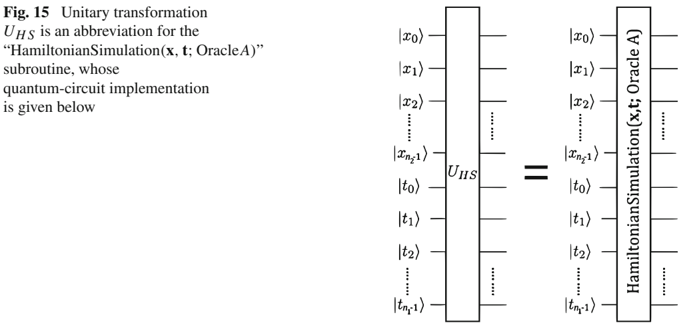
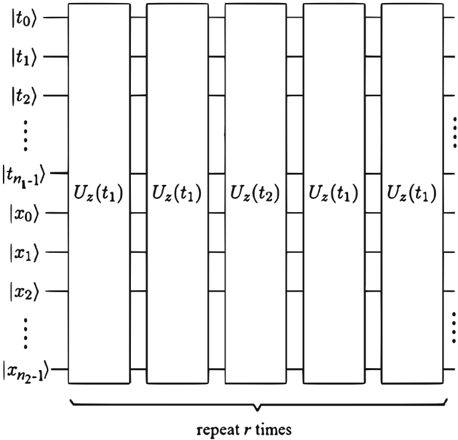
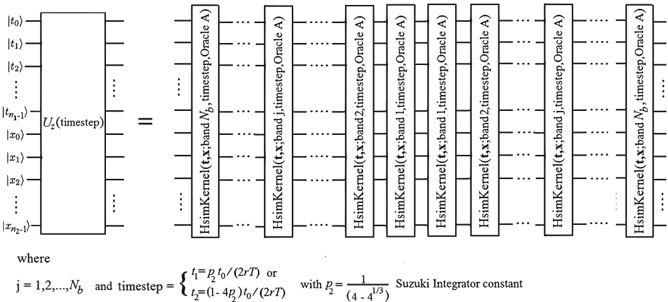
“(8), and the Suzuki higherorder Integrator method [26] with order k = 2 and Trotterization [25] are all accomplished by subroutine ‘HamiltonianSimulation(x, t; OracleA)’, whose implementation is illustrated in Figs.”
MethodInfluentialExponential algorithmic speedup by a quantum walk
Childs, A. M., Cleve, R., Deotto, E., Farhi, E., Gutmann, S., & Spielman, D. A. (2003) · Proceedings of the thirty-fifth annual ACM symposium on Theory of computing · doi:10.1145/780542.780552 · Cited by 825 · cited 2×
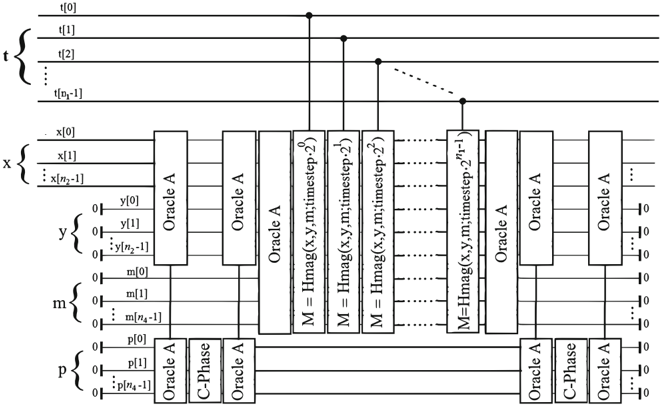
“This “Hamiltonian circuit” can be derived by a procedure resembling the techniques of quantum-random-walk algorithm [30] and is discussed in more detail in Sect.”
MethodEfficient Quantum Algorithms for Simulating Sparse Hamiltonians
Berry, D. W., Ahokas, G., Cleve, R., & Sanders, B. C. (2007) · Communications in Mathematical Physics · doi:10.1007/s00220-006-0150-x · Cited by 692 · cited 20×
“The generalized QLSA [5] is based on two well-known quantum algorithm techniques: (1)QuantumPhase Estimation Algorithm (QPEA) [6,7], which usesQuantumFourier Transform (QFT) [1] as well as Hamiltonian Simulation (HS) [8] as quantum computational primitives, and (2) Quantum Amplitude Estimation Algorithm (QAEA) [22], w…”
BackgroundMethodInfluentialQuantum Computer Science: An Introduction
Mermin, N. D. (2007) · doi:10.1017/cbo9780511813870 · Cited by 592 · cited 12×
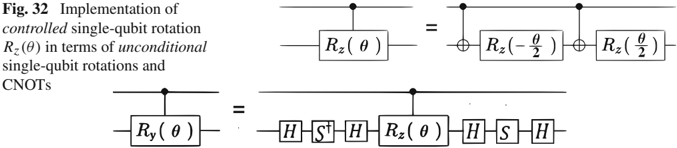
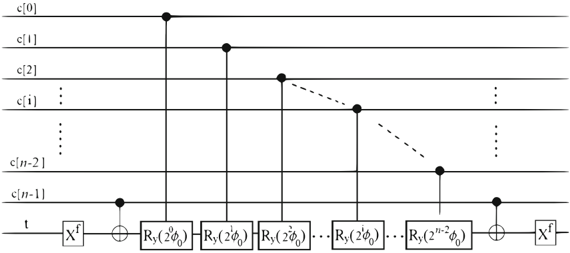
“Moreover, doubly- controlled rotations can be implemented in terms of Toffolis, CNOTs and unconditional single-qubit rotations according to circuit equality given in Fig.”
InfluentialQuantum algorithms for supervised and unsupervised machine learning
Lloyd, S., Mohseni, M., & Rebentrost, P. (2013) · arXiv · doi:10.48550/arxiv.1307.0411 · Cited by 542 · cited 1×
“equations [10], and machine learning [11].”
Quantum Algorithm for Data Fitting
Wiebe, N., Braun, D., & Lloyd, S. (2012) · Physical Review Letters · doi:10.1103/physrevlett.109.050505 · Cited by 528
Quantum Amplitude Amplification and Estimation
Gilles Brassard, A., Høyer, P., Mosca, M., & Tapp, A. (2000) · doi:10.48550/arxiv.quant-ph/0005055 · Cited by 514 · cited 26×
“According to the error analysis in [22], choosing M = 2 log2(1/ε(2)) ensures that the modulus squared α of a quantum amplitude can be estimated by QAEA with a probability greater than 1 − ε within ±εα of its correct value, with ε specifying the desired precision, which in our analysis is chosen to be 0.”
BackgroundMethodInfluentialHamiltonian Simulation with Nearly Optimal Dependence on all Parameters
Berry, D. W., Childs, A. M., & Kothari, R. (2015) · 2015 IEEE 56th Annual Symposium on Foundations of Computer Science · doi:10.1109/focs.2015.54 · Cited by 372 · cited 8×
“for the three approaches [8], [43] and [45], respectively.”
BackgroundMethodInfluentialQuipper: a scalable quantum programming language
Green, A. S., Lumsdaine, P. L., Ross, N. J., Selinger, P., & Valiron, B. (2013) · Proceedings of the 34th ACM SIGPLAN Conference on Programming Language Design and Implementation · doi:10.1145/2491956.2462177 · Cited by 334
Self-citationExponential improvement in precision for simulating sparse Hamiltonians
Berry, D. W., Childs, A. M., Cleve, R., Kothari, R., & Somma, R. D. (2014) · Proceedings of the forty-sixth annual ACM symposium on Theory of computing · doi:10.1145/2591796.2591854 · Cited by 324 · cited 4×
“Moreover, unlike the approach [43], the query complexities derived in [44,45] are shown to be independent of the number of qubits acted on.”
BackgroundInfluentialOn the Product of Semi-Groups of Operators
Trotter, H. F. (1959) · Proceedings of the American Mathematical Society · doi:10.2307/2033649 · Cited by 322
Preconditioned Quantum Linear System Algorithm
Clader, B. D., Jacobs, B. C., & Sprouse, C. R. (2013) · Physical Review Letters · doi:10.1103/physrevlett.110.250504 · Cited by 288 · cited 24×
“With these generalizations aiming at improving the efficiency and practicality of the algorithm, CJS-QLSA was shown to have the run-time complexity6 Õ ( κd7 log(N)/ǫ2 ) , (3) which is quadratically better in κ than in the original HHL-QLSA.”
BackgroundMethodResultInfluentialHigh-order quantum algorithm for solving linear differential equations
Berry, D. W. (2014) · Journal of Physics A: Mathematical and Theoretical · doi:10.1088/1751-8113/47/10/105301 · Cited by 277 · cited 1×
“equations [10], and machine learning [11].”
A lambda calculus for quantum computation with classical control
SELINGER, P., & VALIRON, B. (2006) · Mathematical Structures in Computer Science · doi:10.1017/s0960129506005238 · Cited by 177
Self-citationExperimental Quantum Computing to Solve Systems of Linear Equations
Cai, X.-D., Weedbrook, C., Su, Z.-E., Chen, M.-C., Gu, M., Zhu, M.-J., Li, L., Liu, N.-L., Lu, C.-Y., & Pan, J.-W. (2013) · Physical Review Letters · doi:10.1103/physrevlett.110.230501 · Cited by 173 · cited 1×
“Recent efforts in demonstrating small-scale experimental implementation of QLSA [12,13] have further highlighted its popularity.”
BackgroundExact synthesis of multiqubit Clifford+Tcircuits
Giles, B., & Selinger, P. (2013) · Physical Review A · doi:10.1103/physreva.87.032332 · Cited by 163
Optimal ancilla-free Clifford+T approximation of z-rotations
Ross, N. J., & Selinger, P. (2016) · Quantum Information and Computation · doi:10.26421/qic16.11-12-1 · Cited by 152
Quantum computer science: an introduction
(2008) · Choice Reviews Online · doi:10.5860/choice.45-4430 · Cited by 150
A logarithmic-depth quantum carry-lookahead adder
Draper, T. G., Kutin, S., Rains, E. M., & Svore, K. M. (2006) · CaltechAUTHORS (California Institute of Technology) · doi:10.5555/2012086.2012090 · Cited by 138
Fast and efficient exact synthesis of single-qubit unitaries generated by Clifford and T gates
Kliuchnikov, V., Maslov, D., & Mosca, M. (2013) · Quantum Information and Computation · doi:10.26421/qic13.7-8-4 · Cited by 136
Exponential algorithmic speedup by a quantum walk
Childs, A. M., Cleve, R., Deotto, E., Farhi, E., Gutmann, S., & Spielman, D. A. (2003) · Proceedings of the thirty-fifth ACM symposium on Theory of computing - STOC '03 · doi:10.1145/780551.780552 · Cited by 134
Kliuchnikov, V., Maslov, D., & Mosca, M. (2013) · Physical Review Letters · doi:10.1103/physrevlett.110.190502 · Cited by 128
Optimum phase-shift estimation and the quantum description of the phase difference
Luis, A., & Peřina, J. (1996) · Physical Review A · doi:10.1103/physreva.54.4564 · Cited by 125 · cited 15×
“Indeed, while CJS removed the QAA step from the HHL algorithm, they replaced it with the nearly equivalent QAE step, which we believe has a similar resource requirement as the former, and thus may require up to O(κ/ǫ) iterations to ensure successful amplitude estimation within multiplicative accuracy ǫ, in addition to…”
MethodInfluentialOptimal ancilla-free Clifford+V approximation of z-rotations
Ross, N. J. (2015) · Quantum Information and Computation · doi:10.26421/qic15.11-12-4 · Cited by 123
Edge-based finite elements and vector ABCs applied to 3-D scattering
Chatterjee, A., Jin, J., & Volakis, J. L. (1993) · IEEE Transactions on Antennas and Propagation · doi:10.1109/8.214614 · Cited by 113 · cited 4×
“For details, see [5] and [23,24] including its supplementary material.”
BackgroundMethodInfluentialAn Introduction to Quantum Programming in Quipper
Green, A. S., Lumsdaine, P. L., Ross, N. J., Selinger, P., & Valiron, B. (2013) · Lecture notes in computer science · doi:10.1007/978-3-642-38986-3_10 · Cited by 107 · cited 2×
“The programming language Quipper [14,15] is a domain-specific, higher-order, functional language for quantum computation.”
BackgroundSelf-citationSelinger, P., & Valiron, B. (2009) · Cambridge University Press eBooks · doi:10.1017/cbo9781139193313.005 · Cited by 103
Self-citationÖmer, B. (2000) · Cited by 102
A two-qubit photonic quantum processor and its application to solving systems of linear equations
Barz, S., Kassal, I., Ringbauer, M., Lipp, Y. O., Dakić, B., Aspuru-Guzik, A., & Walther, P. (2014) · Scientific Reports · doi:10.1038/srep06115 · Cited by 100
Efficient Clifford+T approximation of single-qubit operators
Selinger, P. (2015) · Quantum Information and Computation · doi:10.26421/qic15.1-2-10 · Cited by 92
Constructing arbitrary steane code single logical qubit fault-tolerant gates
Fowler, A. G. (2011) · Quantum Information and Computation · doi:10.5555/2230936.2230946 · Cited by 88
Representation of Quantum Circuits with Clifford and $π/8$ GatesPreprint
Matsumoto, K., & Amano, K. (2008) · arXiv (Cornell University) · doi:10.48550/arxiv.0806.3834 · Cited by 77
On the Conditioning of Finite Element Equations with Highly Refined Meshes
Bank, R. E., & Scott, L. R. (1989) · SIAM Journal on Numerical Analysis · doi:10.1137/0726080 · Cited by 77 · cited 2×
“Indeed, as was rigorously proven in [27,28], FEM matrix condition numbers are generally bounded from above by O(N 2/n) for n ≥ 3 and by Õ(N ) for n = 2, with n the number of dimensions of the problem.”
BackgroundEfficient decomposition of single-qubit gates intoVbasis circuits
Bocharov, A., Gurevich, Y., & Svore, K. M. (2013) · Physical Review A · doi:10.1103/physreva.88.012313 · Cited by 72
Constructing arbitrary Steane code single logical qubit fault-tolerant gates
Fowler, A. G. (2011) · Quantum Information and Computation · doi:10.26421/qic11.9-10-10 · Cited by 72
Fast and efficient exact synthesis of single qubit unitaries generated by Clifford and T gates
Kliuchnikov, V., Maslov, D., & Mosca, M. (2012) · arXiv (Cornell University) · doi:10.48550/arxiv.1206.5236 · Cited by 56
Ambainis, A. (2010) · arXiv (Cornell University) · doi:10.48550/arxiv.1010.4458 · Cited by 55 · cited 5×
“In a subsequent work, Ambainis [4] proposed using variable-time quantum amplitude amplification to improve the run-time of HHL algorithm from Õ(κ2 logN) to Õ(κ log3 κ logN), thus achieving an almost optimal dependence on the condition number κ.5 However, the improvement of the dependence of the run-time on κ was the…”
BackgroundMethodInfluentialAltenkirch, T., & Green, A. S. (2009) · Cambridge University Press eBooks · doi:10.1017/cbo9781139193313.006 · Cited by 51
Embedded Languages for Describing and Verifying Hardware
Claessen, K. (2001) · Cited by 45
Remarks on Matsumoto and Amano's normal form for single-qubit Clifford+T operatorsPreprint
Giles, B. G., & Selinger, P. (2013) · arXiv (Cornell University) · doi:10.48550/arxiv.1312.6584 · Cited by 42 · cited 4×
“For 51 Gj gates, we would get 26 T gates, 26 H gates and 14 S gates by extrapolation, for a total of 65 gates. b. Plato implementation of gate sequence approximations We have implemented a combination of Fowler’s method and the more recent single-qubit ‘normal form’ representation by Matsumoto and Amano [41, 42] in Ha…”
MethodInfluentialSolving systems of linear equations on a quantum computer
Barz, S., Kassal, I., Ringbauer, M., Lipp, Y. O., Dakić, B., Aspuru‐Guzik, A., & Walther, P. J. (2013) · arXiv (Cornell University) · doi:10.48550/arxiv.1302.1210 · Cited by 37
Optimization of the Solovay-Kitaev algorithm
Pham, T. T., Van Meter, R., & Horsman, D. (2013) · Physical Review A · doi:10.1103/physreva.87.052332 · Cited by 29
Towards Large-Scale Quantum ComputationPreprint
Fowler, A. G. (2005) · arXiv (Cornell University) · doi:10.48550/arxiv.quant-ph/0506126 · Cited by 21
Optimal ancilla-free Clifford+T approximation of z-rotationsPreprint
Ross, N. J., & Selinger, P. (2014) · arXiv (Cornell University) · doi:10.48550/arxiv.1403.2975 · Cited by 21
Efficient Clifford+T approximation of single-qubit operatorsPreprint
Selinger, P. (2012) · arXiv (Cornell University) · doi:10.48550/arxiv.1212.6253 · Cited by 18
Exponential improvement in precision for Hamiltonian-evolution simulationPreprint
Berry, D. W., Cleve, R., & Somma, R. D. (2013) · arXiv (Cornell University) · doi:10.48550/arxiv.1308.5424 · Cited by 15 · cited 6×
“for the three approaches [8], [43] and [45], respectively.”
BackgroundMethodInfluentialHigh-accuracy finite-element methods for positive symmetric systems
Layton, W. (1986) · Computers & Mathematics with Applications · doi:10.1016/0898-1221(86)90182-3 · Cited by 4
(1961) · IBM Journal of Research and Development · doi:10.1147/rd.53.0261 · Cited by 3
HIGH-ACCURACY FINITE-ELEMENT METHODS FOR POSITIVE SYMMETRIC SYSTEMS
Layton, W. (1986) · Elsevier eBooks · doi:10.1016/b978-0-08-034313-6.50018-3 · Cited by 1
Research works printed but not linked: 3
- Nielsen, M.A., Chuang, I.L.: Quantum Computing and Quantum Information. Cambridge University Press, Cambridge (2000)
- Bocharov, A., Gurevich, Y., Svore, K.M.: Efficient decomposition of single-qubit gates into V basis circuits. Phys. Rev. A 88(012313), 13 (2013)
- Kliuchnikov, V., Maslov, D., Mosca, M.: Asymptotically optimal approximation of single qubit unitaries by Clifford and T circuits using a constant number of ancillary qubits. Phys. Rev. Lett. 110(190502), 5 (2013)
Cited by
Biamonte, J., Wittek, P., Pancotti, N., Rebentrost, P., Wiebe, N., & Lloyd, S. (2017) · Nature · doi:10.1038/nature23474 · Cited by 4,779
Variational quantum algorithms
Cerezo, M., Arrasmith, A., Babbush, R., Benjamin, S. C., Endo, S., Fujii, K., McClean, J. R., Mitarai, K., Yuan, X., Cincio, L., et al. (2021) · Nature Reviews Physics · doi:10.1038/s42254-021-00348-9 · Cited by 3,385
“These pioneering quantum algorithms, however, will be difficult to implement in the near term due to the enormous circuit depth requirements [117].”
BackgroundQuantum Algorithms: A Survey of Applications and End-to-end Complexities
Dalzell, A. M., McArdle, S., Berta, M., Bienias, P., Chen, C.-F., Gilyén, A., Hann, C. T., Kastoryano, M. J., Khabiboulline, E. T., Kubica, A., et al. (2023) · RWTH Publications (RWTH Aachen) · doi:10.18154/rwth-2026-02888 · Cited by 363
Quantum Linear System Algorithm for Dense Matrices
Wossnig, L., Zhao, Z., & Prakash, A. (2018) · Physical Review Letters · doi:10.1103/physrevlett.120.050502 · Cited by 223
Quantum technology for military applications
Krelina, M. (2021) · EPJ Quantum Technology · doi:10.1140/epjqt/s40507-021-00113-y · Cited by 176
Metadata
- Authors
- Scherer, A., Valiron, B., Mau, S.-C., Alexander, S., van den Berg, E., & Chapuran, T. E.
- Affiliations
- Macquarie University (AU)
- Supélec (FR)
- Corresponding author
- Scherer, Artur
- Venue
- Quantum Information Processing
- Published
- 2017-01-25
- Volume
- 16
- Issue
- 3
- Pages
- 16:60
- ISSN
- 1570-0755 (ISSN-L)
- 1573-1332
- OpenAlex
- W2478948476
- Cited by
- 73
- References
- 65
- Citations by year
- 2026: 1 · 2025: 6 · 2024: 6 · 2023: 10 · 2022: 9 · 2021: 14 · 2020: 10 · 2019: 7 · 2018: 6 · 2017: 3
- FWCI
- 4.24
- Type
- journal article
- Language
- en
- Open access
- hybrid
- doi.org
- Licence
- cc-by
- creativecommons.org/licenses/by/4.0 (tdm)
- creativecommons.org/licenses/by/4.0 (vor)
- Locations
- Quantum Information Processing (publishedVersion, cc-by)
- arXiv (Cornell University) (submittedVersion)
- HAL (submittedVersion, other-oa)
- arXiv (Cornell University)
- Funders
- Intelligence Advanced Research Projects Activity (D12PC00527)
- Topics
- Physical Sciences › Computer Science › Artificial Intelligence › Quantum Computing Algorithms and Architecture
- Physical Sciences › Physics and Astronomy › Atomic and Molecular Physics, and Optics › Quantum Information and Cryptography
- Physical Sciences › Physics and Astronomy › Atomic and Molecular Physics, and Optics › Quantum many-body systems
- Keywords
- resource estimation, metal targets, circuit depth, Quipper, linear system solution
About these checks
Registry, retraction, Cites and statistics results are computed, not judged, with one exception: a printed reference that no index lists is read once by a model before it counts as a citation error. Claims are extracted by a model and kept only when their quote appears verbatim in the text; each cited source is then checked, with a model’s help, for whether it says what the claim relies on. Those verdicts can be wrong — read the claim’s quote and the cited source before relying on one.
Statistics and arithmetic are recomputed, not judged.
Confidence bands are shown only for fields calibrated on our annotated test set. None is calibrated yet, so no band is shown.
What counts as a claim ›How we measure confidence ›How we check this ›
Are you an author, or do you see a problem with this page? Request a review
Data sources
Bibliographic data: Semantic Scholar, OpenAlex, Crossref.
Contains information from the Semantic Scholar Academic Graph Datasets, made available under the ODC Attribution License (ODC-BY 1.0).
Semantic Scholar’s data is described in: Kinney, R., et al. (2023). The Semantic Scholar Open Data Platform. arXiv:2301.10140.
