

The DOI matches its Crossref record; 331 of the 332 references it cites were found in a registry or an index; 179 of the 264 sources its claims cite were checked for support.
Variational quantum algorithms
Open accessAbstract
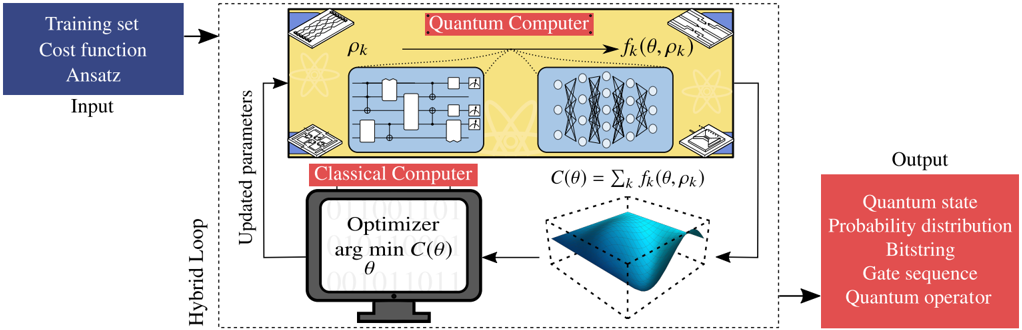
Applications such as simulating complicated quantum systems or solving large-scale linear algebra problems are very challenging for classical computers, owing to the extremely high computational cost. Quantum computers promise a solution, although fault-tolerant quantum computers will probably not be available in the near future. Current quantum devices have serious constraints, including limited numbers of qubits and noise processes that limit circuit depth. Variational quantum algorithms (VQAs), which use a classical optimizer to train a parameterized quantum circuit, have emerged as a leading strategy to address these constraints. VQAs have now been proposed for essentially all applications that researchers have envisaged for quantum computers, and they appear to be the best hope for obtaining quantum advantage. Nevertheless, challenges remain, including the trainability, accuracy and efficiency of VQAs. Here we overview the field of VQAs, discuss strategies to overcome their challenges and highlight the exciting prospects for using them to obtain quantum advantage. The advent of commercial quantum devices has ushered in the era of near-term quantum computing. Variational quantum algorithms are promising candidates to make use of these devices for achieving a practical quantum advantage over classical computers. Variational quantum algorithms (VQAs) are the leading proposal for achieving quantum advantage using near-term quantum computers. VQAs have been developed for a wide range of applications, including finding ground states of molecules, simulating dynamics of quantum systems and solving linear systems of equations. VQAs share a common structure, where a task is encoded into a parameterized cost function that is evaluated using a quantum computer, and a classical optimizer trains the parameters in the VQA. The adaptive nature of VQAs is well suited to handle the constraints of near-term quantum computers. Trainability, accuracy and efficiency are three challenges that arise when applying VQAs to large-scale applications, and strategies are currently being developed to address these challenges. Variational quantum algorithms (VQAs) are the leading proposal for achieving quantum advantage using near-term quantum computers. VQAs have been developed for a wide range of applications, including finding ground states of molecules, simulating dynamics of quantum systems and solving linear systems of equations. VQAs share a common structure, where a task is encoded into a parameterized cost function that is evaluated using a quantum computer, and a classical optimizer trains the parameters in the VQA. The adaptive nature of VQAs is well suited to handle the constraints of near-term quantum computers. Trainability, accuracy and efficiency are three challenges that arise when applying VQAs to large-scale applications, and strategies are currently being developed to address these challenges.
Overview
CoChat Summary
TL;DR
Variational quantum algorithms (VQAs) train parametrized quantum circuits with a classical optimizer and are presented as the leading strategy for obtaining quantum advantage on noisy intermediate-scale quantum (NISQ) devices. The review surveys VQA components, applications, challenges, and prospects, emphasizing that trainability, accuracy, and efficiency remain central obstacles.
Key findings
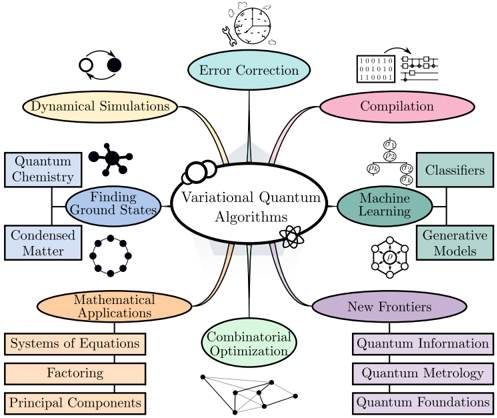
- VQAs have been proposed for essentially all applications envisioned for quantum computers, including finding ground and excited states, dynamical quantum simulation, combinatorial optimization, linear systems, compiling, error correction, machine learning, and metrology.
- Current state-of-the-art device size ranges from 50 to 100 qubits, and VQAs are argued to be the best hope for near-term quantum advantage because they keep circuit depth shallow and outsource parameter optimization to classical optimizers.
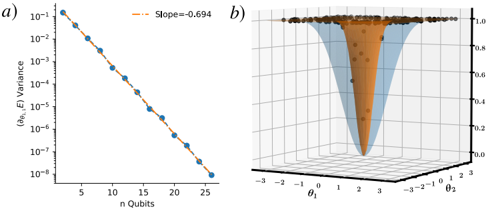
- Trainability is threatened by barren plateaus, where cost-function partial derivatives vanish exponentially with system size on average; noise can also induce barren plateaus regardless of the ansatz.
- Resource and scaling examples reported include: VQE requires \(O(1/\epsilon^2)\) measurements for precision \(\epsilon\), whereas quantum phase estimation requires \(O(\log(1/\epsilon))\); chemical Hamiltonians have Pauli-string counts scaling as \(n^4\), with commuting groupings reducing measurement scaling to \(n^3\); classical shadows scale logarithmically with \(n\); and a variational quantum linear solver study used \(n=10,\ldots,30\) qubits for Ising-inspired systems and \(n=2,\ldots,7\) qubits for random sparse linear systems.
Methods
- Design: narrative review/overview of the VQA field, not a primary experimental or theoretical study.
- Data or sample: no primary data or sample; the paper synthesizes prior literature and cites numerical and experimental results from other works.
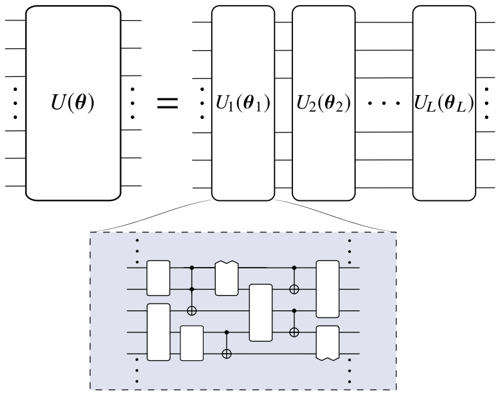
- Main analysis: conceptual description of VQA architecture (cost function, ansatz, gradients, optimizers), applications, challenges, and opportunities for near-term quantum advantage.
Limitations
- The paper states that challenges remain including the trainability, accuracy, and efficiency of VQAs, and that barren plateaus could erase a potential quantum advantage.
- The paper states that the degree to which error mitigation can correct noise effects is still an open question, and that measurement efficiency is not guaranteed even without barren plateaus.
- Evident from the text: as a review, it presents no new experimental results, and many performance claims rely on cited heuristic or numerical studies rather than a systematic meta-analysis.
Model-written summary. Check it against the paper before relying on it.
Integrity signals
Registry
Cites
Statistics
Figures
Verification
Claims the paper makes
53 Valid · 75 Not valid · 50 Not checked · 84 Own results and interpretations
At least one cited source doesn’t support this claim or points to a different paper, and none confirmed it — see the verdicts below.
In the paper
“Hence, a VQA for factoring as a potential near-term alternative was introduced in Ref. [145].”
What the sources say
- Disputedcites [145] LaRose, R., Tikku, A., O’Neel-Judy, É., Cincio, L. & Coles, P. J. Variational quantum state diagonalization. NPJ Quantum Inf. 5, 57 (2019). sourceExperimental — accuracy not yet measured
The Introduction says factoring is typically a longer-term application because of its high resource requirements, while identifying other applications as nearer term. The paper introduces variational quantum state diagonalization, not a variational algorithm for factoring. (LLM, conf=0.88)
Checked by a reasoning model — may be wrong.
plain- Asserted: passes — The authors put it forward as true.
- Checkable: passes — It can be checked against evidence.
- Load-bearing: unclear — It is unclear whether the paper’s conclusions depend on it.
- Based: passes — The paper gives a reason why it holds.
- Disputed
At least one cited source doesn’t support this claim or points to a different paper, and none confirmed it — see the verdicts below.
In the paper
“This qubit requirement can be reduced with the VQA of Ref. [113], which requires only n qubits.”
What the sources say
- Disputedcites [113] Wang, D., Higgott, O. & Brierley, S. Accelerated variational quantum eigensolver. Phys. Rev. Lett. 122, 140504 (2019). sourceExperimental — accuracy not yet measured
Section II B (p. 3) describes an (n+1)-qubit controlled sign flip in the proposed algorithm and says its cited implementation requires additional ancillas. That contradicts the claim that this VQA requires only n qubits; the paper discusses reductions in measurements and circuit depth, not a reduction to n qubits. (LLM, conf=0.84)
Checked by a reasoning model — may be wrong.
plainstates a cause- Asserted: passes — The authors put it forward as true.
- Checkable: passes — It can be checked against evidence.
- Load-bearing: unclear — It is unclear whether the paper’s conclusions depend on it.
- Based: passes — The paper gives a reason why it holds.
- Disputed
The cited sources that could be checked couldn’t confirm or dispute this claim.
In the paper
“The classical optimization problems associated with VQAs are expected to be NP-hard in general as they involve cost functions that can have many local minima [94].”
What the sources say
- Could not verifycites [94] Schuld, M., Bergholm, V., Gogolin, C., Izaac, J. & Killoran, N. Evaluating analytic gradients on quantum hardware. Phys. Rev. A 99, 032331 (2019). sourceExperimental — accuracy not yet measured
The Introduction (p. 1) describes hybrid quantum-classical cost functions and the need for gradients, but does not address the complexity of optimizing them. Searches for “NP-hard,” “local minima,” and related terms found no passage saying that VQA optimization is generally NP-hard or attributing that difficulty to many local minima. (LLM, conf=0.74)
hedgedstates a cause- Asserted: passes — The authors put it forward as true.
- Checkable: passes — It can be checked against evidence.
- Load-bearing: unclear — It is unclear whether the paper’s conclusions depend on it.
- Based: passes — The paper gives a reason why it holds.
- Could not verify
The cited sources that could be checked couldn’t confirm or dispute this claim.
In the paper
“Numerical simulations showed that QVECTOR can find quantum codes that outperform existing ones [152].”
What the sources say
- Could not verifycites [152] Biamonte, J. et al. Quantum machine learning. Nature 549, 195–202 (2017). sourceExperimental — accuracy not yet measured
The closest discussion in our copy, “Designing and controlling quantum systems” (p. 12), concerns machine-learning methods for improving quantum gates, not finding quantum codes. Searches for QVECTOR and for simulations of codes outperforming existing ones found no passage addressing the claim. (LLM, conf=0.76)
plainstates a cause- Asserted: passes — The authors put it forward as true.
- Checkable: passes — It can be checked against evidence.
- Load-bearing: passes — The paper’s conclusions depend on it.
- Based: passes — The paper gives a reason why it holds.
- Could not verify
The cited sources that could be checked couldn’t confirm or dispute this claim.
In the paper
“The importance of parameter initialization was made clear in Ref. [204] where it was noted that the optimal parameters in QAOA exhibit persistent patterns.”
What the sources say
- Could not verifycites [204] Volkoff, T. & Coles, P. J. Large gradients via correlation in random parameterized quantum circuits. Quantum Sci. Technol. 6, 025008 (2021). sourceExperimental — accuracy not yet measured
Appendix C (page unavailable) studies QAOA with parameters constrained to be equal across layers and describes that approach as suboptimal for the ring-of-disagrees problem. The Introduction and Conclusions discuss parameter correlation and trainability, but the passages found do not say that optimal QAOA parameters exhibit persistent patterns (searched: optimal parameters, QAOA patterns, initialization). (LLM, conf=0.76)
boosted- Asserted: passes — The authors put it forward as true.
- Checkable: passes — It can be checked against evidence.
- Load-bearing: passes — The paper’s conclusions depend on it.
- Based: passes — The paper gives a reason why it holds.
- Could not verify
125 more claims · 57 with their cited sources checked
Create a free account to see all 262 claims and to verify the 13 references still open.
- Probably not a substantial claim. 94
- It may state two separate claims as one. 57
Claims other papers make about this one
Each is checked against this paper’s own text: does it say what the citing paper says it does?
The source backs part of the claim, not all of it — or backs it for a different population, condition or comparison.
In the citing paper
“Google's recent proof of quantum supremacy is a major step forward for quantum computing [15].”
From Quantum Computing: Vision and Challenges (2025) · cites this paper as [15]
Experimental — accuracy not yet measuredThe cited source says what the claim attributes to it.
In the citing paper
“An important class of algorithms for NISQ hardware are socalled hybrid quantum-classical algorithms that partition the computational workload between a classical and a quantum computer.[124,125]”
From Quantum Computing for Molecular Biology** (2023) · cites this paper as [125]
The cited source says what the claim attributes to it.
In the citing paper
“In this regard, References [164] and [171] focus on gate-based algorithms that can be implemented on NISQ devices and therefore may be applied to various application areas with CO just as one example of those.”
From Quantum Combinatorial Optimization in the NISQ Era: A Systematic Mapping Study (2024) · cites this paper as [171]
Self-check
Percentages, sums and reported differences re-computed from the paper’s own numbers.
Each contradiction between two passages listed here was confirmed by an independent check.
Rated minor: it would not touch a result — a value no result rests on, a p-value that stays on the same side of the significance level, or a conflict that is clerical, resolved elsewhere in the paper, or outside its own findings.
In the paper
§ E. Error correction · p. 12
“two parametrized circuits V ( θ 1 ) (on n ≥ k qubits) and W ( θ 2 ) (on n + r qubits)”
§ E. Error correction · p. 12
“ρ out = W ( θ 1 ) V ( θ 1 )( ψ ⊗ | 0 〉〈 0 | ⊗ n -k + r ) V ( θ 1 ) † W ( θ 1 ) †”
Rated minor: it would not touch a result — a value no result rests on, a p-value that stays on the same side of the significance level, or a conflict that is clerical, resolved elsewhere in the paper, or outside its own findings.
In the paper
§ 1. Linear systems · p. 11
“the task is to prepare a normalized state | x 〉 such that A | x 〉 ∝ | b 〉”
§ 1. Linear systems · p. 11
“one can then construct a Hamiltonian whose ground state is the solution to the QLSP and apply a variational approach to minimize the cost C ( θ ) = 〈 ψ ( θ ) | H G | ψ ( ψ ) 〉 . Refs. [139-141] considered the Hamiltonian H G = A ( ✶ -| b 〉 〈 b | ) A †”
Citations
Cites
Adam: A Method for Stochastic Optimization
Kingma, D. P., & Ba, J. (2014) · arXiv · doi:10.48550/arxiv.1412.6980 · Cited by 98,946
Self-Consistent Equations Including Exchange and Correlation Effects
Kohn, W., & Sham, L. J. (1965) · Physical Review · doi:10.1103/physrev.140.a1133 · Cited by 64,135
Quantum Computing in the NISQ era and beyond
Preskill, J. (2018) · Quantum · doi:10.22331/q-2018-08-06-79 · Cited by 8,830 · cited 1×
“But excitement grew as to what could be done with these new devices, which have been called Noisy Intermediate-Scale Quantum (NISQ) computers [7].”
BackgroundAlgorithms for quantum computation: discrete logarithms and factoring
Shor, P. W. (2002) · Proceedings 35th Annual Symposium on Foundations of Computer Science · doi:10.1109/sfcs.1994.365700 · Cited by 8,713
Quantum Computation and Quantum Information: 10th Anniversary Edition
Nielsen, M. A., & Chuang, I. L. (2012) · doi:10.1017/cbo9780511976667 · Cited by 8,436
Quantum supremacy using a programmable superconducting processor
Arute, F., Arya, K., Babbush, R., Bacon, D., Bardin, J. C., Barends, R., Biswas, R., Boixo, S., Brandao, F. G. S. L., Buell, D. A., et al. (2019) · Nature · doi:10.1038/s41586-019-1666-5 · Cited by 7,720 · cited 1×
“This size actually allows one to achieve quantum supremacy, outperforming the best classical supercomputer, for certain contrived mathematical tasks [8, 9].”
BackgroundSelf-citationDensity matrix formulation for quantum renormalization groups
White, S. R. (1992) · Physical Review Letters · doi:10.1103/physrevlett.69.2863 · Cited by 7,702
Biamonte, J., Wittek, P., Pancotti, N., Rebentrost, P., Wiebe, N., & Lloyd, S. (2017) · Nature · doi:10.1038/nature23474 · Cited by 4,779 · cited 1×
“to use quantum algorithms for machine learning applications [134, 148, 256, 257].”
MethodA variational eigenvalue solver on a photonic quantum processor
Peruzzo, A., McClean, J., Shadbolt, P., Yung, M.-H., Zhou, X.-Q., Love, P. J., Aspuru-Guzik, A., & O’Brien, J. L. (2014) · Nature Communications · doi:10.1038/ncomms5213 · Cited by 4,552 · cited 3×
“3, VQE is aimed at finding the ground state energy EG of a Hamiltonian H [16].”
BackgroundMethodSelf-citationQuantum Algorithm for Linear Systems of Equations
Harrow, A. W., Hassidim, A., & Lloyd, S. (2009) · Physical Review Letters · doi:10.1103/physrevlett.103.150502 · Cited by 3,325 · cited 2×
“The classical algorithmic complexity for this task scales polynomially in the dimension N , whereas the now-famous HHL quantum algorithm [4] has a complexity that scales logarithmically in N , with some scaling improvements having been proposed [113– 116].”
BackgroundMethod
Research works printed but not linked: 5
- IBM Makes Quantum Computing Available on IBM Cloud to Accelerate Innovation. Press release at https://www-03.ibm.com/press/us/en/pressrelease/49661.wss (2016).
- Rattew, A. G., Hu, S., Pistoia, M., Chen, R. & Wood, S. A domain-agnostic, noise-resistant, hardware-efficient evolutionary variational quantum eigensolver. Preprint at https://arxiv.org/abs/1910.09694 (2019). · arXiv
- Wang, G., Koh, D. E., Johnson, P. D. & Cao, Y. Minimizing estimation runtime on noisy quantum computers. Phys. Rev. X Quantum 2, 010346 (2021).
- Stoudenmire, E. & Schwab, D. J. Supervised learning with tensor networks. Adv. Neural Inf. Proc. Syst. 29, 4799–4807 (2016).
- Franken, L. & Georgiev, B. Explorations in quantum neural networks with intermediate measurements. In Proc. ESANN (2020); https://www.esann.org/sites/default/files/proceedings/2020/ES2020-197.pdf
Cited by
The Variational Quantum Eigensolver: A review of methods and best practices
Tilly, J., Chen, H., Cao, S., Picozzi, D., Setia, K., Li, Y., Grant, E., Wossnig, L., Rungger, I., Booth, G. H., et al. (2022) · Physics Reports · doi:10.1016/j.physrep.2022.08.003 · Cited by 1,031
Noise-induced barren plateaus in variational quantum algorithms
Wang, S., Fontana, E., Cerezo, M., Sharma, K., Sone, A., Cincio, L., & Coles, P. J. (2021) · Nature Communications · doi:10.1038/s41467-021-27045-6 · Cited by 773
“At the heart of this discussion are Variational Quantum Algorithms (VQAs), which are believed to be the best hope for near-term quantum advantage [2–4].”
BackgroundSelf-citationChallenges and opportunities in quantum machine learning
Cerezo, M., Verdon, G., Huang, H.-Y., Cincio, L., & Coles, P. J. (2022) · Nature Computational Science · doi:10.1038/s43588-022-00311-3 · Cited by 689
“These involve a sequence of unitary gates acting on the quantum data states | ψ j (cid:105) , some of which have free parameters θ that will be trained to solve the problem at hand [38].”
BackgroundSelf-citationPractical quantum advantage in quantum simulation
Daley, A. J., Bloch, I., Kokail, C., Flannigan, S., Pearson, N., Troyer, M., & Zoller, P. (2022) · Nature · doi:10.1038/s41586-022-04940-6 · Cited by 669
Ising machines as hardware solvers of combinatorial optimization problems
Mohseni, N., McMahon, P. L., & Byrnes, T. (2022) · Nature Reviews Physics · doi:10.1038/s42254-022-00440-8 · Cited by 543
“Hybrid Quantum-Classical Algorithms The aim of variational quantum algorithms 158 is to solve classical and quantum optimization problems by combining a parametrized quantum circuit with a classical optimizer to obtain the variational parameters.”
Method
Metadata
- Authors
- Cerezo, M., Arrasmith, A., Babbush, R., Benjamin, S. C., Endo, S., Fujii, K., McClean, J. R., Mitarai, K., Yuan, X., Cincio, L., & Coles, P. J.
- Affiliations
- Los Alamos National Laboratory (US)
- Google (United States) (US)
- University of Oxford (GB)
- NTT (Japan) (JP)
- RIKEN (JP)
- Japan Science and Technology Agency (JP)
- Peking University (CN)
- Corresponding author
- Cerezo, M.
- Coles, Patrick J.
- Venue
- Nature Reviews Physics
- Published
- 2021-08-12
- Volume
- 3
- Issue
- 9
- Pages
- 625-644
- ISSN
- 2522-5820 (ISSN-L)
- OpenAlex
- W3111162498
- Semantic Scholar
- c1cf657d1e13149ee575b5ca779e898938ada60a
- Cited by
- 3,385
- References
- 200
- Citations by year
- 2026: 874 · 2025: 896 · 2024: 699 · 2023: 521 · 2022: 317 · 2021: 78
- FWCI
- 29.21
- Type
- journal article
- Language
- en
- Open access
- green
- arxiv.org
- Licence
- www.springernature.com/gp/researchers/text-and-data-mining (tdm)
- www.springernature.com/gp/researchers/text-and-data-mining (vor)
- Locations
- Nature Reviews Physics (publishedVersion)
- arXiv (Cornell University) (publishedVersion)
- OSTI OAI (U.S. Department of Energy Office of Scientific and Technical Information) (submittedVersion, cc-by)
- arXiv (Cornell University)
- Funders
- U.S. Department of Energy (#89233218CNA000001, KA2401032, DE-AC52-06NA2-5396, AC52-06NA25396, 20190065DR)
- Ministry of Education, Culture, Sports, Science and Technology (JPMXS0118068682, JPMXS0118067394, JP-MXS0120319794, CREST)
- Office of Science (89233218CNA000001, KA2401032, DE-AC52-06NA25396)
- National Nuclear Security Administration (DEAC52- 06NA25396, 89233218C-NA000001)
- Horizon 2020 Framework Programme (820495)
- Engineering and Physical Sciences Research Council (820495, M013243/1, EP/T001062/1, EP/M013243/1, T001062, H2020)
- Japan Society for the Promotion of Science (JPMXS0118067394, 20K22330, JPMJER1601, JPMXS0120319794, CREST, 16H02211)
- Advanced Scientific Computing Research (DE-AC52-06NA25396, 89233218CNA000001)
- Laboratory Directed Research and Development (20200056DR, DE-AC52-06NA2-5396, 89233218CNA000001, 20190065DR, 20180628ECR)
- Core Research for Evolutional Science and Technology (JPMJCR1673)
- Precursory Research for Embryonic Science and Technology (JPMJPR2019)
- Exploratory Research for Advanced Technology (JPMJER1601)
- Los Alamos National Laboratory (20200056DR, 89233218CNA 000001, KA2401032, AC52-06NA25396, 20180628ECR, 20190065DR, DE-AC52-06NA25396)
- Topics
- Physical Sciences › Computer Science › Artificial Intelligence › Quantum Computing Algorithms and Architecture
- Physical Sciences › Physics and Astronomy › Atomic and Molecular Physics, and Optics › Quantum many-body systems
- Physical Sciences › Physics and Astronomy › Atomic and Molecular Physics, and Optics › Quantum Information and Cryptography
- Keywords
- variational quantum algorithms, variational quantum circuits, quantum advantage, near-term quantum computing, quantum chemistry simulation, quantum linear algebra, trainability, noisy quantum hardware, classical optimization
About these checks
Registry, retraction, Cites and statistics results are computed, not judged, with one exception: a printed reference that no index lists is read once by a model before it counts as a citation error. Claims are extracted by a model and kept only when their quote appears verbatim in the text; each cited source is then checked, with a model’s help, for whether it says what the claim relies on. Those verdicts can be wrong — read the claim’s quote and the cited source before relying on one.
The claim verdicts this report counts are experimental: their accuracy is not yet measured.
A language model drew the claims from the paper on 2026-10-10, under version 3 of the claim definition (model deepseek-v4.1-flash, prompt extract-v3).
A second model labelled each claim on 2026-10-10 (model jev-1.13-20260917, definition revision gold-guideline-v0.2).
Cited sources are checked with a language model’s help (gpt-6-sol).
Statistics and arithmetic are recomputed, not judged.
Confidence bands are shown only for fields calibrated on our annotated test set. None is calibrated yet, so no band is shown.
What counts as a claim ›How we measure confidence ›How we check this ›
Are you an author, or do you see a problem with this page? Request a review
How to cite
Cite CoChat for the checks on this page, and the paper for its own findings.
- This page
- CoChat. (2026). Citation check: Variational quantum algorithms. https://app.cochat.ai/papers/10.1038/s42254-021-00348-9
- The paper
- Cerezo, M., Arrasmith, A., Babbush, R., Benjamin, S. C., Endo, S., Fujii, K., McClean, J. R., Mitarai, K., Yuan, X., Cincio, L., & Coles, P. J. (2021). Variational quantum algorithms. Nature Reviews Physics. https://doi.org/10.1038/s42254-021-00348-9
Data sources
Bibliographic data: Semantic Scholar, OpenAlex, Crossref.
Contains information from the Semantic Scholar Academic Graph Datasets, made available under the ODC Attribution License (ODC-BY 1.0).
Semantic Scholar’s data is described in: Kinney, R., et al. (2023). The Semantic Scholar Open Data Platform. arXiv:2301.10140.
