

Teaching and Learning Science in Authoritative Classrooms: Teachers' Power and Students' Approval in Korean Elementary Classrooms
Open accessThe DOI matches its Crossref record; 82 of the 89 references it cites were found in a registry or an index; 3 of the 42 sources its claims cite were checked for support.
Abstract
This study aims to understand interactions in Korean elementary science classrooms, which are heavily influenced by Confucianism. Ethnographic observations of two elementary science teachers’ classrooms in Korea are provided. Their classes are fairly traditional teaching, which mean teacher-centered interactions are dominant. To understand the power and approval in science classroom discourse, we have adopted Critical Discourse Analysis (CDA). Based on CDA, form and function analysis was adopted. After the form and function analysis, all episodes were analyzed in terms of social distance . The results showed that both teachers exercised their power while teaching. However, their classes were quite different in terms of getting approval by students. When a teacher got students’ approval, he could conduct the science lesson more effectively. This study highlights the importance of getting approval by students in Korean science classrooms.
Verifying this paper
8 of 9 steps done · this page updates itself — you can leave and come back
- Registry recordVerified
- Full textRead the full text
- Reference list82 references found
- Reference checkChecking each cited work — 82 of 82
- StatisticsRecomputed
- Claims235 claims anchored to a quote
- Cited sourcesChecked
- Self-checkChecked
- VerificationFindings verified
Overview
CoChat Summary
TL;DR
This ethnographic Critical Discourse Analysis study examines power and approval in two Korean elementary science classrooms shaped by Confucianism. Both teachers exercised authority, but only Teacher A gained students’ approval, which helped him lead the lesson; Teacher B’s coercive control met student resistance and hindered teaching.
Key findings
- Both teachers exercised power, but their classes differed in getting approval. Teacher A controlled discourse through ignoring interruptions, controlling turn-taking, speech tempo, and pauses, yet gained approval through interesting materials, storytelling, and clear explanations; students described him as scary but able and continued participating. Teacher B forced participation, ignored students’ reasoning, and withdrew directions; students resisted through silence, ignoring, reluctant replies, and criticism, so he had trouble leading the class.
- Approval mattered for teaching: when Teacher A got students’ approval, he could conduct the science lesson more effectively; Teacher B had difficulties leading without students’ approval. The paper argues students’ approval of teachers is important in authoritative Korean science classrooms.
- The study involved two elementary science teachers in Seoul, each with 17 years of science teaching experience. Teacher A taught 6th grade science on volcanoes and rocks; Teacher B taught 5th grade science on weather forecasting. Before main data collection, the researchers videotaped 27 lessons of Teacher A and 24 lessons of Teacher B; main data consisted of six lessons from each teacher.
Methods
- Ethnographic observation: one researcher observed and videotaped science classes, took field notes, and interviewed teachers and students. Classes were transcribed and coded into four-digit turn-taking codes; nonverbal expressions such as silence, hesitating, being daunted, and ignoring were marked in round brackets.
- Participants and data: two elementary science teachers and their students in Seoul, Korea; Teacher A’s 6th grade volcanoes/rocks class and Teacher B’s 5th grade weather forecasting class; 27 + 24 preliminary lessons and six main lessons per teacher.
- Analysis: Critical Discourse Analysis (CDA), form and function analysis, then social distance analysis (close, neutral, distant) with plotting; triangulation was done through analyses by both researchers and by showing tentative results to participants and reflecting their opinions.
Limitations
- Stated limitations: Not stated in the paper; the paper does not include a limitations section.
- Evident limitation: the study is a small qualitative case study of two teachers and their elementary classes in Seoul, Korea, so findings are context-specific and not generalizable.
- Evident limitation: the analysis relies on selected episodes, researcher coding, and interviews; although triangulation was used, interpretations of power and approval remain qualitative.
Model-written summary. Check it against the paper before relying on it.
Integrity signals
Registry
Cites
Statistics
Figures
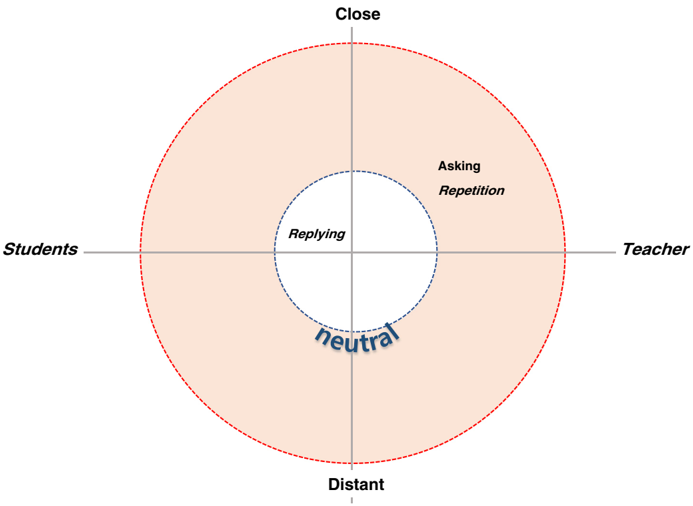
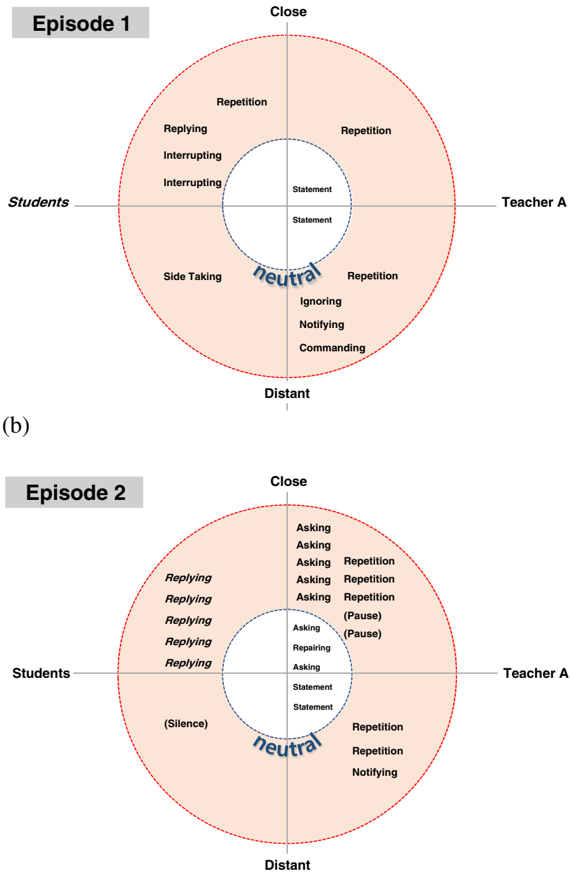
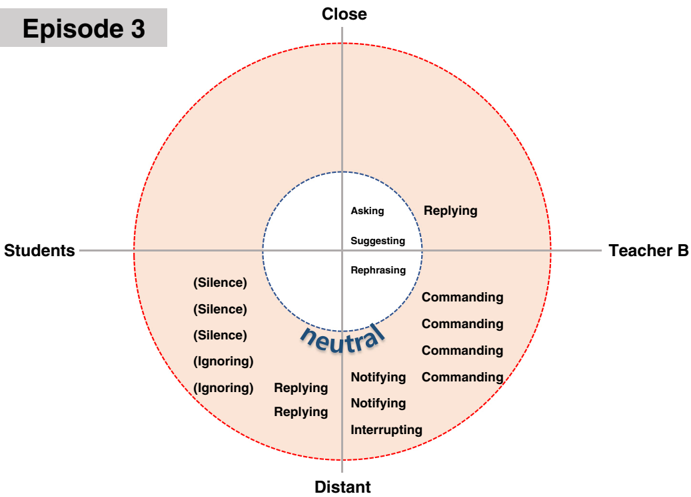
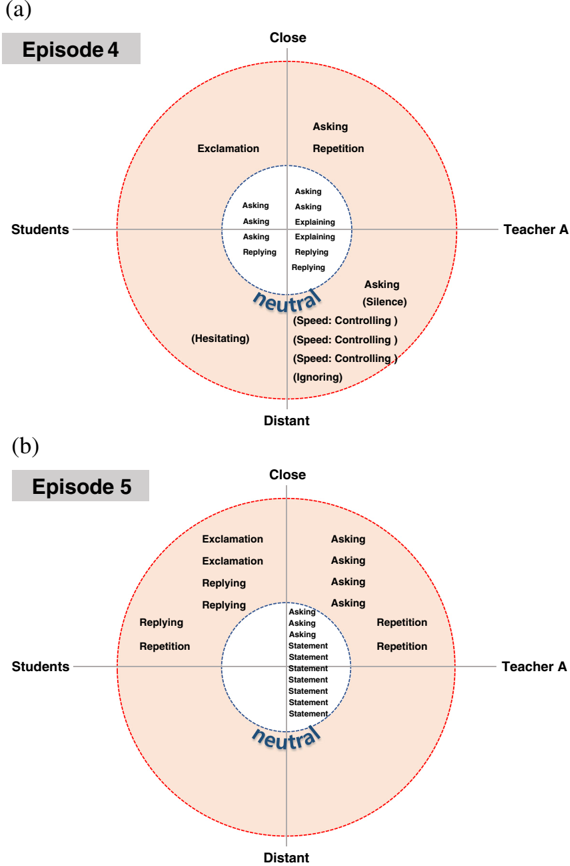
Verification
Claims the paper makes
3 Valid · 1 Not valid · 31 Not checked · 200 Own results and interpretations
Every source the paper cites for this claim was checked and supports it.
In the paper
“This situation is not typical in Confucianism-influenced classrooms (Chan and Chan 2005).”
§ The Author(s) 2017. This article is an open access publication > Obliging Students ' Participation and Open Notice of His Power: Teacher B ' s Episode
What the sources say
- Supportedcites Chan and Chan 2005 matched to “Chinese culture, social work education and research” (2005) source
Our copy sets out what is characteristic of Confucian-influenced Chinese teaching and learning: under 'The incompatibility of Chinese culture and scientific enquiry' ('Never criticize your teacher') the teacher-student hierarchy is defined by li, challenging a teacher's ideas is deemed impolite, and students 'respond to teachers with attention, silence and fear... do not question them or even challenge their judgements'; under 'The methods of Chinese teaching' ('Teaching moral standards rather than critical analysis') Confucian teaching stresses acting by a moral code and 'how' rather than 'why'. Together with 'The methods of Chinese learning' (memorizing, avoiding risk-taking, blind following of authority), these passages establish the normative classroom pattern, so a contrary situation is indeed presented as not typical of Confucianism-influenced classrooms. Note the paper frames these points for Chinese culture/teaching generally, citing Biggs (1996) and Bond (1991) for the classroom-behaviour data, while endorsing and relying on them as its own account. (LLM, conf=0.80)
plain- Asserted: passes — The authors put it forward as true.
- Checkable: passes — It can be checked against evidence.
- Load-bearing: unclear — It is unclear whether the paper’s conclusions depend on it.
- Based: passes — The paper gives a reason why it holds.
- Supported
The cited sources support only part of this claim — read each source’s verdict below.
In the paper
“Previous research about East Asian classrooms has suggested that teachers ' authority is highly valued in East Asia (Biggs 1996; Chan and Chan 2005; Li et al. 2007; Lee et al. 2009).”
§ The Author(s) 2017. This article is an open access publication > Introduction
What the sources say
- Not matchedcites Biggs 1996
An author–year citation the paper’s reference list doesn’t settle. We don’t search these by name.
- Supportedcites Chan and Chan 2005 matched to “Chinese culture, social work education and research” (2005) source
In 'The incompatibility of Chinese culture and scientific enquiry' our copy states plainly that 'A teacher's role is highly respected, as he or she owns knowledge and truth' and that 'Challenging a teacher's ideas is deemed to be impolite', with the teacher-student hierarchy defined by li (rites). The same section adds that 'Chinese culture is authority-oriented and hierarchically structured' and that 'Respect of and obedience to authorities and seniors are regarded as virtues', and 'The methods of Chinese learning' notes the 'overemphasis on respecting teachers'. This is a broad background statement carried jointly by several pooled citations, and the source clearly treats the topic that way for Chinese (Hong Kong) society, the East Asian case it examines; it does not survey other East Asian countries, but the substance attributed — high valuation of teachers' authority — is stated. (LLM, conf=0.82)
- Not matchedcites Li et al. 2007
This doesn’t read as a citation we can look up.
hedged- Asserted: passes — The authors put it forward as true.
- Checkable: passes — It can be checked against evidence.
- Load-bearing: passes — The paper’s conclusions depend on it.
- Based: passes — The paper gives a reason why it holds.
- Not matched
The sources with a verdict support this claim; the rest weren’t checked yet, have no full text we could read, or their verdicts aren’t rated yet.
In the paper
“This shows a typical understanding of the roles of student and teacher in a Confucian culture (e.g. Bond 1991; Chan and Chan 2005; Li et al. 2007).”
§ The Author(s) 2017. This article is an open access publication > <Interview with Juno>
What the sources say
- Not checked — no full text of the sourcecites Bond 1991 matched to “Beyond the Chinese face” (1991)
- Supportedcites Chan and Chan 2005 matched to “Chinese culture, social work education and research” (2005) source
The section 'The incompatibility of Chinese culture and scientific enquiry' states the Confucian teacher–student role definition directly: 'The hierarchy of teacher and student is defined by li (rites)... A teacher's role is highly respected, as he or she owns knowledge and truth. Challenging a teacher's ideas is deemed to be impolite,' with students showing 'almost unquestioning acceptance' and treating disagreement as a personal attack. The same section ties this to Confucius explicitly (the Wu Lun / Five Cardinal Relations, hierarchical elder–junior ranking, obedience to seniors as a virtue), and 'The methods of Chinese teaching' adds the teacher's duty to reserve knowledge to maintain status within that hierarchy. The citing sentence is a paraphrase offered as an identification of a typical Confucian understanding of student and teacher roles, which our copy of Chan and Chan (2005) sets out at length. (LLM, conf=0.88)
- Not matchedcites Li et al. 2007
This doesn’t read as a citation we can look up.
plainSingle case- Asserted: passes — The authors put it forward as true.
- Checkable: passes — It can be checked against evidence.
- Load-bearing: passes — The paper’s conclusions depend on it.
- Based: passes — The paper gives a reason why it holds.
- Rests on an assumption not shown here.
A result the paper reports from its own data — it cites no other source for it, so there is none to check. The quote shows it is in the paper.
In the paper
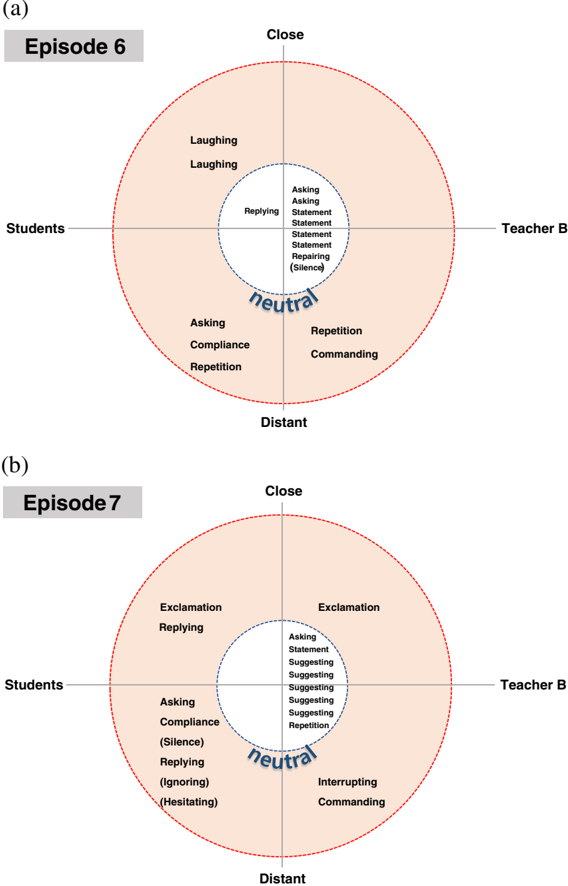
“Notable trait in terms of social distance between students and Teacher B was weighted toward the section Distant.”
§ The Author(s) 2017. This article is an open access publication > Obliging Students ' Participation and Open Notice of His Power: Teacher B ' s Episode
plainstates an associationSingle case- Asserted: passes — The authors put it forward as true.
- Checkable: passes — It can be checked against evidence.
- Load-bearing: unclear — It is unclear whether the paper’s conclusions depend on it.
- Based: passes — The paper gives a reason why it holds.
A result the paper reports from its own data — it cites no other source for it, so there is none to check. The quote shows it is in the paper.
In the paper
“This episode shows Teacher A stopping Eugene from participating.”
§ The Author(s) 2017. This article is an open access publication > Information Provider and Controlling Students ' Answers: Teacher A ' s Episode
plainstates a causeSingle case- Asserted: passes — The authors put it forward as true.
- Checkable: passes — It can be checked against evidence.
- Load-bearing: passes — The paper’s conclusions depend on it.
- Based: passes — The paper gives a reason why it holds.
113 more claims
Create a free account to see all 235 claims and to verify the 2 references still open.
- It may state two separate claims as one. 63
- Probably not a substantial claim. 71
Self-check
Percentages, sums and reported differences re-computed from the paper’s own numbers.
Each contradiction between two passages listed here was confirmed by an independent check.
Rated minor: it would not touch a result — a value no result rests on, a p-value that stays on the same side of the significance level, or a conflict that is clerical, resolved elsewhere in the paper, or outside its own findings.
In the paper
§ The Author(s) 2017. This article is an open access publication > Information Provider and Controlling Students ' Answers: Teacher A ' s Episode
“| 3566 | Ss | (with diffidence) Nooooo … | Replying | Informing | N |”
§ The Author(s) 2017. This article is an open access publication > Information Provider and Controlling Students ' Answers: Teacher A ' s Episode
“| 3566 | Juno | (with diffidence) Nooooo … | Replying | Joining the discourse | C |”
Citations
Cites
(1990) · Cited by 24,217
(1980) · Cited by 22,286
Qualitative evaluation and research methods
Ellis, D. (1990) · International Journal of Information Management · doi:10.1016/0268-4012(90)90041-p · Cited by 17,943
Qualitative Analysis for Social Scientists
Strauss, A. L. (1987) · doi:10.1017/cbo9780511557842 · Cited by 12,277 · cited 1×
“This collaborative analysis reduced the influence of bias and subjectivity and improved the validity of our analysis and the interpretation of results (Patton 1990; Strauss 1987).”
MethodHandbook of research on teaching
Wittrock, M. C. (1986) · Bibliothèque et Archives nationales du Québec (Québec government) · Cited by 10,625
Introduction to Functional Grammar
Matthiessen, C., & Halliday, M. A. K. (1989) · Language · doi:10.2307/414947 · Cited by 9,880
An Introduction to Functional Grammar
Halliday, M. A. K., Matthiessen, C. M. I. M., Halliday, M., & Matthiessen, C. (2014) · doi:10.4324/9780203783771 · Cited by 9,662
(1990) · Cited by 8,425
An Introduction to Discourse Analysis: Theory and Method
Gee, J. P. (1999) · Cited by 6,820
Analysing Discourse: Textual Analysis for Social Research
Fairclough, N. L. (2003) · Cited by 6,470
Research works printed but not linked: 6
- Ferguson, M. R. (2001). Teaching and learning inside the Korean culture. International Educator, 10 (2), 16 -23.
- Foucault, M. (1972). The archeology of knowledge and the discourse on language . New York: Pantheon Books.
- Hodge, R., & Kress, G. (1991). Social semiotics . Cambridge: Polity Press; Ithaca: Ithaca, Cornell University Press. Hong, J., & Engeström, Y. (2004). Changing principles of communication between Chinese managers and workers. Management Communication Quarterly, 17 , 552 -585.
- Kim, Y. (2005). The stories of four schools . Seoul: Mooneumsa.
- Leu, Y-C. & Wu, C-J. (2005). Investigation on an elementary teacher ' s mathematics pedagogical values through her approach to students ' errors. Proceedings of the 29th Conference of the International Group for Psychology of Mathematics Education. V ol. 3 (pp. 249 -256). Melbourne: University of Melbourne.
- Park, K. (2005). Mencius ( 孟子 ) . Seoul: HongIk.
Cited by
Alahmari, M., Jdaitawi, M. T., Rasheed, A., Abduljawad, R. M., Hussein, E. T., Alzahrani, M. A., & Awad, N. (2023) · Contemporary Educational Technology · doi:10.30935/cedtech/13177 · Cited by 76
Education for Sustainability Meets Confucianism in Science Education
Li, B., Sjöström, J., Ding, B., & Eilks, I. (2022) · Science & Education · doi:10.1007/s11191-022-00349-9 · Cited by 53
Bae, C. L. L., Mills, D., Fa, Z., Sealy, M., Cabrera, L., & Sea, M. (2021) · Review of Educational Research · doi:10.3102/00346543211042415 · Cited by 40
Khoza, H. C., & Msimanga, A. (2021) · Research in Science Education · doi:10.1007/s11165-021-10024-8 · Cited by 30
Examining Science Teacher Reflections on Argument-Based Inquiry Through a Critical Discourse Lens
Quarderer, N. A., & McDermott, M. A. (2018) · Research in Science Education · doi:10.1007/s11165-018-9790-z · Cited by 19
Metadata
- Authors
- Lee, J.-A., & Kim, C.-J.
- Affiliations
- Seoul National University (KR)
- Corresponding author
- Kim, Chan-Jong
- Venue
- Research in Science Education
- Published
- 2017-09-05
- Volume
- 49
- Issue
- 5
- Pages
- 1367-1393
- ISSN
- 0157-244X (ISSN-L)
- 1573-1898
- OpenAlex
- W2752390134
- Cited by
- 27
- References
- 89
- Citations by year
- 2026: 3 · 2025: 2 · 2024: 2 · 2023: 6 · 2022: 6 · 2021: 4 · 2020: 2 · 2019: 1 · 2018: 1
- FWCI
- 3.90
- Type
- journal article
- Language
- en
- Open access
- hybrid
- doi.org
- Licence
- cc-by
- creativecommons.org/licenses/by/4.0 (tdm)
- Locations
- Research in Science Education (publishedVersion, cc-by)
- Topics
- Social Sciences › Education › Science Education and Pedagogy
- Social Sciences › Linguistics and Language › Discourse Analysis in Language Studies
- Social Sciences › Arts and Humanities › Language and Linguistics › Language, Discourse, Communication Strategies
- Keywords
- science education, teacher authority, classroom discourse, Confucianism, teacher-centered instruction, social distance, Korean elementary education, teacher-student relationship
About these checks
Registry, retraction, Cites and statistics results are computed, not judged, with one exception: a printed reference that no index lists is read once by a model before it counts as a citation error. Claims are extracted by a model and kept only when their quote appears verbatim in the text; each cited source is then checked, with a model’s help, for whether it says what the claim relies on. Those verdicts can be wrong — read the claim’s quote and the cited source before relying on one.
A language model drew the claims from the paper on 2026-10-10, under version 3 of the claim definition (model deepseek-v4.1-flash, prompt extract-v3).
A second model labelled each claim on 2026-10-10 (model jev-1.13-20260917, definition revision gold-guideline-v0.2).
Cited sources are checked with a language model’s help (qwen3.8-omni-flash).
Statistics and arithmetic are recomputed, not judged.
Confidence bands are shown only for fields calibrated on our annotated test set. None is calibrated yet, so no band is shown.
What counts as a claim ›How we measure confidence ›How we check this ›
Are you an author, or do you see a problem with this page? Request a review
Data sources
Bibliographic data: Semantic Scholar, OpenAlex, Crossref.
Contains information from the Semantic Scholar Academic Graph Datasets, made available under the ODC Attribution License (ODC-BY 1.0).
Semantic Scholar’s data is described in: Kinney, R., et al. (2023). The Semantic Scholar Open Data Platform. arXiv:2301.10140.
