

The rate of growth in scientific publication and the decline in coverage provided by Science Citation Index
Open accessThe DOI matches its Crossref record; 47 of the 48 references it cites were found in a registry or an index.
Abstract
The growth rate of scientific publication has been studied from 1907 to 2007 using available data from a number of literature databases, including Science Citation Index (SCI) and Social Sciences Citation Index (SSCI). Traditional scientific publishing, that is publication in peer-reviewed journals, is still increasing although there are big differences between fields. There are no indications that the growth rate has decreased in the last 50 years. At the same time publication using new channels, for example conference proceedings, open archives and home pages, is growing fast. The growth rate for SCI up to 2007 is smaller than for comparable databases. This means that SCI was covering a decreasing part of the traditional scientific literature. There are also clear indications that the coverage by SCI is especially low in some of the scientific areas with the highest growth rate, including computer science and engineering sciences. The role of conference proceedings, open access archives and publications published on the net is increasing, especially in scientific fields with high growth rates, but this has only partially been reflected in the databases. The new publication channels challenge the use of the big databases in measurements of scientific productivity or output and of the growth rate of science. Because of the declining coverage and this challenge it is problematic that SCI has been used and is used as the dominant source for science indicators based on publication and citation numbers. The limited data available for social sciences show that the growth rate in SSCI was remarkably low and indicate that the coverage by SSCI was declining over time. National Science Indicators from Thomson Reuters is based solely on SCI, SSCI and Arts and Humanities Citation Index (AHCI). Therefore the declining coverage of the citation databases problematizes the use of this source.
Overview
The claims and statistics of this paper haven’t been checked yet.
Free: it reads the open-access text and checks the first 5 claims that cite a source we can check. Create a free account to check every claim.
Integrity signals
Registry
Cites
Statistics
Figures
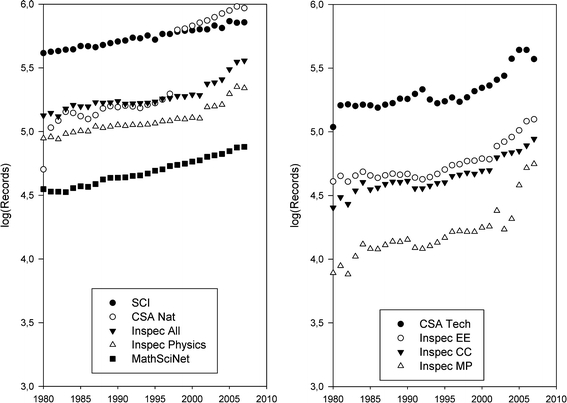
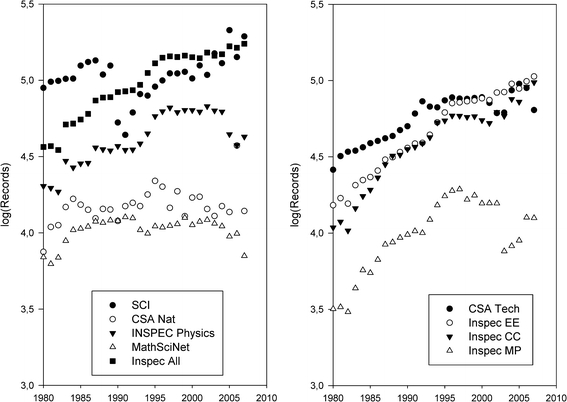
Verification
Claims the paper makes
The claims and statistics of this paper haven’t been checked yet.
Free: it reads the open-access text and checks the first 5 claims that cite a source we can check. Create a free account to check every claim.
Claims other papers make about this one
Each is checked against this paper’s own text: does it say what the citing paper says it does?
The cited source says what the claim attributes to it.
In the citing paper
“The rate at which new papers are added to the scientific literature has steadily increased in recent decades [28,29].”
From The natural selection of bad science (2016) · cites this paper as [28]
Self-check
Percentages, sums and reported differences re-computed from the paper’s own numbers.
The self-check needs the paper’s full text.
Citations
Cites
An index to quantify an individual’s scientific research output
Hirsch, J. E. (2005) · Proceedings of the National Academy of Sciences · doi:10.1073/pnas.0507655102 · Cited by 11,669 · cited 1×
“The Hirsch Index (Hirsch 2005) is one example of a science indicator derived from SCI.”
BackgroundThe Matthew Effect in Science: The reward and communication systems of science are considered.
Merton, R. K. (1968) · Science · doi:10.1126/science.159.3810.56 · Cited by 6,720 · cited 2×
“This conclusion is supported with a reference to Bradford’s Law (Bradford 1950; Garfield 1972, 1979), a bibliometric version of the Pareto Law, often called the Matthew Principle: ‘to him that hath shall be given’ ( Merton 1968, 1988 ).”
(1968) · PubMed · Cited by 4,803
Price, D. J. D. S. (1963) · Columbia University Press eBooks · doi:10.7312/pric91844 · Cited by 4,264 · cited 1×
“…interest of about 7% per annum, thus doubling in size every 10–15 years, growing by a factor of 10 every half century, and by something like a factor of a million in the 300 years which separate us from the seventeenth-century invention of the scientific paper when the process began’’ (Price 1965).”
BackgroundScience and Engineering Indicators
Washington, E., & Warren, M. E. (2004) · Cited by 2,822
Garfield, E. (1972) · Science · doi:10.1126/science.178.4060.471 · Cited by 2,788
Citation Indexing-Its Theory and Application in Science, Technology, and Humanities
Goodwin, J., & Garfield, E. (1980) · Technology and Culture · doi:10.2307/3104125 · Cited by 1,639
Science and Engineering Indicators
Bond, J. S., Humphrey, D. C., Paton, K. L., Hightower, A. M., Suter, L. E., Johnson, J. M., Pollak, M., Jankowski, J. E., Lehming, R., Rausch, L. M., et al. (1993) · Defense Technical Information Center (DTIC) · Cited by 1,631
The Matthew Effect in Science, II: Cumulative Advantage and the Symbolism of Intellectual Property
Merton, R. K. (1988) · Isis · doi:10.1086/354848 · Cited by 1,397 · cited 2×
“This conclusion is supported with a reference to Bradford’s Law (Bradford 1950; Garfield 1972, 1979), a bibliometric version of the Pareto Law, often called the Matthew Principle: ‘to him that hath shall be given’ ( Merton 1968, 1988 ).”
MethodMeho, L. I., & Yang, K. (2007) · Journal of the American Society for Information Science and Technology · doi:10.1002/asi.20677 · Cited by 974 · cited 5×
“…than by using the two other sources and also that there is only a limited overlap between the citations found through Google Scholar and those found using the Web of Science (Meho 2006; Meho and Yang 2007; Bar-Ilan 2008; Kousha and Thelwall 2008; Vaughan and Shaw 2008, and references therein).”
BackgroundMethodInfluentialProblems of citation analysis: A critical review
MacRoberts, M. H., & MacRoberts, B. R. (1989) · Journal of the American Society for Information Science · doi:10.1002/(sici)1097-4571(198909)40:5<342::aid-asi7>3.0.co;2-u · Cited by 803 · cited 2×
“As an example, MacRoberts and MacRoberts (1989) noted that SCI and SSCI covered about 10% of the scientific literature.”
BackgroundWhich h-index? — A comparison of WoS, Scopus and Google Scholar
Bar-Ilan, J. (2008) · Scientometrics · doi:10.1007/s11192-008-0216-y · Cited by 728 · cited 2×
“The use of Google Scholar as a citation source involves many problems (Meho 2006; Bar-Ilan 2008).”
MethodThe Scientific Wealth of Nations
May, R. M. (1997) · Science · doi:10.1126/science.275.5301.793 · Cited by 595 · cited 2×
“A publication by May (1997) with a high impact can serve as an example of the problems.”
BackgroundThe Access/Impact Problem and the Green and Gold Roads to Open Access
Harnad, S. R., Brody, T., Vallières, F., Carr, L. A., Hitchcock, S., Gingras, Y., Oppenheim, C., Stamerjohanns, H., & Hilf, E. R. (2004) · Serials Review · doi:10.1016/j.serrev.2004.09.013 · Cited by 529 · cited 1×
“Harnad et al. (2004) stated with reference to Ulrich that about 24,000 peer-reviewed research journals existed worldwide.”
Background(1952) · Physics Today · doi:10.1063/1.3067448 · Cited by 445
de Solla Price, D. J., & Page, T. (1961) · American Journal of Physics · doi:10.1119/1.1937650 · Cited by 444
Van Leeuwen, T. N., Moed, H. F., Tijssen, R. J. W., Visser, M. S., & Van Raan, A. F. J. (2001) · Scientometrics · doi:10.1023/a:1010549719484 · Cited by 430 · cited 1×
“Thorough studies of the problems inherent in the choice of journals covered by SCI have been reported (van Leuwen et al. 2001; Zitt et al. 2003).”
BackgroundThe rise and rise of citation analysis
Meho, L. I. (2007) · Physics World · doi:10.1088/2058-7058/20/1/33 · Cited by 371
Public Knowledge: An essay Concerning the Social Dimension of Science
Ziman, J. M., & Crane, D. (1969) · Physics Today · doi:10.1063/1.3035233 · Cited by 228
Public Knowledge: An Essay concerning the Social Dimension of Science
Ziman, J. M. (1969) · CERN Document Server (European Organization for Nuclear Research) · Cited by 190
The growth and number of journals
Mabe, M. (2003) · Serials: The Journal for the Serials Community · doi:10.1629/16191 · Cited by 179 · cited 2×
“According to Mabe (2003) the ISI journal set represents about 95% of all journal citations found in the ISI database.”
BackgroundKousha, K., & Thelwall, M. (2008) · Scientometrics · doi:10.1007/s11192-008-0217-x · Cited by 172 · cited 2×
“…than by using the two other sources and also that there is only a limited overlap between the citations found through Google Scholar and those found using the Web of Science (Meho 2006; Meho and Yang 2007; Bar-Ilan 2008; Kousha and Thelwall 2008; Vaughan and Shaw 2008, and references therein).”
BackgroundMethodA bibliometric overview of public health research in Europe
Clarke, A., Gatineau, M., Grimaud, O., Royer-Devaux, S., Roberts, N. W., Lebis, I., & Lewison, G. (2007) · European Journal of Public Health · doi:10.1093/eurpub/ckm063 · Cited by 147 · cited 1×
“It is difficult to make firm estimates about how many non-English valuable publications were missed but it is a reasonable conjecture that the number is substantial (Clarke et al. 2007).”
BackgroundScience, technology and industry outlook 2000
Radošević, S. (2001) · Technovation · doi:10.1016/s0166-4972(01)00044-x · Cited by 142
An empirical study of scientific production: A cross country analysis, 1981–2002
Crespi, G., & Geuna, A. (2008) · Research Policy · doi:10.1016/j.respol.2007.12.007 · Cited by 142 · cited 3×
“Crespi and Geuna (2008) have discussed the output of scientific research and developed a model for relating the input into science to the output of science.”
BackgroundGrowth dynamics of scholarly and scientific journals
Mabe, M. A., & Amin, M. (2001) · Scientometrics · doi:10.1023/a:1010520913124 · Cited by 139 · cited 2×
“The question has been taken up by Mabe and Amin (2001).”
BackgroundInfluentialComparisons of results of publication counting using different methods
Gauffriau, M., Larsen, P. O., Maye, I., Roulin-Perriard, A., & von Ins, M. (2008) · Scientometrics · doi:10.1007/s11192-007-1934-2 · Cited by 118 · cited 1×
“However, the values obtained by whole-normalized counting for large data sets are close to those obtained by complete-normalized counting (Gauffriau et al. 2008).”
ResultSelf-citationScience, Technology and Innovation
(2020) · Springer eBooks · doi:10.1007/978-94-017-8905-9_300670 · Cited by 112
A new look at evidence of scholarly citation in citation indexes and from web sources
Vaughan, L. Q., & Shaw, D. (2007) · Scientometrics · doi:10.1007/s11192-008-0220-2 · Cited by 100 · cited 4×
“…than by using the two other sources and also that there is only a limited overlap between the citations found through Google Scholar and those found using the Web of Science (Meho 2006; Meho and Yang 2007; Bar-Ilan 2008; Kousha and Thelwall 2008; Vaughan and Shaw 2008, and references therein).”
BackgroundMethodInfluentialDr Jekyll and Dr Hyde: author‐reader asymmetries in scholarly publishing
Mabe, M. A., & Amin, M. (2002) · Aslib Proceedings · doi:10.1108/00012530210441692 · Cited by 96 · cited 3×
“Publications and citations constitute the scientific discourse (Ziman 1968; Mabe and Amin 2002; Crespi and Geuna 2008; Larsen et al. 2008).”
BackgroundPublication, cooperation and productivity measures in scientific research
Gauffriau, M., Larsen, P. O., Maye, I., Roulin-Perriard, A., & von Ins, M. (2007) · Scientometrics · doi:10.1007/s11192-007-1800-2 · Cited by 95 · cited 1×
“However, there are technical problems in counting publications (Gauffriau et al. 2007).”
BackgroundSelf-citationWeb of Science with the Conference Proceedings Citation Indexes: the case of computer science
Bar‐Ilan, J. (2010) · Scientometrics · doi:10.1007/s11192-009-0145-4 · Cited by 91 · cited 10×
“However, a special effort has been made recently to increase the coverage of computer science in SCI/SCIE, see ‘‘Conference contributions’’.”
BackgroundInfluentialThe Thomson Scientific journal selection process.
Testa, J. (2006) · PubMed · Cited by 88
Carpenter, M. P., & Narin, F. (1981) · Journal of the American Society for Information Science · doi:10.1002/asi.4630320606 · Cited by 81 · cited 1×
“…were about 43,000 scientific periodicals in the British Library Lending Division (BLLD) and that BLLD attempted exhaustive coverage of the world’s scientific literature with a stated policy of subscribing to any scientific periodical requested if it had scientific merit (Carpenter and Narin 1982).”
BackgroundZitt, M., Ramanana-Rahary, S., & Bassecoulard, E. (2003) · Scientometrics · doi:10.1023/a:1021923329277 · Cited by 78 · cited 6×
“As mentioned above, Zitt et al. (2003) have made a detailed study of the problems inherent in the choice of journals covered by SCI.”
BackgroundInfluentialAn index to quantify an individual's scientific outputPreprint
Hirsch, J. E. (2005) · arXiv (Cornell University) · Cited by 73
The Scientific Foundations of Science Policy
Price, D. J. D. S. (1965) · Nature · doi:10.1038/206233a0 · Cited by 65 · cited 1×
“…interest of about 7% per annum, thus doubling in size every 10–15 years, growing by a factor of 10 every half century, and by something like a factor of a million in the 300 years which separate us from the seventeenth-century invention of the scientific paper when the process began’’ (Price 1965).”
BackgroundIs Science A Case of Wasteful Competition?
van Dalen, H. P., & Klamer, A. (2005) · Kyklos · doi:10.1111/j.0023-5962.2005.00294.x · Cited by 54 · cited 1×
“On the other hand van Dalen and Klamer (2005) reported that according to Ulrich’s International Serials Database in 2004 about 250,000 journals were being published, of which 21,000 were refereed.”
BackgroundBenchmarking Google Scholar with the New Zealand PBRF research assessment exercise
Smith, A. G. (2007) · Scientometrics · doi:10.1007/s11192-008-0219-8 · Cited by 42 · cited 2×
“Smith (2008) has investigated the citations found in Google Scholar for universities in New Zealand.”
BackgroundAnalysis of Scifinder Scholar and Web of Science citation searches
Whitley, K. M. (2002) · Journal of the American Society for Information Science and Technology · doi:10.1002/asi.10192 · Cited by 42 · cited 2×
“Using WoS and SciFinder from Chemical Abstracts Service for a random sample of 15 chemists Whitley (2002) reported 3,234 citations in SciFinder, 2,913 in WoS.”
MethodICT assessment: Moving beyond journal outputs
Butler, L. (2007) · Scientometrics · doi:10.1007/s11192-008-0102-7 · Cited by 35 · cited 2×
“In a study of the publication activities of Australian universities Butler (2008) has calculated the coverage of WoS for all publications and for journal articles for publications from 1999 to 2001.”
BackgroundDo new SCI journals have a different national bias?
Shelton, R. D., Foland, P., & Gorelskyy, R. (2008) · Scientometrics · doi:10.1007/s11192-009-0423-1 · Cited by 22 · cited 3×
“From soon after the inception of SCI, it has been criticized for being biased toward papers in the English language and those from the United States (Shelton et al. 2009).”
BackgroundScientific Output and Impact: Relative Positions of China, Europe, India, Japan and the USA
Larsen, P. O., Maye, I., & von Ins, M. (2008) · Collnet Journal of Scientometrics and Information Management · doi:10.1080/09737766.2008.10700848 · Cited by 21 · cited 2×
“Publications and citations constitute the scientific discourse (Ziman 1968; Mabe and Amin 2002; Crespi and Geuna 2008; Larsen et al. 2008).”
BackgroundSelf-citationLarivière, V. (2005) · Cited by 17
A new input indicator for the assessment of science & technology research?
Vasconcelos, S. M. R., Sorenson, M. M., & Leta, J. (2009) · Scientometrics · doi:10.1007/s11192-008-2082-z · Cited by 12 · cited 1×
“In a recent study it is demonstrated that in Brazil the lack of skill in English is a significant barrier for publication in international journals and therefore for presence in WoS (Vasconselos et al. 2009).”
BackgroundThe Rise and Rise of Citation AnalysisPreprint
Meho, L. I. (2006) · arXiv (Cornell University) · doi:10.48550/arxiv.physics/0701012 · Cited by 4 · cited 2×
“The use of Google Scholar as a citation source involves many problems ( Meho 2006;”
MethodArchambault, É., Vignola‐Gagné, É., Côté, G., Larivière, V., & Gingras, Y. (2005) · Zenodo (CERN European Organization for Nuclear Research) · doi:10.5281/zenodo.10031267 · Cited by 4
Research works printed but not linked: 9
- Björk, B.-C., Roos, A., & Lauro, M. (2008). Global annual volume of peer reviewed scholarly articles and the share available via Open Access options. Proceedings ELPUB2008 Conference on Electronic Publishing. Toronto, Canada, June 2008, pp. 1–10. Retrieved December 9, 2008 from http://elpub.scix.net.
- Bradford SC Documentation, Washington DC, Public Affairs Office. See: Bradford, S.C. (1953) 1950 Documentation, London Crosby Lockwood & Sons
- Google. (2008). About Google Scholar, support for scholarly publishers. Retrieved November 19, 2008 from http://scholar.google.com.
- Larsen, P.O., & von Ins, M. (2009). The steady growth of scientific publication and the declining coverage provided by science citation index. In B. Larsen & J. Leta (Eds.), Proceedings of ISSI 2009—the 12th international conference of the international society for scientometrics and informetrics, Rio de Janeiro, Brazil (Vol. 2, pp. 597–606). Published by BIREME/PAHO/WHO and Federal University of Rio de Janeiro, 2009. ISSN 2175-1935.
- Reed Elsevier. (2008). Scopus. Retrieved November 19, 2008 from http://www.reed-elsevier.com.
- Testa, J. (2008b). Regional content expansion in web of science: Opening borders to exploration (pp. 1–3). Retrieved December 7, 2008 from http://www.thomsonreuters.com/business_units/scientific/free/essays/regionalcontent/.
- Thomson Reuters. (2008b). Conference proceedings citation index. Retrieved January 15, 2009 from http://www.thomsonreuters.com/products_services/scientific/Conf_Proceedings_Citation_Index.
- Thomson Reuters. (2009a). ISI web of knowledge, journal citation reports, science edition and social sciences edition. Retrieved February 1, 2009.
- Thomson Reuters. (2009b). ISI web of knowledge, journal citation reports, science edition and social sciences edition. Retrieved July 30, 2009.
Cited by
The role of google scholar in evidence reviews and its applicability to grey literature searching
Haddaway, N. R., Collins, A. M., Coughlin, D., & Kirk, S. (2015) · PLOS ONE · doi:10.1371/journal.pone.0138237 · Cited by 2,387
“com/journal-citation-reports/), and the volume of published scientific research is growing at an ever-increasing rate [1,2].”
BackgroundGusenbauer, M., & Haddaway, N. R. (2020) · Research Synthesis Methods · doi:10.1002/jrsm.1378 · Cited by 2,379
Green supply chain management: A review and bibliometric analysis
Fahimnia, B., Sarkis, J., & Davarzani, H. (2015) · International Journal of Production Economics · doi:10.1016/j.ijpe.2015.01.003 · Cited by 2,131
Bornmann, L., & Mutz, R. (2015) · Journal of the Association for Information Science and Technology · doi:10.1002/asi.23329 · Cited by 1,576
A review of the literature on citation impact indicators
Waltman, L. (2016) · Journal of Informetrics · doi:10.1016/j.joi.2016.02.007 · Cited by 1,356
Metadata
- Authors
- Larsen, P. O., & von Ins, M.
- Corresponding author
- Larsen, Peder Olesen
- Venue
- Scientometrics
- Published
- 2010-03-10
- Volume
- 84
- Issue
- 3
- Pages
- 575-603
- ISSN
- 0138-9130 (ISSN-L)
- 1588-2861
- PMC
- PMC2909426
- OpenAlex
- W2057954853
- Cited by
- 964
- References
- 48
- Citations by year
- 2026: 27 · 2025: 49 · 2024: 58 · 2023: 65 · 2022: 65 · 2021: 81 · 2020: 99 · 2019: 65 · 2018: 83 · 2017: 74 · 2016: 82 · 2015: 78 · 2014: 60 · 2013: 49 · 2012: 15
- FWCI
- 25.46
- Type
- journal article
- Language
- en
- Open access
- hybrid
- doi.org
- Licence
- cc-by-nc
- creativecommons.org/licenses/by-nc/2.0 (tdm)
- Locations
- Scientometrics (publishedVersion, cc-by-nc)
- PubMed Central (publishedVersion, cc-by-nc)
- PubMed (publishedVersion)
- RePEc: Research Papers in Economics (acceptedVersion)
- Funders
- Statens Serum Institut
- Topics
- Social Sciences › Library and Information Sciences › scientometrics and bibliometrics research
- Social Sciences › Library and Information Sciences › Library Science and Information
- Social Sciences › Psychology › Experimental and Cognitive Psychology › Psychology Research and Bibliometrics
- Keywords
- Science Citation Index, Social Science Citation Index, peer-reviewed journals, open access archives, science indicators, engineering sciences
About these checks
Registry, retraction, Cites and statistics results are computed, not judged, with one exception: a printed reference that no index lists is read once by a model before it counts as a citation error. Claims are extracted by a model and kept only when their quote appears verbatim in the text; each cited source is then checked, with a model’s help, for whether it says what the claim relies on. Those verdicts can be wrong — read the claim’s quote and the cited source before relying on one.
Statistics and arithmetic are recomputed, not judged.
Confidence bands are shown only for fields calibrated on our annotated test set. None is calibrated yet, so no band is shown.
What counts as a claim ›How we measure confidence ›How we check this ›
Are you an author, or do you see a problem with this page? Request a review
Data sources
Bibliographic data: Semantic Scholar, OpenAlex, Crossref.
Contains information from the Semantic Scholar Academic Graph Datasets, made available under the ODC Attribution License (ODC-BY 1.0).
Semantic Scholar’s data is described in: Kinney, R., et al. (2023). The Semantic Scholar Open Data Platform. arXiv:2301.10140.
