

The rate of growth in scientific publication and the decline in coverage provided by Science Citation Index
Open accessThe DOI matches its Crossref record; 47 of the 48 references it cites were found in a registry or an index.
Abstract
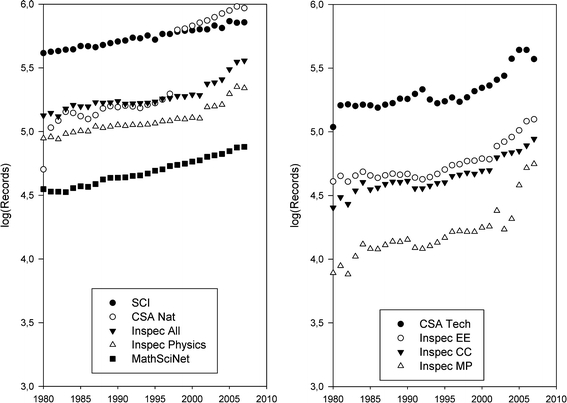
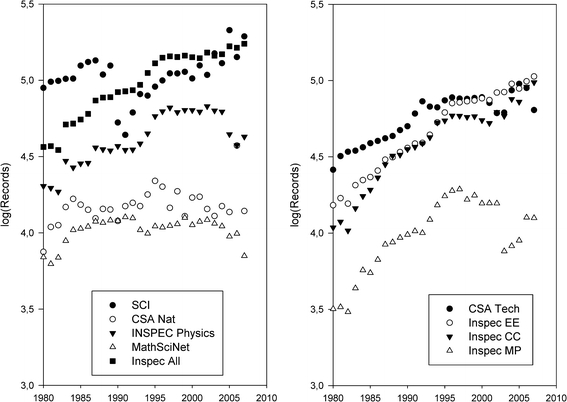
The growth rate of scientific publication has been studied from 1907 to 2007 using available data from a number of literature databases, including Science Citation Index (SCI) and Social Sciences Citation Index (SSCI). Traditional scientific publishing, that is publication in peer-reviewed journals, is still increasing although there are big differences between fields. There are no indications that the growth rate has decreased in the last 50 years. At the same time publication using new channels, for example conference proceedings, open archives and home pages, is growing fast. The growth rate for SCI up to 2007 is smaller than for comparable databases. This means that SCI was covering a decreasing part of the traditional scientific literature. There are also clear indications that the coverage by SCI is especially low in some of the scientific areas with the highest growth rate, including computer science and engineering sciences. The role of conference proceedings, open access archives and publications published on the net is increasing, especially in scientific fields with high growth rates, but this has only partially been reflected in the databases. The new publication channels challenge the use of the big databases in measurements of scientific productivity or output and of the growth rate of science. Because of the declining coverage and this challenge it is problematic that SCI has been used and is used as the dominant source for science indicators based on publication and citation numbers. The limited data available for social sciences show that the growth rate in SSCI was remarkably low and indicate that the coverage by SSCI was declining over time. National Science Indicators from Thomson Reuters is based solely on SCI, SSCI and Arts and Humanities Citation Index (AHCI). Therefore the declining coverage of the citation databases problematizes the use of this source.
Overview
The claims and statistics of this paper haven’t been checked yet.
Free: it reads the open-access text and checks the first 5 claims that cite a source we can check. Create a free account to check every claim.
Integrity signals
Registry
Cites
Statistics
Figures
Verification
Claims the paper makes
The claims and statistics of this paper haven’t been checked yet.
Free: it reads the open-access text and checks the first 5 claims that cite a source we can check. Create a free account to check every claim.
Claims other papers make about this one
Each is checked against this paper’s own text: does it say what the citing paper says it does?
The cited source says what the claim attributes to it.
In the citing paper
“The rate at which new papers are added to the scientific literature has steadily increased in recent decades [28,29].”
From The natural selection of bad science (2016) · cites this paper as [28]
Self-check
Percentages, sums and reported differences re-computed from the paper’s own numbers.
The self-check needs the paper’s full text.
Citations
Cites
An index to quantify an individual’s scientific research output
Hirsch, J. E. (2005) · Proceedings of the National Academy of Sciences · doi:10.1073/pnas.0507655102 · Cited by 11,669 · cited 1×
“The Hirsch Index (Hirsch 2005) is one example of a science indicator derived from SCI.”
BackgroundThe Matthew Effect in Science: The reward and communication systems of science are considered.
Merton, R. K. (1968) · Science · doi:10.1126/science.159.3810.56 · Cited by 6,720 · cited 2×
“This conclusion is supported with a reference to Bradford’s Law (Bradford 1950; Garfield 1972, 1979), a bibliometric version of the Pareto Law, often called the Matthew Principle: ‘to him that hath shall be given’ ( Merton 1968, 1988 ).”
(1968) · PubMed · Cited by 4,803
Price, D. J. D. S. (1963) · Columbia University Press eBooks · doi:10.7312/pric91844 · Cited by 4,264 · cited 1×
“…interest of about 7% per annum, thus doubling in size every 10–15 years, growing by a factor of 10 every half century, and by something like a factor of a million in the 300 years which separate us from the seventeenth-century invention of the scientific paper when the process began’’ (Price 1965).”
BackgroundScience and Engineering Indicators
Washington, E., & Warren, M. E. (2004) · Cited by 2,822
Garfield, E. (1972) · Science · doi:10.1126/science.178.4060.471 · Cited by 2,788
Citation Indexing-Its Theory and Application in Science, Technology, and Humanities
Goodwin, J., & Garfield, E. (1980) · Technology and Culture · doi:10.2307/3104125 · Cited by 1,639
Science and Engineering Indicators
Bond, J. S., Humphrey, D. C., Paton, K. L., Hightower, A. M., Suter, L. E., Johnson, J. M., Pollak, M., Jankowski, J. E., Lehming, R., Rausch, L. M., et al. (1993) · Defense Technical Information Center (DTIC) · Cited by 1,631
The Matthew Effect in Science, II: Cumulative Advantage and the Symbolism of Intellectual Property
Merton, R. K. (1988) · Isis · doi:10.1086/354848 · Cited by 1,397 · cited 2×
“This conclusion is supported with a reference to Bradford’s Law (Bradford 1950; Garfield 1972, 1979), a bibliometric version of the Pareto Law, often called the Matthew Principle: ‘to him that hath shall be given’ ( Merton 1968, 1988 ).”
MethodMeho, L. I., & Yang, K. (2007) · Journal of the American Society for Information Science and Technology · doi:10.1002/asi.20677 · Cited by 974 · cited 5×
“…than by using the two other sources and also that there is only a limited overlap between the citations found through Google Scholar and those found using the Web of Science (Meho 2006; Meho and Yang 2007; Bar-Ilan 2008; Kousha and Thelwall 2008; Vaughan and Shaw 2008, and references therein).”
BackgroundMethodInfluential
Research works printed but not linked: 9
- Björk, B.-C., Roos, A., & Lauro, M. (2008). Global annual volume of peer reviewed scholarly articles and the share available via Open Access options. Proceedings ELPUB2008 Conference on Electronic Publishing. Toronto, Canada, June 2008, pp. 1–10. Retrieved December 9, 2008 from http://elpub.scix.net.
- Bradford SC Documentation, Washington DC, Public Affairs Office. See: Bradford, S.C. (1953) 1950 Documentation, London Crosby Lockwood & Sons
- Google. (2008). About Google Scholar, support for scholarly publishers. Retrieved November 19, 2008 from http://scholar.google.com.
- Larsen, P.O., & von Ins, M. (2009). The steady growth of scientific publication and the declining coverage provided by science citation index. In B. Larsen & J. Leta (Eds.), Proceedings of ISSI 2009—the 12th international conference of the international society for scientometrics and informetrics, Rio de Janeiro, Brazil (Vol. 2, pp. 597–606). Published by BIREME/PAHO/WHO and Federal University of Rio de Janeiro, 2009. ISSN 2175-1935.
- Reed Elsevier. (2008). Scopus. Retrieved November 19, 2008 from http://www.reed-elsevier.com.
- Testa, J. (2008b). Regional content expansion in web of science: Opening borders to exploration (pp. 1–3). Retrieved December 7, 2008 from http://www.thomsonreuters.com/business_units/scientific/free/essays/regionalcontent/.
- Thomson Reuters. (2008b). Conference proceedings citation index. Retrieved January 15, 2009 from http://www.thomsonreuters.com/products_services/scientific/Conf_Proceedings_Citation_Index.
- Thomson Reuters. (2009a). ISI web of knowledge, journal citation reports, science edition and social sciences edition. Retrieved February 1, 2009.
- Thomson Reuters. (2009b). ISI web of knowledge, journal citation reports, science edition and social sciences edition. Retrieved July 30, 2009.
Cited by
The role of google scholar in evidence reviews and its applicability to grey literature searching
Haddaway, N. R., Collins, A. M., Coughlin, D., & Kirk, S. (2015) · PLOS ONE · doi:10.1371/journal.pone.0138237 · Cited by 2,387
“com/journal-citation-reports/), and the volume of published scientific research is growing at an ever-increasing rate [1,2].”
BackgroundGusenbauer, M., & Haddaway, N. R. (2020) · Research Synthesis Methods · doi:10.1002/jrsm.1378 · Cited by 2,379
Green supply chain management: A review and bibliometric analysis
Fahimnia, B., Sarkis, J., & Davarzani, H. (2015) · International Journal of Production Economics · doi:10.1016/j.ijpe.2015.01.003 · Cited by 2,131
Bornmann, L., & Mutz, R. (2015) · Journal of the Association for Information Science and Technology · doi:10.1002/asi.23329 · Cited by 1,576
A review of the literature on citation impact indicators
Waltman, L. (2016) · Journal of Informetrics · doi:10.1016/j.joi.2016.02.007 · Cited by 1,356
Negative results are disappearing from most disciplines and countries
Fanelli, D. (2012) · Scientometrics · doi:10.1007/s11192-011-0494-7 · Cited by 1,248
The natural selection of bad science
Smaldino, P. E., & McElreath, R. (2016) · Royal Society Open Science · doi:10.1098/rsos.160384 · Cited by 860
“The rate at which new papers are added to the scientific literature has steadily increased in recent decades [28,29].”
BackgroundEnhancing the Effectiveness of Team Science
(2015) · National Academies Press eBooks · doi:10.17226/19007 · Cited by 620
Røttingen, J.-A., Regmi, S., Eide, M., Young, A. J., Viergever, R. F., Årdal, C., Guzman, J., Edwards, D., Matlin, S. A., & Terry, R. F. (2013) · The Lancet · doi:10.1016/s0140-6736(13)61046-6 · Cited by 477
Making literature reviews more reliable through application of lessons from systematic reviews
Haddaway, N. R., Woodcock, P., Macura, B., & Collins, A. (2015) · Conservation Biology · doi:10.1111/cobi.12541 · Cited by 416
Full-Text or Abstract? Examining Topic Coherence Scores Using Latent Dirichlet Allocation
Syed, S., & Spruit, M. (2017) · 2017 IEEE International Conference on Data Science and Advanced Analytics (DSAA) · doi:10.1109/dsaa.2017.61 · Cited by 400
“There is an ever-growing amount of scientific literature with which scientists must grapple and which threatens to overwhelm their capacity to stay up to date with new research [1].”
BackgroundBig Data and supply chain management: A review and bibliometric analysis
Mishra, D., Gunasekaran, A., Papadopoulos, T., & Childe, S. J. (2018) · Annals of Operations Research · doi:10.1007/s10479-016-2236-y · Cited by 382
Supply chain management 1982–2015: a review
Asgari, N., Nikbakhsh, E., Hill, A., & Farahani, R. Z. (2016) · IMA Journal of Management Mathematics · doi:10.1093/imaman/dpw004 · Cited by 378
On scientific understanding with artificial intelligence
Krenn, M., Pollice, R., Guo, S. Y., Aldeghi, M., Cervera-Lierta, A., Friederich, P., dos Passos Gomes, G., Häse, F., Jinich, A., Nigam, A., et al. (2022) · Nature Reviews Physics · doi:10.1038/s42254-022-00518-3 · Cited by 372
“[70] Peder Larsen and Markus Von Ins, “The rate of”
BackgroundPractical guides for x-ray photoelectron spectroscopy: Quantitative XPS
Shard, A. G. (2020) · Journal of Vacuum Science & Technology A Vacuum Surfaces and Films · doi:10.1116/1.5141395 · Cited by 369
Teachers’ Instructional Adaptations: A Research Synthesis
Parsons, S. A., Vaughn, M., Scales, R. Q., Gallagher, M. A., Parsons, A. W., Davis, S. G., Pierczynski, M., & Allen, M. (2018) · Review of Educational Research · doi:10.3102/0034654317743198 · Cited by 351
The state of the art in biomimetics
Lepora, N. F., Verschure, P., & Prescott, T. J. (2013) · Bioinspiration & Biomimetics · doi:10.1088/1748-3182/8/1/013001 · Cited by 326
The unequal impact of parenthood in academia
Morgan, A. C., Way, S. F., Hoefer, M. J. D., Larremore, D. B., Galesic, M., & Clauset, A. (2021) · Science Advances · doi:10.1126/sciadv.abd1996 · Cited by 315
A billion-dollar donation: estimating the cost of researchers’ time spent on peer review
Aczel, B., Szaszi, B., & Holcombe, A. O. (2021) · Research Integrity and Peer Review · doi:10.1186/s41073-021-00118-2 · Cited by 306
“The number of articles being published has been growing rapidly for many decades [28, 29].”
BackgroundChirico, R. D., Frenkel, M., Magee, J. W., Diky, V., Muzny, C. D., Kazakov, A. F., Kroenlein, K., Abdulagatov, I., Hardin, G. R., Acree, W. E., et al. (2013) · Journal of Chemical & Engineering Data · doi:10.1021/je400569s · Cited by 306
Constructing knowledge graphs and their biomedical applications
Nicholson, D. N., & Greene, C. S. (2020) · Computational and Structural Biotechnology Journal · doi:10.1016/j.csbj.2020.05.017 · Cited by 299
A multi-disciplinary perspective on emergent and future innovations in peer review
Tennant, J. P., Dugan, J. M., Graziotin, D., Jacques, D. C., Waldner, F., Mietchen, D., Elkhatib, Y., B. Collister, L., Pikas, C. K., Crick, T., et al. (2017) · F1000Research · doi:10.12688/f1000research.12037.1 · Cited by 289
The expansion of Google Scholar versus Web of Science: a longitudinal study
de Winter, J. C. F., Zadpoor, A. A., & Dodou, D. (2014) · Scientometrics · doi:10.1007/s11192-013-1089-2 · Cited by 270
“Excellence R Us”: university research and the fetishisation of excellence
Moore, S., Neylon, C., Paul Eve, M., Paul O’Donnell, D., & Pattinson, D. (2017) · Palgrave Communications · doi:10.1057/palcomms.2016.105 · Cited by 264
An overview of quinoline as a privileged scaffold in cancer drug discovery
Musiol, R. (2017) · Expert Opinion on Drug Discovery · doi:10.1080/17460441.2017.1319357 · Cited by 246
“The differences that can be observed in Figure 1 do not exceed the natural overall increase in the number of scientific papers that are published every year [46].”
BackgroundA review on hydrogen embrittlement and risk-based inspection of hydrogen technologies
Campari, A., Ustolin, F., Alvaro, A., & Paltrinieri, N. (2023) · International Journal of Hydrogen Energy · doi:10.1016/j.ijhydene.2023.05.293 · Cited by 206
Scherer, R. W., Ugarte-Gil, C., Schmucker, C., & Meerpohl, J. J. (2015) · Journal of Clinical Epidemiology · doi:10.1016/j.jclinepi.2015.01.027 · Cited by 174
“The number of peer-reviewed full-text scientific articles in biomedical journals has increased exponentially recently [1], as has the number of scientific conferences and correspondingly the number of conference abstracts.”
BackgroundAutomated hypothesis generation based on mining scientific literature
Spangler, S., Wilkins, A. D., Bachman, B. J., Nagarajan, M., Dayaram, T., Haas, P., Regenbogen, S., Pickering, C. R., Comer, A., Myers, J. N., et al. (2014) · Proceedings of the 20th ACM SIGKDD international conference on Knowledge discovery and data mining · doi:10.1145/2623330.2623667 · Cited by 170
“The pace of scientific publications is growing at an exponential rate [18] with over 50 million papers published so far [16], and over a million additional articles published annually [4].”
Co-Authorship and Bibliographic Coupling Network Effects on Citations
Biscaro, C., & Giupponi, C. (2014) · PLoS ONE · doi:10.1371/journal.pone.0099502 · Cited by 151
Machine Learning in Materials Discovery: Confirmed Predictions and Their Underlying Approaches
Saal, J. E., Oliynyk, A. O., & Meredig, B. (2020) · Annual Review of Materials Research · doi:10.1146/annurev-matsci-090319-010954 · Cited by 161
Laakso, M. (2013) · Scientometrics · doi:10.1007/s11192-013-1205-3 · Cited by 160
“The study is limited by use of the exclusive WoK index and reliance on SHERPA/RoMEO for copyright data.”
MethodInfluentialPrinciples of Sound Ecotoxicology
Harris, C. A., Scott, A. P., Johnson, A. C., Panter, G. H., Sheahan, D., Roberts, M., & Sumpter, J. P. (2014) · Environmental Science & Technology · doi:10.1021/es4047507 · Cited by 152
The Peer Review Process: Past, Present, and Future
Drozdz, J. A., & Ladomery, M. R. (2024) · British Journal of Biomedical Science · doi:10.3389/bjbs.2024.12054 · Cited by 120
Review on environmental alterations propagating from aquatic to terrestrial ecosystems
Schulz, R., Bundschuh, M., Gergs, R., Brühl, C. A., Diehl, D., Entling, M. H., Fahse, L., Frör, O., Jungkunst, H. F., Lorke, A., et al. (2015) · The Science of The Total Environment · doi:10.1016/j.scitotenv.2015.08.038 · Cited by 154
Bibliometric Analysis of Neurology Articles Published in General Medicine Journals
Wilson, M., Sampson, M., Barrowman, N., & Doja, A. (2021) · JAMA Network Open · doi:10.1001/jamanetworkopen.2021.5840 · Cited by 150
“To establish these 4 additional disciplines, we examined the JCR categories and selected the 4 specialties with the highest number of total citations in the JCR 2017 report that also met the following criteria: (1) the specialty must be relevant to all age groups, excluding, eg, gerontology and pediatrics, and (2) the…”
BackgroundMethodFour challenges when conducting bibliometric reviews and how to deal with them
Romanelli, J. P., Gonçalves, M. C. P., Pestana, L. F. D. A., Soares, J. A. H., Boschi, R. S., & Andrade, D. F. (2021) · Environmental Science and Pollution Research · doi:10.1007/s11356-021-16420-x · Cited by 164
The misleading narrative of the canonical faculty productivity trajectory
Way, S. F., Morgan, A. C., Clauset, A. J., & Larremore, D. B. (2017) · Proceedings of the National Academy of Sciences · doi:10.1073/pnas.1702121114 · Cited by 156
“Past studies have also found that publication rates have increased over time (29, 30).”
BackgroundAdamczyk, A., Kim, C., & Dillon, L. (2020) · Sociological Inquiry · doi:10.1111/soin.12351 · Cited by 141
Scientific output and its relationship to knowledge economy: an analysis of ASEAN countries
Nguyen, T. V., & Pham, L. T. (2011) · Scientometrics · doi:10.1007/s11192-011-0446-2 · Cited by 177
“Moreover, the growth in the number of publications over the years could partly be due to the increase in the number of journals indexed by ISI (Larsen and von Ins 2010).”
BackgroundExplaining the increase in publication productivity among academic staff: a generational perspective
Kyvik, S., & Aksnes, D. W. (2015) · Studies in Higher Education · doi:10.1080/03075079.2015.1060711 · Cited by 135
Li, S., Jiao, F., Zhang, Y., & Xu, X. (2018) · The Journal of Academic Librarianship · doi:10.1016/j.acalib.2018.11.012 · Cited by 133
Digital Reconstructions of Neuronal Morphology: Three Decades of Research Trends
Halavi, M., Hamilton, K. A., Parekh, R., & Ascoli, G. A. (2012) · Frontiers in Neuroscience · doi:10.3389/fnins.2012.00049 · Cited by 144
Cleaning up the big muddy: A meta-synthesis of the research on the social impact of dams
Kirchherr, J., Pohlner, H., & Charles, K. (2016) · Environmental Impact Assessment Review · doi:10.1016/j.eiar.2016.02.007 · Cited by 130
“6 Examples of key books/book chapters in our sample are The Future of Large Dams by Scudder (2006), Silenced Rivers: The Ecology and Politics of Large Dams by McCully (2001) or Water Resources: Environmental Planning, Management, and Development by Biswas (1997).”
BackgroundMethodInfluentialQuantifying the cognitive extent of science
Milojević, S. (2015) · Journal of Informetrics · doi:10.1016/j.joi.2015.10.005 · Cited by 106
“Specifically, the volume of articles produced annually has been estimated to grow between ~5% (Larsen & von Ins, 2010) and 8 to 9% (Bornmann & Mutz, 2015) a year, i.e., the scientific output is doubling every 15 to 9 years, respectively.”
BackgroundAuthor Impact Factor: tracking the dynamics of individual scientific impact
Pan, R. K., & Fortunato, S. (2014) · Scientific Reports · doi:10.1038/srep04880 · Cited by 139
Text analysis tools for identification of emerging topics and research gaps in conservation science
Westgate, M. J., Barton, P. S., Pierson, J. C., & Lindenmayer, D. B. (2015) · Conservation Biology · doi:10.1111/cobi.12605 · Cited by 123
Collazo‐Reyes, F. (2013) · Scientometrics · doi:10.1007/s11192-013-1036-2 · Cited by 121
The Coverage of Microsoft Academic: Analyzing the Publication Output of a University
Hug, S. E., & Brändle, M. P. (2017) · Scientometrics · doi:10.1007/s11192-017-2535-3 · Cited by 120
Citation recommendation: approaches and datasets
Färber, M., & Jatowt, A. (2020) · International Journal on Digital Libraries · doi:10.1007/s00799-020-00288-2 · Cited by 81
Javed, S. A., & Liu, S. (2017) · Scientometrics · doi:10.1007/s11192-017-2586-5 · Cited by 119
“2013; Liu and Lin 2010, p. 166). Xie and Liu (2015) used NDGM for interval grey number sequence prediction.”
MethodSentiment analysis on IMDB using lexicon and neural networks
Shaukat, Z., Zulfiqar, A. A., Xiao, C., Azeem, M., & Mahmood, T. (2020) · SN Applied Sciences · doi:10.1007/s42452-019-1926-x · Cited by 126
Automated Chemical Reaction Extraction from Scientific Literature
Guo, J., Ibanez-Lopez, A. S., Gao, H., Quach, V., Coley, C. W., Jensen, K. F., & Barzilay, R. (2022) · Journal of Chemical Information and Modeling · doi:10.1021/acs.jcim.1c00284 · Cited by 104
Religion and Crime: A Systematic Review and Assessment of Next Steps
Adamczyk, A., Freilich, J. D., & Kim, C. (2017) · Sociology of Religion · doi:10.1093/socrel/srx012 · Cited by 131
Huffman, M. D., Baldridge, A. S., Bloomfield, G. S., Colantonio, L. D., Prabhakaran, P., Ajay, V. S., Suh, S., Lewison, G., & Prabhakaran, D. (2013) · PLoS ONE · doi:10.1371/journal.pone.0083440 · Cited by 113
Zhu, Z., & Dumitraş, T. (2016) · ACM SIGSAC Conference on Computer and Communications Security (CCS) · doi:10.1145/2976749.2978304 · Cited by 107
Macrodynamics of Economics: A Bibliometric History
Claveau, F., & Gingras, Y. (2016) · History of Political Economy · doi:10.1215/00182702-3687259 · Cited by 112
“This increase amounts to an average annual growth rate between 5 and 6 %, which is comparable to the global annual growth of science over the same period (Larsen and Ins 2010).”
Murphy, D. W., Gemmell, B. J., Vaccari, L., Li, C., Bacosa, H. P., Evans, M., Gemmell, C. G., Harvey, T., Jalali-Mousavi, M., & Niepa, T. H. R. (2016) · Marine Pollution Bulletin · doi:10.1016/j.marpolbul.2016.10.028 · Cited by 110
Author Impact Factor: Tracking the Dynamics of Individual Scientific Impact
Fortunato, S. (2014) · Purdue e-Pubs (Purdue University System) · Cited by 101
Predicting publication success for biologists
Laurance, W. F., Useche, D. C., Laurance, S. G., & Bradshaw, C. J. A. (2013) · BioScience · doi:10.1525/bio.2013.63.10.9 · Cited by 100
Verification of systems biology research in the age of collaborative competition
Meyer, P., Alexopoulos, L. G., Bonk, T., Califano, A., Cho, C. R., de la Fuente, A., de Graaf, D., Hartemink, A. J., Hoeng, J., Ivanov, N. V., et al. (2011) · Nature Biotechnology · doi:10.1038/nbt.1968 · Cited by 94
Sustainable infrastructure: A review and a research agenda
Thomé, A. M. T., Ceryno, P. S., Scavarda, A., & Remmen, A. (2016) · Journal of Environmental Management · doi:10.1016/j.jenvman.2016.09.080 · Cited by 101
Gammino, V. M., Diaz, M. R., Pallas, S. W., Greenleaf, A. R., & Kurnit, M. R. (2020) · PLoS neglected tropical diseases · doi:10.1371/journal.pntd.0008474 · Cited by 98
Martins, N. R. B., Angelica, A., Chakravarthy, K., Svidinenko, Y., Boehm, F. J., Opris, I., Lebedev, M. A., Swan, M., Garan, S. A., Rosenfeld, J. V., et al. (2019) · Frontiers in Neuroscience · doi:10.3389/fnins.2019.00112 · Cited by 91
English as the lingua franca of international publishing
O’Neil, D. (2018) · World Englishes · doi:10.1111/weng.12293 · Cited by 91
Clinical Features of Foodborne and Wound Botulism: A Systematic Review of the Literature, 1932–2015
Chatham‐Stephens, K., Fleck‐Derderian, S., Johnson, S. D., Sobel, J., Rao, A. K., & Meaney‐Delman, D. M. (2017) · Clinical Infectious Diseases · doi:10.1093/cid/cix811 · Cited by 90
Schopow, N., Osterhoff, G., & Baur, D. (2023) · JMIR Medical Informatics · doi:10.2196/48933 · Cited by 80
“Such processes are not only susceptible to human error [27] but also struggle to cope with the exponential increase in available medical literature [28].”
BackgroundThe landscape of biomedical research
González-Márquez, R., Schmidt, L., Schmidt, B. M., Berens, P., & Kobak, D. (2024) · Patterns · doi:10.1016/j.patter.2024.100968 · Cited by 89
Hirose, N., Ishimaru, M., Morita, K., & Yasunaga, H. (2020) · Annals of Clinical Epidemiology · doi:10.37737/ace.2.1_13 · Cited by 91
Warren, J. (2019) · Sociological Science · doi:10.15195/v6.a7 · Cited by 91
The growth of science and database coverage
Michels, C., & Schmoch, U. (2012) · Scientometrics · doi:10.1007/s11192-012-0732-7 · Cited by 96
“The decrease period in the social sciences is described in Larsen and von Ins (2010), but proves to be intermediate based on more topical data.”
BackgroundThelwall, M., & Kousha, K. (2015) · El Profesional de la Información · doi:10.3145/epi.2015.sep.08 · Cited by 75
Publication Trends in Model Organism Research
Dietrich, M. R., Ankeny, R. A., & Chen, P. M. (2014) · Genetics · doi:10.1534/genetics.114.169714 · Cited by 82
Large-scale extraction of gene interactions from full-text literature using DeepDive
Mallory, E. K., Zhang, C., Ré, C., & Altman, R. B. (2015) · Bioinformatics · doi:10.1093/bioinformatics/btv476 · Cited by 89
Self-Plagiarism in Academic Publishing: The Anatomy of a Misnomer
Andreescu, L. (2012) · Science and Engineering Ethics · doi:10.1007/s11948-012-9416-1 · Cited by 92
Bornmann, L., Thor, A., Marx, W., & Schier, H. (2016) · Journal of the Association for Information Science and Technology · doi:10.1002/asi.23627 · Cited by 74
“The problem of insufficient coverage, particularly for the WoS, does not seem to be decreasing, at least in the case of the social sciences, but rather to be growing (Larsen & von Ins, 2010).”
BackgroundPredatory and fake scientific journals/publishers: A global outbreak with rising trend: A review
Lukic, T., Blesic, I., Basarin, B., Ivanovic, B., Milosevic, D., & Sakulski, D. (2014) · Geographica Pannonica · doi:10.5937/geopan1403069l · Cited by 80
Bibliometric Trends in Industry 5.0 Research: An Updated Overview
Madsen, D. Ø., Berg, T., & Nardo, M. D. (2023) · Applied System Innovation · doi:10.3390/asi6040063 · Cited by 90
Neural Networks for Joint Sentence Classification in Medical Paper Abstracts
Dernoncourt, F., Lee, J. Y., & Szolovits, P. (2017) · Proceedings of the 15th Conference of the European Chapter of the Association for Computational Linguistics: Volume 2, Short Papers · doi:10.18653/v1/e17-2110 · Cited by 68
de Winter, J. C., & Dodou, D. (2015) · PeerJ · doi:10.7717/peerj.733 · Cited by 78
“Conservation value”: a review of the concept and its quantification
Capmourteres, V., & Anand, M. (2016) · Ecosphere · doi:10.1002/ecs2.1476 · Cited by 83
Scientific Publishing in Biomedicine: A Brief History of Scientific Journals
Ghasemi, A., Mirmiran, P., Kashfi, K., & Bahadoran, Z. (2022) · Intern J Endocrinol Metab · doi:10.5812/ijem-131812 · Cited by 89
Little Gang Research, Big Gang Research
Pyrooz, D. C., & Mitchell, M. M. (2015) · Wiley eBooks · doi:10.1002/9781118726822.ch3 · Cited by 84
Just another niche in the wall? How specialization is changing the face of mainstream economics
Cedrini, M. A., & Fontana, M. (2017) · Cambridge Journal of Economics · doi:10.1093/cje/bex003 · Cited by 93
Life Science’s Average Publishable Unit (APU) Has Increased over the Past Two Decades
Cordero, R. J. B., Leon-Rodriguez, C. M. D., Alvarado-Torres, J. K., Rodriguez, A. R., & Casadevall, A. (2016) · PLoS ONE · doi:10.1371/journal.pone.0156983 · Cited by 77
“However, the small increase in this parameter is paradoxical given the increasing size of the scientific literature [18,21,22] and the need for referencing the increasing number of techniques used in each article.”
Jappe, A. (2020) · PLOS ONE · doi:10.1371/journal.pone.0231735 · Cited by 64
“One important issue in bibliometric assessment is the extent to which bibliometric databases actually cover the investigated research fields [3, 21, 46].”
BackgroundPopović, Z., Matić, R., Bojović, S. R., Stefanović, M., & Vidaković, V. (2016) · Journal of Ethnopharmacology · doi:10.1016/j.jep.2016.01.034 · Cited by 74
Publication Growth in Biological Sub-Fields: Patterns, Predictability and Sustainability
Pautasso, M. (2012) · Sustainability · doi:10.3390/su4123234 · Cited by 72
“a lower boundary for the observed publication growth patterns) [17].”
BackgroundAdvanced Materials Based on Nanosized Hydroxyapatite
Rial, R., González‐Durruthy, M., Liu, Z., & Ruso, J. M. (2021) · Molecules · doi:10.3390/molecules26113190 · Cited by 72
“In fact, as Larsen and von Ins showed, the number of publications between 1907 and 2007 has grown in all disciplines, due to the increased number of publications in all disciplines due to several factors discussed in their paper [7].”
BackgroundMustafa, G., Usman, M., Yu, L., Afzal, M. T., Sulaiman, M. A., & Shahid, A. (2021) · Scientific Reports · doi:10.1038/s41598-021-01460-7 · Cited by 72
The case for an open science in technology enhanced learning
Kraker, P., Leony, D., Reinhardt, W., Gü, N. A., & Beham, N. (2011) · International Journal of Technology Enhanced Learning · doi:10.1504/ijtel.2011.045454 · Cited by 72
The world network of scientific collaborations between cities: domestic or international dynamics?
Maisonobe, M., Eckert, D., Grossetti, M., Jégou, L., & Milard, B. (2016) · Journal of Informetrics · doi:10.1016/j.joi.2016.06.002 · Cited by 71
Web of Science Core Collection’s coverage expansion: the forgotten Arts & Humanities Citation Index?
Liu, W., Ni, R., & Hu, G. (2024) · Scientometrics · doi:10.1007/s11192-023-04917-w · Cited by 76
“However, the growth of research output may also be an artifact caused by the expansion of the used database itself (Harzing & Alakangas, 2016; Larsen & Von Ins, 2010; Michels & Schmoch, 2012).”
Solid waste indicators and their implications for management practice
Deus, R. M., Bezerra, B. S., & Battistelle, R. A. G. (2018) · International Journal of Environmental Science and Technology · doi:10.1007/s13762-018-2163-3 · Cited by 77
Your evidence or mine? Systematic evaluation of reviews of marine protected area effectiveness
Woodcock, P., O’Leary, B. C., Kaiser, M. J., & Pullin, A. S. (2016) · Fish and Fisheries · doi:10.1111/faf.12196 · Cited by 74
The impact of researchers’ perceived pressure on their publication strategies
Johann, D., Neufeld, J., Thomas, K., Rathmann, J. M. K., & Rauhut, H. (2024) · Research Evaluation · doi:10.1093/reseval/rvae011 · Cited by 76
Transitive reduction of citation networks
Clough, J. R., Gollings, J., Loach, T., & Evans, T. (2014) · Journal of Complex Networks · doi:10.1093/comnet/cnu039 · Cited by 88
“As the number of papers published in scientific journals grows exponentially [1, 2] it is increasingly difficult for academics to keep track of new developments in their field.”
BackgroundGrowing complex network of citations of scientific papers: Modeling and measurements
Golosovsky, M., & Solomon, S. (2017) · Physical review. E · doi:10.1103/physreve.95.012324 · Cited by 82
Nikseresht, A., Hajipour, B., Pishva, N., & Mohammadi, H. A. (2022) · Environmental Science and Pollution Research · doi:10.1007/s11356-022-19863-y · Cited by 73
“…past 2–3 years, the newly released papers have never gained as much momentum, because citations still need to be accrued and it usually takes a while to accumulate citations throughout management and business studies (eager readers can refer to the research conducted by (Larsen and von Ins 2010)).”
BackgroundThe reliability of evidence review methodology in environmental science and conservation
O’Leary, B. C., Kvist, K., Bayliss, H. R., Derroire, G., Healey, J. R., Hughes, K., Kleinschroth, F., Sciberras, M., Woodcock, P., & Pullin, A. S. (2016) · Environmental Science & Policy · doi:10.1016/j.envsci.2016.06.012 · Cited by 65
ChatGPT and the future of journal reviews: A feasibility study
Biswas, S., Dobaria, D., & Cohen, H. L. (2023) · The Yale Journal of Biology and Medicine · doi:10.59249/skdh9286 · Cited by 65
Metadata
- Authors
- Larsen, P. O., & von Ins, M.
- Corresponding author
- Larsen, Peder Olesen
- Venue
- Scientometrics
- Published
- 2010-03-10
- Volume
- 84
- Issue
- 3
- Pages
- 575-603
- ISSN
- 0138-9130 (ISSN-L)
- 1588-2861
- PMC
- PMC2909426
- OpenAlex
- W2057954853
- Cited by
- 964
- References
- 48
- Citations by year
- 2026: 27 · 2025: 49 · 2024: 58 · 2023: 65 · 2022: 65 · 2021: 81 · 2020: 99 · 2019: 65 · 2018: 83 · 2017: 74 · 2016: 82 · 2015: 78 · 2014: 60 · 2013: 49 · 2012: 15
- FWCI
- 25.46
- Type
- journal article
- Language
- en
- Open access
- hybrid
- doi.org
- Licence
- cc-by-nc
- creativecommons.org/licenses/by-nc/2.0 (tdm)
- Locations
- Scientometrics (publishedVersion, cc-by-nc)
- PubMed Central (publishedVersion, cc-by-nc)
- PubMed (publishedVersion)
- RePEc: Research Papers in Economics (acceptedVersion)
- Funders
- Statens Serum Institut
- Topics
- Social Sciences › Library and Information Sciences › scientometrics and bibliometrics research
- Social Sciences › Library and Information Sciences › Library Science and Information
- Social Sciences › Psychology › Experimental and Cognitive Psychology › Psychology Research and Bibliometrics
- Keywords
- Science Citation Index, Social Science Citation Index, peer-reviewed journals, open access archives, science indicators, engineering sciences
About these checks
Registry, retraction, Cites and statistics results are computed, not judged, with one exception: a printed reference that no index lists is read once by a model before it counts as a citation error. Claims are extracted by a model and kept only when their quote appears verbatim in the text; each cited source is then checked, with a model’s help, for whether it says what the claim relies on. Those verdicts can be wrong — read the claim’s quote and the cited source before relying on one.
Statistics and arithmetic are recomputed, not judged.
Confidence bands are shown only for fields calibrated on our annotated test set. None is calibrated yet, so no band is shown.
What counts as a claim ›How we measure confidence ›How we check this ›
Are you an author, or do you see a problem with this page? Request a review
Data sources
Bibliographic data: Semantic Scholar, OpenAlex, Crossref.
Contains information from the Semantic Scholar Academic Graph Datasets, made available under the ODC Attribution License (ODC-BY 1.0).
Semantic Scholar’s data is described in: Kinney, R., et al. (2023). The Semantic Scholar Open Data Platform. arXiv:2301.10140.
