

Detecting h-index manipulation through self-citation analysis
Open accessThe DOI matches its Crossref record; 17 of the 18 references it cites were found in a registry or an index.
Abstract
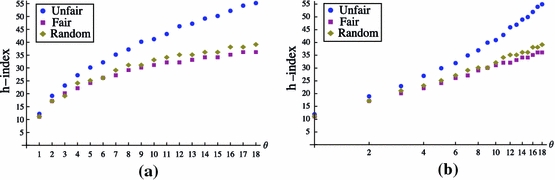
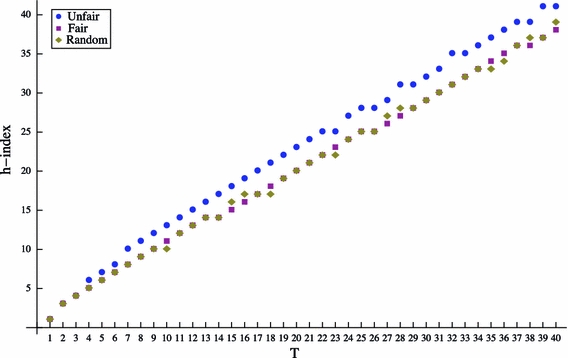
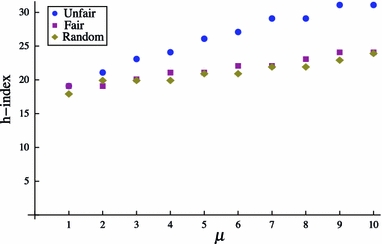
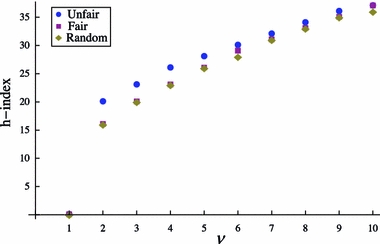
The h-index has received an enormous attention for being an indicator that measures the quality of researchers and organizations. We investigate to what degree authors can inflate their h-index through strategic self-citations with the help of a simulation. We extended Burrell's publication model with a procedure for placing self-citations, following three different strategies: random self-citation, recent self-citations and h-manipulating self-citations. The results show that authors can considerably inflate their h-index through self-citations. We propose the q-index as an indicator for how strategically an author has placed self-citations, and which serves as a tool to detect possible manipulation of the h-index. The results also show that the best strategy for an high h-index is publishing papers that are highly cited by others. The productivity has also a positive effect on the h-index.
Overview
The claims and statistics of this paper haven’t been checked yet.
Free: it reads the open-access text and checks the first 5 claims that cite a source we can check. Create a free account to check every claim.
Integrity signals
Registry
Cites
Statistics
Figures
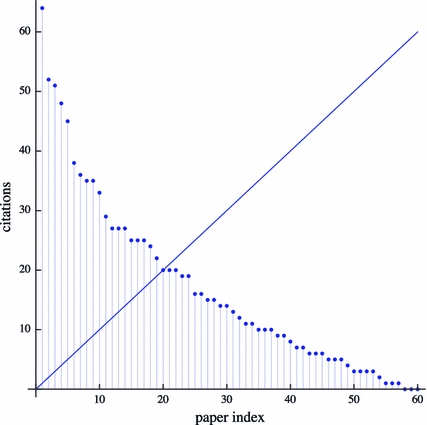
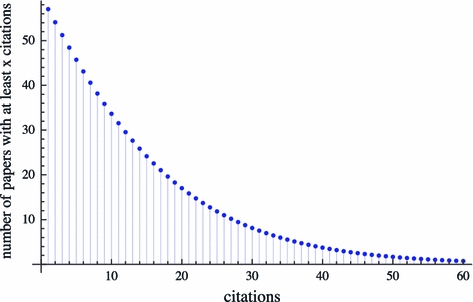
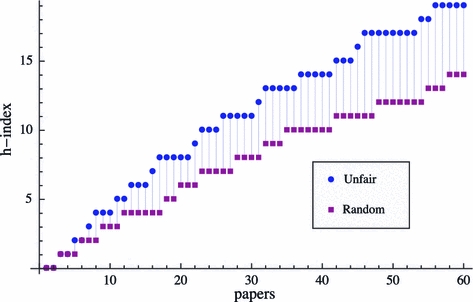
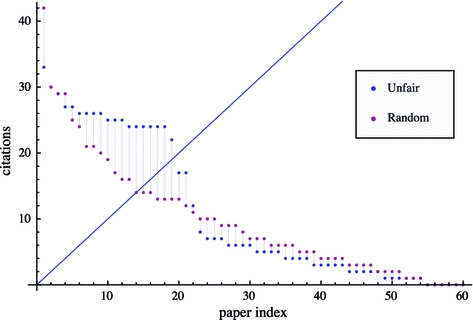
Verification
Claims the paper makes
The claims and statistics of this paper haven’t been checked yet.
Free: it reads the open-access text and checks the first 5 claims that cite a source we can check. Create a free account to check every claim.
Claims other papers make about this one
Each is checked against this paper’s own text: does it say what the citing paper says it does?
In the citing paper
“For example, since the adoption of the h-index, researchers have been observed to artificially inflate their indices through self-citation [43] and even a clever type of quasi-fraud.”
From The natural selection of bad science (2016) · cites this paper as [43]
Self-check
Percentages, sums and reported differences re-computed from the paper’s own numbers.
The self-check needs the paper’s full text.
Citations
Cites
An index to quantify an individual’s scientific research output
Hirsch, J. E. (2005) · Proceedings of the National Academy of Sciences · doi:10.1073/pnas.0507655102 · Cited by 11,669
Theory and practise of the g-index
Egghe, L. (2006) · Scientometrics · doi:10.1007/s11192-006-0144-7 · Cited by 2,354 · cited 1×
“A wealth of extensions, modifications have since been proposed [12, 13] and also new indicators have been developed, such as the g -index [4].”
MethodMeho, L. I., & Yang, K. (2007) · Journal of the American Society for Information Science and Technology · doi:10.1002/asi.20677 · Cited by 974
Seglen, P. O. (1992) · Journal of the American Society for Information Science · doi:10.1002/(sici)1097-4571(199210)43:9<628::aid-asi5>3.0.co;2-0 · Cited by 693
A macro study of self-citation
Aksnes, D. W. (2003) · Scientometrics · doi:10.1023/a:1021919228368 · Cited by 357 · cited 2×
“And maybe we even should not filter them, since they form an organic part of the citation process [8] and self-citations make up for up to 36% of all citations [1].”
BackgroundMetrics: A profusion of measures
Van Noorden, R. (2010) · Nature · doi:10.1038/465864a · Cited by 267
Self-citation corrections for the Hirsch index
Schreiber, M. (2007) · Europhysics Letters (EPL) · doi:10.1209/0295-5075/78/30002 · Cited by 172
Hirsch's h-index: A stochastic model
Burrell, Q. L. (2006) · Journal of Informetrics · doi:10.1016/j.joi.2006.07.001 · Cited by 148
A bibliometric approach to the role of author self-citations in scientific communication
Glänzel, W., Thijs, B., & Schlemmer, B. (2004) · Scientometrics · doi:10.1023/b:scie.0000013299.38210.74 · Cited by 142
Assessing scientific research performance and impact with single indices
Panaretos, J., & Malesios, C. (2009) · Scientometrics · doi:10.1007/s11192-008-2174-9 · Cited by 130
Research works printed but not linked: 1
- Burrell Q. L. Should the h-index be discounted? ISSI Newsletter 2007 3-S 65 67
Cited by
Items 301–337 of 337
Beyond the h-index: Unveiling nuances and demanding rigor in academic metrics
Saleem, S. M., & Jan, S. S. (2024) · Journal of Family Medicine and Primary Care · doi:10.4103/jfmpc.jfmpc_1855_23
Consideration of Neglected Citations by Hirsch Index
Fathi, M. S. A. (2024) · Annals of Library and Information Studies · doi:10.56042/alis.v71i2.8854
The replication crisis in science and its overlap with kinanthropology: an introduction (Part 2)
Mališ, J., & Baloun, L. (2024) · Tělesná kultura · doi:10.5507/tk.2024.003
Do Women Benefit More than Men From Coauthoring with a Prominent Researcher?Preprint
Aguirre-Guerrero, D., García-Guzmán, M. E., Ramírez-Álvarez, A. A., & Terrazas-Santamaría, D. (2024) · SSRN Electronic Journal · doi:10.2139/ssrn.4904485
Expounding Conflicts of Interest
Periyasamy, G., Gupta, H., Chatterjee, S. C., & Paul, B. (2024) · Springer eBooks · doi:10.1007/978-981-97-4060-4_7
GADEC: Discovering Abnormal Citation Groups Based on Enhanced Local Community Expansion and DQN
Zhu, Y., Wang, X., Lin, X., & Peng, Y. (2024) · Lecture notes in computer science · doi:10.1007/978-3-031-68312-1_3
The Relationship between China and Vietnam in Research Documents: Text Analytics
Maneewong, C., Boonwanna, T., Nguyen, L., Li, C., & Chansanam, W. (2024) · International Research Journal of Multidisciplinary Scope · doi:10.47857/irjms.2024.05i04.01181
From Static to Dynamic: Survey-based Academic Impact Measurement
Li, Y., Ma, Y., Liu, J., & Lu, W. P. (2024) · ACM/IEEE Joint Conference on Digital Libraries · doi:10.1145/3677389.3702510
Trends in Self-citation Rates in High-impact Neurology, Neuroscience, and Psychiatry JournalsPreprint
Rosenblatt, M., Mehta, S., Peterson, H., Dadashkarimi, J., Rodriguez, R. X., Foster, M. L., Adkinson, B. D., Liang, Q., Kimble, V. M., Ye, J., et al. (2025) · eLife · doi:10.7554/elife.88540.3
Rosenblatt, M., Mehta, S., Peterson, H., Dadashkarimi, J., Rodriguez, R. X., Foster, M. L., Adkinson, B. D., Liang, Q., Kimble, V. M., Ye, J., et al. (2025) · eLife · doi:10.7554/elife.88540.4.sa2
Darnalis, N. M., Zainal, H., & Germovsek, E. (2025) · Journal of Scientometric Research · doi:10.5530/jscires.20250983
Gurbanova, M. (2025) · Science Education and Innovations in the Context of Modern Problems · doi:10.56334/sei/8.11.50
Quincho-Lopez, A. (2025) · International Journal for Educational Integrity · doi:10.1007/s40979-025-00205-7
Martinez, R. M. G. (2025) · Research Square · doi:10.21203/rs.3.rs-7900636/v1
Warning Before the Collapse: How the Research Boom is Undermining Scientific Integrity?Preprint
Belkacem, A. N. (2025) · Research Square · doi:10.21203/rs.3.rs-8068394/v1
Tail Risk Protection via reproducible data-adaptive strategies
Spilak, B. (2024) · edoc Publication server (Humboldt University of Berlin) · doi:10.18452/28076
Visualizing research fields based on scholarly communication on the web
Kraker, P. (2013) · Unipub UB Graz (Universität Graz)
A New H-indexPreprint
Kumar, S. (2025) · Engineering Archive (engrXiv) · doi:10.31224/6102
A scientometric analysis of computer science subfields
Braga, A. H. (2013) · LA Referencia (Red Federada de Repositorios Institucionales de Publicaciones Científicas)
A New H-indexPreprint
Kumar, S. (2026) · SSRN Electronic Journal · doi:10.2139/ssrn.5977394
Assessment of H-index and research impact amongst academic medical oncologists in Canada
Whitelaw, S., Ordaz, D. J. G., Moustaqim‐Barrette, A., Netchiporouk, E., & Litvinov, I. V. (2026) · Frontiers in Research Metrics and Analytics · doi:10.3389/frma.2026.1743565
Alt-Index: A proposed Index for measuring the social activity of scientific research
Hassan, S. U., Imran, M., & Zuccala, A. (2018) · Research at the University of Copenhagen (University of Copenhagen)
de Oliveira, O. J. (2024) · Directory of Open access Books (OAPEN Foundation)
Do Women Benefit More Than Men fromCoauthoring with a Prominent Researcher?Preprint
Aguirre-Guerrero, D., García-Guzmán, M. E., Ramírez-Álvarez, A. A., & Terrazas-Santamaría, D. (2026) · Research Square · doi:10.21203/rs.3.rs-9035498/v1
Competition, Interdisciplinarity and Teams in Science
Maublanc, F. (2018) · theses.fr (ABES) · doi:10.70675/3c177a14z10daz49a3z8377z405da1682772
Calle-Pesántez, S. E., & Oliván, J. A. S. (2025) · Zaguan (Universidad de Zaragoza)
C-PRISM: Complexity-informed profile for research impact and scholarly merit
Raina, S. K., Kumar, R., & Kaushal, K. (2026) · Journal of Family Medicine and Primary Care · doi:10.4103/jfmpc.jfmpc_2287_25
Liu, Y., Yang, J., Liu, G., & Huang, L. (2026) · Scientometrics · doi:10.1007/s11192-026-05658-2
A New Paradigm for Scientific Publishing, Peer Review, and Impact Assessment
Argibay, N., Rowland, L., Rock, J., & McDermott, E. (2026) · The Scientific Review · doi:10.67486/tsr.2026.1
The H‑Index and Beyond: New Tools for Evaluating Researcher Performance
Salari, M., & Rezaeian, M. (2026) · مجله علمی دانشگاه علوم پزشکی رفسنجان · doi:10.66224/jrums.24.10.979
Brooker, R. (2026) · Open Access at Essex (University of Essex) · doi:10.5526/err-00043534
Measuring the research impact of an author
Bari, A. U. (2023) · Journal of Pakistan Association of Dermatologists · doi:10.66344/jpad.v33i2.2272
Albert, M.-N., & Nassar, A. E. (2026) · Research Square · doi:10.21203/rs.3.rs-10027334/v1
Cuce, P. M., & Cüce, E. (2026) · Journal of Information Science · doi:10.1177/01655515261500381
Rumin, R., & Potiopa, P. (2014) · Studies in computational intelligence · doi:10.1007/978-3-319-11328-9_8
Metadata
- Authors
- Bartneck, C., & Kokkelmans, S.
- Affiliations
- Eindhoven University of Technology (NL)
- Corresponding author
- Bartneck, Christoph
- Venue
- Scientometrics
- Published
- 2010-11-11
- Volume
- 87
- Issue
- 1
- Pages
- 85-98
- ISSN
- 0138-9130 (ISSN-L)
- 1588-2861
- PMC
- PMC3043246
- OpenAlex
- W2151568674
- Semantic Scholar
- 233bb635351639395295af24bb392547b1c4ef77
- Cited by
- 301
- References
- 18
- Citations by year
- 2026: 13 · 2025: 12 · 2024: 20 · 2023: 22 · 2022: 10 · 2021: 30 · 2020: 29 · 2019: 33 · 2018: 26 · 2017: 16 · 2016: 26 · 2015: 21 · 2014: 14 · 2013: 15 · 2012: 11
- FWCI
- 9.62
- Type
- journal article
- Language
- en
- Open access
- hybrid
- doi.org
- Licence
- cc-by-nc
- creativecommons.org/licenses/by-nc/2.0 (tdm)
- Locations
- Scientometrics (publishedVersion, cc-by-nc)
- PubMed Central (publishedVersion, cc-by-nc)
- PubMed (publishedVersion)
- TU/e Research Portal (publishedVersion, other-oa)
- TU/e Research Portal (submittedVersion)
- RePEc: Research Papers in Economics (submittedVersion)
- UC Research Repository (University of Canterbury) (submittedVersion, cc-by-nc)
- TU/e Research Portal (submittedVersion, other-oa)
- Topics
- Social Sciences › Library and Information Sciences › scientometrics and bibliometrics research
- Social Sciences › Education › Academic integrity and plagiarism
- Physical Sciences › Computer Science › Information Systems › Web visibility and informetrics
- Keywords
- self-citation, citation manipulation, Q index, publishing business models, research productivity, citation impact indicators
About these checks
Registry, retraction, Cites and statistics results are computed, not judged, with one exception: a printed reference that no index lists is read once by a model before it counts as a citation error. Claims are extracted by a model and kept only when their quote appears verbatim in the text; each cited source is then checked, with a model’s help, for whether it says what the claim relies on. Those verdicts can be wrong — read the claim’s quote and the cited source before relying on one.
Statistics and arithmetic are recomputed, not judged.
Confidence bands are shown only for fields calibrated on our annotated test set. None is calibrated yet, so no band is shown.
What counts as a claim ›How we measure confidence ›How we check this ›
Are you an author, or do you see a problem with this page? Request a review
Data sources
Bibliographic data: Semantic Scholar, OpenAlex, Crossref.
Contains information from the Semantic Scholar Academic Graph Datasets, made available under the ODC Attribution License (ODC-BY 1.0).
Semantic Scholar’s data is described in: Kinney, R., et al. (2023). The Semantic Scholar Open Data Platform. arXiv:2301.10140.
