

Detecting h-index manipulation through self-citation analysis
Open accessThe DOI matches its Crossref record; 17 of the 18 references it cites were found in a registry or an index.
Abstract
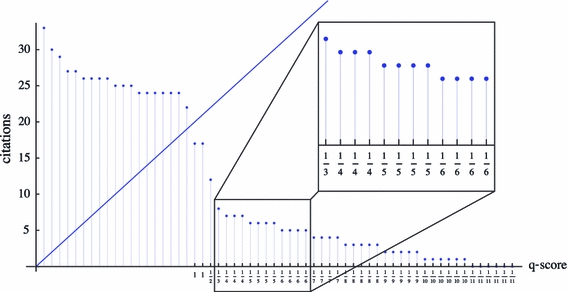
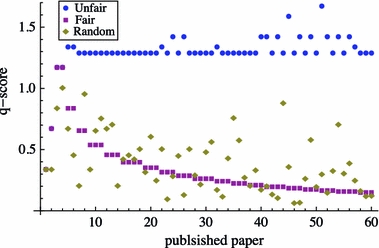
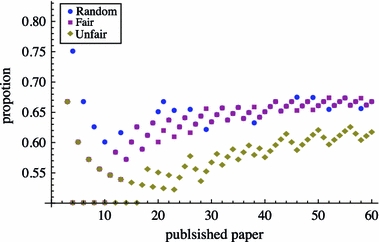
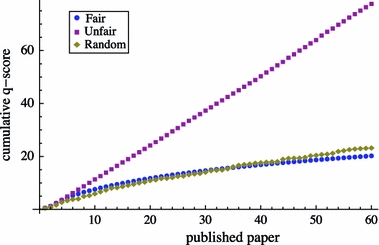
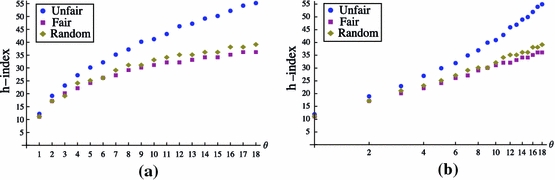
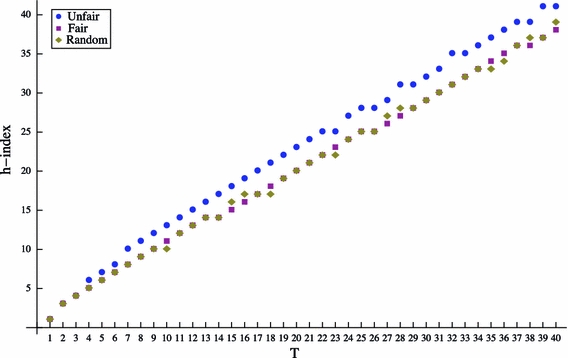
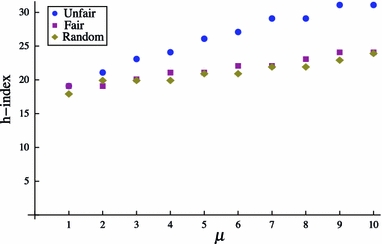
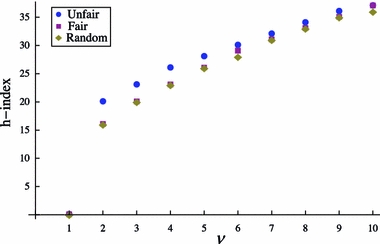
The h-index has received an enormous attention for being an indicator that measures the quality of researchers and organizations. We investigate to what degree authors can inflate their h-index through strategic self-citations with the help of a simulation. We extended Burrell's publication model with a procedure for placing self-citations, following three different strategies: random self-citation, recent self-citations and h-manipulating self-citations. The results show that authors can considerably inflate their h-index through self-citations. We propose the q-index as an indicator for how strategically an author has placed self-citations, and which serves as a tool to detect possible manipulation of the h-index. The results also show that the best strategy for an high h-index is publishing papers that are highly cited by others. The productivity has also a positive effect on the h-index.
Overview
The claims and statistics of this paper haven’t been checked yet.
Free: it reads the open-access text and checks the first 5 claims that cite a source we can check. Create a free account to check every claim.
Integrity signals
Registry
Cites
Statistics
Figures
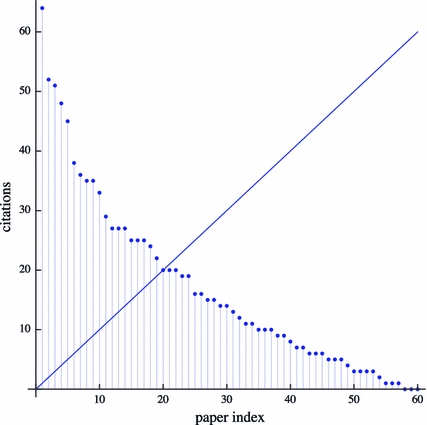
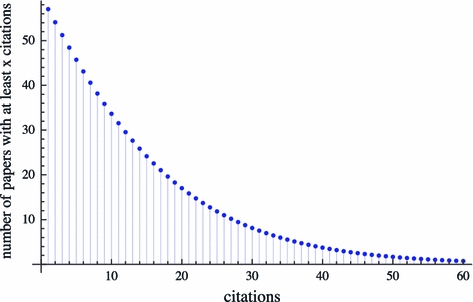
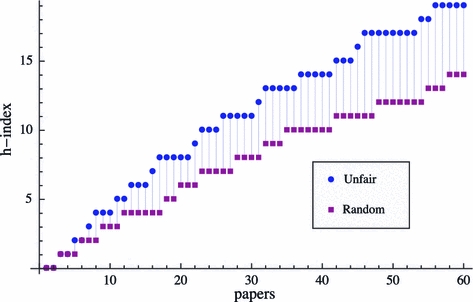
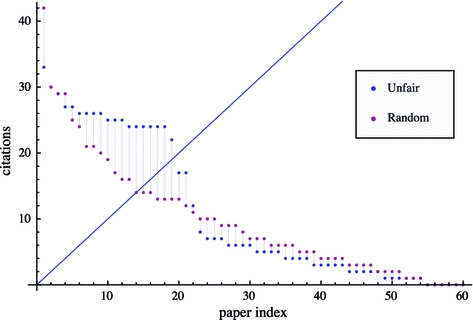
Verification
Claims the paper makes
The claims and statistics of this paper haven’t been checked yet.
Free: it reads the open-access text and checks the first 5 claims that cite a source we can check. Create a free account to check every claim.
Claims other papers make about this one
Each is checked against this paper’s own text: does it say what the citing paper says it does?
In the citing paper
“For example, since the adoption of the h-index, researchers have been observed to artificially inflate their indices through self-citation [43] and even a clever type of quasi-fraud.”
From The natural selection of bad science (2016) · cites this paper as [43]
Self-check
Percentages, sums and reported differences re-computed from the paper’s own numbers.
The self-check needs the paper’s full text.
Citations
Cites
An index to quantify an individual’s scientific research output
Hirsch, J. E. (2005) · Proceedings of the National Academy of Sciences · doi:10.1073/pnas.0507655102 · Cited by 11,669
Theory and practise of the g-index
Egghe, L. (2006) · Scientometrics · doi:10.1007/s11192-006-0144-7 · Cited by 2,354 · cited 1×
“A wealth of extensions, modifications have since been proposed [12, 13] and also new indicators have been developed, such as the g -index [4].”
MethodMeho, L. I., & Yang, K. (2007) · Journal of the American Society for Information Science and Technology · doi:10.1002/asi.20677 · Cited by 974
Seglen, P. O. (1992) · Journal of the American Society for Information Science · doi:10.1002/(sici)1097-4571(199210)43:9<628::aid-asi5>3.0.co;2-0 · Cited by 693
A macro study of self-citation
Aksnes, D. W. (2003) · Scientometrics · doi:10.1023/a:1021919228368 · Cited by 357 · cited 2×
“And maybe we even should not filter them, since they form an organic part of the citation process [8] and self-citations make up for up to 36% of all citations [1].”
BackgroundMetrics: A profusion of measures
Van Noorden, R. (2010) · Nature · doi:10.1038/465864a · Cited by 267
Self-citation corrections for the Hirsch index
Schreiber, M. (2007) · Europhysics Letters (EPL) · doi:10.1209/0295-5075/78/30002 · Cited by 172
Hirsch's h-index: A stochastic model
Burrell, Q. L. (2006) · Journal of Informetrics · doi:10.1016/j.joi.2006.07.001 · Cited by 148
A bibliometric approach to the role of author self-citations in scientific communication
Glänzel, W., Thijs, B., & Schlemmer, B. (2004) · Scientometrics · doi:10.1023/b:scie.0000013299.38210.74 · Cited by 142
Assessing scientific research performance and impact with single indices
Panaretos, J., & Malesios, C. (2009) · Scientometrics · doi:10.1007/s11192-008-2174-9 · Cited by 130
Is there a place for a mock h-index?
Prathap, G. (2009) · Scientometrics · doi:10.1007/s11192-009-0066-2 · Cited by 118
A bibliometric approach to the role of author self-citations in scientific communication
Glänzel, W., Thijs, B., & Schlemmer, B. (2003) · Lirias · Cited by 86
Ike Antkare one of the great stars in the scientific firmament
Antkare, I. (2010) · Cited by 83
Predictive aspects of a stochastic model for citation processes
Glänzel, W., & Schubert, A. (1995) · Information Processing & Management · doi:10.1016/0306-4573(94)e0012-q · Cited by 67
A stochastic model for the ageing of scientific literature
Glänzel, W., & Schoepflin, U. (1994) · Scientometrics · doi:10.1007/bf02017212 · Cited by 60
A multidimensional extension to Hirsch’s h-index
García-Pérez, M. Á. (2009) · Scientometrics · doi:10.1007/s11192-009-2290-1 · Cited by 46
Comment: Bibliometrics in the Context of the UK Research Assessment Exercise
Silverman, B. W. (2009) · Statistical Science · doi:10.1214/09-sts285a · Cited by 8
Research works printed but not linked: 1
- Burrell Q. L. Should the h-index be discounted? ISSI Newsletter 2007 3-S 65 67
Cited by
The natural selection of bad science
Smaldino, P. E., & McElreath, R. (2016) · Royal Society Open Science · doi:10.1098/rsos.160384 · Cited by 860
“For example, since the adoption of the h-index, researchers have been observed to artificially inflate their indices through self-citation [43] and even a clever type of quasi-fraud.”
MethodEdwards, M. A., & Roy, S. (2017) · Environmental Engineering Science · doi:10.1089/ees.2016.0223 · Cited by 688
Roldan-Valadez, E., Salazar-Ruiz, S. Y., Ibarra-Contreras, R., & Rios, C. (2019) · Irish Journal of Medical Science (1971 -) · doi:10.1007/s11845-018-1936-5 · Cited by 443
Using publication metrics to highlight academic productivity and research impact
Carpenter, C. R., Cone, D. C., & Sarli, C. C. (2014) · Academic Emergency Medicine · doi:10.1111/acem.12482 · Cited by 377
“One obvious issue with citation counts as a measure of impact is that they can be manipulated by deliberate self-citation or reciprocal citations by colleagues.(45,46) One study analyzing articles from the journal Science found a strong relationship between the number of citations of a manuscript and the number of ref…”
Over-optimization of academic publishing metrics: observing Goodhart's Law in action
Fire, M., & Guestrin, C. (2019) · GigaScience · doi:10.1093/gigascience/giz053 · Cited by 351
“…of the measures can be compromised, and unwelcome and unethical behaviors may develop, such as salami publications [17], ghost author-ships [18], p-hacking [19], metrics manipulation [20], faking research data [21], faking of peer reviews [22], and even plagiariz-ing by a peer reviewer [23].”
Influential
Metadata
- Authors
- Bartneck, C., & Kokkelmans, S.
- Affiliations
- Eindhoven University of Technology (NL)
- Corresponding author
- Bartneck, Christoph
- Venue
- Scientometrics
- Published
- 2010-11-11
- Volume
- 87
- Issue
- 1
- Pages
- 85-98
- ISSN
- 0138-9130 (ISSN-L)
- 1588-2861
- PMC
- PMC3043246
- OpenAlex
- W2151568674
- Cited by
- 301
- References
- 18
- Citations by year
- 2026: 13 · 2025: 12 · 2024: 20 · 2023: 22 · 2022: 10 · 2021: 30 · 2020: 29 · 2019: 33 · 2018: 26 · 2017: 16 · 2016: 26 · 2015: 21 · 2014: 14 · 2013: 15 · 2012: 11
- FWCI
- 9.62
- Type
- journal article
- Language
- en
- Open access
- hybrid
- doi.org
- Licence
- cc-by-nc
- creativecommons.org/licenses/by-nc/2.0 (tdm)
- Locations
- Scientometrics (publishedVersion, cc-by-nc)
- PubMed Central (publishedVersion, cc-by-nc)
- PubMed (publishedVersion)
- TU/e Research Portal (publishedVersion, other-oa)
- TU/e Research Portal (submittedVersion)
- RePEc: Research Papers in Economics (submittedVersion)
- UC Research Repository (University of Canterbury) (submittedVersion, cc-by-nc)
- TU/e Research Portal (submittedVersion, other-oa)
- Topics
- Social Sciences › Library and Information Sciences › scientometrics and bibliometrics research
- Social Sciences › Education › Academic integrity and plagiarism
- Physical Sciences › Computer Science › Information Systems › Web visibility and informetrics
- Keywords
- self-citation, citation manipulation, Q index, publishing business models, research productivity, citation impact indicators
About these checks
Registry, retraction, Cites and statistics results are computed, not judged, with one exception: a printed reference that no index lists is read once by a model before it counts as a citation error. Claims are extracted by a model and kept only when their quote appears verbatim in the text; each cited source is then checked, with a model’s help, for whether it says what the claim relies on. Those verdicts can be wrong — read the claim’s quote and the cited source before relying on one.
Statistics and arithmetic are recomputed, not judged.
Confidence bands are shown only for fields calibrated on our annotated test set. None is calibrated yet, so no band is shown.
What counts as a claim ›How we measure confidence ›How we check this ›
Are you an author, or do you see a problem with this page? Request a review
Data sources
Bibliographic data: Semantic Scholar, OpenAlex, Crossref.
Contains information from the Semantic Scholar Academic Graph Datasets, made available under the ODC Attribution License (ODC-BY 1.0).
Semantic Scholar’s data is described in: Kinney, R., et al. (2023). The Semantic Scholar Open Data Platform. arXiv:2301.10140.
