

Can tweets be used to detect problems early with scientific papers? A case study of three retracted COVID-19/SARS-CoV-2 papers
Open accessThe DOI matches its Crossref record; 46 of the 47 references it cites were found in a registry or an index.
Abstract
Methodological mistakes, data errors, and scientific misconduct are considered prevalent problems in science that are often difficult to detect. In this study, we explore the potential of using data from Twitter for discovering problems with publications. In this case study, we analyzed tweet texts of three retracted publications about COVID-19 (Coronavirus disease 2019)/SARS-CoV-2 (severe acute respiratory syndrome coronavirus 2) and their retraction notices. We did not find early warning signs in tweet texts regarding one publication, but we did find tweets that casted doubt on the validity of the two other publications shortly after their publication date. An extension of our current work might lead to an early warning system that makes the scientific community aware of problems with certain publications. Other sources, such as blogs or post-publication peer-review sites, could be included in such an early warning system. The methodology proposed in this case study should be validated using larger publication sets that also include a control group, i.e., publications that were not retracted.
Overview
The claims and statistics of this paper haven’t been checked yet.
Free: it reads the open-access text and checks the first 5 claims that cite a source we can check. Create a free account to check every claim.
Integrity signals
Registry
Cites
Statistics
Figures
Verification
Claims the paper makes
The claims and statistics of this paper haven’t been checked yet.
Free: it reads the open-access text and checks the first 5 claims that cite a source we can check. Create a free account to check every claim.
Claims other papers make about this one
Each is checked against this paper’s own text: does it say what the citing paper says it does?
In the citing paper
“Our finding validates at population-wide scale a recent case study of three retracted COVID-19 papers (40) in suggesting that collective attention on Twitter includes meaningful discussions about science and may contain useful early signals related to problematic papers that could eventually contribute to their investigation.”
From Dynamics of cross-platform attention to retracted papers (2022) · cites this paper as [40]
In the citing paper
“A recent case study suggested that Twitter attention received after publication could be indicative of factual information that should be investigated (40).”
From Dynamics of cross-platform attention to retracted papers (2022) · cites this paper as [40]
In the citing paper
“As suggested in a recent case study (40), knowing how retracted papers are mentioned may uncover users who are improving science-related discussions on Twitter by identifying papers that require a closer examination.”
From Dynamics of cross-platform attention to retracted papers (2022) · cites this paper as [40]
Self-check
Percentages, sums and reported differences re-computed from the paper’s own numbers.
The self-check needs the paper’s full text.
Citations
Cites
6 retracted
Mehra, M. R., Desai, S. S., Ruschitzka, F., & Patel, A. N. (2020) · The Lancet · doi:10.1016/s0140-6736(20)31180-6 · Cited by 1,200 · cited 14×
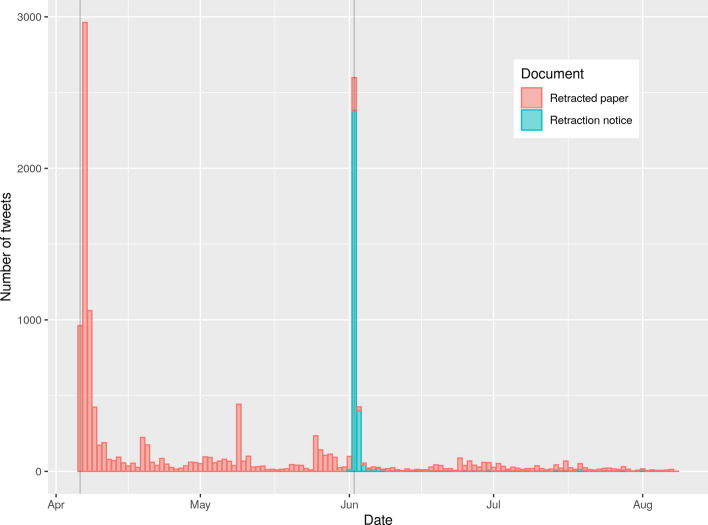
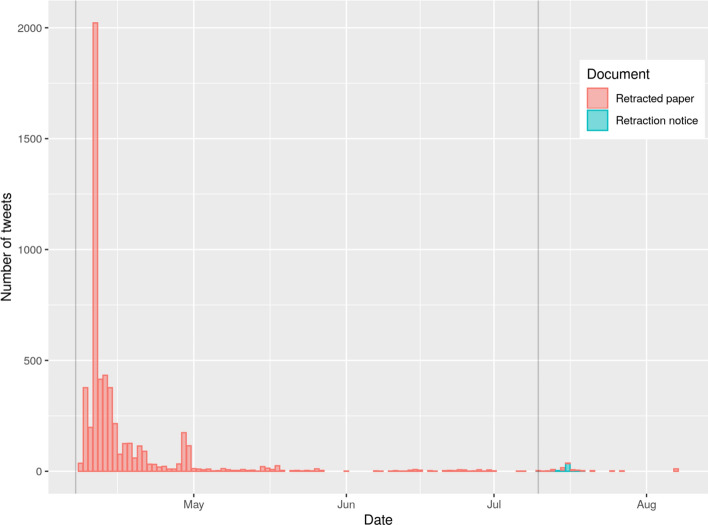
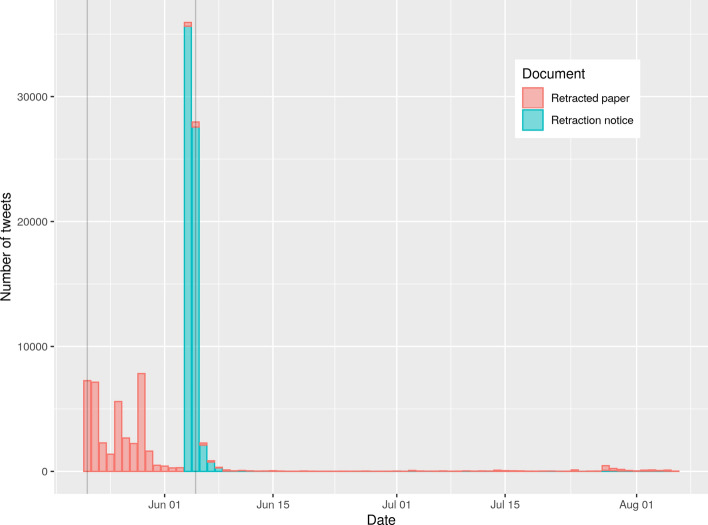
“Figure 9 shows the tweets per day that mention either the paper Mehra et al., (2020a) or its retraction Mehra et al. (2020b). The publication dates of the paper and the retraction notice are marked as gray vertical lines. The retraction notice has been tweeted a day before its official publication date. On these 2 day…”
BackgroundInfluentialRetractedMehra, M. R., Ruschitzka, F., & Patel, A. N. (2020) · The Lancet · doi:10.1016/s0140-6736(20)31324-6 · Cited by 553 · cited 4×
“Figure 9 shows the tweets per day that mention either the paper Mehra et al., (2020a) or its retraction Mehra et al. (2020b).”
BackgroundInfluentialRetractedBae, S., Kim, M.-C., Kim, J. Y., Cha, H.-H., Lim, J. S., Jung, J., Kim, M.-J., Oh, D. K., Lee, M.-K., Choi, S.-H., et al. (2020) · Annals of Internal Medicine · doi:10.7326/m20-1342 · Cited by 193 · cited 1×
“The study was published on 6 April 2020 and retracted on 2 June 2020 because they “had not fully recognized the concept of limit of detection (LOD) of the in-house reverse transcriptase polymerase chain reaction used in the study” (Bae et al., 2020b).”
RetractedWang, X., Xu, W., Hu, G., Xia, S., Sun, Z., Liu, Z., Xie, Y., Zhang, R., Jiang, S., & Lu, L. (2020) · Cellular & Molecular Immunology · doi:10.1038/s41423-020-0498-4 · Cited by 175 · cited 5×
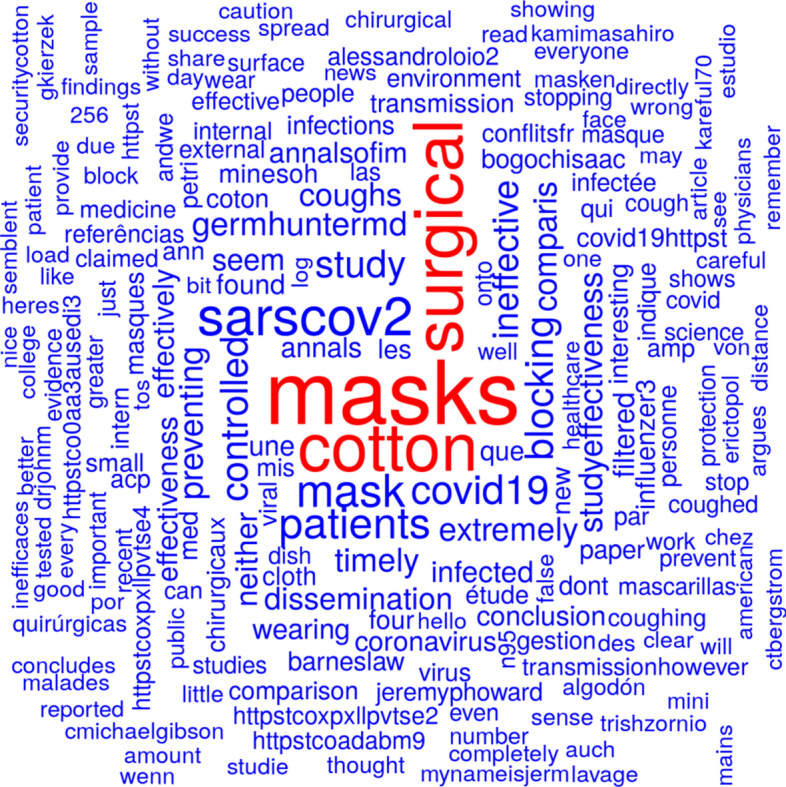
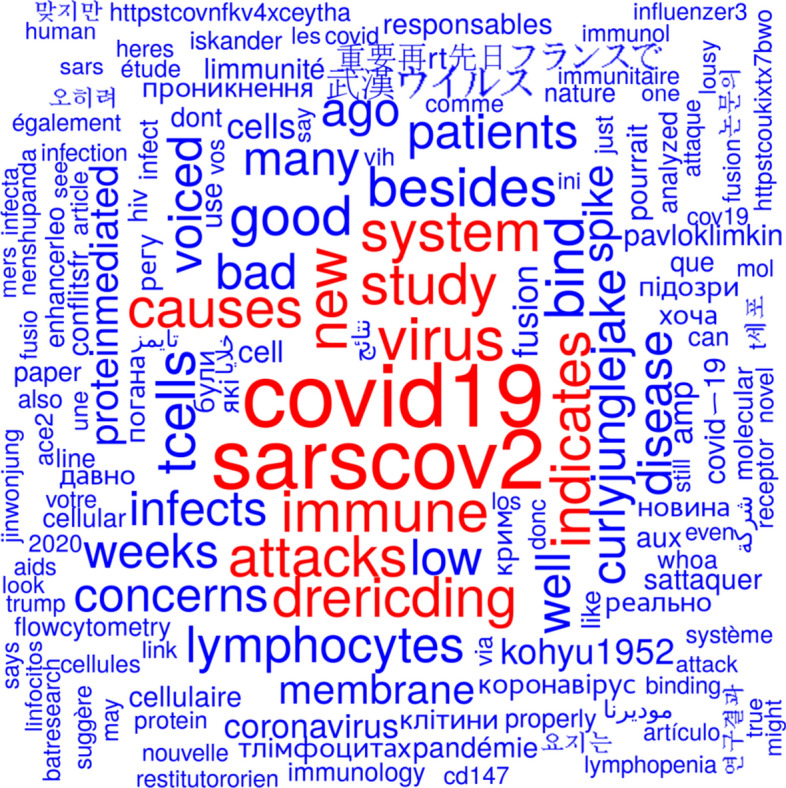
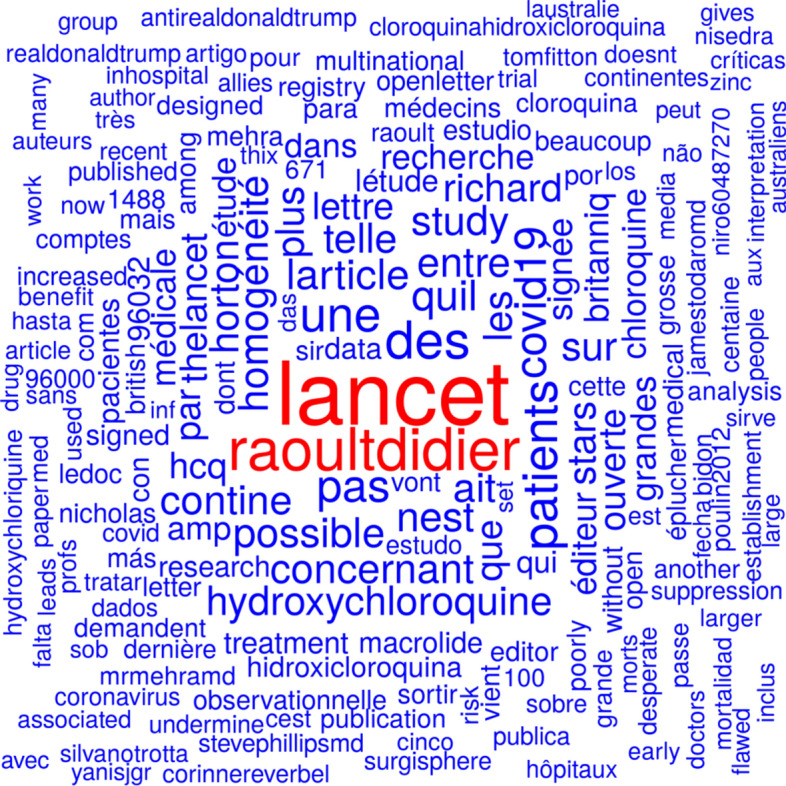
“8 Word cloud from tweet texts based on the tweets mentioning Wang et al., (2020a) or Wang et al., (2020b) since publication date of the retraction”
BackgroundMethodResultInfluentialRetractedWang, X., Xu, W., Hu, G., Xia, S., Sun, Z., Liu, Z., Xie, Y., Zhang, R., Jiang, S., & Lu, L. (2020) · Cellular & Molecular Immunology · doi:10.1038/s41423-020-0424-9 · Cited by 161 · cited 1×
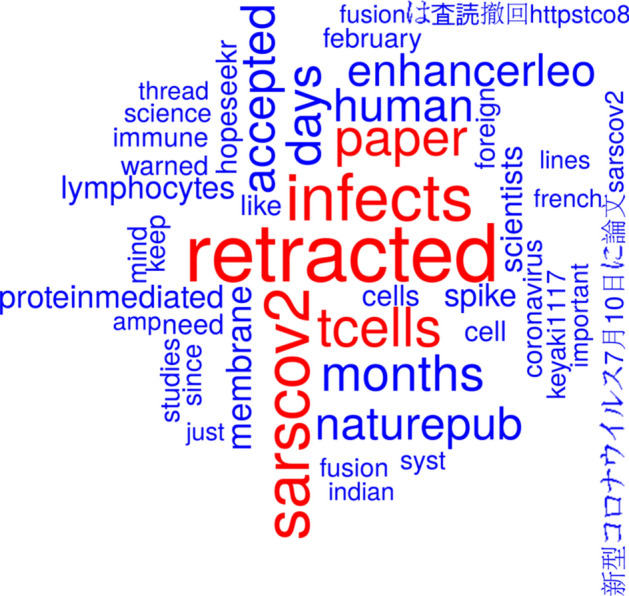
“This paper has been published on 7 April 2020, and retracted on 10 July 2020 (Wang et al., 2020b) because “[a]fter the publication of this article, it came to the authors attention that in order to support the conclusions of the study, the authors should have used primary T cells instead of T-cell…”
ResultRetractedRetracted publications and their citation in dental literature: A systematic review
Rapani, A., Lombardi, T., Berton, F., Del Lupo, V., Di Lenarda, R., & Stacchi, C. (2020) · Clinical and Experimental Dental Research · doi:10.1002/cre2.292 · Cited by 62 · cited 1×
“About half of the retracted publications contained at least one co-author from Asia (Rapani et al., 2020).”
BackgroundRetractedWickham, H. (2016) · Use R! · doi:10.1007/978-3-319-24277-4 · Cited by 33,115
ggplot2: Elegant Graphics for Data Analysis
Wickham, H. (2009) · doi:10.1007/978-0-387-98141-3 · Cited by 14,447
tidyverse: Easily Install and Load the 'Tidyverse'
Wickham, H. (2016) · CRAN: Contributed Packages · doi:10.32614/cran.package.tidyverse · Cited by 1,381
Web of Science as a Data Source for Research on Scientific and Scholarly Activity
Birkle, C., Pendlebury, D. A., Schnell, J., & Adams, J. (2020) · Quantitative Science Studies · doi:10.1162/qss_a_00018 · Cited by 1,283 · cited 3×
“The Web of Science (WoS; Birkle et al., 2020) has a document type named “retraction” that has indexed documents with publication years since 1974.”
BackgroundMethod
Research works printed but not linked: 2
- Roe, P., & Lewison, G. (2019). The anatomy of retracted papers in the Web of Science, 1998–2017. Paper presented at the ISSI 2019—17th International Conference of the International Society for Scientometrics and Informetrics, Rome, Italy.
- Toupin, R., Millerand, F., & Larivière, V. (2019). Scholarly communication or public communication of science? Assessing who engage with climate change research on Twitter. Paper presented at the 17th International Conference on Scientometrics and Informetrics (ISSI 2019) with a special STI conference track, Rome, Italy.
Cited by
Dynamics of cross-platform attention to retracted papers
Peng, H., Romero, D. M., & Horvát, E.-Á. (2022) · Proceedings of the National Academy of Sciences · doi:10.1073/pnas.2119086119 · Cited by 57
Schneider, J., Woods, N. D., Proescholdt, R., Fu, Y., & The RISRS Team (2021) · MetArXiv (OSF Preprints) · doi:10.31222/osf.io/ms579 · Cited by 18
Amiri, M., Yaghtin, M., & Sotudeh, H. (2023) · Scientometrics · doi:10.1007/s11192-023-04871-7 · Cited by 12
“Moreover, tweets are found to contain retraction-related keywords (Abhari et al., 2022), and some hints that raise doubts about retracted articles in their pre-retraction phase (Haunschild & Bornmann, 2021).”
A comparative study on characteristics of retracted publications across different open access levels
Zheng, E., & Fu, H. (2024) · Journal of Data and Information Science · doi:10.2478/jdis-2024-0010 · Cited by 11
“Readers could use PubPeer or other online platforms to help build an early warning system that made the scientific community aware of the problems in publications (Haunschild & Bornmann, 2021).”
Unraveling retraction dynamics in COVID-19 research: Patterns, reasons, and implications
Khurana, P., Sharma, K., & Uddin, Z. (2024) · Accountability in Research · doi:10.1080/08989621.2024.2379906 · Cited by 13
“The scholarly literature can be corrected through retraction, which is gaining more attention as a means of ensuring that publications adhere to ethical standards and research rules (Haunschild and Bornmann, 2021; Eldakar and Shehata, 2023).”
The propagation of error: retracted articles in marketing and their citations
Moussa, S. (2022) · Italian Journal of Marketing · doi:10.1007/s43039-021-00044-7 · Cited by 10
“Articles with a high number of negative sentiments should be further examined to detect whether they involve ethical misconduct (e.g., plagiarism) or scientific distortion (e.g., fabricated data) (see e.g., Haunschild & Bornmann, 2021).”
BackgroundBürgi, C. R. S., & Wohlrabe, K. (2022) · Scientometrics · doi:10.1007/s11192-022-04473-9 · Cited by 7
“Furthermore, there have been a number of retractions and corrections in response to the impacts, see, e.g., Haunschild and Bornmann (2021), Soltani and Patini (2020), Moradi and Abdi (2021), Bagdasarian et al.”
BackgroundZheng, E., Fu, H., Thelwall, M. A., & Fang, Z. (2025) · Journal of the Association for Information Science and Technology · doi:10.1002/asi.70028 · Cited by 14
“For example, Haunschild and Bornmann (2021) found that critical tweets questioning the validity of two out of three COVID-19 articles began circulating shortly after their publication.”
Do male leading authors retract more articles than female leading authors?
Zheng, E., Fu, H., Thelwall, M. A., & Fang, Z. (2025) · Journal of Informetrics · doi:10.1016/j.joi.2025.101682 · Cited by 8
The Contribution of Saudi Arabian Scholars to the Literature on COVID-19: A Bibliometric Study
Al-Duwaish, A., Shehata, A. M. K., Farrag, A., Alshara, M. A., Eldakar, M. A. M., & Al-Hugail, A. (2021) · Science & Technology Libraries · doi:10.1080/0194262x.2021.1994100 · Cited by 6
“While many studies focused on COVID-19 bibliometrics, much focused on measuring the Altmetrics of COVID-19 research as it was seen as an important indicator of the importance and quality of the research.”
BackgroundInfluentialda Silva, J. A. T., Tsigaris, P., & Moussa, S. (2025) · Journal of Electronic Resources Librarianship · doi:10.1080/1941126x.2025.2497727 · Cited by 18
“Other technological innovations, like social media (Haunschild & Bornmann, 2021), or machine learning-based technological innovations are occasionally used to assess the quality of academic publishing, such as cheating (Kamalov et al., 2021).”
Meta-research on COVID-19: An overview of the early trendsPreprint
Colavizza, G. (2021) · arXiv (Cornell University) · doi:10.48550/arxiv.2106.02961 · Cited by 9
Twitter for microblogging in oral health care, research, and academics
Chowdhry, A., & Kapoor, P. (2021) · Journal of Oral and Maxillofacial Pathology · doi:10.4103/jomfp.jomfp_190_21 · Cited by 4
“[32] However, many simple queries or confusions related to publication can be managed “away from the journal” on the Twitter platform.”
BackgroundCelebrating Failure: Learning lessons from a leading consumer behavior journal’s retractions
Moussa, S. (2022) · CBR - Consumer Behavior Review · doi:10.51359/2526-7884.2022.254032 · Cited by 5
Wang, P. (2023) · Conference on Human Information Interaction and Retrieval · doi:10.1145/3576840.3578281 · Cited by 6
“Studies of Tweet spreading retracted publications have moved beyond the counting of the tweets and retweets over time to analyzing the text to identify if critical tweets on circulated papers can provide some discussion of or clue to problematic papers [27, 46].”
BackgroundAmiri, M., & Sotudeh, H. (2025) · Scientometrics · doi:10.1007/s11192-025-05231-3 · Cited by 4
“Previous studies have highlighted the potential for social media to both spread awareness of retractions and contribute to the ongoing dissemination of retracted research (Haunschild & Bornmann, 2021).”
Altmetrics can capture research evidence: an analysis across types of studies in COVID-19 literature
Valderrama, P., Arroyo‐Machado, W., & Torres‐Salinas, D. (2023) · El Profesional de la Informacion · doi:10.3145/epi.2023.mar.13 · Cited by 3
“Despite the risks on Twitter, Haunschild and Bornmann (2021) saw its potential as an early warning system for identifying potentially problematic information.”
BackgroundHow social are open-access debates: a follow-up study of tweeters' sentiments
Sotudeh, H. (2023) · Online Information Review · doi:10.1108/oir-09-2022-0502 · Cited by 3
Amiri, M., & Sotudeh, H. (2025) · Scientometrics · doi:10.1007/s11192-025-05477-x · Cited by 3
“Pre-retraction tweets contain retraction-related key-words (Dambanemuya et al., 2024; Toney & Abdulla, 2023) and exhibit negative sentiment (Haunschild & Bornmann, 2021), indicating potential early warnings.”
InfluentialRetractions of COVID-19-Related Research Publications During and After the Pandemic
Mattoon, E. R., Casadevall, A., & Fang, F. C. (2025) · The Journal of Law Medicine & Ethics · doi:10.1017/jme.2025.33 · Cited by 5
“35 Following these concerns, Surgisphere declined to allow third-party auditors to conduct a private audit of the dataset.”
Can tweets predict article retractions?
Zheng, E., Fu, H., & Fang, Z. (2023) · International Conference on Science, Technology and Innovation Indicators (STI) · doi:10.55835/644126a8763e8d2091a0cfdc · Cited by 1
Benlidayı, İ. C. (2023) · Central Asian Journal of Medical Hypotheses and Ethics · doi:10.47316/cajmhe.2023.4.1.06
How is pandemic perceived in China? A case study of COVID-19
(2023) · Data Science and Informetrics · doi:10.59494/dsi.2023.4.3
Quality control of research data during the pandemic: A case study of retracted COVID-19 papers
(2023) · Data Science and Informetrics · doi:10.59494/dsi.2023.4.4
Zhang, Y., & Fang, Z. (2025) · Journal of the Association for Information Science and Technology · doi:10.1002/asi.70002 · Cited by 1
“…analyzing engagement behaviors (Alperin et al., 2019; Didegah et al., 2018; Haustein et al., 2014; Holmberg & Thelwall, 2014), and investigating the content generated by users on social media platforms (Haunschild et al., 2021; Kousha et al., 2012; Robinson-Garcia et al., 2017; Shema et al., 2015).”
Expresiones de la ética científica en Twitter/X: un análisis de co-ocurrencia de hashtags
Aguilar-Gallegos, N., Romero-García, L. E., & y García, R. R. D. (2026) · Redes Revista hispana para el análisis de redes sociales · doi:10.5565/rev/redes.1163
Yaghtin, M., Sotudeh, H., Hoseini, M., & Amiri, M. A. (2026) · Online Information Review · doi:10.1108/oir-04-2025-0270 · Cited by 2
Maleki, A., & Holmberg, K. (2026) · Research Evaluation · doi:10.1093/reseval/rvag014 · Cited by 1
Peng, Z., Zhao, M., Wang, H., Yang, A. J., & Deng, S. (2026) · Scientometrics · doi:10.1007/s11192-026-05808-6
“…retraction notices, and the role of platforms like Retraction Watch and social media in disseminating information about problematic papers (Amiri et al., 2024; Andersen & Wray, 2019; Casadevall et al., 2014; De Cassai et al., 2022; Haunschild & Bornmann, 2021; Khan et al., 2022; Xu et al., 2023).”
Metadata
- Authors
- Haunschild, R., & Bornmann, L.
- Affiliations
- Max Planck Institute for Solid State Research (DE)
- Max Planck Society (DE)
- Corresponding author
- Haunschild, Robin
- Venue
- Scientometrics
- Published
- 2021-04-26
- Volume
- 126
- Issue
- 6
- Pages
- 5181-5199
- ISSN
- 0138-9130 (ISSN-L)
- 1588-2861
- PMC
- PMC8072087
- OpenAlex
- W3158277584
- Semantic Scholar
- 6857b6f29196113adfd9c571e498d3c1fb467028
- Cited by
- 29
- References
- 47
- Citations by year
- 2026: 4 · 2025: 7 · 2024: 2 · 2023: 8 · 2022: 4 · 2021: 4
- FWCI
- 3.84
- Type
- journal article
- Language
- en
- Open access
- hybrid
- doi.org
- Licence
- cc-by
- creativecommons.org/licenses/by/4.0 (tdm)
- creativecommons.org/licenses/by/4.0 (vor)
- Locations
- Scientometrics (publishedVersion, cc-by)
- PubMed Central (publishedVersion, cc-by)
- PubMed (publishedVersion)
- RePEc: Research Papers in Economics (submittedVersion)
- Funders
- Max Planck Institute for Solid State Research
- Topics
- Social Sciences › Library and Information Sciences › Academic Publishing and Open Access
- Social Sciences › Library and Information Sciences › scientometrics and bibliometrics research
- Social Sciences › Education › Academic integrity and plagiarism
- Keywords
- Twitter, retracted article, COVID-19 research, SARS-CoV-2, research misconduct, early warning systems, tweet analysis, post-publication peer review, research integrity
About these checks
Registry, retraction, Cites and statistics results are computed, not judged, with one exception: a printed reference that no index lists is read once by a model before it counts as a citation error. Claims are extracted by a model and kept only when their quote appears verbatim in the text; each cited source is then checked, with a model’s help, for whether it says what the claim relies on. Those verdicts can be wrong — read the claim’s quote and the cited source before relying on one.
Statistics and arithmetic are recomputed, not judged.
Confidence bands are shown only for fields calibrated on our annotated test set. None is calibrated yet, so no band is shown.
What counts as a claim ›How we measure confidence ›How we check this ›
Are you an author, or do you see a problem with this page? Request a review
Data sources
Bibliographic data: Semantic Scholar, OpenAlex, Crossref.
Contains information from the Semantic Scholar Academic Graph Datasets, made available under the ODC Attribution License (ODC-BY 1.0).
Semantic Scholar’s data is described in: Kinney, R., et al. (2023). The Semantic Scholar Open Data Platform. arXiv:2301.10140.
