

The DOI matches its Crossref record; 58 of the 58 references it cites were found in a registry or an index.
Search where you will find most: Comparing the disciplinary coverage of 56 bibliographic databases
Open accessAbstract
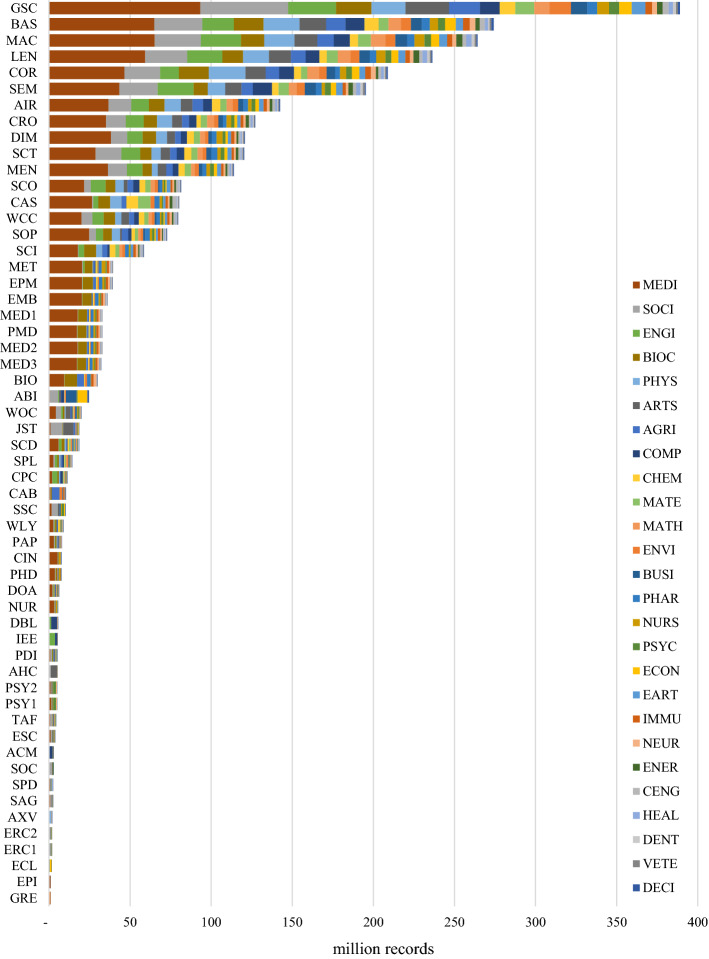
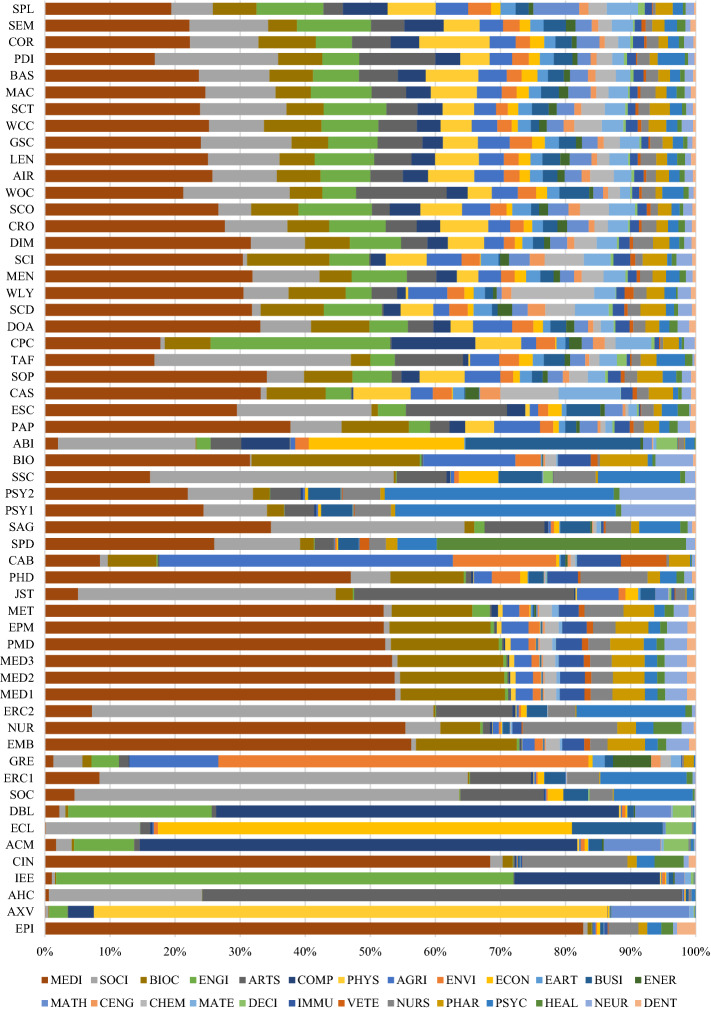
Abstract This paper introduces a novel scientometrics method and applies it to estimate the subject coverages of many of the popular English-focused bibliographic databases in academia. The method uses query results as a common denominator to compare a wide variety of search engines, repositories, digital libraries, and other bibliographic databases. The method extends existing sampling-based approaches that analyze smaller sets of database coverages. The findings show the relative and absolute subject coverages of 56 databases—information that has often not been available before. Knowing the databases’ absolute subject coverage allows the selection of the most comprehensive databases for searches requiring high recall/sensitivity, particularly relevant in lookup or exploratory searches. Knowing the databases’ relative subject coverage allows the selection of specialized databases for searches requiring high precision/specificity, particularly relevant in systematic searches. The findings illustrate not only differences in the disciplinary coverage of Google Scholar, Scopus, or Web of Science, but also of less frequently analyzed databases. For example, researchers might be surprised how Meta (discontinued), Embase, or Europe PMC are found to cover more records than PubMed in Medicine and other health subjects. These findings should encourage researchers to re-evaluate their go-to databases, also against newly introduced options. Searching with more comprehensive databases can improve finding, particularly when selecting the most fitting databases needs particular thought, such as in systematic reviews and meta-analyses. This comparison can also help librarians and other information experts re-evaluate expensive database procurement strategies. Researchers without institutional access learn which open databases are likely most comprehensive in their disciplines.
Overview
The claims and statistics of this paper haven’t been checked yet.
Run the check — free, no account needed. It reads the open-access text and checks the sources it cites.
Integrity signals
Registry
Cites
Statistics
Figures
Verification
Claims the paper makes
The claims and statistics of this paper haven’t been checked yet.
Run the check — free, no account needed. It reads the open-access text and checks the sources it cites.
Claims other papers make about this one
Each is checked against this paper’s own text: does it say what the citing paper says it does?
The source backs part of the claim, not all of it — or backs it for a different population, condition or comparison.
In the citing paper
“Research has established that, while Scopus has greater breadth in its inclusion of academic journals, WoS is known for its greater keyword sensitivity and a historically extensive volume of references [25,26].”
From Evolution of Primary Research Studies in Digital Interventions for Mental Well-Being Promotion from 2004 to 2023: A Bibliometric Analysis of Studies on the Web of Science (2024) · cites this paper as [25]
Experimental — accuracy not yet measured
Self-check
Percentages, sums and reported differences re-computed from the paper’s own numbers.
The self-check needs the paper’s full text.
Citations
Cites
Cochrane Handbook for Systematic Reviews of Interventions
(2019) · doi:10.1002/9781119536604 · Cited by 14,828
The journal coverage of Web of Science and Scopus: A comparative analysis
Mongeon, P., & Paul-Hus, A. (2016) · Scientometrics · doi:10.1007/s11192-015-1765-5 · Cited by 5,274
Web of Science (WoS) and Scopus: The Titans of Bibliographic Information in Today’s Academic World
Pranckutė, R. (2021) · Publications · doi:10.3390/publications9010012 · Cited by 2,696 · cited 4×
“BOK estimates confirm that both WOS CC and Scopus tend to cover more from the Life Sciences, Physical Sciences, and Health Sciences and less from the Social Sciences and Humanities than Google Scholar does (Pranckutė, 2021; Singh et al., 2021).”
BackgroundMethodInfluentialThe role of google scholar in evidence reviews and its applicability to grey literature searching
Haddaway, N. R., Collins, A. M., Coughlin, D., & Kirk, S. (2015) · PLOS ONE · doi:10.1371/journal.pone.0138237 · Cited by 2,387
Gusenbauer, M., & Haddaway, N. R. (2020) · Research Synthesis Methods · doi:10.1002/jrsm.1378 · Cited by 2,379 · cited 5×
“A recent study points to the importance of the differences in search functionality between databases and how they are important for specific search requirements (Gusenbauer & Haddaway, 2020).”
BackgroundMethodInfluentialThe Journal Coverage of Web of Science, Scopus and Dimensions: A Comparative Analysis
Singh, V. K., Singh, P., Karmakar, M., Leta, J., & Mayr, P. (2021) · Scientometrics · doi:10.1007/s11192-021-03948-5 · Cited by 2,342
Bramer, W. M., Rethlefsen, M. L., Kleijnen, J., & Franco, O. H. (2017) · Systematic Reviews · doi:10.1186/s13643-017-0644-y · Cited by 2,114 · cited 1×
“In all cases, users should search multiple databases when searching systematically (Konno & Pullin, 2020), including databases with specialized content (Table 5) (Bramer et al., 2017).”
BackgroundMartín-Martín, A., Orduna-Malea, E., Thelwall, M., & Delgado López-Cózar, E. (2018) · Journal of Informetrics · doi:10.1016/j.joi.2018.09.002 · Cited by 1,990
A Comparison between Two Main Academic Literature Collections: Web of Science and Scopus Databases
Chadegani, A. A., Salehi, H., Yunus, M. M., Farhadi, H., Fooladi, M., Farhadi, M., & Ebrahim, N. A. (2013) · Asian Social Science · doi:10.5539/ass.v9n5p18 · Cited by 1,933
Google Scholar, Scopus and the Web of Science: A Longitudinal and Cross-Disciplinary Comparison
Harzing, A.-W., & Alakangas, S. (2016) · Scientometrics · doi:10.1007/s11192-015-1798-9 · Cited by 1,784
Constructing bibliometric networks: A comparison between full and fractional counting
Perianes-Rodriguez, A., Waltman, L., & van Eck, N. J. (2016) · Journal of Informetrics · doi:10.1016/j.joi.2016.10.006 · Cited by 1,416
Martín-Martín, A., Thelwall, M., Orduna-Malea, E., & Delgado López-Cózar, E. (2021) · Scientometrics · doi:10.1007/s11192-020-03690-4 · Cited by 1,018
Meho, L. I., & Yang, K. (2007) · Journal of the American Society for Information Science and Technology · doi:10.1002/asi.20677 · Cited by 974
Martín‐Martín, A., Thelwall, M. A., Orduña‐Malea, E., & Delgado López-Cózar, E. (2020) · LA Referencia (Red Federada de Repositorios Institucionales de Publicaciones Científicas) · Cited by 916
Visser, M., van Eck, N. J., & Waltman, L. (2021) · Quantitative Science Studies · doi:10.1162/qss_a_00112 · Cited by 865
Three options for citation tracking: Google Scholar, Scopus and Web of Science
Bakkalbasi, N., Bauer, K., Glover, J., & Wang, L. (2006) · Biomedical Digital Libraries · doi:10.1186/1742-5581-3-7 · Cited by 752
A new methodology for constructing a publication‐level classification system of science
Waltman, L., & van Eck, N. J. (2012) · Journal of the American Society for Information Science and Technology · doi:10.1002/asi.22748 · Cited by 700
Gusenbauer, M. (2019) · Scientometrics · doi:10.1007/s11192-018-2958-5 · Cited by 687
A comparison of Scopus and Web of Science for a typical university
Vieira, E. S., & Gomes, J. A. N. F. (2009) · Scientometrics · doi:10.1007/s11192-009-2178-0 · Cited by 625
Nussbaumer-Streit, B., Klerings, I., Dobrescu, A. I., Persad, E., Stevens, A., Garritty, C., Kamel, C., Affengruber, L., King, V. J., & Gartlehner, G. (2020) · Journal of Clinical Epidemiology · doi:10.1016/j.jclinepi.2019.10.011 · Cited by 440
Web of Science and Scopus Language Coverage
Vera-Baceta, M.-A., Thelwall, M., & Kousha, K. (2019) · Scientometrics · doi:10.1007/s11192-019-03264-z · Cited by 423
Wang, Q., & Waltman, L. (2016) · Journal of Informetrics · doi:10.1016/j.joi.2016.02.003 · Cited by 417
Coverage analysis of Scopus: A journal metric approach
Anegón, F. D. M., Chinchilla‐Rodríguez, Z., Vargas‐Quesada, B., Corera‐Álvarez, E., Muñoz-Fernández, F. J., González-Molina, A., & Herrero-Solana, V. (2007) · Scientometrics · doi:10.1007/s11192-007-1681-4 · Cited by 381
Searching for studies: a guide to information retrieval for Campbell systematic reviews
Kugley, S., Wade, A., Thomas, J., Mahood, Q., Jørgensen, A. K., Hammerstrøm, K., & Sathe, N. (2017) · Campbell Systematic Reviews · doi:10.4073/cmg.2016.1 · Cited by 371
A Criteria-based Assessment of the Coverage of Scopus and Web of Science
Aksnes, D. W., & Sivertsen, G. (2019) · Journal of Data and Information Science · doi:10.2478/jdis-2019-0001 · Cited by 344
Statistics Principles and Methods
Malone, L. C., Johnson, R. A., & Bhattacharyya, G. K. (1997) · The American Statistician · doi:10.2307/2684703 · Cited by 267
Martín-Martín, A., Orduña-Malea, E., & López-Cózar, E. D. (2018) · Scientometrics · doi:10.1007/s11192-018-2820-9 · Cited by 228
Empirical Analysis and Classification of Database Errors in Scopus and Web of Science
Franceschini, F., Maisano, D., & Mastrogiacomo, L. (2016) · Journal of Informetrics · doi:10.1016/j.joi.2016.07.003 · Cited by 225
The Consumer Price Index as a Measure of Inflation
Bryan, M. F., & Cecchetti, S. G. (1993) · National Bureau of Economic Research · doi:10.3386/w4505 · Cited by 195
Kousha, K., & Thelwall, M. A. (2007) · Scientometrics · doi:10.1007/s11192-008-0217-x · Cited by 169
Harzing, A.-W. (2019) · Scientometrics · doi:10.1007/s11192-019-03114-y · Cited by 164
A new methodology for comparing Google Scholar and Scopus
Moed, H. F., Bar‐Ilan, J., & Halevi, G. (2016) · Journal of Informetrics · doi:10.1016/j.joi.2016.04.017 · Cited by 159
Google Scholar coverage of a multidisciplinary field
Walters, W. H. (2006) · Information Processing & Management · doi:10.1016/j.ipm.2006.08.006 · Cited by 157
Methods for estimating the size of Google Scholar
Orduña‐Malea, E., Ayllón, J. M., Martín‐Martín, A., & López‐Cózar, E. D. (2015) · Scientometrics · doi:10.1007/s11192-015-1614-6 · Cited by 147
Publishing volumes in major databases related to Covid-19
da Silva, J. A. T., Tsigaris, P., & Erfanmanesh, M. (2020) · Scientometrics · doi:10.1007/s11192-020-03675-3 · Cited by 140
Walpole, S. C. (2019) · Journal of Clinical Epidemiology · doi:10.1016/j.jclinepi.2019.03.004 · Cited by 125
The Coverage of Microsoft Academic: Analyzing the Publication Output of a University
Hug, S. E., & Brändle, M. P. (2017) · Scientometrics · doi:10.1007/s11192-017-2535-3 · Cited by 120
A Web-scale system for scientific knowledge exploration
Shen, Z., Ma, H., & Wang, K. (2018) · doi:10.18653/v1/p18-4015 · Cited by 120
Where and how early career researchers find scholarly information
Nicholas, D., Boukacem‐Zeghmouri, C., Rodríguez‐Bravo, B., Xu, J., Watkinson, A., Abrizah, A., Herman, E., & Świgoń, M. (2017) · Learned Publishing · doi:10.1002/leap.1087 · Cited by 119
Kousha, K., & Thelwall, M. A. (2020) · Quantitative Science Studies · doi:10.1162/qss_a_00066 · Cited by 103
García‐Pérez, M. A. (2010) · Journal of the American Society for Information Science and Technology · doi:10.1002/asi.21372 · Cited by 101
Comparing Journal and Paper Level Classifications of Science
Shu, F., Julien, C.-A., Zhang, L., Qiu, J., Zhang, J., & Larivière, V. (2019) · Journal of Informetrics · doi:10.1016/j.joi.2018.12.005 · Cited by 95
Gusenbauer, M., & Haddaway, N. (2020) · Research Synthesis Methods · doi:10.1002/jrsm.1457 · Cited by 88
Dimensions: redescubriendo el ecosistema de la información científica
Orduña‐Malea, E., & López‐Cózar, E. D. (2018) · El Profesional de la Informacion · doi:10.3145/epi.2018.mar.21 · Cited by 71
Orduña‐Malea, E., Martín‐Martín, A., & López‐Cózar, E. D. (2017) · Revista española de Documentación Científica · doi:10.3989/redc.2017.4.1500 · Cited by 65
Wilder, E. I., & Walters, W. H. (2021) · Scholarly Assessment Reports · doi:10.29024/sar.36 · Cited by 58
Identifying research supporting the United Nations Sustainable Development Goals
Jayabalasingham, B. (2019) · Data Archiving and Networked Services (DANS) · doi:10.17632/87txkw7khs · Cited by 55
About the size of Google Scholar: playing the numbersPreprint
Orduña‐Malea, E., Ayllón, J. M., Martín‐Martín, A., & López‐Cózar, E. D. (2014) · arXiv (Cornell University) · doi:10.48550/arxiv.1407.6239 · Cited by 51
Bornmann, L. (2018) · Scientometrics · doi:10.1007/s11192-018-2855-y · Cited by 40
Gusenbauer, M. (2021) · Research Synthesis Methods · doi:10.1002/jrsm.1520 · Cited by 39
Assessing the risk of bias in choice of search sources for environmental meta‐analyses
Konno, K., & Pullin, A. S. (2020) · Research Synthesis Methods · doi:10.1002/jrsm.1433 · Cited by 30
Design and Analysis of Algorithms
Sen, S., & Kumar, A. (2019) · Cambridge University Press eBooks · doi:10.1017/9781108654937 · Cited by 28
Herzog, C., & Lunn, B. K. (2018) · Scientometrics · doi:10.1007/s11192-018-2854-z · Cited by 26
Lazarus, J. V., Palayew, A., Rasmussen, L. N., Andersen, T. H., Nicholson, J., & Norgaard, O. (2020) · Journal of Medical Internet Research · doi:10.2196/23449 · Cited by 25
Non-English language publications in Citation Indexes -- quantity and qualityPreprint
Москалева, О., & Akoev, M. (2019) · arXiv (Cornell University) · doi:10.48550/arxiv.1907.06499 · Cited by 10
Shorten, J., Seikel, M., & Ahrberg, J. H. (2005) · Library Resources and Technical Services · doi:10.5860/lrts.49n2.123 · Cited by 8
(2022) · WORLD SCIENTIFIC eBooks · doi:10.1142/9789811255120_0003 · Cited by 4
Law Librarianship Scholarship: A Survey of Publications Using Scopus DataPreprint
Flanagan, G. P. (2014) · SSRN Electronic Journal · doi:10.2139/ssrn.2512487 · Cited by 1
Research works printed but not linked: 22
- arXiv. (2021). arXiv.org. Retrieved July 18, 2021, from https://arxiv.org/.
- Association for Computing Machinery. (2022). The ACM guide to computing literature. Retrieved January 17, 2022, from https://libraries.acm.org/digital-library/acm-guide-to-computing-literature.
- Clarivate Analytics. (2022e). Web of Science: Conference proceedings citation index. Retrieved January 17, 2022e, from https://clarivate.com/webofsciencegroup/solutions/webofscience-cpci/.
- dblp computer science bibliography. (2022). What is dblp? Retrieved January 17, 2022, from https://dblp.org/faq/What+is+dblp.html.
- DOAJ. (2022). About DOAJ. Retrieved January 17, 2022, from https://doaj.org/about/.
- Elsevier. (2021). ScienceDirect. Retrieved August 20, 2021, from https://www.sciencedirect.com/.
- Elsevier. (2022a). Scopus®: Expertly curated abstract & citation database. Retrieved January 17, 2022, from https://www.elsevier.com/solutions/scopus.
- Elsevier. (2022b). What are the most used Subject Area categories and classifications in Scopus? Retrieved January 18, 2022, from https://service.elsevier.com/app/answers/detail/a_id/14882/supporthub/scopus/~/what-are-the-most-frequent-subject-area-categories-and-classifications-used-in/.
- Europe PMC. (2021). About Europe PMC. Retrieved August 10, 2021, from https://europepmc.org/About.
- Google Scholar. (2022). Stand on the shoulders of giants. Retrieved January 17, 2022, from https://scholar.google.com/intl/en/scholar/about.html.
- IEEE. (2021). About IEEE Xplore. Retrieve August 16, 2021, from https://ieeexplore.ieee.org/Xplorehelp/overview-of-ieee-xplore/about-ieee-xplore.
- John Wiley & Sons. (2022). Wiley Online Library: 7.5 million articles from over 1,600 journals, at your fingertips. Retrieved January 17, 2022, from https://onlinelibrary.wiley.com/researchers.
- JSTOR. (2022). ABOUT JSTOR. Retrieved January 17, 2022, from https://about.jstor.org/.
- National Library of Medicine. (2022). PubMed Overview. Retrieved January 17, 2022, from https://pubmed.ncbi.nlm.nih.gov/about/.
- OECD. (2021). Inflation (CPI) Indicator. Retrieved January 16, 2022, from https://www.oecd-ilibrary.org/economics/inflation-cpi/indicator/english_eee82e6e-en.
- SAGE. (2022). Journals. Retrieved January 17, 2022, from https://us.sagepub.com/en-us/nam/journals.
- Springer Nature. (2022). SpringerLink. Retrieved January 17, 2022, from https://link.springer.com/.
- Taylor & Francis. (2022). Journal solutions. Retrieved January 17, 2022, from https://librarianresources.taylorandfrancis.com/product-info/journals/.
- Wolters Kluwer Health. (2022a). APA PsycInfo. Retrieved January 17, 2022a, from https://ospguides.ovid.com/OSPguides/psycdb.htm.
- Wolters Kluwer Health. (2022b). CAB Abstracts Database Guide. Retrieved January 17, 2022b, from https://ospguides.ovid.com/OSPguides/cabadb.htm.
- Wolters Kluwer Health. (2022c). Embase: Excerpta Medica Database Guide. Retrieved January 17, 2022c, from https://ospguides.ovid.com/OSPguides/embase.htm.
- Wolters Kluwer Health. (2022d). MEDLINE® 2021 Database Guide. Retrieved January 17, 2022d, from https://ospguides.ovid.com/OSPguides/medline.htm.
Cited by
Sorted by citations
Appraising systematic reviews: a comprehensive guide to ensuring validity and reliability
Shaheen, N., Shaheen, A., Ramadan, A., Hefnawy, M. T., Ramadan, A., Ibrahim, I., Elsayed, M., Ashour, M. E., & Flouty, O. E. (2023) · Frontiers in Research Metrics and Analytics · doi:10.3389/frma.2023.1268045 · Cited by 392
Gusenbauer, M. (2024) · Research Synthesis Methods · doi:10.1002/jrsm.1729 · Cited by 174
Gusenbauer, M., & Gauster, S. P. (2024) · Technological Forecasting and Social Change · doi:10.1016/j.techfore.2024.123833 · Cited by 197
The GABAergic system in Alzheimer’s disease: a systematic review with meta-analysis
Carello-Collar, G., Bellaver, B., Ferreira, P. C. L., Ferrari-Souza, J. P., Ramos, V. G., Therriault, J., Tissot, C., De Bastiani, M. A., Soares, C., Pascoal, T. A., et al. (2023) · Molecular Psychiatry · doi:10.1038/s41380-023-02140-w · Cited by 98
Turosz, N., Chęcińska, K., Chęciński, M. A., Brzozowska, A., Nowak, Z., & Sikora, M. (2023) · Dentomaxillofacial Radiology · doi:10.1259/dmfr.20230284 · Cited by 74
Metadata
- Authors
- Gusenbauer, M.
- Affiliations
- Universität Innsbruck (AT)
- Corresponding author
- Gusenbauer, Michael
- ORCID
- Gusenbauer, Michael
- Venue
- Scientometrics
- Published
- 2022-05
- Volume
- 127
- Issue
- 5
- Pages
- 2683-2745
- ISSN
- 0138-9130 (ISSN-L)
- 1588-2861
- PMC
- PMC9075928
- OpenAlex
- W4229045617
- Cited by
- 211
- References
- 58
- Citations by year
- 2026: 70 · 2025: 58 · 2024: 53 · 2023: 27 · 2022: 3
- FWCI
- 21.28
- Type
- journal article
- Language
- en
- Open access
- hybrid
- doi.org
- Locations
- Scientometrics (publishedVersion, cc-by)
- PubMed Central (publishedVersion, cc-by)
- PubMed (publishedVersion)
- RePEc: Research Papers in Economics (submittedVersion)
- Digital Library of the University of Innsbruck (University of Innsbruck) (submittedVersion, cc-by)
- Funders
- University of Innsbruck and Medical University of Innsbruck
- Topics
- Social Sciences › Library and Information Sciences › scientometrics and bibliometrics research
- Social Sciences › Library and Information Sciences › Library Science and Information
- Physical Sciences › Computer Science › Information Systems › Web visibility and informetrics
- Keywords
- bibliographic databases, subject coverage, database comparison, search engine coverage, Google Scholar, Scopus, Web of Science, Embase, Europe PMC, PubMed, database selection, systematic reviews, open access databases
About these checks
Registry, retraction, Cites and statistics results are computed, not judged, with one exception: a printed reference that no index lists is read once by a model before it counts as a citation error. Claims are extracted by a model and kept only when their quote appears verbatim in the text; each cited source is then checked, with a model’s help, for whether it says what the claim relies on. Those verdicts can be wrong — read the claim’s quote and the cited source before relying on one.
Statistics and arithmetic are recomputed, not judged.
Confidence bands are shown only for fields calibrated on our annotated test set. None is calibrated yet, so no band is shown.
What counts as a claim ›How we measure confidence ›How we check this ›
Are you an author, or do you see a problem with this page? Request a review
